Ve Laruya Kossar i Haenz
THE KNIGHTS ATLAS OF HAENSE
VA LANZSK TER DLUM TEA DENN DLUM INDERE
Since the times of yore when the Bogatyr formed the first band of chivalric companions in ancient Ruska, to be a Knight has been to live a life for others.
To be a Knight is to champion the virtues of humanity, to defend the weak, and exact justice. To be a Knight is to take up arms not for gain for glory, but for righteousness and truth. To be a Knight is to sacrifice the ordinary pleasures of life, and to devote oneself to the wellbeing of others. Whether in the days of King Barbov the Black, or King Petyr the Founder, or the present-day of King Sigismund III, this salient creed has endured in myth and fable. Some have mastered this creed and embodied it as examples of what it means to lead a virtuous existence, others have given their lives in pursuit of it, while some have failed to heed its lessons and fallen to the temptations of the Archdaemon. Whether the truest Knight or most vile knave, this Knight's Atlas - continuing the archives of Ser Nikolaus the Strong and Ser Boris the Persistent - shall record the lives and legends of each man and woman who have ever taken the mantle of Knight of Haense.
This Atlas records the lives and deeds of Knights who have died, or been discharged from their duties. It dates back as far as the infancy of the Kongzem of Haense under King Andrik II, and thus this extensive record is divided into seven periods:
I. The Order of the Golden Gryphon - 137 E.S. - 197 E.S. | 1584 A.H. - 1644 A.H.
I.I: Ser Sergei 'the Defender' Kovachev
I.II: Ser Brennus 'the Norlander' Kaedric
I.III: Ser Rickard 'the Palatine' Barrow
I.IV: Ser Jon Marband
I.V: Ser Dmitry 'the Meyster' Ruthern
I.VI: Ser Brynden 'the True' Vanir
I.V: Ser Osgod 'Warchief' Colborn
I.VI: Ser Fiske 'the Bloody' Vanir
I.VII: Ser Aldrick 'the Stalwart' Baruch
I.VIII: Dame Natalia 'the Soldier' Barbanov
I.IX: Ser Berengar 'the White' Helvets
I.X: Ser Petyor 'the Huntsman' Vance
II. The Knights of Bihar - 234 E.S. - 289 E.S. | 1681 A.H. - 1707 A.H.
II.I. Ser Hans de Ruyter
II.II. Ser Dominic 'the Stalwart' Grimm
II.III. Ser Varon 'the Fierce' Kovachev
II.IV. Ser Heinrik 'Old-Crow' Ludovar
III. The Marian Period - 289 E.S. - 343 E.S. | 1736 A.H. - 1790 A.H.
III.I. Ser Bjolfr 'One-Leg' Nord
III.II. Ser Jan 'the Black' Baruch
III.III. Ser Roderik 'Turncloak' Kortrevich
III.IV. Ser Nikolaus 'the Strong' Kortrevich
III.V. Ser Gerard 'the Bear' Stafyr
III.VI. Ser Konrad 'Wolfsbane' Stafyr
III.VII. Dame Maria 'the Voluptuous' Preussens
III.VIII. Ser Alaric 'Falcon-Blood' Hanethor
III.IX. Ser Olavo 'the Ginger' Castelo
III.X. Ser Khroll 'the Elf'
III.XI. Ser Ulric 'the Unwavering' Vyronov
III.XII. Ser Wilheim 'the Stallion' Barclay
III.XIII. Ser Thomas 'Sea-Devil' Raleigh
III.XIV. Dame Primrose 'the Forbearing' Kortrevich
III.XV. Ser Roderick 'the Loyal' Kortrevich II
III.XVI. Ser Robert 'the Unyielding' Vyronov
III.XVII. Dame Winnifried 'the Bold' Kortrevich
III.XVIII. Ser Selrik 'the Scholar' Wick
III.XIX. Ser Jonathan 'the Tower' Frostfire
III.XX. Ser Aedan 'the Phoenix' Capulei
III.XXI. Ser Tiberius 'Tidebreaker' Barrow
III.XXII. Ser Markus 'the Bull' Kortrevich
III.XXIII. Ser Robin 'the Persistent' Kartyr
III.XXIV. Ser Ivan 'the Protector' Ruthern
III.XXV. Dame Karolina 'the Giant' Barclay
III.XXVI. Ser Bjornolf 'the Berserker' Storn
III.XXVII. Ser Georg 'the Courageous' Bykov
III.XXVIII. Ser Marcus 'Forgemaster' Erdhart
III.XXIX. Ser Demetrius 'the Young' Ruthern
III.XXX. Ser Ivan 'the Red Bull' Kortrevich
III.XXXI. Ser Siegmund 'the Shepherd' Wick
IV. The Reformation Period - 343 E.S. - 398 E.S. | 1790 A.H. - 1845 A.H.
IV. I. Ser Maverick 'the Keeper' Baruch
IV. II. Ser Boris 'the Persistent' Ruthern
IV. III. Dame Anabela 'the Ember' Ruthern
IV. IV. Ser Viktor 'the Valient' Rauen
IV.V. Ser Brandt 'the Patient' Barclay
IV.VI. Ser Alric 'the Cavalier' Ruthern
IV.VII. Ser Zodd 'the Ironclad' Calliban
IV.VIII. Ser Rubern 'the Butler' Barclay
IV.IX. Ser Aleksandr 'the Ardent' Vyronov
IV.X. Ser Cedric 'the Kind' Barclay
IV.XI. Ser Fiske 'the Daring' Vanir III
IV.XII. Ser Hildebrand 'the Gryphon' Mondblume
IV.XIII. Ser Franz 'the Oracle' Bihar
IV.XIV. Ser Aleksandr 'the Whisper' Bihar
IV.XV. Ser Grigoryi 'the Burned' Vilac
IV.XVI. Ser Antonius 'the Fervid' Vilac
IV.XVII. Ser Oliver 'the Lion' Helane
IV.XVIII. Dame Marie Barclay
IV.XIX. Ser Demetriyus 'the Preserver' Aubert
IV.XX. Ser Ailred 'Steelheart' Ruthern
IV.XXI. Ser Karl 'the Humble' Amador
V. The Bogatyr Period - 398 E.S. - 531 E.S. | 1845 A.H. - 1979 A.H.
V.I. Ser Erwin 'the Headhunter' Bishop
V.II. Ser Reinhardt’'the Unbroken’ Barclay
V.III. Dame Marie ‘the Marigold’ Ruthern
V.IV. Ser Casimir ‘the Chaste’ Colborn
V.V. Ser Elimar ‘the Wayward’ Mondblume
V.VI. Ser Abraham ‘the Faithful’ Rutledge
V.VII. Ser August ‘the Merciful’ Barclay
V.VIII. Ser Emil ‘the Guardian’ Barclay
V.X. Dame Mariya ‘the Grey’ Vyronov
V.XI. Ser Walton ‘the Wall’ Kranz
V.XII. Ser Barley ‘the Mystic’ Wick
V.XIII. Dame Emelya ‘the Temperate’ Kortrevich
V.XIV. Ser Matyas ‘the Emissary’ Baruch
V.XV. Dame Lynette ‘the Resolute’ Mendez
V.XVI. Dame Tavisha ‘the Independent‘ Morovar
V.XVII. Ser Viktor ‘the Beast’ Baruch
V.XVIII. Ser Conrad ‘the Bulwark’ Barclay
V.XIX. Ser Peter ‘the Unwavering’ Ruben
V.XX. Ser Jakob ‘Ivansbane’ Morovars
V.XXI. Ser Sebsatien ‘the White Sun’ de Savoie
V.XXII. Ser Vanhart ‘the Carrot’ Barclay
V.XXIII. Dame Giovanna ‘Serpentsbane’ Barclay
V.XXIV. Ser Vladimir ‘Hothand’ var Ruthern
V.XXV. Ser Vladrik ‘The Houndsman’ O’Rourke
V.XXVI. Dame Alexandra ‘Dragonsight’ von Audrick
V.XXVII. Ser Atilan Bishop
V.XXVIII. Dame Ada ‘the Dauntless’ Colborn
V.XXIX. Dame Cirilla of Karosgrad
V.XXX. Ser Baldrum ‘the Sworn’ Colborn
V.XXXI. Ser Emeric ‘the Independent’ Radovanic
V.XXXII. Dame Rosalind Valkonen
V.XXXIII. Ser Audo ‘the Raven’ Weiss
V.XXXIV. Ser Konstanz Barclay
V.XXXV. Ser Stefan ‘Starsteel’ Bihar
V.XXXVI. Ser Mikolaj ‘the Oracle’ Radovanic
V.XXXVII. Ser Arthur ‘Spawnkiller’ Gant
V.XXXVIII. Ser Sterling ‘the Swan’ Amador
V.XXXIX. Ser Andrik var Ruthern
V.XXXX. Ser Fredrich Ludovar
V.XXXXI. Ser Mikhail Valkonen
V.XXXXII. Ser Walter ‘Graveguard’ Weiss
V.XXXXIII. Ser Emilio ‘the Roach’ Varoche
V.XXXXIV. Ser Garen Baruch
V.XXXXV. Ser Rickard ‘the Centaurion’ Tosali
V.XXXXVI. Ser Caspian ‘the Last Crow’ Colborn
VI. The Retinal Period - 532 E.S. - 563 E.S | 1979A.H. - 2010 A.H.
VI.I Ser Belisar ‘The Regent’ var Ruthern
VI.II Ser Alexander ‘Farflung’ Alstion
VI.III Ser ‘Longstrider’ Nikolas
VI.IV Ser Gentry ‘The Fair’ aus Welle
VI.V Ser Gerard ‘The Don’ aus Welle
VI.VI Ser Joakim ‘The Kingsblade’ Colborn
VI.VII Dame Yvaine ‘The Builder’ van Leuven
VII. The Conclusion Period - 564 E.S. - 576 E.S | 2011 A.H. - 2023 A.H.
VI.I Ser Andrei ‘The Ever Loyal’ Kortrevich
VI.II Dame Teodora ‘Svartdahlian’ Colborn
VII.III Dame Dima ‘The Lamb’ Kortrevich
VII.IV Ser Alekzmirez ‘The First Eagle’ Korvacz
VII.V Ser Sigmar ‘The Valiant’ var Ruthern
I
THE ORDER OF THE GOLDEN GRYPHON
137 E.S. - 197 E.S. | 1584 A.H. - 1644 A.H.
The first of the Kongzem's Knights were those of the Order of the Golden Gryphon on Axios.
In the early days of the Kongzem, shortly after it had celebrated the crowning of its second-ever monarch - King Andrik II - the lords of Haense convened in the capital to advise their new King on the governance of his realm, and among their first acts was the creation of the Order of the Golden Gryphon as the first knightly echelon of the Kongzem. Led by the Meyster Knight, the Order enshrined the earliest values of chivalry that have moulded the creed of the orders of today, with the Gilded Talon serving as a badge of distinction for its honourable members. The Golden Gryphon levied strict joining requirements on aspiring Knights; only those of noble standing were permitted to train as squires, with the exception of extraordinary commoners.
The Order also included the rank of 'Arma Patrinae' for squires who failed to meet the criteria to become a Knight. The most elite of the Golden Gryphons were also selected to serve as 'Knights of Ottosgrad', the Crown and Royal House's personal protectors, comparable to the future Marian Retinue. Owing to the early time period that was the Kongzem of Haense in Axios, there exists only minimal surviving records of the Order of the Golden Gryphon. From what scholars have determined, members of the Order seemed to be largely influential Haensemen in their own right, and thus many of the Golden Gryphons are remembered for reasons unrelated to their knighthood.
The Order fell into disuse after the Kongzem fell during the Great Northern War, but it was later re-established by King Otto II with a new generation of Knights after King Stefan I reformed the Kongzem in the Royal Capital of Alban.
____________________________________________________
SER SERGEI KOVACHEV
THE DEFENDER
Knight of Turov
@NJBB
84 E.S. - 142 E.S. | 1531 A.H. - 1589 A.H.
_______________
Knighted by King Andrik II, and remembered as ‘the Defender’.
Born on a spring morning in the Gryphon’s Nest, Ser Sergei was the premier vassal and bannerman of the early Haeseni monarchs as Count of Turov, progenitor-title of the famous Duchy of Carnatia. Together with the Marquis of Vasiland - Fiske Vanir - and the Baron of Monstadt - Ruslan Amador - he formed the backbone of the Kongzem in Axios throughout the reign of King Andrik II. Records commemorate him as a skilled marshal who developed the military strength of the Kongzem, which at the time relied on bannermen levies, through the expansion of the House Kovachev armsmen.
While also serving as an instrumental advisor to King Andrik II and his successors, Ser Sergei’s most notable deed came in the form of his refusal to follow King Andrik II into rebellion against the Orenian Emperor Philip I. Because of Ser Sergei’s opposition, the rest of the Haeseni nobility followed suit, depriving King Andrik II of critical support, which consequently led to the King’s execution. Despite having betrayed his Haeseni liege, Ser Sergei’s tough action is credited as preserving the Kongzem’s place in the world at a time where it was growing and vulnerable. Had the rebellion gained support and been defeated, it is widely accepted that the entire Kongzem might have been destroyed, and thus historians have given Ser Sergei the moniker of ‘the Defender’.
After King Andrik II’s failed rebellion and death, Ser Sergei remained as a loyal advisor and supporter to the young King Marius I, before dying at the age of fifty-eight as one of the most influential Haensemen of his time.
____________________________________________________
SER BRANNUS KAEDRIC
THE NORLANDER
Knight of Turov
@W31RDO
Unknown | Unknown
_______________
Knighted by King Andrik II, and remembered as ‘the Norlander’.
Ser Brennus was born a Norlander farmer on the Isle of Avar - in Vailor - who enlisted as a young soldier in the Nortruppen army of Sven Ruric, who had made it his mission to revive Avar from its current state of disrepair. Ser Brennus rose to the rank of Kommissar - the second in command of the army - but he later abandoned this position after Thomas Ruric rebelled against Orenia owing to Ser Brennus’ split loyalties.
When the Descendant people migrated to Axios, Ser Brennus wandered for a time before he came to serve Ser Sergei Kovachev - the Count of Turov and bannerman of Haense - and was granted a fief of land, where he constructed the Norlandic settlement of Myrka, which became famous for its mead hall. After years of loyal service to Ser Sergei, the Count of Turov recommended Ser Brennus to be knighted, and so he was called before the Royal Court in Ottosgrad and dubbed a Knight by King Andrik II. However, when the Norlandic people later began to re-emerge in a bid to establish a new homeland in the city of Svenheld, Ser Brennus felt an urge to return to his origins - to the culture and identity that he had known growing up, and read about its past greatness. He thus requested to be relieved of his oath to Ser Sergei, which the Count of Turov granted with a heavy heart and a solemn farewell to his friend and loyal bannerman. And so it was that Ser Brennus gathered the people of Myrka, and travelled west to Svenheld, where they were warmly welcomed.
An experienced architect from the construction of Myrka, Ser Brennus aided in the development of Svenheld to the extent that most buildings in the city bore his hallmark, and so he was honoured with an entire portion of the city being named the Kaedric District. Thereafter, Ser Brennus lived out the rest of his days in comfort in a city he felt he truly belonged in, and died peacefully as an old and accomplished man of both Haense and Norland.
____________________________________________________
SER RICKARD BARROW
THE PALATINE
Knight of Karlsburg
@Ark
Unknown | Unknown
_______________
Knighted by King Andrik II, and remembered as the Palatine.
Despite his birth as a bastard, Ser Rickard earned his moniker for his service as the Kongzem of Haense’s first-ever Lord Palatine under its first-ever monarch, King Petyr I, and later under King Andrik II. Though he would not be dubbed into the Order of the Golden Gryphon until the Order’s establishment later in his life under King Andrik II, Ser Rickard led a distinguished military career as a veteran of Haense’s inaugural victory in the Riga War, and as a commander in many of the skirmishes the Kongzem faced in its infant years, when bandits and marauders thought to take advantage of the newborn realm.
On the crest of his military success, Ser Rickard became a highly-influential statesman to the first two Haeseni monarchs, to the extent that he served as de-facto ruler in the twilight years of King Petyr I’s reign when the monarch’s health worsened. Though he continued to serve as Palatine into the reign of King Andrik II, who knighted him into the Order of the Golden Gryphon, he resigned following a period of tension between him, and the King and his brother, who sought to consolidate more direct power in the Crown. He remained as an influential courtier, and stood by Ser Sergei Kovachev in opposing King Andrik II’s ill-fated rebellion against the Orenian Empire.
He died in his later years as one of the most important Haensemen of the Kongzem’s infant years.
____________________________________________________
SER JON MARBRAND
Knight of Rostig
@MostlyAedra
Unknown | Unknown
_______________
Knighted by King Andrik II, and remembered as the Palatine.
Little records have survived of Ser Jon Marbrand. All that is known of the Knight is that he was an avid tourney-goer who sponsored the prize of the 1st Royal Tournament of St. Karlsburg, and that he served as the Commander of the 1st Division of the Marbrand Militia, founded by Jory Marband in 101 E.S. | 1548, under House Ruthern.
____________________________________________________
SER DMITRY RUTHERN
THE MEYSTER
I Meyster Knight
@ruthernland
114 E.S. - 149 E.S. | 1561 A.H. - 1596 A.H.
_______________
Knighted by King Andrik II, and remembered as the Meyster.
Serving as the second Count of Metterden, Ser Dmitry nurtured House Ruthern to stand alongside the County of Turov, the Margravate of Vasiland, and the Barony of Monstadt as the pillars of the newborn Kongzem. He was knighted into the Order of the Golden Gryphon by King Andrik II when it was established, but he later joined Ser Sergei Kovachev and the other bannermen in opposing Kin Andrik II’s ill-fated rebellion against the Orenian Emperor. He was named the Meyster Knight and leader of the Order of the Golden Gryphon, and thus was responsible for the operation and running of the Order.
Ser Dmitry himself was renowned as an industrious economist and investor who held estates in both Johannesburg and St. Karlsburg, and even founded the Worker’s Guild. These successes, achieved with the help of his brother Godric, led to Ser Dmitry becoming one of the wealthiest men in all of Axios. The suicide of his wife, however, weighed heavily on the Count and plagued him with depression for the remainder of his life that led to the collapse of the Worker’s Guild and a loss in the fortune of House Ruthern. So crippling did this depression become that Ser Demitry’s son - Boris Ruthern - succeeded in petitioning King Marius I to have him granted the County of Metterden so that House Ruthern itself did not collapse. Two years later, Ser Dmitry passed away.
The cause of his death was not recorded, and nor was his successor as Meyster Knight of the Order.
____________________________________________________
SER BRYNDEN VANIR
THE TRUE
Marquis of Vasiland
@Assassinofawsome
Unknown | Unknown
_______________
Knighted by King Andrik II, and remembered as the True.
Ser Brynden was dubbed into the Order of the Golden Gryphon while also serving as the Lord Marshal of King Andrik II’s armsmen and Marquis of Vasiland, thus making him one of the most powerful men in all of Haense. When King Andrik II entered into rebellion against the Orenian Emperor Philip I, Ser Brynden was the only Knight and bannerman who actually supported the Haeseni King, though the rebellion ultimately failed as a result of most of the other bannermen standing with Ser Sergei Kovachev’s refusal to aid the King.
After the Uprising had been put down, the wrathful Philip I was convinced not to kill Ser Brynden by his Arch-Chancellor - Prince Leopold Francis - but instead took one of Ser Brynden’s hands. Thereafter, Ser Brynden was said to be bitter and distracted while serving as Lord Marshal to the young King Marius I after having witnessed the execution of his friend and liege. When Ser Brynden failed to fulfil royal reforms and was said to mismanage the war budget, he was removed.
The Marquis’ name faded into obscurity, and his death is vaguely recorded around the time of the Great Northern War.
____________________________________________________
SER OSGOD COLBORN
WARCHIEF
Knight of Karlsburg
@Birdnerdy
Unknown - 135 E.S. | Unknown - 1582 A.H.
_______________
Knighted by King Andrik II, and remembered as ‘Warchief’.
Ser Osgod was one of the most decorated war veterans of his time, having served throughout the campaigns of the Johannian wars, and most notably in the Riga War. He was a soldier in the Gold Corps that resided in the Duchy of Carnatia who served alongside Duke Jan Kovachev and Petyr Barbanov - the man who would go on to be the first King of Haense. His moniker derived from his in-depth knowledge of warfare, born from his career as a soldier, and he was known to be particularly skilled in infantry and light-cavalry.
He later served in the Krajian Rebellion, commanding forces to repel the so-called ‘Anarchy Period’ under John II of Oren. All this military expertise led to his appointment as the first ever Lord Marshal of Haense under King Petyr I, a position in which he slowly worked to reform martial levies among the Noble Houses. When King Andrik II succeeded his father as monarch, Ser Osgod was among those he dubbed into the Order of the Golden Gryphon.
Sometime before King Andrik II’s Deep Cold Uprising against Philip I of Oren, the grizzled and aged Ser Osgod perished from an infected wound.
____________________________________________________
SER FISKE VANIR
THE BLOODY
Knight of Vasiland
@InfamousGerman
77 E.S. - 143 E.S. | 1524 A.H. - 1590 A.H.
_______________
Knighted by King Andrik II, and remembered as ‘the Bloody’.
Ser Fiske held the title of Baron of Kraken’s Watch, and later was granted the Margravate of Vasiland by John III of Oren. Despite being held in favour by the Orenian Emperor, Ser Fiske was a staunch supporter of northern unification and of King Petyr I, the Kongzem’s first monarch. He is best remembered for his role as Lord Paramount of the Carnatian League during the Riga War, which, under his leadership, successfully besieged Kraken’s Watch to regain the noble status of House Vanir. His moniker was derived from the ferocity of his command and ruthlessness during this time.
When King Andrik II assumed the throne, Ser Fiske was knighted into the Order of the Golden Gryphon, though, now an older man, he fell ill with a fever at the age of sixty-six, and died in his hard-won home.
___________________________________________________
SER ALDRICK BARUCH
THE STALWART
Knight of Ayr
@CaptainHaense
158 E.S. - 226 E.S. | 1605 A.H. - 1673 A.H.
_______________
Knighted by King Otto II, and remembered as ‘the Stalwart’.
Ser Aldrick was born in the Ayrian castle of Saint’s Rest, but the invading Courlanders in the Great Northern War resulted in him being moved to the safety of Liefgaard, high in the mountains of Carnatia, which resisted the worst of the war, though Ser Aldrick spent much of his childhood worrying the small castle would fall under attack. Once he reached manhood after the Kongzem had retaken its land from the Kingdom of Courland in the Greyspine Rebellion, Ser Aldrick set his sights on knighthood, a dream that had been nurtured in his years of cloistering at Liefgaard, where he often duelled his cousin Joren with toy swords.
When the Royal Court was re-established at the newly-built stockade of Alban, Ser Aldrick squired beneath the new monarch, King Stefan I, and he earned his knighthood under King Otto II when he saved his father from an attempted assassination from an unknown assailant - believed by some historians to be the estranged Lord Arik Ruthern, enraged over a broken betrothal. After being knighted into the Order of the Golden Gryphon, the passing of Ser Aldrick’s father and his inheritance of the County of Ayr demanded his attention at the Baruch estates, though his early years as Count were uneventful except for the migration to Atlas, which he used the Baruch fleet to facilitate.
Once the Royal Court had relocated to Markev on Atlas, Ser Aldrick was a notable opponent to the centralised Haeseni Royal Army - instead advocating for the army to be made up of vassal levies - and made a point of wearing his own colours and showing off his personal armsmen and their independent operations. Despite this opposition, he remained a close friend of the Royal House, and in particular through his niece, Queen Ingrid. When the Royal House of Barbanov left Markev under King Otto III after heavy attacks from the Kingdom of Renatus, the Kongzem of Haense floundered without leadership. Despite the empty throne - though the capital was briefly held by remaining administrators and mercenaries - Ser Aldrick continued to tend his lands as a Haense vassal north of Markev until the succession crisis was resolved by the succession of the line of Bihar, to whom Ser Aldrick pledged his fealty anew.
As he grew older, Ser Aldrick suffered from a sickness of the lungs, and without quick access to medics in their rural holdings, he peacefully resigned himself to death and passed surrounded by his family.
___________________________________________________
DAME NATALIA BARBANOV
THE SOLDIER
Knight of Alban
@frankdh
166 E.S. - Unknown | 1613 A.H. - Unknown
_______________
Knighted by King Otto II, and remembered as ‘the Soldier’.
Born a bastard to St. Henrik Otto, she was legitimised as a member of the Royal House of Barbanov shortly into her life. As a girl, she was the victim of an attempted kidnapping in the Royal Capital of Alban by two Orcs. The ensuing struggle, termed the Riot of Alban, resulted in the would-be kidnappers being beaten to death by the peasantry and their bodies paraded through the streets.
She became the first Dame ever knighted in Haense, Dame Natalia was an exception to the original rule in King Andrik II’s rendition of the Order of the Golden Gryphon that only males could be honoured with knighthood. As cousin to King Otto II, Dame Natalia lived up to her moniker as an influential and dedicated presence within the Haeseni Royal Army, but was a greater aid to her cousin in the form of an administrator of the Royal Capital of Alban and the Essenstadt Palace. She was, above all else, known to be a most reliable advisor in a wide range of matters throughout King Otto II’s reign.
___________________________________________________
SER BERENGAR HELVETS
THE WHITE
Knight of Alban
@Abeam
126 E.S. - 192 E.S. | 1573 A.H. - 1639 A.H.
______________
Knighted by King Otto II, and remembered as ‘the White’.
A Kaedreni knight in Westerlandic service before and following the collapse of the Fifth Orenian Empire, Ser Berengar Helvets was knighted by Imperial Grand Knight Vitallius de Capua during the reign of Emperor John III Owyn for heroism in the war against the Mordring Horde. Ser Berengar continued serving the Kingdom of the Westerlands until the collapse of the Kingdom with the fall of its capital, Bastion, to the undead legions of Dragaar Lich Mordring. He later came to reside in Haense and his knighthood reaffirmed in the Kongzem by King Otto II for his previous acts of bravery and service in the Westerlands as well as his continued martial prowess.
Ser Berengar was the premier soldier of King Otto II’s reign of the Kongzem in the days of Alban following its revival by King Stefan I after the Greyspine Rebellion. He was credited for major military reforms and organisations of the time after rapidly ascending through the ranks, and eventually achieved the office of Grand Commandant. While the precise deeds of his knighthood were not recorded, he was known for his quick wits and adaptability as a battle commander.
Surviving records indicate that after a long military career, he retired to the colony of Otistadt, where he served as elder and then Maer until his death.
___________________________________________________
SER PETYOR VANCE
THE HUNTSMAN
Knight of Alban
@Imperium
Unknown | Unknown
_______________
Knighted by King Otto II, and remembered as ‘the Huntsman’.
Ser Petyor was a loyal armsman in the Royal Capital of Alban, and lived up to his future moniker as a hunter of not only local game, but took upon himself the task of keeping unwelcome beasts and monsters away from the city’s borders. It was in the course of that duty that the Huntsman, alongside a band of companions, found himself hunting a Winged Screamer - a massive predatory bird - that had been abducting cattle from nearby farms and killing any farmers who got in its way.
After tracking the Screamer to its nest in the mountains, Ser Petyor’s party engaged it in combat, but when the Screamer began to flee, the Haensemen had no choice but to scramble atop its back to stop it from escaping. They struggled with it in mid-air, high above the Kongzem, before driving the killing blow into it. The Screamer crash-landed into the woods near Alban, while Ser Petyor and his party managed to safely drop into a snowdrift with no serious injuries.
For this deed, King Otto II knighted him, and Ser Petyor remained his loyal servant throughout the rest of his reign.
II
THE KNIGHTS OF BIHAR
234 E.S. - 289 E.S. | 1681 A.H. - 1707 A.H.
When the Order of the Golden Gryphon fell into obscurity following the end of King Marius I’s reign with the Great Northern War, the next official iteration of Haeseni Knighthood came many years later with the Knights of Bihar.
Notoriously the most poorly-recorded of the Knightly Orders, the Knights of Bihar encapsulates a period of knighthood throughout the reigns of King Sigmar I and King Robert I in the Royal Capital of Markev, on Atlas. While there did exist the formal position of Knight Paramount - the leader of the Knights, comparable to the Meyster Knight of the Order of the Golden Gryphon - who even on the Aulic Council as one of King Robert I’s closest advisors, the lack of accurate records of the Knights of Bihar themselves make it very difficult to identify the men and women who served in the Order, and was the primary motivation for King Marius II to reform Knighthood again in 289 E.S. | 1707.
While scholars have been able to list some of the Knights below, many of the Knights of Bihar remain unknown.
___________________________________________________
SER HANS DE RUYTER
I Knight Paramount
@Nectorist
209 E.S. - 303 E.S. | 1656 A.H. - 1750 A.H.
_______________
Knighted by King Robert I, and was noted to have taken no moniker.
A gentry-born Heartlander, Ser Hans began his knighthood in the service of the Duke of Belvitz, but he was well-connected to the Kongzem of Haense through his brothers Pierre-Laurens - who had died saving King Sigmar I from a rogue mage - and Theodric - the future High Pontiff Pontian II. Despite being relatively unremarkable in this early stage, he and his family were considered reliable, and so King Robert I invited Ser Hans to serve as Knight Paramount in his Royal Court in Markev to lead the Knights of Bihar using his experience from Belvitz.
While Ser Hans was successful in recruiting young noblemen to join the new Order, he was also notable for being brash and confrontational, which led to his Knights clashing frequently with the Mournstone family, Arberrang, and the Earl of Nordengrad, among other smaller vassals of Hanse and the Empire. One of these conflicts would serve as Ser Hans’ undoing -- in 242 E.S. | 1689, Pontian de Ruyter - the-then Bishop of Markev - delivered reports of the villagers of Arberrang practising witchcraft, and so Ser Hans rallied the Knights of Bihar to put down the threat. They rode out to the village, and slaughtered nearly everyone in true knightly fashion. One of the Arberrang survivors, however, escaped and sent word to Earl Torsten of Nordengrad, who mustered his army and marched on Arberrang, where the outnumbered Knights of Bihar suffered a devastating defeat. With Ser Hans captured, Earl Torsten promptly declared a rebellion against the Empire and began the Third Atlas Coalition War. Though Haense and the Empire would triumph in the war, the Knights of Bihar fell defunct after their defeat at Arberrang, and Ser Hans retired from his duties as Knight Paramount in 245 E.S. | 1692.
Though he disappeared to his country estates for over twenty-five years, Ser Hans’ once again took up service again in 278 E.S. | 1725, this time outside of Haense in the retinue of Duke Adrian de Sarkozy of Adria under whom he went on to become acting captain of the reformed Nauzica Brigade, which suffered from the same successes and failures as the Knights of Bihar had under Ser Hans. Despite his advanced age, Ser Hans used his position to help the Duke of Adria in the Lorraine Revolt and later secure the Lord Protectorship of the Empire after the death of Emperor Alexander II.
After this final act, Ser Hans’ injuries and age forced him into permanent retirement, and he died at the age of 94.
___________________________________________________
SER DOMINIC GRIMM
THE STALWART (II)
V Knight Paramount | III King’s Champion
@Kanadensare
209 E.S. - 268 E.S. | 1656 A.H. - 1715 A.H.
_______________
Knighted by King Robert I, and remembered as ‘the Stalwart’.
The hardy Ser Dominic was acclaimed as one of the best swordsmen and military strategists on Atlas during his lifetime, a feat which he endeavoured to prove on the freezing Yatl battlefields against the Vaeyl Order, during the Third Atlas Coalition War, which earned him his place as one of King Robert I’s few Knights of Bihar and his trusted servant. When King Marius II later reformed Knighthood in the city of Old Reza, he served as one of his new Marian Knights against the aggressive incursions of the Kingdom of Renatus. In one of the battles against Renatus, Ser Dominic saved the life of his wounded King by dragging him away from the field.
Following the betrayal of the Knight-Paramount Ser Rodrik Kortrevich when he defected to the Kingdom of Renatus, Ser Dominic was appointed as the third Knight-Paramount of the Marian Retinue just before the outbreak of the bloody and devastating War of the Two Emperors, during which King Marius II charged Ser Dominic with executing Ser Jan Baruch who had, like Ser Rodrik and Ser Varon, turned-cloak to join Renatus. Ser Dominic did not face an arduous hunt, however; during a sitting of the Royal Court, Ser Jan presented himself and challenged the King to a duel. The Stalwart, as the Knight Paramount and King’s Champion, met Ser Jan’s challenge, and killed the turncoat.
Two years after this fateful duel at Court, Ser Dominic was intercepted by Renatian raiders on the roads to Leuven. Despite a brave resistance, he was overwhelmed and captured. After being taken back to the city of Helena, Ser Dominic was executed by his former superior, Ser Rodrik, at the age of fifty-nine. The Stalwart’s body was sent overseas to Aeldin, to the House Grimm stronghold of Kaer Glythen, where he was buried.
___________________________________________________
SER VARON KOVACHEV
THE FIERCE
III Knight Paramount | I King’s Champion
@Arygon
228 E.S. - Unknown | 1675 A.H. - Unknown
_______________
Knighted by King Robert I, and remembered as ‘the Fierce’.
Ser Varon succeeded Ser Hans de Ruyter as 2nd Knight Paramount of the Knights of Bihar, and therefore sat as an Aulic Councillor to King Robert I in Markev and later Old Reza. When King Marius II succeeded as father as monarch and reformed Knighthood to create the Marian Retinue, he did so with the guidance of Ser Varon, who remained as Knight Paramount of the new and reformed order. He held this post for nearly two-decades, during which he became renowned for his skill in combat that earned him his moniker, before he abruptly went missing in 259 E.S. King Marius II declared him dead three years later in 262 E.S.
Despite this declaration, years later, Ser Varon appeared in the Kongzem again. The former Knight-Paramount petitioned the King to restore his old titles and honours that had been withdrawn since his alleged death, but King Marius II, offended by Ser Varon’s unexplained and abrupt disappearance for years, refused, and told the former Knight-Paramount he would have to work to restore the King’s broken trust. Instead, Ser Varon declared support for the Kingdom of Renatus - bitter enemies of the Kongzem of Haense - before the disgraced Knight disappeared into obscurity once again.
Haeseni spies reported his death during Haeseni-Renatian conflict, but was never confirmed. Ser Varon was never heard of again, both within Renatus or Haense.
___________________________________________________
SER HENRIK LUDOVAR
OLD-CROW
Knight of Bihar | Marian Knight
@Legoboy7984
215 E.S. - 283 E.S. | 1662 A.H. - 1730 A.H.
_______________
Knighted by King Robert I, and remembered as ‘Old-Crow’.
As one of the few members of the Knights of Bihar, Ser Henrik was considered a veteran upon his induction into the newly-formed Marian Retinue by King Marius II, which replaced the Knights of Bihar as a formal and organised chivalric order. As befits a grizzled warrior who lived to be an old man, Ser Henrik saw no shortage of war in his lifetime. The Old Crow served in the Third Atlas Coalition War, and then the bitter and bloody War of the Two Emperors. He participated in nearly every battle of the latter campaign, from the initial Siege of Nordengrad to the conclusive Battle of Leuven. Despite his long and decorated career as a soldier and a Knight, the Old Crow also held the Ducal title of the House of Ludovar, for twenty-three years until his death as an elder befitting his moniker.
III
THE MARIAN PERIOD
260 E.S - 343 E.S. | 1707 A.H. - 1790 A.H.
The Knights of Bihar had, by the time of King Marius II’s coronation in Old Reza, suffered from a lack of centralisation and structure.
Therefore, one of the King’s earliest acts was to reform the scattered Knights into the Marian Retinue, which formed a structured hierarchy of chivalric warriors under the Knight Paramount with the Marian Retinue Edict. This Edict and the Retinue marked the beginning of the Marian Period, which began the practice of documenting Knights and their achievements in great detail.
The Knights dubbed in this Period served under King Marius II and his successors at a time where the Kongzem of Haense faced constant tension and threats from international conflict, the most notable of which was the War of the Two Emperors against the Kingdom of Renatus. Decades of fighting and bloodshed forged the Marian Retinue and the future of Haeseni Knighthood in fire, and in the bloody battles of the Period, many Knights achieved great fame, and even great infamy for some.
The Marian Period lasted from King Marius II’s Edict in 260 E.S. | 1707 A.H., until King Josef I's Court reformed knigthood with the Edict of Knightly Orders in 343 E.S. | 1790 A.H.
___________________________________________________
SER BJOLFR NORD
ONE-LEGGED
Marian Knight
@GhostSHTR
211 E.S. - 281 E.S. | 1658 A.H. - 1728 A.H.
_______________
Knighted by King Robert I, and remembered as ‘One-Leg’.
Ser Bjolfr began his career as a warrior from the mere age of ten when he enlisted in the Brotherhood of Saint Karl as apprentice to the Lord Marshal Rhys var Ruthern, and grew up to hold command in the myriad of conflicts that plagued Atlas in his lifetime, such as his command of Haeseni forces against the Vaeyl Order and against the rebels of Arberrang throughout Atlas’ Third Coalition War. At the behest of King Robert I, he was assigned as personal protector to the future King Marius II throughout his childhood.
Despite his militant lifestyle from a very young age, Ser Bjolfr also served two terms as the Grand Maer of Markev (249 E.S. - 254 E.S. | 1696 - 1704), during which he played a pivotal role in the Haeseni migration from Atlas to Arcas through the Straits of Serrimor. Prior to the migration, Ser Bjolfr served as artillery commander alongside the Imperial General Tiberius who orchestrated the bombardment of Lasthope - stronghold of the Red Vaeyl faction - that allowed the infantry to breach the enormous keep.
Following his lengthy military career, in which he sustained many injuries both mental and physical - such as the loss of his leg that led to his moniker - Ser Bjolfr One-Leg was honourably discharged by King Marius II following recent bouts of paranoia. The aged Knight, having recovered some of his mental faculties after years of rest, served as advisor to King Andrik III in his later years before passing away peacefully at the age of seventy.
___________________________________________________
SER JAN BARUCH
THE BLACK
Marian Knight
@Subscriptshark
233 E.S. - 267 E.S. | 1680 A.H. - 1714 A.H.
_______________
Knighted by King Marius II, and remembered as ‘the Black’.
Ser Jan was the sixth warrior granted the honour of serving in the recently-formed Marian Retinue, in which he was regarded as a quiet, introverted warrior. Despite his social meekness, Ser Jan’s prowess shone in battle, where he was often the first to charge into danger. For this unyielding bravery, he became known as the ‘the Bold’ throughout his early years as a Knight, but his future deeds would overshadow this accolade.
At the outbreak of the War of the Two Emperors, Ser Jan broke his oath and became the third Marian Knight to abandon King Marius II and instead swear to the Kingdom of Renatus, though scholars have failed to define what prompted the Baruch Knight’s betrayal. Ser Jan then fought fervently against the Kongzem of Haense and his former brothers-in-arms, which naturally earned him widespread scorn and hatred that led to his disownment from the House of Baruch and prompted King Marius II to task Ser Dominic Grimm with killing the traitorous knight.
Later in the War, Ser Jan abruptly rode to New Reza and presented himself at a sitting of the Royal Court, where he demanded a duel of honour with King Marius II. The King named Ser Dominic Grimm to serve as his champion, and Ser Jan died in the ensuing duel. In proclaiming his death, Ser Dominic rechristened Ser Jan as ‘the Black’ for his crimes.
___________________________________________________
SER RODRIK KORTREVICH
TURNCLOAK
IV Knight Paramount | II King’s Champion
@Milenkhov
238 E.S. - 303 E.S. | 1685 A.H. - 1750 A.H.
_______________
Knighted by King Marius II, and remembered as ‘the Turncloak’. Paired with his brother, Ser Rodrik is one of the most storied figures in Haeseni Knighthood.
Upon the disappearance and legal death of Ser Varon Kovachev, Ser Rodrik was named to the prestigious post as the second Knight Paramount of the Marian Retinue under its namesake liege, King Marius II. Even throughout his early years of service, Ser Rodrik’s skill in arms earned him recognition as one of the greatest Haeseni swordsmen to ever live -- an accolade which holds true nearly two-hundred years later. His consequent appointment as King’s Champion was uncontested.
Among Ser Rodrik’s many feats included his defeat of ‘the False Crow’ in an honour duel in the name of his King, and, paired with his sword skills, his devout loyalty earned him the moniker of ‘the Loyal’ in his early years. However, like Ser Jan, Ser Rodrik would ultimately be remembered by a different title; for when the War of the Two Emperors began, Ser Rodrik forsook his oaths to the Kongzem after a bitter disagreement with the King, and turned to the Kingdom of Renatus. Unlike the betrayals of Ser Varon and Ser Jan, Ser Rodrik’s treachery deeply shook the Kongzem, for he was known by all to be a swordsman and commander of unrivalled calibre.
These Haeseni fears came to fruition throughout the War, where Ser Rodrik served as an instrumental commander to the Renatian efforts. Among his accomplishments as a Renatian warrior included the capture and execution of his former compatriot, Ser Dominic Grimm, and his appointment as Grand Knight of the ‘Imperium Renatum, in which he led the Renatian Knights to considerable renown. Much like King Marius II has tasked Ser Dominic Grimm with bringing the treacherous Ser Jan Baruch to justice, the King knew he needed to do the same for Ser Rodrik. Yet Ser Rodrik was all but unkillable on the battlefield, and so the King gave this task to the one Knight who might stand a chance - Ser Rodrik’s brother, Ser Nikolaus Kortrevich.
Despite this assignment, Ser Rodrik remained a Renatian commander of great prestige after the War of the Two Emperors had ended. When the Pertinxaxi forces of Renatus left to return to their homeland of Aeldin, Ser Rodrik chose to accompany them, but not before making the curious decision to leave his children - Alessandra and Aleksandr - in the legal care of his hunter and brother, Ser Nikolaus. When Ser Rodrik settled on Aeldin, he was soon followed by that same brother, and they duelled.
Both of the Kortrevich Knights died in their confrontation.
___________________________________________________
SER NIKOLAUS KORTREVICH
THE STRONG
VI Knight Paramount | IV King’s Champion
@Zanthuz
233 E.S. - 303 E.S. | 1680 A.H. - 1750 A.H.
_______________
Knighted by King Marius II, and remembered as ‘the Strong’. Paired with his brother, Ser Nikolaus is one of the most storied figures in Haeseni Knighthood.
After traditional training, Ser Nikolaus was admitted to the Marian Retinue as a model soldier and commander, whose early career featured leading Haeseni forces against the many brigands who attacked the capital of Old Reza during this tumultuous period. He was widely recognised by his peers as an elite swordsman, but always seemed shy of the skill exhibited by his younger brother, Ser Rodrik Kortrevich. However, when the War of the Two Emperors broke out, Ser Nikolaus remained staunchly loyal to the Kongzem of Haense while Ser Rodrik turned-cloak to the Kingdom of Renatus after a prolonged disagreement with King Marius II.
After Ser Dominic Grimm was executed by Ser Rodrik in the Renatian capital, Ser Nikolaus was named the fourth Knight Paramount of the Marian Retinue. King Marius II also bestowed upon him the title of King’s Champion, and tasked him with bringing justice to his younger brother for his betrayal. Though Ser Nikolaus was committed to seeing this task through, little opportunity to do so arose in the bloody war that followed. He fought bravely on the Haeseni frontlines, to the point where he instilled fear in his foes as one of the premier Haeseni warriors. Not only did he fight head-on, but he also served as one of King Marius’ foremost commanders, with his most notable battle being the Siege of Helena.
When the War finally concluded, Ser Nikolaus chose to focus on his duties as Knight Paramount while his brother remained alive in Renatus, and so the elder Kortrevich Knight nurtured the Marian Retinue into a much more centralised and fearsome military force with the additions of many skilled warriors, such as Ser Wilheim Barclay and Ser Thomas Raleigh to fill the seats of Ser Ulric Vyronov and Ser Gerard Stafyr. After the passing of King Marius II, he aided King Andrik III in the formation of the Order of the Crow as an expansion of Knighthood within the Kongzem.
Ser Nikolaus served as one of the longest-leading Knight Paramounts to date, with his tenure amounting to thirty-five years. Though he devoted much of his later life to the development of Knighthood, he never forgot the quest given to him by the late King Marius II - to exact revenge against Ser Rodrik for his betrayal. And so, when Ser Rodrik accompanied the Pertinaxi forces to Aeldin after the War of the Two Emperors, Ser Nikolaus followed him across the sea for a final confrontation.
The two brothers - the two Knights - duelled, and Ser Nikolaus dealt a mortal blow that killed Rodrik, before he himself succumbed to his wounds.
___________________________________________________
SER GERARD STAFYR
THE BEAR
Marian Knight
@dandan1350
242 E.S. - 300 E.S. | 1689 A.H. - 1747 A.H.
_______________
Knighted by King Marius II, and remembered as ‘the Bear’.
Following exemplary military service during the War of the Two Emperors, Ser Gerard was admitted into the Marian Retinue as a Knight. He wished to marry the King’s sister, and, to prove himself worthy, was tasked with hunting a bear. It was only when he presented the bloodied pelt to the Princess did the King grant his blessing for the union, and he sealed his moniker as a Knight.
Despite this, the Bear achieved greater distinction as a member of King Marius’ Aulic Council as Lord Justiciar. When he was appointed to the judicial office, he was honourably discharged to focus on his civil duties as Justiciar and advisor to the Crown. Following leal service as Knight and Councillor to King Marius II and later King Andrik III - his personal friend - Ser Gerard passed away in Nenzing, the seat of House Stafyr, at the age of fifty-eight.
___________________________________________________
SER KONRAD STAFYR
WOLFSBANE
Crow Knight
@AndrewTech
254 E.S. - 333 E.S. | 1701 A.H. - 1780 A.H.
_______________
Knighted by King Marius II, and remembered as ‘Wolfsbane’.
Much like the Bear, Ser Konrad’s career as a Knight was eclipsed by his tremendous fame as a Haeseni statesman. Before he distinguished himself as a politician in the Royal Duma, Imperial Senate, and the Imperial House of Commons, Ser Konrad trained in traditional Haeseni knighthood as befit his station. His trial as a squire pit him against a dire wolf, which he slew to earn both his knighthood and his moniker. With this prestigious chivalric title, Ser Konrad became a pioneering member in the establishment and development of the Royal Duma as the Haeseni legislature, which was but one of his many political acts that shaped Haeseni politics for over half a century. Ser Konrad went on to serve as both Lord Speaker of the Duma and Lord Palatine to King Andrik III, and later represented the Haeseni people in the Orenian Empire as Majority Leader and President of the Imperial House of Commons.
In a poetic turn of fate, Ser Konrad succumbed to old age while presiding over a session of the Royal Duma.
___________________________________________________
DAME MARIA PREUSSENS
THE VOLUPTUOUS
Marian Knight
@Disheartened
239 E.S. - Unknown | 1686 A.H. - Unknown
_______________
Knighted by King Marius II, and remembered as ‘the Voluptuous’.
As the first Dame to serve Haense, Dame Maria completed the traditional training trials as a noble-born maiden before she was knighted by her liege into the Marian Retinue. After the disappearance of the first Knight Paramount and her cousin - Ser Varon Kovachev - she wed Charles Preussens, who was landed outside of the Kongzem and in turn placed strain on her responsibilities as a Dame. Consequently, her service lasted only a few short years into King Andrik III’s reign before she was honourably discharged.
She left the Kongzem thereafter, presumably to live with her husband. Archivists were unable to determine her fate.
___________________________________________________
SER ALARIC HANETHOR
FALCON-BLOOD
Crow Knight
@AmK
255 E.S. - Unknown | 1702 A.H. - Unknown
_______________
Knighted by King Marius II, and remembered as ‘Falcon-Blood’.
Renowned for his archery skills, Ser Alaric was said to be capable of striking down a soaring falcon from a great distance, and he was knighted or his role in foiling the assassination attempt of a Haeseni lord at a festival in Old Reza. His most notable deed during his tenure was his role in the rescue of the future King Andrik IV and his mother Queen Milena when they were kidnapped by September Prince Cultists; Ser Alaric accompanied Ser Konrad Stafyr in tracking the cultists and saving the kidnapped royals in a surprise attack.
Years later, the archer-Knight vanished mysteriously like Ser Varon Kovachev once had. Unlike Ser Varon, Ser Alaric never reappeared.
___________________________________________________
SER OLAVO CASTELO
THE GINGER
Crow Knight
@ThatCanadian
256 E.S. - Unknown | 1703 A.H. - Unknown
_______________
Knighted by King Marius II, and remembered as ‘the Ginger’.
The foreign-born Knight was dubbed for his red hair, which served as a constant source of amusement for his liege, King Marius II. He attained knighthood for his brave intervention with a robbery of peasants in Old Reza, after which he served a short tenure as a Crow Knight before he cemented the mystery of Haeseni Knights disappearing without a trace by doing just that.
He was never heard nor seen again.
___________________________________________________
SER KHROLL
THE ELF
Marian Knight
@Lhindir_
66 A.E.S. - Unknown | 1381 A.H. - Unknown
_______________
Knighted by King Marius II, and remembered as ‘the Elf’.
Ser Khroll was the first Elf to ever receive Haeseni Knighthood after being admitted to the Marian Retinue following his pledge of fealty to the Kongzem after the Burning of Ves, the city in which Ser Khroll had served as leader of the Adrian guard until he joined the Haeseni Royal Army under Lord Marshal Otto Kortrevich. He assisted the Marshal in the reformation of the Army’s recruitment efforts and military prowess.
Owing to his long life as an Elf, Ser Khroll lived to experience many major human wars throughout history since the Dukes’ War, including the Eighteen Year War, the Great Northern War, and the Third Atlas Coalition. Legend claims that Ser Khroll was even present for the unification of Hanseti and Ruska to create the Kingdom of Haense, and thus he was seen as something of a symbol of Kongzem’s origins. Much like many other Knights of the Retinue, Ser Khroll eventually disappeared from the Kongzem, but as an Elf who would live for centuries more, his face was often seen in the cities of Haense decades, and even centuries, after he had been knighted.
He is presumably alive to this day.
___________________________________________________
SER ULRIC VYRONOV
THE UNWAVERING
Marian Knight
@giambro
255 E.S. - 277 E.S. | 1702 A.H. - 1724 A.H.
_______________
Knighted by King Marius II, and remembered as ‘the Unwavering’.
Ser Ulric was one of the youngest men to ever be Knighted at the mere age of fourteen. This was the product of a childhood of military training during which he served as an Imperial Squire to Emperor Joseph Marna at age eleven before becoming a ward of King Marius II, who soon knighted him. By the age of sixteen, Ser Ulric had established himself as a capable Knight of the Marian Retinue despite his youth, which he had proven through daring feats such as the slaying of the fearsome Arcadius, a monstrous grizzly bear on Mount Ayr. Before war with Renatus broke out, Ser Ulric married Dame Primrose Kortrevich.
Bears, however, was not the only thing Ser Ulric slew. He fought alongside his brothers and sisters-in-arms in the bloody clashes of the War of the Two Emperors, and in one skirmish he was even captured by Ser Rodrik the Turncloak. Ser Ulric was able to escape the fate of other Knights who had been captured by Ser Rodrik - namely Ser Dominic Grimm - by swearing a fake oath of fealty to the Renatian Emperor and escaping to Haense, but he returned to the Kongzem as a wounded and paranoid-ridden man. So desperate was Ser Ulric’s mental condition after his return that he attacked his brother, Count Lerald Vyronov, and had to be tied down by his friends. In his frenzy, Ser Ulric continued to resist until Erik Kortrevich elbowed him to the head, and Ser Ulric fell down a flight of stairs.
Ser Ulric died of head wounds sustained in this fall.
___________________________________________________
SER WILHEIM BARCLAY
THE STALLION
Marian Knight
@MadOne
247 E.S. - 329 E.S. | 1694 A.H. - 1724 A.H.
_______________
Knighted by King Marius II, and remembered as ‘the Stallion’.
The Stallion earned his knighthood for distinguished service in the War of the Two Emperors, during which he fought as a squire under Prince Otto Sigmar and participated in every battle of the war - he even commanded in some skirmishes. Upon his knighthood, Ser Wilheim was dubbed ‘the Stallion’ for his heist of sixteen thoroughbred Renatian warhorses from the Helenan stables, which formed the foundation for a famed career as a skilled Knight. Though originally named to the Order of the Crow, his diligence and devotion to the Kongzem was recognised by King Andrik III when promoting him to the Marian Retinue. After the War of the Two Emperors, Ser Wilheim continued to build his renown as a Knight by fighting in the ensuing conflict between the Dwarves of the Grand Kingdom of Urguan and the newly-reformed Holy Orenian Empire, in which Ser Wilheim and his Haeseni unit was the only army from the Orenian side to achieve a victory over the Dwarves during the short three-month war.
For his service on the battlefield - and his work domestically - King Andrik III enfeoffed Ser Wilheim and his family with the Barony of Freising. Despite his new title, Ser Wilheim continued his military career as a commandant in the Brotherhood of Saint Karl responsible for the Chapter of the Destrier. Consequently, he was later appointed as the twenty-ninth Lord Marshal of Haense. Ser Wilheim, who was by now a military veteran of great renown, reformed the Army by consolidating its crippled militias into a central and organised force. Under his steady command, the Brotherhood flourished and prospered, which allowed it to endure the Troubles later in King Andrik III’s reign.
Throughout the rest of his life, Ser Wilheim continued to fight fervently by leading Haeseni forces against the Lorraine Rebellion, the Ruberni War, and against Norlandic incursions. When political circumstances pressed Ser Wilheim into what many termed an unjust and forced retirement, the first Barclay Lord and Knight did not lay down his weapon, and continued to fight when the Scyfling War broke out.
He died at the age of eighty-seven, having established a militant legacy that would be followed by his descendants for three generations.
___________________________________________________
SER THOMAS RALEIGH
THE SEA-DEVIL
Marian Knight
@Herylion
242 E.S. - Unknown | 1689 A.H. - Unknown
_______________
All records of Ser Thomas Raleigh were damaged beyond repair for reasons modern archivists cannot determine.
___________________________________________________
DAME PRIMROSE KORTREVICH
THE FORBEARING
Marian Knight
@MikoMonster
256 E.S. - 311 E.S. | 1703 A.H. - 1758 A.H.
_______________
Knighted by King Andrik III, and remembered as ‘the Forbearing’.
Since childhood, Dame Primrose had dreamed of knighthood, yet she struggled to earn a place as a squire, despite her father’s reputable position, before she eventually trained under Ser Henrik Ludovar and her own famous father, Ser Nikolaus the Strong, which culminated in her dubbing as the second recorded Dame of Haense by King Andrik III. Later, she was appointed to the Marian Retinue as reward for her service to the Kongzem during the Troubles.
Throughout her years of loyal fealty, she mentored Princess Arianne of Kaedrin, and her climatic feat came when she formed part of the Haeseni crew on the Athera Expedition in 309 E.S. | 1756, with the boy-king Sigismund II. Shortly after the Haeseni expedition began making their way to Siegrad - ancient birthplace of Haense - they found themselves locked in combat with Scyfling skirmishers led by Bralt the Boar who sought to kill the young Haeseni King. While the Haeseni evaded the initial ambush through the help of the Volik Clan, Bralt the Boar continued to hunt them across northern Athera.
When the expedition ventured into the ruins of Siegrad, and into the lair of a sleeping Wyrm to retrieve relics of Saint Karl, Bralt once again ambushed the party from above by throwing down pots and pans to make noise to wake the Wyrm, which proceeded to wreak devastation upon the Haeseni party. In order to distract the Wyrm to afford the King and the others a window to escape, Dame Primrose sacrificed herself, and was crushed.
___________________________________________________
SER RODERICK KORTREVICH II
THE LOYAL
Marian Knight
@Bisscy
256 E.S. - Unknown | 1703 A.H. - Unknown
_______________
Knighted by King Andrik III, and remembered as ‘the Loyal’. Not to be confused with the earlier Ser Rodrik Kortrevich, brother to Ser Nikolaus.
Ser Roderick was dubbed by his liege after he aided in the extermination of a spider infestation and a Cave Troll in the demesne of New Reza, yet before these deeds, he had fought in the War of the Two Emperors as an armsman of House Alimar, which led to him suffering a serious wound inflicted by a Pertinaxi soldier. In recognition of his service throughout the war, he was given the moniker ‘the Loyal’ -- the same moniker the previous Ser Rodrik Kortrevich had once used before he joined Renatus. The younger Ser Roderick, upon his dubbing, swore to ‘cleanse the taint’ of his moniker.
After the War of the Two Emperors, Ser Roderick was promoted from Crow Knight to the Marian Retinue. With the War concluded, Ser Roderick primarily served as an architect of New Reza’s defences thereafter. Years later, after prolonged absences, the Loyal Knight was honourably discharged from his knightly duties and instead returned to his origins as an armsman to the Princes and Princesses of House Alimar, namely Grand Prince Kazimar and Grand Prince Otto Alimar.
Ser Roderik’s loyalty fell under question when he let the former Prince of Rubern - and enemy of the Kongzem - Vladrick Alimar inside New Reza, and claimed he did so to allow Prince Vladrick to see his estranged daughter. Owing to these allegations, Ser Roderick fled the Kongzem, and disappeared. It was not until many years later that Ser Roderick’s son - Ser Ivan - travelled to the Druid’s Grove to have his arm healed. It was there, of all places, that he found his father sheltering in the Grove.
The two had a heartfelt reunion in which they made their peace, and Ser Roderick was never heard of again.
___________________________________________________
SER ROBERT VYRONOV
THE UNYIELDING
Crow Knight
@Legoboy7984
270 E.S. - 320 E.S. | 1717 A.H. - 1747 A.H.
_______________
Knighted by King Andrik III, and remembered as ‘the Unyielding’.
After a hard-won dubbing from arduous squire trials, Ser Robert earned his moniker for his endurance, which he further proved in the border skirmishes of the Rubern War. Apart from his military service, Ser Robert became the ninth patriarch of House Vyronov for five years after his abrupt and controversial death, which came about when his brother Karl Vyronov was murdered, and Ser Robert was accused of the crime. After being tried under Haeseni and Imperial law, he was found guilty and died in custody before his execution.
Consequently, he was posthumously dishonourably discharged.
___________________________________________________
DAME WINNIFRED KORTREVICH
THE BOLD
Crow Knight
@TheIchorDruid
270 E.S. - 329 E.S. | 1717 A.H. - 1759 A.H.
_______________
Knighted by King Andrik III, and remembered as ‘the Bold’.
Dame Winnified earned her moniker for her sharp and silver tongue that often wore down opposition to her opinions. Despite her Alimar origins, during the Rubern War she proved her loyalties to the Kongzem by standing against Prince Vladrick Alimar’s rebellion. Although a respected warrior, she was better known for her domestic services on the Queen’s Council as Lady Chamberlain from 298 E.S. | 1745 until 306 E.S. | 1753, where she organised many balls, masquerades, and hunts.
She resigned from her position when she was diagnosed with tuberculosis, and when her condition worsened, she chose to die with a sword in hand then succumb to her illness. She challenged her uncle, Prince Otto Sigmar, to a duel, in which he granted her the mercy of a death of her choosing.
___________________________________________________
SER SELRIK WICK
THE SCHOLAR
Crow Knight
@EmbryoGod
Unknown - 324 E.S. | Unknown - 1771 A.H.
_______________
Knighted by King Andrik IV, and remembered as ‘the Scholar’.
A mysterious and enigmatic man - befitting a man of the Wick family - had a great affinity of magic and Haeseni history, which he was well-versed in as far back as when Haense was a mere Duchy. During his long tenure as a Crow Knight, Ser Selrik’s knowledge of the arcane allowed him to also serve as Arch Mage of the Royal Academy. He claimed to have once served the Kongzem as far back as King Otto III, under whom he led the Baranyan Company in the Czena War, but scholars have long since pointed out no human could be so long-lived.
After he was laid to rest in the Wickwald in 324 E.S. | 1771, historians unearthed records from the pre-Bihar period that detailed a man of the name ‘Selrik Wick’ had been awarded the rank of Baron in Markev after he defeated a necromancer. Thus, much mystery surrounds the Scholar, and his true origins and nature.
___________________________________________________
SER JONATHAN FROSTFIRE
THE TOWER
IX Knight Paramount
@AdmiralLB
258 E.S. - 315 E.S. | 1705 A.H. - 1762 A.H.
_______________
Knighted by King Andrik IV, and remembered as ‘the Tower’.
A common-born man, Ser Jonathan earned his station through military service in the Brotherhood of Saint Karl from a young age, which culminated in his promotion to the rank of Sergeant at twenty-seven. In recognition of his service, and in pursuit of giving greater opportunities to the common class, King Andrik IV allowed him to train as a squire. Thus, Ser Jonathan endured through his training trials, which included several odd feats such as creating a prosthetic tongue for a fellow Haeseni soldier. After his training, he became a Marian Knight and personal protector of King Andrik IV, who called him ‘the Tower’ for his great height.
After Ser Markus was removed as Knight Paramount, King Andrik IV honoured Ser Jonathan with the title, who was now many decades into his service of the Kongzem. During his tenure, he also assumed the role of Royal Executioner. He met a bizarre and mysterious end when, at the coronation of King Sigismund II, his body was found with a longsword ran through him while still standing upright.
___________________________________________________
SER AEDAN CAPULEI
THE PHOENIX
Marian Knight
@Aidoro
279 E.S. - 307 E.S. | 1726 A.H. - 1754 A.H.
_______________
Knighted by King Andrik III, and remembered as ‘the Phoenix’.
As the last Knight dubbed by King Andrik III, Ser Aedan earned his moniker from heroism shown in the Fire of Old Reza, in which he rescued many trapped civilians. Like most Knights, he also served in the Brotherhood of Saint Karl, in which he was renowned for his mastery of the warhammer, which he put to use in the skirmishes of the Rubern War. Most notably, Ser Aedan was the wielder of the polehammer of Voron Rovin himself, the first King of Aesterwald who was said to wield the strength of a giant, which many took as testament of Ser Aedan’s own physical prowess.
Ser Aedan died in a fire that he was said to have started himself, though no one understood why. Even years after his burnt body was laid to rest, many wondered if his moniker ought to be taken literally, and that he somehow still lived.
___________________________________________________
SER TIBERIUS BARROW
TIDEBREAKER
VII Knight Paramount
@Eddywilson2
Unknown - 307 E.S. | Unknown - 1754 A.H.
_______________
Knighted by King Andrik III, and remembered as ‘Tide-Breaker’.
The bastard-born Ser Tiberius earned his fame in the Rubern War as one of the most prominent Haeseni commanders and leader of the Barayan Company. After the untimely death of King Andrik IV left the Haeseni throne to the five-year-old King Sigismund II, Ser Tiberius, riding off the respect he had amassed in the Rubern War, was chosen to serve as Lord Regent of the Kongzem until King Sigismund II came of age. However, when a raid of the Kongzem’s Haelunorian enemies went poorly, Ser Tiberius was captured and tortured. Though he did manage to escape and return to his place as Regent, his administration became increasingly distracted by stalemate international conflict.
Before the Regency had ended, Ser Tiberius was captured once again -- this time by Ruberni rebels who formed part of the Alliance of Independent Nations that, at the time, waged war against Haense and the Orenian Empire. This time, Ser Tiberius was not so lucky: despite an attempt to rescue him by his soldiers, he was hanged.
___________________________________________________
SER MARKUS KORTREVICH
THE BULL
VIII Knight Paramount
@CaptainZenny
272 E.S. - 347 E.S. | 1719 A.H. - 1794 A.H.
_______________
Knighted by King Andrik IV, and remembered as ‘the Bull’.
Similar to Ser Konrad Stafyr, Ser Markus - the second patriarch of House Kortrevich - is more widely remembered for his controversial tenure as Lord Palatine of the Kongzem. It was his administration that presided over the Rubern War, consequent to which Ser Markus became the only Lord Palatine to date to have a motion-of-no-confidence passed against him by the Royal Duma, though the King ignored this plea to have Ser Markus removed. Owing both to this stubbornness to remain as Palatine and his House sigil, Ser Markus became known as ‘the Bull’. When he did eventually - and willingly - resigned as Lord Palatine, he then served as Knight Paramount for just two brief years before the young King Sigismund II had him replaced with Ser Jonathan Frostfire. Not long after, he was declared legally deceased by the King following prolonged absence from the Kongzem.
After his death, it was discovered from the diary of Queen Maya of Muldav that Ser Markus had dishonoured his marriage vows to Dame Winnifred by committing adultery with the Orenian Lady Mary Philippa of Sunholdt, and had even made advances on Queen Maya as King Andrik IV lay on his deathbed. Therefore, a great deal of respect was lost for the Bull following his death.
___________________________________________________
SER ROBIN KARTYR
THE PERSISTENT
X Knight Paramount
@Coolcod77
276 E.S. - 323 E.S. | 1723 A.H. - 1770 A.H.
_______________
Knighted by King Sigismund II, and remembered as ‘the Persistent’.
Ser Robin was born a commoner on the outskirts of the Graiswald, and enlisted to serve in the Brotherhood of Saint Karl from the age of sixteen. After enlisting, his level-head and surety of arms saw him climb to the rank of Lieutenant under the Lord Marshal - Erwin Barclay. Despite his common birth, Ser Robin had always aspired to become a Knight, and after proving himself in his military service, he was given the honour of squiring beneath Ser Khroll the Elf. He succeeded in his training, and because of his commitment and endurance to seeing his dream realised, he was Knighted and became known as the Persistent.
Ser Robin was a raid commander through the Rubern War, and he led the Haeseni forces to victory on several occasions, including the capture of the enemy Duchess of Lorraine. His other feats included the recovery of the Iron Bulava - the badge of office of the Lord Marshal - when it was stolen by a villainous mage, and he fought in the frontlines of the Scyfling Invasion. During the Raid of New Reza, when Scyfling warriors infiltrated and took over part of the Ekaterinburg Palace in New Reza, Ser Robin was killed fighting in the cramped, smoke-filled corridors of the Palace dungeons.
___________________________________________________
SER IVAN RUTHERN
THE PROTECTOR
Crow Knight
@Twandhi
277 E.S. - 328 E.S. | 1724 A.H. - 1775 A.H.
_______________
Knighted by King Sigismund II, and remembered as ‘the Protector’.
A legitimised bastard who was trained and knighted in the traditional chivalric process, Ser Ivan was known for his reckless dedication to protecting those around him with his life. During his knighthood, he achieved two great feats: the first was when he drove out the bandit-heretics from the city of Brunswick, which was then reformed into the Viscounty of Batavia; the second came during the hottest period of the Scyfling War, when during the First Battle of Metterden, Ser Ivan lived up to his moniker by protecting his cousin - Queen Viktoriya - at the cost of his own life.
___________________________________________________
DAME KAROLINA BARCLAY
THE GIANT
Crow Knight
@MissToni
305 E.S. - 321 E.S. | 1752 A.H. - 1768 A.H.
_______________
Knighted posthumously by King Sigismund II, and remembered as ‘the Giant’.
Dame Karolina, remarkable for her massive height of 6’2 and strength - which she often proved in wrestles with her cousin Manfred Barclay - had long since aspired to become a Knight of the Kongzem, yet just as she was coming of age to begin her training and squire properly, the Scyfling War broke out. When Dame Karolina found herself rushed to the defence during the First Siege of Vasiland after the Battle of the Northern Sea, she became trapped in the keep when the Vile Tooter set fire to it. The floorboards collapsed beneath her, and the splinters gored the Dame.
As the first major casualty of the War, King Sigismund II knighted her posthumously for her sacrifice.
___________________________________________________
SER BJORNOLF STORN
THE BERSERKER
Crow Knight
@rep2k
280 E.S. - 322 E.S. | 1727 A.H. - 1769 A.H.
_______________
Knighted by King Sigismund II, and remembered as ‘the Berserker’.
A common-born soldier with fearsome skill with a greataxe, Ser Bjornolf served in the Brotherhood of Saint Karl for twenty-two long years before the King opted to reward his loyal service with the honours of a Crow Knight, accompanied by the moniker of the Berserker, coined by the Knight Paramount Ser Jonathan for his axemanship. He was, naturally, a veteran of many battles such as that of Boomhill, where he was honoured for saving the life of Prince Nikolas -- the King’s brother.
He also fought in the Ruern War and, of course, the Scyfling War. In the latter, Ser Bjornolf was part of an elite Haeseni force tasked with infiltrating the Scyfling-occupied Fort Buck to rescue hostages. After a cache of gunpowder was detonated beneath the Fort prematurely, filling the place with smoke and fire, the Haeseni party were confronted by the Scyfling warlord Bralt the Boar in the chaos. While the rest of the party fled with the rescued hostages, Ser Bjornolf was among those who stayed to hold off Bralt’s advance.
In the smouldering ruins of Fort Buck, they duelled. Both of Ser Bjornolf’s arms were cleaved off by Bralt’s axes, before he was finished off with a blow to the stomach while his countrymen escaped with their objective.
___________________________________________________
SER GEORG BYKOV
THE COURAGEOUS
Crow Knight
@Mio
280 E.S. - 322 E.S. | 1727 A.H. - 1769 A.H.
_______________
Knighted posthumously by King Josef I, and remembered as ‘the Courageous’.
Ser Georg was one of the first Haeseni nobles to train as a squire during the Reformation Period, yet it was no secret that he had been pressured into the role by his father - Ser Ivan the Red Bull - which served to deter the young Bykov from committing to his training. When the Inferi Invasion united the nations of Arcas across multiple fronts, Ser Georg accompanied his father and the other Haeseni warriors to the Siege of Aegrothond, where they mounted a naval defence. When Ser Georg attempted to board an enemy ship, he was skewered by an enemy ballista, and died in his father’s arms.
He was knighted posthumously by King Josef I, having gone from a reluctant boy to a soldier who made the ultimate sacrifice to save his own father.
___________________________________________________
SER MARCUS ERDHART
FORGEMASTER
Marian Knight
@Sarven
264 E.S. - 345 E.S. | 1711 A.H. - 1792 A.H.
_______________
Knighted by King Sigismund II, and remembered as ‘Forgemaster’.
As durable as his famed metalwork, Ser Marcus was one of the longest serving Haeseni Knights. He began his exploits as the Royal Blacksmith of the Court, from whom no shortage of aspirational smiths sought to train under, before he came to use his own steel as a Knight himself. Throughout this career, he saved the life of King Sigismund II during an assassnation attempt at a medal ceremony for the Rubern War, and during the climatic Great Battle of the North of the Scyfling War, he fought with the cavalry in the western plains of Metterden where he and Amelot the Brave held the left flank by felling trees to slow the Scyfling advance. Later in the Battle, when it reached its pinnacle at Valles, he covered the retreat of Haense’s Volik allies back to New Reza.
Once the end of the Scyfling War brought about a period of relative peace, Ser Marcus remained a passive and devout servant as Haeseni Knighthood entered the Reformation Period. After over five decades of service, he eventually retired, and shortly after passed away of old age.
___________________________________________________
SER DEMETRIUS RUTHERN
THE YOUNG
Crow Knight
@Aidoro
300 E.S. - 349 E.S. | 1747 A.H. - 1796 A.H.
_______________
Knighted by King Sigismund II, and remembered as ‘the Young’.
Ser Demetrius rivalled Ser Ulric Vyronov as one of the youngest Haeseni ever knighted at fourteen years of age, an honour that came about as a result of Ser Demetrius’ prodigal swordsmanship. Ser Demetrius primarily served as a guard and advisor to the Royal House of Bihar - in particular Princess Nataliya Reza, to whom he was a father figure. He did, of course, also see his fair share of combat, at first in the fires of the Scyfling War, and later as a commander in the Sutican War where tensions flared between the Begrudged Alliance of nations and the Orenian Empire, under whom the Kongzem of Haense was a vassal at the time.
After his military career, he was killed during the migration from Arcas to Almaris while guiding Princess Nataliya to safety.
___________________________________________________
SER IVAN KORTREVICH
THE RED BULL
Crow Knight
@erictafoya
291 E.S. - 351 E.S. | 1738 A.H. - 1798 A.H.
_______________
Knighted by King Sigismund II, and remembered as ‘the Red Bull’.
Like many before him, Ser Ivan long dreamed of knighthood -- a dream that was heavily reinforced by the many other Knights that had hailed from House Kortrevich, which inspired his moniker after Ser Marus the Bull, and he earned his honour after his service in the Brotherhood of Saint Karl afforded him a squireship under Ser Aedan Capulei and Ser Khroll. Despite the inspiration he took from his House’s knightly history, he was disowned for wedding the disowned Angelika Bykov, together with whom he sired Ser Georg Bykov.
While he was also a scholar and writer, his time as a Knight saw him fight in five major conflicts: the Rubern War; the Battle of Boomhill, in which he assisted in saving the life of the King’s brother Prince Nikolas; the Scyfling War; the Sutican War; and finally the Inferi Invasion, in which his son - Ser Georg - died protecting him. Not long after the construction of Karosgrad and the migration to Almaris, he and his cousin Lord Viktor Kortrevich encountered marauders while hunting. The Kortrevich Knight refused to lay down his arms, and died, buying Lord Viktor time to flee.
After his death, his disownment from House Kortrevich was reversed.
___________________________________________________
SER SIEGMUND WICK
THE SHEPHERD
Crow Knight
@gavyn
276 E.S. - 323 E.S. | 1723 A.H. - 1770 A.H.
_______________
Knighted by King Sigismund II, and remembered as ‘the Shepherd’.
Originally a Captain of the Golden Hussar company, his liege dubbed him a Knight of the Crow following the dissolution of the Hussars. He also served as patriarch of House Wick during their ennoblement under King Sigismund II, but after prolonged disagreement between the King and the Orenian Emperor resulted in the creation of a singular peerage, several Haeseni Houses lost their nobility -- House Wick included - and did not get it back, depriving Ser Siegmund of his noble title but not of his hard-earned Knighthood. During his career, he fought in the dominating conflicts of the time - namely the Rubern War and the Scyfling War. He perished in the latter, giving his life defending King Sigismund II during the darkest hour of the Great Battle of the North.
IV
THE REFORMATION PERIOD
343 E.S. - 398 E.S. | 1790 - 1845
After many decades and across countless conflicts, the Marian Period waned as Haeseni Knighthood entered a slow decline after the death of Ser Nikolaus the Strong.
By the end of King Sigismund II’s reign and the death of the-then Knight Paramount - Ser Robin Kartyr - Knighthood had all but fallen by the wayside. It was given as an honorific to Haensemen of particular merit, but even this purpose became redundant when King Sigismund II created the meritorious and civilian Order of Queen Maya and the Lily. By the time of the King’s death, there were only three Knights remaining.
After King Sigismund II’s suicide left his young son King Josef I under the regency of Konstantin Wick, one of the things the new Lord Regent aspired to do was revive the prestige of Haeseni Knighthood following its long decline in the second half of the Marian Period. In order to do so, the Lord Regent published the Edict of Knightly Orders in 343 E.S. | 1790 that created the Knight’s Table as the governing body of all Knights, led by the Knight Paramount, alongside several other major changes: the Marian Retinue became the exclusive kingsguard of the Crown, while the Crow Knights were repurposed as questors and knight-errants who served the wider Kongzem; squirehood was reformed to only allow commoners for acts of heroism, akin to the requirements of the Order of the Golden Gryphon; and training was restructured to have squires undertake the Trials of Strength, Chivalry, and Wisdom.
The formation of the Knight’s Table marked a period of rebuilding and growth, as new generations of Knights underwent arduous training to revive Haeseni Knighthood to the glory of old, and laid the foundations for the strength Knighthood would once again exert later in the Bogatyr Period.
__________________________________________________
SER MAVERICK BARUCH
THE KEEPER
Marian Knight
@Drew2_dude
318 E.S. - 359 E.S. | 1765 A.H. - 1806 A.H.
_______________
Knighted by King Josef I, and remembered as ‘the Keeper’.
Following the Edict of Knightly Orders that began the Reformation Period, Ser Maverik was raised as the first Marian Knight to the young King Josef I. The Ayrian, known to be a close personal friend of the young King, was immediately raised to the Retinue without any formal training as the King sought to rebuild the smaller Marian Retinue with entirely trustworthy men, a role which Ser Maverik fulfilled dutifully, earning him the moniker as the King’s Keeper. While Ser Maverik achieved no great feats of glory, he fulfilled the expectations of a silent protector absolutely, and kept the King safe throughout his long reign.
When King Josef I fell ill and passed away, Ser Maverik ran himself through with his own sword.
__________________________________________________
SER BORIS RUTHERN
THE PERSISTENT (II)
XI Knight Paramount
@GMRO
308 E.S. - 361 E.S. | 1755 A.H. - 1808 A.H.
_______________
Knighted by King Josef I, and remembered as ‘the Persistent’, in honour of Ser Robin Kartyr.
Ser Boris was the first man dubbed a Crow Knight in the Reformation Period after he earned the respect and intrigue of Lord Regent Konstantin Wick with his ideas for rebuilding and reforming Knighthood. After his participation in the Scyfling War - in which he covered the Volik retreat in the Great Battle of the North, resulting in the loss of his arm - the Sutican War, and the Inferi Invasion, he became a squire and underwent the new training regime. As his Final Quest to become a Knight, Ser Boris was tasked with slaying a Fleugl - a carrion, tentacled sea monster - that had made its next in shipwrecks left over from the Scyfling War. With careful planning and meticulous strategy, Ser Boris weakened the Fleugl with poison bait before he engaged it atop the treacherous footing of shipwrecks on the water’s surface. While he slew the beast, he suffered a wound from its venomous tentacles, and required immediate surgery after the battle to survive.
Not long after becoming a Knight, he was given the role as Knight Paramount to realise his vision for Haeseni Knighthood. Ser Boris thereafter began the long process of rebuilding the Order with squires fully trained through the Trials of Strength, Chivalry, Wisdom, and their Final Quest, which slowly nurtured a generation of skilled and dedicated warriors loyal to the King.
When the Rimetroll War broke out, Ser Boris was one of the commanders at the Great Raid of Karosgrad. As the main gate fell under threat from being breached by Rimetrolls - and therefore endangering the entire populace - Ser Boris fought the massive foes in close combat to ward off their assault, which resulted in his death when he was smashed by a Rimetroll.
Trollslayer’s Ballad was written in his memory.
__________________________________________________
DAME ANABELA RUTHERN
THE EMBER
Crow Knight
@Eryane
334 E.S. - 362 E.S. | 1781 A.H. - 1809 A.H.
_______________
Knighted by King Josef I, and remembered as ‘the Ember’. Sometimes known as ‘the Alcoholic’.
As one of the last members of the House Vilac and survivor of three major fires that inspired her moniker, Dame Anabela came under the care of House Ruthern and began her training for knighthood at the tender age of eight, when she served as a page to the Knight Paramount, Ser Boris Ruthern, and the Count of Metterden, Aleksandr Ruthern. Once she came of age, she became an official squire and underwent her Trials with proficiency and remarkable speed - by her second month as a squire, she had already completed one, and the other two followed before long. For her Final Quest, Dame Anabela faced a Yeti in the Rimeveld wastes north of Karosgrad, and saved three Haeseni that had been taken prisoner by the ice-monster for consumption. After slaying the beast, and later mounting an expedition to the inhospitable region to learn more of the beasts that lived there, she earned the admiration of her first page and squire - Mariya Amador - who would later marry King Heinrik II.
After her knighting, Dame Anabela’s efforts focused on the training of her two squires - Mariya Amador and the commoner Hildebrand Mondblume. After eight years, she was honourably discharged from service, and died just a year later. It later became known that the Ember suffered heavily from alcoholism, so much so that it was rumoured she beat King Josef I himself in drinking contests.
__________________________________________________
SER VIKTOR RAUEN
THE VALIANT
Marian Knight
@Pureimp10
321 E.S. - 365 E.S. | 1768 A.H. - 1811 A.H.
_______________
Knighted by King Josef I, and remembered as ‘the Valiant’.
Inspired by tales of his Haeseni ancestor - Geralt Rauen, Lord Marshal to King Otto III - the Aeldin-born Ser Viktor, bored of his homeland and in search of glory, travelled to Karosgrad. He began by enlisting in the Brotherhood of Saint Karl, but made no secret of his fascination with the reformed Knights of the Kongzem. When his ancestral name earned him a meeting with King Josef I, the King spontaneously decided to take on Ser Viktor as one of his Marian Knights in recognition of his sword skills and his ancestral name. Following that fateful meeting, Ser Viktor served his new King devoutly, forming the silent but sure duo of protectors alongside Ser Maverick that constantly served as the King’s unflinching shadow throughout the tail-end of the Scyfling War, the Sutican War, the Inferi Invasion, and the Rimetroll War.
In the latter conflict, Ser Viktor met his end when he leapt into a crowd of Rimetrolls during the Great Raid of Karosgrad, piloting one of the beasts to kill three of the attackers before he himself perished.
Trollslayer’s Ballad was composed in his memory.
__________________________________________________
SER BRANDT BARCLAY
THE PATIENT
Crow Knight
@GoodGuyMatt
328 E.S. - 369 E.S. | 1775 A.H. - 1815 A.H.
_______________
Knighted by King Josef I, and remembered as ‘the Patient’.
Before Ser Brandt aspired to join the Knight’s Table, he followed in the Barclay tradition of enlisting in the Haeseni Royal Army and reached the rank of Sergeant that saw him lose an eye fighting in the Scyfling War, while also training as an apprentice of Ser Marcus Forgemaster to become the next Royal Smith, which sparked a tradition of artisan smithing in the Reinmaren nobles. Not only this, but he served the Kongzem politically as Alderman and economist in the Office of the Treasurer.
At the ripened age of forty-four, Ser Brandt elected to resume training to become a Knight - a venture he had begun in his teenage years, but had to stop due to illness. It was owing to this earlier training and his service to the Kongzem politically and economically that he was allowed to resume despite his age, and thus he became fittingly known as ‘the Patient’ when he was knighted in 354 E.S. | 1801 after he slew a Cave Troll skulking under a bridge for his Final Quest. Ser Brandt, like his brothers and sisters on the Knight’s Table, served as a defender in the Rimetroll War, where he saved the future Knight Paramount Ser Alric Ruthern at the Great Raid of Karosgrad by pulling him out of the line of fire of a cannon. During this time, Ser Brandt also joined King Heinrik II’s Aulic Council as Lord Treasurer, but his time as Aulic Councillor was cut short when he was called to the defence at the Raid of Reinmar.
There, while fighting Rimetrolls on his family’s land, he was grabbed by one of the massive beasts, and thrown high into the sky. The fall killed him.
__________________________________________________
SER ALRIC RUTHERN
THE CAVALIER
XII Knight Paramount
@louislxix
328 E.S. - Unknown | 1775 A.H. - Unknown
_______________
Knighted by King Heinrik II, and remembered as ‘the Cavalier’.
A famed Ruthern swordsmen, Ser Alric underwent traditional training as a noble squire, and easily conquered his Trials of Strength, Chivalry, and Wisdom, before he slew the Crowdrake of Vidaus - a ferocious, man-eating bird that had been terrorising the shepherds near the Cavalier’s homeland - to earn his dubbing. Though initially inducted into the Marian Retinue for his skill as a warrior, the likes of which were said to rival even Ser Rodrik Kortrevich, he was soon appointed as Knight Paramount after the death of his predecessor and cousin, Ser Boris the Persistent, whose death drove him to upholding the legacy of Ruthern Knights.
Ser Alric was kept as King Heinrik II’s right-hand man - and enforcer - in the turbulent years that followed. When the King ordered the execution of his aunt in a fit of madness, Ser Alric complied without question; when the King sent the Knight’s Table to locate his runaway sister, the Cavalier was the first to take up the search. Despite the controversy that surrounded many of King Heinrik II’s decisions, Ser Alric’s sheer loyalty was beyond question. None could doubt his competency as Knight Paramount, either; not only did he earn the title of Grand Champion of Karosgrad through tournament victories, but he also carried on his cousin’s work in nurturing the new Knight’s Table and raising a new generation of fearsome Knights, such as Ser Grigoryi and Ser Antonius, while also developing new knightly cultures and traditions, such as building the first proper headquarters for the Knight’s Table in the Nikirala Palace.
For all his success, the Cavalier was followed by scandal for most of his tenure. He was well-known as a womaniser - especially in his youth, and, outside of the actions he committed at the command of his King, Ser Alric was accused of assaulting Lord Stefan Vyronov and found guilty of the crime in court. He was known to be a hard teacher, one who tolerated little disrespect from his squires, some of whom he removed from the Knight’s Table for breaches of etiquette and protocol. Other rumours shrouded the Cavalier, with some claiming he was responsible for the murder of his first wife, and others claiming he sired many bastards outside of his marriages. One thing that both admirers and foes of Ser Alric agreed was that he was prone to shifts of mood, from violent and ominous, to charming and charismatic. Despite all this, he remained a loyal soldier to King Heinrik II throughout, and played a pivotal role in defeating the Rimetroll War alongside Lord Marshal Friedrich Barclay.
After the second wedding of King Heinrik II, he abruptly vanished alongside the two Knights of the Vilac family. He was never seen nor heard of within the Kongzem again, and his House never found a body to confirm his death.
__________________________________________________
SER ZODD CALLIBAN
THE IRONCLAD
Crow Knight
@AdmiralLB
141 E.S. - Unknown | 1588 A.H. - Unknown
_______________
Knighted by King Josef I, and remembered as ‘the Ironclad’.
Years before becoming a soldier or Knight, Ser Zodd earned his keep as a monster-hunter that travelled across the Descendant realms before eventually arriving in Haense and enlisting in the Haeseni Royal Army. He served many years of his long Elven life under several Lord Marshals, from Ser Wilheim Barclay, all the way to Lord Johann Barclay, many decades later, and assisted the Brotherhood as both a soldier and esteemed blacksmith. Ser Zodd’s skill in the forge, much like Ser Marcus Erdhart, inspired a new generation of Haeseni blacksmiths, chief among them being Ser Brandt Barclay.
On the battlefield, Ser Zodd slew one of the leaders of the Inferi Invasion during the Siege of Aergrothond, for which he was invited to serve as a squire with the support of Ser Ruben Barclay. His long life of hunting and martial service allowed him to excel in his squire trials, and for his final Knight’s Quest he hunted and slew a pack of Boggens who had used their illusory powers to lure and slaughter unwary travellers near Karosgrad to earn his knighthood in 354 E.S. | 1801. After knighthood, Ser Zodd, continued to serve loyally as a soldier and smith, perfecting his work in the forge to produce the best works in the Kongzem after a time while taking Jackson Porter, a commoner who saved Queen Isabel from a suicide attacker, as his squire. Despite not being an official member of the Marian Retinue, Ser Zodd was well known to be the protective shadow of King Sigismund III both before and after he assumed the Crown, and gave the King many of the swords he uses today.
After long years of service under several kings, Ser Zodd’s Elven lifespan had condemned him to watch many of his friends and loved ones perish over the decades, whether to old age, illness, or in battle, and this string of losses eventually ate away at the distinguished Ironclad Knight. Jackson Porter’s death in the Rimetroll War served as the nail-in-the-coffin for Ser Zodd, who felt his own worth as a Knight had diminished from being unable to protect Jackson and his other loved ones. He petitioned King Sigismund III to be released from his oath, and the Ironclad was honourably discharged.
He became a hermit living in reclusivity in northern Almaris, though he occasionally visited Karosgrad.
__________________________________________________
SER RUBEN BARCLAY
THE BUTLER
Marian Knight
@ItsMisterCannibal
304 E.S. - Unknown | 1751 A.H. - Unknown
_______________
Knighted by King Josef I, and remembered as ‘the Butler’.
Born as Ruben Ruthern, the Butler began his working life as a manservant to the Royal House of Barbanov-Bihar in the Ekaterinburg Palace of New Reza under King Sigismund II and later King Josef I as a young boy. After participating in a joust at the mere age of eleven, Ser Ivan Kortrevich offered to train the young Ruthern as a squire, which proved to be a hard and arduous affair. As a squire, he participated in the traumatic Battle of Boomhill and later the Scyfling War, after which he was dubbed as a Knight, with his moniker inspired by his continued service as head servant - Grand Lord - to the Royal House, though later in life he retired from servitude to focus wholly on his duties as Knight.
Ser Ruben went on to fight in the Sutican War and the Inferi Invasion, and accompanied King Josef I to Oren when the Kongzem of Haense achieved independence from the Empire. Controversially, he married matrilineally into House Barclay against the wishes of his family, which led to him being disowned from House Ruthern, and tutored Georg Bykov, whose death in the Inferi Invasion’s Siege of Aegrothond left the Butler mentally scarred.
He carried on his duties throughout the reign of King Josef I, during which he was best remembered for his friendship and dedication to the Royal House, before he was honourably discharged as he grew older.
__________________________________________________
SER ALEKSANDR VYRONOV
THE ARDENT
Marian Knight
@Sarmadonn
324 E.S. - 407 E.S. | 1771 A.H. - 1854 A.H.
_______________
Knighted by King Josef I, and remembered as ‘the Ardent’.
Ser Aleksandr began his soldiering at the age of fifteen in the Haeseni Royal Army at a time in which the Descendant realms were locked in combat with the Inferi Invasion. After displaying no small amount of courage in battle and with aid from his noble blood, he was admitted to the Knight’s Table as a squire under Ser Ivan the Red Bull. After a lengthy time serving as one of the first squires since the migration to Almaris, Ser Aleksandr went out to face his final Quest in the very port of Karosgrad itself, where a giant crab had been attacking ships. When his plan went wrong, the Ardent was almost killed when the crab chased him towards the city, and he was grievously wounded before successfully dropping the portcullis on the crab to kill it. He was left bedridden with his injuries for weeks before he was finally Knighted.
A distinguished warrior, Ser Aleksandr was later appointed to the Marian Retinue, and notably served as a close protector and friend to Queen Isabel. So close did they appear that the Hearsay of Haense - the Kongzem’s infamous gossip newspaper - reported that the two had an affair. After years of quiet service, Ser Aleksandr’s age - and an accumulation of injuries from his long military career as both Knight and soldier - retired from the Knight’s Table. Long after his discharge and with the ascension of King Sigismund III, Ser Aleksandr revealed to the monarch he had had a bastard who he wished to revive House Vyronov, a feat which the King gave his blessing to.
Not long after this confession, Ser Aleksandr passed peacefully from old age.
__________________________________________________
SER CEDRIC BARCLAY
THE KIND
XIV Knight Paramount | III Meyster Knight
@Frymark
329 E.S. - 384 E.S. | 1776 A.H. - 1831 A.H.
_______________
Knighted by King Heinrik II, and remembered as ‘the Kind’.
Ser Cedric, son to Ser Brandt Barclay, had grown up with his noble kin in the Duchy of Reinmar as the oldest of four siblings before he enlisted in the Haeseni Royal Army in accordance with the martial tradition of his House, where he proved himself a capable soldier and officer that rose to the rank of Sergeant. He joined the Knight’s Table as a squire under Ser Fiske Vanir, and after completing his Trials, succeeded in his Quest to hunt down a pack of carnivorous reptilian creatures that had thawed from the ice of the Rimeveld.
His competence as a soldier and commander saw him excel above many other skilled Knights at the time to become the Meyster Knight, second-in-command of the Knight’s Table. After the Knight Paramount, Ser Alric Ruthern, was deployed to assist with the Attenlund Expedition in the east, it fell upon Ser Cedric to succeed him, and thus King Heinrik II appointed him as the new Knight Paramount. In his ten-year tenure that followed, Ser Cedric led the Knight’s Table through the Rimetroll War, and the Nachezer War, which cost the Kind both his legs, which he had to acquire prosthetic replacements for, and his left eye. Despite being charged with a harsh command of the Siege of Vidaus and the Siege of Valwyck during the Nachezer War, his moniker was born from a striking display of compassion despite this trying time.
In following the industrious tenure of Ser Alric as Knight Paramount, Ser Cedric introduced several changes to Knighthood, such as the introduction of the short-lived rank of Hussar Knight, reforms to the Trial of Wisdom and the Trial of Strength, the introduction of the Trial of Piety, and the creation of the Knight’s Tribunal to rule on matters of knightly conduct. Not long after his fifty-third birthday, he led a party of Knights to investigate a disturbance in the hills east of Krusev, where they encountered a party of enigmatic black-clad warriors known only as the ‘Jigsaw Knights’, who claimed to be on Almaris for some holy mission. When the Jigsaw Knights refused to comply with the Knight Paramount’s questions, a massive battle broke out.
Though the Jigsaw Knights were forced to retreat with heavy losses, Ser Cedric suffered a mortal wound, and died on the battlefield.
__________________________________________________
SER FISKE VANIR III
THE DARING
Crow Knight
@Sander
322 E.S. - 370 E.S. | 1769 A.H. - 1817 A.H.
_______________
Knighted by King Heinrik II, and remembered as ‘the Daring’.
After succeeding his father as Margrave of Vasiland at the tender age of six, Ser Fiske was left with his House in utter ruins after many of his kin had fallen in the Scyfling War, with Vasiland being the site of three sieges and several years of Scyfling occupation. Despite the enormous task he faced of rebuilding his House, Ser Fiske exhibited both enthusiasm and diligence, and began leaving his mark on the Kongzem through the hosting of popular events such as the Highland Games.
Seeking to restore prestige to the Vanir name, he squired under Ser Ruben the Butler as he began courting Princess Juliya Bihar, secondborn daughter of the late King Sigismund II. He progressed steadily through his Trials as one of the first squires of the Reformation Period, and eventually undertook his Quest to slay a Cockatrice that had made its nest in the burnt corpse of the Wickwald, a task that also required him to deal with leftover Scyfling settlers in the area. After his subsequent knighting, he embarked on a pilgrimage to Aeldin, before returning to the Kongzem in time for the migration to Almaris and his wedding with Princess Juliya.
Though he sired six children with the Princess, his second child was a miscarriage that caused endless distress for the Knight and his marriage. He continued trying to rebuild House Vanir on Almaris following the construction of their new keep - Castle Hallaberg - and became increasingly religious in the years after his miscarriage and memories of his slaughtered family from childhood. The result of this saw Ser Fiske become a recluse within his lands, and the goal of continuing to restore House Vanir began to slowly slip away as the Knight spent most of his days praying, to the neglect of his duties as Margrave and Knight. Despite occasional questing and training squires, Ser Fiske largely faded into obscurity, and before long was honourably discharged.
Ser Fiske, having disappeared from public life, later went on a pilgrimage again across the seas. Word returned to Almaris that his ship had been sunk by pirates.
__________________________________________________
SER HILDEBRAND MONDBLUME
THE GRYPHON
Crow Knight
@Limo_man
326 E.S. - 386 E.S. | 1773 A.H. - 1833 A.H.
_______________
Knighted by King Heinrik II, and remembered as ‘the Gryphon’.
As one of the well-known Mondblume commoners, Ser Hildebrand restored his family name to notoriety within the Kongzem through his enlistment in the Brotherhood of Saint Karl and later as a squire upon the Knight’s Table, admitted in recognition of he and his family’s contribution to the Kongzem. During his Trial of Chivalry, he climbed to the top of the mountains surrounding the vales of the Grand Kingdom of Urguan and plucked a feather from a young Gryphon. In doing so, he angered the Gryphon’s mother, and narrowly escaped with his life, after which Ser Hildebrand became fascinated with Gryphons. When the time came to embark on his final Quest, he was charged with slaying the mother Gryphon, which had begun attacking travellers on the Dwarven roads since Ser Hildebrand enraged it. In a vicious battle atop the mountain's windswept slopes, Ser Hildebrand slew the Gryphon after taking cover in the mountain’s narrow crags. Left grievously wounded, he collapsed after descending the mountains before he was found by a Dwarf.
After he recovered from his injuries in Urguan and returned to the Kongzem, he was dubbed a warrior of the Knight’s Table alongside Ser Aleksandr the Whisper and Ser Franz the Oracle, and took his moniker in memory of the graceful beast he had slain. After being dubbed, Ser Hildebrand continued his steadfast duties as soldier, Knight, and later a member of the Royal Duma. He, very unusually, earned the favour of King Heinrik II, who realised the long-standing dream of the Mondblume family by enfeoffing Ser Hildebrand as a noble, and granted him the Barony of Richtenburg.
With his life-long dream achieved, Ser Hildebrand passed away at the age of sixty.
__________________________________________________
SER FRANZ BIHAR
THE ORACLE
Crow Knight
@garentoft
330 E.S. - Unknown | 1777 A.H. - Present
_______________
Knighted by King Heinrik II, and remembered as ‘the Oracle’.
The Oracle was the last-born of King Sigismund II’s children, who were rumoured to be cursed by a Scyfling prophecy. Franz had not yet been born when his father committed suicide, and so it was widely said that he was doubly cursed as a result. Thus, it came as no surprise - but a great deal of concern - to some when the young Ser Franz was often seen speaking to people who did not seem to be there, and claimed he could see the spirits of the dead. With his father’s suicide leaving the throne to his older brother King Josef I in a time of political turmoil, Ser Franz achieved only minimal attention and tutelage growing up, but had a close bond with his siblings.
Even as he grew into a man, he adamantly maintained that he could see and speak to ghosts, who supposedly counselled and advised him. Ser Franz might have been dismissed for a madman, had he not achieved great success in the Royal Court and eclipsing all his siblings but for King Josef I. He followed his brother Ser Aleksandr into knighthood, after slaying a pack of Cave Leeches near Vidaus for his final Quest, he was dubbed alongside his brother and given the Oracle moniker for his alleged supernatural powers. Among his many successes included forming part of the first expedition to Almaris prior to migration, a staggering five consecutive terms as Grand Maer of Karosgrad in which he was a pioneering member of the Royal Duma that passed many Maer Edicts and legislative bills, and service in the Brotherhood of Saint Karl. Ser Franz was well known for his romantic ventures - after his marriage to Lorena Barrow, he would later openly admit he had an affair with Wilhelmina Beatrix, the divorced wife of Orenian Emperor John Charles, and a subsequent affair and marriage to Nataliya Kovachev. Despite several children out of wedlock, his lawfully-born children from his first marriage assisted him in being granted the new title of the Barony of Ghaestenwald from his nephew King Heinrik II in 377 E.S. | 1824 A.H.
Ser Franz’s seminal feats came when he accompanied Prince Andrik Nikolas on the Menagerie Expedition to southern Almaris to study the exotic region. In a strange turn of events, Ser Franz was captured by monkeys, and held at ransom until Prince Andrik’s party slew an alpha gorilla who ruled the jungle with an iron fist. As the Oracle grew older, many theorised that his encounter with the monkeys led to him losing his wits, though others blamed his age or prophetic abilities. After going missing several times, he abdicated his title of Baron of Ghaestenwald to his son and was honourably discharged from the Knight’s Table alongside his brother. Though he remained a frequent sight in the Kongzem, his powers of prophecy and speaking to the dead seemed to grow stronger, until he proclaimed that he was no longer Ser Franz, but simply the Oracle.
King Sigismund III gave him the title of Oracle of Maenvestiyaeo, and the old man took up residence in the ruins of Krusev, where, to this day, he reads the fortunes of those who make the pilgrimage to see him. Squires who have completed their training seek him out to be assigned their final Quest.
__________________________________________________
SER ALEKSANDR BIHAR
THE WHISPER
Crow Knight
@Xarkly
326 E.S. - Unknown | 1773 A.H. - Unknown
_______________
Knighted by King Heinrik II, and remembered as ‘the Whisper’.
Born as one of the allegedly cursed children of King Sigismund II, Ser Aleksandr grew up with an intrusive stutter that left him unable to speak full sentences without several attempts at pronunciation, which led to the future Knight becoming anti-social, and came to view himself as a profound disappointment to his royal lineage, though he was forever grateful for a close bond with most of his siblings. Unable to perform any courtly duties owing to his speech, Ser Aleksandr decided to devote himself to becoming a Knight despite lacking any particular gifts in arms, and came to believe that he would be able to live up to the expectations of a son of a King through knightly service.
Through rigorous training and commitment, Ser Aleksandr squired beneath Ser Fiske Vanir and endured through his Trials of Strength, Chivalry, and Wisdom. As part of his Trial of Chivalry, Ser Aleksandr took a vow of silence in the Basilica of Karosgrad as a way to hide his stutter and completely dedicate himself to his ambitions. Prior to being knighted, he was part of the team of Knights led by Ser Alric the Cavalier that attempted to drive out bandits from the ruins of Vaelya, and was mentally shook when he witnessed three squires getting obliterated by cannon-fire. After his Trials, he killed a massive Dulk in the Astfield as his final Quest and was knighted by his nephew, King Heinrik II, alongside his younger brother Ser Franz. He took his moniker in respect to his vow of silence.
He was seen to have kept his vow throughout his service as a Crow Knight, and despite this, he was known to hold a deep hatred for King Heinrik II for his conduct towards others in the Royal House, particularly Queen Mariya Amador, whom squired under Ser Aleksandr before the King ordered her to cease training as a Knight. In addition to the future Queen, Ser Aleksandr also trained Dame Marie Barclay and, to a lesser extent, Ser Karl Amador. The King’s sister - Princess Katerina - called upon Ser Aleksandr’s aid to flee the Kongzem following beatings from her brother, for which Ser Aleksandr was arrested briefly but shortly released. His hatred for the King intensified when he ordered the execution of his elder sister, the disowned princess Nataliya Reza, though he remained on the Knight’s Table during this period nonetheless.
When King Heinrik II’s second wife - Queen Annika - was stabbed during a masquerade ball, Ser Aleksandr was considered one of the primary suspects, though the investigation was abandoned when no proof could be obtained. As he grew older, the Whisper was honourably discharged and took to a reclusive retirement.
__________________________________________________
SER GRIGORYI VILAC
THE BURNED
Crow Knight
@pkdon
326 E.S. - Unknown | 1773 A.H. - Unknown
_______________
Knighted by King Heinrik II, and remembered as ‘the Burned’.
Born August Vilac, the Burned took the Raev name Grigoryi when he arrived in the Kongzem of Haense with his cousin, Ser Oliver Helane, and would go on to form the undefeatable unit of warriors under Ser Alric. When he first settled in Karosgrad, he enlisted in the Brotherhood of Saint Karl and rose through the ranks with haste due to his immense skill with a sword, which rivalled that of the greatest Knights, such as Ser Ailred Steelheart and Ser Rodrik Turncloak. The Knight Paramount, Ser Alric, was known to favour the skilled Ser Grigoryi, and allowed him to squire under Ser Franz the Oracle. After persevering through his trials, he earned his dubbing after his final Quest pitted him against a rabid bear, whom he fashioned his greathelm after.
As a Knight, Ser Grigoryi was best known for his tournament victories, of which there were many. He triumphed over many of his comrades in Karosgrad, and boldly represented King Heinrik II in jousts and duels abroad. He even became Grand Champion of Karosgrad in the first Grand Tourney, in which he defeated reputable warriors who had travelled from all across the continent to compete. His tenure as Knight was cut short when he received a summons from his father, calling upon his aid for familial matters. Ser Grigoryi was thus honourably discharged by Ser Cedric, and left the Kongzem.
__________________________________________________
SER ANTONIUS VILAC
THE FERVID
Crow Knight
@Milenkhov
354 E.S. - Unknown | 1801 A.H. - Unknown
_______________
Knighted by King Heinrik II, and remembered as ‘the Fervid’.
A swordsman of great renown, the Fervid travelled to the Kongzem in the company of Ser Oliver and Ser Grigoryi, forming a band of skilled yet enigmatic companions around Knight Paramount Ser Alric. Admitted to the Knight’s Table both in recognition of his skill and his heritage as Prince of Vilachia, Ser Antonius rose swiftly through the ranks and successfully completed his Trials before he went on to hunt a Rimeveld Greatwolf in his final Quest.
As a Knight, Ser Antonius served in Ser Alric’s small band that acted as King Heinrik II’s most trusted and confidential liegemen, who carried out tasks such as hunting down the runway Princess Katerina on the King’s behalf. He also distinguished himself in the blizzards of the Rimetroll War, where he and the other Knights played instrumental roles in some of the major battles, in particular the Great Raid of Karosgrad. Alongside Ser Alric, Ser Antonius was hailed as one of the only soldiers who was not afraid to charge headfirst into the freezing-breath of the Rimetrolls, though many wondered how he survived such endeavours. During the Siege of Krusev, Ser Antonius led the final push up to the castle, where a Rock Troll guarded the food supplies. Ser Antonius bid his companions stay back as he engaged the Troll alone; his soldiers watched increduously as the castle suddenly caught fire, with many claiming that Ser Antonius had exhaled the fire from his own mouth. When the blaze settled, the Fervid was nowhere to be found, and thus presumed dead.
Many years later, however, a letter of nobility indicated that Ser Antonius had been granted lands far to the south in the newly-reformed Principality of Savoy. His fate and deeds since are unknown.
__________________________________________________
SER OLIVER HELANE
THE LION
Crow Knight
@Werew0lf
343 E.S. - 388 E.S. | 1790 A.H. - 1835 A.H.
_______________
Knighted by King Heinrik II, and remembered as ‘the Lion’.
Ser Oliver, as the nephew of Emperor Peter III of Oren, was of Imperial blood, yet he fell afoul of his kin when an attempted rebellion to seize the throne failed. He sought refuge in the Kongzem, where instead of settling in the court as other high-borns might, the Lion instead launched himself into the military service. His distinct bloodline and natural skill with a blade earned him the favour of the Knight Paramount - Ser Alric - whom he came to squire under directly. After he succeeded in his Trials, he took his moniker from his final Quest, where he travelled to southern Almaris and single-handedly put down a pack of lions.
After his dubbing, he formed part of Ser Alric’s elite retinue and most trusted armsmen of King Heinrik II. Adding to his renown, he slew a feral Wyvern in the Haeseni wilderness on his own, which, while celebrated, led many to speculate his strength was superhuman. This rumour - legend to some, conspiracy to others - was fuelled by observations that Ser Oliver did not seem touched by age over his time as a Knight. After the Rimetroll War, however, Ser Oliver disappeared from the Kongzem in the same period as the other Knights of Ser Alric’s retinue.
He was presumed dead after a time, which records from abroad later confirmed.
__________________________________________________
DAME MARIE BARCLAY
Crow Knight
@EnderMaiashiro
345 E.S - 380 E.S. | 1792 A.H. - 1827 A.H.
_______________
Knighted by King Heinrik II.
As a girl, Dame Marie was well-known for forming part of a close trio of friends with Lord Stefan Vyronov - the future Baron of Astfield - and Lady Mariya Amador - the future wife of King Heinrik II. When Stefan fell afoul of Knight Paramount Ser Alric and was both desquired and beat, Marie stood as his supporter, earning her the disfavour of both the Knight Paramount and the King, though she did not suffer any direct consequences. The Barclay-born girl was admitted to the Knight's Table as a squire and trained under Ser Aleksandr Bihar alongside Queen Mariya, both of whom were said to have a near-parental relationship with the silent Knight.
After completing her Trials, Dame Marie was tasked with the challenge of slaying an Owlbear in the Rimeveld Wastes, a feat which cost her her right ear and damaged her scalp, and would have killed her were it not for the convenient proximity to the Barony of Astfield. After becoming a Dame, she went on to marry Lord Stefan and became the Baroness of Astfield to aid him in running House Vyronov. As a Knight, she was noted to serve King Heinrik II warily after his treatment of Queen Mariya, and her subsequent faked death. Despite this, Dame Marie was a loyal servant of the Kongzem -- during the Nachezer War, she paid the ultimate price for that loyalty when she was cut down when her patrol was ambushed by the Nachezer parasites.
__________________________________________________
SER DEMETRIYUS AUBERT
THE PRESERVER
III Meyster Knight
@MCVDK
358 E.S. - Unknown | 1805 A.H. - Unknown
_______________
Knighted by King Heinrik II, and remembered as ‘the Preserver’.
Born a Heartlander, Ser Demitriyus was born in Old Providence to the wealthy Aubert family, but he was left an orphan at the age of nine when both his parents perished. Following this tragedy, Ser Demitriyus migrated to the Kongzem of Haense with his half-sister Gwyn - who would act as a new mother figure to the future Knight - and he was brought under the care and tutelage of Lord Palatine Adrian Colborn. With the patronage of the Lord Palatine, Demitriyus became a squire on the Knight’s Table just days before he was deployed to assist the Brotherhood of Saint Karl with the Attenlund Expedition, and so he served in the frontier from the age of fourteen to eighteen. For his service in the Attenlund, he was awarded the Vydrian Banner and Stalwart Sword honours upon his return.
As a Knight, Ser Demitriyus’ main conflicts came from the aftermath of the Expedition, the Nachezer threat, and the end of the Rimetroll War. For his level-head and sharp mind, he was named as Meyster Knight to Knight Paramount Cedric Barclay, with whom he drafted many reforms for the Knight’s Table, and served as patron Knight to Princess Petra Bihar. After the death of Ser Cedric and the appointment of Ser Karl Amador to the seat of Knight Paramount, he was honourably discharged from the Table and took to wandering.
The Preserver took to roaming the continent while mastering the art of Alchemy, and occasionally visited Karosgrad.
__________________________________________________
SER AILRED RUTHERN
STEELHEART
Marian Knight
@louislxix
354 E.S. - 407 E.S. | 1801 A.H. - 1854 A.H.
_______________
Knighted by King Heinrik II, and remembered as ‘Steelheart’.
Born first-in-line to inherit the Duchy of Vidaus, Ser Ailred faced trials from a young age that began with the death of his alcoholic mother, Dame Anabela the Ember, which led to the future Knight swearing to abstain from alcohol himself. He was known for strange notions in his youth, such as claiming that he could heal the mortally wounded, but his peculiar ideas were entirely overshadowed by the Ruthern’s prodigal and unrivalled skill with a blade under the tutelage of Duke Ruslan Baruch in his formative years.
He enlisted in the Haeseni Royal Army alongside his future wife Princess Fenika, and thereafter remained a dedicated military man for the rest of his life, though in his earlier years he took an interest in penmanship under the Queen’s Council, and was a capable pianist as one of the first men in the Kongzem to own a piano. To the surprise of none, Ser Ailred excelled within the Army, and reached the rank of Sergeant before long, though he truly proved himself when he served as the security force on the treacherous Attenlund Expedition. When Lord Marshal Friedrich Barclay retired, King Heinrik II, impressed by Ser Ailred’s merit in the Attenlund and his skill in combat, promoted him as the next Lord Marshal, which soon coincided with his accession as Duke of Vidaus. Throughout his tenure, Ser Ailred distinguished himself as an influential figure, not only within the Haeseni Royal Army - which he reformed into the 3rd Brotherhood of Saint Karl - but also in the Kongzem’s politics. He was a founding member of the Ducal Union, alongside Duke Ruslan Baruch, Count Jan Kortrevich, Viscount Isaak Amador, and Baron Hildebrand Mondblume, which aimed to be a powerful political lobby that led reforms to the Royal Duma and, controversially, butted heads with the Lord Palatine Adrian Colborn over the matter of House Barclay’s ducal status, who King Heinrik II would consequently demote to a County, before the Union fell into disuse.
Before too long into his tenure, the death of his wife in childbirth notoriously afflicted him with violent moodswings and periods of grief. Despite this, or perhaps because of this, he dedicated himself to his military work in leading the defence of the Kongzem during the Nachezer War - which saw his own home of Vidaus besieged during a ball - and later led Brotherhood troops south to assist the Sutican Loyalists in the Sutican Civil War, which was settled in a single, decisive battle for Haense and her alies. The Haelunorian War then occupied Steelheart’s attention after, following a string of slights, King Heinrik II issued an unanswered ultimatum to the Silver State before sending Ser Ailred to raid and harry them. Though the isle of Karinah’siol proved highly difficult to breach, Ser Ailred led several successful attacks that later forced the High Elves and their Savoyard protectors to sign the Silver Peace under King Sigismund III with highly favourable terms.
Having achieved a great deal, Ser Ailred retired from his post in 398 E.S. | 1845 to instead serve as a Marian Knight, but when the War of the Wigs began after Emperor Philip II was overthrown in the south, Ser Ailred accepted the role as Field Marshal, using his unmatched skill and experience in military command to lead the Kongzem and her allies to victory in the Battle of Eastfleet and the Siege of Southbridge.
After destroying the Orenians at Southbridge, a fleeing Orenian soldier fired an arrow into the Haeseni victors, killing Ser Ailred in a stroke of tragic misfortune.
__________________________________________________
SER KARL AMADOR
THE HUMBLE
XVI Knight Paramount
@giambro
369 E.S. - Unknown | 1816 A.H. - Unknown
_______________
Knighted by King Heinrik II, and remembered as ‘the Humble’.
Born the second child of Lord Ramdir Amador, Ser Karl grew up as a close friend to the future King Sigismund III, forming part of a trio of friends with Lord Kaustantin Baruch, who would later become Lord Palatine. Though slightly older than the other boys, Karl played with and cared for them like an older brother. He first took up work as an assistant investigator in the Office of the Jusiticar under Lady Tatiana Kortrevich, with his first case being the attempted murder of Queen Annika Vyronov. Though Ser Karl suspected Ser Aleksandr Bihar was responsible, the investigation was dropped due to lack of proof, though Ser Karl came to know and learn a little from the Whisper Knight at the time.
As a young man, he was elected Grand Maer of Karosgrad, but he was best known for his appointment as the sixteenth Knight Paramount by King Heinrik II in the final years of the monarch’s reign. Ser Karl took a romantic interest in a Farfolk girl from Yong Ping, but later learned she was connected to a cult of Dark Mages and Undead. When he learned that the girl had died in a pirate raid and come back to life, he was targeted by the cult, who raided Karosgrad in an attempt to kill Ser Karl, but were instead cut down by the city’s garrison.
Thereafter, he served as King Sigismund III’s Knight Paramount until he became disinterested in the Royal Court. He was honourably discharged by his dear friend, and took to tending his children and grandchildren in peace in the Amador lands.
V
THE BOGATYR PERIOD
398 E.S. - 531 E.S. | 1845 A.H. - 1978 A.H.
After years of careful nurturing since Ser Boris’ leadership, the Knight’s Table achieved strength and numbers.
When King Heinrik II abdicated to his son King Sigismund III, the new young monarch - who was famously known for his fascination with romanticised fables of Knights - sought to further build upon what the Knight Paramounts Ser Boris, Ser Alric, Ser Cedric, and Ser Karl had built by, in particular, borrowing from Raev mythos to shape the modern culture and creed of the Knight’s Table. After holding the role of Knight Paramount himself for a time following Ser Karl’s retirement, King Sigismund III issued the Kossar i Haenz reforms in 398 E.S. | 1845, which was dominantly influenced by Raev folklore, namely the Bogatyr of King Barbov the Black of ancient Ruska.
During this Period, the Knight’s Table composed a group of trusted companions and advisors for King Sigismund III, and saw several cultural ceremonies being developed, such as the Drowning of the Blades ritual to appoint the Knight Paramount and the Steel Pledge election. Further into the Bogatyr Period, the King fully separated the Marian Retinue from the Knight’s Table so that they became devoted fully the duties of protecting the Crown rather than questing and taking squires, and instead officially replaced the Order of the Crow with the Knight’s Table itself, giving each of its Knights a numbered rank.
__________________________________________________
SER ERWIN BISHOP
THE HEADHUNTER
7th Knight of the Table
@i.uomini
371 E.S. - Unknown | 1818 A.H. - Unknown
_______________
Knighted by King Sigismund III, and remembered as ‘the Headhunter’.
Ser Erwin was born in Karosgrad to the Bishop family following their flight from the Orenian Empire after the Sedan Rebellion was defeated. Ser Erwin enlisted in the Brotherhood of Saint Karl, as did many other of the Sedan refugees, while his family settled as tenants to House Barclay in the Duchy of Reinmar before, following the death of his father, he became the head of his large family and began to aim at achieving nobility within the Kongzem.
After Ser Erwin answered a letter of distress from Ser Reinhardt Barclay, who was left grievously wounded in the Staalmarsh swamp after slaying a Thorqal, he was permitted to join the Knight’s Table as a squire with the blessing of the Knight Paramount, Ser Karl Amador for his role in warding off another Thorqal from the wounded Ser Reinhardt as he was carried away in a boat. Thereafter, Ser Erwin completed his training under the tutelage of Ser Abraham Othan, and was knighted after his Quest to slay a beast that terrorised shepherds and farmers near the Orenian border. Ser Erwin is also remembered for his domestic work during this time, particularly as a legal advisor and ambassador to the Grand Kingdom of Urguan.
When the War of the Wigs broke out, Ser Erwin served in the campaign in Lower Petra that achieved resounding victories at the Battle of Eastfleet and the Siege of Southbridge against the Orenians. Shortly before the Siege of Haverlock, Ser Erwin travelled to the newly-established seat of Sedan with his friend - Lord Sigmar Mondblume - sell a grain shipment when a traitor in the city guard allowed an Orenian force to enter and arrest both Sigmar and Ser Erwin, who were then hanged without last rites. This cold-blooded execution prompted an extensive campaign of Haeseni revenge raiding on the Oren by Lord Marshal Johann Barclay and Ser Viktor Baruch.
__________________________________________________
SER REINHARDT BARCLAY
THE UNBROKEN
XVII Knight Paramount
@Capt_Chief26
364 E.S. - 4 | 1811 A.H. - 1901 A.H.
_______________
Knighted by King Heinrik II, and remembered as ‘The Unbroken’.
Ser Reinhardt, son to the Knight Paramount Ser Cedric Barclay, had grown up with his noble kin in the Duchy of Reinmar as the oldest of four siblings before he enlisted in the Haeseni Royal Army in accordance with the martial tradition of his House, where he proved himself a capable soldier and officer that rose to the rank of Sergeant. He joined the Knight’s Table as a squire under Ser Demetryius Aubert, and after completing his Trials, succeeded in his Quest to hunt down and slay a ferocious Alligator like beast known as a Throqal in the depths of the Staalhmarsh region within the Attenlund province.
His commitment as a soldier and unwavering loyalty to the knightly orders and the Crown saw him excel. He was promoted to the knightly rank of Meyster by the Knight Paramount at the time, Ser Karl Ruslan Amador. His early beginnings as a soldier in the Brotherhood of Saint Karl saw him clash with the many threats that plagued Haense in those days, including the terrible Nachezers and the Rimeveld Trolls. Once dubbed the “Unbroken” by Koenig Heinrik II, the young knight saw himself sent abroad to keep the peace in the Southern Canonist Kingdom of Sutica. On deployment, he found himself engaging in conflict with Sutican rebels who had taken to using guerilla tactics against the northern host. During his early years of his knighthood, Ser Reinhardt had quickly become friends with fellow knights such as Dame Lynette Mendez, Ser Zoddric Caliban, and Ser Karl Ruslan Amador, all who became steadfast allies to him throughout their careers.
Ser Reinhardt had served as Meyster knight for about 30 years and in that time, he was helping the Koeng Sigismund III co-run the knights table while the knight was serving as High Seneschal on the Koeng’s Aulic Council. During this time, the Meyster knight saw the blasphemous Michaelite schism take place and fail, he bore witness to the takeover of the Orenian Empire by Anathema Emperor Phillip III and fought in the fallout of it named ‘The Sinners’ War’. In this period of conflict, the Meyster knight stepped down from his position of High Seneschal after 20 years of service and submitted his candidacy to his fellow knights to serve as the next Knight Paramount. The election, permitted by King Sigismund III out of the norm, saw him win with a majority ruling, and ascend as the XVI Knight Paramount of Haense. After dawning the armour of his station, the new Knight Paramount saw to the reforms that his fellow knights had demanded. Ser Reinhardt was the first in well over a century to sit on the Aulic Council as Knight Paramount to draw more relevance to the role and for the love King Sigismund III bore for honour and chivalry, ratified in the Edict of Silk and Steel.
Ser Reinhardt would eventually retire as Knight Paramount to live out the remainder of his days in the Duchy of Reinmar, he would however offer his constant wisdom and guidance to his successor, Ser Walton. Two of Ser Reinhardt’s sons, August and Emil Barclay, would continue his legacy and both serve as knights.
__________________________________________________
DAME MARIE RUTHERN
THE MARIGOLD
Crow Knight
@sarahbarah
382 E.S. - 424 E.S | 1829 A.H. - 1871 A.H.
_______________
Knighted by King Sigismund III, and remembered as ‘The Marigold’.
Dame Marie was born into a wealthy and prestigious house and from a very early age she was raised with pomp and duty instilled into her. For much of Marie’s youth she was pampered and sheltered from much of the world’s bitterness, raised to be a dutiful bride and bring pride and honour to her house. She was bid to marry a Ruthern boy who would one day become Duke, whilst initially a miserable affair, their love for each other slowly grew until it blossomed into a marriage that resulted in four children. Alas the death of her father shook her family's foundations and yet she persevered.
It was during her time as a squire in which she became entrapped within a farm house which was filled with grains of barley, slowly suffocating Marie. Marie, however, strove to live and managed to survive the crush and suffocation in the farm house. Dame Marie Ruthern was anointed by King Sigismund III and dubbed ‘The Marigold’. The Marigold - A flower, bearing delicate petals and hues of bright yellow and orange, symbolising resilience and perseverance. She served the crown loyally, though often lost a sense of purpose as the years passed her by. However on a fateful night at a Barovifest masquerade she would find her purpose once again. Dame Marie was stationed with the future queen, Amadea, when she noticed the fittings of the chandeliers above her were becoming loose and with only a second to spare she pushed Lady Amadea aside as the chandelier came crashing down. Dame Marie saved the future queen from an ill fate but at the expense of her own life, having been crushed beneath the chandelier.
__________________________________________________
SER CASIMIR COLBORN
THE CHASTE
Crow Knight
@Totalitarianism_
346 E.S - Unknown | 1793 A.H. - Unknown
_______________
Knighted by King Heinrik II, and remembered as ‘The Chaste’.
Very few records have survived the ages pertaining to Ser Casimir. Ser Casimir was a devout soldier of the Brotherhood of Saint Karl and made his way through the ranks of Haeseni society, eventually becoming the High Justicar and acted as prosecutor in many cases. When Ser Casimir reached the old ages he petitioned King Sigismund III to retire both from his position in the Order of the Crow and as High Justicar, which the King accepted. Ser Casimir then led a simple life of owning and running the tavern, ‘The Cock and Swallow’, which he built himself, though was eventually renamed to the ‘Old Stout Crow Pub’ in honour of the previous tavern. The Knight then vanished into obscurity, appearing every now and then but little was known about him in his later years and he is presumed deceased although nobody was ever recovered. Whilst he has disappeared, his buildings continue to live on after him.
__________________________________________________
SER ELIMAR MONDBLUME
THE WAYWARD
Crow Knight
@Bonito
371 E.S - 421 E.S. | 1818 A.H. - 1868 A.H.
_______________
Knighted by King Sigismund III, and remembered as ‘The Wayward’.
Much of Ser Elimar Mondblume’s youth remains unknown to the Order of the Crow. Ser Elimar presented himself to the Knight’s Table, at a meeting of the Order to be considered for Knighthood. Amongst those gathered was the King, the Crow Knights and a handful of other noblemen who came to witness the proceedings. It was during this meeting that an apparition of Saint Karl had appeared before the hall, telling the Knight Paramount to make him a squire. Elimar was made a squire after his meeting with the Knight’s Table, his start was rather slow however for a number of Knights were not actively training squires during the time resulting in him being passed to multiple mentors. Despite a stalled start as a squire, Elimar was able to successfully pass his trials and was dispatched to Elveness after disturbing reports of dragonfire and a gory battle had reached the King. Ser Elimar was present when the Azdrazi and Azdromoth laid siege to the city of Elvenesse, Ser Elimar fought valiantly against Azdromoth however the damage to the city was far too great.
Ser Elimar returned to Karosgrad and was anointed by King Sigismund III where he then served as one of the Kingdom’s finest protectors against the forces of the dark. Ser Elimar was able to successfully fell a great number of creatures including: a dragon, Azdrazi, a basilisk, pirates, a wolfbeast and a great number of others attributed to him. Due to Elimar’s renowned skill in hunting down the evil beasts that lurk in the shadows, this made him a target. The circumstances regarding Ser Elimar’s death are conflicting but it is believed that a plot was hatched by a sect of vampiric beings. Elimar and his wife were cornered in Woldzmir where the vampires had attempted to force his wife, Moliana, to kill him. A statement from Woldzmir had claimed that both Ser Elimar and his wife, Moliana, died together at the keep. A conflicting report was then later published by the Lectors which alleged that Ser Elimar was able to escape the keep on that fateful day. There were rumours that Ser Elimar had been spotted meeting with King Sigismund III on his deathbed which seemed to prove the Lector’s were correct, however the recorded date of Elimar’s demise remains that which was issued from his family in Woldzmir.
Ser Elimar was dubbed ‘The Wayward’ for his adventurous spirit. The skilled Knight would often travel far and wide, often in search of darkspawn or to discover new things.
__________________________________________________
SER ABRAHAM RUTLEDGE
THE FAITHFUL
Crow Knight
@1_Language_1
378 E.S. - Unknown| 1825 A.H. - Unknown
_______________
Knighted by King Sigismund III, and remembered as ‘The Faithful’.
Born in 1825 as Abraham Othan Rutledge, he was a stranger to Haense and canonism. Though, after being converted and blessed into Abraham by Tylos I, the young lad sought to become a knight after fending a younger Prinzenas Petra Emma from a gang of street urchins. Once sixteen, Abraham was accepted as Ser Reinhardt's squire, and strove to prove that being a knight entailed more than just brawn. In his trials to knighthood, Abraham defended Fakhr Oasis from a Straadoth in 387 E.S, using his brains and quick-thinking to kill it faster than what mere strength would have allowed. After strengthening minor relations between Haense and the Rexdom in 388 E.S, Rex Skaatchnak'Izig sent Abraham on an intellectual trial to aid the nation; gathering a boatload of books for their library. In 389 E.S, Grand King Levian'Tol Grandaxe assigned a special mission to Abraham: to find, locate, and report all information and locations of vampires and their hideouts. He successfully located vampire hotspots, and Urguan set out to catch-and-cure. In 391 E.S, Prince Tundrak commanded the odd squire to scout for Frost Witches. Abraham managed to find not one, but five key hiding-places for Frost Witches; as well as five places of interest. The information was accurate, and the Frost Witches were driven further back from the region.
After completing his trials, the foreign man became Haense's first Southeron Knight. King Sigismund III knighted his old friend as Ser Abraham the Faithful, of Saint Emma. Ser Abraham remained a loyal knight for many years alongside his trusty Bokolo mount, eventually forced into retirement after falling into a deep sleep. The deep sleep came as a result of losing his right eye, suffering muscle loss and minor brain damage in the process. He retired from knighthood, as well as the military where he was a decorated armiger. Nowadays, Ser Abraham enjoys his retirement by advising squires, and advocating for newer generations of knights to be more than just brawn and steel; to be level headed, slow to anger, and ever honourable.
__________________________________________________
SER AUGUST BARCLAY
THE MERCIFUL
Crow Knight
@Gandhi
390E.S. - Unknown | 1837 A.H. - Unknown
_______________
Knighted by Sigismund III, and remembered as ‘The Merciful’.
Ser August Barclay began his career at the age of seven, becoming a page under his adoptive father, Ser Reinhardt Barclay. Reinhardt and August travelled the wilds and hunted a prairie dulk, this is when Reinhardt recognised August’s potential under his tutelage. August remained as a page under Reinhardt’s mentorship until he reached the age fourteen and was voted in as a squire by the Knight’s Table. As a squire, August was passed over to Ser Abraham who would see him through his training and trials until the Knight’s Table sent him off on his Knight’s Quest.
Ser August was sent into the Krusev forests to track and slay a pack of wolves that plagued the crypts of Krusev. Before he knew it - he was beset upon by a skinwalker, during his battle with the beast, he encountered a Svarling. The Svarling would also duel with August where the being would become mortally wounded in the fight, August would kill him as an act of mercy which earned him the moniker of ‘The Merciful’.
As a Knight, Ser August would lose both of his natural born eyes, losing one to direwolves in Yong Ping and the other during a firebomb attack upon his wedding. Ser August was involved in a number of different wars, namely The Sinners War where he would partake in both sieges of Southbridge, alongside Haverlock, and take part in a number of skirmishes.
Ser August Barclay would then settle down with his wife, Theodosya Mondblume, to look after his children. Ser August was permitted to resign at the age of twenty six.
__________________________________________________
SER EMIL BARCLAY
THE GUARDIAN
Crow Knight
@Liokv
387 E.S - 454 E.S | 1834 A.H. - 1901 A.H.
_______________
Knighted by Sigismund III, and remembered as ‘The Guardian’.
The third child of Ser Reinhardt Barclay, Ser Emil was born from an unbroken lineage of knights stemming back to his great-grandfather Ser Brandt Barclay. His childhood was peaceful and thus filled with joy as the Kingdom and House Barclay transitioned into a new era under both King Sigismund III and Duke Johann Barclay.
Ser Emil became a page during the, then, Knight Paramount Ser Karl Ruslan Amador’s tenure at the age of nine, and served briefly as a page under King Sigismund. During his years as a page, Emil continued developing his skills mainly under Ser Reinhardt.
After a number of years, Ser Emil was accepted as a squire to the Order of the Crow, with Ser Abraham Rutledge serving as his knight mentor. Under Ser Abraham’s tutelage, the Barclay faced the trials of courage, faith, and strength. After a lengthy and arduous squireing, Ser Emil was assigned his knight’s quest by King Sigismund. He was to be sent alongside fellow squires Dame Emelya and Dame Marie to retrieve critical knowledge from the ruins of the lost Balian, rumored to be haunted by some otherworldly spirit. There, the trio clashed with the forces of nature, controlled by the castle’s keeper, and successfully acquired several maps containing ancient Almaris knowledge.
Ser Emil aptly took up the moniker, ‘The Guardian,’ after his son Leon accompanied him on his knight’s trial— through which he had to act as a protector for. This moniker would carry on throughout his life as he served as a guardian to the king, as well as to his kin, and served as a guardian to those new initiates entering the Brotherhood of Saint Karl.
Ser Emil participated in the Tripartite-Orenian War, early on in which he was captured by enemy forces and subsequently rescued. He participated in several decisive battles, including the initial Tripartite victory at the Battle of Eastfleet, the Siege of Southbridge and the final Battle of Philip’s Folly.
__________________________________________________
DAME MARIYA VYRONOV
THE GREY
Crow Knight
@EnderMaiashiro
373 E.S. - Unknown | 1820 A.H. - Unknown
_______________
Knighted by King Sigismund III, and remembered as ‘The Grey’.
A child of nobility who was brought with honour and duty instilled into them, a sword in her hand from a very early age. Being the child of Dame Marie Barclay, she had rather large boots to fill and much was expected from her. Mariya was raised to become a Knight to continue her family's tradition, she would make the fith consecutive Knight of her bloodline. Mariya would enlist in the Brotherhood of Saint Karl wherein she would showcase her skills, having been trained in the art of combat from her adolescence. Ser Reinhardt Barclay took a keen interest in the Vyronov and took her under his wing as his squire. Mariya would learn of the Knight’s code of chivalry and what it would mean to be a knight, from Ser Reinhardt. As a squire, Mariya accompanied Ser Reinhardt to the Siege of Southbridge where they would shell the Imperial fort with trebuchet fire.
After passing her Knight’s trials, Mariya was sent off to a farming village on the borders of Old Sedan where troubling reports of farmers being terrorized and brutalized, by rat-like creatures, came from. Dame Mariya tracked the creature from the village and happened upon a ratiki which she engaged in a tense battle with it. An unknown elf also happened upon the scene and got knocked out by the ratiki and so Mariya had to save the elf and defeat the creature - she was successful but at the cost of a hand.
After her ascension to Knighthood she was dubbed ‘The Grey’, the moniker has numerous connotations behind them, one such connotation was that she was the last of the line of Vyronov’s, their crest being predominantly grey and the other connotation was that she had been Sigismund’s shadow for a majority of her life. In her spare time Mariya took ownership of the main tavern of Karosgrad, which she proudly ran for 60 years. Dame Mariya, herself, had no children or a husband and so she devoted herself fully to the Crown and to God.
Dame Mariya Vyronov became a life-long friend of King Sigismund III and would almost always act as his protector, his shadow. Mariya was presented at the bedside of Sigismund III, alongside Ser Reinhardt, Ser Walton and two of his children, Klara Elizaveta and Maya. King Sigismund III declared his wishes to die in combat. Dame Mariya confessed to Sigismund that she had finally found the child that she never had. Alongside a majority of the Crow Knights, Mariya escorted King Sigismund from his bed chambers into the square of Karosgrad where he had his fateful duel with Ser Walton. Mariya, in unison with the other Crow Knights, kept the crowd at a distance and ensured nobody would interrupt Sigismund’s deathly duel; she did this whilst her life long friend died behind her. Dame Mariya Vyronov would then later retire from the Knight’s Table.
__________________________________________________
SER WALTON KRANZ
THE WALL
XVIII Knight Paramount
@ReveredOwl
385 E.S. - 454 E.S. | 1832 A.H. - 1901 A.H.
_______________
Knighted by King Sigismund III, and remembered as ‘The Wall’.
A low-born man whose foundations began in his youth when he enlisted in the Brotherhood of Saint Karl and joined them on numerous military operations. After some time he joined the elite unit of the Brotherhood, the Storm Banner, which took much training and determination. Being a member of the elite unit, he often found himself attending important meetings and acting as a guard to them until he met Queen Emma Karenina at a dinner in Otistadt. Having struck up a friendship with the Queen, Walton would often accompany her in her duties or on her travels to ensure she was safe. This act of devotion and loyalty to the Crown is what first attracted Ser Reinhardt’s attention to the youthful soldier.
During the peace between the Kingdom and the Orenian Empire, the princess, Klara Elizaveta, set out to the Duchy of Sunholdt to join them in a jubilant ball. It was towards the end of this ball when screams erupted from the hall and the glass windows shattered from rocks and molotov cocktails. A band of miscreant bandits were breaking in and there were no soldiers present to repel them, the alarm was raised but help would not arrive in time. After retreating to the inner apartments of the manor, a rope was dropped from one of the balcony from which Walton lead a group of unarmed party-goers, including Klara, out of the building and escorted them back to Providence, ensuring all of the Haeseni present made it back to the embassy safely. Hours had passed and the Imperial State Army sallied out to repel the bandits whilst Walton escorted Klara and the Queen-Mother back to Karosgrad. This act at the Duchy of Sunholdt was what prompted Ser Reinhardt to take Walton under his tutelage, the Orenian officials also dubbing Walton ‘King of the Bounty’ for his actions that day.
As a squire under the Knight Paramount, Walton learnt a plethora of combat techniques and diplomatic etiquette, continuing to prove his worth and loyalty to the Crown. Eventually passing his trials he was sent out on his Knight’s Quest where he slain two prairie dulks, albeit losing his leg in the process. After having his leg replaced by the Lectorate of Exalted Owyn, he was always seen at the royal family's side and accompanied them wherever they went. It was this loyalty, friendship and devotion that Walton held for the King and his family, which drew King Sigismund III to bestow upon him his harshest of trials. King Sigismund was ailing and growing frail on his deathbed; he would soon die and the King decided that he would rather die with sword in hand then in his bed. The King challenged Ser Walton to a duel, one which he knew would be his end, a challenge that Walton took to heart. King Sigismund III died to Walton’s blade in the square of Karosgrad, in front of his people and his children, this drew the ire of Queen Emma Karenina who was not present to witness such for she would have put a stop to it.
Despite Walton’s regicide that nearly broke the stoic knight, he continued to serve Sigismund’s heir, King Karl III, loyally. Walton ascended through the ranks of the Order of the Crow, all the way to Knight Paramount where he implemented a number of reforms and rebuilt the Knight’s keep. Ser Walton would then become a personal Knight assigned to the Princess Aanaliesa, however this was short lived as news reached the city that the Inferi would soon lay siege to it. Ser Walton took part in the siege of Karosgrad, initially starting with the Grand Prince’s force on the eastern gate of the city, he would relocate several times. Ser Walton assisted a number of soldiers in killing the giant ape which climbed the walls of the palace and then led the evacuation of the unarmed citizenry and nobility. Ser Walton would return to the city and later die in combat as the siege was coming to an end.
Ser Walton earned the moniker ‘The Wall’ for his steadfast loyalty to the Crown, acting as their protector ever since he first enlisted as a soldier in the Brotherhood of Saint Karl and to his dying breath.
__________________________________________________
SER BARLEY WICK
THE MYSTIC
Crow Knight
@Scourge
354 E.S. - Unknown | 1801 A.H. - Unknown
_______________
Knighted by King Karl III, and remembered as ‘The Mystic’.
Little is known about Ser Barley. Born a bastard of List Wick, he was raised by his grandfather Coltaine. He enlisted with the Brotherhood, serving the Crown and the Kingdom with dedication. It was there that he first encountered the alchemical arts, sparking a lifelong interest in alchemy.
As a knight, Ser Barley Wick was dispatched to investigate multiple disappearances in the ruins of Ando Alur. During this mission, he encountered a peasant woman and was ambushed by a giant arachnid. He slew the creature and took its eyes, along with those of its spawn, as trophies. It is also rumoured that his sister was attacked by vampires, igniting his vendetta against them. He relentlessly hunted and exterminated many involved in his sister’s attack. Within the Order, Ser Barley became renowned for his mastery in alchemy, earning the moniker ‘The Mystic.’
Ser Barley married Elizaveta Barbanov and established his residence in his family’s hold of Woldzmir. He retired there after inheriting it upon Moliana Wick’s death and passed away peacefully, surrounded by his family.
__________________________________________________
DAME EMELYA KORTREVICH
THE TEMPERATE
Crow Knight
@ScoutTheWitch
384 E.S - EST 460 E.S | 1831 A.H. - EST 1897 A.H.
_______________
Knighted by King Sigismund III, and remembered as ‘The Temperate’.
Dame Emelya "The Temperate" Eloise Kortrevich is defined by her level head, and wise mind. Her masterful skill with the longsword is topped tenfold by her rationale, forged from training she undertook during her time as a squire in order to offset her from her peers. When she wasn’t defending the kingdom, Dame Emelya was studying the various beasts of the land, processes of alchemy, and martial techniques. Her deep set honor and adherence to proper etiquette direct most of her actions and, while usually calm and polite, when the situation calls for it, she could be a brutal and merciless warrior, all without a shift in demeanor.
As a result of her dutiful studying, she strove to become the Knightly Lore-Keeper. She was put in charge of documenting various reports, written history and the Order’s scholarly work. As the Lore-Keeper, she would publish a book that the Order of the Crow would use for centuries, a book which documented the various nefarious and mythical beasts that roamed the realm. She would later fall into obscurity, and while her exact time of death is unclear, she was presumed to have died around 460 E.S. from old age.
__________________________________________________
SER MATYAS BARUCH
THE EMISSARY
Crow Knight
@ThanksChris
402 E.S. - Unknown | 1849 A.H. - Unknown
_______________
Knighted by King Karl III, and remembered as ‘The Emissary’.
Born as the second born son to Kaustantin Baruch, the Palatine of Sigismund III, Matyas took to learning letters and swordsmanship from a young age in the Duchy of Valwyck from his father and the court at large, often found trailing knights in the hopes of becoming one. Matyas would eventually manage a squirehood offered by Ser Walton, he would focus primarily upon swordsmanship and his diplomatic skills. His training was often delayed either due to conflict of arrangements of aulic responsibilities, but he would eventually complete his Knight’s quest alongside Barley Wick. The two were tasked with investigating disappearances on the outskirts of Urguan and discovered a large cavern of large arachnids, they rescued a woman from the cave and successfully defeated the eight legged beasts.
Ser Matyas Baruch was renowned for his diplomatic skills and way with words, acting as diplomat for the King on a number of occasions. As a result of his dedication to diplomacy, Matyas found himself promoted to Aulic Envoy. Ser Matyas often found himself rather busy with his duties as aulic envoy and so his squires would be reassigned to other knights who were able to train them through their squireship.
__________________________________________________
DAME LYNETTE MENDEZ
THE RESOLUTE
Meyster Knight
@CopOwl
350 E.S. - 415 E.S | 1797 A.H. - 1862 A.H.
_______________
Knighted by King Heinrik II, and remembered as ‘The Resolute’.
Born from a commoner household, Lynette had high aspirations for herself and came to Karosgrad in pursuit of Knighthood. Lynette swiftly enlisted within the Haeseni Royal Army which she poured her heart and joy into it, Lynette was fully devoted to her military service and ascended through the ranks of the royal army. Her impeccable service and leadership within the Haeseni Royal Army garnered attention from the Order of the Crow with Lynette being invited into the order as a squire.
Passing through her trials with relative ease, King Heinrik II sent her out on her Knight’s Quest. Lynette was sent out into the countryside, where reports were being received by the King’s council, to hunt a pack of wolves which had been harassing local farmers. Dame Lynette was able to track the pack of wolves rather swiftly and killed them all, including the dire wolf which was the head of the pack, the Dame lost her hand during this quest but returned back to Karosgrad successful.
After having returned successfully from her trial, Lynette was dubbed Dame Lynette Mendez ‘The Resolute’ for her commitment to her duties and the royal family. Dame Lynette utilized her skill and military experience to assist other nations such as, Yong Ping, to remove beastial threats that endangered their citizenry. The Dame had a large number of beautiful creatures slain at her hand. Lynette was often seen by the King’s side during meetings and rarely left his side, becoming one of the King's most trusted Knights. Lynette died in the line of duty, she was watching over the palace grounds when she was poisoned, her body was found rigid and still in its same pose - watching over the palace.
__________________________________________________
DAME TAVISHA MOROVAR
THE INDEPENDENT
Crow Knight
@Althea_
Unknown | Unknown
_______________
Knighted by King Heinrik II, and remembered as ‘the Independent.’
All records of Dame Tavisha have been destroyed.
__________________________________________________
SER VIKTOR BARUCH
THE BEAST
Marian Knight
@indiana105
Unknown | Unknown
_______________
Knighted by King Sigismund III, remembered as ‘the Beast.’
Viktor Baruch was born into the Baruch family, a distant cousin to the Duke of Valwyck. His early years were marked by his aspiration to serve loyally to a higher cause. It is here where he found his path of servitude to the King and the Barbanov household.
Viktor’s rise to prominence came from within the Brotherhood of St. Karl, where he earned his title as a knight of the Crow and Marian. As a knight, he became renowned for his martial prowess and unflinching resolve. His early deeds included felling Olivier the Elder at Southbridge with a well-placed arrow and slaying hordes of Imperial infantry in small skirmishes. His courage knew no bounds, whether fighting against the beasts of the Attenlund, the elves of Haelun’or, or the cravens of Providence. Known as the battle-hardened veteran that he was, he earned the moniker ‘the Beast’, known for his wrath against enemies of the Dual-Kingdom. He was also instrumental in the storming of the Aster Palace, where he captured the Emperor.
__________________________________________________
SER CONRAD BARCLAY
THE BULWARK
XIX Knight Paramount
@ColdestPepsi
429 E.S. - 471 E.S. | 1876 A.H. - 1918 A.H.
_______________
Knighted by King Karl III, and remembered as ‘the Bulwark’
Conrad Barclay was of Reinmaren descent and born into the ducal house of Barclay. Little is known about his early life, but it is believed he had a rather martial upbringing. From the age of twelve, Conrad served Ser Walton and the Knightly Order as a page and subsequently as a squire.
As a knight, he was known for his alchemical studies and was a teacher to most of the pages and squires of the Order. He too, like all other knights, fought valiantly against the spawn of Iblees to preserve light within this world. His feats as Knight Paramount are recorded within history, known as a reformer, he brought many reforms to the Knightly Orders of the Kingdom. He commanded many successful defenses in the Inferi Invasions and fought in the many wars in King Karl III’s reign - the Sinner’s War and the Invasion of Haelunor.
__________________________________________________
SER PETER RUBENS
THE UNWAVERING
Marian Knight
@FlemishSupremacy
Unknown | Unknown
_______________
Knighted by King Heinrik II, and remembered as ‘The Unwavering’.
Little is known about the early life of Ser Peter Rubern, more commonly known as Flemius. From a young age, he displayed exceptional strength and enlisted in the Brotherhood. His remarkable abilities quickly caught the attention of the King and his council, and he was knighted after his valiant actions in the campaign against the Nachezhers, where he single-handedly decimated most of their ranks. This marked the beginning of his distinguished career as a Marian Knight, serving as a close protector to King Heinrik II, his son Sigismund III, and grandson Karl III.
During his tenure in the Marian Retinue, Ser Flemius also served in the Brotherhood, rising to the rank of Captain and becoming a cornerstone of the Haeseni military elite. As a knight, he was renowned for his frequent duels in the King’s honor and remained undefeated throughout his career. He won numerous tournaments across the continent and was crowned Grand Champion of Karosgrad. He participated in all of Haense’s military campaigns and was one of the few Marian Knights involved in the capture of the Emperor of Oren. His most famous feat was commanding the artillery brigades during the Siege of Southbridge, where he swiftly reduced the enemy fort. For his stalwart service to the King, he earned the moniker ‘the Unwavering’.
In his later years, Flemius commissioned an animatti to replace him, which continued to serve the royal family until the death of King Aleksandr II. Ser Flemius passed away shortly thereafter, peacefully.
__________________________________________________
SER JAKOB MOROVAR
IVANSBANE
Crow Knight
@NLThomas
437 E.S. - 472 E.S | 1884 A.H. - 1919 A.H.
_______________
Knighted by King Karl III, and remembered as ‘Ivansbane’.
Not much is known about Ser Jakob Morovar’s early life.
After slaying a frost witch during his trials, Ser Jakob earned the moniker 'Icebreaker.' Renowned for his swordsmanship, he effortlessly dispatched enemies, even when outnumbered. During the rebellion of House Ivanovich against the crown, Ser Jakob stood his ground, cutting down many rebels. When he faced their leader, who had insulted the King, he swiftly defeated him, brutally bashing his head in. His ruthless suppression of the Ivanovich Rebellion earned him the moniker 'Ivansbane.'
Ser Jakob also served in the Petran Civil War as one of the few handpicked soldiers in Prince Marius Audemar’s personal retinue. He is best remembered for his determination to root out darkness, notably fighting against the Inferi invaders. For his zealotry and faith, he earned the fourth seat at the Knight’s Table.
His death remains shrouded in mystery, with rumors of foul play surrounding his demise.
__________________________________________________
SER SEBASTIEN DE SAVOIE
WHITE SUN
Crow Knight
@tcs_tonsils_
432 E.S. - 485 E.S. | 1879 A.H. - 1932 A.H.
_______________
Knighted by Karl III and remembered as ‘White Sun.’
Ser Sebastien was the last of the royal Savoyard household, de Savoie. After the fall of Savoy, the young Sebastien took up residence in Karosgrad, the capital of Haense. As the final scion of his family, he vowed to uphold the legacy of his fallen household and nation. He began his journey as a squire in the Order of the Crow, evolving into a fearless warrior. For his trials, he fought and defeated a bear with his bare hands and outsmarted a frost troll. His ultimate bogatyr trial was to conquer a giant maneater plant.
As a knight, Ser Sebastien was celebrated by the populace for his radiating kindness and unwavering servitude, earning him the moniker ‘White Sun.’ He served valiantly in the War of the Silver Isles, the Inferi Invasion, the Adrian Rebellion, and the Coalition War on the League of Veletz. Known for his sharp mind and combat prowess, Ser Sebastien used both his sword and wits to defeat three enemy horsemen while on foot.
Ser Sebastien retired and had a peaceful death surrounded by his family.
__________________________________________________
SER VANHART BARCLAY
THE CARROT
Marian Knight
@Xarkly
Unknown | Unknown
_______________
Knighted by King Georg I, and remembered as the Carrot.
The Carrot was born to the Waldenian lineage of von Alstreim, who settled their home of Merryweather in Almaris’ trophic south. Merryweather, and Vanhart’s family, had been vassals to the Principality of Savoy before its ill-fated demise some years earlier, and so Vanhart enjoyed a few fleeting years of childhood in the summer heat in the company of his beloved brother Heinrich, and sister Calliope, before his House uprooted, and travelled north to pledge fealty to a new liege - King Frederick of Oren.
Alas, Oren was never Vanhart’s destination - for, as he came of age, his hand was promised in a political marriage to the Lady Johanna Barclay, a fellow Waldenian who stood to inherit the Duchy of Reinmar in Haense. Were his southern upbringing not obvious enough, Vanhart stood out like a sore thumb amidst the Haensemen not only for his crop of carrot-orange hair, but also for his pudgy bulk. His initial years in Haense were not easily born, and he mostly lived as a recluse in Reinmar’s halls.
Not forever, though; eventually, Vanhart found his stride. His hulking size and booming voice became flagship characteristics of the man as he grew to sire a gaggle of children with his wife, after he became her Duke-Consort proper. His tale as a Knight, however, only began later in his life; while he partook in some battles when war broke out between Haense and Oren, he found his place as a guardian to the Haeseni Kings during Siegmund Carrion’s siege of Karosgrad. In this battle, as the walls of Karosgrad were rent asunder, Vanhart used a ‘Magic Flying Carpet’ - a personal treasure of his, it is said - to carry around King Karl III from battlefield to battlefield, including his final duel against Siegmund himself.
In that same battle, Vanhart’s wife met her end. Her death served to not only sober the red-head Waldenian, but he found new purpose in serving the Haeseni crown. After King Karl III’s own death, Vanhart became a stalwart protector of his son, King Georg I, who knight him as ‘the Carrot’, or ‘the Flying Carrot’, for his famous carpet, which Vanhart took to wearing as a cloak. Vanhart remained a constant shadow, and even a father-figure, for King Georg. He went on to prove his mettle as a warrior in the Adrian-Haeseni conflict in the twilight years of Almaris, during which Vanhart was among the knights who trawled the Heartland roads, slaying no small amount of Adrian retainers. Most notable among these was Lorena Gant, sibling to one of Vanhart’s fellow warriors - Ser Arthur Gant - who had defected from Haense.
In King Georg’s fading years, he sought to end his reign by embarking on a one-way voyage in search of a friend from his childhood - a person more dear to him than any other. Vanhart alone was King Georg’s companion in this voyage, and he embarked in service of his King, for however many years remained.
__________________________________________________
DAME GIOVANNA BARCLAY
SERPENTSBANE
Crow Knight
@Oriaros
Unknown | Unknown
_______________
Knighted by Karl III, and remembered as ‘Serpentbane’.
Originally Giovana Florentino, she arrived in Haense as an orphan at the age of eight. She was taken in by her distant relatives from a region near the Empire of Oren. In her early years, she was conscripted into the Brotherhood as a child soldier. Soon after, she became a page to Ser Walton ‘the Wall’ whom was introduced to her by Ser Conrad ‘the Bulwark.’
Before rising to the honor of Dame, she aided in the formation of a company of heavy cavalry called the Hussars that relentlessly hunted down the spawn of Iblees. It was during this time which she became legitimized as a bastard of the Falstaff household. For her bogatyr trial, Dame Giovanna slayed a giant serpent that had preyed on farmer’s livestock. For this feat, she was given the moniker ‘Serpentsbane.’
Upon completion of her trial, Dame Giovanna was knighted at the young age of nineteen - one of the youngest knights in the Order at the time. She served dutifully in defense against the Inferi invasion where she suffered grievous wounds, ultimately leading to her premature death.
__________________________________________________
SER VLADIMIR VAR RUTHERN
HOTHAND
XX Knight Paramount
@Dyl
425 E.S. - 505 E.S. | 1872 A.H. - 1952 A.H.
_______________
Knighted by Karl III, and remembered as ‘the Hothand.’
Vladimir dedicated his life to knighthood and service to the Crown from a young age. A rotund and frightened child, the knight would come to study under Ser Walton, the Knight Paramount at the time. Under his tutelage, Vladimir’s skill with the blade quickly grew, with the knight almost besting a Marian Knight in a duel at the age of fourteen. Likewise the knight’s confidence grew as well, and he’d shed the weight he was known for as a child. Vladimir grew up alongside Georg I, being good friends with the monarch and his family, this connection led to Vladimir being noticed by Karl III, the monarch having high aspirations for the Ruthern.
At Karl III’s urging, Vladimir led several Haeseni on a quest to locate the dragon Cloudbreaker, a quest which would earn his knighting in the year 1826. He wasted no time carving a name for himself, never shying away from the battle and the front lines. During Karl III’s war against the Inferi, Ser Vladimir found himself in battle against several inferi, and through these battles he earned his moniker due to the scars he had gained upon his left hand. Ser Vladimir’s moniker extended to his personality, as the knight was known to act on impulse, a prime example being the knight’s rivalry with one of the commanders of the Mori’Quessir, a rivalry which would almost cost the knight’s life.
Although he was a dedicated knight, Ser Vladimir served the kingdom as a monsignor to the Church. A role he would hold for well over half a century, a feat which would see him inducted into the Order of the Black Sepulchre.
__________________________________________________
SER VLADRIK KORTREVICH nee O’ROURKE
THE HOUNDSMAN
Crow Knight
@Cally
427 E.S. - Unknown | 1874 A.H. - Unknown
_______________
Knighted by King Georg, and remembered as ‘The Houndsman’.
Vladrik was born into the house of O’Rourke and where he was raised in proper noble fashion. From a young age, Ser Vladrik enjoyed hunting in the woods around his family’s hold with his family hound. He would marry into the house of Kortrevich to become the consort of Jerovitz. Although often troubled with familial issues, he found time to squire under Ser Barley Barclay, and eventually completed his trials. During his bogatyr trial, he slayed a powerful necromancer and lost his forearm doing so.
During his service to the Knightly Order, he was a commandant of a regiment of soldiers in the Inferi Siege of Karosgrad. He was a war-hardened veteran of the order, serving in the gruelling Coalition wars against the Empire of Oren and the civil wars that plagued the Heartlands in the years to follow. He is most well-known for his love of hunting as he was seen frequenting the Queenswoods with numerous hounds, earning him the moniker ‘the Houndsman’. Not only did he hunt animals, but also darkspawn that festered in the far-reaches of the Kingdom.
Ser Vladrik left his family for a routine hunt one day, and never returned. His body was never found and he was pronounced dead by his family.
__________________________________________________
DAME ALEXANDRA VON AUDRICK
DRAGONSIGHT
Crow Knight
@Ztrog
430 E.S. - 495 E.S. | 1877 A.H. - 1942 A.H.
_______________
Knighted by King Georg I, and remembered as ‘Dragonsight’.
Little is known about Dame Alexandra’s life. But from what we know, Alexandra earned her moniker by fighting a beast blind and defeating it. She served in a time of peace and did not know the terror of war. Among many of her feats, she slayed a mystic wight barrowlord and helped the Queen escape from Mori Raiders. She ascended to the rank of ‘Knight Smith’ and ‘Knight Martial’ within the Crow Order.
__________________________________________________
SER ATILAN BISHOP
Crow Knight
@Unknown
Unknown | Unknown
_______________
Dishonorably discharged from the order by Ser Conrad Barclay for strange behaviour.
__________________________________________________
DAME ADA COLBORN
THE DAUNTLESS
Crow Knight
@Delta
350 E.S. - 415 E.S | 1797 A.H. - 1862 A.H.
_______________
Knighted by King Heinrik II, and remembered as ‘the Dauntless’.
All records of Ada Colborn have been destroyed.
__________________________________________________
DAME CIRILLA
Crow Knight
@ImDrippedJr
Unknown | Unknown
_______________
Knighted by King Georg I as a Crow Knight.
There are few records that exist of Dame Cirilla’s life. She defeated a giant frog-like creature terrorizing the swamplands east of the capital to complete her bogatyr trial, and thereafter was knighted by King Georg. As a knight, she commanded the Haeseni forces during the defense of Varhelm; a fierce and strategically vital battle meant to bleed the assaulting Mori’Quessir’s energies, and buy time for the far north to evacuate. Her life as a knight was short, one day she took her usual stroll beyond the City’s walls, and simply never returned.
__________________________________________________
SER BALDRUM COLBORN
THE SWORN
Crow Knight
@Kaladin Stormblessed
428 E.S. - 477 E.S. | 1875 A.H. - 477 A.H.
_______________
Knighted by King Georg I, and remembered as ‘The Sworn’.
Baldrum Colborn was the eldest son of Ser Maric ‘the Steadfast’ and born into the noble scyfling house of Colborn. It is tradition in the Colborn house to have a rather martial education and upbringing, and as such Baldrum was put through rigorous training by his knightly father. He went on to enlist and serve in the Brotherhood before becoming a squire.
As a squire, he fought in the defense against the Inferi Invasion and Mori Wars as an officer in the Brotherhood. It is here where he proved his mettle in battle by slaying many hordes of darkspawn in battle. He personally led many battles against the Mori, one of which was the effort to reclaim Ostrevik. For his bogatyr trials, he killed a gigantic serpent deep in the swamps surrounding Karosgrad.
During his knighting ceremony, he stated for verbatim ‘I so swear’ multiple times earning him the moniker ‘the Sworn.’ As a knight, he continued his work purging darkspawn from the continent and fighting for good. He valiantly sacrificed himself in the Mori siege on Haense when a Dreadknight blocked the exit for many Brotherhood soldiers - and so he faced down the knight to allow the others to escape.
__________________________________________________
SER EMERIC RADOVANIC
THE INDEPENDENT
Marian Knight
@ContestedSnow
419 E.S. - 506 E.S | 1866 A.H. - 1953 A.H.
_______________
Knighted by King Georg, and remembered as ‘the Independent’.
Emeric Ladislau Radovanic was born in the year 419 E.S. to a commoner family with a mercenary history, and raised in a small northern village along the highlands skirting the Rimeveld’s southern edge. He did not stay long and in his adolescence was struck with wander-lust. His life was nearly claimed by the northern mountains as a result of his foolhardiness, and he was only saved by the intervention of a Black Companyman in the service of the House Ruthern.
Much of his early adulthood after was dedicated to leal near-zealous service to House Ruthern, serving two Dukes, and ultimately wedding one of the House. Battle and blood-shed came easily to the then-young man, and he took to killing the house’s enemies with great diligence; though the affable nature of his youth was replaced by a steely and placid attitude. His transformation from bannerman of Ruthern to Marian Knight originated in his service during the Inferi War of Almaris, where he dedicated himself to defending the realm, and lost his arm in battle with an Inferi Commander, ‘Rokmael’Ozog’. His swordstaff had struck a powerful blow and cut the creature down before it could kill many of his compatriots. This act of bravery caught the attention of the crown, as did his following services.
In following battles against the Inferi, he continued to fight despite his crippled nature, and eventually his missing limb was restored by a mysterious benefactor, to whom he swore a promise of secrecy.
On completion of his trials, of which details are unfortunately lost, Ser Emeric was knighted in the year 459 E.S., and continued his service to the Crown in secret operations during the Adrian Rebellion, later fighting loyally against the Mori’Quessir invasion. He had a part in the recruiting of the Brotherhood of Brev to the cause of the Almarisian, as a companion to the Marius Audemar; further, they participated in political struggles in these overseas lands, and contributed to the overthrowing of the government of the region. The Brotherhood of Brev would later prove instrumental in securing Old Savoy as a safe refuge for the descendents upon Almaris, and eventually defended the route through which the descendents escaped eventually to Aevos.
Ser Emeric spent the exile from Almaris safe-guarding the King personally. He disappeared from public view in his old age, thereafter, though his family continued on after him, and he refused to give up his armour or his title.
His last appearance was in the Battle of Winburgh, where he had answered the call to service once more despite his advanced age; the old, scarred knight was in his eighties. He met his end serving as heavy infantry alongside the soldiery, and died alongside compatriots in Veletzian soil in the opening acts of the war.
__________________________________________________
DAME ROSALIND VALKONEN nee Weiss
Crow Knight
@CyyanTea
481 E.S. - 526 E.S. | 1928 A.H. - 1973 A.H.
_______________
Knighted under King Aleksandr II. Born into the house of Weiss and raised in the martial tradition of said House from an early age, Rosalind joined the brotherhood as soon as she was able. She would squire under Ser Fredrich Ludovar, completing her Bogatyr trials in the old tradition. Rosalind grew fond of another soldier and knight, Ser Mikhail Colborn, where they founded the house of Valkonen. Rosalind would actively partake in the courts of Haense under Queen Amaya of Venzia, organising the life of Haense and court reforms.
During her tenure as knight, Dame Rosalind would serve in the Veletz coalition war in several notable battles as lieutenant for the Rosen banner of Queen Amaya. During the battle of Hippo’s Gorge, Dame Rosalind Valkonen would prove herself particularly noteworthy in the cavalry charge, slaying one of Veletz’ great champions of battle.
__________________________________________________
SER AUDO WEISS
THE RAVEN
XXI Knight Paramount
@Frostdrop1
445 E.S. - 523 E.S. | 1892 A.H. - 1970 A.H.
_______________
Knighted by Georg, and remembered as ‘the Raven’.
Audo Weiss was born in Karosgrad to a noble family. From a young age, he showed his prowess on the battlefield and his aspiration to become a knight and entered into the service of his King at a young age. He participated in the Second Inferi War and the struggle for Adrian Independence before being knighted for his wartime accolades.
As a knight, Ser Audo was battle hardened and fought through a multitude of wars: the Mori’Quessir invasion, Orkish incursions, the Coalition War on Veletz, Rozanian invasion of Sedan, and Siege of the Shattered Skies. His most important feats come from his service in the Mori’Quessir invasion where he singlehandedly slayed their giant spider mount. After the collapse of Almaris, Ser Audo fled to Aevos and was the first to map the surrounding land of the new capital, Valdev. He was titled ‘the Raven’ by King Aleksandr II.
Ser Audo’s death is largely shrouded in mystery. He left years prior to find his son and never returned, his body was returned by an elf to the gates of the capital.
__________________________________________________
SER KONSTANZ BARCLAY
XXII Knight Paramount
@Coolcod77
463 E.S. - 516 E.S. | 1883 A.H. - 1963 A.H.
_______________
Knighted by King Georg I.
Konstanz Barclay was raised in the typical tradition of Reinmaran blood of horse-riding and all associated trials in keeping with his culture as son of Duke Wilheim II of Reinmar. Konstanz however from an early age also picked up an aptitude as a poet and bard, famed for his voice throughout the kingdom’s taverns. Konstanz would go on to impress with skills as a jouster within the brotherhood landing him as a squire of Ser Vladimir Ruthern.
Accomplishing his Bogatyr trials, he would go on to find and slay a Crowdrake avenging Baron Konstanz Barclay of Sigrad who had died previously in his own knight trials against one. He was knighted by King Aleksandr II for this feat. As the favoured pupil of Ser Vladimir, the knight paramount instilled much knowledge into Ser Konstanz wishing to see him succeed him to continue his works. Upon Ser Vladimir’s retirement, Ser Konstanz was nominated to succeed though upon succession would instead opt to pursue a life as a wandering bard, returning briefly to fight during the Veletz Coalition war before disappearing once more.
__________________________________________________
SER STEFAN BIHAR
OF THE THOUSAND ISLES
Crow Knight
@CheekyNolan
Unknown | Unknown
_______________
Knighted by King Georg, and dubbed ‘Starsteel’, ‘The Prinzen Pirate’, and ‘of the Thousand Isles’ after his signature starsteel weapon his uncle bequeathed him and for his ‘shining’ personality in a moniker that serves as a double entendre. The latter two are a reference to the Prince’s time travelling the seas as a pirate, predominantly in the lawless archipelago known as the Thousand Isles. The second son of King Georg, Stefan was squired beneath Knight Paramount Vladimir var Ruthern and during that time fought the first duel within Haense since the world’s populations landed on Aevos. He beat his friend, Andrik var Ruthern, whilst drunk after being goaded into doing so by his paramour Franziska Morovar. Stefan was later knighted after the completion of his Bogatyr trials, fulfilled in full when he trekked above the rocky Gates of Muldav after tracking a manticore there. He slew the beast and took its head back as a trophy that he tossed around the main square of Valdev before presenting it to his father.
__________________________________________________
SER MIKOLAJ RADOVANIC
THE ORACLE
Crow Knight
@Demavend
Unknown | Unknown
_______________
Knighted by King Aleksandr II, and dubbed ‘The Oracle’
, Mikolaj was born a bastard of House Radovanic and House Ruthern, son of Ser Emeric and Adelaija Ruthern. Little is known of his early life beyond squiring under Ser Vanhart the Carrot. During his youth, it quickly became apparent that the boy was blessed with visions of the future. He was taken under the wing of the first Oracle of Prince Franz Barbanov-Morovar, eventually ascending to the position after official appointment. Mikolaj was knighted after the completion of his Bogatyr trials in which he slew a cockatrice harassing the roads.
As a knight, Ser Mikolaj would become a regular monster hunter slaying several more creatures in bounties and quests. He also found himself in several duels against Oyashimen and a Mori Dark Elf General in the fall of Almaris. He would also go onto perform several prophecies for the kingdom, including that of the twin crows, foretelling the marriage of Ivan VIII and Nataliya I.
Ser Mikolaj would eventually leave the Order of the Crow on account of disagreements within the order with the Knight Paramount of the time, Audo Weiss, citing suspicion over magical items used by House Weiss and the Order. He would continue to serve the kingdom dutifully after leaving the order, fighting in the Veletz coalition war whilst also training Prince Josef Stanimar of Galahar as the future Oracle. He disappeared to pursue life as a hermit after the death of King Ivan VIII & Nataliya in a fire.
__________________________________________________
SER ARTHUR GANT
SPAWNKILLER
Crow Knight
@indiana105
454 E.S. - 525 E.S. | 1901 A.H. - 1972 A.H.
_______________
Knighted by King Georg, and dubbed ‘Spawnkiller’ by the smallfolk after his killing of a vampire who was with child, Arthur Gant was one of the most prominent knights of his time. The eldest son of Lord Palatine Otto Gant, Arthur was squired beneath [MENTOR] upon enlisting in the Brotherhood as a boy. At the age of 19 Arthur took up arms against the Duchy of Adria in the Battle of Two Churches. The Pontifical host struggled with desertion and the complete lack of willing commanders. The young squire took control of what remained of the coalition army and led them into the capital of Velec, where they were frustrated by an entrenched enemy and unassailable fortifications, before withdrawing in eventual defeat.
Arthur continued to harry the Adrians throughout the remainder of his squirehood, leading small bands into the Adrian countryside to assault travelers and small patrols of Greycloaks. Not one of these excursions ended in defeat for the Haeseni, who executed numerous Adrian retainers with impunity and maintained full control of the road from Velec to the ruin of Vienne. The greatest of these raids occurred when Arthur and Grand Prince Aleksandr Otto led a small force of men to seize the soon-to-be Duchess of Adria, the treacherous Mariya Barrow. She was returned to her home of Karosgrad, and beheaded before the steps of the Nikirala Prikaz by Arthur himself. For this, he was dubbed Ser at the following session of court.
In one of his final incursions into Adrian lands, Ser Arthur apprehended and imprisoned his defector sister, Lorena Gant. She was summarily executed by Ser Vanhart ‘the Carrot,’ despite much protest from Arthur himself. The events of that day form the plot of Lorena’s Lament, a dramatized retelling penned by Ludvika of Ludovar. After the signing of the Peace of Whitespire and the cessation of hostilities with the Adrians, his time as a knight was marked by conflict with the table, namely Ser Audo ‘the Raven,’ whom he would best in single combat after a heated exchange in the Duma.
In his final years, Arthur wed Duchess Roslin of Valwyck, and was named Lord Marshal of the Brotherhood of Saint Karl by King Aleksandr II, as well as inheriting the barony of Gant. His tenure saw early success, with the Brotherhood brought from the brink of disbandment to a small force of well-trained guardsmen. Ser Arthur led a Brotherhood expedition into the Westerwald in pursuit of a band of poachers. They were ambushed on the banks of a river, where Arthur was struck in the throat by an arrow and killed.
__________________________________________________
SER STERLING AMADOR
THE SWAN
Marian Knight
@_RoyalCrafter_
450 E.S. - Unknown | 1897 AH - Unknown
_______________
Knighted by King Georg I and remembered as 'the Swan.’
Sterling Amador was born on the outskirts of Karosgrad in the realm of Almaris. He was raised as an only child, as his father passed away early in his duty as a soldier. At a young age, Sterling was sent to Numendil to squire under Ser Garen, where he excelled in jousting. For his knightly trials, he was tasked with hunting down Tuosk the Undead in the catacombs under Barrowtown, where he defeated it in single combat.
Upon being knighted, Ser Sterling returned to Haense, where he competed in a tournament to become the champion of Queen Sofia, emerging victorious and being named the Marian Knight of Queen Sofia. As a knight, Ser Sterling fought primarily in the Mori Invasion of Almaris. He vanquished multiple Mori with a simple swing of his mace, even defeating a giant Worm Eater in the lake outside Karosgrad, earning him the moniker 'the Swan.'
As the knightly order fell into ruin and inactivity, Ser Sterling decided to establish his own holding outside the realm. This holding became known as the independent Duchy of Silasia. As Duke, he fought in the Coalition War against Veletz. Even in his old age, he continued to seek out knightly challenges and bested them, including felling a necromancer and the demon wolf, Fenrir.
Ser Sterling ultimately sacrificed himself to rid his Duchy of a plague caused by darkspawn.
__________________________________________________
SER ANDRIK VAR RUTHERN
Marian Knight
@ReveredOwl
460 E.S. - 513 E.S. | 1907 A.H. - 1960 A.H.
_______________
Knighted by Aleksandr II as a Marian Knight.
Knighted by Aleksandr II for his service in the Brotherhood of Saint Karl and defense of the royal line, Ser Andrik fought valiantly in the Covenant War. He was frequently sent out on raiding parties and patrols into enemy territories. On one instance, he besieged a bandit tower behind Valdev where he rescued Princess Isabel Theodora Barbanov from the depths of the tower. He was instrumental in the organization of the Ruthern artillery squadrons which obliterated the enemy’s fortresses.
Ser Andrik died honorably in battle after being captured by Adrians after a handful of Brotherhood soldiers sallied out to relieve Petra, which was under siege. Upon his capture, he chose death over losing his sword arm as a knight with no sword arm is a knight no more.
__________________________________________________
SER FREDRICH LUDOVAR
Crow Knight
@RaijenStars
Unknown | Unknown
_______________
Ser Frederich was knighted by King Aleksandr II as a Crow Knight.
Fredrich Ludovar was born into the noble Ludovar family and like all noble children of the time, he made a presence in the capital. During his youth, tensions between the Kingdom of Haense and the Duchy of Adria spilled over into open conflict. As such, the young Ludovar enlisted into the Brotherhood to serve his Kingdom dutifully. It was here that his service was noted and recognized. He was awarded squireship and quickly proved himself.
To pass his bogatyr trials, he was tasked with slaying a large reptilian creature that had prayed on trading caravans traversing the Kingdom’s roads. The young squire set out to prove himself and hunted down this ferocious beast to the South of Haense, near the neighboring Hyspian Sovereignty. It was here that Fredrich outsmarted the beast and slayed it.
As knight, he continued to dutifully serve the Kingdom. He participated in the long Covenant War - partaking and leading many skirmishes on enemy movements and fortifications.
__________________________________________________
SER MIKHAIL VALKONEN
Crow Knight
@ClatterCake
Unknown | Unknown
_______________
All records of Ser Mikhail have been destroyed.
__________________________________________________
SER WALTER WEISS
GRAVEGARDE
Marian Knight
@SethWolf
472 E.S. - Unknown | 1919 A.H. - Unknown
_______________
Knighted by King Aleksandr II and remembered as ‘Gravegarde.’
Ser Walter was born into the noble Weiss family and was among the last of his generation to witness the continent of Almaris. He and his brother, Stanislaw, were both baptized by Pontiff Sixtus IV and lived through the Mori genocide of the continent. From an early age, Ser Walter aspired to be a soldier. He trained tirelessly, dreaming of a career in the Brotherhood, and eventually lied about his age to enlist prematurely. Rising quickly through the ranks, he twice refused promotion to Officer, choosing instead to remain an Armiger. He served in the Great Covenant War against Veletz.
Ser Walter was knighted as a Marian Knight for his steadfast defense of the King during the Bej Nikrala, the Great Storm. Marching alongside King Aleksandr outside the walls, he held the Hanseni banner high. As the storm bore down, the King ordered a retreat, but Ser Walter defiantly planted the banner atop the walls. Taking cover, Ser Walter told the King that he wished to serve permanently at his side, even if it meant his death. The King replied, "Your resolve will be tested in the banner you planted. If the banner on the bridge still stands, I will name you my Marian.” After the storm passed, the banner still stood, and he was knighted on the spot by the King.
As a Knight, Ser Walter is most famous for his legendary duel against the Ice King, Jormunharr Ingormensson. The Ice King had challenged Queen Amaya to a duel, and she named Ser Walter as her champion. They ventured to the tallest peak in the North to fight in a Holmgang. The duel commenced, and despite sustaining grave injuries, Ser Walter defeated the Ice King, vanquishing him from the realm. Thus, he earned the moniker ‘Gravegarde.’
Ser Walter mysteriously disappeared at the same time as King Aleksandr.
__________________________________________________
SER EMILIO VAROCHE
THE ROACH
Crow Knight
@Monster_Duck
Unknown | Unknown
_______________
Knighted by King Aleksandr and remembered as ‘the Roach.’
Ser Emilio the Roach, born Emilio Pasquale Varoche, started his life at the duchy of Napoliza. At a young age he began his paigeship under Ser Garen Baruch and subsequently squired for Dame Rosalind. While a squire his mother died under mysterious circumstances and he grew distant from his homeland of Aaun.
While a squire he slew many in the covenant war, and joined the Brotherhood of St. Karl. Due to valiance against Veletzian and Krugmar forces he was knighted following the battle of Hippo's Gorge where he helped erect the defenses that kept enemy cavalry at bay. Despite being Illatian, he settled into Valdev quite well, making many friends and allies within the nation.
Once knighted, his chief enemy was the harrower's forces. He was part of initial scouting missions in the north observing massive legions of Ailmerian forces before returning to see that under the leadership of Tyr the harrower had conquered the initial gates to Vidaus. He fought in the front lines with his Illatian kin in an attempt to retake this gate, slaying one of the harrower's chosen in the process. In the offensive he slid underneath the closing gate pursuing the enemy and was captured.
Not too long after this he managed to escape the camp of Ailmere soldiers and return to safety. Not long after this his father disowned him due to many fluke charges, culminating in Ser Emilio discovering that his father also named Emilio was the cause of his mother Adelheid's untimely passing. Upon his disinheritance he wandered the north for many years before eventually returning to the Kingdom of Haense in time for a new threat: the mysterious cog. While investigating the cog he learned how to turn it on, but the machinery soon turned on him and its cannons vaporized him in mere seconds. With his last words he looked up to the cog after having lost his lower half and said one phrase "Holy Garumdir ''.
__________________________________________________
SER GAREN BARUCH
Crow Knight
@ferdaboy
462 E.S. - 536 E.S. | 1909 A.H. - 1983 A.H.
_______________
Knighted by Aleksandr II.
Ser Garen Baruch had spent most of his childhood squired to the Grand Prince Ivan, heir to the Kingdom, who saw it fit to knight the Lordling after he had made his prowess known in siegecraft during the Great Coalition war. Garen, alongside the Friar Josef, organized and led the siege weapons of the Coalition in the first two battles of the lengthy war. Breakwater and Brasca. Unfortunately, Ser Garen’s time as a knight was short lived. The death of his eldest brother, and heir to the duchy led him to be the sole inheritor of the Baruch titles. Thus, he was forced to abandon his oaths as a knight in order to ensure the survival and relevance of his house.
__________________________________________________
SER RICKARD TOSALI-RUTHERN
THE CENTURION
Crow Knight
@GMRO
461 E.S. - Unknown | 1908 A.H. - Unknown
_______________
Knighted by King Ivan VIII, remembered as ‘the Centurion.’
Ser Rickard was born to the ancient house of Tosali, a knightly household that fought at the battle of the Rothswood aside the Haeseni rebels. He would be remembered as ‘The Centurion’ for over a hundred years of service as a sworn knight. At a young age, he became a ward under Duke Viktor Ruthern of Vidaus, becoming a part of the Black Company and Brotherhood of Saint Karl from an early age. Rickard became a squire under Ser Mikolaj Radovanic. A rough and ready squire, he was often found brawling within the period.
Rickard continued to serve dutifully within the Brotherhood of Saint Karl and at the outbreak of the Covenant War, he rose to be an Officer within the Brotherhood. He served dutifully and at the outbreak of the War of the Covenant, he was tasked with commanding the Brotherhood in battle. He proved himself with a decisive victory at the Siege of Breakwater where the Veletz army was brutally defeated.
After this battle, he was knighted by Grand Prince Ivan for his services and leadership during the siege. Ser Rickard continued to lead the war-effort, fighting in the Battle of Hippo’s Gorge and he was the first to breach the wall in the Siege of Drusco.
Near the conclusion of the war, Ser Rickard killed a son of Prince Gaspard van Aert of Blackvale, Ruben van Aert, in cold bold in Balian when it was revealed he h the sword of Godfrey; then slaying a second van Aert after he was challenged to a duel outside of Balian.
Ser Rickard continued to serve the realm and his wife’s house, Ruthern, after the war. He became Lord Regent of Ruthern for his daughter and wielded the hammer of Ruther. It was about this time where he was appointed Lord Marshal of the Brotherhood and revitalized the order after a period of decline, bringing the order back to a formidable force. During this time he led several incursions into the Westerwald forest including against a giant Wyrm which he climbed atop, driving a stake through its head. Rickard disappeared into a hermetic life for a time as a wandering monk.
After a long period, Ser Rickard returned to the kingdom of Hanseti-Ruska to offer his services to the new king after the death of Ser Caspian Colborn, returning to the role of Marshal. He would once more revitalize the brotherhood training a new office core to ensure the brotherhood’s continuance. He also fought against the darkspawn forces of Ailmere. As the most veteran politician of the time, when Marius III died he would serve as a part of the regency council of Karl IV until he reached majority. He would serve five monarchs by the end of his time in Aleksandr II, Ivan VIII & Nataliya I, Marius III and Karl IV.
__________________________________________________
SER CASPIAN COLBORN
THE LAST CROW
Crow Knight
@Sandman_Plays
490 E.S. - 548 E.S. | 1937 A.H. - 1995 A.H.
_______________
Knighted by King Ivan VIII, and remembered as ‘the Last Crow.”
Ser Caspian arrived in Valdev as a boy of small lineage, an orphan. He had traveled the continent as a poor boy who helped the needy. Upon his arrival in the capital of Haense, he was mentored by Ser Leonid Kortrevich. Among his first tasks was to guard King Aleksandr II on a hunting trip, hurling himself in front of the stag that had charged the King. Caspian was promoted for his valiants efforts to footman and squire.
As a squire, he was given the task to prove himself in single combat against the knights of the realm. Thereafter, Caspian defeated Ser Leonid of Reinmar in a duel under the watchful eye of the Knight Paramount. Upon his passing, he was knighted by King Ivan VIII, a Crow Knight. In his tenure, he guarded the Barbanov household dutifully. Ser Caspian rose to the rank of Lord Marshal, cementing himself as one of the most influential figures in the Kingdom at the time. His service to the Kingdom and martial ability are an inspiration to all who wish to serve the Kingdom as he did.
VI
THE RETINAL PERIOD
532 E.S. - 563 E.S. | 1979 A.H. - 2010 A.H.
Bloodshed and beheading, a group of Sers not to be tested in their mettle.
Made Knight Paramount beneath the whim of King Ivan VII, Ser Belisar was one to prove himself worthy of the title and the blade he wielded. His companions were no different and their presence was either one to be feared or respected depending on where they were. Most of this period was spent deterring pests to the Kingdom, including Daelish men, darkspawn, and anything else worth their time. With their shining armor, they attracted many, introducing the limitation of Pages and Squires.
As this period aged, so did the maturity of their actions, and daunting expeditions, as well as field battles became the ordinary until most opposition returned to lurking until their scheming would become easier with the lack of these Knights.
__________________________________________________
SER BELISAR VAR RUTHERN
THE REGENT
XXIII Knight Paramount
@Masouri
514 E.S - Unknown | 1961 A.H. - Unknown
_______________
Knighted by Ivan VIII and remembered as ‘the Regent.’
Belisar was the second youngest child of seven from Duchess Mikhaila vas Ruthern and Ser Rickard Tosali in Vidaus. Far removed from any inheritance claims, he was subjected to a rigorous training regimen under the watchful eye of Alexander Montalt, a ruthless sellsword. With a natural talent for combat, Belisar quickly mastered the art of the sword. At the age of twelve, he and Ser Alexander Alstion bested the entirety of the Brotherhood in an impromptu tournament. Despite his evident potential, he instead squandered his youth in the streets of New Valdev, often finding himself in bar fights or causing diplomatic incidents.
As Captain of his house levy, he started a feud with his long-removed Ruthern kin in the Kingdom of Balian. At that time, King Ivan VIII began to notice the young prodigy and took him as a squire. His first task as a squire was given to him by King Ivan of Haeseni-Ruska, King John of Aaun, and His Holiness Caius; to make the Ravenmire pretenders bend the knee to the church. And so, Ser Alexander Alstion and Belisar journeyed to this northern kingdom and identified their targets. The two bested the Knights of Ravenmire whilst outnumbered - cleaving the head off Ser Illatius. After the decisive skirmish between Alexander and Belisar, Ravenmire’s leaders, recognizing the futility of resistance, publicly renounced their titles and apologized to the nations they had defied. Belisar returned the next day at the Royal Court to give the head of Ser Illatius to King Ivan - displeasing most of the court.
As a squire, he continued to hunt and kill the enemies of the Kingdom. With the resurgence of the Daelish threat, King Ivan assigned him to the bandit-rid Midlands to cleanse the filth from the lands. So did Belisar comply, bringing the scalps of the Daelish to the King and crucifying bandits outside New Valdev. Thereafter, Belisar was made the first Marian Knight of the newly reformed Retinue with his friend, Ser Alexander. Upon assuming the mantle of Knight Paramount and the subsequent reformation of the Marian Retinue, Ser Belisar was given the title of ‘Kastellan of Ivangrad’ to oversee the newly formed Aestmarch.
As Knight Paramount, Ser Belisar was a mentor and steadfast leader of the Retinue. He most notably guided Ser Nikolas, Ser Gentry Aus Welle, Ser Gerard Aus Welle, Dame Yvaine van Leuven, and Ser Andrei Kortrevich through squireship. Together with his sister, Milena vas Ruthern, he emerged as one of the most influential figures of King Marius III’s reign. Amid the turmoil of the Heartland Strife, Ser Belisar was personally selected by the King to represent him at crucial peace summits. In the King’s prolonged absences, the duties of governance were left to the pair of siblings, earning Ser Belisar the moniker of ‘the Regent.’ His influence over the Kingdom extended far beyond this, serving as Lord Regent for four years to the young King Karl IV and interim Marshal after the mysterious disappearance of Ilya Ivanovich.
His feats in combat rivaled those of his political career. It was no secret that Ser Belisar’s true passion was on the battlefield rather than political office. He led a campaign into the frozen wastes of Ailmere, where he purged the land of Frost Witches and darkspawn. His courage and skill saw him through countless battles, including a fateful duel with a towering Pale Knight. He fought in the underwater Shu’ul War, against the undead in the Tomb of Horror, and embarked on a grueling three-year expedition to The Mountain with Prince Josef Stanimar in his final years as Knight Paramount.
During retirement, Ser Belisar retired to a secluded cabin in the northern wilderness with his wife, the Viscountess Sifrá Korvacz, where he awaited the day his services would once again be called upon.
__________________________________________________
SER ALEXANDER ALSTION
FARFLUNG
Marian Knight
@Halt
512 E.S. - 534 E.S | 1959 A.H. - 1981 A.H.
_______________
Knighted by King Ivan VIII, and remembered as ‘Farflung.’
Alexander was the sixth son of King John I and Prince of the Apostolic Kingdom of Aaun. As the youngest of his kin, Alexander was unlikely to inherit the crown and was left to his own devices where he roamed the continent. The young boy was enthralled by the stories of knights and sell-swords, and so he set out to become a knight.
On a journey to the neighboring Commonwealth of Petra, he caught the eye of their Queen, Catherine I, challenging the young boy to a friendly duel. After his victory, the Queen, impressed by his ability, offered him squireship. On multiple occasions the young teen set out to fight brigands on the roads that plagued the Heartlands, even saving the Queen from a foul beast.
The young Prince then traveled to the Kingdom of Hanseti-Ruska where he fell in love with Princess Stefaniya Edvarda, starstruck at her beauty and charm. It was here where he met his best friend, Belisar var Ruthern, and won an impromptu tournament and bested half of the Brotherhood. To court the Barbanov Princess, he dueled the King Ivan VIII in front of the noble masses and won, earning her hand in marriage. At their betrothal dinner, both the Alstion and Barbanov royal households sat with the Pontiff who jointly declared the heretics and traitors in the North must be dealt with. Thus, Alexander and Belisar var Ruthern mounted their horses and rode northeast. Upon entry to the Sovereignty of Ravenmire, the pair identified their targets and bested the Knights of Ravenmire whilst outnumbered. After the decisive skirmish between Alexander and Belisar, Ravenmire’s leaders, recognizing the futility of resistance, publicly renounced their titles and apologized to the nations they had defied.
Alexander was called back to the Aaunic court, unexpectedly, by his father King John. His father announced to all of the realm that he was to knight his son, but to his surprise his son rejected his offer. Publicly humiliating his father, Alexander left the Apostolic Kingdom of Aaun for good - guilty for ashaming his father in such a way. Alexander ventured back to the northern Kingdom of Haense and served the King for many years. He set out to become a knight, for his late father’s memory.
For his trials, he bested a Nephilim and brought back a dragon-scale to the King and Queen. He was knighted alongside his companion, Ser Belisar var Ruthern. The pair became the first knights of the newly refounded Marian Retinue.
Forever haunted at night by visions of his father, inner turmoil took hold of the Alstion-Barbanov prince. One morning, the Knight-Prince was found dead in the Palace - his cause of death unknown.
__________________________________________________
SER NIKOLAS
LONGSTRIDER
Marian Knight
@Pureimp10
516 E.S. - Unknown | 1963 A.H. - Unknown
_______________
Knighted by King Ivan VIII. and remembered as ‘Longstrider’.
Born as a secret bastard to the then Patriarch Josef of Jorenus and an unknown Veletzer woman during the War of the Grand Covenant, Nikolas had a very sheltered childhood. He never knew his mother, as the woman had died during childbirth, and grew up in the Kingdom of Haense, hidden from the public owing to his father’s position as both Cardinal and Lord Palatine. His early years were spent confined within the Patriarch’s second home in Hyspia - still a vassal of the Kingdom at that time. It had originally been gifted to the Patriarch for his service in the war but its four walls had become Nikolas’ personal prison.
With few friends and little else to do, Nikolas took to watching soldiers train - swordsmen striking at practice dummies and each other, archers practicing their form and perfecting their aim, and horsemen riding to train their endurance and balance. He picked up what little he could and, when Patriarch Josef retired from his positions and left the public’s eye, Nikolas used what he learned to pick fights with the other children. A rowdy boy, he lost more fights than he won, but his determination soon caught the eye of the Brotherhood, and he spent a few years as a common soldier.
He showed great potential as a soldier, eventually catching the eye of Ser Belisar, who had been looking for more squires and recruits for the reformer Marian Retinue. Nikolas, who had craved brotherhood ever since his isolated childhood, was taken on as Belisar’s squire. As a squire would be where he met Sers Gentry and Gerard, the four of them later becoming the face of the Retinue and growing their own legends and friendship. As a squire, he too was tasked with tracking down and killing Daelish bandits that had taken to marauding travelers on Haeseni roads. He performed this task well, and was later knighted by King Ivan VIII for his valor.
His service thus far caught Belisar’s eye as well, and he was soon named second in command of the Marian Retinue. When Ser Belisar was struck by illnes at the peak of the first Daelish crisis, Ser Nikolas led the Retinue’s efforts to scout and find their base of operations and the publication of its location to Haense’s allies. Through his work, and the work of his fellow Marians, the Daels were put down. He also took part in the war against Ailmere and other darkspawn settlements in the north of Aevos. During one of the many skirmishes of the conflict, it was reported that Nikolas had spent the entire battle running and had not even drawn his sword by the time the battle was over, earning him the nickname ‘Longstrider’. Although he protested the name at first, he soon came to accept it upon hearing the songs sung of him in the taverns of the Kingdom. As a knight, he accompanied his fellow Marians and Prince Josef on their climb up the Mountain, and fought in the underwater Shu’ul war, even leading a portion of the Haeseni contingent during the first major battle of the war.
As Nikolas grew older, his activities as a Marian slowed with him. He kept a squire, but largely stayed out of Retinue business and leadership after Belisar, Gentry, and Gerard all retired. In his old age, the commonfolk of Haense say that he keeps himself busy by running along the woods and snows of the north.
__________________________________________________
SER GENTRY AUS WELLE
THE FAIR
Marian Knight
@Worply
514 E.S. - Unknown | 1961 A.H. - Unknown
_______________
Knighted by King Ivan VIII. and remembered as ‘the Fair.’
Gentry aus Welle was born a twin of Gerard aus Welle into a peasant family living in New Valdev. The two twin brothers hustled the streets of the capital to make ends meet. Naturally gifted entrepreneurs, they sold a variety of wares and items they scavenged for before finally landing on being distillers. It was then when they created the famous Shiller High Life beer and captured the attention of a youthful Ser Belisar.
The two were challenged to a drinking contest by the Marian Knight and were swiftly defeated by the avid drinker. It was then when Gentry and Gerard were both offered pageship under Ser Belisar. As pages, they fought in the defense of Waltonberg, slaying multiple undead, and also patrolled the streets of New Valdev. Shortly after, Gentry enlisted within the Brotherhood and earned his spot as one of the most capable soldiers of the King. With the untimely passing of Ser Alexander, the Retinue’s ranks were left barren.
Eager to prove themselves, Gerard and Gentry went out into the world to fight the Daelish bandits who plagued the ruined Midlands - scalping many bandits and even rescuing a few innocent citizens. Their skirmishes with these petty bandits brought notice to their battle prowess. They were knighted shortly after this, when they assisted in the successful defense of Waltonburg against the undead.
As Knights, they continued their dutiful service to the Barbanov household. They fought in the undead tomb in Waltonberg, assisted in the Shu’ul War, and led many skirmishes against the Ferrymen and Daelish forces.
Ser Gentry went on to wed the Duchess Tatiyana vas Ruthern and lived his retirement in Vidaus to look after his children.
__________________________________________________
SER GERARD AUS WELLE
THE DON
Marian Knight
@mythodon
513 E.S. - Unknown | 1960 A.H. - Unknown
_______________
Knighted by King Ivan VIII, and remembered as ‘the Don.’
Gerard aus Welle was born a twin of Gentry aus Welle into a peasant family living in New Valdev. The two twin brothers hustled the streets of the capital to make ends meet. Naturally gifted entrepreneurs, they sold a variety of wares and items they scavenged for before finally landing on being distillers. It was then when they created the famous Shiller High Life beer and captured the attention of a youthful Ser Belisar.
The two were challenged to a drinking contest by the Marian Knight and were swiftly defeated by the avid drinker. It was then when Gentry and Gerard were both offered pageship under Ser Belisar. As pages, they fought in the defense of Waltonberg, slaying multiple undead, and also patrolled the streets of New Valdev. Shortly after, Gerard enlisted within the Brotherhood and earned his spot as one of the most capable soldiers of the King. Gerard, ever so prideful, fought a boxing match in the square of Haense against a djinn who had defeated the entirety of the Haeseni populace - he came out victorious by a wide margin. Though with the untimely passing of Ser Alexander, the Retinue’s ranks were left barren.
Eager to prove themselves, Gerard and Gentry went out into the world to fight the Daelish bandits who plagued the ruined Midlands - scalping many bandits and even rescuing a few innocent citizens. Their skirmishes with these petty bandits brought notice to their battle prowess. They were knighted shortly after this, when they assisted in the successful defense of Waltonburg against the undead.
As Knights, they continued their dutiful service to the Barbanov household. They fought in the undead tomb in Waltonberg, assisted in the Shu’ul War, and led many skirmishes against the Ferrymen and Daelish forces.
__________________________________________________
SER JOAKIM COLBORN
THE KINGSBLADE
Marian Knight
@Seuss
501 E.S. - 574 E.S | 1948 A.H. - 2021 A.H
_______________
Knighted by Marius III, and remembered as "The Kingsblade."
Ser Joakim was not native born to the realm of Aevos, but instead guided his siblings from the isle of Vigr. The once whole lineage of Colborn split apart in Markev, Atlas, only to join once more under the steadfast Scyfling.
The larger than average warrior grew in notability at a surprising rate due to his unstoppable crusade against the increasing number of Darkspawn throughout Aevos. The knight was known for slaying frost witches within cities, conquering necrotic castles, and storming the depths of the Red Lich's castle, aiding in the defeat of the aforementioned Gashadakuro. Sworn as the Raven to Koeng Ivan's Crow, Ser Joakim carried out his duty in the line of the Brotherhood of Saint Karl, quickly rising through the ranks to Lieutenant. Under his tutelage, the new recruits were trained in all manners of weaponry and hand to hand combat - a crucial must when the ever looming threat of war lingered across the midlands for decades.
With the turning of tides under Marius III, the Ser was anointed to the position of Marian, and under the same blood pact carried out with the Koeng's predecessor, Joakim was chosen as the sworn Raven once more and remained by Marius' side his entire life, balancing his service to the Crown and its kin with his everlasting conquest against evil. In times of great absence, the Ser often returned with heads and bodies of necromancers and Ibleesians alike, and not an injury to show for it. Among his larger than life appearance, Joakim was known to wield a mace of unruly design: a black mace bearing the cross of the Teutonic Cross, embedded in gold. The metallic head of the mace sparked with lightning, emitting flickers and flashes.
His servitude across three Koengs earned him the title of Kingsblade, and hardly ever were the Koengs Ivan VIII, Marius III, and Karl IV seen without the giant Scyfling at their side. This extended to the Koenas, the princes and princesses, and the Aulic Councils that served each Koeng dutifully. The truest sense of a knight in how he carried himself throughout the realm.
__________________________________________________
DAME YVAINE VAN LEUVEN
THE BUILDER
Marian Knight
@DahStalker
517 E.S - Unknown | 1964 A.H. - Unknown
_______________
Knighted by Marius III, and remembered as “The Builder.”
All records of Yvaine van Leuven have been destroyed.
VII
THE CONCLUSION PERIOD
564 E.S. - 577 E.S. | 2011 A.H. - 2024 A.H.
After a lackluster dwindling of expectations, the retinue was reformed with standards, despite their numbers.
A period of two Kings, the Conclusion Period was boisterous even in its short time. The role of Knight Paramount was handled by Ser Andrei Kortrevich during this, and most notably recorded would be the political meetings attended, reforms submitted, and the war against the Holy League.
Whilst not properly disbanded, after the dispersion of Haeseni Houses, it was assumed the Retinue was to do the same, the idea settling upon the highest of shelves until it was deemed their proper time to return.
__________________________________________________
SER ANDREI KORTREVICH
THE EVER LOYAL
XIV Knight Paramount
@Gandhi
541 E.S - 576 E.S. | 1988 A.H. - 2023 A.H.
_______________
Knighted by Karl IV, and remembered as “The Ever Loyal.”
Andrei Otto Kortrevich was born a noble in Emsgrad, to the once Viscountal House Kortrevich, now County, to Emma Amador and Erik Kortrevich.
From the moment he knew the basics of life, Andrei found himself heavily inclined to serve justice and live with honor. He joined the Retinue at the earliest convenience, a Page and Squire beneath Ser Belisar, the Knight Paramount of his time.
Of course, with great success came great challenges, and a rock settled in the road of Andrei’s journey to knighthood. With the departure of his elder sister, heir to House Kortrevich, he was left to take the mantle and by Knightly standards, would no longer be permitted to hold the title of a Ser if he were to be a Count.
This did not stop him from enacting upon his beliefs as a squire, and often he continued to partake in missions with fellow Pages and Squires in the Retinue.
Then came the missing of his courtee, Dima Kovachev, and upon finding her, the further outcome of the incident pushed him to strive for better and petition to King Karl in order to become a Knight. Soon after he was Knighted, with the retirement of Ser Belisar did Andrei take up the rank of Knight Paramount once he successfully completed the Drowning of The Blade.
His time as a Knight was filled less with wielding a sword and more with politics as he acted as councillor for not only Karl IV, but Joren I. He partook in the war against the Holy League, fighting alongside fellow retinue members while ensuring any who wished to fight found themselves armed. Upon the surrender of Hanseti-Ruska, he would not leave his homelands, passing in a blaze which engulfed Emsgrad’s library.
__________________________________________________
DAME TEODORA COLBORN
SVARTDAHLIAN
Marian Knight
@PeachLova
540 E.S - Unknown . | 1987 A.H. - Unknown
_______________
Knighted by Karl IV, and remembered as “Svartdahlian,” or “The Black Dahlia.”
Teodora Juliya Colborn was born the eldest child of Margrave Davyd Edzar Colborn and Grand Lady Svetlana Teodora vas Ruthern-Colborn.
At the age of five, she was made a page of the Marian Retinue under her uncle, Ser Joakim Colborn, who began training her in the methods of Scyfling warfare. By eight, she saw her first battle in an underwater operation against aquatic warbands known for raiding allied settlements. Throughout her adolescence, she would take part in many expeditions, including to the fae realm, the desert alongst the Carrenguard, as well as the Underdark . At the age of seventeen, she would rise in the ranks of the Marian Retinue, being named Ser Joakim’s squire.
As a squire, Teodora continued to serve the Retinue by leading numerous efforts for those beneath her rank. She later assisted Knight Paramount Ser Andrei Kortrevich in selecting and mentoring new pages and squires. At twenty-four, by command of Oracle Prince Josef Stanimar, with the blessing of Knight Paramount Andrei Kortrevich and King Karl IV, she was tasked with slaying a darkspawn for her knighthood trials. Teodora faced a palelord on the steps of the cursed city of Lumbridge, ultimately delivering its head to the throne of King Karl IV. Before the royal court, she was formally knighted and named Dame Teodora.
In the early days of her Damehood, Teodora continued to serve alongside Ser Joakim in the defense of New Valdev against darkspawn and other threats. Together, they led an inquisition to protect a lord of House Weiss, and continued operations in the Underdark. As interim Kapten, she as well, led the Carrenguard in the siege of a witch’s castle, aided by Dame Dima Kortrevich. Together, they fought through waves of fiends under the witch’s control, including a corridor battle against several paleknights, a clash that nearly cost both Dames their lives.
Alongside the Marian Retinue, and with the forces of Hanseti-Ruska and its allies, Dame Teodora fought at the Siege of Koppany and later took part in a significant field engagement near the contested region in the war against the Holy League. Throughout the war, Teodora remained steadfast in her duties. She was later appointed protector of Princess Ipera Nikulara, overseeing diplomatic efforts led by the princess between Haense and Norland. Even as the conflict endured, she continued to serve, both as Protector of the Scyfling people and as a proud Dame of the Marian Retinue.
__________________________________________________
DAME DIMA KORTREVICH
THE LAMB
Marian Knight
@Frawlic
543 E.S - Unknown | 1990 A.H. - Unknown
_______________
Knighted by Tomasz Karoswald, and remembered as “The Lamb.”
Dima Aina Milena Kortrevich was born a noble in Kovgrad, to the Baronial House Kovachev, to Rezalisa Kovachev and Andrey Barrow.
It was far from likely that Dima would have grown to find a blade in her hand, sickly in her younger days with bouts of coughing and whistled breaths. Though originally, her younger self had strived for the courtly systems, the girl warded beneath Grand Lady Mahaut van Leuven, eventually she came to enjoy the field and its compromise better, training beneath Ser Joakim as an initiate in the brotherhood.
She was a late bloomer in consideration to the Retinue, joining in her later adolescence as sickness had consumed her teenage years. By this point, Dima had already seen plenty of field action with the Brotherhood, though violent tendencies died down as she became better equipped in wielding her tongue to solve issue. Still, she was swift in battles amongst Aevos and charming to those she met without armaments. As leadership wavered in the Brotherhood, her attention became more focused on external affairs, conquering the underdark, wraiths and much more. The Squire was Knighted one year after her wedding to Ser Andrei Kortrevich, having completed her Bogatyr Trial in hunt of a great ice elk’s antlers.
During her time as a Dame, she partook in little bloodshed, choosing a show of kindness to disarm her opponents, and if failing in that, allowed a peer in the Retinue to do the dirty work, gaining her her moniker. Little bloodshed did not mean none, and still her affairs remained external, dealing with elementals and The Divide. Periodically, at the behest of her husband she would take temporary leave from the retinue.
Open participation was taken in the war in defense against the Holy League, and with the surrender of Hanseti-Ruska, the widowed Dima set aside most of her weapons in trade for a more peaceful life with her four children.
__________________________________________________
SER ALEKZMIREZ KORVACZ
THE FIRST EAGLE
Marian Knight
@Sladetricity
543 E.S - Unknown | 1990 A.H. - Unknown
_______________
Knighted by Joren I, and remembered as “The First Eagle.”
Alekzmirez Belisar Korvacz was born a noble within Xéniavaros, to the Viscomital house of Korvacz, to Viscountess Sifrá Korvacz and Ser Belisar var Ruthern.
Most of his childhood was spent within the tall walls of Xéniavaros, his time was allotted to reading and training, reserved from most within the kingdom. He lacked friends, and only kept himself busy with spars between him and his grandfather. It wasn’t until the age of seven that he was made a page within the Retinue.
While his time in the retinue began whilst he was young, he rarely showed any progress due to the lack of anyone to train him. It wasn’t until he was fifteen that he was finally put under a knight, Dame Yvaine van Leuven. The Dame, in her older years, was found absent, so he sought to teach himself or with the assistance of the others pages and squires. After her unfortunate passing, he was moved to be a squire under Ser Joakim Colborn. Then a few years later, he was finally knighted upon the completion of his Bogatyr Trial.
The Korvacz’ time as a knight was rather short, holding few accomplishments to his name. His knighthood was spent assisting defeat a Wyvern, exploring the underdark, and fighting in the Covenant War against the Holy League. He was dubbed ‘The First Eagle,’ being the first Korvacz to be knighted within Hanseti-Ruska. He was a steadfast guard to the King and Queen, and held himself proud amongst his few companions within the retinue. After the surrender of Hanseti-Ruska, Alekzmirez joined a majority of the refugees within Norland.
__________________________________________________
SER SIGMAR VAR RUTHERN
THE VALIANT
Marian Knight
@Terry
512 E.S - Unknown | 1959 A.H. - Unknown
_______________
Knighted by Karl IV and Joren I, and remembered as “The Valiant.”
Sigmar Rhys var Ruthern was born second-oldest of seven siblings in Morteskvan of the Duchy of Vidaus to the Ducal House of Ruthern, to Duchess Mikhaila var Ruthern and Ser Rickard Tosali of Valdev.
From a young age, the young lord seemed always destined for a life of warfare, having operated their House’s ballista atop Morteskvan at the age of five, helping slay a horde of enemies attempting to besiege his Ducal homelands.
From then, the boy would live a life mostly opposite of his siblings, more happy and jovial than the average Ruthern, having joined the Brotherhood of Saint Karl in his upper teens. When the Marian Retinue was formed years after, with his brother Belisar as its first Knight Paramount, would Sigmar seek to join. Upon amassing a great donation to the Crown of Haense, he was granted admittance as a Squire beneath Ser Joakim.
During this time, Sigmar would also take up posts in various other positions of the Haeseni Government, most notably being as Deputy Emissar and Deputy Palatine underneath his sister, Princess Milena Anastasia, and Lord Speaker of the Royal Duma.
His training as a Squire beneath the Scyfling Knight was grueling, his mentor having him run up and down the steep sides of Mountains almost on the daily, but after almost twenty years of persistence and perseverance, was Sigmar finally granted his life goal of being a Knight, now dubbed as Ser Sigmar. He would remain as a Knight for years to come.
This life goal, however, would quickly come tumbling down, as following miscommunication and mistrust between himself and his then-liege, Karl IV, the King would strip the man of his rank, forcing the elder Ruthern to become merely a citizen once more. It was not until the unfortunate passing of Karl IV and the ascension of his brother, Joren I, that Sigmar would be granted permission to don the Retinue armor once more.
Sigmar would continue to discharge his Knightly duties up until and after the Covenant War against the Holy League, and following the surrender of Hanseti-Ruska, would the Ser continue his responsibility as a Knight of Haense to the Crown, never once faltering in his oath made to his King and Queen, with or without title.
__________________________________________________


.png.042ea2173bde1836fcb06ff643f1e1ff.png)

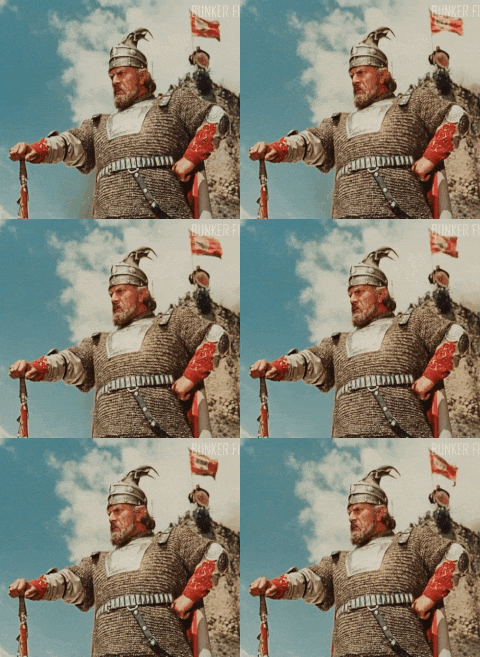
.thumb.png.e31f012ee612b287cfd5223b6934dd8c.png) Issued by the MARIAN RETINUE OF HANSETI-RUSKA c. 7th OF VYZMEY AND HYFF, 572 E.S. REFORMS FOR THE MARIAN RETINUE. VA BIRODEO HERZENAV AG ELDERVIK, TO IDLE IS TO DISHONOR ONESELF. It is most shameful that any Haeseni should waste away in idleness – most grievous is it for a Knight of our fair Kongzem to do it, those intended to embody valor and righteousness; the chosen guardians of the Edlervik. It is why, through the many decades since the most recent reformation of the Marian Retinue, and the absolving of the Order of the Crow – have we seen fit to amend many issues that have plagued His Majesty’s Retinue. So we may best honor and embody the Bogatyrs of yore, those who served the old King Barbov – and further, so we shan’t idle or forsake such an opportunity. Since the time of our crow-ly order, the Knights of Hanseti-Ruska have had to live up to the expectations and standards set before them. Within our modernity, we have lost the basic essence of how a Knight is supposed to perform and uphold themselves. Whilst attending to the Crown, and representing themselves as guardians of the Edlervik, a Knight must be sure to remember the following, lest the Knight Paramount or Crown themselves remember the fragile hold on which a knightly title is held and see it stripped from their very being. ❖ㅤTHE CODE OF CHIVALRY 〣 VE CURAN I CAEZKEN The Code of Chivalry, as is earlier referenced was a combination of centuries of different reformations and rebrandings of Haeseni Knighthood – culminated in a work by Koeng Sigisimund III. Knights of the Retinue are intended to act as beacons of valor, prestige, and honor within the Kongzem; and the official reinstatement of the Code of Chivalry, unchanged from the times of Koeng Sigismund shall display this. ❖ㅤPRESENCE 〣 HUMOVSK For those of the Marian Retinue – presence is principle; for one’s sword to be valorous and righteous, they must be wholly capable of safeguarding the Edlervik and Crown with their life. One who is absent, be they of any rank upon His Majesty’s Retinue – is unfit for such a role, not only because their truancy will leave the Crown undefended; but because they shan’t understand those who they pledge their blade for. It is most grievous a decision for a Knight to shirk their duties—as they had been bestowed such a righteous opportunity to defend the Kongzem – willingly choose to rest and rust in idleness. ❖ㅤCOOPERATION 〣 HAVYJSK It is only righteous and fair that the Knights of His Majesty’s Retinue may disagree and bicker, such is one of the afforded reasons that a Knight must face their equal in a duel, should they be challenged. Regardless, it is imperative that the differences or qualms any Knights of the Retinue bear with one another shouldn’t linger, or be left to dawdle – for it very well could risk the well-being of those it is expected to protect, in times of turmoil. A Page, or Squire too shan’t be irreverent to the Knights of the Retinue, for they stand lower. It is wise for a Knight to hear the voices of his underlings, but it shan’t be expected that their opinion be heeded. ❖ㅤPAGES 〣 DZETZENS Pagehood within Haeseni Knighthood is not a concept that has its roots within the Marian Retinue, instead, it is a rank that carries over from the Order of the Crow – it is why pagehood, as we understand it within the Retinue, is lackluster with baseline regulations for selecting apt youth. As of recent times, Pages have been used as a fallback when no standing Knight is capable of receiving a squire, or when the Retinue wishes to test an adult of their wit and strength. This should not and will not be our intent when choosing a suitable Page – they ought to be in the prime of their youth, from ages seven onwards to thirteen; they shan’t be expected to be seasoned or quick with a blade. Once reaching the age of ascension, would a Page require the approval of three Knights to move upwards within the Retinue’s ranks. ❖ㅤSQUIRE-ASPIRANTS 〣 SIKORT-AETIRKANS Within recent times there has been an extensive number of individuals enlisting in the Retinue, beyond the years of which the average Page would see themselves. Many at this point have already been open to the fields of battle, and the search for betterment, as well as chivalry. To this, we introduce Squire-aspirants. We hope, with this introduction, to avoid demeaning the prowess, and capability of those older than Pages, but still too fresh to the Retinue to shoulder the title of Squire, to give them a proper chance to prove themselves within our ranks. It is also a rank for Pages that have yet to gain the approval of their Knights but have surpassed the age of pagehood. ❖ㅤSQUIRES 〣 SIKORTS One of the eldest elements of Knighthood, not solely within the Kingdom is squirehood, which truly represents the transformation to Knighthood – it is where the truest test of wit, skill, and loyalty are displayed. Similar to Pages, Squires too will be expected to be of suitable age, this being fourteen and onwards; unlike Pages, however, there isn’t a specific age too old. Furthermore, it will be the duty of the Knight Paramount to choose among those candidates most fitting, with the words of the Knights of the Retinue also heeded; it is then to which a Squire will be granted out onto one of the suited Knights. The most capable squire shall have already bloodied their blade before undertaking their place in the Retinue – their honor shall be intact, and loyalty unbroken; and whilst their time as a Squire may mold them, they ought already be steeled and suited to complete the trials ahead. ❖ㅤKNIGHT-ASPIRANTS 〣 KOSSAR-AETIRKANS There has never been an exact addressment for those who have begun to seek their Bogatyr Trial within the Retinue. The addition of Knight-aspirants brings relative ease to future Knights and current Squires to more easily comprehend the order of promotion so we may better understand where in place those within the Retinue fall. ❖ㅤMEETINGS 〣 VE KOSSAR ROZIK Communication is key, so the saying goes, and no great order works well together unless there is a proper way for them to speak freely amongst themselves and propose thoughts. By the stead of the Knight Paramount, or an assigned Knight in their absence, every two years a gathering of the table is to be held so there may be an upstream of communication, promotion, and information in rotation amongst the Retinue. ❖TRAININGS 〣 BOTTEL PLAIS No good Knight is untrained in their weapon of choice, and to slack in the use of it may hinder such an ability. It is asked that anyone within the Retinue attempt to attend the mock skirmishes hosted by the Brotherhood of Saint Karl at least once every four years. ❖ㅤCITIZENSHIP 〣 EDLERVIK As it has been since the last age of Marian Knights, nobles of any standing, excluding those who are to inherit land and title, can strive for a place within the Marian Retinue. In these reforms, we extend the invitation to any with Haeseni citizenship to place themselves forth in these aspirations. To be considered a Haeseni citizen, you must live in or under someone who pays taxes for a building of residence. Further extension of these requirements asks that an individual must have lived within this residence for at least seven years. The time of Knight Trials has become one of ease, and even sheer luck could bring success in the most tasking and demanding feats. It is because of this that the reinstitution of these smaller trials, before a Knight-aspirant’s Bogatyr Trial, is to be completed, in the following order, for a Squire to be deemed ready to take on their Bogatyr Trial. If the individual trials are not successfully completed upon the first attempt, a Squire must wait seven months to complete that trial again. ❖ㅤTHE TRIAL OF WILL 〣 VE PLATZYJA I MYLAH First seen in the Order of the Crow was the trial of Mylah, dubbed after a Dame with indomitable will. To complete her trial, a Squire must be thrust into an environment of duress upon their life and seek escape. ❖ㅤTHE TRIAL OF JUDGMENT 〣 VE PLAZTYJA I JOSZEF To be a Knight is to be fair and kind, as was the late Ser Joszef. This trial too has been used throughout the entirety of the Order of Crows, lost within the time of Marians. With the readdition, to complete his trial, a Squire is to show unquestionable honor and morality to all they impose. ❖THE TRIAL OF WIT 〣 VE PLAZTYJA I SZITIBOR Luck and circumstance may not always be upon the Knight’s side, and they may be entirely underprepared for the scenarios ahead. To ensure, like Szitibor, that a Squire is capable, even empty-handed, they must best a beast of sorts with only the clothes upon their back. ❖ㅤTHE TRIAL OF THE WARRIOR 〣 VE PLAZTYJA I SLAVOMIR Unseen in the generation of new Knights is the trial of Slavomir, as well, originating from the times of the Order of Crow. Slavomir, the master of all knights, presented himself the best he could amongst his table, and so to complete his trial, a Squire is to present themselves the best they can in duel combat against the Knights of their table. ❖THE BOGATYR TRIAL 〣 VE KOSSAR’S PRIVESK PLAZTYJA The Bogatyr Trial, agone by many titles and variations, has always been the final trial of a Knight-aspirant, showing high risk which reaps high reward. The Knight-aspirant, once completing the four trials before, is permitted to request a final quest, be it from the Crown, the Oracle, or the Knight Paramount themselves. Unassisted, they are to complete the Bogatyr Trial within the span of three Royal Courts, lest they be set back to Squire to provide others the opportunity to complete the tasks dawned upon Knight-aspirants. VE MARIAN KURSAIN | THE MARIAN RETINUE. Ser Belisar Ruthern, 533 E.S VE OREDEN I VE KARONY | THE ORDER OF THE CROW. Ser Walton Kranz, 439 E.S KOSSAR I HAENZ | KNIGHTS OF HAENSE. Koeng Sigismund III, 398 E.S THE CODE OF CHIVALRY | VE CURAN I CAEZKEN. The Knights Table, c. 572 E.S DLUM VE EDLERVIK AG VE BIRODAL, HIS EXCELLENCY, Ser Andrei Kortrevich, Count of Jerovitz, Viscount of Krusev, Baron of Koravia, Lord of Emsgrad, Lord Protector of the Koravians, Lord-Captain of ve Bykursain, Knight Paramount of Hanseti-Ruska THE RIGHT HONORABLE, Dame Dima Kortrevich, Countess of Jerovitz, Viscountess of Krusev, Baroness of Koravia, Lady of Emsgrad, Lady Protector of the Koravians, Knight of the Marian Retinue.
Issued by the MARIAN RETINUE OF HANSETI-RUSKA c. 7th OF VYZMEY AND HYFF, 572 E.S. REFORMS FOR THE MARIAN RETINUE. VA BIRODEO HERZENAV AG ELDERVIK, TO IDLE IS TO DISHONOR ONESELF. It is most shameful that any Haeseni should waste away in idleness – most grievous is it for a Knight of our fair Kongzem to do it, those intended to embody valor and righteousness; the chosen guardians of the Edlervik. It is why, through the many decades since the most recent reformation of the Marian Retinue, and the absolving of the Order of the Crow – have we seen fit to amend many issues that have plagued His Majesty’s Retinue. So we may best honor and embody the Bogatyrs of yore, those who served the old King Barbov – and further, so we shan’t idle or forsake such an opportunity. Since the time of our crow-ly order, the Knights of Hanseti-Ruska have had to live up to the expectations and standards set before them. Within our modernity, we have lost the basic essence of how a Knight is supposed to perform and uphold themselves. Whilst attending to the Crown, and representing themselves as guardians of the Edlervik, a Knight must be sure to remember the following, lest the Knight Paramount or Crown themselves remember the fragile hold on which a knightly title is held and see it stripped from their very being. ❖ㅤTHE CODE OF CHIVALRY 〣 VE CURAN I CAEZKEN The Code of Chivalry, as is earlier referenced was a combination of centuries of different reformations and rebrandings of Haeseni Knighthood – culminated in a work by Koeng Sigisimund III. Knights of the Retinue are intended to act as beacons of valor, prestige, and honor within the Kongzem; and the official reinstatement of the Code of Chivalry, unchanged from the times of Koeng Sigismund shall display this. ❖ㅤPRESENCE 〣 HUMOVSK For those of the Marian Retinue – presence is principle; for one’s sword to be valorous and righteous, they must be wholly capable of safeguarding the Edlervik and Crown with their life. One who is absent, be they of any rank upon His Majesty’s Retinue – is unfit for such a role, not only because their truancy will leave the Crown undefended; but because they shan’t understand those who they pledge their blade for. It is most grievous a decision for a Knight to shirk their duties—as they had been bestowed such a righteous opportunity to defend the Kongzem – willingly choose to rest and rust in idleness. ❖ㅤCOOPERATION 〣 HAVYJSK It is only righteous and fair that the Knights of His Majesty’s Retinue may disagree and bicker, such is one of the afforded reasons that a Knight must face their equal in a duel, should they be challenged. Regardless, it is imperative that the differences or qualms any Knights of the Retinue bear with one another shouldn’t linger, or be left to dawdle – for it very well could risk the well-being of those it is expected to protect, in times of turmoil. A Page, or Squire too shan’t be irreverent to the Knights of the Retinue, for they stand lower. It is wise for a Knight to hear the voices of his underlings, but it shan’t be expected that their opinion be heeded. ❖ㅤPAGES 〣 DZETZENS Pagehood within Haeseni Knighthood is not a concept that has its roots within the Marian Retinue, instead, it is a rank that carries over from the Order of the Crow – it is why pagehood, as we understand it within the Retinue, is lackluster with baseline regulations for selecting apt youth. As of recent times, Pages have been used as a fallback when no standing Knight is capable of receiving a squire, or when the Retinue wishes to test an adult of their wit and strength. This should not and will not be our intent when choosing a suitable Page – they ought to be in the prime of their youth, from ages seven onwards to thirteen; they shan’t be expected to be seasoned or quick with a blade. Once reaching the age of ascension, would a Page require the approval of three Knights to move upwards within the Retinue’s ranks. ❖ㅤSQUIRE-ASPIRANTS 〣 SIKORT-AETIRKANS Within recent times there has been an extensive number of individuals enlisting in the Retinue, beyond the years of which the average Page would see themselves. Many at this point have already been open to the fields of battle, and the search for betterment, as well as chivalry. To this, we introduce Squire-aspirants. We hope, with this introduction, to avoid demeaning the prowess, and capability of those older than Pages, but still too fresh to the Retinue to shoulder the title of Squire, to give them a proper chance to prove themselves within our ranks. It is also a rank for Pages that have yet to gain the approval of their Knights but have surpassed the age of pagehood. ❖ㅤSQUIRES 〣 SIKORTS One of the eldest elements of Knighthood, not solely within the Kingdom is squirehood, which truly represents the transformation to Knighthood – it is where the truest test of wit, skill, and loyalty are displayed. Similar to Pages, Squires too will be expected to be of suitable age, this being fourteen and onwards; unlike Pages, however, there isn’t a specific age too old. Furthermore, it will be the duty of the Knight Paramount to choose among those candidates most fitting, with the words of the Knights of the Retinue also heeded; it is then to which a Squire will be granted out onto one of the suited Knights. The most capable squire shall have already bloodied their blade before undertaking their place in the Retinue – their honor shall be intact, and loyalty unbroken; and whilst their time as a Squire may mold them, they ought already be steeled and suited to complete the trials ahead. ❖ㅤKNIGHT-ASPIRANTS 〣 KOSSAR-AETIRKANS There has never been an exact addressment for those who have begun to seek their Bogatyr Trial within the Retinue. The addition of Knight-aspirants brings relative ease to future Knights and current Squires to more easily comprehend the order of promotion so we may better understand where in place those within the Retinue fall. ❖ㅤMEETINGS 〣 VE KOSSAR ROZIK Communication is key, so the saying goes, and no great order works well together unless there is a proper way for them to speak freely amongst themselves and propose thoughts. By the stead of the Knight Paramount, or an assigned Knight in their absence, every two years a gathering of the table is to be held so there may be an upstream of communication, promotion, and information in rotation amongst the Retinue. ❖TRAININGS 〣 BOTTEL PLAIS No good Knight is untrained in their weapon of choice, and to slack in the use of it may hinder such an ability. It is asked that anyone within the Retinue attempt to attend the mock skirmishes hosted by the Brotherhood of Saint Karl at least once every four years. ❖ㅤCITIZENSHIP 〣 EDLERVIK As it has been since the last age of Marian Knights, nobles of any standing, excluding those who are to inherit land and title, can strive for a place within the Marian Retinue. In these reforms, we extend the invitation to any with Haeseni citizenship to place themselves forth in these aspirations. To be considered a Haeseni citizen, you must live in or under someone who pays taxes for a building of residence. Further extension of these requirements asks that an individual must have lived within this residence for at least seven years. The time of Knight Trials has become one of ease, and even sheer luck could bring success in the most tasking and demanding feats. It is because of this that the reinstitution of these smaller trials, before a Knight-aspirant’s Bogatyr Trial, is to be completed, in the following order, for a Squire to be deemed ready to take on their Bogatyr Trial. If the individual trials are not successfully completed upon the first attempt, a Squire must wait seven months to complete that trial again. ❖ㅤTHE TRIAL OF WILL 〣 VE PLATZYJA I MYLAH First seen in the Order of the Crow was the trial of Mylah, dubbed after a Dame with indomitable will. To complete her trial, a Squire must be thrust into an environment of duress upon their life and seek escape. ❖ㅤTHE TRIAL OF JUDGMENT 〣 VE PLAZTYJA I JOSZEF To be a Knight is to be fair and kind, as was the late Ser Joszef. This trial too has been used throughout the entirety of the Order of Crows, lost within the time of Marians. With the readdition, to complete his trial, a Squire is to show unquestionable honor and morality to all they impose. ❖THE TRIAL OF WIT 〣 VE PLAZTYJA I SZITIBOR Luck and circumstance may not always be upon the Knight’s side, and they may be entirely underprepared for the scenarios ahead. To ensure, like Szitibor, that a Squire is capable, even empty-handed, they must best a beast of sorts with only the clothes upon their back. ❖ㅤTHE TRIAL OF THE WARRIOR 〣 VE PLAZTYJA I SLAVOMIR Unseen in the generation of new Knights is the trial of Slavomir, as well, originating from the times of the Order of Crow. Slavomir, the master of all knights, presented himself the best he could amongst his table, and so to complete his trial, a Squire is to present themselves the best they can in duel combat against the Knights of their table. ❖THE BOGATYR TRIAL 〣 VE KOSSAR’S PRIVESK PLAZTYJA The Bogatyr Trial, agone by many titles and variations, has always been the final trial of a Knight-aspirant, showing high risk which reaps high reward. The Knight-aspirant, once completing the four trials before, is permitted to request a final quest, be it from the Crown, the Oracle, or the Knight Paramount themselves. Unassisted, they are to complete the Bogatyr Trial within the span of three Royal Courts, lest they be set back to Squire to provide others the opportunity to complete the tasks dawned upon Knight-aspirants. VE MARIAN KURSAIN | THE MARIAN RETINUE. Ser Belisar Ruthern, 533 E.S VE OREDEN I VE KARONY | THE ORDER OF THE CROW. Ser Walton Kranz, 439 E.S KOSSAR I HAENZ | KNIGHTS OF HAENSE. Koeng Sigismund III, 398 E.S THE CODE OF CHIVALRY | VE CURAN I CAEZKEN. The Knights Table, c. 572 E.S DLUM VE EDLERVIK AG VE BIRODAL, HIS EXCELLENCY, Ser Andrei Kortrevich, Count of Jerovitz, Viscount of Krusev, Baron of Koravia, Lord of Emsgrad, Lord Protector of the Koravians, Lord-Captain of ve Bykursain, Knight Paramount of Hanseti-Ruska THE RIGHT HONORABLE, Dame Dima Kortrevich, Countess of Jerovitz, Viscountess of Krusev, Baroness of Koravia, Lady of Emsgrad, Lady Protector of the Koravians, Knight of the Marian Retinue..thumb.png.e31f012ee612b287cfd5223b6934dd8c.png)