littyfam
-
Posts
120 -
Joined
-
Last visited
Content Type
Profiles
Personas
Wiki
Rules
War
Systems
Safety
Player Conduct
Roleplay Leadership Guidelines
- Roleplay Leadership Guidelines
- Roleplay Leadership Guidelines Comments
- Roleplay Leadership Guidelines Reviews
Forums
Everything posted by littyfam
-
THE HIGH PRIESTS A REVISION OF PRE-INTERREGNUM PONTIFICAL SUCCESSION Written by Daniel Pontius de Senna Published on the 5th of Sun’s Smile, 653 A.A. FOREWORD I had first written this essay as that final task of my acolyteship, under the late H.P. Bernard II. Whereas it was accepted by that present Pontiff, it has since lacked publication. I thus publish it in this rough and unedited form, for I lack both time and will to see it reviewed to any extent greater than I had done some two decades ago. I ask, therefore, that the reader forgives any errors of grammar or phrasing; where argument or evidence is in question, I shall readily answer to any queries or counters. I maintain a rough reference of texts both primary and secondary which, due to its length, I have not hereunder attached. The greatest of my conjectures surround the Sack of Pontia, hence its relative lack of analysis, alongside my suppositions on the intentions of Anti-Pontiff Hogarth and Dawn of Perea. To these I eagerly invite the opinions of others, in support or otherwise. For the sake of convenience, I have used the traditional calendar of Man in my dating. I do hope that this proves elucidating to some, and puts aptly to words the assumptions of others. PREFACE Forasmuch as the Mother Church maintains an able archive of its materials and histories, a considerable portion of its contents have gone unreviewed after their initial promulgation. I thus write this cursory examination of the progress of the High Priesthood through its establishment under Ex. Owyn, until its effective dissolution upon the first division of the Kingdom of Oren. I shall establish first the limitations of this work: it is principally concerned with correcting the chronology of the early Church, with only limited analysis reserved for the tenures of the High Priests. I shall leave this latter element to another paper. Indeed, this is a necessary conceit of the study: without first correcting the broader Pontifical narrative, any close analysis shall walk on unsteady ground. Herein I thus deal in an uncontextualized world largely enclosed to the High Priesthood. The reader must be aware that this early Church was very unlike ours. Its structures were far more fluid and intertwined with the incipient Orenian state, with a dogma fundamentally unlike any which emerged in the wake of the 1455 Council of the One Faith. I begin first with an outline of the historiography of the early Church, and continue thereafter with my amendments. I shall offer thereafter a suggestion as to the origins of the various inaccuracies present in past histories, insofar as I am able. HISTORIOGRAPHY There is not a great deal to be said as regards those prior iterations of early Pontifical chronologies. As mentioned prior, there has hitherto been witheringly little historiographical revision of most any historical documentation of the Church. This earliest period has seen itself especially susceptible to such a deficiency, given both the scarce primary documentation and general insignificance in later narratives, both secular and religious, of this era. The earliest extant history of the Church is dated to the tenure of High Ecclesiarch Radomir I, written sometime between 1444 and 1448.¹ The reign of the final pre-Interregnum High Priest can be decisively placed in 1315.² There thus stands some 129 years at minimum between Radomir’s chronology and the events it describes; that it is laden with inaccuracies should be surprising to none. Its contents are thus: I – HP EVARISTUS I & CLEMENT I The first heads of the Holy Faith appointed by the successor of Horen, Owyn I. II – HP SIXTUS I III – HP ALEXANDER I IV – HP PONTIAN I V – HP STEPHEN I VI – PAUL I VII – PAUL II VIII – SIXTUS II IX – LIBERIUS I X – MARK I The last leader of the Faith under the divine line of Horen, he was removed forcefully after the deposition of the king. XI – BERNARD I The first recorded leader of the Faith under the usurper Perea and Sheffield dynasties, before which the Church was held in high regard by the line of Horen. XII – EVERARD I The progenitor of House Hightower, Everard I was the last High Priest of a unified Oren. He died a martyr, attempting to prevent the non-believer Sheffield king from abolishing the Church entirely. After his reign the kingdom splintered, causing the Church to be absorbed into the Phoenix Kingdom of Renatus and lose a great deal of power and influence. THE FIRST INTERREGNUM Gospel tells us that it was during the year 38 that Ex. Owyn anointed Evaristus and Clement as leaders over his priesthood.³ We must therefore understand, per Radomir’s chronology, that twelve generations of High Priests reigned in excess of twelve centuries altogether. This is a dubious implication, and one evidently identified by Radomir’s successors, for the first amendment to this narrative emerged during the pontificate of HP Daniel I, after 1471.⁴ There are three alterations which may be dealt with individually. i. ADDITIONS TO LIBERIUS I IX – LIBERIUS I It was under Liberius I when the great Priestly See of Pontian I was ravaged, the archives of the Faith lost, and the Priesthood destroyed. Whilst the majority of mankind still heralded the faith of Horen I, there was no singular Head of Faith until the High Priest Marcus; instead, the Church’s dogma was governed by various clerical circles who acted as peers. What little is known about the Church prior to the Sack of Pontia was due to texts saved in his escape. While the existence of a St. Pontian is attested so early as 1444 in the writings of Radomir’s contemporary, John of Corazon, there is no mention of a ‘Priestly See of Pontian I’, prominent or otherwise, until this very edition of Daniel I.⁵. It seems likely, therefore, that this addition was a later interpolation of a comparatively minor event, possibly intended to rectify the temporal dissonance implicit in Radomir’s edition. ii. AMENDMENTS TO MARK I X – MARCUS I The first and last leader of the Faith under the line of Horen, he was appointed in the reign of St. Daniel, who sought to restore the Priesthood after centuries of decentralized clergy. He proved able and competent in swaying the various religious circles to submit to his authority. It should first be noted that Mark’s has here been rendered in the Flexio style - particularly notable given that the same was not done for the proceeding Bernard and Everard; this shall be taken up once more in my conclusions. What is stranger, however, is the complete recontextualisation of the subcontents. What was once an oblique reference to St. Daniel of Al’Khazar has become very explicit (and even seems to reference the unique manner of St. Daniel’s founding of the Kingdom of Oren, with the addition of ‘first … leader of the Faith under the line of Horen’; we must presume this an oddly-phrased reference to the aforementioned).⁶ There is a curious turn to historicity thereafter, absent in Radomir’s version: where Radomir’s Horenic monarch had been erroneously deposed, this omits any reference to the end of St. Daniel’s reign. One might also note that further adaptations have been made (see ‘restore the Priesthood’) that the text might align with the above Liberian inventions. I shall elaborate further on both these elements in my conclusive comments. iii. AMENDMENTS TO BERNARD I XI – BERNARD I The first non-human leader of faith and the first recorded leader of the Faith under the usurper Perea and Sheffield dynasties, before which the Church was held in high regard by the line of Horen. Bernard was of halfling origin and relatively mild-mannered. There is only a minor addition here, being that of Bernard’s background. One might note that, at this time, halflings were not considered as within the lineage of Horen - a matter later amended by a 1662 decree of Jude I.⁷ Daniel’s discovery of some additional information regarding the life of Bernard must be presumed. So for Daniel’s edition. This particular iteration was copied ad unguem in both the c. 1578 Historem Pontificum and the 1760 Pontificum Historia, the latter being the most recent comprehensive chronology of the Pontificate. Thus stand the prior histories of the early Pontificate. A REVISED CHRONOLOGY OF THE EARLY CHURCH It is by necessity that my chronology begins in earnest at that same point as Tanith of the Westerland’s foundational A Brief Summary of Early Imperial History: with St. Daniel’s foundation of Al’Khazar.¹ Where we might certainly infer the existence of a continuous priesthood in the Thousand-Year Silence, it is wholly doubtful that any continuous High Priesthood was maintained through the period of the Seven Kingdoms.² I propose, therefore, that the High Priests Sixtus I through Mark I were priests raised to the office by individual ‘princes of piety’ [Gsp 5:26], but likely not in any sense of direct Pontifical inheritance - as was recordedly done by St. Daniel in the Kingdom of Oren, and later by Ex. Godfrey. To order them in any other manner than that presented by Radomir would be simple folly, for there remains only brief attestations of a scarce few among their number. Thus, to a new chronology of the Danielan High Priesthood. Sometime in the late 13th century, the last remaining heir of an otherwise obscure King of Aaun relocated his seat from the historic center of Horenic authority, Jrent, to a small northwestern fishing village, ostensibly nearer to Gospel’s Paradisus. This town was known as Al’Khazar, and for a time boasted no High Priest, nor any great temple, save a small squareside shrine dedicated to Ex. Horen. At a court gathering in the early period of St. Daniel’s reign at Al’Khazar, Everard Hightower was appointed as High Priest of Oren - the reasons thereof are, however, unknown. He established the first cathedral in the burgeoning capital, and would come to centralise his authority both within and without the kingdom. He was, in quick succession, appointed to the stations of High Chancellor and Archmage, thereby ensuring the prominence of his household for some few succeeding generations. Everard would hold tenure through the entirety of Pampo Perea’s reign, even conducting his funerary rites. It was during the early stage of the rule of Pampo’s seneschal and successor, Edmund, that Everard would retire from the High Priesthood, investing his authority with the Bishop of Dunwood: Oliver Sturdyfoot II. Oliver would reign as High Priest for only a few months, in the year of 1314: a period entirely contained within the rule of Edmund Sheffield. Upon his death later that year, he would invest the High Priesthood with his son, Bernard Sturdyfoot. As with his father, little can be definitively discerned of Bernard’s High Priesthood. It is certain that he reigned during the final part of Edmund’s kingship, though there stands no evidence of any partisanship on his part during the succession crisis that followed Edmund’s death. Contemporaneously, the eminent Archbishop of Kal’Urguan, Hogarth Irongut, had his position within the dwarven capital revoked. Hogarth, who had to that point supported Perea’s Queen-Consort, Dawn, to succeed to the throne, was swayed to Enor’s camp with the promise of the Orenian High Priesthood. Shortly into Enor’s kingship, Bernard came to blows with the royal: Al’Khazar’s cathedral was requisitioned by the crown, and Hogarth was spuriously invested with the High Priesthood - an Anti-Pontificate that would retain the support of the state until the ultimate collapse of the Kingdom of Oren, at which point both claimants to the High Priesthood fell into obscurity, alongside the title itself. Thus did the First Interregnum begin. ADDITIONAL COMMENTARY I. THE POLYECCLESIASTIC CHURCH While the Church has often deferred to a simplistic model of singular and direct succession through the line of Sts. Evaristus and Clement, composed of a unitary clergy in subservience to a singular High Priest, it is abundantly apparent that the consolidated post-Danielan church was very much an invention of its times. I therefore propose an alternative organisational model for the pre-Danielan clergy: a polyecclesiastic church, that being a church comprising a number of divided hierarchies, largely contained to individual temporal states, with each governed by its own High Priest. Gospel speaks at length on the progressive degradation of the ecclesiastic institute through the Silence, taking particular care to emphasise that ‘virtue was preserved only by keepers of ashen urns, paupers, and princes of piety’ [5:26], a statement that implies much for the dissolute hierarchy of the post-Owynic clergy. The nomenclature of the Danielan Church seems additionally informative. It is not for mere excess that its High Priests were known as High Priests of Oren; their role was implicitly bound to and confined by the state within which they served. This was not the universal church that was confirmed in the afterglow of Ex. Godfrey’s empire, but a limited one. The term appears to have come to such ubiquity by the time of the Danielan Church that it found use in both fictionalised tales, as in the High Priest of Nox of The Great Adventures of Tegchen, described to be the parish priest of ‘a small human town’ of the same name, and in the terminology of adjacent assemblies, as that High Priest Omni of the quasi-heretical Ascended. It is this same model which serves with ease to explain the late placement of the First Interregnum. The temporal failings of the pre-Danielan succession in both Radomir and Daniel’s editions of the Church’s chronology have already been outlined - if, rather, this succession was not linear nor singular, then there would be no individual High Priesthood able to experience an interregnum (and hence no ‘First Interregnum’), and no direct succession of priests need be necessary to fill the 12-century gap. A polyecclesiastic clergy, therefore, adequately fills the gaps present in the historiographical record. The dominance of the Kingdom of Oren in the late 13th and early 14th centuries over the Aegisian polities marks the beginning of the transition to a singular clerical hierarchy - a monecclesiastic church. Whereas the concept of heterogenous state-bound priesthoods had remained in the social conscience at least so late as the reign of St. Daniel, the High Priest of Oren was the de jure leader of the entirety of the True Faith congregation across the continent. De facto, however, prominent diocesan authorities preserved a significant part of their autonomy. By the First Interregnum, the ecclesiate was in flux. Ex. Godfrey’s installation of Gideon Silverblade as the High Pontiff Pius I would formalise this transition, placing at last the entirety of his empire’s religious institute beneath both the de jure and de facto authority of the High Pontiff. No longer would a High Priest be beholden to the woes and wiles of the state, but a High Pontiff would exist beyond them. II. THE SACK OF PONTIA In following from the above, it becomes necessary to question the veracity of the Sack of Pontia under Liberius’ reign as a singularly cataclysmic event. I do not doubt the existence of the sack itself, but rather pose that it has been abstracted and massively exaggerated in the historical record. Rather, the sack might well be indicative of a greater historical pattern of institutional dissolution of both temporal and ecclesiastical institutions as was prevalent during the latter stages of the Thousand-Year Silence. In other words, the proverbial icon of an era of collapse. III. ON EVERARD I While beyond strictly beyond the intended purview of this paper’s chronological examinations, a correction of early Pontifical histories would be incomplete without examining the historical status of High Priest Everard I. He has found much enshrinement since his lifetime: he has been held for centuries as a saint of the Lord, and is among the prominent few of them, bearing the Society of St. Everard in his name. For all the piety that tradition affords him, the historical record speaks otherwise. Certainly, during his reign as High Priest little fault can be held against him. He was among the most prominent figures of the Kingdom of Oren, and served both parish and church dutifully. It is after his 1314 retirement, during the reign of Enor, that his legacy becomes wholly more suspect. It is widely known that the plague of the Undead came readily to the fore through Enor’s kingship (and this was in no small part a cause of the ultimate trifurcation of Oren with the Phoenix Revolution), though where Enor’s corruption has been presumed (and his notes seem to attribute his failings rather to simple ineptitude than a grander scheme), an extant letter more accurately locates the sullying of the Orenian state’s chief apparatus within his Chancellor, the by-then abdicated Everard I. The contents of the letter stand as thus, Mr. Hawk Whitestorm, On behalf of the Forsaken Nation of Drauchreich, I would like to express our gratitude for your aid in the conquest of Al’Khazar. The details you provided us regarding guard postings and defensive strategy were a great help to our decisive victory. We look forward to your continued services towards our great cause. We have dispatched the agreed upon compensation of 3 diamond stacks to the indicated location. Regards, Apostle Everard, Member of The Forsaken Nation of Drauchreich. While this remains the sole evidence of his malfeasance, the contents are quite explicit. At the earliest point of Al’Khazar’s fall, and likely spanning into even his tenure as High Priest, Everard held affiliations to and a position (‘Apostle’) within that reviled Undead hotbed of Drauchreich. This was a tie maintained even after death; while a transcription of his funerary announcement places him dead at 61, a letter of application has him yet living nigh two decades later, at the age of 79. The status of his soul itself, therefore, is readily debatable. I shall not theorise as to why Everard’s life came to be rendered so completely otherwise from the historical fact - but I shall reiterate the vitality of acknowledging his life as it was, and not as we would wish it to be. Aught otherwise would be wilful ignorance. POSTWORD I hope that I have demonstrated here the need for critical review of our Church’s inherited histories. It is very well and good to tend to matters more explicitly spiritual - the Scrolls, analyses of the plethora of virtues and sins, and all that common fare - but our Church is one burdened with acknowledgement of both a continuous tradition and the Holy Word. We cannot act as dutiful clerics if either field is let to fallow, else we become mere actors at play.
-

A Thesis on: The Fracturing of Horen’s Sons
littyfam replied to wildspaghett's topic in Ecclesiastical Theses
A response is addressed as regards this thesis, from a priest of little renown. * Goodbrother Blackfern, It is my opinion that, whether by purposed intent or otherwise, you have misread what precisely is meant by 'wrath', ira, in the Holy Word. I shall, for the sake of brevity, limit my argument to explicit references of the aforementioned, your claims of 'cruelty' (and all that necessarily follows from this characterisation) being predicated upon that Canonical concept. Let us refer first to Virtue 5:9, 'So I am the Most High, and in pursuit of My Virtue, I bid My faithful this: You shall not raise a hand in wrath, nor in envy, nor in any kind of sin.' 'Sum Ego Dominus DEVS altissimus, et in persequentes Virtutum Meum, Ego impero fideles in hoc modo: vos non crispate manus in ira, neque in invidia, neque in aliis peccatis.' I shall defer largely to the analysis of Bl. Fabian the Lesser's Jus Bellum Justum: 'He thus indicates that violence, or the raising of the hand, is not sinful under circumstances where it is not connected to the other sins, such as wrath or avarice. The astute religious scholar will then determine that it is permissible for a Canonist state to wage war where the war’s essential goal is a virtuous one.' We read, therefore, this instance of wrath as mortal sin. Indeed, it is this very same wrath, of condemnable nature, that is spoken of in Gospel 2:45, 68, 3:4, and that mentioned by you in 4:53. We cannot, however, follow the conclusion that wrath is inherently sinful, nor inherently cruel. For wrath is an aspect of the Lord: 'And verily you must find that pain comes not from the wrath of the Lord (ira DEI), but as we reject Him,' (Spirit 6:15). How, then, can it be that '[s]uch wounds [of wrath] do not fade—they fester'? The pains you speak of, these 'wounds', are not born by wrath, but by the rejection thereafter. I implore you: recall Owyn. It was his mortal wrath, his worldly wrath, that wrought sin, yet it was by his acts in the name of divine wrath that he found absolution (Gospel 5:18-22). You name these wars cruel, but they only seem cruel to you for your heart bleeds too readily. Where the priest is meant to be a guide, certainly, he is meant, also, to be an exacter of penance. The willing may be led forth by the Word, yet the unwilling, always, have courted the Blade. Forgive any sloppiness on my part in this response. I recover still from my travels, but I thought this thesis one amply deserving of response. With God as our Guide, Fr. Daniel Pontius de Senna * -
Full Name of Man - Alexandre Matthias Devereux Date of Birth of Man - 2030 Name of Woman - Ipera Amelya Enswerp Date of Birth of Woman - 2036 Location of Ceremony - Cathedral of the Fifty Skulls, St. Godwinsburg, Alba Date of Ceremony (Year) - 2063 Name of Clergyman who performed ceremony - Fr. Daniel Pontius de Senna
-
IMPERIAL PROCLAMATION | THE VUILLERIAN ENLIGHTENMENT
littyfam replied to FireAGN's topic in Emissary Publications
In that undercarriage of Rittersberg's chapel, did the good Father Pontius, a Sennan by birth, comment thus, to his nearseated brother... "Why, it seems that our far-flung idiots of cousins have deigned to repent before His Imperial Majesty and the Good Lord God. Fitting, I suppose, that their titles have been stripped - it would not do well for the Empire to have halfwits as enfeoffed lords, would it?" @FireAGN -
A CALL TO CONVENTION OF THE DIOCESE OF ST. THOMAS OF GAEKRIN Unto the priests, monastics, and acolytes of the diocese, Some seven years have passed since the last common gathering of our priesthood. In this interim has the Diocese of St. Thomas of Gaekrin borne witness to a great expansion of those clerics and acolytes active within its borders. Whereas the cathedra yet remains in sede vacante, following the retirement of the good Abbot Shaulbert, it is found prudent by us portion of priests operational within the diocese to call for the convocation of these pertinent parties, that we may discuss St. Thomas’ ongoings, both present and future. It is within this meeting that we encourage the oration of the imperial clergy’s suggestions and issues, that all may aid in their construction or resolution. We invite, therefore, those priests both formally and informally operational within the diocesan boundaries and the greater Crownlands to gather within the Imperial City of Rittersberg, at its parish chapel, during the month of Horen’s Calling, 2064. Additionally welcomed are those provincial monastics and acolytes. As for Godfrey, so for us. May the Lord guide our word and hand. Signed in Faith Fr. Daniel Pontius de Senna Fr. Anselm von Callahan Fr. Lothaire Paul Halcourt
-
Full Name of Man - Leonhardt Aldersberg Date of Birth of Man - 2034 Name of Woman - Mallory Helvets Date of Birth of Woman - 2024 Location of Ceremony - Cathedral of the Fifty Skulls, St. Godwinsburg, Alba Date of Ceremony (Year) - 2061 Name of Clergyman who performed ceremony - Fr. Daniel Pontius de Senna
-
Rittersberg Mayoral Ballot, 634 AA
littyfam replied to cadazio's topic in Imperial Capital, Rittersberg
✠ Full Legal Name: Daniel Pontius de Senna ✠ Age (Must be over 18): 28 ✠ Residence (Must be within Rittersberg): Hadriansmarkt 3 ✠ I cast my vote in favor of…: Gennad var Vigo -
[!] A letter was delivered to the High Jeweller. Of Mirion-Angbar I write in correction of that section concerning the Harrenite Ludodain, as pertains to its particular origins. As I recall, it was during my son's youth, when he found companionship in some youthful Haeseni king or prince - when that polity was yet in existence - that he took to the gathering of a number of a number of signatures from the denizens of the White City in support of the implementation of an iteration of Haeseni Chess within the city walls, in part as a diplomatic venture. This was submitted to his grandmother, who yet reigned as Queen. Thus was a board set nearabouts the mountain-keep, where, no doubt, it took to a life of its own. If you should need any further explanation, do send word. Aeneth Ilia de Ekain Queen-Mother of Idunia
-
NAME: Daniel Pontius de Senna VOCATION: Priest TRIBE / CULTURE: Rhenyar BIRTH YEAR: 2033 ORDINATION DATE: 2059 ORDINATOR: Bernard II CURRENT DIOCESE: St. Thomas of Gaekrin ASSIGNMENT: Wandering Priest WRITTEN WORKS: TBA OOC: USERNAME: littyfam DISCORD: littyfam
-
Volume 2 13th of Horen’s Calling, 631 AA ✠ A CALL FOR STAFF ✠ Whereas the Imperial Gazette has found fair footing in its recollections of His Imperial Majesty’s Witenmot, and is readily able to recount all official proceedings of the Imperium, it is with great joy that it announces its intention to expand its purview into broader journalistic activities, inclusive of reports of ongoings from the multiplicity of imperial provinces, published interviews of individuals of note, and other writings of miscellany. It is thus that the Gazette publishes this call for those willing to act as interviewers, reporters, and writers beneath the oversight of the Chancellery. Citizens of the Empire wishing to serve as reporters or scribes may address a letter of interest to the Master of the Imperial Gazette, Daniel Pontius de Senna, and arrange an interview at his office within the Rathaus. WITENMOT, 628 AA SESSION The second session of His Imperial Majesty’s First Witenmot (The Wise Assembly) has been concluded. The following is a record of the events that occurred therein; ✠ The Matter of Idunia Seats The Witenmot deliberated whether or not Idunia should be given additional seats in the Assembly. Motsmembers voted and resolved as follows; 2 Additional Seats - No Votes. 1 Additional Seat - 6 Votes 0 Additional Seats - 2 Votes. THUS, it is resolved that the Exilic Kingdom of Idunia shall be awarded one additional seat upon the Witenmot. The next session shall debate, discuss, and resolve which community will host this seat. ✠ Lex Tiberi Penalty for Murder The Witenmot deliberated what the Imperial Penalty for those guilty of murder should be. The Assembly voted as follows; Drawing and Quartering - 1 Vote Hanging - 6 Votes Beheading - 2 Votes THUS, it is resolved that all persons found guilty of murder by a fair and impartial Imperial Trial will be sentenced to hang by the neck until dead. ✠ On Imperial Road Improvements The Witenmot deliberated whether or not any of the major arterial roads connected to the capital should be cobbled, at the expense of the Imperial Treasury. The Assembly voted as follows; Capital to St. Godwinsburg - 1 Vote Capital to Tarnavon - 0 Votes Capital to Leonstadt - 0 Votes. No Roads - 7 votes THUS, it is resolved no roads connecting major hubs to the capital shall be cobbled at imperial expense. THE IMPERIAL CORONATION In jubilant spirits does this Gazette reiterate the coming investiture of His Imperial Majesty, Hadrian, as Emperor of Man. As happened with their predecessors, the Emperor Tiberias, and the Apostolic King Tar-Anorhil of Idunia, His Imperial Majesty’s coronation shall be duly followed by that of the High King Tar-Zôrzagar of Idunia - both with the endorsement and anointment of His Holiness, High Pontiff Bernard II of the Church of the True Faith. The proceedings are to begin on the 7th of Aurelian’s Glory, in the year 631 AA, within the Imperial Palace. ON THE IMPERIAL CHANCELLERY His Imperial Excellency, the Archchancellor, has bidden that the imperial citizenry be made aware of the functionary and hierarchy of the Imperial Chancellery, as it stands in relation to the Imperial Privy and the broader bureaucracy of the Empire. In the same likeness of the Imperial Privy, the Chancellery - though distinct in its branch - derives its authority from that of the Archchancellor. It stands directly beneath the Imperial Privy in the order of precedence, holding significant administrative importance within the imperial bureaucracy. The Commissioners of the Chancellery are accountable directly to the Archchancellor, and govern a number of subsidiary offices that serve to aid in the regular operation of their relevant domain within the Chancellery. Thus stands the composition of the Imperial Chancellery. APPOINTMENTS ✠ To the Privy of Middelan His Imperial Excellency, Aetius Vanderius Thrax, is appointed to the seat of the Lord Marshal. Her Imperial Excellency, Valentina Antonia, Princess of Asturias, is appointed to the seat of the Lady Chamberlain. His Imperial Highness, Johannes Marius, Duke of Hollyhold, is appointed to the seat of the Prince-Justiciar. ✠ To the Imperial Chancellery His Excellency, Sir Heinrik Pinkhasov Ludovar, Duke of Kvasz, is appointed to the seat of the Vice Chancellor. His Excellency, Daniel Pontius de Senna, is appointed to the seat of the Imperial Master of the Gazette. Her Excellency, Andromede dey Mesford, is appointed to the seat of the Imperial Master Physician. His Excellency, Niccolò Rosevena, is appointed to the seat of the Dean of the Crownlands. Her Excellency, Anastasia von Augusten, is appointed to the seat of the Reeve of the Burgundian Crownlands. AVE IMPERIUM H V M A N I T A S I N V I C T A HIS IMPERIAL MAJESTY, Hadrian I of the House Horen, by the Grace of GOD, Emperor of Man, Holy Imperator, King of Burgundy, Seventis, Salvus, Renatus & Oren, Duke of Middelan, Helena, Lorraine, Sunholdt and Reutov, Protector of Grense, Protector of the Heartlanders, Patriarch of House Horen & the Tiberian Dynasty, Captain-General of the Church, Defender of the Faith. HIS IMPERIAL EXCELLENCY, Ledicort de Senna, Imperial Archchancellor. HIS EXCELLENCY, Parzival von Augusten, Viscount of Azor, Heir to the House of Augusten, Lord Exchequer of Alba, Lord Speaker of the Witenmot, Folkman of Steinwal, and Sergeant of the Prince’s Army of Alba. HIS EXCELLENCY, Daniel Pontius de Senna, Master of the Imperial Gazette.













-
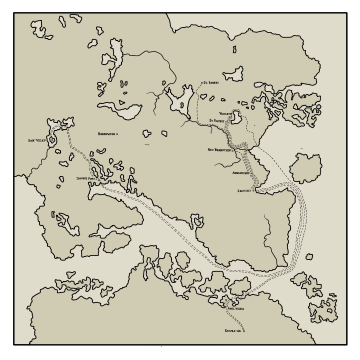
THE TRAVELS OF BROTHER NICOLOSO AN ACCOUNT OF A MONK’S JOURNEY IN THE TIME OF THE PETRAN CIVIL WAR Edited and annotated by Acolyte Daniel Pontius de Senna With advisement from Magister Avartagh of Lemon Shire Published on the 8th of Harren’s Folly, 627 AA. PREFACE With the consent of Magister Avartagh, I publish this edited and annotated edition, with additional analysis, of a diary written by one Br. Nicoloso, a monk of the Church, through 481 to 483 AA. While little textual remnants exist of this man outside of this thin tome, there can be no doubt that this man had a legible impact upon his contemporaries. Indeed, Fr. Avartagh tells me that His Holiness Leviticus saw in this monk a model of faith - one which would turn him towards the priesthood. While I have endeavoured to explain as much of the text as I am able (even to rudimentary excess), there are notable absences. I pray that you excuse them; whether by the obscurity of time, or some other obfuscations, their meaning is lost to me. THE TRAVELS OF BROTHER NICOLOSO DAY I - DRAGON’S ROAR, 481 AA A quiet day, a quiet land. A small camp of soldiers and men living in tents asked for a prayer.¹ Poor things out in the rain. In Petra,² a man named Wings³ dubbed me Brother Barrel. DAY II - HOREN’S CALLING, 482 AA A man named Callahan⁴ asked me to oversee the camp as clergy. Met the duke,⁵ and the brewer baron,⁶ and fellow Illatians.⁷ Settled a froggy dispute, rebuilt the shrine. A coup in Petra,⁸ visited the duke⁹ there. Dodged an arrow staying with the camp. DAY III - OWYN’S LIGHT, 482 AA Visited the Silver City,¹⁰ learned of magic and demonology. Need to send Callahan to Barrowwood?¹¹ Scouted the city in the sands.¹² Accepted Tater. Keep an eye out for an old grey man, name starts with A. Petra came to blows.¹³ Saved Wings, a brave knight died in my arms.¹⁴ Buried two children and a mother.¹⁵ Brother Tio¹⁶ tried to slap His Grace;¹⁷ I stopped and scolded him. He cursed me. I will not return to Petra. DAY IV - GODFREY’S TRIUMPH, 482 AA Petra's madness spreads. A good spirit walks among us - he sought to aid his friend Sandra against Valda.¹⁸ A small trial was held for their childishness. He fears for his future, though he has all the time in the world. A good man. Afanasy is with me now. DAY V - AURELIAN’S GLORY, 482 AA A slow day, spent speaking with the holy ghost. My knowledge of drink has been challenged, I must show the little ones how it is done. DAY VI - SUN’S SMILE, 482 AA The Idiot's Divorce has ended with a slaughter in Petra.¹⁹ I was not there to witness it, but the woman won. DAY VII - HARREN’S FOLLY, 482 AA Brain attacked the town. Buried Valerie O'Bryan, tossed like a doll against the walls. Callahan has gone mad with grief. Nearly killed in the orc city²⁰ for speaking Blah, Fe-Orc²¹ fought for me, as did a shaman. DAY VIII - DRAGON’S ROAR, 482 AA Finished my first batch. The Fe-Orc who aided me in their city lost a finger to a dwarf. Need a witch doctor to trade for my own. Borok, Bumba, and Al-Ok are known.²² DAY IX - HOREN’S CALLING, 483 AA Automail²³ is what they call it; there are smiths outside Minitz,²⁴ but I have not seen them. A bloody imprint of a hand stands here. Luckily, she was hesitant to have it cleaned. DAY X - OWYN’S LIGHT, 483 AA Caius of Myrine²⁵ will write if he finds the automail makers, return a letter if I find them first. A bloody imprint of a hand, absent of a middle finger, stands here. A knight is finding an automail maker for me. Hopefully I will not need to lose a finger. Blissfoil and Frostvine to reduce pain, as per Miss Holly.²⁶ DAY XIII - SUN’S SMILE, 483 AA Leave stone buttons so the blind may walk the monastery.²⁷ Buried Otto with a bottle of Monk.²⁸ I think he would have liked that. ¹ This refers to the lands held by the recently-enfeoffed Duchy of Adria, then settled only by a small camp without any major permanent structures. ² At this time, Petra had established itself as a newly-independent Archduchy, with its capital in the resettled ruins of Old Vienne, thereafter known as Valfleur. ³ A minor nobleman of Petra of the name Sir Gregory von Draco, commonly known as ‘Wings’. ⁴ He who would later be elected as High Pontiff Leviticus, yet at this time was a lawyer acting as Diplomat of Adria. His allegiance to the Duchy is attested in Dwarven records. ⁵ This referring to Heinrik Sarkozic, Duke of Adria. ⁶ Likely Stefan Euler, Baron of Eulersburg. His family would later come to be renowned in the art of foodmaking and beermaking. ⁷ Illatians are definitively attested for within the Adrian camp at the time. ⁸ The seizure of Valfleur by Constanz Novellen’s Sons of Petra. ⁹ This referring to Constanz Novellen, Archduke of the Petra. ¹⁰ The High Elven capital, commonly referred to as the ‘Silver City’ irregardless of its iteration, was at this time Asul’hileia, after the completion of its construction some 18 years prior in 463 AA. ¹¹ In all likelihood an erroneous reference to the Barrowlands, settled only two years prior in 479 AA, with the foundation of Uther Pendraic’s Barrowton, in his capacity as Lord of the Barrow Marches. ¹² A possible reference to the ruins of Kisura-Ar, excavated a century prior by Aaliyah of Brev, and situated within an area termed the Red Desert. ¹³ The first major battle of the Petran Civil War, the Battle for Castle Moere, which was stormed by forces of Archduchess Renilde during a tribunal gathered to try her for adultery. ¹⁴ A likely reference to Sir Arthur de Lyons, then the Knight-Paramount of Petra, who perished in the Battle for Castle Moere. ¹⁵ The ‘two children’ mentioned here may possibly be Casimir and Augustus Vilac, alleged to have perished during the battle. Later records of the Church contest this. ¹⁶ It is possible, though highly unlikely, that the ‘Tio’ here indicates Teodosio Cardinal Tyria. A more probable explanation is that of a fellow monk, whose name is otherwise lost to recorded history. ¹⁷ This possibly referring to Viktor Cardinal Nescia, whose presence at the battle is rumoured, though remains unmentioned in any contemporary writings. ¹⁸ Likely Dame Valda Arvidottor, whose presence within the Duchy of Adria is attested at the time. She would later join the Citrine Guard of Lemon Hill. ¹⁹ The conclusive Battle for the Commonwealth, won by the forces of Archduchess Renilde. ²⁰ This is almost certainly the effective capital of Krugmar at the time, San’Velku. ²¹ A commonplace term referring to female orcs. ²² These referring to Ar-Borok’Akaal, the recently anointed Rex of Krugmar, the witch doctor Bumba’Akaal, and perhaps the Motsham Al-Uk’Yar. ²³ ‘Automail’ being a certain variety of metalwork that enables the replacement of limbs, oft with devices of greater capacity for use than flesh. ²⁴ Particularly, Minitz’s principal city of Neu Brandthof. ²⁵ This being Caius Mareno, then the heir to the March of Myrine, a vassal of the Principality of Savoy. ²⁶ The only extant reference to a Holly at the time of the Nicoloso’s travels is of a brief mention within the judiciary proceedings of Minitz; this is congruous with Nicoloso’s presence at Minitz the previous month. Her likeness of identity must thus be presumed. ²⁷ There exists three options of varying likelihood for the monastery indicated here. The most plausible is that of the Abbey of Saint Robert of Metz, which maintained a community until the flight from Almaris, followed thereafter by the Monastery of Saint Foltest, located near Valfleur yet lacking a continued ecclesiastical presence from its foundation, followed thereafter by the Fraternal Society of Saint Wilfriche, given the lack of evidence for any structure of theirs remaining to the 20th century. ²⁸ While the ‘Otto’ mentioned here is unattested, physical evidence indicates the ‘Monk’ was an alcoholic beverage, familiarly referred to as ‘Drunken Monk Mead’. RECONSTRUCTION OF BR. NICOLOSO'S JOURNEY Whereas effectively the entirety of Nicoloso’s actual pathway is absent from the text, we can surmise, through extant maps and the contents of his diary, the most probable journey undertaken by the monk. In the month of Dragon’s Roar, 481 AA, we can place Nicoloso in Petra with certainty. The nearest camp occupied by soldiers, therefore, would be the Adrian Camp; thus, in this month, he travels from the Adrian Camp to Valfleur. By the month of Horen’s Calling, 482 AA, Nicoloso must have returned to the Adrian Camp, wherein the then-Adrian Diplomat, Callahan, asked his aid. Once more, he journeys to Petra, and then returns to the Adrian Camp. In the month of Owyn’s Light, 482 AA, he visits Asul’hileia. Given the lack of any land route, it seems likely that he travelled via the nearby port at Eastfleet to the aforementioned High Elven cityport. From there, he might have travelled through the adjacent Red Desert to the ruins of Kisura-Ar. By the latter half of this month, he must have returned to Petra, at the sub-urban Castle Moere. Here, I have presumed his travel through one of two minor unnamed ports nearer to the Petran polity, in respect of the lacking mention of any events within the Adrian Camp between these two points. At this point, I assume his return to Adria, wherein he seems to have settled. Through Godfrey’s Triumph, Aurelian’s Glory, and Sun’s Smile, there is no indication of travel beyond the Adrian Camp. In Harren’s Folly, 482 AA, he is explicit in his visitation of San’Velku. If any land route existed between the Adrian Camp and the orcish city, it was certainly an obscure and dangerous one. Therefore, I have chosen to model his travel as occurring via an Eastfleet-Talon’s Port voyage, wherefrom a short path existed to the abovementioned capital. Through Dragon’s Roar, 482 AA, I posit his return to the Adrian Camp where he would have, in all likelihood, tended to this batch of alcohol. While a chance certainly exists that he either remained in or returned to San’Velku, I think it more likely that an exchange of letters took place between the unnamed Fe-Orc and Nicoloso. This, however, is near-entirely conjecture on my part. In Horen’s Calling, 483 AA, Nicoloso seems to have travelled to Minitz’s Neu Brandthof. Given the mention of a ‘Miss Holly’, evidenced as a resident of Minitz, he seems to have remained in Neu Brandthof through Owyn’s Light, 483 AA. As footnoted before, I think it most probable that Nicoloso occupied himself in the Abbey of Saint Robert of Metz in the lands of the Kingdom of Haense, thus journeying there sometime between Owyn’s Light and Sun’s Smile 483 AA, though certainly not inclusive of the two months named. REFERENCES BY USE DAY I. HRM Eleanor of Provins, Queen-Consort of Aaun, A Study into the Cultures of the United Kingdom of Aaun, 487 AA; HL Erika Kortrevich, The Petran Civil War: A Haeseni Perspective, 589 AA; Sir Gregory von Draco, Vote ‘Wings’: Future Mayor of Valfleur, 473 AA. DAY II. HL Allessandra de Vend, Minutes of the Grand Duma of 1919, 492 AA; Goldhand Company, Goldhand Acquisition and Sales: A Trading Company, 490 AA; HG Heinrik Sarkozic, Duke of Adria, Summons to the Grand Duma of Adria: 1906, 479 AA; HG Heinrik Sarkozic, Duke of Adria, Ducal Letters for the Barony of Eulersburg, 480 AA; TH Stefan Euler, Baron of Eulersburg, The Adrian Cooking Guild, 482 AA; HL Amelia Varoche, The Diary of Amelia Varoche, 479 AA. DAY III. HE Elarhil Sullas, Okarir’mali of Haelun’or, The Opening of Asul’hileia, 463 AA; The Reformed Silver Council, 463 AA; HL Uther Pendraic, Lord of the Barrow Marches, Call to the Brave, 479 AA; HL Uther Pendraic, Lord of the Barrow Marches, The Barrowton Founding Festival: An Invitation to All, 481 AA; Aaliyah of Brev, The Necropolis of Kisura-Ar, 381 AA; HL Anthony Alexios Basrid, The Study of the Kharasi Oasis & Desert Regions, 380 AA; THR Robert Joseph de Lyons, Viscount of Enderoca, From River to Desert to Shore: The Modern History of House de Lyons, 560 AA; Father Blackwater, The Blackwater Dossier, 483 AA; HH Pontian IV, High Pontiff of the Church of the Canon, Nineteenth Golden Bull of Jorenus, 480 AA. DAY IV. The Sisters of St. Catherine, The Lessons of Saint Catherine, 485 AA; The Citrine Guard, 521 AA. DAY VI. Sir Paul Montalt, The Battle for the Commonwealth, 482 AA. DAY VII. Lakeidas’Raguk, Announcement of a Tourney, 476 AA; Grishnaakh’Raguk, The Taste of the Eternal Uzg: A Comprehensive Guide on Orcish Cuisine, 349 AA. DAY VIII. Willy of San’Velku, Rex of the Iron Horde, A Long Road Travelled, 482 AA; Kor’garr, The Kaktuz Weekli Vol. 4, 483 AA. DAY IX. Nikolai Pyotr Savelie, House Savelie, 508 AA; The Grand Opening of the Golden Boar, 481 AA. DAY X. HG Valentin van Aert, Duke of the Blackvale, and HL Caius Mareno, Pactum Fratrum in Armis, 488 AA; HL Heledd Glennmaer, Houses of Canondom: A Heraldic Study, 569 AA; The Order of Saint Tylos, Banishment of Richter Touya ‘Abysswalker’, 479 AA. DAY XIII. HH Tylos II, High Pontiff of the Church of the Canon, The Tenth Golden Bull of Jorenus, 443 AA; HH Tylos II, High Pontiff of the Church of the Canon, The Ninth Golden Bull of Jorenus, 441 AA; HL Alexander Leopold Novellen-Aldersberg, Map of the Kingdom of Oren, 455 AA; Fraternal Society of Saint Wilfriche, 433 AA. MAP & APPENDICES Adapted from Peralien, A Political Map of Almaris: 81 SA, 450 AA, and Alexander Leopold Novellen-Aldersberg, Map of the Kingdom of Oren, 455 AA. A description of a bottle of Drunken Monk Mead, found by HH High Pontiff Leviticus The bottle is a simple one, with a Lorraine inscribed upon the top of the cork. The smell - or what remains of it, two centuries having passed since its presumed creation - is flowery and woody, beneath the alcoholic remains. It is a dull, sheer gold in colour, albeit not wholly transparent. UNEDITED MANUSCRIPT

-
✠ Legal Name: Daniel Pontius de Senna ✠ Age: 19 ✠ Residence in Rotesberg: Grensewacht 1 ✠ I cast my vote in favor of: Ezra Helenus de Senna
-
Wheresoever Theodorus Manfred found himself, he came upon a copy of the missive, and thus spoke - as was his wont - to those about him: "'If men shall name the Father Drusco some scheming schismatic, then it is only for their own prior schism. What can the burning of a relic, and decree of reversion to some ancient church be, otherwise? What can the questioning of the Enlightened Truth of the Word of God as delivered by His High Exalted be, save schism? What can the refutation of the venerated, beatified, canonized, and the Aegisian High Pontificate heretofore be, save schism? If any man shall be remembered as a schismatic, 'tis not I, 'tis not Ludiger, 'tis not Drusco." And so, in what idle time he had, the priest turned to writing.
-
S E V E N T E E N P A S S A G E S OF SCRIPTURE FOR THE MAINTENANCE OF MORTAL VIRTUE AS STANDS ABANDONED WHERE THE SO-NAMED CHURCH OF THE TRUE FAITH ABANDONS TRADITION and LAW and PRECEDENT, let my argument stand solely on the grounds of THE SACRED WORD OF THE LORD GOD AS DELIVERED UNTO HIS FOUR PROPHETS IN VIRTUE, SPIRIT, GOSPEL, and AUSPICE. PAY HEED TO THESE DIVINELY DELIVERED TEXTS, And so I shall guide you in a theater of virtue, and the virtuous shall not live except by My Word. (Virtue, 1:7) I bid My faithful this: You shall not blaspheme My Word, nor any thing that is holy. (Virtue, 1:8) And you shall discover strength of heart as you work the forge and the plow. So I am the Most High, and in pursuit of My Virtue, I bid My faithful this: You shall not be idle, nor forget your duties in favor of sloth. (Virtue, 4:7-8) You shall not raise a hand in wrath, nor in envy, nor in any kind of sin. (Virtue, 5:9) And as I have ordered the estates of the earth, so have I ordered your path as well, and established the powers of My world. (Virtue, 6:5) Whatever the Lord GOD spoke, the Lord GOD spoke indeed. His word is not abrogated, never annulled. (Spirit, 2:9-10) There can be no laxity in faith for any reason, not war nor peace, not wealth nor poverty. (Spirit, 2:13) For he who rejects holiness does reject the Lord, and there is no GOD but GOD, who is the GOD of Horen and of all things. (Spirit, 3:13) He cannot be divided nor made again, and His mysteries are the holy mysteries. (Spirit, 7:17) So he descended the emanations of glory, and drew farther from GOD, until he reached the Void. And lo, he was cursed by its touch. And GOD was wroth. (Gospel, 1:17-19) He was wrathful, for he too resisted the call of Iblees, but did not receive the Lord’s Word. (Gospel, 3:5) The priesthood of Owyn, of Evaristus and Clement, carried out His command faithfully and preserved the Word of GOD, the Spirit and the Virtue. (Gospel, 5:24) For seven days and seven nights, the priests of the Lord quarreled and prayed, but could not agree. Finally, the Lord’s servant James came before them, and spoke “O elders, the Lord has sent us a prophet after one thousand years of Silence. If we cannot serve the prophet of the Lord, we serve Iblees.” And the priests were humbled, and Godfrey saw that James was good and pious. (Gospel, 6:54-57) But it came that Reynard, Godfrey’s seneschal, envied the blessings of the Lord. Long had he held the crown of Renatus in waiting for the line of Horen, and now he hated that he had not taken it. So Reynard went to Godfrey’s servant, Zacarias, and spoke “See, Godfrey has stolen your kingdom. You are the blood of our last king, who took the throne in Daniel’s departing, and who is Godfrey to steal it? Who can know his lineage and his claim?” (Gospel, 7:2-6) And the second condemns diligence, and sloth is exalted. And the last condemns faith, and doubt is exalted. So the world is a pit of suffering. (Auspice, 1:24-26) Their enemy is Iblees, who cowers in the Void. And in his army are Iblees’s slaves, the Saulicians and the apostates, consorters with Iblees, witches, and all those who serve them. (Auspice, 2:42-43) So each is given a law unto their kind, and the world is perfected. This is the promise of GOD to the World, that it shall belong to the virtuous, who love Him. (Auspice, 3:16-17) I TELL YOU THUS: the Word has been refuted; it has been blasphemied; they have claimed its annulment. Sloth and wrath have been made churchly consort; the Throne is desecrated; the clerical estate has been sent unto disorder. The Church does not preserve the Word. Holiness has been refuted, and the holy mysteries divided. The Church is made maiden of the Deceiver, and cursed by his touch, for envy has taken the hearts of once-holy men. The Church is made to quarrel, and diligence condemned. The army of the Deceiver is made mortal. THE CHURCH DOES NOT LOVE HIM. With the Lord as my guide, Father Theodorus Manfred
-
Appended to some copies of the document, or else scribbled on its hindside or some other free space, was this commentary: Pay heed, goodfellows of the Mother Church. There is naught but inspired truth here, derived of the Lord's Four Words. I proclaim accordance with these declarations of Fr. Lüdiger. Fr. Theodorus Manfred
-
H O L Y M E N ! Pay heed now, wanton fools! Fools are made of us all - by the Deceiver and his unholy retinue. So it has been, and so it shall be, until the Days of Auspice. Look now: what do these so-called Curiates say, unto the greater Priesthood of Owyn? That we are misled by idiotic minds; that we are bound in half-hearted thoughts; that we are unaware of the greater machinations of the Lord God’s world. I tell you now: we are not. It is the false priest who would name himself absolute, above all Tradition, above all Precedent. For so long as these two pillars have stood - proverbial Towers of Aemon and Daemon - has the Mother Church of the Lord God and His Holy Word stood at ease. It is in the so-called High Priest’s absconding from both that their rejection is evident. No High Priest, no High Pontiff - not among the Exilic nor the Aeldinic - shall derive his authority but from that Tradition established under the Exalted Owyn, and continued by will of Godfrey, and then by the greater priesthood, until this present day. It is the schismatic who would reject it. I shall not linger overlong on word, nor on argument; where men shall find precedent, they shall find it in their own understanding of the history of the faith and her Mother Church. What I shall say, is merely this: Holy Men We find a duty upon ourselves that some many dozen men - perhaps hundreds, I would not know - have found set upon them afore now. It is a faith we must restore, as in the days of Everard the First - sinful as revision might see him - and James the First, and Radomir the First, and Thomas the First and Daniel the Second, and Lucien the Fifth, and Daniel the Sixth, and Everard the Sixth, and all those now-estranged men of the Pontificate, of the benign and venerable and blessed and saintly; in their spirit, we must our Mother Church restore. Thus do I, and all my fellow priests, and monastics, and acolytes, and laymen, in await of righteous restoration, await and will the coming of a true Ecumenical Council, swayed only by the will of the Priesthood of Owyn and none other. With God as our guide, Theodorus Manfred
-
C O N V E R S A T I O N S O N T H E M O U N T V O L . I O N T H E C O N S T I T U T I O N O F T H E P R I E S T H O O D A N D R E L A T E D M A T T E R S A S T R A N S C R I B E D B Y Ilia Aeneth de Ekain I F O R E W O R D This is the first of what I hope to be many recountings of discussions upon Lemon Hill. Much of the conversation has been altered from its form as it happened: some very minor points have been removed, phrases have been clarified (and bracketed where my presumptions are more distant from the individual’s spoken word), and points have been combined and reordered for sake of clarity. Here, I (being Ilia Aeneth, in text as [I]) discuss two matters, the composition of the priesthood, and Gospellian provisions of priestly anointment, with an aside on the oral composition of Gospel, with Fr. Adolpha, Vicar of Lemon Hill [A], Fr. Elim, Bishop of Lemon Hill [E], and Fr. Albert [Al]. II P O I N T S & D I S C U S S I O N S O N T H E C O M P O S I T I O N O F T H E P R I E S T H O O D As first introduced by Fr. Adolpha. [A] I have been drafting a more polished architecture for female priesthood. The present protocol aims to directly symmetrical to the man’s ordainment when it had ought be syzygial: a balance of the Lord’s sefirots; male, female, and neither. [I] I recall Everard VI’s original permittance of it.¹ [A] I think that is precisely the issue: it is merely permittance. It is silly to call a woman-priest ‘mother’ simply because that is the equivalent to the man-priest’s ‘father’. [I] I recall of the first two legally ordained women,² one referred to herself as presbyter.³ [E] How is presbyter any different to ‘father’ or ‘mother’? In Akritian, it is simply ‘elder’. [A] The ambiguation of both terms to presbyter is problematic. The clergy should occupy paternal and maternal dimensions, and equivalent responsibilities. [E] They precisely do; thereby the ‘father’ and the ‘mother’. [A] It seems that, now, the woman-priest takes the title of ‘mother’ because it the rational equivalent to ‘father’, despite her lacking distinct [maternal] responsibilities. Ergo, the clergy occupies two paternal dimensions, and neglects the maternal dimension. [I] If the priest is [paternal] ‘father’, the nun ‘sister’ and later [maternal] ‘mother’, what of the ‘brother’, as in the monk? [A] The monk does not fit into the syzygy. He has no place in the family hearth; he does not belong to the house, only the threshold. [E] Why do you say that? A monk is not necessarily ordained. Only a few are: the hieromonk. [A] Because he reminds us that not all members of the [Churchly?] body are vital. The syzygy is not a complement. I think [the syzygy] more so a [maternal-paternal] tension, a dialectic within the body of the Church. [Al] So you say that my monastic status is subservient to my clerical role? I thought of my status as that of equal parts: my monastic oaths bind me equally as my ordained duties. [A] Perhaps [the monastic and clerical] are equal parts that do not make the same thing. The monk is not confused for the priest, nor the sister for the mother. They are combined, but distinct; not a union. [Al] You are correct - the path of a monastic is not a direct path to the priesthood. [I] I refute that the ‘sister’ and ‘mother’ are so distinct. The ‘sister’ and ‘mother’ are more alike to acolyte and priest: the sister is given to become a ‘mother’, should she serve dutifully [unlike the monk and priest]. [A] I reject that. It is not a path; proximity is not progression. ‘Sister’ is a distinct place, as ‘mother’, ‘father’, and ‘brother’ are. [I] You have convinced me; the ‘mother’ holds a definably alternate role to the ‘sister’. [A] Indeed; alternate, but not interchangeable. Definably and yet not distantly different. These are different bearings. [Al] It reminds of the earliest formations of monastic life: keepers of ashen urns. Perhaps it served to delineate the roles within the keepers of faith. [A] Then it is right that they were differentiated; not to divide, but to define [their distinct roles]. ¹ Everard VI, On Female Priesthood, 1849. ² One must note the illegally-ordained Fr. August; August Cardinal Providentia, A Public Letter From Cardinal Prvidentia, 1950. ³ This was Presbyter Ileana, later to become Pontifical Secretary. O N G O S P E L L I A N A N O I N T M E N T As first introduced by Ilia Aeneth. [I] The foremost provision of ordination in Gospel is that of the state of ‘freedman’ and virtue. This is the only explicit reference to ‘freedmen’ in Gospel. [A] [In contemporary times] not all the freed are called, nor all the virtuous ordained. It seems that Gospel distinguishes between those fit to serve, and those chosen to serve. One must wonder what constitutes the condition of ‘freedman’. [I] It seems that it refers to the freed subjects of the Harrenite lords [in the context of Gospel].¹ One must note that the term ‘men’ carries broader meaning than its conventional usage throughout Gospel: it appears to refer to all of the Horenic Tribe [inclusive of women]. [A] There seems to be a symbolic dimension to freedom from the Harrenite occupation, that deserves its own inquiry. [I] Indeed. It seems ‘free’, ‘freed’, and ‘freedom’ are terms used exclusively in association with Harren: in the episodes of the freedom of the virtuous subjects, the freedom of Joren, and so on. [A] That would mean that the freedman is not free in essence, but by circumstance; not a state of nature, but of conferred dignity, as the term is not disambiguated past that use. ‘Freed’ as a condition of belonging where bondage is presumed, as in the Harrenic case of exile and sin. This is rarely the language of the altar, and never the language of the tabernacle: when we speak of the priest, he is never freed, but ‘called’ or ‘chosen’. [I] There is also some worth in comparing the latter verses of Owyn, and the earlier verses of Silence. Both speak of the anointment of the first priests. Here is an aside on a potential episodic delivery of Gospel. [I] It seems a strange redundancy that the subsequent episodes of Owyn and Silence both speak of the anointment of the first priests as separate matters. Could this indicate a multi-sessionary delivery? [A] The [preface of the] Jamesian translation allows us to infer that it was one session. [I] Indeed. It refers to ‘a direct dialogue’, and not ‘direct dialogues’; there remains other evidence for an episodic delivery. This seems a matter that deserves its own inquiry. A return to the topic of discussion. [A] The earliest reference [in Gospel] may suggest the opportunistic formation of the priesthood. They were freedmen, but distinctly those that remained. I refute this idea, that God does not operate by opportunity. Rather, I think this suggests other dimensions that have been overlooked or otherwise not tabulated in Owyn or preceding histories. [I] However, Gospel characterises God in ways unfamiliar to the contemporary Canonist: think to references to His wrath, a convention different from unemotional depictions of God as are presently common. [A] Certainly, but opportunism bypasses His design. The remainder of Gospel indicates the opposite: an architectural logic. [I] I concur, but in the instance that it is read as opportunism, I think this is one of those aforementioned contrivances that enable mortal understanding [alike to the case of God’s wrath], for that understanding is the purpose of Gospel. [A] I concede to you on that point. It would naturally track that there are other dimensions and conditions unclear to us because they are out of orbit with mortal understanding [and so go unmentioned or uncontrived in Gospel]. [I] Some others are explicitly mentioned, however, in Gospel. There is that where the Lord bids Owyn to ‘anoint servants in [his] lineage.’² [A] The meaning of ‘lineage’ is ambiguous in Gospel: it can refer to either tribe or leviticus from Owyn. Scattering uses the same term to describe the three kingdoms and tribes of men [hence the potential reference to tribe, rather than conventional understandings of ‘lineage’]. Here the discussion is dissolved, to be returned to in later conversation or as written material. ¹ There remains possibility here for the discussion of this provision as relates to the ordination of temporal lords. I urge any theologian to look to Gospel 4:47-61 if the topic does interest them. ² Note here that this provision could be argued to apply only to Evaristus and Clement, that it is only returned to at the verse noting their specific anointment.
-
O , I D I O C Y ! O R , A R E F U T A T I O N A N D C O N S I D E R A T I O N O F C R I T I C I S M O F T H E H I G H C U R I A I F O R E W O R D & A D D R E S S I shall keep this as brief as I may, that my writings hereafter are extensive (and ridden with a numerous errors of academic literacy; they are a slog, and I shall not condemn the reader for skimming them wholesale). What follows hereunder is a critique of each point of critique as set forth by the writers Esfir d’Arkent, and Calliope Colborn in their Transgressions of the Curia. Do not mistake this as some personal attack upon the pair, nor as any-such hostility toward the signatory states of the document. It is a mere explanation of the historical, historiographical, and theological failings of the various (and I emphasise this word, for they are many in substance and quantity) points of criticism set upon the Holy Mother Church within the missive. Where I see value in these critiques, I name it (though perhaps in a more ireful and condemnatory manner than the objective reader may prefer; forgive me this expression of emotion), and where I see abject manipulation or else idiocy, I name it also. Let it be acknowledged that I am no bipartisan, yet nor am I wholly partisan in this affair. Where my husband is Antonius of Númendil, my father is the late H.P. Deunoro I; I am not lacking in either personal involvement nor in theological aptitude, and I caution the reader to acknowledge both of these elements as pertinent to my analyses. With such warnings and prefaces outlined, I bid you: let the arguments stand as they may, and read them for what they are: critiques of critiques, and no abject defense of the Mother Church (for I myself take issue with some of their recent practice, and this I have named to members of the Curiate and general Priesthood both). May the Lord God on High guide my hand. II R E B U T T A L I F A I T H As regards schism, The Mother Church has never held as its mandate the continual and uninterrupted unity of the faithful. What its mandate is (and this is a matter repeatedly ignored or else misunderstood by the writer-pair of this missive), is to “instruct [...] in the path of holiness” (Gospel 5:4); this is the maintenance of virtue (and not necessarily piety - these are distinct things) among the members of the faithful so-including the Canonist Princes invested with an equivalent mandate to see to the worldly needs of the Tribes. That the Mother Church and its High Priest are infallible is an idea well-refuted by the Fr. Bainbridge in his Response to a Brother in Faith, and so I shall not argue to that point (indeed, the Mother Church has long seen misappropriation of its mandate). What I argue, here, is that irregardless of purported tyranny, corruption, or aggression, the response of the Horenic Covenant is explicit schism incited of its own actions. That the Mother Church may rebuke (or thereafter excommunicate, and thereafter anathematise) lords-temporal in the pursuit of virtue is established theologically, traditionally, and legislatively. I will recall here the excommunications of Philip III, of Veletz, of Philip I, of Heinrik Sarkozic. I do not argue for the efficacy of these as regards the Church’s mandate, but merely that multiple precedents provide for the excommunication (and calls to arms if the excommunicant does not enter penitent negotiations with the Church, or where they fail) of lords-temporal as a legitimate practice. This is no method of aggression, but a method well-established and well-engaged with by the Petrans, by the Hanseti, by Balian heretofore. What the Curia has done is no inciting of schism, but a simple fulfillment of its mandate as so decreed by the Lord God. As regards pagan associations, I do not rebut the basic premise of this point. That the Mother Church employs Horenic heathens as allies is a regrettable thing. I rebuke, here, the explicitly-named argument that the Church attempts “to destroy [C]anondom”. The Mother Church cannot be divided from the faith. To do so would be to refute the decree of the Lord God as expressed by Owyn in his anointing of Clement, Evaristus, and the Priesthood of Owyn (Gospel 5:3-5); the Church derives its authority from the Laurel of Horen, which is the element of Prophecy, and so is the element of instruction in virtue. This is to say that Godfrey made to destroy the True Faith by his prophetic conquests, or that Owyn made to destroy virtue by his culling of the unfaithful. The Church cannot destroy Canondom; it is Canondom, insofar as the Prophet was a vessel for virtue. As regards imperial ambition, Herein exists a fundamental misunderstanding (and I shall not resort to suppositions of intentional misappropriation of fact, for that would be a grave indignity) of the matter of the Kingdom of Aaun. Let an objective sequence of events be outlined (named objective for I will be offering simple summaries of appended documents and missives as existed contemporaneously to the matter): Charles II and Hedwig of Aaun are called to ecclesiastical trial for purported conspiration in the death of their kinsman James Marcel Whitespire. That same month, Tiberias van Aert alleges the discovery of the body of James Marcel Whitespire within a chapel of the Hand of Horen, and reaffirms his intent to battle the Kingdom of Aaun under justification of kinslaying. That same month, Tiberias van Aert alleges an attempt on his life by the Kingdom of Aaun, and reaffirms his intent to battle the Kingdom of Aaun (despite the legislative processes employed by the Mother Church). Charles II calls his allies, and refutes the claim of James Marcel Whitespire’s murder. That same month, Hedwig of Aaun publicly confesses her culpability in James Marcel Whitespire’s murder, and maintains her husband’s innocence. The following month, Charles II abdicates and the Church is placed as Regent of Aaun. The Treaty of Minas Aranath is signed. Godwin II is alleged to have attempted violation of the Treaty of Minas Aranath, and the Church demands guardianship over him until his majority. Godwin II signs the Charter of Lemon Hill (herein I suppose his reunion with the Church). Aaunic councillors are alleged to have attended a conference seeking schism, and the Aengul Raguel’s warning of Whitespire’s destruction is named. In this interim, Godwin II presumably departs from the continent for an extended period. Godwin II returns after his absence, and names his expectation of coronation. Godwin II announces his abdication in favour of Mark Anthony Alstion. Extensive discussions regarding Aaunic leadership, witnessed by myself, among countless others, occurs in this period. These go generally unrecorded. The Pontifical States are established, encompassing the lands of Aaun. The extant polity of Alba is later granted to the Alstions. I ask, then, where is the imperialism in this? The Mother Church had offered trial and hence penance for Charles II; he had chosen abdication. The Mother Church had offered guardianship of Godwin II and his later coronation; he had chosen to depart the continent. The Mother Church had offered a return of the Alstions to the throne; they bickered and squabbled until no suited candidate remained. What else, then, but to take charge of so sinful a place? This was no coup - it was a circumstance of misfortune for the House Alstion, now restored as Dukes of Alba. I shall not recount this all for Balian, not least that they were granted the resumption of their monarchial authorities as the Alstions might have been, had they been so penitent as the present John II. This pattern you claim is not of Churchly imperialism, but of a pattern of impious and schismatic kings brought to answer for their crimes by trial and force - as is the Mother Church’s mandate. As regards my lord-husband Antonius of Numendil, I take a personal note of offence here, and shall deal with this matter as one deals with an insult upon their house and household: with the greatest ire, and the greatest condemnation. My husband is a wrathful man by nature, I know this well, yet he does well to temper and quell it always - what else can man do but resist his sinful temptations? Your greatest claim to his bias is that he shouted, that he passioned - shall man not be passionate when he sees sin, when he supposes some attempt at attack upon the Vicar’s Seat? What, then, of these half-formed notions of breaches in Canon Law, that the secular lord cannot engage in the High Curia? I shall engage with this on two bases: first, as regards tradition and Canon Law objectively, and second, as regards the particularities of my husband as he has existed. On that first basis: there is no prescription forbidding temporal interaction with the Mother Church’s High Curia - indeed, the office of Monsignor once functioned explicitly for this statal-churchly dialogue (though is now defunct for many reasons); look, also, to recent tradition, where a priest (Fr. John Alstion) was given to become king (John I of Aaun), where a once-duke (Brandt of Minitz) was given to become a High Pontiff (Caius I). To dissolve the intimacy between church and state is to ignore both their functions of instruction and governorate, both of which must necessarily concern themselves with virtue. On that second basis: since his latter youth, my husband has involved himself dearly with the Mother Church (and most-so with H.P. Harrentzedek). In earlier affairs (which went uncondemned by either Balianite or Hanseti), he had acted as Seneschal of the Holy League (beginning in 1995), and now sits as an ordained priest. This is the Gospellian model of the lord-temporal; as Horen, and Owyn, and Godfrey were prophet-kings (bearing the Laurel of prophet as the priest does now, and the authority of the lord-temporal), so is my husband. To suppose dearly involvement of the lord-temporal in the Mother Church as erroneous is to suppose them as inherently divided - it is not so, has not been so, must not be so. I defer here to Fr. Witmar’s Throne and Altar. I shall be a ways more brief in the analyses to follow, that a-many of the particularities of argument relevant henceforth have been outlined hitherto. II H A N S E T I - R U S K A As regards the posthumous excommunication of Karl IV, I shall not comment on the matter, that I was on hermitage at the time of the affair, and so know pity-little on the intricacies of either Churchly nor Hanseti views. As regards Joren I, From whence the authors derived this alleged “core [C]anonist tenet of ‘Not punishing the son for the sins of the father’”, I do not know. Ancestral (both matrimonial and patrimonial) sin is well-attested to: the imperfections of the Brothers are revealed for the sin of the First Woman (Gospel 1:43-46); the Krugite Tribe is marked with tusks for the wrath of Krug (Gospel 3:19), and, if one acknowledges the validity of the Books of Godfrey and Sealing, the matter is made explicit, “But the evil of Iblees hides in men’s hearts, for all bear the mark of their forebears’ sins” (Gospel 6:3), “But none escape the sins of their fathers” (Gospel 6:41), “‘As Horen and Owyn, as all men, you suffer the sins of your father and your mother’” (Gospel 7:28). The Tribe in their entirety (the Brothers, Krug) and the descendants (Godfrey, Sealing) are made culpable for the sin of their kinsman. So was Godwin bidden repent for his parents’ sin (or, more rather, charged to be led away from a path-alike), and so was John bidden repent for his parents’ sin (and so granted reassumption of his kingdom in light of his fulfilled penance) - why, then, shall the matter of Karl and Joren be governed differently? It would be a graven error, in contravention of Gospellian tradition. As regards diplomatic aggression, I will not dignify this feeble villainisation (for this is a practice that all parties in conflict adopt) of the Mother Church with a response; its flaccidity is evident to any with half a mind. As regards assassination plots, Indeed, if such a plot does exist (of which this is my first hearing of it), then I would charge those aware to gather some decent source and submit it unto the High Court, as due process bids. I await this eagerly, for to have sinners charged with their sin is a joyous thing, as was done with the Alstions of Enswerp and the House Keen hitherto. III B A L I A N As regards threats, While I am hesitant to retread old ground at length (one shall recall the extensive discussion made of this affair at the trials of the Balianites), I shall address it in passing. What the queen had shorn, was a sheep of the sacred flock. This is to desecrate an altar, or destroy a sacramental relic; while undue wrath of His Holiness might be acknowledged, the premise of outrage at desecration is one any half-decent Canonist should agree with. As regards the Balianite Regency, If men shall balk at the High Curia maintaining continued oversight of a state so fallen into sin as to scheme schism, then we are in truly Godwinite times. As regards Fr. Ledicort, and Robert de Rouen, If the Balianite court holds fairly evidence of such trespasses, then I urge them, as I have the Hanseti, to compile it, and submit it to the High Court, as due process designates, more so than this endless listing of minor individual grievance as representative of His Holiness’ Curia. As regards Ivan of Lotharia, I should pray that these are not words spoken by the once-Eminent Ivan, for they read of a gross misunderstanding of the place of the College. Where the College, where the Curia, where the Episcopy operates, they operate at will and designate of His Holiness. Do not mistake this; do not presume that these men operate at will of their diocese - they operate by pleasure of the Lord God through His High Vicar. IV P E T R A As regards Ivoria, The legislate-ancestors of the Petrines and Balianites shall weep at how drearily far their sons and daughters have fallen. Let us read the article as written: “Should the City-State of Hohkmat move from the region of Nortrebanc, the region is to be immediately ceded to the Heartlander Confederation to reunite the Petran Meadowlands.” To be established first, is that the city-state did not relocate - indeed, it willingly submitted to the Pontifical States as a fief (and so did not move from the region, as named) and came, by intervention of the Aengul Raguel, to be razed. I might also mention that the entity of the Heartlander Confederation was no longer extant, yet that occupies a more tenuous legal discussion far beyond my feeble mind. This was the submission of a sovereign state to another to become as a fief, and then the fall of that state (and not their relocation; the institution simply ceased to exist), and its later occupation by the Ivorian. As regards the Order of St. Jude, I had myself been a delegate to Ivoria upon the raising of the issue, and I am told delegates-direct to the Judites were disseminated in a manner alike. Where concessions were made (as duly acknowledged by the writers), if these remain still to ill-effect, then I charge you as I have charged the Hanseti, and the Balianite: raise the matter with the Mother Church, and decry it not merely when it is convenient to for matters of warfare. On mediation, Once more do I remind the writers that the Mother Church’s mandate is not absolute peace, but the instruction of virtue. The High Curia is no “Peacemaking body”, it is an aide to the Lord God’s Vicar in the instruction of virtue. That it often occupies a function of mediation is simply that - a temporary occupation. As regards the particularities of Celia’nor, I refer only to The Apostolic City Accord, and its complete addressment of the issue. V H Y S P I A As regards Krugistan, I shall not speak to this specific instance, referring once more to my hermitage, yet I shall acknowledge some petty contradiction (if only for my personal entertainment, that the theological minutiae of argument hitherto has tired my mind): so have the writers demanded mediation of the Mother Church, and yet rebuke its method of mediation as employed in the matter of Krugistan. If the High Curia’s mediation does not please the lords-temporal, then I know not why you demand that they mediate in other matters - it makes drearily little sense in this aged mind of mine. ¹ While Bainbridge’s thesis as regards the absolute divisibility of Church and State is one yet-debatable (and disagreeable to I), his refutation of pontifical and churchly infallibility (or conversely that they are both corruptable), and that there remains a necessity for checks on corruption within the Church is well-argued and remains applicable to the point at hand. ² See Owyn’s rebukes in Spirit, and his subsequent investment of instructional authority in Clement and Evaristus and his greater Priesthood of Owyn. ³ While I am loathe to mention the Codex Iurius Canonici Danielus Pontifex, given its dissolution beneath S.H.P Caius I, it remains the major guiding document of Canon Law, and so I refer here Title IV, Chapters 3-6. ⁴ Do note here that I speak particularly of Horenic heathens, for the Malinite, Krugite, or Urguanite is not explicitly rebuked for their heathenry in Spirit or Gospel, but for their sinful practices. It is only the Horenite who is obliged to pay absolute credence to the Holy Word (and if one is disposed to belief in Auspice, the aid of Krug, Malin, and Urguan in the final battle, who each were not blessed with knowledge of the Word, implies the general permittance of the non-Horenic heathen in Canonist warfare if it is for the purposes of the promotion of virtue). ⁵ I name them half-formed for there is no particular title, or chapter, or article given as underpinning claim. ⁶ Note also the equivalency in patrimonial predestiny; think to Harren Horenson as heir to the prophecy of Horen. ⁷ I shall remind the Petrine that they had acknowledged the sovereignty of the City-State of Hokhmat in the same document they cite (that is, an absolute authority over itself). That the city-state had chosen to submit to Pontifical oversight, was a sovereign action. III P O S T S C R I P T Here stand my critiques, and I bid these lady-writers: critique my criticisms, that that is the very purpose of debate. Name my idiocies as I have named yours, for I am a drearily fallible woman, and wont to an erroneous and wanton sort of writing. One may note the consolidation of points heretofore - that is purposeful, for some are indivisible (and so strangely divided in the original text) from their preceding or following. Where granularity is lost, a greater clarity of thesis is gained - I pray that the reader appreciates this. One may note, also, the lacking mention of Celia’nor - this is similarly purposeful. What transgressions the authors may name as regards the heathen state are irrelevant to matters of Canondom, save where they intersect with Canonist affairs (namely on the matter of the Petrine treaties, addressed hitherto). The lord-temporal may dither and fret on heathen states, yet never has the Mother Church been given to address of the heathen save that glorious act of proselytisation. With such clarities outlined, I say once more: let my rebukes stand as they are, and let them remain unmanipulated by friend or foe to support or diminish any present notions of conflict among Church and State. That is not the purpose of this exercise - it is only an address of what seemed to I a grievous misappropriation of fact evident in the reviewed document. May the Lord God on High hold us dear to Him. Ilia Aeneth of Albarosa
-
T H E C O N C O R D A T O F P O R T O R E G N E B Y D E C R E E O F T H E C O U R T O F M O N T L E M O N I O N F A I T H & U N I O N It was by the Star of Saint Lothar that John Casimir found the Rock of Atrus. So are the machinations of the Lord God, who guides us by His Holied Devices - and of those, is the Holy Mother Church the foremost. So have the relations between that governance of Balian and the Mother Church seen much dispute, and much strife. Yet, it is in these days whereupon the Lord God does send His Skyward Messengers that our mortal devotion is compounded. No longer are the Days of Silence upon us, and no longer shall the Mother Church stand in silence on matters of mediation and Spirit. It is thus reaffirmed that the Kingdom of Balian holds staunchly to its faith in the Holy Mother Church and its High Pontiff, and thus that the Court of Mont Lemon affirms its efforts to promote that union that ought stand between all Tribes of Man, by way of the Faith of the Canon. I I O N D E F E N C E So did the King John II of Balian first speak his oath of defense in name of the Holy Mother Church upon his ascension as Prince of Canondom, and so is such a compulsion to defense of threat unto the institutions, offices, and persons of the Mother Church confirmed, as includes the cathedra of the High Pontiff as stands upon the Mont Lemon. It is thusly that the Holy Mother Church remains in its shepherding duty, and so too defends the Balianese Folk, that there be servitude for servitude, under the Light of the Almighty God of Horen. I I I I N V E S T M E N T S KNIGHTS OF THE ORDER OF THE PROPHETIC HILL OF LORINA As invested upon the 10th of Owyn’s Flame, 2011 & Which does so provide diplomatic entry unto the Mont Lemon and its Court of Mont Lemon. HIS MAJESTY JOHN II of NOVELLEN D’ATRUS & HIS EXCELLENCY MARCEL ELIO of VUILLER I V G R A N T I N G O F E M B A S S I E S THE EMBASSY OF THE COURT IN BALIAN As situated about, or within, Portoregne. ✠ THE SHRINE OF THE BALIANITES As situated upon the Mont Lemon. HER APOSTOLIC EXCELLENCY Ilia Aeneth de Ekain HIS APOSTOLIC EXCELLENCY Ledicort Alexander Vuiller HIS ROYAL MAJESTY, JOHN II, by the Grace of God, King of Balian, Prince of Providence, Duke of Helena, Sunholdt and Lorraine, Count of Pompourelia and Kositz, Viscount of Eflen and Anatis, Baron of Renzfeld, Brucca, Valens, Malenos, Montcoure and Ciavola, Lord of Portoregne, Atrus and Monterosa, Warden of La Costa Rubinissima, Protector of the Heartlanders and the South, etcetera. HIS EXCELLENCY, Sir Marcel Elio Harald Vuiller, Duke of Aquilae, Cavalier of the Order of St. Michael, Royal Sentinel of Balian, Royal Legate of the Kingdom of Balian
-
A P R O C E S S I O N F O R T H E M A R T Y R S I N T H E N A M E O F T H E S A I N T L Y L O R I N A I N T H E N A M E O F T H E B U R N I N G M A R T Y R S A C A L L T O S A C R E D P R O C E S S I O N It is in these days of newfound peace and retribution that the deeds of our forefathers must be remembered; those perished in the pursuance of the Lord God’s faith. So is all the flock of Canondom invited unto the foot of Lemon Hill, wherefrom a procession shall continue to that olden Temple of the Sacred Heart stood at its peak. LET THE HOLIED BLOOD OF THE DEAD BATHE US The Patron of Martyrs, St. Christopher of Hanseti The Patron of Franciscan Martyrs, St. Wilfriche of Hanseti, and the Franciscan Martyrs, Damon, Dmitri, Francis, Fredek, Peter, Peter, Stephen, Jon The Martyred St. Nicholas of New Reza The Martyred St. Arpad of Vilacz The Martyred St. Charles of Petrus The Martyred St. Carolus of Carrenhall The Martyred St. Malcolm of Fjordheim The Martyred St. Ottomar of Merryweather The Blessed Karosgradi Martyrs, Aldric, Fr. Amadeus, Fr. Carlos, Fr. Otho The Blessed Host of Martyrs, Adaldag, Basil, Jago, Francisco, Jude II, Lucien III, Owyn II, Pius II, Josephine, Laurens, Melchior, Stephan, Vytenis, Wigbrecht, IN ETERNAL FAITH Lay-Abbess Ilia
-
T H E R E V I T A L I S A T I O N O F T H E A B B E Y O F T H E S A C R E D H E A R T I N T H E N A M E O F T H E S A I N T L Y L O R I N A I P R E F A C E WHAT WOE, has come upon man, who sees not the Orders of Julia. WHAT WOE, has come upon man, who withers in penance. WHAT WOE, has come upon man, who is now rebuked from the Lord. THUS, is the Abbey of the Sacred Heart, once founded by the Mother Lorina in the year 1933, placed under newfound administrate and purview. So is it called to newfound purpose, for tutelage, for housing, for alms, for penance. Where it has stood largely empty, in shadow of its grander sister in the Holy See, it is now opened. For laymen, for monastics, for clerics, it stands opened. LET THEM BE ARRIVED. II O R G A N I S A T I O N LET IT BE KNOWN, That no standing, no order, no hierarchy, is instated here. Let it be as the Days of Gospel, where all man were alike and equal. Let the ABBOT guide, but be held as no greater fellow than his peers. Let the PRIEST exact rites, but be held as no greater fellow than his peers. Let the ORDERMAN battle, but be held as no greater fellow than his peers. Let the MONASTIC pray, but be held as no greater fellow than his peers. SO IT IS. III I N T E N T FOR THE LORD GOD IS MERCIFUL ONLY IN STRUGGLE, Let it be that the tenants and visitors of the Sacred Heart are ever-penitent. Let them struggle in atonement. Let their skin be marred and their vessel be undone. Let the soul be cleansed and made holy by this struggle, by these pains. Let these pains guide, and make guides of men. Let the LORD grant his mercy to the truly penitent. LET THIS PENANCE BE THE ETERNAL PURPOSE OF THE SACRED HEART. OF THOSE WHO SEEK THEIR COMING UNTO THIS PLACE, Of the PIOUS, Of the SINNER, Of the LEPER, Of the PENITENT, Of the TAINTED, Send word to the Lay-Abbess Ilia, or come upon the Abbey in your true personage, or speak to the Lay-Abbess in passing. IN ETERNAL FAITH Lay-Abbess Ilia
-
D I E S I R A E OR A REFUTATION OF WRATHFUL ACTS AS COMMITTED UPON THE FAMILY WICK I BY WHAT PRESCRIPTIONS DOES MAN DRAW BLOOD? No Son of the Sons need be killed or maimed, save the wholly unrepentant and the wholly tainted. This is a truth, a veritable truth, that stands in the Lord’s Holy Word. Read these sacreds texts thus, “So Harren fell before Owyn, and assented to the command of GOD, and ordered his lords of mixed blood to free their subjects. But Owyn was wroth for the death of his father. He raised the sword of GOD in vengeance, and with it he slew his own uncle. Thus the lords of mixed blood scattered into the night, and there was a great thunder. Here, the Lord spoke ‘O Owyn, Son of Godwin, Son of Horen, you spill the blood of your uncle in the tabernacle of Horen. Even as My holiest city was sacred in spite of Harren’s rejection, it is spoiled by the blood of kin. You betray man with your wrath, and once again Horen’s sons are divided.’” (Gospel 4:43-53) Whereupon Harren’s killing might have been righteous and goodly (a supposition which I shall not proclaim wholly truthful for the truth thereof is one known only fully to the Lord God), there are elements twofold which proclaim it as unrighteous: that of kinslaying, and that of unrighteous wrath, or wrath-by-vengeance. Whereas the particular binds and extent of kin do not extend so far as to bind that of the Wicks with those of the Harrenites, and so no argument can be made on that former breach, that of the latter is one wholly examinable in this circumstance. Let it be further proclaimed, “Horen went out of his tabernacle and found that in their wrath and wickedness, the unholy had slain each other. They lay upon the ground with the body of Saul, and the whole camp was unclean.” (Gospel 2:45-46) “So I find that you seek power in wrath, but there is no power like unto GOD’s. For he is the Most Merciful, the Most Powerful, and even the thousand petty wraths of the spirits do not overcome His mercy.” (Spirit 5:13-14) “So I am the Most High, and in pursuit of My Virtue, I bid my faithful this: You shall not raise a hand in wrath, nor in envy, nor in any kind of sin.” (Virtue 5:9) So it is evident that it is not wrath itself that is sin (for to be inclined to unwise action is no sin in itself), but that false killing or act in the name of wrath is sin. Where the camp is not unclean by the mere presence of the unholy, it is made unholy in their killings of wrath. Where the Son of Krug is not rebuked for his feeling of wrath itself (for that wrath which was his imperfection is an emotion given to the Lord God also), but that the Ork makes false power by his wrath and his killing, as the killing of Horen. Where the emote of envy or wrath is not itself condemned, act (violence in the foremost) by consequence of it is condemned. Thus is this prescription of sinful violence examined, and so the bounds of righteous killing itself must be established. Read these sacred texts, “‘You stand before me in the waters of Gamesh, Owyn, Son of Godwin, Son of Horen. Your people cry out for justice and purity. Take hold of this blade, a symbol of holiness, and by it you shall cleanse mankind of sin.’” (Gospel 4:22-24) “In his grief, Owyn went into the greatest city of Edel, and reproofed the wicked for seven days, until every servant of Iblees lay dead at his feet, and he collapsed. The Lord saw the penance of Owyn, which was the death of the unrepentant. And Owyn was made again as the light of his blade, and the great city was destroyed.” (Gospel 5:18-20) Noted otherwise to these quotations are those definitions of justice and righteousness. Where Harren is named the purifier, and given that attribute of justice, justice can hence be seen as the expulsion of sin in favour of purity, as in its description unto Owyn, where justice is the cleansing of sin. The qualification, then, of Harren’s justice was righteousness. The examination thereof finds itself in the closing refrains of Virtue, where the righteous man is named as the virtuous man, for they are those who follow the Will of God. Thus prefaced, these quotations act as evidence for the nature of righteous judgment-by-killing. Where Owyn’s blade is given as a tool to enact justice (or else the cleansing of sin), the killing consequent of it is thus shown that killing (or else violence) is only righteous when done to cleanse and refute existing sin. This cleansing of sin finds its particularities in the second quotation, wherein the wicked are those of unrepentant nature who do so serve Iblees in their sin. It is thus that the prescriptions of righteous violence are found: it must be violence enacted upon those who act in sin and remain unrepentant thereof, and can extend so far as the direct killing of such sinners. II AS RELATED TO THE WICKS OF THE WICKWALD With these relevant prescriptions of righteous and sinful violence established heretofore, they can be applied to that violence as enacted upon the House of Wick most-late. Let each case be considered: I. FELIX WICK This shall stand as the sole irrefutable killing of righteousness herein. Where he was proven as acting in sin by untoward magicks, and this proof hence accepted by his kin, he is evidenced as having incited sin with a lack of repent, hence being killed in righteous nature. II. THE BLIND WICK Where evidence hereupon stands as uncertain, that base consideration of mortal judgment had ought to be considered: forasmuch as the Wick had not been revealed by known tests, some untoward nature, or aid, or manner of sin may have existed. It is in this very uncertainty that the Wick’s blinding is sinful: where the sole irrefutable judge is the Lord God, who so extends that ability unto the bearer of the Laurel, who is the High Priest, who so extends that upon his High Court, such is not an ability inherent to the layman. The layman has not the Laurel, and so cannot make absolute judgment, save proof in the absolute. Where this mauling may have been righteous if due course were followed, it was not, and so remains sinful. III. THE MALE WICK The same evidence spoken of in Case II is that applicable here, and so shall go unrepeated. IV. THE FEMALE WICK Where that same application extends unto this fourth case as the prior two, it is extended thus: where the monarch has ostensibly proclaimed some supremacy of judgment and truth, the extent of the sin in unrighteous violence is revealed. No longer is it mere wrath, where ill-emote has incited some unwise killing, but it is the pride of the Godwinite, who proclaims absolute monarchical superiority over the Lord God. What judgment has the layman lord, in matters uncertain? The layman lord has naught, for he is vested with the due and duty to maintain the livelihood of his men, and has not the due of judgment as vested in the High Priest and the Priesthood of Owyn. V. THE CHILD WICK This shall stand as the sole point of absolute refute herein. Where a child of great youth cannot bear sin (for ill taintings have not yet entered their soul), and those of more advanced age are capable only of minimal sin and are otherwise redeemable (by virtue of the youth of their malleable souls), this violence stands as wholly unrighteous. To maim a child of no or little sin, is to maim for sake of wrath. The child bears great potential for repent, or else greater guidance from sin: so was the case of Godwin Alstion in his youth. That this has been refused in favour of some violence, is a grave misact. III FINAL REFUTE So do I rebuke the acts of the Harrenite lords of the White City, as my lordly husband would have. Never have I withered nor shied from the killings of those who bear it as their due; I have seen bandits slain, and tainted men culled - for these were acts of righteous violence. I rebuke these, for they are not righteous, for they have revealed in the Harrenite government some sinful bearing of wrath and pride. The Wick is not unholy by his mere name nor affiliate. If it were thus, then all man would be killed; all Harrenite, all Godwinite, all Jorenite. That their kin has sinned, is some great shame - and if some individual bears a greater culpability for these crimes than has been named, then let the Lord God by his Vicar and Priesthood judge them, for any-such capacity thereof has been shown absent among those of the Harrenite Crown, and if they do so deign as to read this paltry text, then let this be known: your acts are as Harren, who was prideful and of ill-temperament. Your acts are as Owyn in his gravest day, where unrighteous wrath had become of him and penance was his due. Your acts are as sin in the highest, and I bid you find repent of them. IN ETERNAL FAITH Aeneth Ilia, Wife to Antonius
-
T H E M A T R I M O N Y O F M I S S A E N E T H I L I A J O S E B I Ñ E D E E K A I N H R H A N O R H I L A N T O N I U S C A R A N E T H I O N T H E R O Y A L W E D D I N G O F 1 9 9 6 A S D E C R E E D B Y T H E W H I T E T H R O N E O N T H E 2 2 n d O F S U N ‘ S S M I L E I N T H E Y E A R 1 9 9 5 “All took concubines, except for Horen, who took only one wife. Her name was Julia, and they kept their union holy.” (Gospel 2:3-4) T O T H E S U B J E C T S O F N Ú M E N D I L A N D T H E G R E A T E R T R I B E O F H O R E N I A F U N E R A L T O F A T H E R S In the preceding moments of the nuptial ceremonies, the funeral of the late High Pontiff Deunoro I, as father to the bride, shall be conducted within the Temple Mont Lemon. A prayer in memoriam of the late Peter Stroheim shall be conducted in accompaniment, as father of the bridegroom. To this occasion is all of Canondom invited, in memory of Frantzisko. II M A T R I M O N Y That sacrament so delivered unto us by God in His vehicle of the Father, St. Horen and his St. Julia - that very matrimony - is an affair solemn and holy. It is thus that under due consideration of their Paths, the marital sacrament is to be delivered unto Crown-Prince Anorhil Antonius Caranethion Arthalion of Númendil and Miss Aeneth Ilia Josebiñe de Ekain of the Apostolic City. Those noble and common company of theirs are hence invited as witness to the union in the Temple Mont Lemon, upon the 11th of Horen’s Calling 1996. III A F E A S T T O M O T H E R S Thereafter shall there be a pilgrimage between the great temples of Aevos, by Aemon to Daemon, arriving in Númenost the Fair whereupon a reception shall be held, dedicated to Tar-Caraneth as mother to the groom. IV I N V I T A T I O N S T O A L L S A C R A M E N T S A N D H A P P E N I N G S N A M E D H I T H E R T O A R E I N V I T E D HIS HOLINESS, High Priest Ro’eh Tzon I and his Curia, the College, and the Synod of Bishops HER ROYAL MAJESTY, Tar-Caraneth of Númendil and all of Royal House Arthalionath T H E F R I E N D S O F N Ú M E N O S T SHUGO OJŌ-SAMA, Ugokoyama Atsuko and all Koyo-Kuni HER ROYAL MAJESTY, Adalia I of the Petra and her subjects HIS GRACE, Duke Tiberias van Aert and the flock of Grense HIS ROYAL HIGHNESS, August Valentin of Beleth and his subjects HIS GRAND MAJESTY, Ulfar Starbreaker of Urguan and his subjects HIS ROYAL HIGHNESS, Prince Leon in Reinmar and of Minitz and his subjects HER ROYAL HIGHNESS, Princess Frederica in Reinmar and of Sutica and her subjects HIS LORDSHIP, Burgrave Otto Stroheim of Langenkirch and his House Stroheim HIS LORDSHIP, Thegn Conan of Sólgaard and his Nordling Tribe HIS LORDSHIP, Lord Paramount Glyndwr Glennmaer of Garenbrig and the Knights of the Pyre HIS LORDSHIP, Sir Edwyn O’Rourke of Al’Ildic and his noble pedigree HIS LORDSHIP, Sir Eldacar Marsyr of Cartref Mor and his noble pedigree HIS GRACE, Exilic-Duke Markus Sarkozic of Adria and the Great Adrian Duma HIS LORDSHIP, Alteon Gwynadar and his noble pedigree HIS LORDSHIP, Stefan Euler and the Knights of the Ivory Tower HIS HIGHNESS, Bo I of Ravenmire and his subjects HER HIGHNESS, Xiomara I of Hyspia and her subjects O T H E R F R I E N D S O F T H E B E T R O T H E D HIS EMINENCE, Mattia Cardinal Andrikev HER EMINENCE, Clover Cardinal Mont Lemon HIS EXCELLENCY, Brother Franz THE REVEREND Adolpha Yohānāh HER ROYAL HIGHNESS, Dame Rowena of the Petra THE HONOURABLE, Viscount Karl Weiss of Novkursain and his House Weiss HER LADYSHIP, Dame Amélie Auclair of Rhénanie and her House Auclair HIS LORDSHIP, Sir Caius Mareno of Grense and the House Mareno HER LADYSHIP, Heledd Glennmaer of Garenbrig HER LADYSHIP, Verena Weiss SIR Jurkha of the Fellowship and his fellows SQUIRE Authadan of Willowmere and his fellows MISTER Calaron Wick and his dutiful family MISTER Hythael of Amrûn MISTER Gawain of Mont Lemon MISS Lucia of Whitespire MISS Andree Inés of Númenost PILGRIM Moon Seong-Hwa PILGRIM Auris Vourkehardt and her hard-vourking family S I G N E D MISS Aeneth Ilia Josebiñe de Ekain of the Apostolic City HIS ROYAL HIGHNESS, Anorhil Antonius Caranethion of the House Arthalionath, Crown Prince of Númenost, Captain of the Radiant Guard, Templar of the Archangel Michael, Knight of the Realm
-
O N C E F R A N T Z I S K O O N C E D E U N O R O N O W G O N E B U T O W Y N W A S W R O T H F O R T H E D E A T H O F H I S F A T H E R I F R A N T Z I S K O And a man came to this sorry babe, who was his kin, and said: you are alone, and I am also, and so you are now mine. And so she was not so sorry, or so weeping, or so alone. She was gone from that little caravan, and with him to his manse. It was a pious place, but scarcely suited to some prepubertal girl - there were nuns, and priests, and Cardinals, and acolytes, and choirboys, and all of these were older and graver and she would bristle at that. No courtly governesses, or noble peers, or ballrooms, or training yards; there were halls of meek and holy men, who made their bickerings of semantic and theology, and she did not care. And so she did not like the man who had taken her from some unknown pasture to this sacramental district - perhaps she loved him, she did not know, but she did not like the man, for he had made of her youth a spinster’s life chambered in a country priory. But he said, then: you must go unto the cities of our world, and find a suitor, find a husband, and she joyed. He had understood her, she thought, for this was all she wanted, this girlhood of hers. So she went to Valdev and to Whitespire, to Vallagne and to La Dorada. And she grew distant. He met her once more and said: what is this impious creature you are? What accent, what foreignness, what impropriety, and she revolted from his touch. In the eastern hills she encountered some fellow of her father and his little cohort, and joined them some ways along their pilgrimage, and she was soon joined to some man there, and said this to her father, and he joyed. No more cloister, said he, and so she joyed also, and they began their little ponderings and negotiations, once more as that sorry babe and her saviour. And then, there was death. II D E U N O R O The little congress of the College began, and she sat near. He did not come with the rest from their chamber, and so she knew - of her father was now a Vicar, as was his greatest will and desire. And so was his joy hers. She went with him on some of his trips - to the Princes and their little lords; to chapels and palaces. She understood it now, how man might his father like and love both, for she did, now. She gave her advice, and he heeded it rarely, but the mere giving was enough - for that was her place, and it was now fulfilled. She acted as aide insofar as she could, and so had presumed that role of daughter, and was no more a saved babe but a child of his. Then, very then, too then, he had absconded from her side, or perhaps she his. She heard of him, but he spoke not to her. This was as it was, and she was contented in it, for she moved to a greater fate: to become as Julia or Tara. She did not know, o, she did not, not ‘till his finals days. And then, there was death. III G O N E As Horen, or Owyn, or Godfrey, he was. A saviour, lost to Canondom. His death was not theirs; it was inglorious. No great betrayal, no great light, no great rising. Very soon, too soon; no, he had not been ill thus. He was crippled by some youthful ailment, but many men are made as injurious in their youth and live to their natural end. She had seen him only some year, some two, ago - this was not as Tylos II, who had withered in his monastic chamber for some great time. This was unfounded; this was unright. Men - goodly men - did not die as this, save by the hand of some betrayer, some Saul. And then, she wrote. IV L E T T E R S I T I B E R I A S II C A L L A H A N III T H O M A S
-
A LETTER TO THE ROYAL DUMA: ON THE MOVEMENT OF LIVESTOCK
littyfam replied to shay's topic in Kingdom of Hanseti-Ruska
DELIVERED ON BEHALF OF THE ALBAROSAN SEE BY ILIA OF THE APOSTOLIC CITY “ And they shaped in this plane many lands, and they separated the earth from the seas, and sowed the Lord’s treasures into it. And the Lord breathed life into the beasts, and ordered their estates. And GOD saw that it was good. ” Gospel 1:11-13 I shall not deign to place under question Her Highness’ ability of mind or hearing both - I am sure she, having born witness to the event itself, is well-aware of the causes under which this most recent shepherding came to pass. I am sure she is aware that this was a procession conducted by the Cardinal Callahan. I am sure she is aware that it was endorsed by the Cardinal Villorik. I am sure she is aware that this was a Canonist pilgrimage, and New Valdev only one destination among many. Then, still, one must wonder, in acknowledging her knowing of these facets, for they were widely evident and spoken-of this prior Saint’s Day, why they have spurred her to seek limitations on pious acts such as these. I will not question her faith - it is not for me to know - but I will say that any notions of limitations to the progress of animals, whether for pilgrimage or otherwise, is but mere foolishness. Let each point be refuted: The preservation of public order What, then, is this? This is a blithe insult to God. Consider the phrasing adopted: “[to] prevent … chaos within city limits.” The implication is well-apparent here: that His Eminence’s pilgrimage is a source of chaos, and hence otherwise to God’s Whole Goodliness. This would be to name Ex. Horen’s progress to the Grotto of Gamesh as an incision of chaos, also, as it is pilgrimage alike. This would be to place pilgrimages in the vein of Saul’s impious inquisition unto Horen’s encampment, to say that the Cardinal Callahan has acted in a manner Ibleesian, and hence sown chaos upon a City of God. I cannot help but refute this on its mere basis - whereas holy men may be fallible, and may be sinful, and may be at times impious, Callahan is known and regarded as a member of His Holiness’ College for God’s Vicar has deemed him so, for his general piety in service of the Holy Mother Church. To say that he is Saulician, is to say that His Holiness has made continued and wanton error in his maintenance of good Callahan’s appointment. If this is Her Highness’ intention, then I bid her: send word unto the Pontiff, and let him be the arbitrator of justice, as he is empowered to by our Lord. The protection of property What is all land, but the domain of God granted upon us? I refer to the translated Holy Word inscribed hitherto: these lands are all the Lord’s, and are all granted for man and beast alike, for these are our and their estates both. To say: let us ban animals, let us ban their progress, is to say that His ordering of this worldly plane is wrongful; this is heresy. Animals have not the capacity for sin, for they bear not the wisdom of us fallible beings. They cannot be chided or chastised as us, for they act merely as God has ordered them to. It is thus that any limitations upon the estates of these God-given beings is a prideful and greed-bound matter in itself; it favours the fallible man over the ordered beast. The maintenance of cleanliness I will refer to the points written just hence. Worldly cleanliness is a human deed, and wrought of our impious minds, also. Whereas men may wash themselves, and perfume, and garb in great gowns and suits - these are all things in themselves. Whereas they may pose pride at times, they carry not the weight of the burden of God’s greater plane - what Her Highness seeks here is to impose our worldly and flaccid pride unto the Lord’s greater dominion, to make of His granted Bounty hers alone, and that is a sin, indeed. I will say further: Horen did not come upon his tabernacle and say: this is too meagre, this is too little, this is too dirty, for it was the Lord’s, and it was goodly in that. Where we may exalt Him through our stone chapels and gold idols, these are not ours, they are His; it is not clean for virtue of us, it is clean for Him. The ensurance of public safety I will not tire you with continued regard to the same points, but only further them so: there is no safety, but in the embrace of God’s Virtue. There is no comfort, but in His arms. The soldier does not battle for he seeks safety; he battles for God. Owyn did not smite a thousand thousand unrepentant for he sought the safety of his fellows; he smote them for it was God-given Path. Do not seek safety for you fear your worldly things and worldly life, for that is pride. “And you shall be without pretense or conceit, for before the mountain, the ant and the aurochs are equally small.” Virtue 7:7 We are but naught to him but cogs in His Plan; it is our duty to serve Him as we are bidden, and to not fear it. Let safety be made as disregard, lest it be the coming of greed. It is so that I say: this is a foolish endeavour. Look to the pious pilgrims: Callahan, and Jerkah, and Cathan, and Anorhil, and Aerin, and Adolpha, and Moon, and Floris, and Auris. Look to your pious fellows: Villorik, and Karl, and Almalna. Look to them, and say: this is a goodly image; they do not fear their property, or their cleanliness, or their worldly order, or their safety. Look upon them, and hold that image near, for it is a goodly one - it is one delivered by God unto his pilgrims and his flock. Do not impose yourself upon His Bounty. Live with it, and feel blessed in it, for these are all His Blessings, and we must not disregard them for our sin. In pious and goodly faith Ilia of the Apostolic City