LuxyLucy
-
Posts
226 -
Joined
-
Last visited
Content Type
Profiles
Personas
Wiki
Rules
War
Systems
Safety
Player Conduct
Roleplay Leadership Guidelines
- Roleplay Leadership Guidelines
- Roleplay Leadership Guidelines Comments
- Roleplay Leadership Guidelines Reviews
Forums
Everything posted by LuxyLucy
-
Anastazie would be bubbly with delight as what she'd known would occur for years would finally be announced!
-
THE SUN’S RAY BIRTH OF A HARALDRSSON ᛊᛏᚨᚾᛞ ᚨᚷᚨᛁᚾᛊᛏ ᛏᚺᛖ ᛚᛟᚾᚷ ᛞᚨᚱᚲ Issued by HIGH-KING HARALDR and QUEEN ANASTAZIE, on the 17th of Donovansharðhugaðr, IAÁ ASKR AR 596, AGE OF DRAGONFYRE; HEED ELDRHIRD, As the lands defrost and flowers bloom, spring brings us yet another gift: the High King and Queen or Norland wish to announce the birth of their second child and son. His arrival came at noon, at the warmest hour of this winter’s day, with rays of sun piercing the clouds like blades. Contrasting with his brother, the boy is of good and fair health, his birth coming with little issue. It was noted that his hands curled into fists upon his arrival, akin to his own father’s coming. In recognizing the significance of his heralding, we dub him, HÅKON SIGURÐUUR HARALDRSSON @Iulius The Queen rests in her chambers, the High King attending her as she recuperates. With strokes of a quill, he makes his will known to his subordinates, to carry out duties whilst he sees to the Queen’s recovery. May he be guided, and his path be steady. AND SO IT SHALL BE, BY THE WILL OF OUR ALLFATHER, HIS MAJESTY, Haraldr av Edvardsson Ruric as High-King of Norland, High Chieftain of the House of Ruric, Chieftain of the Clan Edvardsson, Jarl of Verdegrad, Blood of the Herald & Lord of the Ashwood Throne, Protector of the Highlanders HER MAJESTY, Anastazie Brzezinski, as Queen of Norland, Lady of the Ashwood Throne, Protector of the Highlanders, Lady Protector of the Koravians



-
Linde Illena would be busy, scents of nutmeg and cinnamon filling the ever-whimsical Kortrevich home. As she tried to create the perfect hot cocoa mixture. Wait- Where did all the maple syrup go?
-
MEMORIAL FOR THE FALLEN LION: The Funeral of Kazimir Audo Weiss
LuxyLucy replied to MunaZaldrizoti's topic in Karoslund
Kazimir Weiss stayed behind. He stepped over to Linde, and with his palms pressing above a knee, the armored man knelt down beside her- the same gentle expression painting his face. "Vyr name is Linde, mm?" He asked in a calmed tone. Linde Illena mourned, that guardian of the Karoslund, protector of the crows, who had comforted her upon the death of her mother, was now gone. Her lithe hand gently scratched at the neck of the family cat, Baron. As her memory drew upon the home that neighbored her own, with the slight humming of bees from their Weiss hives and colorful flowers that bloomed all nearby. The scent of baked honey treats that came from their kitchen, as the Lady Olga baked. The north was colder, now missing one of its pillars, a sentinel of that community in diaspora. -
ISSUED BY Linde Illena Kovachev. ⸙ ISSUED ON Thirteenth of Joma Ag Umund , 592 E.S. VA VE EDLERVIK, CASTLES AND OTHER FORTIFICATIONS HAVE EVOLVED TOGETHER WITH SOCIETY AND TECHNOLOGY. Our cultures have made prodigious advances in the evolution and construction of castles and other defenses. The stone castle is the prominent feature of our landscape, only overshadowed by the great cathedrals. The castle is a symbol of status for many powerful nobles who could then challenge the authority of their king. As the castle’s role and function have changed, so have their sizes and shapes. Stone castles have emerged as the dominant fortification along with the fortified city with their masonry defenses. Though, it’s not to say the more ancient type of earth and timber fortification known as the grod has gone extinct. They continue to dominate in the forms of small strongpoints and fortified towns. Understanding the distribution of population and its relationship to the size of armies is quite important not only in understanding warfare, but also the role and significance of external threats that exert strong influence on the course of events and development of fortifications. The cannon for instance has not made castles obsolete, but has caused the reduction in the height of walls, not only to reduce their vulnerability, but also to increase the range and effectiveness of the defenders’ artillery. THE TERMS CASTLE, CITADEL, FORT, AND FORTRESS HAVE BEEN USED SYNONYMOUSLY WITH STRONGHOLD. Which has led to much confusion over time. Each, however, should have its own meaning in military architecture. Although the castle is considered a private fortified residence, the term is not used in the same way in every region of Aevos, or in the same context with royal castles. The most accurate definition of a castle would be a fortification that is characterized by high walls, usually a moat, and towers, regardless of whether it was a private residence or not. The term fort does not strictly apply to most fortifications since it refers to a small strongpoint usually occupied by military personnel. The typical castle, on the other hand, has not only a military function but also a residential and/or administrative function. The word citadel applies to any strongpoint and can be used to refer to a castle or a section of city that has a fortified position similar to a castle in size. Although fortress is a term that is usually reserved for large fortifications that wouldn’t be classified as a castle, sometimes it can refer to a very large castle-like fortification or a heavily fortified city (town). The fortified city or town usually has many features in common with the castle, but it is larger and may also include a castle, especially if it is a city rather than a town. Many features such as gatehouses, special roofs, crenelations, and moats, which were initially developed for castles, have been incorporated in urban fortifications as well. Other types of fortified positions include tower houses, observation posts, and coastal fortifications, as well as fortified churches, cathedrals, and monasteries. Often these positions incorporate the defensive features found in castles and fortified towns. The tower house is simply a residential structure attached to or part of a tower and is somewhat similar to a keep. Observation posts, including those used along the coast, are similar to bergfrieds or keeps but are usually a solitary tower from which a watchman can sound the alarm as soon as he spots intruders. Fortified religious structures look like their unfortified counterparts, but comprise defensive positions like turrets, crenelations, and even murder holes. The fortified monasteries sometimes look like a small fortified town. The origins of the castle are lost in the mists of time, but can be traced to three main types of early fortifications: the grod, the bergfried, and the motte and bailey. The most ancient of them, the grod, was essentially a ring fortification that varies in size and consists of an earthen rampart, wooden walls, a fortified gate, and a moat. The bergfrieds are tall towers that are mostly made of wood and are tall and narrow. They serve as little more than lookout towers, but some may serve as residences. Though some have been made out of masonry, they’re an incorporated part of castles rather than standalone structures. The motte and bailey castle, which may have evolved from earlier ring works akin to the grod. Consist of a wooden tower or donjon standing atop of a manmade mound or motte. The motte is located within a courtyard or bailey encircled by a timber palisade with a fortified gate. Whenever the terrain allows it, the bailey, also known as the ward, was circular. More complicated versions of the motte and bailey include two or more baileys. Though eventually with further innovations in masonry work, stone began to replace the timber as a building material. At first, only the donjon was made of stone. Later the gatehouse and finally the walls were also made of masonry. The donjon, which later became known as the keep, was not only a defensive position, but also served as the residence of the local lord or castellan. The entrances to the keep and the bergfried are placed on the floor above the ground floor. The wooden keeps are built on manmade mounds or mottes for defensive reasons and serve as the point of last resistance in the motte and bailey castle. As they became larger and heavier when stone was used, the motte became less practical and was eventually eliminated. In time, many of the larger keeps were incorporated in the main line of defense, after which they were eliminated altogether. In the grod and the motte and bailey castle, towers were at first made of wood and either attached to or part of the timber stockade atop an earthen rampart. The rampart was made of soil excavated from the moat. After stone and brick were adopted as building materials for the keeps and gatehouses, the towers too were made of masonry. The towers can be an integral part of the wall or separate entities to which the walls are attached. In some cases, they project out from the wall, allowing the defenders to cover the curtain walls with flanking fire (and are commonly known as flanking towers). When built of stone or brick they usually have several floors, which are not always connected internally. In some cases, the back of the tower is left open to make it easier to haul up supplies and projectiles from the ground level to the fighting platforms above. In addition, the open back prevents the enemy from taking the tower and using it against the defenders. In some cases, access to the tower from the wall walk or allure is only possible over a small drawbridge. The square shape creates dead angles on the outside, making towers vulnerable to mining. So architects introduced a circular or semicircular pattern to remedy this problem. The spacing of towers along the walls of a castle or a city depends on various factors such as terrain and resources available to the builder. In most cases, towers are placed at the corners but sometimes are also added at regular or irregular intervals along the perimeter. The construction of towers does not follow any standard pattern. The size and shape of towers vary considerably, depending on the designer’s vision and financial means. Another important feature adopted at the same time as the round tower is the plinth or thickening and outward sloping of the walls at the base of the tower. The function of the plinth or battered plinth is to add stability to the tower wall and make it more resistant to mining. Eventually the plinth was also adapted to walls. The gate is one of the most critical parts of the defenses of a castle or fortified city since it is theoretically the easiest point of entry which allows access to the interior. Special attention was therefore devoted to its defense and additional obstacles were placed in front of it. Not unexpectedly, the first type of towers built into walls were gatehouses. In the motte and bailey castle, the gatehouse and the keep are the first positions to be made of masonry. The gatehouse normally consists of battlements from which the defenders could keep the enemy away from the gate. As the gatehouses became more sophisticated, various additional defenses such as moats and drawbridges were added. However, where there is no moat, there is no drawbridge. This is mostly the case for interior gatehouses. Drawbridges usually are simply structures that are raised by means of chains and winches. More refined versions are called a turning bridge, which is raised by means of a counterweight attached to the end of the bridge. When the weighted end is released, it drops into a pit moving the other end of the bridge to a ninety degree angle. This mechanism is not only faster to operate, but requires less effort. Whether there is a drawbridge or not, the gatehouses include a set of heavy wooden and metal reinforced doors and a portcullis, a wood, iron, or, more commonly, iron-shod wood grating. The portcullis is positioned in grooves in the wall and lowered or dropped down from above with the help of a winch. As gatehouses became more sophisticated, they also grew in size, becoming the dominant position in the castle in some cases. Often, the approaches and entrance to the gatehouse are placed at an angle so as not to face outward, thus making it more difficult for attackers to maneuver their weapons directly against the drawbridge or gate. This type of arrangement is particularly effective against the ram. Eventually, an outwork or barbican is added in front of the gatehouse for extra protection. The barbican has no standard shape. Some barbicans are directly linked to the gatehouse by walls, forcing the attacker into a narrow, easily defended passage before he could reach the gate. In many cases barbicans are linked to the gatehouse only by a bridge. Most barbicans display the defensive features typical of the gatehouse. In addition to a gatehouse it is quite common for fortified cities and castles to have posterns. These are relatively small entrances only large enough for a knight and his horse to pass through. Posterns serve as exits from which the garrison can launch a sortie, as escape routes for the defenders, or as places from which to dispatch messengers. The postern is also known as a sally port. Some posterns are heavily defended and placed in a mural tower. The postern is usually, but not always, located beyond the reach of siege weapons. The term enceinte refers to the walls and towers that encircle a fortified position, be it a castle, fortified city, or fortified monastery. The curtain refers to sections of wall between towers or the walls of the enceinte. It is quite possible that the early stockades that surround a stronghold are not equipped with fighting positions and that they rely on the towers for their defense. However, before long they have become an active part of the defense of the castle. The walls are the last elements of the fortified positions to be converted to masonry. There is no systematic study on the thickness of curtain walls, however, it is a fact that their thickness varies from one fortification to another. The techniques used in the construction of the earth and wood fortifications before the introduction of masonry produced exceptionally thick walls. The timber palisades, on the other hand, are rather thin and vulnerable to fire and decay. The first stone or brick walls that replaced the timber palisades, though more durable, are rather thin. While larger cities expand their walls to protect their populations, smaller ones, especially if they are townships, are not always able to afford new walls and go without, unless the sovereign believes it necessary to fortify them for strategic reasons. Auvergnian buttresses, known as contreforts in Auvergnians, are used to reinforce the walls. The walls of the keeps and the enceinte are built to accommodate the installation of wooden hoardings from which the defenders are able to cover the foot of the wall. The thickness of curtain walls varies according to need. Thus the more vulnerable wall sections are thickest, while those protected by natural features of the terrain are thinner. The walls of keeps vary between one point five and two meters in thickness, although some are as thick as four meters. Further innovations in military architecture include the machicoulis, the plinth, and the regular spacing of towers. The art of building stone machicoulis or machicolations onto masonry walls makes it possible to replace the wooden hoardings, which are very vulnerable to fire. The plinth, an outward splaying of the base of the walls, serves as an effective defense against mining. The plinth also maximizes the effects of the projectiles dropped from the hoardings or machicoulis. The regular spacing of the towers on the enceinte increases the effectiveness of the defenses. In our current era, we’re experiencing what may be the zenith of the age of the castle. As with further innovations in pyrotechnics such as the cannon, may in time make our castles obsolete in the fashion of war. The walls of the enceintes have become thicker, and the plinth is much more common throughout Aevos. Moats have grown to twelve to twenty meters in width and ten meters in depth. Vaulted towers range from seven to twelve meters in diameter. Castles reach unprecedented sizes. The battlements refer to the upper part of a fortified position. They are usually crenelated to protect the defenders from enemy missiles. Crenelations consist of a succession of openings called embrasures and small sections of wall called merlons. The simplest, and earliest merlons and embrasures were rectangular in shape. However, many variations soon appeared, reflecting regional and ethnic tastes, converting the crenelations into a decorative feature. It is not uncommon to see unusually high or curved merlons. Crenelations on the older wooden fortifications are rectangular in shape. The embrasures between merlons sometimes include shutters to give the defenders added protection. With the trend toward building masonry fortifications and the skill of the masons became more refined, the crenelations became more complex. In some regions a firing slit, known as an arrow loop, is added to the merlons. These arrow loops afford the archer increased protection because he does not have to step out into the open embrasure to fire his arrows. The inner section of the arrow loop has to be wide enough for the archer to be able to hold his weapon and fire downward and still give him some degree of coverage. To accomplish this, the position is wedge shaped and the loop itself is cut low enough to give a downward view. More sophisticated arrow loops in the merlons and the walls are formed as wedge-shaped recesses with two loops, which gives the archer two firing directions, thus increasing his angle of fire. Along the top of the wall, behind the crenelations, is the wall walk or allure, which allows the defenders to serve the battlements. In many cases, towers also have allures. Access to the allure and battlements could be by ladder or stairway, although the latter is preferred in masonry fortifications. In some cases the access stairways are located exclusively in the wall towers, which means that if the attackers manage to reach the allure, they would be trapped there, exposed to the fire from the courtyard and the towers, with no way down from the wall unless they captured a tower. Both tower and wall battlements are equipped with additional defensive devices known as hoardings. These wooden structures form positions that project from the wall in front of the crenelations and are normally covered by a wooden roof to protect the defenders. During the construction of the masonry fortifications, slots and supports are set into their walls and towers to accommodate the wooden corbels or beams and supports for the hoardings. The hoardings create an overhanging gallery that runs along the wall or around a tower. However, they do not always cover the entire length of a wall or go all the way around a tower. The hoardings have embrasures similar to those of the crenelations, which may also have included shutters. The hoardings not only protect the defenders from the elements and from enemy fire, but, most importantly, they also serve to protect the foot of the walls from the enemy. The wooden floors of the hoardings have openings from which the defenders can drop rocks or hot liquids on the attackers swarming below. When the base of the wall has a plinth, the projectiles bounce outward and can inflict casualties even on troops standing near the wall but not directly underneath the hoardings. The archers can also fire directly upon anyone below the hoardings. If a section of the hoardings is destroyed, the battlements of the walls still remain behind them. It is common that the hoardings are only temporary and set up when a site is under threat of attack. When the threat no longer exists, or the war is over, they are usually removed. The hoardings are temporary only in the sense that they are not intended as a permanent fixture. However, wooden fortifications can last for years and even decades, and there is no reason to believe that the hoardings could not last as long. The wooden hoardings may be replaced by two types of machicolations known in Auvergnian as machicoulis and berteche. Stone corbels are used to support these stone projections, which have the same role as the hoardings. In addition to merlons and embrasures, the stone machicolations include openings in the floor between the battlements and the wall from which the bottom of the wall can be covered. In general, the machicoulis covers a long section or the entire length of a curtain wall or tower. A second type of machicoulis, known as a machicoulis surarche, consists of arches that support the battlements. In this case, the openings are located between the top of the arch and the wall. However this type of machicoulis prevents the foot of the arch from being covered. To counteract this disadvantage, the foot of the arch is usually very narrow compared to its upper section. Mast machicoulis are open at the top, but occasionally they are covered by a roof, especially when they encircle all or part of a tower or span a section of curtain and are situated below the battlements. The breteche covers only a small portion of the wall and looks like a box projecting from the wall or tower. Some breteches are open on top, others are completely enclosed, but most contain a firing embrasure or a small opening for defending and observing the environs of the castle and an opening in the floor large enough to throw projectiles on the area directly below. They are normally placed either above a window or doorway to project it. The first breteches were of wood, but now they are made of masonry. A feature that is very similar to the covered breteche and can easily be mistaken for it is the garderobe, which is not a defensive position but a latrine. In theory, it can be used to cover the base of a wall from its opening, but it is never placed above a window or doorway for obvious reasons. Additional firing embrasures for weapons like the bow and crossbow can also be found in towers at different levels. Windows, however, are a liability, and are not likely to be found outside the residential areas. Towers are virtually windowless because windows create weak points, jeopardizing the security of the entire castle. Only residential towers, like the keep, actually have windows. The most important windows have glass and the chapel windows are usually made of stained glass, while the others are small and often secured with iron bars due to how expensive glass is. Windows generally open on the courtyard or on a section of the wall that is well-sheltered from enemy fire. In most towers, narrow slit-like openings shed natural light on the stairways. Embrasures for weapons are long and narrow with space on the inside for the bow or crossbow, similar to those found in the merlons of the battlements. There is a wide variety of slits, depending on the purpose they serve. Some are cross shaped to improve the field of vision along with a oilet, a small circular opening to give a better view. Large round openings may also be added to the bottom of some slits to accommodate the use of cannons. Towers usually include some type of roof often composed of slate or lead. The roofs are generally tall and conical, giving the castle an even more imposing air, particularly after the masonry walls are painted. One advantage of the conical roof is that it protects the defenders from the weather when it is extended over the merlons. In many cases, however, the roof does not extend over the tower's battlements and not all towers have roofs. A roof damaged by the enemy’s artillery could also interfere with and endanger the defenders. Staircases in large towers are often made of wood and serve as access to all the floors. Circular stone staircases are found in towers or in corner turrets of the larger towers. Usually, the staircase turns upward in a clockwise direction in order to allow a man to fight with his sword in his right hand, while retreating up the tower. The moat is undoubtedly one of the oldest features of fortifications. In its simplest form it is a ditch that serves as an obstacle meant to check the enemy’s momentum. In its more complex forms it presents a serious barrier even to the most formidable of armies. The moat is an integral part of fortifications throughout Aevos, beginning with the motte and bailey castle. Few fortified positions are found without a moat, unless they are located on high and rough terrain where a precipice precludes its need. However, even in rugged terrain, an effort is often made to include some kind of moat. At times, natural water obstacles, such as a river, a lake or a pond, takes the place of the moat. The moat does not always encircle the entire fortifications, especially if there are other obstacles. In some cases there is a moat both outside and inside a fortification. This happens mostly in fortified cities where an exterior moat protects the enceinte and an interior one covers the citadel inside the walls. The same arrangement is occasionally found in exceptionally large castles. The moat has to be deep enough to prevent a man from wading through it and wide enough to prevent him from leaping over it. The moat of the early motte and bailey may not have adhered to this principle, since its size depended largely upon the amount of material excavated to create the earthen and timber walls of the bailey and the motte. Generally, a depth of about three meters appears to be sufficient, though moats now are often deeper. Moats are rarely water filled because it is rather difficult to direct water into it, especially if no natural source is available. In addition, water that can be diverted into a moat can also be diverted out. Though in some regions, moats are almost invariably filled with water because the fortifications are built near natural water obstacles like rivers, lakes, ponds, or swamps, which abound in the area. Often, when the earth is dug to build the walls, the resulting ditch will automatically fill with water from the underlying water table. Although water-filled moats are considered very romantic, they are in fact rather unpleasant since garbage from the kitchens and human waste from the garderobes end up in them, turning them into giant cesspools. Whether dry or wet, shallow or deep, moats are further reinforced with obstructions such as sharpened stakes at the bottom and along the inner wall. Deep moats also present a serious obstacle to mining under the walls. Also without filling in the moat, the attacker is not able to assault the enceinte with siege towers or exploit any breach created by their missile-throwing artillery. A fortified site always needs one or more wells to provide water for the garrison, especially during protracted sieges. It is also important to have a well within the keep. In addition, rainwater is usually collected in cisterns located in some of the towers of the fortifications. Water is not only essential to sustain the garrison, but also to put out fires set by incendiary projectiles launched by the besiegers. Hoardings and other wooden components of the fortifications are particularly vulnerable to fire and are often covered with wet hides or other fire-resistant materials. A reliable water supply is absolutely necessary not only to put out the fire, but to keep the wooden components wet and as impervious to fire as possible. The residence of the owner of the castle is usually located in a keep or some other tower-like position and usually occupies the upper levels. The great hall is usually the largest building in the inner ward or a large room in a great keep which could be used for banquets and entertainment for the noble and his entourage. It is the center of social life for the nobility serving in the castle and the population surrounding it. It is here that the lord of the castle holds court and adjudicates legal disputes between his tenants. The great hall is heated by a fireplace, which, until more recent history, consisted of a round or octagonal shallow depression located in the middle of the chamber where logs burned, giving off warmth and smoke in equal measure, and presenting a constant danger to the occupants. When the chimney flute was invented, the fireplace was moved to the side of the room and placed against the walls. In many cases the fireplaces on each floor are linked to the same chimney stack. Because of the hazard from the fire, kitchens are located in a separate building and the food is carried into the great hall for consumption. Tapestries decorate the walls and also provide some degree of insulation. Artificial light, provided by torches or candles, is necessary to make the dark chambers livable. In some cases a room with windows, known as a solar, serves as the family’s work room. A few larger masonry keeps have forms of sewage systems. Bath water is usually heated in the kitchens before it is carried in jars to the lord’s chambers where it is poured into a wooden tub. Garderobes are found in different locations and usually projected over a bild wall, like a window box. The garderobe is outfitted with a small bench with a round opening on the seat, which, more often than not, opened directly over the moat. Wherever a sewage system has been installed, the waste is born down to the lowest level of the tower, which acts as a large cesspool. About twice a year peasants will often have to clean out the cesspool. Depending on the size and type of fortification there are stone or wooden buildings for the garrison. The barracks for a large castle usually consists of a two-story building with the stables on the lower level. Other structures include storage rooms, dairies, still-rooms, and so on. These are usually attached to the walls of the castle or in detached buildings in the courtyard. The courtyard or bailey is the main open area within a castle. A castle can have one or more courtyards, separated by additional walls. In the case of the castles with concentric walls, the narrow space between the walls is called list rather than bailey. Often the lists are used for jousting. When a castle has one or more baileys, they are usually referred to as the inner and outer ward or the upper and lore or even middle wards, depending on the layout. Castles also have one or more chapels for the lord and the garrison where Mass is said on Holy days if the lord is rich enough to have a chaplain. If not, a priest or monk may stop there on his rounds, which may take weeks or months. Often couples take advantage of the priest’s visit to get married. Prisoners are usually held in the highest room of a tower, from which it would be difficult to escape. The highest point usually is the keep or donjon, so the term dungeon became synonymous with prison. Though, when some prison cells are moved underground, that part of the castle becomes known as the dungeon. A special type of fortifications is the bastide, which is a town used to occupy a border region. Kings will finance the construction of these towns and grant special privileges to those who are willing to settle in them. The typical bastide is laid out in a rectangular shape, ranging in length from two-hundred to five-hundred meters and has a grid-like street plan which includes the main road that passes through the center. Some of the larger bastides have irregular shapes. The funds provided for these towns cover the construction of a set of walls which are neither very thick nor very high. The bastides usually have no towers other than the two at the main gates. When feasible the entire settlement is surrounded by a moat. The settlers are expected to form a militia to defend the town and maintain the King’s hold on the region. A true bastide has no strongpoint in the form of a noble’s keep or castle, however, some noblemen build towns similar to the bastide next to their castles. Over time the term bastide has widened to encompass several types of fortifications, including wood or stone works built outside of the main defenses of a fortified city, or some types of field fortification or even small forts. Another type of fortification or even small forts. Another type of fortification used is the counter-castle, a temporary or permanent fortification erected by the besiegers in order to isolate the castle of the city under siege. Counter-castles are sometimes identified as towers or castles when they become permanent structures and their original purpose is forgotten. Often the besiegers surround their objectives with wooden and earth fortifications called bastilles. Fortified houses or maisons fortes have become popular among the minor nobility, who need to protect themselves against bandits. These fortified houses usually sport one or two towers. Fortified bridges are a commonality in Aevos, especially within the Empire since they serve as gates into fortified sites bordering a river. Some of the better-known bridges will have stone structures like towers and other assortments of defenses added to them. TO FULLY UNDERSTAND THE DEVELOPMENT OF THE CASTLE AND ITS VARIOUS FEATURES, IT IS ALSO IMPORTANT TO COMPREHEND SIEGE METHODS AND THEIR EVOLUTION. Siege methods are practically as old as fortifications themselves, since as soon as the first defensive walls went up, there was someone desirous to tear them down. Before tackling the enceinte of the fortification, the besiegers usually have to cross the moat. Small ditches serving as a moat could be quickly negotiated either with a good leap or with the help of a log or plank thrown across. If the moat was too deep or wide to be easily crossed or if it blocked the advance of the siege machines, it had to be filled in. If it was water filled, it sometimes had to be drained first. Filling in sections of the moat with dirt, rock, wood, huge bundles of sticks, and other materials was hazardous since it had to be done under a rain of projectiles coming from the castle walls. Once the moat was filled, the walls and gates had to be tackled next. The oldest type of siege equipment for this kind of operation is the ram. A heavy log carried by a small contingent of men was sufficient to bash in the gate of a smaller fortification. To deal with larger gates and sections of wall, the ram is usually mounted on a carriage. The most sophisticated rams consist of a tree trunk or large log slung from a framework mounted on wheels. The log is equipped with an iron head that prevents it from shattering as it smashed into the gate or wall. The contraption is covered with a roof of wet hides to protect its operators from the flammable materials raining down from the battlements. These mobile shelters with or without the ram are known as cats and when not mounting a ram they can be used to protect engineers engaged in other activities like working at the base of the wall or filling in moats. A smaller cat with a pointed iron pole instead of a ram is used to chisel away at the joints between stone blocks near the base of a wall. These cats also have other colorful names such as mouse, weasel, and sow, which is one of the most popular. The cat mounted ram was a long lasting prominent siege weapon. The besieged defended themselves from the rams by smashing them to pieces with heavy projectiles or with beams swinging from above. An efficient method of dealing with the ram is using a hook on a pole to catch it and overturn it. The simplest method of assault against a castle is the escalade, which involves the scaling of the walls and towers by means of ladders. The ladders have to be of sufficient length to reach the battlements. The attackers find themselves in an extremely vulnerable position while climbing the ladders since they have no other protection than their armor and have to depend on covering fire from friendly archers. If the wall to be attacked has hoardings, they have to be destroyed at the point of entry before the escalade can take place, otherwise the attackers will find themselves standing on the roof of the hoardings, presenting easy targets for the archers in the adjacent towers. In general, the escalade is faster than the ramming, and can be used in conjunction with other stratagems. However, well-defended high walls makes escalades impractical or even suicidal. The solution to the problem is the siege tower or belfry. This device is a wooden tower built on wheels. It consists of several levels that can be ascended by the besiegers. The number of levels depends on the belfry’s height, which in turn depends on the height of the castle walls. At the top, or near the top of the belfry is a wooden drawbridge, which is dropped on the battlements as soon as the tower is moved within reach. The occupants of the belfry are then able to storm over the enemy battlements. More complex siege towers include an additional floor from which archers can fire down into the enemy positions. Some siege towers are even equipped with a battering ram on their lower level. Like the cats, they are hung with wet hides for protection. The building and transportation of these structures is no simple task. The greatest problem is moving these large structures across the moat and up to the walls in preparation for an assault. First, a solid causeway has to be laid down across the moat so the siege tower does not tip over under its great height and weight. The slightest unevenness can spell disaster for the besiegers. Once past the moat, the tower has to be carefully moved into position without toppling over in the uneven terrain surrounding the castle walls. Even the slightest incline could render the whole operation quite arduous if not impossible. All these painstaking maneuvers has to be accomplished under a steady rain of projectiles from the walls of the castle unless the defenders can be kept pinned down to prevent them from interfering. It is the task of bowmen, crossbowmen, as well as missile-throwing artillery to keep the defenders pinned down off the walls. Wooden or wicker shields on wooden frames known as mantlets, usually about two meters high and two meters wide, held upright by wooden supports offers enough protection to the archers to enable them to get close enough to lay down a barrage of arrows on a chosen spot. The missile-throwing artillery includes machines in use since ancient times. The ballista, a giant crossbow, is a torsion weapon that fires arrows called bolts on a crossbow, which has a devastating effect on the soldiers. Some of these bolts are so large that they can go right through several men. However, the ballista has almost no effect on the walls themselves. The catapult, also known as the mangonel, is another torsion weapon that’s been in use since ancient times. It consists of a beam with a cup for the projectile at one extremity attached to a frame, usually with wheels. The beams are winched down into a horizontal position, and, when released, spring up to a vertical position where it is stopped by a crossbar. The momentum catapults forward the projectile resting in the cup. Catapults are used in groups to lay down an effective barrage against sections of walls. These batteries of catapults achieve mixed results since they are low velocity and are not able to fire extremely large and heavy projectiles. Their maximum range though is about five-hundred meters, which keeps them beyond the range of enemy archers. The trebuchet is a missile-firing weapon of which its history may also go back to ancient times, though it’s much more vague. It consists of a long beam with a sling for the projectile on one end and a heavy counterweight on the other. The weapon varies in size and can hurl projectiles varying from forty to well over one-hundred and fifty kilograms, depending on the length of the beam and the weight of the counterweight. Trebuchets fire at a high trajectory and are such an accurate and destructive weapon that despite the invention of cannons, are still arguably the most effective form of siege warfare. When used in batteries, or combined with catapults they can place a devastating fire upon the enemy walls. Despite their low velocity, the heavy projectiles of a trebuchet descend from a high trajectory crashing down with devastating effect on masonry or wood. With a range probably slightly greater than the catapult, it was also safe from enemy archers. A simpler weapon, sometimes confused with the trebuchet, is the perrier. It too consists of a beam with a sling, looking much like a trebuchet. However, instead of being set into motion by a counterweight, it relies on man- or animal-power to provide the force necessary to launch the projectile. Trebuchets come in many different designs and this may be why they are given a variety of different names. The defenders’ response to these weapons is to build higher walls, which, unfortunately, remains vulnerable to the trebuchet and to mining. As a result, walls became thicker. In addition to projectile-firing weapons, the aggressors also resort to mining to bring down fortification walls. In its simplest form mining consists of attacking the foot of a wall with picks and other tools under the protection of cats and large shields. The objective was to cut into the base of the wall in order to weaken its structure. Although the miners often dig from the shelter of a covered trench to protect themselves from the defenders, the operation is extremely hazardous. A more involved mining method requires a great expenditure of pure physical labor. The miners begin their tunnel from a covered position somewhere behind the moat and preferably out of the range of enemy missile fire and proceed to dig their way right under the moat to the foundations of the walls. Once they’ve reached their goal, the miners prop up the end of their tunnel with wooden timbers, fill it with flammable material and set it on fire. When the supports burn through, the mine collapses bringing down the portion of wall above it. However, this operation does not always meet with success. This type of mining is only practical in ground that is neither marshy nor rocky. The miners’ main fear is that the defenders might detect them and dig a countermine. The way to detect the miners’ presence is to set a small bowl of water on the walls or in a previously prepared countermine and watch for the water to ripple. Once the miners are detected, a countermine is dug to intercept them. The object of the defenders is to drive off the miners by smoking them out or by sending a small armed contingent after them. The mine is then destroyed. An architectural response to the mining is the plinth, which renders the base too thick to undermine or ram down. Curiously enough, the miners, whose job is not only arduous but also fraught with dangers such as cave-ins and countermining, are among the least respected contingents of the besieging force. Defenders are not completely helpless against the besiegers, because they too have missile-throwing machines at their disposal. Ballistas are usually placed on towers and ramparts and are quite lethal to the besiegers, who are usually only protected by hide and wood contraptions. Catapults are normally placed in courtyards and are used with great effect against the enemy siege machines. The besieged also pour hot liquids, though oil is too expensive to pour over the battlements or through openings in hoardings or machicolations to stop attackers. To counteract incendiary weapons, besieged and besiegers alike rely heavily on wet hides to protect flammable structures such as castle hoardings or siege towers and cats. In addition, since aged human or animal urine is quite effective in dousing or retarding flames, large amounts of the liquid is collected and stored within the castle walls before a siege. Once the battle starts the urine is poured over the protective hides. The most recent siege weapon to join the arsenal is the cannon. Their original variants were too small to have any significant effect on fortifications. However, they have become increasingly more effective against weaker fortifications, where several extremely large guns may have a decisive influence on the outcome of the siege. It must also be noted that as castle and city fortifications improved to meet the challenges of siege weapons, especially the massed batteries of siege artillery, armies became ever better organized and equipped to deal with the more complex fortifications. Thus, development in one area feeds the growth in the other in an ever-rising spiral. EA BYK ZWE ZANYOTSKER ZWEER EA TER PETRAVEZKER, Linde Illena Kovachev.
-
A little girl played with her doll in front of her small cottage home, a hop here, a skip there, a flutter of giggles and laughter. Before her gaze rose to see her grandmother before her. The woman approached, looking down at her with reddened eyes and a demeanor wrought with sadness. Linde Illena Kovachev would hurriedly raise a gloved hand and give a cheery wave up to the woman. "Hiii Hauchmamej!" the girl would chirp out, "Why're you sad?" She'd murmur along curiously, perking her brows. "Don't worry! Mutter will be back soon, I'm sure you can adulty talk with her!" Esfir Artemisia d'Arkent would pause as she gazed upon the ignorance of the young girl, her brows creasing as she'd move to kneel down before the girl, forcing a strained smile. "Eja, love. I just...- Something sad happened. But-" The woman would glance around, before bringing her gaze back down to the girl. "Where is your Papej? Is he about?" Linde Illena Kovachev would gently hug the doll in her arms, tilting her gaze as she looked towards the woman as she crouched before her, the smile on her features remained as she lightly swayed side to side before her. "Mmm! Vader left the adult meeting in a hurry, and I haven't seen him since! I've just been waiting out here for them to get home, I like to greet Mutter at the door!" Esfir Artemisia d'Arkent would seem to choke on her words before she could force them out. "You are so sweet to do that, Linde.. Do you- think perhaps you'd like to wait inside, out of the cold?" Linde Illena Kovachev would lower her gaze then for a moment to her doll, speaking a few soft words to it. "Wanna go inside Kareena?" She'd question along softly, gently herd hand moved the doll, so it'd give a nod, before she'd raise her gaze back up to her grandmother as she'd give her own nod in response. "I love them! But - okayyy, we can go inside, mmm it's been getting very cold recently, so Mutter's been making me wear more bundles." She would then slowly begin to twirl upon her boots as if she were a little dancer, before prancing her way off towards the door of her family's home. "Look at all the pretty orchids, Mutter planted them for me I think, she said it's where my middle name comes from, the Illena Orchid!" Esfir Artemisia d'Arkent swept her hand into the house, gesturing Linde forward as her smile tightened, causing her lips to press into a thinner line. "And exactly right she was to say such, would you like to sit, my dear?" Linde Illena Kovachev would giggle along in her fit of babbles and squeaks as the noisy little girl scurried her way along further into her home, climbing her way up to a middle seat on the far end of the table. "Okie Dokie Hauchmamej!" She'd chime along in response, struggling to climb atop of the stool but eventually succeeding, as she'd settle her little doll onto the table. Esfir Artemisia d'Arkent was slow in her steps, heavy on the hardwood floors as she trailed Linde further into the house. Once the girl had found herself a seat at the table, she would kneel on the floor to meet her at eye level once more. It was uncomfortable for her considering her age, but more than that, her hand was trembling. Slowly, she inhaled, before the d'Arkent forced herself to speak. "Linde, my sweet girl, there is... something you ought to know. You- your Papej should probably be the one to speak of it, but considering his... absence right now.. It might be better if I tell you." Linde Illena Kovachev would twirl herself atop the seat, scooting around to face Esfir, she'd tilt her head, a curious gaze plastered upon her scrunched up little features as her gloved hands lightly fidgeted with the fabrics, her little nose lightly tapping at her upper lip as she'd take in a breath. "Mmm, what's wrong Hauchmamej?" She'd murmur along softly in turn. "Mmm, oh! Oh! Are we going to be sharing secrets!? I like secrets! Mutter showed me a secret hidey spot!" Esfir Artemisia d'Arkent upon the realization that she was actually going to have to deliver the news, the color began to drain from her face; she looked sick. Her trembling hand reached for Linde's and held it tightly. "...It is your Mutter, dear," The woman choked out, tears beginning to well in the eyes that had already seemed to have cried buckets that day. "She has..- She has been taken to the Seven Skies." Linde Illena Kovachev gazed up towards Esfir, lightly swaying her legs along as she inspected her features, her brows perking as she witnessed the discoloration taking place, as her shaky hand took up the young girl's lithe gloved hand. A light tilt of her head then as the mention of her mother was spoke. "What about Mutter?" She'd murmur along, her smile fading as she looked quizzically towards the woman as tears were forming upon Esfirs eyes. The child seemed lost for words. "Mmm, mmm! Why would she go there?" She'd question along softly in response, scrunching her brows, a lack of understanding. "When does she get back, tomorrow?" Esfir Artemisia d'Arkent would bite down hard on her lip, her head hanging low as she listened to Linde's innocent response. A shaky, almost strangled exhale escaped the woman, before she brought herself to whisper again. "Mutter will... Niet be coming back, anytime soon. She-" The next words that came were bitter, and barely disguised the sob that caught her throat. "She has died, sweet Linde." Linde Illena Kovachev would look confused, her features scrunched as she nervously kicked her legs against each other, her hands still fidgeting, as if she were digging at her nails, though the gloves blocked her antics from harm, her gaze lowered a bit as she took in a deep inhale. "Mmm... What's." She'd mumble along, her own voice becoming weak, filled with worry. "What do you mean...?" She'd murmur out meakly. "I just saw her- Why, why would she go away and not come back." She'd whimper out in response, her cheeks shifting as her teeth bit into her gums as she twisted her hands into knuckles, huffing and setting them on her lap. "Why would she go byebye, I wasn't bad... I did my chores, no monsters are supposed to come if you do your chores!" Esfir Artemisia d'Arkent "Oh, my girl..." Her breath hitched, and at that point there was no stopping the tears she had fought so hard to keep back. Esfir wrapped Linde in a tight hug, should she allow such, as she sought to comfort the child. "Mutter did niet mean to leave, I promise you. She did niet want to, I know it." The Emeritus sniffled, wiping at the tears with her hand as she continued. "And you certainly did nothing wrong. The monsters did niet come because of you. We just-" And then, she trailed off. Even she was at a partial loss for how to address Philippa's death. Linde Illena Kovachev would let out a meak whimper, the spirited young girl was quiet, her features lowered as her hands grew still, legs dangling aimlessly from atop of her stool as she would sniffle, her small form wrapped into a tight hug by Esfir as the girl sat there with a pout. "Then why.. Mutters aren't supposed to leave! Mmm... My friends! They have; they have their Mutters!" She'd let out with a frustrated tone, her cheeks trembling. "It's not fair!" She'd wail out. Esfir Artemisia d'Arkent sat in silence for a good few minutes, allowing both herself and the now motherless Kovachev to sob in their grief. When Esfir brought herself to a modicum of composure, she murmured, "Nie, Linde... It's niet fair. Mothers aren't supposed to leave." Perhaps those words were spoken bitterly in themselves, but the concern was still greatly on the topic of death. "It is... Going to be hard sometimes, and it will be sad... But even if you nie longer have your Mutter-" Esfir pulled back some to look upon the girl properly. "You will have your Papej, and your siblings, and me. And we will love you, and be there for you... And I will niet leave for a very, very long time." Linde Illena Kovachev would stay there quiet for a long while, she was pouting, tears forming upon her features as they'd roll down her cheeks, drip, drop, drip, drop as they'd fall onto her gloved hands, leaving the material wet in her sadness. A croak and a raspy breath as dribbles of snot would begin to flow down and out of her nose, leveling out upon her upper lip, before going down further. "But..." She'd murmur out weakly, her words were weak in heartbreak. "I want. I want.. I.." She'd pause then, as the girl would erupt into a fit, a childish tantrum as she scrunched her features further, brows furrowed as her little hands clenched before she'd then wail out loudly. "I WANT MUTTER!" Esfir Artemisia d'Arkent would wince as the shriek split through her ears from the close proximity. But even then, the weary d'Arkent kept as calm as she could, considering the mascara that stained her own cheeks. "...I know, Linde." She whispered. "There is...-" A blink, before she reconsidered her words. "We will miss her a lot, and she will miss you too. It is... Okay to be sad right now while we do miss her." Linde Illena Kovachev would subside in her tantrum, wailing voice quieting as she'd lean herself forward, collapsing against Esfir as she'd simply sob against the woman. "I want... I - I want Mutter back..." She'd murmur out, before the sound of three soft knocks upon the door of that crying home, her gaze being brought to that door as her crying would stop... Hope? "M-Maybe, it's Mutter!" She'd hurriedly speak out, as she was then scooped up into Esfir's arms and carried towards the door as the puffy cheeked sobbing girl clung to the woman, as they approached the door. But there was no hope, no wish to be spoken beneath a shooting star, her mother was gone. And all she could do, all that little girl could do was crumple to the floor and gaze upon the portrait of her mother, how long would it be till her only memory of her mother's face, was that 2D portrayal of her hanging upon the dining room wall.

-
Are you affiliated with any confectionery aligned organizations? That may, form their basis of existence around the combination of sugar and butter?
-
A woman long gone could only help but smile, as she watched over her loved ones. "See, I told you so." Was all she would speak, in joy for her little sister.
-
ISSUED BY Primrose Kortrevich. ⸙ ISSUED ON Twelfth of Msitza and Dargund, 578 E.S. VA VE EDLERVIK, A MAN MAY A WHILE NATURE BEGUILE BY DOCTRINE AND LORE AND YET AT THE END WILL NATURE HOME WEND THERE SHE WAS BEFORE. Among all products of an autonomous, autopoetic cultural realm, human ideas have their own histories. Such an idea distinguishes between humans and other things of this world, calling the latter ‘nature’, that which is not ‘human’, not ‘culture’. A conceptual dichotomy between culture and nature is commonly a characteristic of our modernity. But can also be traced in other settings, including, in some ways, Karoslund. The realm of science is this world apart from humans, an autonomous sphere of material things subject to its own casualty. The ecological principle recognizes the interconnectedness of living and non-living things through various relationships, predator-prey, competition, processes and cycles. Each set of closely interacting living and nonliving things is called an ecosystem; at a large scale, less closely linked ecosystems form a landscape, ecological counterpart to the geographers’ region. How then is nature to be connected to culture and placed into time as a protagonist in a human story? How is environmental history possible? Is nature but a backdrop to human affairs, having no or insignificant actual effects on us? Or does natural forces reign responsible for human history itself. Is it not natural conditions that actually dominate, with climate especially the source of how our physiology, psychology, and social organization is shaped? Do the tropical and temperate zones produce peoples of different temperaments? Is the need to manage floodwaters what compels the formation of our elaborate bureaucratic states. All humans can know, use, or encounter the cultural construct. Nature, science, mythology, and everything purportedly known outside human consciousness is but an artefact of that consciousness. The non-cultural is unknowable and thus without meaning in human history. At most, one can trace the evolution of human ideas about the non-human but never really test these against any external reality. We must acknowledge the power of culture in shaping human perception and human actions in our past, but also the present. Material nature, living and nonliving, and human communications (symbolic culture) join in an interactive and reciprocal relationship mediated by human material life. Humans experience elements of the natural world directly but can grasp it only through cultural representation, mainly in the form of language. Once absorbed into the cultural sphere, this information is there subject to its autonomous actions and may become a part of a new cultural construct, a programme to do something of a material quality. The programme itself has, however, no environmental impact, no effect on the natural sphere, until human work there modifies the existing flows of energy and materials. Work and its outcomes then become subject to autonomous natural causation, which may itself alter subsequent human experience of nature. As culture responds - to represent experience and as natural processes are themselves affected by human work, reciprocal change rolls through the interactive system. The process is recursive; causes turn into effects which turn into further causes. Over time culture and nature co-adapt; they engage in co-evolution. A DIFFERENT, ECOLOGICAL HERITAGE. Comes to the cultures of humanity, peoples who are termed ‘pagans'. This term marks cultures which are not ‘civilized’ by Heartlanders behavioral standards, for not following The Church of the Canon. Those who live to the north are plainly not, in part from their interaction with different environmental conditions. These peoples live and move about in a realm that is mostly wooded and more or less damp throughout the year. Hence their structures of living are in the first place adapted to dwelling among trees and secondly adapted to the particularities of climate and moisture of northern Aevos. Woodland adaptations include the practice of what can be called either alternating fallow agriculture or infield-outfield. In this arrangement trees are cleared near the settlement to form arable land and that arable is farmed each year until it becomes exhausted. Then the parcel is left to go back to pasture and a new arable field is cleared nearby. Much later on the first patch might again be put to arable use, but only after a long cycle had left significant brushwood growing on it and restored most of the soil’s fertility. Farmers also try to maintain fertility on existing arable land, such as the use of marl as a soil improver. A cultural understanding of the world these people have, has been inferentially linked to the assemblage of land-based resources being used to support some kind of extended family unit. The resources of each household support practices we call mixed farming. Although arable is important, so too is livestock, significantly more so than in stereotypical Heartlander agriculture. Northern peoples show greater preference for cattle and pig and less for the sheep and goats favored by southerners. Cattle and pigs are well adapted to open woodlands and woodland edges. The cattle browse on leaves and other herbage while omnivorous pigs root from the deep soil the many things they like. I have found in my short time of shepherding the Koravian Greys and Markevian cattle to Karoslund, their quick affinity to the environment not too dissimilar from the northern reaches of the Karoswoods of home. Norn material culture rests primarily on wood. Habitations are made from logs or more commonly vertical planks set into the soil. So too were fortifications. Over wide areas of Norland stone can be difficult to obtain and work, while wood is abundant. Building settlements and clearing land around the farmsteads opens up the woodland, forming edge habitat where sun-loving berries and various fruit trees multiply. As domestic animals use the woodland for pasture, it is further opened up. This changes the species composition in the woodland. Another adaptation to climatic moisture, the agriculturalists of the Norns seem to use symmetrical ploughs and have developed ways of handling this equipment to help manage water on their fields. Rather than just crumbling the surface and leaving it behind the track of the plough, they manipulate the tool to pick up some of the soil and move it somewhat to one side. Then by ploughing in a concentric path round and round a parcel they can push the soil in a predetermined direction. Used consistently over time the practice produces a slightly domed cross section, called ridge-and-furrow, with the soil in the middle of the parcel being higher and drier than that on the periphery, which would be marginally wetter. The ploughman gains some insurance: in an especially dry year the plants down in the furrow might still yield and in a wet year those a bit higher can do better. Ploughing these furrows also channels runoff, making it possible in the high precipitation zones to drain some excess water from the field. Southern farmers rarely wish to move precious water off their fields, but in the north a waterlogged soil threatens germination. Norn agriculturalists have also developed a garden culture that focuses on cool-season plants - cabbages, onions, roots, some of the legumes that will grow in the coolish winters, very similar to the ones favored by the people of the former Kingdom of Hanseti-Ruska. What people eat determines very importantly how they use land, but what people eat itself derives as much from cultural expectations as from physiological needs. In an agricultural society diet is the main driver of land use, but the intermediary between diet and land use is power, whether that power comes from a legal or coercive authority or from the sheer force of numbers of individuals who may be relatively powerless taken on at a time. People exercising either the power of numbers or that of legitimate or illegitimate coercion determine land use and thus construct their landscapes. A good first approach considers whether people eat bread and meat or not. Northern living calls for more energy than living in the south, and northern cultures are distinctly more carnivorous than the southern ones. But the choice of bread and meat is often more a matter of wealth and status than simply where a person lives, what they can afford, and what is needed for nutritional purposes. Elites want meat and elites want white bread. To elites' bread is an essential sign of being civilized. Wheat or rye bread is an established essentiality in Canon life. So, too, are breads acknowledged as the best vegetable food for humans. Humours define bread grain as the only cereal both warm and most. Other grains are either cool and moist or warm and dry. For the human body is also warm and moist, so a person who consumes a warm and moist cereal properly nourishes the body. If one would build up a human body and its vital blood, one eats bread if one could. Peasants eat cereals, too, and collectively in vast quantities, but not so much bread. Peasants eat porridge and peasants drink ale. Peasants' cereals go into these more fluid forms. Their cereals are more commonly barley, oats, millet, spelt, and other such grains. Cereals provide the cheapest calories; raising cereals supports more consumers at the subsistence level. Hence there is an elite cultural thrust towards cereal production and there is a growing mass cultural, actually nutritional, thrust for cereal production to meet the needs of lesser folk. Culture and nutrition together propel the trend of ‘cerealization’, with cereal grains gaining a larger role in the diet and in the agrarian regime. The move towards grain eating calls for greater emphasis on arable land in the agricultural sector. More land is put to the plough. The large scale of this has been seen in the arrival of the Haeseni diaspora that arrived in Norland, with the lack of developed housing and arable land, there has been a rush of infrastructural development, the clearing of woodlands and the sprouting of seed to accommodate the refugees. Peasant farmers tend nevertheless to retain large pastures as they are obliged to provide so much grain to their lords that they lack further surplus to feed livestock. As livestock energies and excrements provide essential inputs to the peasant production system, peasant communities are desperate to keep land for their animals to graze. Elites who keep their carnivorous habits provide another force countervailing cerealization. Notably retaining a gourmands delight in flesh from the tastiest, fattiest, juiciest young animals. The noble elite can be seen as ‘top predators’, for they eat only the very best animals and lots of them. That consumption pattern means men of power are interested in continued production of certain kinds of animals, which also shapes management of land and configures the landscape. Assertion of elite interests in specific foods can also be recognized as driving changes in land use and peasant agricultural operations. We’ve watched in the centuries as free independent peasant farmers, who practice a variety of agro pastoral activities and consume a diverse diet of plant and animal products, cereal grains and other foods. Are taken over by professional fighters, to the detriment of the farmers. They lose lands to their new lords, an elite-centered spatial structure pulls peasants, willingly or not, to the forts where the militarily dominant group lives. Peasants now pay rents for the lands they work and dues for certain activities. The elite's diet will feature heavy consumption of protein and fat, mainly meat such as pork and white bread made out of wheat. It is a way to display status: the man who matters shows off on his table a tender pork joint and white bread to sop up the juices. Requirements to produce that diet are then imposed upon the peasants, forcing them to focus on cereal culture so as to provide. Farmers are pressed towards reduced diversity in their own production and hence in their own diets. Their agricultural system becomes more susceptible to crop failure and their diets simultaneously degrade. What people decide they want to eat, the power they have to obtain what they want, and the effect on land use of the enforced decisions shape the encounter of humans and nature in an agrarian society. Bread and meat, power and numbers, together drives the transformation of our landscapes. As a result of demand and pressure, that is humans expending resources to meet their wants and needs, landscapes are reconfigured all across Aevos. The largest single form of such transformation, arguably the biggest single human force on our environment, is the large-scale process of clearance and intensification in agriculture that is primarily oriented towards the production of cereals. Most of what follows examines the process: first the great clearance of the woodlands of northern Aevos, then the parallel intensification of cereal production on southern landscapes earlier and differently transformed and under distinctive physical conditions. Additionally, drainage of wetlands in both north and south serves to create more land to plough for cereals. All these material developments correspond with normative cultural disparagement of people who did not focus on cereal production and thus know proper civilized behavior. All such cultural and material construction of landscapes involves an interplay of lords’ power and peasants’ work while creating micro-ecologies all across Aevos. The landscape of northern Aevos is being transformed. What has been mostly covered with multi-use woodland, including parcels that were for short periods of time used as farmland and then left to go back to woods, then becomes permanent arable land. Simultaneously human settlements shift from the small and transitory hamlets to large and stable villages. The process of clearance is no simple matter of cutting trees. Taking down trees to use the wood has always been a normal practice. What is done is called assarting, meaning people grubb trees and shrubs out of the soil, pulling them up by the roots, ripping them from the ground so they can put a plough into that ground. One cannot plough where one has just cut down trees. Roots and stumps will break the plough and then grow back into a woodland. Even with the help of fire, people have to tear the trees out one at a time by muscle power, open the soil surface for plough agriculture, and convert the land from woodland to arable fields. The transformation of these wooden landscapes is accomplished in important part through the diffusion of improved agricultural equipment and techniques oriented to the production of cereals on heavy damp soils. The tool here is a heavy mouldboard plough which has been known in the north probably for some time but had been used only in very local circumstances. Upon the arrival of the Haeseni it is now being spread through most of the area as they bring their agricultural innovations to the region. Essential operational features include handles for steering and a beam on which are mounted a vertical knife and a horizontal wedge-shaped ‘share’. These metal blades together cut a slice from the soil. An angled or curved mouldboard follows to turn that slice over. The heavy mouldboard plough does not just crumble the soil surface as the lighter ploughs you’d see in Burgundy, but it digs into the ground, picks up the soil, and turns it over. This action helps drain wet soils and further lifts the soluble plant nutrients that humid northern conditions leach downwards, returning them to the surface where they can be reached by the relatively shallow roots of annual grasses such as cereal grains. At the same time, by turning a furrow the ploughman is able to control drainage in the field, guiding surface water in a preferred direction or off the field entirely. Especially on heavy soils all of this is much more easily achieved with the heavy mouldboard plough. The heavy plough has, however, technical, hence economic and environmental, implications. As compared with a lighter tool it calls for a stronger draught team: the ploughman has to put more oxen into pulling it and therefore has to have a larger herd or to pool his oxen with those of another. However, keeping more animals requires more fodder to maintain them. There is always tension: more land to plough means more animals to pull and feed. As such the curation of the Koravians cattle species are an invaluable arrival in the north as the ever expansive herds of Markevian cattle pull ploughs across the arable fields of Karoslund, while the Koravian Greys enjoy the shrubbery of the woods. The need for additional fodder can be met through another technical innovation with great power to shape the landscape. This is the practice of arable management best labelled the ‘three-course rotation’ employable on any number of fields. Southern agriculture typically adapts to the region’s perennial shortage of water by farming a parcel one year and then resting it the next, using the fallow to gather two years of water for the next crop of winter grain. The north has a wetter climate and heavier soils; water shortage is not the critical factor. Northern soils can grow grain two years out of three, carrying Snow’s Maiden grain for a year, harvesting in First Seed, leaving the stubble on the land until the following Horen’s Welcome, then ploughing and planting grains which will be harvest later in Amber Cold, and then resting the land for a year while ploughing the fallow to deal with weeds and leached nutrients. Hence northern practice can move from the two-course alternation between winter grains and fallow to a three-course rotation of winter grain-spring grain-fallow on any given piece of land. It means the land produces for two years in three rather than one in two, raising overall output. The spring grains are particularly oats and barley. Barley is the main ingredient for porridge and for beer, beer is essentially a somewhat more liquid porridge with fairly low alcohol content fermented in it. While calories are lost in fermentation, brewing makes good use of stored grain. Barley, and oats, too, can feed horses as well as humans, though neither make genuine bread. But making a three-course rotation work requires year-round moisture; it cannot operate under normal southern conditions where the summer drought kills spring-sown crops. These innovations improve adaptation to northern production conditions. People are adjustingly more knowledgeable to the world in which we all live, gaining more grain while retaining pasture, too. Both during the seven months or so of the fallow year and the three or four between harvest of the winter grain and the next spring’s sowing, animals can go on the field to eat weeds and stubble and to drop their manure. This system incorporates pasture into the permanent arable. This, too, seems to be advantageous on heavy soils where moisture is available year round. Hence under the right conditions of climate, topography, and soil, the whole arrangement produces more crops per hectare per year than the two-course rotations or the infield-outfield regimen used on the light soils of southern realms situated in warmer climates. This new regime is a great deal of more work. It requires more work from the draught animals and more work from the humans. People will have to work more months of the year, more weeks of the month, and more days of the week to make this system produce. Why would a peasant want to do that? What motivates the agricultural clearances and transformation of Norlands landscapes? The answer is that peasants come under pressure. Pressure comes from subsistence needs: growing families that embodies the rising Norlandic population upon the arrival of the Haeseni diaspora that now have more mouths to feed. Pressures can come because lords coerce peasants, can demand crops or labour from them, and enforce those demands through the threat and exercise of violence. But peasants can also determine to work harder on positive grounds, the wish to operate more land and produce more crops, particularly if some local markets might be accessible. If a larger output generates a surplus of cereals in particular, they can exchange the surplus for other desired goods that are not easily produced on a subsistence farm. The pressures that lords might exert varies with what the lord seeks to gain. A lord wishing to increase his own cereal production by putting more labour on his demesne pushes peasants in one direction. If the lord wants rather to obtain more cereals without providing more supervision, the push is for peasants to produce grain rents, preferably wheat and not barley. In other circumstances a lord with much land that is not being used very much might have more interest in getting somebody to work it and provide him with some kind of income. A lord's decision to extract more labor, or more bread, or just any additional income strongly influences the kinds of pressures lords put on peasants and thus how the process of clearance and intensification takes place and relevant institutional structures take shape. The result is different landscape adaptations depending on local soils, on what local lords are demanding, and on regional social, political, and economic conditions, all across the vast area as the people clear woodlands and create grain fields in their place. In the course of these past few years, after the devastating but brief Second Aevos Coalition War, the formerly empty area northwest of Vjardengrad was opened up and settled by the Haeseni diaspora. What was once a few barns in the woods has now been deforested and developed into a proper rooting of civilization within the wilderness. As humanity sets out to transform the landscape largely as sites for producing cereals, but also for non-cereal agricultures, and even on ground that have little at all to do with material outputs. Yet in all instances we’ve colonized nature to create new anthropogenic ecosystems. The interventions have deep environmental effects. Human actors mean to bring about environmental change and accomplish their purpose, but building the new agroecosystems also have unintended consequences. The intent in the clearance of woodlands, drainage of marshes, and irrigation of dry land is human colonization of natural systems. In ecological terms, the purpose is to create new niches where humans can capture a larger share of primary biological production. In order to obtain what we define as food, we’ve replaced old natural ecosystems with low annual productivity relative to the standing biomass of long-lived organisms (mainly trees) with new artificial ecosystems containing a lower biomass of short-lived pioneer plants (mainly grasses). With the transformation from relatively natural to the more anthropogenic, a high diversity of producing and consuming organisms gives way to a low diversity, ideally a monoculture, of annual cereal grains. A once diverse and complicated food web is replaced with a short food chain comprising a few domestic herbivores and many, mainly plant-eating because mainly peasant, humans. Such ecosystems with low diversity of short-lived organisms and truncated food webs are characteristically unstable. They require continued inputs of energy to keep them at the pioneer stage. Annual grasses grow on bare dirt. They live for a year or two, they cover the soil, and then in nature they are succeeded by other kinds of plants. Those who would keep on growing cereal grasses have to keep taking the land back to the bare dirt. Intensive cereal growing demands more human labor and more natural plant nutrients throughout the annual production cycle than earlier more loosely manipulated mixed agropastoralism. Very large unintended consequences accompany the creation of the new agroecosystems. The very process of cutting and uprooting trees and converting open woods to permanent fields destabilizes relations between soil, plants, and water. Trees have been removed that once grew along the mountain slopes and the loss of woody cover results in more rapid and erratic runoff. Streams now alternate seasonally between springtime floods and dry beds in summer droughts. This is due to the clearances. An erratic runoff regime is simply the first element in a causal chain connected to transformation of the landscape. Human colonization on new lands and intensification of production on old ones initiates and accelerates large-scale soil erosion and deposition. The unintended results affect new landscapes even at some distance from the sites of direct human intervention. Broken vegetative cover coupled with soil and nutrient loss exposes large expanses of soil surface for seasonal removal. This most often occurs by water which then deposits the sediment further downstream. A three-course rotation leaves approximately four months between the time a winter grain is harvested and a new spring course planted. It is about seven months from the harvest of a spring grain, through the year of fallow, until sowing of winter grain on that field. Were that fallow left bare and open, and especially were it ploughed, the soil surface will become vulnerable to being washed away by precipitation and the ensuing flow of water. Pioneer farms are especially susceptible to environmental degradation because newcomers lack familiarity with local factors of risk. Settlers undertake to transform their environment and necessarily undergo an adaptation process while learning the limits of their new home, its climate, soils, plants, animals, and even micro-organisms of which they may be totally unaware. Commonly one well-attested result is major erosion in recently cleared regions. Here in Karoslund as we try to adapt to the tests of these new lands and get accustomed to its flora and fauna, it is but a constant balancing act of trying to flourish in our survival and not destroy the ecosystem we are yet to be accustomed too. A switch from woodland to permanent fields alters the runoff regime, which affects soil erosion and deposition, and all this affects the habitat for animals. Loss of woody vegetation transforms terrestrial habitats and alters carrying capacity for wild and domestic beasts. An overview of the landscape formation finds a process driven by the wants and needs of the few powerful and of the many poor. The process - call it colonization - transforms Aevos into a mosaic of artificial ecosystems, most of them designed to maximize cereal production. Grain fields interspersed with meadow, pasture, and large permanent villages replaced earlier mixed-density multi-use woodland where scattered islands of arable fields had supported small, dispersed, and generationally transient human settlements. Both cultural and economic, particularly cultural and natural conditions result in local and regional diversity of great historical longevity. Livestock - cattle, hogs, sheep, goats, horses, donkeys, and poultry, too - are essential and ubiquitous elements in all agroecosystems. But pastoral arrangements also exist independently of the strong arable orientation, constituting a different kind of adaptation to resources and nature but also to links with other societies. Pastoral groups and livestock-based enterprises likely succeed only when they can operate in exchange with more agricultural societies, especially cereal producers. Mixed farming entails metabolic flows within the system between animals and the fields, crops, and people. For those who are livestock-centered, comparable flows are less internal and more between them and other societies. The animals that are reared and the products of those animals moved elsewhere, and notably food in the form of grain comes reciprocally to the pastoralists. So animal keepers who may be viewed as primitive and simple are in fact commonly in exchanges between societies as complex as those elsewhere internal to mixed farming systems. There are three relations of herds to space: local herds, i.e. animals that do not move very far in the course of their lifetime; patterns of transhumance in which animals may move dozens and up to hundreds of miles repeatedly during their lives; and situations involving open-range livestock that in some respects fit between the former groupings and in others respond to quite different variable. Local herds contain domestic animals that live and die within a space of perhaps a day’s journey, a dozen or so miles, always under the control of more or less the same people. This applies in the first place to the livestock of those mixed farming peasants. These are the beasts, draught stock, perhaps sheep, that will be put on the common pasture and make common use of stubble and fallow. They are sedentary. In some places they feed largely on rough pasture, stubble, and weeds. In others, depending on resource endowments and uses, much of their fodder comes in the form of hay. Hay is produced from meadows, places where grasses grow sufficiently that they can be cut, dried, and so kept for future use in that location or to feed animals elsewhere. Meadows are natural growth, not sown crops. They are characteristically associated with wetlands, small river floodplains, and some upland sites. Grazing on common pasture, which ranges from the stubble field through wild herbaceous growth, small bushes, even to woodlands, the animals of a given village community are typically under the care of a common herdsman. Households do not send out someone to look after their own fed head of animals. Rather the community organizes itself so that one individual gathers up the beasts from where they have spent the night, puts them on the pasture, and watches over them during the course of the day. These mixed herds of sheep, cattle, and draught horses when they are not working; pigs might or might not be included. The animals are taken to their forage, then often ‘folded’ on the fallow overnight. A temporary enclosure on the fallow causes the entire herd to leave its droppings there and thus return nutrients to the arable fields. Excrement left on pasture escapes the arable cycle; that from animals kept in stables or barns are the responsibility and resource of the owner. The livestock of mixed farming peasants is one kind of local herd important for animal production, but whole agro pastoral societies also focus on local uses of livestock. Koravian communities have long continued to live using agro pastoral adaptations that elsewhere have generally been thought as characteristics of earlier times when animals have had greater roles in the resource mix than they do now in arable farming. Koravians cultivate the better land in protected and well-drained valleys, while keeping numerous cattle, goats, and sheep to provide dairy foods of great cultural and dietary importance, as well as meat, fibres, and leather. The last two products constitute valued exports. The animals winter at the farmstead and in summer move short distances to pasture in open upland woods. Pastoralism, though normally practiced on land always or seasonally unsuited or unneeded for arable farming, still entails potentially large environmental impacts. The pasturing of large herbivores changes a plant community. Some forage plants react to grazing by dying and others by sprouting and producing ever more biomass. Effects also differ with the variety of livestock, for cattle, sheep, goats, and horses prefer to eat different plants and plant parts. Again, the plant varieties respond differently to this pressure. Additional consequences arise when large numbers of animals are imposed on the landscape, for their hooves will compact certain soils, further affecting which plants will continue to grow there and the amount or speed of runoff. Hooves may alternatively churn up the soil surface and so open it up for erosion. Introducing meaningful numbers of animals into a landscaper thus triggers a whole array of potential ecological consequences. Livestock are ecological connectors. Animals link humans and the cereal culture on one side and woodland or open pasture on the other. They help form the ecological relationships wherein agriculturalists and consumers make use of the biosphere. The availability of four general kinds of resources, namely forage, fuel, raw materials, and timber, influences how humans colonize and manage woodlands. In the first place, woodland provides forage for animals: wood pasture is open to grazing animals which eat new growth, low branches, and as far up as they can reach. Goats can climb trees to reach their browse; cattle and sheep do not. A wood grazed by cattle is visually distinctive for its absence of ground cover and any still succulent branches less than about two meters from the ground. Wood pasture is also exploited by humans going out and cutting ‘leafy hay’, green branches that are then dried and used like hay for feed and bedding. Secondly, woodland is critically important to society for providing fuel as wood or as charcoal. Wood and charcoal are primary sources of heat and energy for our societies. Something of relevant note is that neither fuel wood nor charcoal typically come from full-grown trees. Big trees are too cumbersome to handle; they have to be laboriously cut up or hauled in great weight and bulk out of the woods for use elsewhere. Fuel wood and charcoal are made from branches cut from trees or out of smaller woody plants, stems of fingers to an arm’s thickness. Conveniently portable bundles of fuel wood provide good heat or are burnt nicely to charcoal, which is easier to transport. Woodland provides raw materials. From what grows in woodlands people make baskets, wicker, woven fences, wattle to hold plaster in a wall, and carve or carpenter useful objects of various sizes and scales. Also, from the woodlands people gather plants that meet dietary needs, yield dyestuffs and medicines, and serve a wide array of other purposes. Because, unlike the hard parts of animals, uncarbonized woody material quickly decays in damp northern soils. Finally, woodlands are the source of timber, meaning large beams, whole massive parts of big trees, the sort of material used to farm large human structures such as houses, castles, cathedrals, trebuchets, city gates, mills, or ships. Even regions that build largely in stone or brick have great need for construction timber and go to considerable effort to obtain it. Timber has to be hauled: the oak post for a windmill, or a ship’s mast or ridge pole. It takes heavy animal draught power to move such an object overland from a place in the woods where it has to grow to another place where it is to be put to use. A nearby body of water flowing in the desired direction is most welcome. Rafting of timber often occurs along the large rivers of Aevos, from the rivers Lahy and Dules of home. To lake Ancelie of Norland in which they may flow down the river Petra or Leitha. Elaborate rules have been developed for floating timber because the logs drive endangered riverside facilities and transient drive crews pose social and legal problems. Log drives are an important part of the way humans organize their use of woodland, to accomplish these valued uses of woodland requires know-how. Someone has to be familiar with the baits of trees and apply skill to their growth and harvest. That body of traditional ecological knowledge is called woodmanship - the knowledge and techniques for managing trees, whether by cutting them or by otherwise using them and still keeping the woodland going. Most traditional woodmanship is very much directed towards sustainable use. Woodmanship always applies specific purpose and orients to particular tree varieties. Managers and workers in woodlands handle different kinds of woods differently and for different results. The woodman’s technique called coppice takes advantage of the fact that most broadleaf species will sprout from a stump. You can cut the tree and have it, too, for it sprouts again. From these shoots will come a continual crop of rods, poles, or logs depending on the interval of years the manager will wait until they are cut again. Management of woods as coppice are important as land under tree cover shrinks and demand for wood proliferates with the population and its material culture. Coppice offers the possibility of sustained production of a regular annual yield of raw materials and of fuel, for coppice wood makes good bundles and charcoal. Rather than coppicing, some tree genera ‘sucker’: elms, aspens, and cherries need no stump but can be cut to the ground and will sprout from the surrounding roots to the same effect in ten-year coppice cycles. For all its sustainable aspects, coppice management has ecological impact. Long-term coppice brings regular human activity to the woodland, cutting and removing the crop. This traffic tends to compact the soil. Coppice weakens some tree species, which fail to survive more than two or three rounds of cutting and regrowth. Beech, for instance, gives up and dies, changing the species composition of the woodland. A coppice wood typically contains no trees any older than the coppice cycle being followed; there is no old-growth ancient woodland. Everything is small and brushy. It is a thoroughly colonized landscape, though still indubitably a wooded one. A further risk with coppice is the attraction of tender new woody growth to browning animals. Animals must be excluded from a coppice, or they will eat all the sprouts and the trees will die. Coppice cannot, therefore, be combined with wood pasture. Small wood and forage are incompatible outputs. The alternative is to pollard, a technique involving cutting the tree further up the trunk, just above the reach of a browsing animal. Pollarding involves more human work and danger, swinging an axe atop a ladder. But then the sprouts come from above and animals can still browse below. A ‘shredded tree’ offers a further variant, providing the same protection as the pollard and timber production as well. By climbing the tree to cut branches for leafy hay the tree is left to grow, albeit more slowly. It provides a way to produce fodder, fuel, timber, and other raw materials, while still allowing pasturing livestock below, if at much greater labor cost. Not incidentally, this discussion of managing hardwood trees for continual harvest has only mentioned using an axe. Almost all cutting of standing trees is carried out with an axe or comparable blade and not with a saw. Carpenters, shipwrights, and other woodworkers have saws, but as soon as people became worried about possible overexploitation of woodlands or illegal taking of wood, saws were banned from woodlands. Compared with an axe, the ringing blows of which resound a considerable distance in the woods, the silent saw lets a poacher sneak about and purloin timber or firewood undetected. An uncommonality of woodsmanship is the planting of trees, whether as seed or as seedlings. Illatian peoples have helped spread chestnuts as a semi-wild food source. Otherwise, plantation forestry is of little use within the south but has been introduced for wood production by both Auvergnians and Reinmarens. Plantations are unnecessary in order to work with broadleaf trees managed as coppice, pollard, or shredded trees or left to mature until harvested as selected ‘standards’ for timber. It is needed if managing conifers which, with the exception of yew and juniper, do not sprout again when cut. Conifers are a relatively unimportant component of vegetation communities and most woodlands, especially those to the north of Aevos, they’re rarely managed for them. Only when timber production becomes the primary concern do conifers become central, for timber is what these trees most easily yield. Different purposes for woodlands call for different choices and different strategies. The long-term trend in woodland management moves from multiple uses, that is to say extensive diverse woods with multiple uses of wooded parcels, towards management for an intensive but limited use - one wood to produce fuel, another pasture, etc. the trend away from multiple uses and towards a single use generates conflict between uses and among users. A peasant community reliant on traditional wood pasture for their livestock opposes a lord for whom coppicing for fuel and raw material production promises greater returns. But disputes also arise within peasant society because households require fuel too. Other struggles set lords who seek income from their woodland against peasants who need the whole mix of common resources to meet household requirements for fuel, building, and gathering resources. Agreements, contracts, or judicial decisions establish the right of a possessor of a whole farm in a village to take a limited number of timber trees - as selected by the lord’s forester - to repair a dwelling but forbid such a householder from taking wood to sell. A whole array of intensified management arises when the resources become scarce. Remember, however, that complaints about wood shortage may really indicate that the complainant thinks their wood is getting too costly, whether from competition among users or increasing distance of transports. Big trees remain but they grow ever further away and so become ever more expensive. Mere grumblings about wood shortages does not mean there are no longer woods, only not enough flow of wood product to satisfy someone at a price they are prepared to pay. The woods remain, especially in the north of Norland of which the characteristic has been a pattern of clearance and then sustained use of remaining woodlands. Of which contracts with the southern patterns of cyclical overexploitation, abandonment, and regrowth. In both regions, however, possessors and users of woodland and its products adjust to perceived limits on their resources. One kind of wood pasture feeds not domestic cows, pigs, or sheep, but game animals, deer and boar. Some woodland habitats support furbearers: squirrel, beaver, water rat, wild cats of several kinds, mustelids, fox, wolf, and bear. All these living things have their uses for society, too. Terrestrial hunting is at times relatively unimportant for subsistence purposes. Wildfires do not by and large serve human dietary needs. Most people rarely hunt for food, but hunting maintains immense cultural importance. It is a key part of elite leisure and serves to demonstrate superior social status. Hunting also has interesting significance as a luxury economic enterprise supplying fur garments for personal use and, again, a visible claim to be elevated social rank. Both the hunt and furs make animals signs of something else. Woodlands are large enough that furbearers from them seem important. With huntsmen and local acquisition of furs but overhunting and habitat destruction in the form of great clearances have damaging effects on wildlife populations. Fur-bearers are depleted or extirpated. As more people colonize out into the wilderness, beavers, wild cats and other larger animals disappear and are only to be found in the most remote and rough uplands. The luxury fur trade has shifted to the north of Aevos, in which Norland has become the source for the largest quantity of furs, mostly squirrel skins along with fashionably rich and dark furs from various members of the weasel family. The south itself substitutes itself on rabbits. The first rabbits were reared in protected ‘warrens’. Fearing for these fragile little habitual burrowers, their keepers in the damp north put them on dry sandy soils or build them a light earthen mound for protection. When needed, rabbits are dug out, killed for the tender meat, and the skins used to line garments of lesser, but still well-off folk, especially townspeople. Rabbit provides an alternative to fur from feral domestic cats. Meanwhile the rabbits, having adapted ever more successfully to their new habitats, themselves have gone from feral and have spread all over Aevos. At the same time the native members of the related family, hares seem to have dwindled and, in some areas, disappeared. Elite infatuation with the hunt as a recreation and display of status has motivated royal creations of special privileged jurisdictions called ‘forests. A forest is no woodland, but a legally protected area for managed game. Forests - were established by monarchs for whom hunting was a favored pastime and a manifestation of their royal power. The term and concept have carried across the world. Many follow the model of the royal forests, some aristocrats creating private parks for the same purpose. In forests and parks hunting holds priority over other forms of land use. While other activities might be permitted, even frequent, they are always meant to defer to the needs of the hunt. The forest or park is a distinctive sort of managed landscape, not wilderness but more a pasture growing game rather than livestock. Its vegetation is meant to feed the game, mainly deer and wild boar, its landscape is shaped to facilitate the hunt. With scattered trees and small groves, relatively sparse woodland often designated as parkland. Allowing the mounted hunters to see and pursue the quarry and to be seen and admired by spectators. The hunt is a ceremonial social act of display, initially by a prince, always by a great man. Surrounded by their huntsmen, dogs, and retinue of lesser nobles, the lord demonstrates through elaborate and bloody social ritual their identity, superiority, and prestige. Other hunts are undertaken by the princes' huntsmen and forest-keepers in obedience to orders to harvest deer for a great feast. The forest is thus a managed game preserve used for the production and hunting of semi-wild animals. The environmental effects of forests and parks are, on one hand, protective of the wild: certain habitats are retained and consumptive use of wildlife regulated by severe penalties against illegitimate taking. The effects are also destructive in several ways. Concentrations of game animals modify plant succession just as herds of livestock. Management and pursuit of animals for trophy kills means no concern for expending more energy than the quarry may yield. In this way the hunter does not behave as a natural predator and pursue the most numerous accessible prey but may rather select and chase rare animals to the point of extermination. Such prized game as bear, wolf, and wild pig are extirpated from lands. The use of aquatic wildlife is in a different cultural context from the terrestrial, but the results are parallel. Water-dwelling animals, generically ‘fish’, matter for eating and only marginally for recreation. There is a fairly heavy exploitation of local aquatic ecosystems everywhere, both freshwater and inshore saltwater, for immediate consumption or short-term preservation. Fast smoking or salting can keep freshly caught fish good enough to eat for a few weeks. Peasants seeking their own subsistence do some of the work of fishing, but a larger share is done by full-time fishers who serve their lords but also go to markets to sell. With the rise of populations, the now-familiar pattern of clearance and soil erosion, along with urbanization all have had unintended consequences of driving depletion and destruction of limited natural inland fish populations. There is a constant imbalance between supply and demand. Fishing pressure shrinks the size of favorite varieties due to long-term consumption. Though humans have responded to these perceived shortages of familiar foods. Fisheries which have once been more or less common or open are increasingly privatized, brought under the firm control of lords who lease access at market rates to commercial fishers. The market sector expands to distribute fish to those who have had the wherewithal to buy. Rulers who claim authority over large bodies of water such as big rivers or large inland lakes begin to regulate those fisheries with an aim to preserve fish populations, limit the catch, and allocate it among various users by restricting the size of fish taken and the types of gear employed. Though at the same time expanding fisheries on marine frontiers where the pressure is slighter. The expansion targets certain abundant species that available techniques of drying, salting, and bringing can preserve in bulk for later consumption elsewhere. Such fish are herring and cod, sardines and hake to be found along The Bay of Seals or Hakon’s Maw of which major commercial fisheries have developed to catch and exploit the sea life of Norlands coastal waters. Just as dried cod and brined herrings spread to markets across Aevos, tuna flesh is cooked, barreled in brine, and sent south to Petra and Numendil, along with other cities across the world. The assault also targets marine mammals, prized for their oil, tough hides, and flesh rated best among the ‘fish’, as it most resembles terrestrial meat. Opportune finds or captures of beached whales and attacks on accessible seal colonies in the bay. The Norns seem to be proud sealers working systematically across their maritime coasts, in a hunt for other creatures such as walrus or even the hunt of whales. The perceived shortage of fish also leads to purposeful environmental modification. There may be the construction of artificial pond structures to grow fish on landed estates or fuel the proliferation to rear species such as common carp. Domesticated carp are reared especially in artificial aquaculture enterprises to provide fresh fish to inland elites, the well-off who are too far from the sea to obtain fresh marine fish. Whole headwater streams are dammed and diverted to fill ponds of eventually hundreds of hectares, creating stillwater habitats where few had previously existed and further blocking the runs of native migratory fishes. Like rabbits, carp established feral populations too. An overview of humans exploiting their living environment reveals common patterns of human need - which drives uses in general and each specific use, of potential destruction, of conflict over use - and of efforts to manage. At regional and local scale, the diversity of Aevos’s natural ecosystem calls for indeed, helps create, specific local knowledge and social adaptations, for all that each rest on similar principles both ecological and socio-cultural. The latter means programmes and actions always serve the interests of people with power more than they do others or the environment itself. Still the colonization's of natural biological resources - from the cereal economy, through the sheep, to the coppice woods, to the rabbits, and the fish - often retain some sense of real natural limits, even when pushing against or beyond them. FROM COLONIZATION OF PRIMARY BIOLOGICAL PRODUCTION IN AGRICULTURE. Woodlands, and other biota, we turn to the use and sustainability of mainly non-living parts of the environment. It begins with closer study of the energy basis for all society. There follow issues related to inorganic material resources, particularly mining and metallurgy, and then the wholly anthropogenic artificial ecosystems that are cities. Having observed the flux throughout. Energy is costly and always short in supply; society cannot pour cheap and abundant energy onto our intractable problems. Expending energy is not the first option and oftentimes not even the last. Energy is sparse; it has to be hoarded. Nearly all energy that we can command comes from capturing of the wind to torque our windmills or for instance, the kinetic energy of flowing water is then converted to mechanical energy in a water wheel. Energy is stored in mechanical form in a crossbow cocked by a soldier’s muscles and in a bundle of firewood. Although in each instance it then must be released in some other way. Work occurs only when energy is converted, through the mechanical and physical energy of moving air and water. The muscle power of humans and animals comes from our consumption of food, the energy that plants have captured for days, months, or at most years earlier. Almost nothing we eat has existed for more than a few months, at most a couple of years. Food is not stored very long, even a sausage made from flesh is of a very old plough ox, which still may retain some energy from year-old hay it had eaten as a calf, offering a store of energy. Humans, oxen, horses, donkeys, or any other organism that does draught work in society, converts into their own power the energy we digest. The rest of it serves to maintain the life cycle of ourselves as an organism. The perpetual struggle against friction means that even hitching many people or draught animals to add up their power eventually reaches limits that derive from the sheer weight of all the necessary harnesses. There are inherent constraints to the quantity and weight, the sheer mass, that can be moved using the muscle power that is the principal primer of our society. There is an advantage in the use of mechanical power by reducing its speed and thus slowly moving greater weights. Wheels on wagons will, if the situation makes rolling friction less than dragging friction, gain great efficiencies. But without a surface that has been flattened and made smooth and hard, wheels help little. Every cartload or pack sack, every plough, harrow, or weaver’s shuttle, every load of spices, firewood, water, or manure used by people is moved over the ground by human and animal muscle power. The food - and fodder-producing systems are essential energy producers for movement of bodies and materials. Where muscle power works using energy captured through the consumption of foods in a relatively short time span of at most a few years, burning a fairly old tree releases energy that it has captured maybe a hundred years earlier; coppice-grown fuel is, of course, much younger. Though how exactly these plants capture their energy is a particularly difficult notion to grasp. We all maintain the basic understanding that all plants require sunlight to grow, each with their own different preference for how much sunlight they need to grow in the best of conditions. The sun then could be acclaimed to be the source of all energy, at least that of our muscles for it fuels the growth of plants we may consume, or the plants animals will consume for we will then consume after. However, while I can explain how wind or water may push an object to derive its kinetic energy. I’ve never come across a reason as to how the sun provides this energy and as to how plants use it to grow, mayhap such is a secret Godan wishes to keep from us. Deemed unworthy to ascertain all of which are his gifts of life. The burning of wood provides heating and cooking, a household of four or five people will average just less than five tons per year, with significant regional differences from about one point five tons in Balian to ten or more tons in Norland and areas of colder climate. Fuel costs for these subsistence purposes are genuinely high; this wood has to be obtained in one way or another. It is expensive in money, exchange value, or labor time. It means that ordinary people tend to cook on very small fires and that most buildings are chilly at best except in the warm months of the south. Heating is accomplished with a small hearth made of stone, bricks, ceramics, or similar fire-resistant material. The small brazier is typical, a portable metal grill where some fuel can be burned and moved around to heat the space being occupied at a given time. These serve most southern buildings including very large palaces. Fireplaces, which enable a bigger fire and remove the smell and smoke from the room, are a northern innovation, associated with elite structures, particularly castles that have become more of residences, less purely fortifications. While some fireplaces appear in monasteries, by and large they are a lay development. Yet a fireplace loses most of its heat up the flute with the smoke. A more efficient heating device is the brick or tile stove, what Reinmarans call a Kachelofen. This technology originated in Hanseti-Ruska, it is a combustion chamber sealed away from the occupied space, both drawing air from and venting to the outside. The burning fuel heats the air and the ceramic cladding around the chamber and this fills the room. These highly efficient devices can produce significant quantities of heat. Otherwise, if people feel chilly, they have to cram more of them into a small space or live under the same roof, perhaps in the same room, as their livestock. Dwellings designed for the latter purpose developed among the Norns. The perpetual need for fuel means all kinds and sizes of wood can serve. Any combustible such as straw. Lacking other use and protection is potential fuel, especially if it was nearby and reasonably dry. Dry wood makes a vastly superior fuel, for it lasts longer than green wood in its purpose. Most wood is collected dry by breaking off or picking up dead limbs or else harvested for fuel use but then stored for a year or more to dry it to gain more heat and burning time. It is no surprise that both peasant and urban communities with access to woodlands jealously guard their right to go in and acquire fuel by gathering dead branches or in some instances actually cutting trees, as potentially wasteful as the latter expedient might be. Wood provides the vitally important energy source necessary for space heating and for cooking. Besides setting cut wood aside to dry, the other possible treatment is to convert it into charcoal, an extremely good fuel. This is managed by heating the wood in an absence or limited supply of air, producing charcoal. A charcoal burner stacks wood and covers it with earth or turves so it burns slowly. The resultant charcoal provides significantly more heat and burning longevity then dry hardwood from which it may have been made. It takes three or three and a half times the weight of wood to make a given weight of charcoal, a fuel that is much easier to transport, much lighter, and burns without smoke and emits no contaminants because everything else has been burned off. No pollutants affect a process or final product made with charcoal heat. In consequence charcoal is the fuel necessary for most work involved in firing ceramics and in smelting metals; other combustibles introduce contaminants that damage the product. Lack of smoke and smell also makes charcoal the preferred source of heat in elite dwellings. Not surprisingly, therefore, charcoal is significantly more expensive than wood, so is not typically used by ordinary people who have access to local wood supplies. Maple and beech are, at least in Norland, the preferred source of charcoal, and professional charcoal burners often selectively exploit woodlands of these species. However, in mountain mining districts, maple quickly disappears with altitude, while beech responds poorly to some kinds of coppicing and also thins out at higher elevation. The common mountain conifers - pine, fir, spruce - were the woods those areas used heavily for charcoal production of admittedly inferior quality, but it is close at hand and thus lower in cost. Hauling fuel is a huge and difficult task, calling for expenditure of much muscle power for the sake of the heat energy that is to be gained by burning. Most of the lands are deforested mainly for the sake of arable agriculture. But as those arable clearances slow, fuel demand comes to exert the greater pressure on remaining woodlands. A constant pressure is enacted to protect woods located near mines and salteries. Local fuel shortages lay behind royal restrictions placed on forges and a concern in municipal statutes in which clauses calling for general protection of woodland plainly echo conflict between the creation of arable land and the need for fuel. Worrying about wood fuel is a constant big issue for humanity, whether as wood or charcoal, biomass fuels provide most of our heat energy. Some alternative fuels deserve mention. People who live in wetlands call peat of which are ditched, drained and tilled to make, when cut into blocks and dried, a rather nice fuel. Peat is regionally abundant, so for those who live on top of great quantities, it is well worth using. Peat can be systematically mined - which is a desperately needed source of fuel in areas with relatively little woodland. It is most commonly found in the eastern parts of The Kingdom of Burgundy though within Norland it is to be commonly found within where the land derives its name from this fuel source, The Peatlands along the river Petra of which the lake Ancelie fuels the flow southward. There is also the extraction of ‘mineral coal’ and in Norland typically ‘lake coal’, because it arrives in Vjardengrad, the main center of consumption in Norland, by the large deposits within the open pockets of cliffside erosion from lake Ancelie’s basin. There are many extensive subterranean galleries underlying large parts around the city and lake of which heavy regulations are set to ensure that one does not mine into another and to best avoid mineral pollutants into the fresh lake waters of which is used for drink and aquaculture. Mineral coal is primarily used to burn lime for plaster, an essential building material for a city such as Vjardengrad as it burgeons in population. ‘Lake coal’ is cheaply dug from the shallow and rich surface deposits around Vjardengrad, but is expensive to ship due to its weight, for all its high energy use. The weight of coal means it is rarely used away from the mines unless it can be moved by water. It is also disagreeable when burnt. For there will be many complaints against the noxious fumes from coal, people really do not like the stench of coal smoke, and it is only accepted under duress when wood fuel is scant and costly which is a rarity in the heavily wooded lands of Norland. The stink of coal makes it unacceptable for both food preparation and metalworking. Although different coal sources vary in particulars, mineral coal characteristically contains significant sulphur and phosphorus compounds of which is needed for the use of cannons, as well as traces of heavy metals. Food cooked directly over mineral coal tastes foul, so few willingly use it for that purpose. Smelting metal ores or working refined metals using a coal fire produces an alloy different to that desired. Resistance to coal for such uses have persisted until recent techniques were developed to obtain heat from coal without exposure to its fumes. Various methods separate the coal from the material being worked, so the heat can spread from some kind of reverberatory oven or the like. These new technologies are relatively recent in and developed piecemeal for industrial use and the development of coke, a decontaminated form of coal analogous to the charcoal made from wood. Though still the greater supply of heat energy in society comes from biomass fuels, wood and wood derivatives like charcoal. Inherently limited available supplies of these sources of energy need to be recognized as playing off against regionally different energy demands posed by the diversities in cultures. In the north space heating has greater cultural importance than it has in the south. Despite what are by global standards comparably chilly winter conditions, places in Balian are still heated only with charcoal braziers, while Vjardengrad has fireplaces within every home. People in the maritime north are much more concerned to have warm spaces than the people of the southern regions, which means the former are prepared both to develop the technology and to use more heat energy. On the one hand, the more abrupt relief of the cold in the south and the lack of navigable rivers across most of Aevos raise the per capita demand for draught power in transport; on the other hand, the lighter soils and simpler tillage techniques work in reverse, calling less for big ox or horse plough teams to put traction energy into agriculture. Perhaps these differences balance. The point is to recognize that probing into energy needs calls up many potential connections. In a similar mode, beer-drinking cultures have different energy needs from those of wine-drinking cultures: the former require grain to make their beverage and fuel to prepare it, calling in total for much biomass; the latter use no heat to process their wine, but it is typically moved from production to consumption sites with the water already in it, and so entails more weight, packaging, and transport. Beer is typically made in the locality where it is consumed, and the water is not moved any distance. So, quite apart from the different crop requirements, there are intriguing energy differences. We will make plain that per capita consumption of cereal and fuels in northern cities is significantly greater than rates of southern cities, something probably not only to do with temperature differentials but with cultural distinctions involving how much people eat and how much energy they use in preparing their preferred dietary elements. The context for these decisions is as much cultural as it is based on strictly physical aspects arising from non-living elements of the natural world. The movement of rafts and sailing vessels on the water is the only non-muscular form of transportation. Running water is in fact essential for the transport of timber and fuel. Log drives and fuel rafts from timber harvested in the Ashveil Wilds, set off from Vjardengrad upon lake Ancelie and are sent downstream along the rivers Petra and Leitha to eventual users in Burgundy, Petra and Numendil. Little rowing and sailing skiffs, towed barges, and other small craft swarm on waterways everywhere. Anything that can be set afloat, even with a boat barely four or five meters long, is transported. Some of that movement does involve muscle power as people row, pole, and drag vessels upstream or use draught animals to tow them, but they try wherever possible to use the energy of running water. Sailing vessels are slowly adapted to make more efficient use of moving air. Around the maritime coasts ships reflect cultural traditions and designs with, in all cases, significant reliance on oarsmen. From Balian galleys to Norn longships. The regions subsequently share parallel evolutions of clumsy but capacious wind-powered craft, called navis in Balian. Its northern counterpart is the cog. These are not rowing vessels, being too short and tubby to set up for muscle power but driven mainly by one or two sails. They are ungainly, needing the wind more or less to work. While not very fast, a cog or navis can handle bulky mercantile cargoes. Southern and northern traditions have seemed to merge, probably in the heads and hands of shipwrights along the eastern maritime coasts of Aevos. These are what may be called ‘full-rigged ships’, with increased size, good sea-handling abilities, and a ‘mixed rig’ of a square and triangular ‘lateen’ sail. Offering greater maneuverability but delivering less power when the wind is in certain directions relative to the course of the vessel. The combination of the mixed rig provides the ability to sail closer to a contrary wind and, if the wind is favorable, to use the big sail for greater power and speed. The subsequent trend has to mix rigs, three masts, and more but smaller individual sails, which improve the ability to adjust to wind conditions and employ a smaller crew. The mixed rig thus uses less muscle energy and more wind energy. These chains of innovations create the means of connecting the entirety of our realms. Beside the weights of ship and crew, the greatest mass born by marine transport is itself energy supplies - foodstuffs and fuel. Really expensive goods, spices and precious metals in particular, come in tiny quantities and most of the weight carried on voyages comprise the crew, their fresh water, and their rations. Then very quickly the ships are put to such work as hauling dried codfish from Dunrath, timber and charcoal from Solgaard, the industrial goods of Vjardengrad, carrots and other foodstuffs from Grenzstadt, to cereals and animal byproducts of Karoslund, and similar commodities to and around Aevos. Biomass sources are key pieces of the energy system, even when sailors are better exploiting a non-biomass form of energy. Moving air and water provides alternative ways of moving things, but likely the more important contribution made is to drive the most complex and powerful engines. These are mills. Watermills, that is grinding devices powered by waterwheels. Water-powered mills have gone through an important technical evolution through the ages. The machines began long ago as simple small ‘horizontal’ mills, with a vertical shaft linking millstones at the top with a wheel suspended in the water below and oriented to rotate in the horizontal plane. Driven by the current, the spinning wheel rotates the upper millstone to provide the grinding. The design works on small, fast streams. A larger vertical waterwheel geared to rotate horizontal stones became a great tool of economic development and source of power for humans. All run from undershot wheels, some of them mounted on abutments under bridges and others as ship mills, where the entire mill is mounted on a raft or ship hull anchored in a river where the current turns the wheel. This application is better adapted to fluctuating river levels than as a land-based installation, but when extensively used on northern rivers it can be shut down for weeks by winter ice. Really successful energy capture came with the development and proliferation of the overshot wheel. This design delivers the water from the top, so the wheel is driven primarily by the weight of the water as it falls from a height of three meters or more. Ideally the water hits at about the three-quarter point of the wheel. An overshot wheel works on a small high-gradient stream but, unlike the undershot or breast forms, also on a slow one. The latter situation calls for a more elaborate weir or dam to back up a head pond, and then a mill race or leet to channel the water to and from the wheel. The proliferation of waterwheels is closely associated with the process of centralization, for they are primarily designed and used to power the grinding of grain. They are also linked with seigneurial wealth and power in local society. Creating a watermill takes considerable investment to obtain water rights, establish control over the flow of the watercourse, and then build the physical structure of the mill itself. Maintenance and repairs add to the cost. People of power build mills to extract compulsory milling dues and thereby seize a larger share of the peasants' abilities to produce cereals. However, resistance to such is quite rare as they provide huge savings in peasant labor. The difference between grinding grain every day by hand in the household and doing so occasionally with the use of this power engine, even if for a fee, releases them from a level of food preparation of significant quantities for household labor and employment elsewhere. There is a strong link between the creation of watermills and the increased production of textiles due to the labor-saving quality the watermill provides. The person who runs the mill is a professional miller, a person who, with their own household, concentrates their time on it. They hold the mill as a tenant or lessee and for their services collect a fee, usually something like a tenth or fifteenth of the quantity of grain brought to the mill. The miller pays a portion of that to the lord and the other portion is their own livelihood. With the creation of watermills, and the dominant overshot design, they interrupt the natural flow of the river and form a barrier on it. The mill pond floods out riparian meadows or fields and may damage upstream properties. Others who want to use the river to move goods up- and downstream come into conflict with the miller or mill owner. Likewise, animals such as salmon or sturgeon seeking to move upstream to spawn run into problems, as do the eels which migrate downstream. Millers often make a good side income by trapping fish as they concentrate along the barrier. The fishing rights for a mill, which results from the human modification of the river’s flow, are thus also among the features of this environmental intervention. So, too, are decrees and legislation from regional assemblies and territorial princes ordering mills to provide passage to both river shipping and migratory fish. Waterwheels epitomize the use of natural physical processes to extract energy and the social environmental consequences of this colonization. Windmills are a much more recent device then waterwheels. The windmill is particularly well adopted for use on flat terrain with strong winds such as the fertile valley to the south of New Valdev. Windmills generate much less power than do large waterwheels, but they can be hitched up in tandem. The first form of windmill is called a post mill, the entire mechanism and structure is mounted on a post and turned as one to align the vanes to catch the wind. Post mills continue to be used in many places. Further technical development has evolved from the whole mill being moveable to the tower or ‘smock mill’ design in which only the top part with the axle for the vanes is adjusted. This allows the much larger structures of, for instance, Koravian windmills. The evolution for the post mill to the smock mill permits more effective operation. The overwhelming majority of mills serve exclusively for grinding grain into meal or flour. As an aspect of centralization, they aid the subsistence flow of energy from plants to food, from the agricultural sector into the kitchen, and thus the consumption sector. Industrial mills such as sawmills and fulling mills, paper mills, crushing mills, hammer mills, and the life call for a mechanism different from a grinding mill, which still employs a rotary motion. The working action of a sawmill goes back and forth, and a fulling or hammer mill up and down in reciprocating motion. Industrial mills are applications of the camshaft, essentially an axle with humps or bumps that can trip something up and down and so convert rotation into linear motion. Use of windmills for pumping also a reciprocating action is used during industrialized peat extraction when the soils are sinking and causing worry of floods. The greater diffusion of pumping mills and water-powered pumps of which are the most powerful fixed engines we may use. Just as energy needs can push us to move economic activities closer to reliable sources of fuel, waterpower pulls various manufacturing enterprises to these energy sites. Papermaking and the fulling of woollen cloth, both activities are centered in rural sites where falling water can drive the mills. Access to waterpower is an essential factor to the growing numbers of processes engaging in extracting and working metals and sometimes used to drain mines. Moving water and air are not only themselves inorganic sources of energy for a culture overwhelmingly dependent on organic biomass, but they are also an essential means of access to the inorganic mineral resources that we have come to employ in rising quantities. Life in Aevos rests upon biomaterials. Practically everything anybody handles comes from something that had once been alive: leather, wood, wax, thatch, plant and animal fibers, oil, bone. Metals are nevertheless essential, always for edged tools and common wherever durability is a critical requirement. The human colonization of inorganic nature has significant environmental and cultural linkages. Those of high intellectual culture understand metal as something that comes from the earth. Thinking in terms of four physical elements and the theory of humours, within hollow places deep below the visible soil surface subterranean heat sublimates a mixture of earthy and watery materials into vapor whence, over time, the purer metal hardens out. Continuing slow metamorphosis ripening base metals into noble silver and gold. We may link this natural process to that used by skilled alchemists. How smelters use heat to separate gold, silver, iron, copper, and other metals from the stone with which are still mixed. After strenuous labor has dug from the earth some selected earth-stuff, in the space of a few days the smelter cooks it into metal. So, too, might one hope to take some base metal, carry out arcane procedures, and generate gold and silver. As emerging from the earth like plants or springs of water. But people do have to go to the earth to secure metals. Mining and metallurgical activities spread widely across Aevos with mining areas scattered about wherever usable minerals might be reached, from the surface to, hundreds of meters below ground. Many features of this industry are common irrespective of the metal sought. Once found, an ore body is exploited until it runs out or is out of reach into strata too deep or too filled with water for miners to work. Mining rights, the acknowledged claim to seek and extract that which is in the earth, are everywhere associated with the overlord. Mining is considered a regalian right, transferred to territorial princes. The holder of regalian right grants access to free individual miners in return for their payment to him or her of a ‘royalty’ on what they take out of the ground. Miners typically start as individual entrepreneurs and form self-governing communities under the authority of some officer of the overlord. Mining camps are boom-and-bust phenomena. Rather than single large workings, many mines long remain small, often seasonal, enterprises, commonly found clustered. Where the size of an ore body allows, what begins with such family-scale shafts dug by individual laborers eventually develops into larger undertakings financed by local lords and nearby investors. Starting with a need to produce raw materials to construct things such as rural monasteries, these evolve into key sources of institutional cash income. Later, for example in mineral-rich ranges, lay lords and urban entrepreneurs are often provided the necessarily large commitments of capital. These investments particularly involve drainage, for water in mines will ultimately become the most common limiting factor in their productivity. Many larger sites delve so deep that they run into water problems. Water can be removed from a mine by having a line of small boys pass buckets back and forth and this is certainly done. Miners dig drainage galleries as much as a thousand meters diagonally through the mountain down to the valley floor so the water can run out. Of course, this does not work if a mine has already followed the ore body deeper than the valley itself. Waterwheels can power a windlass, pumps, or bucket chain of one sort or another. Though eventually even these will fail to keep up and the mines will be abandoned till hopefully, one day, more effective drainage techniques become available. Mining and metalworking have become the largest single source of pressure on surviving woodlands in many localities. Mines need timber for pit props and other construction, while the whole growing metals sector requires vast quantities of fuel. Ores are initially, and in some places always, transported to the fuel: it is cheaper to move the rock to the fuel than vice versa. Smelting and forging originally operated at relatively low temperatures and slowly consumed local fuel sources, then moved on to another fuel resource as each locality was depleted. Then as techniques improved, all economically accessible woodlands went out of production. Development of high temperature smelting in blast furnaces makes it possible to work larger ore bodies longer, though it demands more fuel. In some mining areas extensive clear cuts, particularly of mountain conifers, are used to create fuel. Many mining areas develop an extensive trade in wood, floating fuel down mountain streams from higher altitudes to the smelters and forges. Some areas develop specialized coppice managed entirely for metallurgical purposes. A mine that controls such a fuel farm is assured a regular but limited annual supply of energy. Some mines operate for only a portion of the year because that is as much production as they can handle with the fuel on which they can rely. Mining has significant environmental impacts beyond the issue of fuel. Mines clear surface vegetation and break the ground surface to reach the ore, opening up the ground particularly of mountainous areas to erosion. Miners, whose job underground is one of the most dangerous industrial occupations in Aevos, face gas, cave-ins, and other hazards. After extraction, the ore is washed and crushed: this polluted water with dirt and metallic toxins. Smelters emit quantities of gases like large amounts of sulphur dioxide, producing highly corrosive sulphuric acid when mixed with water. Particulates and heavy metals from ores and smelters appear in the soil, plants, animals, and human beings. A better understanding of these environmental impacts and the technological processes that drive the metal industry to consume so much fuel requires separate treatments of non-ferrous and iron metallurgies, as they work quite differently. The three most important bulk metals exploited by us are non-ferrous, namely silver, lead, and copper. Few places produce gold, which is largely obtained from the Scyflings of Kazan and the Emberglades of Hyspia. Silver ore in Aevos contains much more lead than silver. This mineral, galena, is an amalgam of lead and silver sulphides and the rich lead ore to be found. Because the lead-silver ores and also copper minerals smelted are mainly sulphides, the ore has to be reduced, using some other chemical to pull the sulphur compounds away from the metal. Which is why charcoal is such a critically important input for the metallurgical industry. About ninety-eight percent of the metal content in galena is lead and only a mere two to four percent silver. Mining galena and purifying the metals from it yields a thousand kilograms of lead for each kilogram of silver. Leaving Aevos awash in lead, which allows us to use this lead for roofing large buildings such as cathedrals and for water pipes; lead serves to hook together the pieces of stained-glass windows and as brackets and staples connecting stone works. Lead is included in pewter, solder, and other alloys that can be melted, cast, and easily worked. We’ve for the longest time had more lead than we had known what to do with, at least until the development of cannons. Lead-silver sulphide ores are smelted through a double roast-reduction process with an operating temperature of between seven-hundred and nine hundred Celsius. At these temperatures the lead begins to melt and the silver dissolves in the molten lead, while other impurities mostly burn or float off as slag. The second step is to oxidize the lead, leaving behind the silver and great quantities of lead oxide, which can easily be taken back to lead if desired. This is how all silver is extracted, with the development of a high shaft furnace, which uses an air blast to achieve temperatures in the range of twelve-hundred Celsius and liquifies the metals much more quickly. But to obtain a consistently successful air blast a water-powered bellows works best. At this point the smelters, which have been located in the upper watersheds in order to be near their fuel supplies, move several hundred vertical meters downstream to where a larger river can drive bigger wheels to generate the air blast. Copper is one of the few metals present in nature in its pure form; ‘native copper’ is simply lumps of copper produced by natural geological forces. Copper production largely involves exploitation of copper sulphide ores, undertaken in a single-stage process whereby the ore is directly reduced by burning with charcoal. The Saiger process allows reduction of more difficult copper-silver ore. This opens up whole new ore bodies. The new method first reduces the copper-silver mix, then introduces lead to dissolve the silver from the insoluble copper. After reducing the silver from the lead by traditional means, large quantities of copper also remain. Copper is valuable as the foundation for bronze and for brass, the latter being an especially important alloy, a blend of copper and zinc, is then made not by combining the two pure metals but rather roasting their two sulphide salts together and yielding the alloy directly. Production of lead, silver, and copper through these smelting processes generates significant toxic contamination of the environment. They emit dust, fumes, and heavy metals, not only those being refined but traces of others as well. This pollution causes anomalies in vegetation, with soil toxicity causing plants to be unable to grow, breaking down plants if they even do appear at all. When floods erode waste dumps from zinc works, suspended sediment flows down the river and into the meadows. When cattle graze on now dry grass, the metal content of zinc salts kills them all. Iron-making produces comparatively little particulate, gaseous, or toxic effluent, but it imposes even greater energy demands than the non-ferrous metals. These demands multiply greatly. Originally iron was produced from what are called ‘bog ores’, accretions of iron oxide (rust) that form in acidic wetlands where iron is present in underlying soils and rocks. Iron-workers also make use of soft iron ore, and then work with red oxide ore, a harder mineral containing heavy concentration of iron oxides and silicates commonly associated with some other metals. From such materials methods can extract a ton of raw iron from ten tons of ore and eight tons of charcoal. Producing that eight tons of charcoal will take thirty tons of wood, approximately the annual growth increment on a five-hectare beech coppice wood. Fuel costs are forty to eighty percent of production costs for making iron in this way. Iron production follows what is called the ‘direct process’, going straight from the ore to nearly pure wrought iron. This begins with a hearth or low shaft furnace equipped with small air ducts and a bellows that feeds air into the burning mixture of iron ore and charcoal. In this ‘bloomery’, temperatures in the range of eight hundred to nine-hundred Celsius causes most of the ore’s impurities to liquefy and run off as slag, while the resultant pastry lump or ‘bloom’ of iron, still retains significant impurities, could be kept hot on a forge and the remaining slag beaten out physically with a hammer. The eventual product is relatively soft and workable material, very tough but never molten. Waterwheels appear in association with bloomery iron production, at first more for grinding and polishing a final product, and later for driving hammer mills. Another step exploits recognition that wrought iron can have carbon added to it: when it’s heated high enough, a small quantity of carbon makes steel; but if the temperature is higher still and larger amounts of carbon added, the iron melts and can be run into an ingot called a ‘pig’. This ‘cast iron’ has been molten and now takes the shape of a mould. Production of cast iron is achieved in a blast furnace. Iron made in a blast furnace can be identified because the high-temperature slags are distinctive and the iron itself noteworthy for high carbon content. ‘Pig iron’ can be re-melted and cast into another mould. Cast iron is hard but brittle, good for certain kinds of applications and not for others. For some purposes cast iron must be re-melted and more of the carbon extracted to get it back to steel, which is a low-carbon alloy intermediate between wrought iron and cast. Big bloomeries can produce a few hundred kilograms of wrought iron; a blast furnace yields between three and nine tons of cast iron from a single charge and operational cycle. It takes some weeks to set the furnace up, to operate for several days, and then tidy up afterwards, but possible output of iron suddenly increases by an order of magnitude. In places with long traditions of ironmaking like the Dwarves of Urguan, these iron masters have to compete for waterpower sites with operators of fulling and tanbark mills. It is not unusual to see waterpower operating a dual installation in which managers can switch back and forth between running the mechanized air blast into the furnace and running it into a refining forge. Individual entrepreneurs with their own small bloomeries make most of Aevos’s iron. Iron-workers are often thought to possess almost magical skill, able to bring vitally important weapons and tools out of rock, coal, smoke, steam, and the furious noise of hammering. Such small-scale, often itinerant, workplaces are assembled into larger enterprises on estates. But as technical breakthroughs come to the fore, iron production has become much more associated with lay lords and investors. Environmental aspects of manufacturing industries also need recognition. Some of them are very heavy consumers of fuel. Glassmaking heated to a viscous state a mixture of reasonably pure silica sand with potash, which is obtained by burning wood to ashes, running water through them, and then evaporating the water. Which can create one kilogram of glass from somewhere between one and three cubic meters of wood, ninety-seven percent of which goes to make the potash and only three percent for the fuel to fuse the potash and sand together as glass. Very early waterpower was brought to this industry to generate higher heat. Salteries are also major fuel users. Hot, dry places along Beleth Beach can produce salt by evaporating sea water in shallow artificial basins for the Balianite glass industry. But further north it is accomplished by boiling sea water or the output of natural brine springs in large metal vats. Around Burgundy and further north in Norland salt is made from the ash of salt peat. Peat that has come to be heavily mixed with sea water is cut, dried, and used as fuel. Then the ashes are dissolved in water and this water boils to extract the salt. The heat for each batch comes from burning the peat for the next. In some areas along the Peatlands of Norland, peat mining is largely oriented towards the production of salt, using the peat as both raw material and energy source. Another important extractive and manufacturing sector uses essentially no fuel. The people supplying one of the main building materials, stone, worked in quarrying. With picks, wedges, sledgehammers, and human and animal muscle aided by simple pulleys and derricks, they cut and move tons of rock. The phenomenal multiplications of stone buildings. Local sources save great expenditure of energy to move heavy stone. Elsewhere and more generally large amounts of this essential and prestigious material are transported almost exclusively by water. Manufactures other than metals and stone remain in the organic realm. Many small objects are cut from animal bone, the byproduct of the butcher’s trade, as are the skins needed for leather. Besides animal hides, tanneries use a great deal of fuel and generate considerable noxious organic effluents as well. Both tanneries and woolen cloth production also uses some mineral resources (fuller’s earth, alum) as part of their processing. Fabrics made from flax or hemp use fibers extracted by a process of rotting out the rest of the plant (called ‘retting’), which leaves an effluent lethal to living things that drink from or live in water contaminated by it. Most manufacturing enterprises produce certain toxic wastes, and they absorb sometimes very significant quantities of materials. However, as all are typically localized, large areas damaged by pollution are rare. Also localized but widespread and ever more central to the expanding socio-cultural system of Aevos are cities and an increasingly integrated urban network. Urban ecologies form special relationships between the cultural and natural spheres of our world. We will establish the features of the urban sector and the culture-wide socio-economic phenomenon. Little towns, both resuscitated and new, tend to acquire internal self-government after their original economic evolution, and a wave of new urban foundations arise. Urbanization creates a new kind of landscape with problems and possibilities for local environmental management and establishes metabolic patterns that affect environmental relations across much wider areas. Cities provide new human environments. Juridical boundaries and physical walls cut the city off from its immediate surroundings. Within is very largely a built environment full of people. Cities crowd humans and commensal organisms - these creatures that have successfully adapted to living close to human beings rather than trying to get away from them - densely together. This they do in physical surroundings that have been purposely modified for human social needs. Building practices and living habits replicate their vernacular rural origins. Wood, wattle-and-daub, and thatch construction, unpaved passageways, stored foods and raw materials of organic origin provide ample habitat for rats and mice, pigeons and sparrows, cockroaches, and certain exo- and endoparasites (liver fluke, tapeworms, lice, fleas), as well as the dogs, cats, chickens, pigs, and horses townsfolk intentionally keep nearby. The close proximity of people, households, and animals mean easy transfer of parasites between different households and hosts. The one mitigating factor is frequently recurring fire, which clears things out for a time. Further, the urban landscape is increasingly and then purposely impervious. Despite the sometimes-significant intramural burial grounds, gardens, and even vineyards or meadows, towns are a terrain of beaten earth, of buildings, of increasingly paved squares, streets, and courtyards. Rain or melt water, as well as any spilt liquids, either runs rapidly off or pools on the surface, floods, and so offer more habitat for additional kinds of creatures willing to live beside humans. The city is environmentally very different from a rural village. Urban authorities, be they officers of a traditional lord or officials of self-governing communes, are well aware of the hazards of urban life. They promote planning, sanitation measures, and the exile of offensive or dangerous trades to downstream or extramural locations. So, for example, the banning of flax or hemp preparation, cleaning of fish, and dumping of tannery waste in a river. Communal legislation requiring butchers to take their waste to designated dump sites outside town. Municipal authorities obliging each householder to clean the street in front of their place each week under pain of a fine and, in some cities, weekly rubbish removal services. More lavish cities may even have sewer canals that run through the city and return back to the river with its load. The aim of this urban environmental management is improving the quality of life for citizens, not environmental protection. Paved streets and fire-resistant stone, brick, and tile construction come first to the prestigious commercial, administrative, and residential quarters in the city center. The best part of town, as the center is in all cities, remorselessly more salubrious than where laborers' dwellings cram beneath the walls or cluster around the city gates. Nevertheless, cities always suffer distinctly higher death rates than found in the countryside. Cities are death traps for little people. While established mercantile and craft families can last through generations, a very large floating population of impoverished newcomers - rural-urban migration - turns over rapidly. Cities soak up rural surplus of people. Cities are unusual ecosystems because, unlike most others, urban ecosystems cannot maintain or replace themselves. City ecosystems are formed and maintained by cultural inputs, really in one sense by inputs of information. Much as rural decisions make woodlands into fields, urban cultural ferment generates programs, which generate work, in this case the construction and maintenance of the city itself. Cities are not colonized ecosystems, either, but rather wholly artificial ones. Urbanization does not transform nature but creates an entire second nature. Natural processes certainly go on in every city, but many of these processes did not exist, until the city was created. Most city people are engaged in non-agricultural activities. Hence in metabolic terms they are not ‘producers’ and have to continually exchange materials and energy with a differentiated interland outside the city's boundaries, physical or conceptual. It may be estimated that four agricultural producers are needed to support one non-productive individual. Every city exists by exchange with what is outside the city. Cities cannot be without a more extensive ecological presence because cities do not themselves produce what is required to maintain the life of the organisms within them. In consequence urban centers call for analysis in metabolic terms, examining the flows of energy and materials into a city, staying behind in the city as a sink, and flowing out of such a city, her, concertedly, the cities of Aevos. From a spatial perspective this approach is an urban market supplied by regions famously conceived of concentric rings. Though with non-contiguous quality of some inflows, an importance of urban effluents, and the environmental impact of all these movements. Into every city flows foodstuffs (cereals, meats), water, fuel, building supplies (wood, stone), raw materials (fibers, skins), and human beings with their all too material bodies. Cities do not engage in primary production, so they must import energy. The very nature of the urban ecology means cities are dominated by consumer organisms and consumer activities. Vjardengrad consumes between thirty-four thousand to thirty-five thousand tons of grain each year. They use it for food, for drink, and for animal feed. These quantities of cereal take the output of ten to fifteen percent of the arable land around Lake Ancelie to the estuary at Hakon’s Maw, all accessible by water transport. The grain literally floats into the city. The supply zone connects to all parts of Norland along navigable waters. Concentrated urban demand for heat energy organizes and sustains intense coppice wood management on thousands of hectares close to major cities. Wood fuel is produced as near to the city as people can devise or cheap water transport provides. For Petra, woodlands as far as Norland, up and down the river Petra are needed to feed wood into the city. The Petra bores fuel wood and timber from as far as Solgaard, where it is sent down Father’s Froth, navigated around the city of Vjardengrad upon the lake Ancelie, then sent down the river Petra. Urban demand for energy also drives commercial application of fuel, such as the coal veins of lake Ancelie, or the consumers of dried peat. Water delivers grain, fuel, and building materials to towns and is itself a critical metabolic input. Water supply for urban sites is a matter of quantity and quality. Most sites in the urban network of Aevos are located on rivers and streams, so townspeople begin simply exploiting natural local supply, dipping surface water the same way as in a village. Urban growth outstrips or degrades natural local supplies. The response to that shortage depends on local conditions and the kinds of sources that can be acquired. Towns in some areas turn to technology that has originated in monastic water systems, piping water in from springs or upstream diversions. Others use extensive rain-water cisterns, which have both monastic and castle forerunners. Fortifications are sometimes built right on the water and others high up a waterless crag. Castle designers have to consider how deep a well can be successfully dug or else arrange runoff from every hard surface in the castle to flow into a storage tank. Towns thus have models from which to adopt piping or cisterns. It is next to impossible to find a serious urban water supply system in Norland, even in Vjardengrad. Such systems are mainly private which is to say they serve the wealthy and powerful while most ordinary households obtain their water from wells tapping into water under the city or rely on water that professional water carriers bring in from lake Ancelie. Some metabolic inflows come to rest in towns. Cities are a sink, a place where materials settle, and energy is released into entropy. Towns are sinks for wood and stone, as for cultural and biological wastes. Matter accumulates in cities. Culture reuses and recycles a wide variety of materials just as it does symbolic elements. Clothing is passed down from owner to owner until what once graced a prince has become mere rags wrapping a beggar. Bone is made into a wide variety of small utensils and tools, spoons, needles, and the like. Urine is recycled as a fixing agent for the dying of cloth. Built structures decay, are refurbished, or pulled down and a new one erected on the rubble, often reusing the old materials. Cities are also sinks for human bodies. Though it is often required to cremate a corpse to dissuade necromantic corruption. Many wish for their resting place as close as possible to the relics of saints, holy people whose remains are kept in or near an altar. As towns grew up around a cathedral, church, or another with many revered bodies, people try to await eternity in that company. Space within the church is limited, so reserved for the most influential, but close beside the church up against the wall bodies may be buried, reburied, and accumulate, and bones begin to surface if not cremated. To make room for newcomers, other skeletons may be intentionally excavated, removed, and stored in charnel houses that line the interior walls of the cemetery or the exterior walls of the church, or they are placed in a crypt below the building. This accumulation, too, raises the soil surface. The elevated level of old urban cemeteries and in fact the rest of the ground of the city is a contribution from the insoluble remains of the human bodies gathered beneath. Further materials stay in latrines, cesspits, and middens. Outflows from cities include re-exports and value-added manufactured goods, likely more biomaterials (woolen cloth, leather, wood) than metals. Equally out of cities, large quantities of waste. Widespread practice intentionally directs effluents out of the city into the surroundings, especially down any available watercourse. Latrines are typically placed directly over streams that flow out of town. Cesspits have to be emptied into rivers through gates after dark. Landlocked pits are periodically dug out by members of special guilds and the contents carted by night to rivers. Vjardengrad barges its solid waste down to the tidal reaches of Hakon’s Maw and let the churning currents slosh it out into the sea. Market gardeners and vineyard operators may even buy such for use as fertilizer to keep up intensive horticultural production. Each city's primarily market-oriented economy establishes its own extensive ‘ecological footprint’. Cities not only change themselves, but they also impose change on outside, sometimes even distant, natural and colonized ecosystems. Urban growth itself can provoke abandonment of nearby villas. The combination of transport costs and regionally different natural endowments mean that the material effects can occur in rings around the city or be discontinuous if the city draws from or sends its effluents to far-away places. Characteristically, bulk or perishable goods come from very close to the city. Urban demand for peat likewise destroys agricultural use of marshes and boggy landscapes, turning them into sandy heaths or open-water lakes. In retrospect, does the evident environmental impact of urban living, the inorganic economy, and energy extraction, speak of failure to maintain sustainability? Does society push beyond ecological limits and bring about its own collapse? Remember that the urban sector (people, landscapes, material and energy flow) remains a small fraction of the material life of our majorly rural societies. The interactions that people have with their inorganic and non-living environment are but a fraction of those they have with their living or once-living surroundings. Hence any assessment of the overall relationship of civilization with its natural world must always acknowledge this as a predominantly agrarian society in which we have colonized the biosphere to tap energy flow. This is the only standpoint from which to consider the sustainability against overexploitation and endogenous anthropogenic collapse. That we have changed our natural world, even permanently, has been amply shown. The question now is whether our impacts bring about a breakdown of our own ecosystem. The difficulty is to assess or diagnose conditions, stresses, and trends in time where actual outcomes may remain ambiguous and catch up in other independent casual chains. Sustainability always applies within some bounding framework. The long-term continuity of a rate of coppice production becomes moot where a smelter's ore body flooded out or the wood itself cleared for arable fields. So, too, centuries-long maintenance of certain cereal yields to support a peasant household ceases to matter when the lords or kings' takings are abruptly increased. Some plausible stable context is a likely precondition for helpful application of the sustainability concept. On the side of primary production (the organic economy), uses of local ecosystems are fundamental to the survival of individuals, families, and whole societies. Their adaptive colonization's of the natural world keep them alive, functioning, and reproducing for many human lifetimes while imposing demonstrable impacts on their environments. In that sense the initiation of certain uses and impacts plainly do allow future generations to continue living from those same ecosystems. At the opposite extreme, practices which visibly diminish productive resources are also clear: imagine mining soil nutrients, losing soil to erosion, and depleting, even extirpating, certain wildlife species. Yet situations are rarely so simple. What of subsidizing a ‘home’ ecosystem by extracting from another, such as fertilizing arable land with leaf mould from woodland or turves from pasture? Certainly, some well-known practices are intended to limit or mitigate rates of exploitation and to restore productivity for continued use. Carefully managed rotational cycles in arable fields, in coppice, or even in fishponds demonstrably continue for centuries so long as the producing and supervising human unit remains in place. Who can show an inevitable loss of social viability for someone lacking pine marten or sturgeon? Change, even change to be mounted from a biodiversity or conviviality standpoint, is not ecosystem collapse. A damaged ecosystem is no longer pristine but may not have lost its resilience. The energy sector importantly links primary organic production to use of non-living and anthropogenic resource systems. Emergent local shortages of wood fuel are indisputable and so, too, are subsequent rationing or limits on its use, but also intensified production methods (coppice), efforts to reduce transport costs to draw on hitherto untouched reserves, and strong regional turns to mineral substitutes (peat, coal). But when human numbers and demand recede, consumers largely abandon the substitutes and wood fuel again suffice. Increasing use of wind and waterpower draws on limited but renewable energy. Inorganic materials have less quantitative significance for society, although their use is always essential and gain importance owing to technological changes on both the production and demand sides. No use of stock resources such as minerals is ever infinitely sustainable; the issue is rather the depletion rate. Local exhaustion of stocks and wider environmental damage from destructive emissions have been shown. The formation, growth, and spread of the urban sector intensifies many environmental pressures, but also efforts of urban authorities to manage these. Some of that management, however, simply transfers effluents to other, previously less stressed, ecosystems. In sum, then, ought these relationships of societies to their natural world be understood as unsustainable, as themselves leading to destructive overexploitation and collapse? Sheep pastures for wool production and arable cereals, both serving the urban economy, reduce woodland to the point of general wood shortage and grassland to that of erosion. Long use of arable fields means inevitable fertility decline. Commercial demand for silver outstrips technical capacity to maintain output levels of mining. As overambitious princes default on their debts to the city's bankers, a crash is inevitable. For those who see human material economies as embedded in larger ecosystems, it is an intellectual and ideologically inviting proposition that we push too far in all of our relationships with the natural world, sending it over some kind of threshold, and leaving ourselves suddenly vulnerable to ecosystem collapse. We see clear signs of impoverishment, production failures, immiseration, and food and other resource shortages in many parts of Aevos. A great depopulation from war, abandonment of farmland, and regional episodes of soil erosion. Are these to be attributed to the failure of society to apply knowledge and develop appropriate technologies to sustain a stable relationship with the natural world? Do people make the wrong decisions? At the operation level, do we misunderstand our environment and interactions with it? There emerges a need to explore how we make decisions on the use of natural resources and respond to these effects on the uses. Who and what establishes the programs, determines work, and eventually revises those efforts in view of new experiences? HUMANS APPLY OUR ECOLOGICAL KNOWLEDGE AND TECHNICAL KNOW-HOW. Within, socio-cultural rules which identify who can decide what of the natural world is to be used, when, and in what way. These are customary and legal determinations of relations among people rather than religious or philosophical understandings of relations between nature and humankind. While divinely ordained natural law gives humankind all things in common, ‘by the law of custom or statute, this belongs to me, that belongs to someone else’. Property rights encompass the ownership, possession, usufruct, and acknowledge limits to uses of natural resources. They necessarily have social and environmental implications. Of course, the history of property rights and of the authority of the state contains much without direct bearing on human relations with the natural world, so we will try and explore the aspects which are or are said to be prime determinants of human decisions and impacts on natural resource use. Dependent peasants have tacitly to acknowledge that the land they use belongs to their lord and the lord in turn to recognize that peasants need access to various resources to produce what he demands of them. Free peasant proprietors dispose of their own ager (setting aside kinship constraints) and in many places enjoy abundant nearby waste and woods essentially uncontested. Emperors and kings assert public authority over such ownerless tracts, including the power, which they exercise, to grant the land and/or use to favor henchmen and churches. Over the centuries other lordships grow from princely allocation or sheer violent seizure of jurisdiction over people. The trend to privatization (creation of lordships) is nowhere totally and need not immediately have affected farmers’ disposition of resources. Some peasant communities retain impugned access to waste, woods, and waters/ most, at least in long-settled regions, have grudgingly to concede that they exploited fields, pastures, and other resources on sufferance and in accord with some kind of custom, known but unwritten and thus in all but its very existence now lost to historical knowledge. In most countries customary practices have been gradually replaced with more formal legal regimes, perhaps more conducive to identifying points of conflict and certainly to recording disputes and their outcomes. As legal theory itself emerged from the competing claims of kingship and religion to inspire concepts of canon and secular law, oral manorial custom - the way things are done on a lord’s estate - likewise evolves into systems of manorial law, which defines peasants’ obligations and conditional rights, especially to the land and communal resources from which they live and serve their lord. This evolution occurs parallel all over the realms of humanity. Where free peasants allods survive or lords decline to exercise close supervision, farmers might enjoy very considerable freedom to divide, alienate, transfer, and determine the use of their resources. In all normal circumstances, then, there arises an expectation of communal self-regulation, long held in illiterate memory but eventually made materials in ‘bylaws’, ‘customs’, ‘ordinances’, or ‘statutes’ and, mostly much later, in records of their enforcement and of their defense against reactivated or newly conceived lordly claims. In custom and law many communities share decisions on resource management, whether they hold common rights of use on what belongs to a lord or exercise collective rights of ownership. For all the technological and institutional diversity of the exemplary regional cases, all share socially restricted entry, and awareness of limits, mechanisms to control and allocate uses, and efforts to fend off encroachment or willful disposition by lords. As from Norland a symbiosis of grain and stock-raising intensifies on intermingled and unfenced strips, farming households in especially the championing countries of agricultural intent there is a shifting of relations of neighbourly cooperation to collective control over farming practice itself. The trend affects the rights of individuals within their communities and the relations of communities to their lords. Individual tillage of arable fields come to be paired with the common regulation of crops and seasonal routines on adjacent strip parcels which comprises a ‘field’ as rotational unit, and with common pastoral access to waste pasture, uncultivated spaces within the arable fields, and the stubble and fallow of the arable itself. Peasant ploughing of individually held parcels might be cooperative, but is not collective, while the sowing, harvesting, and possession of cereal yields pertain to each household separately. Community bylaws punish those who plough over the boundary or otherwise intrude on land of their neighbors, but also any who dare to sow in the field designated as fallow that year or to leave a strip in a field under crop. This rule can compel reallocation of land among peasant tenures to ensure each has equal parts in each phase of the rotational cycle. Communal bylaws of harvest constrain even the use of individual arable holdings. Removal of the crop is commonly restricted to daylight hours. No one can put livestock to pasture on his or her parcel until the whole field has been harvested; and then other bylaws set dates or a process to determine when harvesting has to be finished. In another place seven days of gleaning (gathering fallen heads of grain) are allowed to landholders (only) before the stubble field is opened for pasture. Very frequently none are allowed to glean unless they have themselves labored in the harvest and village landholders require no more harvest work. Villages manage common meadows as they do arable fields, seasonally assigned to individuals to take the hay, and thereafter treated as common pasture. Other bylaws and institutional arrangements control use of common pasture which has, for instance, to be protected against conversion into arable fields. Pasture commons derive from long-term use by certain farmsteads and can only rarely be traced to specific grants by a lord. Legitimate access to these resources evolves over time from free use of unclaimed waste lands beyond the arable fields, through drawing boundaries between adjacent villages, to opening the arable fields for pasture after harvest and in fallow time. Making this intensified arrangement work requires employment of a common herdsman and enforcing pasture rights as inalienable apart from tenure in the land itself. Long-standing residence, property holdings, and status in the community determines rights of limited (equal or pro-rated) access. Later under continued pressure of human and animal numbers, villagers began to ration (stint) pastoral uses according to similar criteria. Pasturing of sheep is legally delayed until less-close-grazing cattle and horses are well fed. As circumstances change, communities adjust their rules and stints. Intercommoning largely disappearing as the human population grows. Progressively smaller numbers of beasts, and those not sheep, are conceded to households of landless cottars. Even good-sized peasant farms are increasingly limited to that number of head they can carry through the winter; and some regions disallow the pasture of cattle owned by others. In strongly manorialized Norland the collective decisions embodied in village custom are established in the lord’s manorial court, where his local reeve or an outside steward draws a panel of jurors from the larger householders to state village practice, agree on adjustments to those bylaws, and identify and punish offenders. Many places appoint special ‘wardens of autumn’ to enforce the communal regulations. While the entire community attends the court to bear witness and accede to the decisions, violators’ fines go to the lord. Many places include the lord’s demesne in the pattern of collective management simply because his strips intermingle with those of tenants. Though an unseparated demesne is thus held to the same cropping-harvesting-pasturing calendar as the peasants, lords often force collective harvesting of their strips first (labor rent), forbidding others hiring day laborers before the lord’s crop is in, and reserving overnight folding of livestock (manure deposit) to their own strips. Besides exercising coercion within the common fields, the lord’s superior ownership threatened their very existence, should he decide to consolidate his own arable fields and run it outside the collective regime, or to shut down peasant access to his pasture or woodland and then turn those resources to some other purpose. Nevertheless, an outstanding feature of common-field regimes is their resilience, providing the basic property rights framework for peasant agriculture over large expanses of northern Aevos and specifically among Norlanders for centuries. This amalgam of private and community rights evolves across transitions from spare rural settlements to domestic and frontier expansion and great regional densities and then again to the depopulations and regrowth experience through their traumatic history. Beginning with a lack of real markets for consumables or labor, the common fields still prevail; in the thoroughly commercialized times we have entered. Is this better described as stagnation or sustainability? As human settlements and cultivation of the limited suitable terrain intensifies, communities of neighbors defend their mutual rights in what is called a mark against both outside lords and other nearby communities. Local organizations of such fellow commoners crystallize when population growth forces the exclusion of newcomers, while passing continues access to the high summer pastures on to the recognized heirs of those with established rights. Some of these groupings coalesce as corporate entities for an entire mark, others as villages with communal rights to a specific portion, and still others as collective recipients of grants by a lord asserting superior authority, who then also retains a share. The most essential features evolve locality by locality, when people with access rights place limits on their own shares. Many places allow each farmer only as many beasts on the summer pasture as he can overwinter on his own crop of hay; others determine a total carrying capacity for their grazing and partition it among the holder of rights. Typically, no outsider who acquires land in the community receives any right in the commons without the agreement of current possessors. They further set boundaries on communal lands and roadways, regulate access to woodlands for fuel, timber, hunting, and various gathered materials, prescribing the handling of diseased livestock, appointing overseers, and both set and impose heavy fines on violators. Some places maintain village-level commons for draught and household animals kept year-round at the farmsteads; some include meadows and stubble pasture among the common resources, others do not. Pastoral mountain communities do not lack pressures of rising demand, but they respond by enlarging the communal resource base: their institutional arrangements for common use and management persists because they prove well adapted to their environments and pastoral land use. Resource conflicts arise when lords are motivated by prospects of revenue or recreation infringing on common rights. Arbitrary exercise of private rights can entail ecological as well as social tragedies. It takes only a lord's decision to initiate transforming the landscape from one biome to another. Yet given stable environmental conditions private lordships can also provide long-term sustainability. Especially in Aevos we must take care not to conflate environmental justice - equitable human access to things of nature - with the protection and sustainable use of natural systems and relationships. But conflicts over rights and uses of such systems provide one reason for a third force to intervene in our times between private owners and common claimants. Struggles over the right to determine uses of natural resources are complicated but also makes voluminously visible to us the entry of a third party, the overlord, prince, or territorial state. One cannot deny the general notion that a higher public authority is rightly responsible and empowers the ability to enforce the public good; its renewed practical application in fiscal and judicial realms by monarchs and their successors is familiar to all. Progressive enlargement of the concept follows, more explicitly taking in religious practices, economic life, and environmental relations. Attention here is drawn only to the last, its applications, forms, and consequences for owners, users, and their resources. Acknowledged public authorities intervene variously both by private lords (owners) and users (collective or individual) of especially non-arable resources. In halting steps and against continual resistance to constrain behaviors of both sorts of private interests. This inception of governmental interest in regulating resource uses arises from mixed, even opposing, motives. In some circumstances these are at first fiscal or, later, driven simply by the increased ambitions of governments and their officials to curb the autonomy of great or lesser subjects. Equivalent pressures come from below, as disputants call upon their overlord to adjudicate between them and set regulations in the way of further conflict. With whatever mixed impetus, actual programmes and actions further require identification of resource issues as objects of governmental intervention. Princely and republican regulations come out in tandem with those of estate owners, villages, and urban communities, for this is an age congenial to legal enactments, but public authorities seek openly to ground their rules in common good superior to private interests. The particulars of constitutional forms, technologies, or the ecological place of the activities brought under public oversight affects how states actually seek to regulate resource use surprisingly little. Royal license requirements serve, as do those on commons and private concessions, to restrict access by private market contractors and subsistence commoners alike. Operational regulations single out techniques, seasons, and particular resources. From protecting water quality by banning the processing of flax and hemp, to promoting urban sanitation by prohibiting dung, filth, and other corruption from the lanes and waterways throughout the realm, to ordinances prohibiting the (silent) saw in woodlands and reserving certain tree species for use as timber, to ordering weirs and other structures removed to reduce damage from floods. Rationing of livestock on pasture, the quantity of trees cut, the amount of animals caught and sold, or even total consumption itself are meant to prevent overexploitation. Many territorial officials go from confirming and enforcing older local regulations to determining and enforcing similar ones of their own. While state control measures thus emulate the local rules they are meant to supersede, the enforcement mechanisms are more explicitly integrated into larger agencies of public order and justice. A rhetorical shift commonly parallels jurisdictional change. Despite different institutional particulars, state interventions to limit or constrain decisions by private owners and users increasingly appeals to a greater public interest, whether expressing in generic terms or more concretely. The framework of state intervention is consistent. Authorities experience a problem, resource shortage or environmental hazard, which is diagnosed as human failure, the result of overexploitation, wastefulness, and disobedience (to law). The programme for remedy is regulation and enforcement, which entails licensing users, restricting the techniques to be used on the natural system, and rationing the time, location, and/or varieties to be exploited. Secondary considerations arise from more political conditions: fiscal motives have initial but less later importance; more common is a need, often voiced by subject users themselves, for conflict resolution in the resource area as in others (social violence, inheritance, etc.). Both the leading material dangers and the secondary more cultural ones fit comfortably into broader ideological programs to establish or display the authority of the state and, to that end, to assert the importance of the ‘common good’. But then the relative weight of environmental risk management, resource conservation, and the allocation of benefits among competing users. State officials favor more standard and more rational approaches over the varieties of local practice. The state's further tendency to prioritize single favored uses (timber or field production, river navigation, etc.) gnaws away at traditional multiple uses and the diversity of natural ecosystems. Overall, and perhaps to no one's surprise, state intervention proves more inimical to the resource access of peasants and their communities than to that of private landowners. The latter has to accept more limits and/or fiscal charges on their exploitation of what they think belongs to them. Cultural consensus holds the realms and things within it all as made for humans, who in a world of sin and labor rightly possess what is subject to their use. Characteristic possession is, however, of rights, not a whole and unbounded object or claim. Layering of property rights in the same natural object probably inhibits individual or collective possessors from some kinds of destructive overexploitation and certainly establishes the large cultural framework for resource conflicts of all sorts. Indeed, the shape and courses of disputes over the ownership and use of things of nature are little determined by particular qualities of the resource itself, its metabolic place, or the technologies used to colonize it. The same sorts of issues and protagonists come to the fore. Over waters deemed threatening or valuable, and over the animals to be taken from all sorts of habitats. Yet conversely, prevalent property rights regimes, products of larger cultural constructs and constellations of social power, do not themselves determine a priori the sustainability or destructiveness of colonization's of the natural sphere. While the individual or collective quality of the decision-makers certainly partition social gains and losses from exploitation of nature, it determines the destruction, depletion, or durability of a colonized ecosystem less than do the choices of each actually made in an economic and ecological context. Both resource commons and exclusive private rights produce ecological disasters and long-stable adaptive systems. Powers claiming public authority (the state) visibly entering resource conflicts on grounds of ‘common utility’, ostensibly to prevent depletion or to reduce risks to human life and property. Societies generally do acknowledge a need for a degree of protective regulation, for all that each interest group prefers it be of someone else. On a case-by-case basis, it can be difficult to untangle pursuits of the public good from its use as a cover for partisan attacks on rivals or for self-serving aggrandizement and displays of state power itself. Authorities who present themselves as ‘public’ enact laws claiming to preserve and improve environmental conditions and therein frequently appeal to ‘the common good’. This legislation has to indicate some ‘constituency’ aware of and wishing for the resolution of what would be called environmental issues; appeals to the general welfare resonating with politically significant groups. But also, numerous occasions when at least some such enactments are enforced and so do infringe on the rights and punish, perhaps even alter, the behavior of persons who claim and/or use the resource in question. Does this make polities unconcerned for what are recognized as hazards and damage? What matters for environmental outcomes comes to an accurate diagnosis of problems and effectiveness of solutions. The state has become an important determinant of what natural elements belong to its subjects and what they can do with that possession. State intervention is not, however, notably productive of new or different uses of nature. Public thought and policy remain thoroughly utilitarian even when asserting broad social concerns. Environmental protection for its own sake has no meaningful role in official discourse. Strong cultural forces thus greatly determine who establishes programs, who carries out the work, and who gains the rewards from deepening human colonization of Aevos’s natural sphere, but differences among human actors commonly fail to determine large environmental outcomes, notably the scale and sustainability of human actions in nature. On the contrary, all the prerogatives which culturally assign to certain individuals, groups, or institutions remain subject to powerful forces from the natural sphere. Humanity has initiated and undergone seminal cultural developments which inflect basic ways we perceive and represent our experiences of the natural world and then set plans and priorities for material action in it. Much has autonomous origins in a symbolic cultural sphere itself. Cultural paradigms are shifting. While some departed from the course, others continued trends across critical thresholds. This period must be through transitional because in practice and not always consciously, we redefine our expectations towards the natural sphere. At least five such autonomous aspects of cultural evolution alter how we regard the world around us: empiricism, quantification, vernacular literacy, humanism, and ever-pressing claims from markets and from states over use of natural objects and materials. Writing about nature lends growing authority to empiricism and within it to quantifications as tools for learning, thinking, and reporting about the natural world. As a general pattern of lay knowledge of the natural world is acquired through respectful observation of it. We must be consciously careful on how we investigate the operations of nature. “Godan wants us to know the greater origin of things and not simply accept a created object as a creation but to research and learn why it has been placed there. We can investigate and establish what the wool on sheep and the bristles on pigs are good for and assign each its proper place.” Representations of time and space take on quantitative form. Time is an inherently abstract dimension, not intrinsically segmented such that a universal unit begins when the sun comes up or ends when it sets. In place of the natural ‘day’, yet this conception of time as a quantity conceded with the invention and proliferation of mechanical clocks that do break it down into arbitrary units without regard to specific natural events. Cartographers likewise evolve ways to portray the uniform measurement of space. Representing everything from the entire known world to specific continents, countries, and regions. All of these ways of thinking about and with numbers and quantities enters into how people encounter the natural world and represent what they experience there. Extension of innovative seeing and thinking is aided by vernacular literacy in tandem with development of print culture. What begins in secular government then spreads downwards in society to estate management, town administration, business, family correspondence, and the like. This practice has established a genuine ‘middle class literacy’. Almost everyone at least knows someone who can read. It also means demand for written literature to edify, inform, and entertain has attained unprecedented scale. The demand was first met by adopting paper, a writing medium made from rags. No longer are written texts dependent on skinning sheep, goats, and calves. The greater response to demand for written texts is the development and proliferation of printing with moveable type. The printing revolution created more written materials. Each text could spread more widely; each reader has access to more texts. Print magnifies the preservative power of writing. Print fixes texts, making each a standard product. It allows texts to be saved and accumulated more easily than done by hand copying. Print stabilizes texts and the languages in which they appear. People can read a text and distinguish between what they already know (having read it elsewhere) and what is nearly learnt and now to be grappled with. For all these reasons books are a normal part of everyday experience for readers and for those people who can read. Knowledge of the natural world now able to reach a literate community. Authorities see themselves as either confronting a substantive issue or needing to assert their superiority over putative subordinates, which they do by claiming responsibility over use of the world of nature. Though commonly prefaced by worries over resource shortages or the common good, none of this state activity is visibly undertaken for the sake of the environment. Poorly funded administration and enforcement always hobbles claims to state power and so do the recalcitrance of lesser authorities and users of the resources. At times struggling as much against outside intervention as they do against the actual measures imposed. Technical adaptations cross thresholds of effectiveness to achieve broad acceptance and far-reaching consequences. The blast furnace and each such innovative replacement of a bloomery increases by a factor of ten the local capacity for iron production, while demanding only four times more charcoal fuel. In the mining sector a surge in metal production keeps up with a rising demand through the use of larger and more mechanical draining and lifting devices which make more efficient use of muscles as well as waterpower. A person turning a crank has his power magnified by a series of gear connections to drive an endless bucket chain for lifting water from deep in a mine. A full-rigged ship, provided a larger, stutter, vessel, both handier and capable of long ocean voyages. This design shrinks the size of the crew relative to the load it carries but demands more technical proficiency in navigation over long distances. These ships pull more energy out of the wind to move what could not have been moved before. There are four further assertions of human power over the material world. Mechanical clocks appear widely in public urban settings, becoming a proud feature of each new town hall or display structure, places where all can witness local wealth and fashion. Clocks set the time in a day, all of them equal in length and not, as monastic hours had been, shorter in the summer night than daytime and the reverse in winter. Made materially manifest by the hands of the clock, equal and quantified time sets the rhythm for daily life. Town officials prescribe when employees are to open the gates in the morning and lock them in the evening on the basis of when the clock reads a certain time. Time has been transformed. Clocks serve in the rising skill in the precise handling of materials. Though mostly made of wood, key parts are of metal. A clock that can keep more or less accurate time for a week or two proves the pieces possess some degree of precision. The same quality can also be seen in the astrolabe, produced in greater numbers and used more regularly. Another device where materials are manipulated with growing accuracy is the printing press and moveable type itself. As elaborate in its precision and its moving parts as are clocks, the press makes relatively greater use of metal for, as distinct from the smoothly running clock, it has to exert force and absorb abrupt impacts. Wooden pieces wear nowhere near as well as metal. Cheaper but fragile wood is relegated to rarer larger letters and illustrations. Cannons are a highly effective and important use of metal. The idea of an explosion propelling a projectile out of a tube which inventors have to propel the tube itself. From an environmental perspective the ever-rising amount and sophistication of metal use has equal significance. Quantities of metal being used by armies have risen rapidly. Soaring capital and resource costs of war drives states to contrive ever more elaborate institutions and grounds to interfere in their subjects’ relations with nature. New cannon-resistant defense schemes lay waste to the immediate environs of cities, to the critical use of them upon ships. Officials entering private cellars to scrape from the walls blooms of the saltpeter needed for more gunpowder. Pursuit of this natural resource means seizing control over the geochemical process itself. Cannons not only enhance the ability to kill humans and other organisms, but they also embody a collective shift of cultural patterns. And most have to do with power. Power is the primary attribute of water-driven machinery, the strongest terrestrial devices that we can control are ever more complex water- (and to some degree wind-) driven machines serving all sorts of resource extraction and heavy manufactures. A waterwheel drives a shifting camshaft being used to draw wire. This force pulls a rod of metal through a hole in a sheet of heavier metal and thus makes it a smaller wire. The brute task is no longer attempted or limited by the strength of a man or ox. Or a bi-directional waterwheel with a diameter, with controls for an operator to direct the wheel’s rotation. The entire mechanism drives a huge windlass that lifts water from a mine by means of a bucket made by stitching together five or six whole ox hides. Waterpower no does what neither people nor draught animals could originally accomplish. All these innovations - blast furnace, mine drainage, full-rigged ship, clocks, press, cannons, and water-powered machines - manipulate material surroundings. Humans’ self-evident ability to transform our physical world. The distinction here draws between self-generating cultural phenomena and those evolving from continual adaptation to the material world may be visible only in retrospect for the sake of coherent discussion. It is important to acknowledge its far from merely being driven by such natural forces as climate, disease, or geographical relationships. Aevos’ cultures are actively transforming themselves in ways that impinge directly on how humans experience and work in the natural world. EA BYK ZWE ZANYOTSKER ZWEER EA TER PETRAVEZKER, HER LADYSHIP, PRIMROSE EMELYA KORTREVICH.
-
ISSUED BY THE HOUSE OF KORTREVICH c. [577] E.S. The vast majority of this work was written prior to my previous work on documenting the Hussars and the fall of my homeland, The Kingdom of Hanseti-Ruska. As such, some of what is written may be dated in its references. You should know first of all that you will attain this art more by native talent, by acquiring and maintaining good mounts and having the opportunity to ride them regularly, and by living in a household and land that breeds and values good horsemen, than by knowing anything I will write here, or could be written by those who know more about it than I do, in the absence of good and continuous practice and the other advantages I have just listed. But I am writing this documentation to teach those who do not know about such things, and for those who know more, to consolidate in the memory those things that seem good to them, and so that they can teach others, correcting the errors I discuss. Those who wish to possess this art need to have the three main things through which one acquires any art: Great will, adequate ability, and much knowledge. I will express my opinions concerning each of these; and even though ability and will cannot really be taught - since in all matters they are granted by nature and special grace rather than by learning - I will write about them to show the ability we all possess, if we have the will and knowledge. ⋅ ───────────────⊱༺⠀I⠀༻⊰─────────────── ⋅ Long ago upon windswept grasslands, the world was irrevocably changed. There are few instances in history where one isolated event transforms our world forever and single-handedly leaves a deep and indelible imprint on not just humankind but all the peoples of Godan’s creation. With the first comforting hands-on encounter and reassuring whisper between one daring man and one docile mare, an unbreakable bond was forged, and the future of us all was instantly rewritten. This initial opportune courtship was likely the result of a swaggering teenager being dared by his snickering friends to approach a submissive or wounded mare and jump on its back. Imagine the brave stupidity and pubescent thought process of this spirited youth as he determined impulsively that attempting to mount a large, wild animal was a good idea! It is amazing that any of us survived to reach adulthood. Now try to envision the strutting spectacle that unfolded as this peacocking teen led or rode this horse past the dumbfounded and slack-jawed stares of his friends and family. Horse domestication almost certainly should be understood this way. It is doubtful that any prehistoric genius foresaw the potential capabilities of the wild steppe horse. The first person to climb on a horse was likely an adolescent or child. Some kid probably jumped on the back of a mare as a prank, and everyone looked on in astonishment. Little did they know that at that very moment, this intrepid young horse whisperer had recalibrated the trajectory of all our histories. The domestication of horses is nothing short of an Equine Revolution in transportation, traction, trade, and war. It was the complete transformative package of civilization. When the multifaceted power of the horse was finally harnessed, it permanently altered the fabric of humanity and laid the foundations of history. The horse is the most noble conquest man has ever made. Save for small, secluded herds grazing remote pockets of Aegis, the horse had disappeared across the landscapes of our world. Domestication reigned in the horse from the precipice of extinction. Without human intervention, it is likely that the horse would have followed most large mammals and other equine species into oblivion, only to be resurrected as dusty museum displays. Imagine for a moment our story without the historical power of horses. I can safely say that our modern world order and socio-cultural configurations would be completely unrecognizable. We might as well live residing beside another star. With domestication, the destinies of horses and humans were eternally intertwined. Our triumphs and struggles, our accomplishments and failures, and our unfolding story have been forever fused into a single symbolic narrative. The human-horse dyad is the most dominant animal coalition ever witnessed. This ‘Centaurian Pact’ combined the physical and intellectual power of two creatures into a single cohesive unit. Human beings are both literally and figuratively elevated and empowered by horses. The cooperative union represented a qualitative leap in human psychology and physiology that permits man to act beyond their own biological means. Horses allow humanity to circumvent our physical constraints and limitations by redefining and upgrading the capabilities and potential of our species. Possessing a rare combination of size, speed, strength, and stamina, the horse became the pinnacle weapon of war, a political leviathan, a prime economic mover, an agricultural powerhouse, and a universal, multipurpose machine. History marches forward to the cadence of drumming hoofbeats. As much as we think of horses as organic animals, we must also view them as sophisticated machines - one of the oldest and most important inventions in human history. When the heavy burden of transport was lifted from humans and placed on the shoulders of horses and wagons, the modern age of the machine was born. The horse is so paramount and pivotal to human society that the entire existence of our nations would be an impossibility without the historic muscle of our ever-evolving technology, the horse. Meticulous human-induced selective breeding has promoted and enhanced desirable traits in anatomy, temperament, size, speed, and strength. This genetic engineering has enriched the cumulative advancements in training, maintenance, diet, and medicine. The utilitarian potential of this living machine is elevated further with bits, saddles, harnesses, horseshoes, stirrups, Whipple trees, armor, specialized vehicles and plows, and sophisticated equine infrastructure. As a result of these natural and artificial amendments, the horse reaches the apex of biotechnology. The horse is the pinnacle instrument of profit and power. With their unrivaled operative force, they steer and dominate every part of our existence. The horse can be a source of protein, milk, and a variety of secondary products. It is a war-winning weapon, a groundbreaking agricultural engine, and a high-speed vehicle for transportation, trade, and travel. The horse is the prime mover of civilization. Within Mejeni culture horses are classified in several ways, notably function, breed, and color. Some horses are bred for warfare, including types known as the White Comet, Koravian Warmblood, and Kaltblut; others are primarily for riding, such as the hackney, palfrey, ambler, and pacer; and some served for labor, such as sumpters and carthorses. These categories are never absolute, since many horses have to serve multiple purposes, and some types are specifically bred to serve more than one function - the rouncy is one example, usable either as a riding horse or as a light warhorse. With the domestication of horses, human greed and curiosity could now be fully realized. The advent of the farming package, agriculture and domestication of barnyard animals sowing vocational specialization, the first urban city-states, and a surplus economy. High-speed communication allowing distant, previously isolated peoples to become neighbors, allies, or enemies. Remote, exotic lands, only whispered in legend and lore, now entered expanding - and increasingly lucrative and multifarious - trading networks within a flourishing but competitive commercial environment. The chariot and mounted cavalry enhanced significantly the ability of avaricious conquerors to establish, expand, and hold vast empires. The horse is the defining factor that hauled, assembled, and secured these foundational building blocks. It single-handedly created an infinitely smaller and integrated world. One of the reasons horses are so historically dynamic and culturally influential is that they eventually became a relatively egalitarian resource. For the most part, their acquisition and reproduction are outside of government control, commercial manufacturing, business monopolies, social status, and economic condition. Horses are self-reproducing, reasonably self-sufficient, and can be acquired through purchase, trade, theft, and even capture. In this sense, they level the playing field through their ability to gain or subvert power. Horses proffer a sense of liberty and endow the individual with a spirit of freedom. Horses transcend demographics, geography, ethnicity, gender, spirituality, class, and station. Horses pull royal carriages and peasant carts. They convey humble merchants to peddling markets and gilded chariots and chivalrous knights to battlefield glory. Horses haul plows across farms and prance in regal parades. Horses belong to all human beings. They changed the way we hunted, traded, traveled. Equipment of the Equine Breeds are most often categorized by their nation of origin. Such as the White Comet horse, which are admired throughout Haense; other internationally important breeds include the Andalucían of Hyspia, Haflinger of Petra, and the Kaltblut from Reinmar. Coloration has always been an easy way to identify individual horses, but Mejeni culture also takes color as an indicator of a horse’s personality and physical abilities. The fundamental structure underlying the Mejeni saddle is the saddletree, consisting of four wooden components. A pair of panels or “bars” lay along the top of the horse’s ribcage, parallel to the spine, serving to distribute the rider’s weight onto the horse’s ribs. These bars are secured to each other via connecting pieces that arch over the horse’s spine in front and back. The front connector is often termed the pommel or saddlebow, the rear connector is the cantle. Padding underneath the tree protects the horse from chafing. This tree apparatus is secured to the horse by a fabric or leather strap passing under the horse’s belly, called the cinch or girth; some saddles are fitted with double girths, at the front and rear of the saddle. More elaborate saddles add to this basic structure. Stirrups, hanging from straps called stirrup-leathers, are suspended from the tree to add greater stability for the rider. For better comfort and appearance, the saddle can be covered with leather and/or fabric. A covered, and sometimes padded, seat made the tree more comfortable for the rider. Leather saddle-flaps provide a protective layer between the rider’s thighs and the horse; the stirrup leathers may lie either over or under these flaps. Elaborate saddles may also be adorned with a decorative saddle-cover of cloth or leather. War-saddles typically have an enlarged pommel and cantle, also termed the front and rear arcons, providing additional protection and stability. The pommel structure may extend downwards to protect the rider’s legs, with a concave shape to better accommodate them; the top can extend upwards to cover the belly. The cantly may curve forward around the rider’s hips to help stabilize him in combat. Since the cantle might absorb considerable impact, it is sometimes reinforced with iron struts that brace it against the bars of the saddletree. Many saddles have padding inside the pommel and cantle to cushion the rider. The specific design of the saddle depends on its purpose: those for heavy cavalry tend to have higher pommels and cantles, those for lighter riding have lower ones. The jousting saddle is an extreme variant of the Mejeni type, having a very deep pommel and cantle and a sharply angular seat shaped like an inverted V: the jouster stands in the stirrups, bracing against the cantle, rather than actually sitting on the saddle, which is not designed for comfortable riding. The rider might use extra cushions to help absorb the shock of impact, and strapping could be applied to the jouster’s body to help stabilize him in the saddle. Toward the other end of the spectrum is the “oslice” saddle adopted from the Karovians, having a relatively low pommel and cantle along with a long seat, allowing it to be ridden with short stirrups and flexed legs. The typical Mejeni stirrup consists of a loop of metal, flat across the bottom or “tread” where the rider’s foot rests, and arching across the top, with a small loop at the apex to accommodate the stirrup-leather. The Karovian saddle uses trapezoidal-sided stirrups that encase most of the foot - Dszamila calls them “covered stirrups”. For some purposes, especially jousting, the stirrups may be secured in place with bindings. One of the most important means of communication between the rider and horse is the contact between the rider’s hand and the horse’s mouth established through the reins and bit. The bit consists of a solid or jointed mouthpiece of metal that rests on the gummed “bars” of the horse’s mouth, behind the front teeth and in front of the molars. The bit is held in the horse’s mouth by the headstall, a system of leather straps around the horse’s head. Collectively, the entire apparatus is known as the bridle. Different horses have various levels of responsiveness to the bit: a horse who is relatively unresponsive is said to have a “hard mouth”. Such horses call for a more severe bit, as do situations where extra responsiveness is required. Most Karovian bits can be classed as snaffle or curb bits. The simplest and gentlest form is the snaffle, in which the reins attach directly to rings at the ends of the mouthpiece. More severe, and more typical for The Marian Retinues warhorses, is the curb bit. Here the mouthpiece rotates on perpendicular “shanks” at its ends: the upper end of each shank fastened to a strap of the headstall passing behind the horse’s head, and the lower end attached to the reins. When the reins are tensed, the leverage of the shank exerts a powerful action on the horse’s mouth, while also exerting pressure on the back of the horse’s head. This leverage is made possible by the curb, a strap that fastens to the shanks of the bit, passing under the horse’s chin. The curb acts as a fulcrum against the horse’s jaw when the reins are tensed; it also makes it harder for the horse to evade the pressure of the bit. The mouthpiece of the curb bit often arches upwards inside the horse’s mouth: when the reins are tensed, this arch or “port” presses up against the horse’s palate, further intensifying the pressure of the bit’s action. The harsher action of the curb bit helps the rider control their horse amidst the stress and distraction of battle. Some curb bits are designed to accommodate two sets of reins, one attached to snaffle rings at the end of the mouthpiece, the other attached to the bottom of the shanks, allowing the bridle to function as either a snaffle or curb. The Karovian spur came in two basic types. The simple “prick” spur has a fixed spike at the heel, which may be more or less sharp depending on its use and the nature of the horse. Karovian spurs are a variant of the prick type. The “Mejeni” spur has a rotating wheel of a multi-pointed star-shape. Since the Mejeni saddle requires the rider to extend their legs, with their heels at some distance from the horse’s flank, the accompanying spurs often have a long shaft to reach the horse. The elongated design appeals to the Ruskan aesthetic and is often exaggerated in high-fashion spurs. The stirrup-iron, the main metallic portion of the stirrup, is secured to the foot with leather straps, by means of buckles, hooks, or studs that hinge on rings at the terminal points of the iron. As Dszamila tells me, a horseman’s manner of riding needs to be adapted to their equipment and circumstances: each style of equipment is optimized for riding in different ways for specific purposes. The classic riding style of The Marian Retinue is known by its Ruskan name Uzda or “bridle” style, in which the rider’s legs are extended and somewhat forward, the rider braces toward the rear of the saddle, and often sitting against the cantle rather than in the seat. This position limits the degree of contact between the rider’s legs and the horse, requiring a correspondingly heavier reliance on the bit for communication, typically using a curb bit. Ruskan riding is optimized for the armored heavy cavalry tactics of The Marian Retinue, and above all for the shock impact of attacking with a couched lance. Contrasting with the Uzda style is the Karovian-influenced Mejeni style, in which the rider sits in the center of the saddle with their legs flexed and held closer to the horse’s flank. This type of riding allows for more contact between the rider’s legs and the horse, permitting closer communication between the horse and rider, and facilitating the agile light-cavalry tactics favored by the Mejeni and eventually imitated by light cavalry in Hanseti-Ruskan armies. The Mejeni style is particularly suited for spear throwing, since the rider can easily rise in the stirrups to put extra power and height behind the throw. While the shock tactics of heavy cavalry operations represent the core of chivalric horsemanship, this is not the limit of The Marian Retinue’s equestrian range: as my borsa Andrei points out, they need to ride in different styles under various circumstances. The equestrian skills of The Marian Retinue are best showcased in the hunt, in which an unarmored rider engages in close-quarters confrontation with extremely dangerous prey: Andrei focuses on the bear and boar, though also mentions the bull. Andrei makes clear, equestrian hunting requires extensive training for both horse and rider, and the stakes are high: incompetent riding could result in the death of horse or hunter. Andrei tells me: the horse, rider, and lance functions as a single integrated system that can only be understood as a whole. Andrei uses the verb ovládat “wield” with technical force to describe the use of the spear tucked under the armpit in the “couched” position. Andrei calls this position podpaží “underarm”, as opposed to using the weapon overhand as a spear. A rider using the spear underarm is said to “joust”, even when hunting. The lance is about eleven feet long, usually made of ash wood. As Andrei mentions, it can be used with or without a lance-rest and grapper. The lance-rest is a steel hook affixed to the right side of the breastplate, near the armpit. The grapper is a leather ring that slips over the butt of the lance. When the lance is couched, the lance sits in the curve of the rest, with the grapper butting against the front of the rest. The rest serves as a fulcrum to help manage the lance, and at the moment of encounter it transmits the shock from the grapper into the wielder’s breastplate and torso. By transmitting the impact directly to the core of the body, it reduces the risk of injury to the wielder’s arm, while also reducing the play in the system, which allows for a more powerful blow to the target. Managing the lance in the couched position is challenging, and the weapon is normally carried upright or on the shoulder. When held upright, the butt may rest on the saddle or rider, with the lance angling forward and slightly to the right. As Andrei mentions, the butt may rest on the thigh; it can be wedged between the thigh and saddle; or it could be slipped into a small leather pouch attached to the rider’s armor, saddle, or stirrup. Getting the lance from the carrying position to the couched position is challenging, especially when the rider is armored, and Andrei offers careful instruction on how best to manage this: lifting the lance, clearing the armor, settling it into rest, and finally lowering the point. The concluding action would be completed shortly before the setkání “encounter” the term in Koravian for the moment of impact with a couched lance. Equine Psychology Andrei offers a tremendous amount of valuable detail about equestrian practices of the chivalric class: training, equipment, sports, even clothing. Though for all Andrei’s knowledge in the psychology of the horseman, I have found Dszamila’s contrast in the psychology of the horse, which encourages the rider to understand the horse’s emotions in order to improve communication and control. Dszamila is clearly aware of the role of psychology in shaping a horse’s relationship to the rider: “Once the horse has experienced the beatings on the head and between the ears, it will be sufficient to punish him with a harsh voice, and with a very light touch which you can reduce or increase as his trickery reduces or increases, and even more when you know that he is naturally of two minds and of two hearts due to the quality of his coat and his markings. And know that there is no greater terror or punishment for him than the human voice. The voice will never confuse him, distract him, make him forget himself, humiliate him, make him flee, dishearten him, nor make him despair, as beatings with a stick will often do, although these often yield great results and from these arise infinite virtues as well. It is necessary that these should be used in a timely manner, followed by patting him. And with these methods, make him recognize that his own error was the cause of his punishment.” Dszamila acknowledges that the horse is a thinking, feeling creature whose internal world parallels that of human beings, emphasizing that the horse’s emotions play a major role in the equestrian equation: “Nobody in the world, not the shrewdest, or the wisest, if they were put into the form of a horse . . . could find more subtle ways to oppose a man than a horse will; I would say. When I conclude that the horse must know you are his master: that is, he must fear you, then he will love you for his own sake. Fear is the sure hold, for fear is all things in this world, love little, and therefore let your horse fear you.” Andrei discussed both of the main forms of tournament sports of our period, the tourney and the joust. The tourney, sometimes termed a rvačka or “melee”, involves two teams of riders striking at each other with blunt cudgels or swords - in some cases the goal is to strike off the heraldic crests fastened to the rider’s helms, but usually the outcome is determined by a qualitative evaluation of the performances by a panel of judges, Andrei advices that the tourneyer should choose tactics that maximize their visibility and impressiveness. The joust pits individual riders against each other, charging one another with lances. Jousts can take a variety of forms: one such variant is the souboj míru or “joust of peace”, involving specialized equipment designed specifically for the sport, in contrast with the souboj válek or “joust of war”, which uses battlefield equipment with only a few modifications for added safety. In the souboj míru, the jousters wear armor that is more encumbering and protective than battlefield armor, including a jousting helm strapped to the torso armor in front and back for greater rigidity. This helm maximizes protection to the jouster at the cost of mobility and vision, though contrary to persistent myth, the jouster does not lean back at the moment of impact to close off their eyeslot against shards from a shattered lance - a myth clearly debunked by Andrei’s emphasis on the importance of keeping one’s eye on the target. The lance has a three-pronged plukovník or “coronel” point that spreads the impact, increasing the likelihood of a dramatic hit, and prevents penetration of the eyeslot. Such lances also have a conical steel vamplate that slips over the shaft just in front of the hand, providing extra protection to the wielder. Jousters often wear shields that serve as a target for their opponent, although hits on the helm are considered superior to those on the shield. Jousters are separated from each other by a barrier called a tilt. Originally made of cloth on a wooden framework, they’re now constructed entirely of wood. Alekszej mentions a Mejeni tournament sport of kutya játékok, “cane games”. This sport derives from the tactics of Mejeni cavalry: At the signal to begin, opposing teams dash at breakneck speed across the arena, casting blunted javelins at each other and then wheel around to return, protecting their backs with their shields as they retreat. The movements are repeated until men and horses are completely exhausted. Apart from kutya játékok, throwing sports are well established as a chivalric pastime, serving to hone battlefield and hunting skills as well as fostering physical strength and agility. Alekszej offers considerable technical detail on throwing, with specific recommendations on how to throw javelins both on foot and on horseback. Alekszej also tells of a tribal practice of vaulting on horsebacks. According to him, the renowned rider would, “leap from the ground onto a large man mounted on a large horse to ride on his shoulders, only grabbing him by the sleeve to help himself up; and placing one hand on the pommel of the saddle on a large horse, with the other grabbing the mane near its ears, he would spring over his arms from the ground to the other side of the horse”. We will receive help or discomfort in riding from our own outfit - the spurs, gear, style of jupon, overgarment, belt, and what we wear on our head. Our footwear should be tight in the middle of the foot, with the toes slender, a bit long, comfortable, and without a long tip. If it is very slender, and broad in the middle, the foot will hurt and will get tired more quickly. If it is short, hard, or tight in the toes, or has a long tip, the foot will be unable to flex well or firm itself in the stirrup. The spurs should have strong irons, fittings, and leathers, and they should be positioned correctly. The length should be suitable for the saddle in which we are riding, and what we have to do. We should be equipped in such a way that all our legwear is close-fitting, for it will make us ride steadier and firmer, and not loose - yet not so much that it impedes or inhibits us. If we are riding Mejeni-style, the legwear should be fuller and less fitted. The jupon should be made such that it does not constrict or catch anywhere, nor should it cause encumbrance or impediment. It should not be so broad that the body is entirely loose; if it is close-fitting, it should not make us uncomfortable at the collar. If the skirt is long, we should take care that the lacing-points sit above the rear arcon when riding in a Karovian saddle, lest they get untied somewhere if the jupon is open on the sides or ties so tight that its skirt cannot pass beyond the arcon. The overgarment should be reasonably short, as is the custom, with sleeves that are light and not oversized. All riders will certainly find themselves stronger if they are efficiently and lightly clothed than if they are encumbered or wearing garments that impede them. What is said of overgarments also applies to armor, for the lighter and more efficiently a rider is armed in whatever they have to do, the stronger they will find themselves. Some people believe they are harder to shift out of the saddle if they are weighted down, but I believe they will find themselves in a worse position, and slower if they get off balance, so that the benefit is outweighed by the loss. As for being strong in defense, I do not deny that it can be helpful. Our overgarments should be loose fitted, like mantles and surcoats, or others of such fashion that they can be worn easily. If you have to wear a belt, it should be belted at the middle, and tight. If your body feels uncomfortable when it is held down tightly, you should gird yourself low and high, with the belt tight enough to hold itself in place or attached at the sides so that it does not slip. You should not wear a great hood or capuchon on your head, but a small one, or a brimmed hat: on a lively mount you will certainly find anything heavy or inhibiting on your head to be a great encumbrance. You do not need to worry about these things for riding on every mount, but only on a mount that is very active - in that situation, whatever you try to do, you will generally find that a small factor produces great hindrance. And beyond what I write, everyone can experiment to find out what they find advantageous. Every discerning person will certainly find great advantage in the things they have to do, if they start by guarding against anything that can bring them injury or interference. And one of the surest forms of learning that we can acquire is from our own experience. Therefore, you should observe closely and recognize what brings you benefit and seems better; for in this and all things most people have their individual ways that they find greatly helpful or hindering, while others find it differently. ⋅ ───────────────⊱༺⠀II⠀༻⊰─────────────── ⋅ Instructions for striking with the spear overhand To strike well overhand, you should heed these precepts: First you should consider whether it is against something rigid, such as armor or a thick-skinned board, or if you are striking in a spot that is unarmored and of such a nature that the spear penetrates easily. If you are striking a strong target, firm the spear well in your hand, relax your arm, and with fluidity deliver the greatest blow you can; for that will do all the injury, and it will not help at all to bear down on it. If you are striking on something unarmored that the spear can easily penetrate, you should not have trouble lifting your arm much but squeeze the spear in your hand and hold it poised with your body, with your elbow high. When you strike, bear down on it and put your arm into it with the spear. This way sometimes you deliver the blow with four forces: First, with the motion of the horse. Second, with the initial striking of the arm. Third, with the body weight. Fourth, put your hand into it with the spear as much as you can. If you know how to do this well, you can pass right through even a bear, bull, or boar, if you plant the blow well and choose a good spear, and do not come up against any bones that get in the way. When you strike this way, you should intend to pass right through from one side to the other; for if you intend only to strike, once the spear hits the surface, you go no further, while if you try to pass right through, and accustom yourself to doing this, your body and arm continue to bear down on the spear until it passes no further. Those who are good riders, very fluid and sure, do it with such dispatch that others who see it, if they don’t have good knowledge of it, would take it for a single blow. For further explanation, those who hunt big game can do so three ways: with the quarry coming toward them, fleeing them, or with hounds holding them. When you come at the joust, the best way is to hold your hand still near your face, with your elbow high, and prepare to encounter so that it collides into the spear as if you had it underarm; as it hits the target, put your strength behind it wherever it strikes, bearing down on it. This way you plant the weapon better and deliver a much greater spear-blow, if it is something the spear can penetrate. Those who lift their arm often miss, with the quarry passing before they can strike. If it is running away as you come to it, to strike it more readily, you should not wait until you catch right up with it, but before you get there put your body and arm forward. It often happens that in striking this way the animal comes to you and turns to bear down onto the spear, and you can deliver great blows this way. This manner of striking gives rise to a hazard, for as the quarry does this, feeling that it has been struck, it turns between the horse’s forefeet, and since your body is forward, it is hard to keep from falling, for the forward force without help of the reins throws you. And to give a bigger and more certain blow, it is best not to hasten until you have caught right up with it, and strike bearing downward on the spear, not putting the body forward. If the hounds have the quarry, the blow should be delivered with your arm held close in to you, and not lifting it much, and keeping the horse reined in, targeting from a distance; do not stop the horse at the moment of striking, but urge it quickly forward, and as you arrive turn it aside, and immediately strike where you mean to, without inhibition of will. For if you stop and strike standing still, you will always deliver a smaller and slower blow. Those who know how to do it well can strike quite safely in the presence of two or three dogs without being slowed down, displaying great fluidity through such mastery; even if the horse passes by, provided you keep the horse reined in, you can bear down with your body and arm to give a great spear-blow. To bring any quarry to the ground, Andrei has found a particular technique if you have a spear with a strong shaft and a well secured head: in striking, if you enter well and pull it across with a jolt, bearing down toward the ground, it works like a lever, so that few animals can keep from falling, especially if done with the motion of the horse. But many spears get broken this way. When a dog gets the boar, you should take this advice: see whether the boar continues along with the dog or turns. If it goes straight, it is good to run as fast as you can, and strike it; if it turns around, it is better to run more reined in. With any of these ways, in order to hunt well and display good fluidity, it is better to strike in passing than after you stop. How to throw a javelin Four things are necessary for someone who wants to throw a javelin well: First, to throw far. Second, accurately. Third, safely, keeping themself and their horse from falling. Fourth, elegantly. As to the first, whoever wants to do it well should practice first on foot, throwing javelins that would be reasonable to use on horseback: it is natural for people to learn throwing this way, and you cannot hope to throw well from horseback, something you have not first learned to throw on foot. In throwing on foot, some people bear the javelin low as they run, and others high, and throw it from there. The former to Alekszej seems the better way for throwing on horseback. To deliver a great throw from horseback, you should start by itching yourself with a javelin shaft blunted on both ends for your safety. Bringing the horse to the canter, work to relax your arm as if you were throwing on foot, and release it high and smoothly, having squeezed it in your hand, well aimed for distance; for when the javelin is released this way, the motion of the horse makes it travel much further than you might think. You should practice this way at the center for a while, so that you can get better at all these precepts, especially the fling of the arm, for few do it well enough. And among other things you should know how to recognize the forward balance you should give the javelin to make it go smoothly, and as you run, squeeze on it so that, when you throw it, the point goes straight where you want it to go. Once you have been able to do this for a few days at the canter using such a shaft, you can practice with any other projectiles on horseback, always practicing throwing a javelin more than anything else. On foot, avoid using a bar or other heavy projectile, or one very light, which can wrench your arm; throwing a spear on horseback should never cause pain, if your arm is not already injured. The benefit of these two kinds of throwing motions is minimal for someone who is a good thrower on horseback. If you want to make a long throw, you should have a horse with a Mejeni saddle with short stirrups, as is customary, and it should run well and have a somewhat hard mouth; you should use a javelin that is appropriately sized for you, keeping your arm fluid and limber. Run on a flat course with your back to the wind, and when you reach the first houses of the city, fling the spear with your arm, not tightening on the bit at all except after throwing. This way you should throw about a third further than on foot. Alekszej has tested this, having made a throw that exceeded sixteen javelin-lengths; in his jupon with the same javelin, he could reach little more than eleven. He offers this example here for everyone to recognize whether he has reached his potential in this art, realizing the advantage that he can get with his javelin on horseback compared to when he throws on foot. When you want to throw, you should also do your best to avoid all the contraries of the aforementioned advantages that you should ensure to make great throws. And because the baulking of the horse at the moment of throwing is a major impediment, to make sure you avoid this, once you start the run, you should not apply the spurs heavily before you throw, but let him run as he wants, and just before you throw, give him the spurs hard again, and as his gait picks up, promptly throw with the least possible delay. To throw accurately, you should consider whether the throw is short or long. If it is long, help yourself with your skill at throwing and throw it as far in advance as you estimate the quarry can go before the javelin arrives; this throw will have a chance of hitting. If it is short, you should not throw straight ahead, since that is dangerous and not so accurate, but let it go it to whichever side suits you or the situation; affix your gaze on the shoulder of the quarry, and aim it there, throwing high and easily, as if you were playing at the javelin, not making such great account of trying to deliver a powerful throw as of planning it. For if the javelin goes smoothly from the hand, the motion of the horse usually makes it deliver a great enough blow. If you throw standing still, as often happens for hunters, and it is reasonably close, you should observe the same manner of throwing high and easily. To throw safely, you need only observe two things. First, you should never throw straight in front of you. Second, you should practice that as the javelin leaves your hand, you turn your horse in the opposite direction from where you are throwing. To do it elegantly, you should heed three things. First, you must have a suitable horse, saddle, outfit, and javelin. Second, you should keep your feet, legs, and body still, and principally throw with your arm; and you should not unsteady yourself from the saddle when you throw. Third, observing the aforementioned precepts, you should deliver a powerful and smooth throw with the javelin. How to strike with a sword As to teaching how to strike well with a sword, Dima has told me of four ways that one can strike on horseback. First, with a horizontal forehand cut. Second, with a backhand cut. Third, with a vertical cut from high to low. Fourth, with a thrust. She considers the first and second best for striking an opponent on horseback. To deliver a great blow forehand, you should strike with the motion of the horse and body and with the flow of the arm all together. It is very suitable in tourneying; for if one strikes standing still, just with the arm, you deliver a rather weak blow, but with the motion of the horse and the flow of the body and the arm combined, the blow will be considerably greater. Here is a rule for anyone who wishes to deliver fine blows in a tourney: you should normally strike while in motion, firming yourself on your legs, relaxing your body and arm, squeezing the sword well in your hand; and do not deliver the blow straight across or vertically, but obliquely downwards. And for this you should not make tight turns in a grand tourney, nor focus your attention on one opponent, unless to get such an advantage against him from behind or the side as will please you in order to display your great mastery. If you are riding a good horse who is responsive to the spurs, bold, and well trained, at the first clash get each of your targets, and stay reined in to avoid an unexpected fall, as happens to many at such times. And after you first meet an opponent, always strike in a specific place, and once you deliver to one, afterwards go to another without worrying about turning around until you have passed the entire field, seeking the most visible places on the field. And where you see some of your teammates standing close to the opponents, striking hard among them, scattering them with the impetus of the horse, pass quickly and go to strike someone else. This way you obtain these advantages: First, you are highly visible, because you seek in every direction. Second, you give greater strokes, because you strike whomever it suits you: and you will find many who are well placed for you to strike at will without any obstruction. Third, you and your horse work more easily, for you do not have to tire it with running or turning but generally bring it to a canter when you wish to make a particular arrival. Also, since you deliver your blows at intervals, your arm does not get tired. The reverse will happen if you tourney with just a single opponent: if you go back and forth on your horse to strike, each time the opponent must gain an advantage, for it makes work for both you and your horse; and if you strike standing still, your arm soon becomes tired, and the small intervals between the blows make them appear rather weak to the onlookers. To strike with a reverse, you should do it solely with the flow of the arm, and likewise in battle when necessary. The cut from high to low can rarely deliver a great blow to someone else on horseback. With men on foot or games animals, whom you can strike this way, you should never pull with the sword, which will make it cut less, and easily strike your foot or horse, but bear downwards on the blow with all your body, squeezing the sword well in your hand; this way you will deliver a much greater blow, other things being equal with the sword and the thing you are striking. Striking with a thrust is much like a spear used overhand, striking with the arm and bearing down behind it. And you can strike a quarry at a distance straight in front of yourself, and on the outside, in order to keep it from making a turn into the horse’s face when it feels itself injured. The safest is to strike it with a thrust on the outside going across. One should also practice mounting from the ground without any aid on the saddle, and without anyone else holding the horse by the reins or by either of the stirrups. Along with practicing this from both the right and left sides, sometimes holding a spear in hand, and at others even doing it in full armor. Along with remounting from one horse to another on both sides; and it is better to go from the smaller to the larger, or if they are of equal size, then to position the one you are mounting on higher ground, or to grab onto someone standing on foot between them. How to strike with the spurs And now I will write instructions on how to strike with the spurs, the styles of spurs, and how mounts should sometimes be governed with a rod or stick. In striking with spurs people err by excess, omission, or not observing the situation or reasonable manner. Some people err by excess, if the mount goes slowly, owing to limited knowledge and bad habits: they repeatedly goad it, making it recalcitrant. If the horse is naturally lazy and reluctant, this practice increases the problem, for things much used make less feeling. This same issue arises in running: if the horse tends to baulk, constant application of the spurs will make it increase greatly in this habit; if it is frisky, such a practice will make it more so. In doing a great run, there is nothing that causes greater impediment than excessive striking with the spurs, for if a horse is sufficient for running a league in a reasonable manner when it is temperately struck, excessive spurring will make it lose speed within a single bowshot. In addition, excessive and inappropriate striking with the spurs will make it less responsive to direction and become badly bitted. All these evils come to the mount from excessive use of the spurs, leading to displeasure, danger, obstruction, exhaustion, and bad appearance in all the principal things by which good riders are recognized, which come from good striking with the spurs as required in every situation. Therefore, when you do more than you should, good riders judge it for a fault, and it makes you look bad: steadiness is one of the things that looks good on horseback, and excessive striking with the spurs makes the rider unsteady, taking away a large part of their good appearance. Some riders err by omission owing to fear of their mount, as we can see in those who are afraid to give it the spurs when they should. Others do the same by excess of will, through their desire to strike something happens to them, so in fear they hastily shake their legs to get away and fail to make contact with the spurs. By these examples we can recognize how people fail through omission in these cases and other similar ones. When some riders joust, the moment they begin the course, they strike the horse with the spurs, and so apply them for the entire course, if they are accustomed to run hard, or the horse does not go well; and the moment before they arrive at the encounter, they cease to strike it. And because the horse fears the arrival of the opponent when it is near, and because it no longer feels the spurs, it baulks or turns aside. The opposite happens if, as the horse enters into its course, you do not give it the spurs, and just before you arrive at the encounter, you strike reasonably hard depending on what the mount requires; this way, if its will is not already fearful, it will run the course straight. Another is in throwing something, for here again some riders spur their mounts excessively at the beginning, and when they throw, they make such a show of correcting themselves, ceasing to strike them, that soon they make them baulk. They should use the spurs little in the beginning, and continue this way prior to throwing, then apply them hard, and at once throw promptly without delay. There are many different styles of spurs: some people wear them straight of moderate size; short, curving downwards; very long and some curving upwards; some with a wheel, others with a cylinder. All this serves for various purposes: the straight ones of moderate length, for saddles that are of Auvergnian design, are generally good for all mounts and times; those with a cylinder and those with wheels which are considered more elegant and safer for the mounts are helpful not to strike them as hard, although it bothers the horse more if they have long spikes. The downward-turning ones are good for willful horses, so that the legs can enclose them better, and the horse does not feel it so much. Long ones are worn with leg-armor, and for some people who cannot or do not know how to strike well with others. The upturned ones allow you to spur with less effort for small mounts who require a lot. Owing to little knowledge and understanding, some people wear them without considering the situation or reason, wearing the very long and upturned ones on both good horses and willful ones, which is entirely backwards. Therefore, anyone who can, should consider the situation, the nature of their legs, and what the mount is like. And if they have no more than a single pair, they should wear straight ones of moderate length, but with short and small spikes, for these are generally best for all times and any kind of mount. Mejeni spurs are good short, and with a small, thick spike. All spurs, of whatever fashion, should have strong irons, fittings, and leathers, so that our feet are placed just right, and the buckle sits in its place for good appearance and use; for you will need their help when you least expect it, and if they are weak, they will fail, and their failure will bring even greater failings. Therefore, they should be good, well made, and strong, and of a fashion that you feel is suitable for the mount you are riding, the nature of your legs, and what you have to do. In training mounts at the outset, people give their instructions with light whips. This is done so that the spurs will not give them the habit of baulking, recoiling, sucking back, or not running straight; if we use spurs, new mounts often show one of these faults. They use whips before sticks, to make the horse fear correction beyond the actual pain. It is also done to avoid developing unsteadiness in the face for fear of the bit; for horses rotate and turn more naturally with whips than with bits. Once they are made to run in pairs, in addition to the spurs people strike them with the rod, to make them run more, increasing the fear of the blow of the rod above the striking of the spurs. Next, when horses show the vice of biting, pulling to the left, or being rebellious, people correct it in part with the stick. At moments of need, often owing to breaking of the bit or curb, or losing the bit, rides avoid great dangers with the stick, applying it in the face and making the horse turn to a wall or such a spot where it is held forcibly in place; and if they cannot find one, they go uphill, so that it becomes tired with the pain of the spurs; or they use it to turn aside from dangerous places. Considering these benefits that one receives at such times, it is a good custom when riding to bear a stick or rod in the hand, so that you can take advantage of it when needed. Here is some advice from Dszamila as pertaining to how one should attend to lameness, pain, weakness, tiredness, bad manners or vices of the mount. One could offer various general precepts on this subject; but lords and others who can, should avoid riding such mounts, and those who do not have others horses, should run and walk them with great care according as they sense their shortcomings, being mindful of where they are going and what they may or must do on such mounts, paying attention to the hand, reins and spurs. If your mount is lame in the chest, forelegs, or forefeet, or bears down on the bit from tiredness, or strikes its sinews with its shoes, or drags its forefeet, you should be especially careful on the lower slopes of mountains, or hard or rocky ground, even if it is muddy. If the horse bars down forward, going low in the forefeet and forelegs through deficiency or bad habit, or has trouble getting through scrub that is thick or encumbered with mud, water, or brush, you should be very cautious. If the horse is deficient in the hindlegs, of weak loins, tries to dislodge the saddle, has weak lungs, is weak or tired, or its girths slip when climbing, you should take care, for its weakness can greatly impede or hamper the rider. If the horse drags its hindlegs, is frisky, skittish and excessively eager, you should take special care on steep paths, narrow roads, and tight passages. If the horse carelessly crosses its forelegs, runs foolishly, or is very lame, you should be wary of it in all kinds of places, for they are all dangerous. You should be careful of the vices of mounts in every place and time especially in those instances that entail the greatest potential danger or disgrace. You should be very careful of mules in mud, or rough or deep water. You should be careful with jealous mounts, for they never lack a target and opportunity to show their vices. If the horse does not see well, or is poorly bitted, or very lively, you should be more cautious in places thick with trees, watercourses, furrows, pits, stony hillocks, and in thunderstorms, for in such situations one cannot easily turn aside from such dangers. If the horse runs the scrubland jumping on its forelegs with its weight forward, or puts its weight on the bit, or is weak in the forelegs, you should be especially careful of places with rabbit-warrens and very wet moors. The Composite Bow Shooting a composite bow is a dynamic and thrilling form of archery. It is done with flair, punch and attack. It is done standing, kneeling, walking, running; it is done from the platform of thundering chariots and from the back of galloping horses. The materials - wood, horn, sinew - sing in the hand; their oscillations in tune with the body. Composite bows are smooth to draw, both because of their cleverly engineered designs and because of the perfect elasticity of these components. A true horn-and-sinew composite bow is a superior bow. Composite bows have appeared in a diverse array of sculptural forms - beautiful shapes that change dramatically through the various stages of being strung and drawn. To protect the component materials from the weather, composite bows often have coverings of either bark or leather; they are then frequently painted with opulent decoration before being sealed with a lacquer. Composite bows are not only highly efficient weapons; they are also exquisite works of art. A composite bow is ‘composed of three or more layers of dissimilar materials’. This distinguishes it from a self bow, which is one that is made from a single homogenous material, such as a wooden bow from yew or elm and a laminated bow, a bow is a spring. Bending the limbs stores elastic potential energy, which is then released when the bow is shot. The heavier the draw-weight of the bow, the more energy is generated. However, the efficiency of composite-bow materials and design means that less effort has to be expended for a performance equivalent to that of a self or laminated bow. Composite bows are a high-status weapon - they are expensive. Manufacturing requires highly developed skills and takes a long time. The glue used to bond the sinew and horn are slow to dry, and a composite bow takes at least several months in the making. There is a correlation between how long a bow is left to dry and set in a pre-stressed shape before moving to the next stage of manufacture and the resultant power of that bow. The strongest bows take one or even two years to produce, and that gives them considerable value. Despite their expense, composite bows are used in large numbers, both by regiments of infantry archers and massed troops of horse-archers. Even so, this widespread employment does nothing to diminish the high standing of the composite bow among warrior elites - it remains an aristocratic weapon of choice. Geometry There are two essential elements to a composite bow - the geometry and the materials. To begin with the geometry: bow-limbs that bend away from the archer are known as reflex and those that bend towards the archer are known as deflex. A combination of reflex and deflex is called a recurve. Composite bows appear in a variety of forms but they are all, to a greater or lesser extent, recurve bows. There is a trade-off of benefits between reflex and deflex, and the search for the perfect bow led to an extraordinary diversity in bow designs. One distinct advantage of a recurve bow is that the design, combined with the powerfully elastic properties of the materials, induces the limbs to return with an accelerating velocity; this in turn transfers into arrow speed. To deliver an equivalent performance with a non-recurve self-bow would require a heavier draw-weight. Secondly, a recurve design requires less work from the archer to draw the bow to its full extent. When drawing a bow, the ends of the bow do not bend, but rather act as levers. With a relatively straight-limbed bow, there comes a point where the tips pass an optimal angle and no longer offer mechanical advantage to bending the limbs. At this point the archer perceives an increase in the effort required to draw the bow, a phenomenon known as stacking. It feels harder to pull, yet there has been no actual increase in either power or draw-weight. Once the tips cease to act as levers, the archer is in effect trying to stretch the limbs rather than to bend them. By changing the angle of the energy transfer, the recurve limbs of a composite bow, acting like crowbars, permit the archer to draw a bow of comparable draw-weight for significantly less muscular exertion. Contact recurve bows, having long tips that sweep away from the archer, offer an additional advantage to the archer - ‘let off’. Although he has to push through an initial resistance at the commencement of the draw, as the levers reach the appropriate angle, he would feel a distinct let-off in draw-weight. This in turn enables him to hold at full draw for longer. The downside of this design is that with beefed-up tips and string bridges, there is an addition of mass to the limb: mass that requires energy to shift - energy that would otherwise have been transferred to the arrow. With a non-contact recurve bow, there remains some degree of lever advantage; and because the angle is more torsionally stable, the tips could be made thinner and lighter, which enables a more efficient energy transfer to the arrow. Every design modification in the composite bow’s many manifestations have both advantages and consequences. Origins The discovery of the advantages offered by a recurve design may have coincided with the early adoption of composite materials. Adding a sinew backing to strengthen a wooden bow seems the most likely first step; sinew’s value as a strong and elastic material was well understood by early peoples. Compared to wood fibres, sinew fibres have a greater capacity to stretch before breaking, and the back of a bow (the part facing away from the archer) stretches the fibres a great deal on bending. Moreover, the sinew is applied wet in an adhesive solution and it shrinks as it dries. This shrinkage compresses the wood fibres so that they in turn are also more resilient to being pulled apart under tension. As the drying sinew shrinks it also pulls the tips of the bow away from the archer and creates a basic reflex design. Sinew-backed bows with their higher tolerance of tensile failure enables shorter bows to be made. This is especially useful in areas where long billets of suitably elastic bow-woods such as yew or elm are not available. Even where such woods are available, shorter sinew-backed bows are widely used, possibly because hunters seeking concealment in low brush prefer them and because they offer greater power and general toughness. Simple composites of wood and sinew produce very serviceable bows, but the next step is to enhance the power of the limbs by adding horn. Shorter bows are particularly suited to this improvement because continuous strips of horn, whether from water buffalo, bighorn sheep or mountain goats, are limited in size. The inherent ‘springiness’ of horn, especially its ability to store energy under compression, makes it the ideal material to complement the tensile strength of sinew. However, the essential advance that enables the genesis of true composite bows is the discovery of the right types of glue. Only hide and fish glues have the strength and pliability to bond the sinew, and the horn, to a wooden core. The elasticity of these glues also contribute to the overall spring and resilience of composite bows. Exceptionally, some Norn bows have the sinew bound to the wooden core with an elaborate knot system because of the difficulties of manufacturing appropriate glues in extremely cold temperatures. Although the wooden core remains important to hold the bow in shape, in particular resisting torque, and although it continues to assist in the delivery of elastic power, its main function is to act as a framework for the shape of the bow. With everything held in place by multiple layers of sinew, the wooden core is able to take on elaborate shapes created by a series of joins. It could therefore be used to build engineered geometries that would optimize the potential energy created by the horn, the sinew and the wood when under strain. Materials In general, maple is the wood of choice for making the core. Not only does maple have a fine, straight grain and good elastic properties, it also bonds securely with adhesives: Maple accepts glue exceedingly well, and is one of the best-gluing of all cabinet woods. For the finest bows the tree has to be felled when growth is dormant, and a single bole of maple produces sufficient timber for only two bows. Karovian bows famously use the horn of Koravian Grey cattle, one might think of the horn as the muscles of the bow and the wooden core as its skeleton. To extend this analogy, we must also think of the work done by the tendons in an animal body, and this is exactly the role provided by sinew in the composite bow. It is what holds it all together under tremendous strain and it also lends a great deal of elastic power to the flex and return of the limbs. Animal sinew, when hammered and combed to reduce it to fine fibre strands, has phenomenal tensile strength. The best sinew comes from the tendon of cattle. The wood, the horn and sinew all have to be held together by adhesives that remain secure under enormous stresses and are able to flex, stretch and contract without cracking. It is impossible to overstate the importance of the discovery of the correct glues in the development of the composite bow. Leg tendons were, and are still, used for making the glue that is used both to join the section of the wooden core and also to bond the horn to that core. Hide glue is an acknowledged alternative, but tendon glue is the strongest. However, the application of the sinew requires a different genus of adhesive - fish glue. Tuning and stringing the bow When released from its constraints the bow, now firmly set in an acute reflex, requires assistance to reverse the arc so that it can be strung. This is achieved with the aid of shaped wooden blocks, these tie to the bow, holding it in a semi-strung position while the fibres relax, before the bowyer puts a string on it for the first time. Strings can be made from silk, but the best strings should be made from the hide of a lean camel which has gone hungry through the winter and therefore has become emaciated, during winter it should be rubbed with a fine polishing stone; then treated with a mixture of fox fat and yellow beeswax melted together. Strings are also made from goat hide, intestines or sinew. Once strung, there then begins a wrestling match. The bowyer tunes the bow by bending it over his knees and by twisting and flexing it between his powerful hands. He adjusts the limbs correctively and holds them in position for a few minutes, encouraging them to take a new set. Working by eye, he alters any tendency a limb may have for torsion and he balances the tiller - by pushing an amount of curve from one limb, he induces correspondingly more curve in the other. It is strenuous work. Occasionally he will make slight adjustments every time he pulls it back another few inches. In some cases the bow may have to go back into the conditioning box to soften its period to more strenuous manipulation. It is then shot repeatedly over days. With each arrow it is checked, corrected and tuned. When it is finally tamed, a protective leather coving can be glued over the sinew and the bow is handed to an archer. It remains a living thing, however, and that archer needs to know how to care for it and how to keep it fine-tuned. Maintenance Composite bows require contrast expert care and attention. They need to be shaded from direct sunlight just as much as they need to be kept warm and dry. Extreme changes in temperature can cause distortion or reduce performance. When on campaign an archer should never neglect their bow for a single moment, and in extreme temperatures he should inspect it day and night, hour by hour, and not let it out of his mind even if he is sure that it is stable and true. When the weather is cold, the best policy is to put the bow inside his clothes and warm it with his body. When going to bed at night, he should also keep the bow inside his clothes to protect it against the damp. For more extreme twists, misalignments and tiller adjustments, the archer should warm his bow gently by a fire before applying corrective pressures. Heating a bow over a fire before shooting is a normal practice, in case of a colder climate. When more serious modifications are required, you should warm the bow into a rigid structure - some kind of mould or jig - which may be similar to the hood used for the initial stringing of a new bow. Such workshop hardware would presumably be stowed in the baggage train rather than carried by individual archers, though it should be part of every catcher's remit to be able to undertake a sophisticated level of bow maintenance. Apart from their prowess at hitting the mark, this ability to maintain such a nuanced and expensive weapon is something that sets an elite bowman apart from other troops. Although composite bows can remain strung for considerably longer than longbows without detriment, they do need to be unstrung and allowed to relax regularly or else they lose power. It is often that an archer will carry no less than two composite bows. For he must always have one strung in readiness for ambush or other surprise action and the second must rest in its unstrung state, preserving its power. Of equal importance to care for the bow is maintenance of the bowstring, and having a second string for your bow is an essential provision. Silk bow strings should be changed every forty days, or sooner if a lot of arrows have been shot. Shooting Technique There are advantages to using the thumb to draw, whether with a leather tab, glove or solid thumb-ring. One is that it makes it a great deal easier to hold a nocked arrow in place against the bow while moving; this is of significance because composite bows are used by a variety of archers who shoot while in vigorous motion - from chariot-archers, to horse-archers, to skirmishing infantry. All benefit by having more secure control of the arrow immediately prior to shooting. In the three-finger draw, the fingers rotate the string clockwise, and it is partly for this reason that the arrow is placed against the left-hand side of the bow. To keep it in place the archer must keep the directional twist on the string and if necessary give the bow a slight diagonal tilt known as canting the bow. However, when dealing with the bone-shaking bumps and bounces of a galloping chariot or the high-speed dash of a spirited horse, keeping the arrow against the bow becomes more challenging. The thumb-draw, which places the arrow on the right-hand side of the bow, the index finger holds the arrow in place, however erratic the motion. A further factor determining on which side of the bow the arrow should rest is the tendency of an arrow to flex as it is pushed forward by the string. It bends around the bow as it leaves and, depending on whether the string has a clockwise twist finger release or an anti-clockwise twist thumb-draw it clears the bow more cleanly from the appropriate side. Compared to a three-finger draw, the thumb occupies a smaller surface area of the string resulting in less friction and a faster, cleaner release; transferring more energy to the arrow. This is especially true when used with a solid thumb-ring. Here the string of even the heaviest bow sits on the tiniest ledge of a smooth, hard surface. Most importantly, the thumb-draw facilitates a faster loading speed. A right-handed archer wears his quiver on the right hip; from here an arrow can be drawn and placed on the right-hand side of the bow in the most ergonomic fashion. The thumb-draw also enabled a technique for rapid shooting that involved holding arrows in either the bowhand or the string-hand. Thumb-ring technique Shooting with the thumb-draw is an arcane art and when used with a solid thumb-ring, the technique becomes even more nuanced. It is significantly more difficult to learn than the three-finger draw and beginners all too frequently quit early on, finding it too difficult. Shooting the composite bow in an authentic manner is a sophisticated martial art. The entire weight of the draw is held on an extremely narrow surface, and the slightest inconsistency in angles and alignments can cause the string to slip from the ring prematurely. It is a wonderful teacher and yet also an unforgiving taskmaster; errors frequently cause pain to either thumb or index finger. With each increase in draw-weight there is less tolerance for error and the reproving lash of the string becomes even harsher. Eventually, consistency is drilled into the archer’s form and the reward of a fast, clean release is immense. Closely allied to the draw with the thumb-ring is the push with the bow-hand and consequent follow-through. What the archer should do is to dip the bow sharply from the grip in such a way that at the moment the string is loosed he would appear to give his arrow a push with the string. The action must be strongly executed and come from the wrist-joint like the punch of a man in anger. HER LADYSHIP, PRIMROSE EMELYA KORTREVICH, The “Rose” of Kortrevich
-
Though we came into this world together, we depart at different times. There is a unique bond forged between those that join their parents' lives together. Andrei and Primrose shared this bond, from the moment of their birth till the time Andrei’s unison with House Kortreviches motto, “With Duty, Comes Honor.” Would separate them from each other on that mortal plane that was Aevos. She had made a promise to that aspiring knight, who due to circumstances out of their control, had to bear a responsibility he was not birthed to bear. She would always support him, from their time of youth where the shy boy shadowed his extroverted triplet. To when the matured bull took his mantle upon that dais of their childhood home of Emsgrad, she was an extension of himself, a horn that bull may wield to exert, in guiding the Koravians under that Crown of Hanseti-Ruska. The now wilting ‘Rose’ would collapse, within the fires of the Aestmarch that had taken her aunt Adelina and uncle Nikolaus. Her gut felt wretched, as she looked upon their bones and ashes, the fires still alight as they would catch the fabrics of her Bykursain armor, as the metal would start to glow, as the scent of her burning flesh would surround that Leuven search party. Though she made no reaction to those burns, something within ate at her. A greater pain than offered by the nerves of her mortal flesh, an aching of the soul as if something of her very being, was now lost. The only comparison, being when Andrei had entered the vortex upon that River Lahy years ago, completing his childhood dream of knighthood, to serve his pseudo brother Karl. Elia and Louna would plead with her to flee the flames that scorched her flesh, but no response was given. Sosina had to drag the woman from the flames as her expression was blank. Detached from that reality, as that fire within her now lost home, took her other half. An unrecoverable part of that woman died that day. The trajectory of her life left astray, as if a poacher had sawn that horn from its place of residence atop the bulls head. They say time heals all wounds, but this was a maiming of the soul. How is one to keep stable, if your legs are cut out from beneath you? As she lay covered in bandages within Vjardengrad’s clinic, hand shaking with pain from burn blisters, that woman born of Koravian blood, would set out to write, to quell the pain that ached within, that one day would take her, to meet her brother again. “Somewhere near His family house, A Koravian Hussar jumped on his horse, He said goodbye to his Papej, his Mamej, And beautiful Dima. Hey, hey, hey, Koravians, Go past primeval forests and lowlands. Ring, ring, ring, little bell, My little blue-eyed falcon. The wind blows, blows, blows, blows, It has scattered us across the world. The heart is beating, yearning for the Homeland, It’ll stop for a moment and beat again. Hey, hey, hey, Koravians, Go past primeval forests and lowlands. Ring, ring, ring, little bell, My little blue-eyed falcon. Oh, it’s a long way home, For the County, for the Crown. We’ll defeat the temptations of enemies, We’re Koravians, we’re Haeseni! Hey, hey, hey, Koravians, Go past primeval forests and lowlands. Ring, ring, ring, little bell, My little blue-eyed falcon. Hey, hey, hey, Koravians, Go past primeval forests and lowlands. Ring, ring, ring, little bell, My little blue-eyed falcon.”
-
ISSUED BY THE COUNTY OF JEROVITZ c. [576] E.S. This is a continuation of the wide-ranging series treatise I, Her Ladyship, Primrose Emelya Kortrevich, will make an effort in scraping the surface in what there is to know on the subject of warfare, within the culture of my people that reside under the realm of Hanseti-Ruska. While I myself would notably not be classified as one of the martial class, I will extensively use the source of knowledge I have access to in His Excellency, Ser Andrei Kortrevich, the Knight Paramount. What you’re reading is a manual of a tradition taught and passed down by the cultures of the Karovians, the nature of the Hussars have evolved alongside one another in Koppány and Jerovitz. The use of light cavalry in the steppe, such as the Mejeni’s Hussars which have formed the gold standard for light cavalry across Aevos as they are known for their exceptional horsemanship and skill in archery, they are a considerable outlier from most traditional cavalry, but used to be part of a large cultural zone formerly encompassing the former tribal natures of people, they themselves retaining close roots to this. The word “Hussar” translates to coursers or chasers. ⋅ ───────────────⊱༺⠀I⠀༻⊰─────────────── ⋅ The Hussars have become the standard form of cavalry among the Mejeni in addition to the heavy cavalry. Their role is limited to irregular warfare, raiding, securing, covering and reconnaissance of main regular forces. This lightly armed cavalry does not generally take part of a regular army, when the order of battle is formed, they are placed outside it in quite separate groups and used to destroy, burn, kill and instill fear in the enemies camps while they ride ahead of the regular army. Raiding sources of fodder and provisions, harassing enemy skirmishers, overrunning artillery positions, and pursuing fleeing troops. These irregular light horsemen are a form of military levy whereby any landowner with twenty acres is duty bound to provide a mounted and equipped soldier to the Koeng’s army at their own expense. Hussars are recruited only from the land that indicates them by their regiment’s name, so all Hussars of the Mejeni style are of the Koppány Hussars regiment. Hussars have created the tradition of sabrage, the opening of a champagne bottle with a sabre. The blade is placed towards the base of the bottle and thrust along the length of the neck, where force of the striking point hitting the lip breaks the glass to separate the collar from the neck of the bottle. The cork and collar remain together after separating from the neck. It is a practice done in celebration after victory. Their distinctive uniforms set them apart from other cavalry units, featuring fur busbies, dolman jackets, and ornate braiding. Mejeni Hussar uniforms are not only aesthetically pleasing but also carry symbolic meaning. The colors and accessories used in their attire often represent different Mejeni tribalistic origins. For example, red is associated with the Korvacz family, while black is typically worn by other Mejeni Hussars. Numerous decorative elements, such as braids, buttons, and badges, serve as indications of bravery and achievements in battle. These symbols not only instill a sense of pride in the Hussars but also help distinguish them on the battlefield. The Mejeni Hussar military uniforms are known for their distinctive and elaborate design. One of the most notable features is the busby, a tall cylindrical fur hat made of black lambskin. The busby is adorned with a colored bag on top, usually red or blue, and a horizontal plume made of feathers behind it. The upper garment is a dolman, a short jacket with tight-fitting sleeves, which is often embellished with intricate embroidery and braiding. The dolman features a pelisse, a fur trimming that extends down to the waist. The front of the dolman has numerous buttons, usually in groups of three, and are secured with a gold or silver braided frogging. Mejeni Hussars wear breeches that match the dolman, often made of vibrant colors like red or blue. The breeches are tucked into high leather boots. Another distinctive feature is the use of crimson or black sashes worn around the waist, which add an extra touch of elegance to the uniform. Additionally, Mejeni Hussars carry a kontusz, a wide silk sash draped diagonally across the body. The kontusz is often intricately woven with rich patterns and colors, distinguishing the wearer’s rank or unit. It is also common for Hussars to accessorize their uniforms with sabretaches - rectangular leather pouches that hang from the waist belt and display intricate designs or regimental insignia. Hussar armament includes a cavalry saber, lance, long wooden shield and, optionally, light, metal armour or simple leather vest along with javelins, bow and arrows. Their usual form of attack is a rapid charge in compact formation against enemy infantry or cavalry units. If the first attack fails, they retire to their supporting troops, who re-equip them with fresh lances, and then they charge again. After the withdrawal from the lost defense of the Siege of Koppány, there would be a pitched battle of the retreating forces of the Covenant upon the continued assault of the Holy League, the Battle of Cordelie Winewoods, in which this Mejeni song would be dedicated to the many losses suffered that day. “Thousands of Hussars, thousands of brothers Led to the river Petra thousands and thousands of steeds. And the bank was covered with the fallen brothers, And the bloody bodies made the river waters flee. Love it, brothers, love it, love to fight and live, Having such an hetman, you cannot ever grieve! Love it, brothers, love it, love to fight and live, Having such an hetman, you cannot ever grieve! Now the first arrow, now the first arrow, Now the first arrow, brothers, wounded my steed. And the second arrow, and the second arrow, And the second arrow in a twinkle found me... Love it, brothers, love it, love to fight and live, Having such an hetman, you cannot ever grieve! Love it, brothers, love it, love to fight and live, Having such an hetman, you cannot ever grieve! And the wife will hear, will shed not many tears, She will wed again, she will forget about me, Pity for my wild will, for my silent wide field, Pity for my mother, for my stray cream-coloured steed! Love it, brothers, love it, love to fight and live, Having such an hetman, you cannot ever grieve! Love it, brothers, love it, love to fight and live, Having such an hetman, you cannot ever grieve! Ah, my curls that are so light and my eyes that are so grey, Soon they will be overgrown by the grass and webs, While my heart that is so brave and my bones that are so pale Will be scattered by the ravens over the steppes... Love it, brothers, love it, love to fight and live, Having such an hetman, you cannot ever grieve! Love it, brothers, love it, love to fight and live, Having such an hetman, you cannot ever grieve!” ⋅ ───────────────⊱༺⠀II⠀༻⊰─────────────── ⋅ It would be futile to tell of the grandeur and beauty of this cavalry; to speak of their uniforms, their tall lances with long pennants, their bobcat skins and exquisite horses with saddles, stirrups and reins dripping with gold, embroidery and precious stones; to do so would only diminish their beauty. It is a chivalry that has no equal in the world; without seeing it with your own eyes, its vigour and splendour is impossible to imagine. The Koravian Hussar is certainly among the most spectacular soldiers across Aevos. To Koravians they are much more - a symbol of justifiable pride in military achievements. The Koravian Hussar is a hybrid, the offspring of a complicated mix of their Karovian ancestry and influences of Hanseti-Ruska. The first Hussars to appear among the Koravians were also Mejeni. Though recruitment was quickly extended to the Koravians, in Jerovitz these ‘heavy’ Hussars are described by the armaments they use, metal breastplates, helmet, shield, lance. They are described as the ‘hardwood of the army, both an ornament and a defence … Which no people other than the Koravians have, nor can ever have’. The Koravian Hussars are organized along lines that are derived from the same recruitment system formalized by the Auvergnians. The basic company-sized unit is known as a rota, from the Auvergnian route, a contingent raised by a single Kortrevich. The Auvergnians combined small routes into banners of one-hundred for field service, and a similar practice survives in Jerovitz, where small rotas are combined to form a choragiew, literally ‘banner’. However, rota and choragiew have become synonymous - both meaning ‘company’. Rotmistrz and Towarzysz The commander or captain of a company is called a Rotmistrz - ‘rotamaster’. They are normally members of House Kortrevich. The Head of House Kortrevich maintains a Hussar company and draws pay as its Rotmistrz. The Rotmistrz raise their company by contacting a number of Towarzysz or ‘companions’. Each of these assemble a poczet (retinue), the equivalent of the ‘lance’, to serve with them. The poczet comprised, besides the Towarzysz, a number of pacholiks or ‘retainers’ - as many as seven, to as little as two or one. Plus an unspecified number of camp servants who do not appear on a unit's strength. The Towarzysz are in a very real way a ‘companion’ of the Rotmistrz - sharing the economic risk of raising the troops, and then serving alongside them on campaign. The Towarzysz are normally other Kortreviches, though they may also be members of the Gentry or Military Class. Those who enlist do so often out of a genuine feeling of patriotic obligation and a desire to protect the homeland, but Hussar service is also an excellent means of social advancement, the first step on a political career path, and a way of getting noticed in higher circles. The typical length of service is three to five years. Wealthier individuals might purchase a place in the prestigious company of the Kortreviches, enlisting for very short periods of just three months to one year, enough to give them the cachet of a ‘soldier-knight’. Though younger sons, with little chance of inheritance, tend to serve for longer, becoming career soldiers. In difficult times, men of uncertified pedigree and non-nobles might also be accepted as Towarzysze, if they have the funds. Hussar Towarzysze is an elite fraternity. To be a Towarzysz of Hussars conferred an exalted status in Koravian society at large, the Hussar Towarzysz are a junior officer of sort. Retainers and camp servants The typical Towarzyz receives pay for three ‘horses’ or fighting men. Out of that money they raise a poczet, a small train or retinue, related in meaning to a military ‘post’ or ‘watch’, which consists of themself plus two retainers or pacholiks. The pacholik might be a member of the impoverished nobility, though most are from the lower, non-noble classes. Foreigners may refer to them as valets, squires or servants - hinting at the unequal relationship between Towarzysz and pacholik. The Towarzysz have complete jurisdiction over their pacholiks. They can hire and fire them at will, and own their equipment and horses. The army is one of the few routes for social advancement. If a pacholik is able to acquire the necessary funds and horses, they may become a Towarzysz in a lesser status unit of Hussar cavalry, where pedigree is often overlooked. The more successful Towarzysz of less acclaimed cavalry might in turn enlist as a Hussar. The Towarzysz also engage camp servants to look after the wagons, tents and horses of their poczet. These are known as a ciury (singular ciura) or czeladz luzna (‘loose servants’). None-Koravians have difficulty grasping the difference between pacholiks and camp servants, which is not helped by the Hussars’ own habit of referring to the pacholiks and servants collectively as czeladz (singular czeladnik, ‘apprentice’). The vast majority of camp servants are male. While camp servants are not listed on the company registers, there is generally one to four camp servants per fighting man. A Hussar company requires space for the same again or even double the number of loose servants or in other words, one to two servants per fighting man. Junior company staff The Rotmistrz are assisted in their duties by a Porucznik or lieutenant. This officer is elected by the Towarzysz from among their number. Though the post of Towarzysz carries prestige, that of Porucznik is a huge step up the ladder, opening the way to a senior military rank and a civil career. The seniority of a Towarzysz increases the higher up their name is listed on a muster roll, and the closer they come to promotion to Porucznik. The position on the roll is fiercely contested, and is a frequent cause of duels. The Hussar Porucznik are themselves often called upon to perform higher command functions. The Chorazy (standard-bearer) for a company is usually selected from among the younger, more promising Towarzysz, not necessarily one with experience - the post carries few executive powers. In the absence of Porucznik, command of the company often passes to a senior Towarzysz rather than to the Chorazy, and a senior Towarzysz would often be promoted first. There is no fixed requirement for musicians, though a kettle-drummer and several trumpeters are often present on a companies register, especially when in overarching service to Hanseti-Ruska and a Royal company. Each company may also have its own chaplain, barber-surgeon, and blacksmith. Chaplains and barber-surgeons do sometimes appear on the company rolls, but their presence is optional; other providers of specialist skills are rarely listed. Such services are provided informally by camp servants and pacholiks who are craftsmen in civilian life. Similarly, many staff functions are replaced by an assembly of the company’s Towarzys and officers, known as the kolo (circle). This acts as an advisory council for the Rotmistrz and a court for the company. Mustering and pay A Hussar company enters service, much as in any army: the men are lined up before army commissioners, who enter the names of each Towarzysz on to a company register, along with the number of mounted soldiers in their retinue (poczet). The company is then sworn in before its standard. The company register (or ‘muster roll’) is written down periodically and takes the following form: Register of the Hussar Rota of the County of Jerovitz, Poczet of the Rotmistrz twenty-four horses, Porucznik six horses, Chorazy four horses, five further Towarzysze with three horses; Total forty-nine horses. A Hussar's salary is eighteen Krawns, paid quarterly for each ‘horse’ of their Poczet. It may fluctuate wildly during times of crisis, but it is attempted to keep up with inflation. Equipment The state contributes very little to the costs of equipping Hussars. The Towarzysz themself cover the bulk of the expense as a career investment. The Rotmistrz also invests a substantial amount when raising a company, and pays for items such as lances, bobcat skins and wings, as well as subsidizing their Towarzysze. Both Towarzysz and Rotmistrz expect to recover some of their investment through pay and share of war booty, but the biggest reward - especially for the Rotmistrz - would be a lucrative office granted by the Crown upon exemplary service to the Koengdom. Armour Originally their gear was to be in Mejeni style, the armor being ‘properly made on the anvil from copper [i.e. brass] and iron’. In addition the Hussar was to have: helmet, mail sleeves, lance, sabre, javelins, a bow along with arrows carried on the saddle, feathers and other ornaments for splendour and to terrify the enemy according to the wish of each captain. The Mejeni style of armour, evidently intended to replace the hotchpotch of Auvergnian armours worn earlier. Its characteristic feature being the fully articulated, lobster-like breastplate that had originated from the Illatians. Though more modern versions of the Koravian Hussar began to take on a ‘half-lobster’ form, with only three or four bands or lames at the bottom. But it was only after The First Aevos Coalition War of one-hundred and fifty-five S.A. to one-hundred and sixty-six S.A. that the fashion for elaborate weaponry really caught on in Jerovitz, and the Hussar armours of the style familiar to us today started to take hold. The opulence increased during the period of peace that took place afterwards, and perhaps the most splendid turnout ever achieved so far was in two-hundred and twenty-four S.A. at the outbreak of The Second Aevos Coalition War. Hussar armour is spectacular, in part because it is burnished rather than blackened to prevent rust as in other units. It is not particularly expensive to make, and both the steel surfaces and the brass fittings appear crude from close up. The sheer variety of types is evident of the larger number of workshops producing it. Given a supply of steel plate produced in quantity by foundries in the County of Jerovitz. Any small-town armourer can knock out a reasonably attractive suit of armour in Hussar style, unlike the more Full-Plate styles. House Kortrevich of Jerovitz family run workshop supplies large consignments of Hussar armours for warriors across Hanseti-Ruska, specializing in the productions of Hussar armors for the cavalry forces of their Koengdom. The Hussar’s helmet for a long time followed Mejeni patterns. Like the armour, it began to evolve typically Koravian features after The First Aevos Coalition War. These include bronze fittings and rivet heads finished as rosettes in honor of Dame Primrose Kortrevich - presumably invoking her protection. The pacholiks in the rear ranks are given cheaper helmets, though a few are better made, though some wear gilded helmets fitted with feathers in a decorative clasps. The earlier iron sleeves or mail sleeves were worn with plate gauntlets though both were gradually replaced by armguards known as karwasze. At first listed singly, originally worn on the bridle arm, though they are now common and worn in pairs. In theory pacholiks receive gear of inferior finish that nevertheless provides as good protection as that of the Towarzysz. Though Craftsmen’s price lists and contracts confirm that almost every item - from armour to lance - is made in a cheaper variant for the pacholik. However, not all pacholiks receive such equipment. It is sometimes recommended to reduce the size of poczets so the Towarzysz can afford to equip their fewer retainers to a higher standard. Swords Many Koravian swords are gold-plated and encrusted with jewels; these are mostly fashion accessories - symbols of nobility, carried as part of everyday attire. Combat swords are black and planer, with hand grips and scabbards of black leather. The szabla (sabre) evolved from Mejeni prototypes. The ‘Mejeni’ style which became popular had a particularly heavy blade and an open hilt, and was designed for delivering hacking blows at a gallop. A true melee sabre evolved only after The First Aevos Coalition War: the blade became lighter, the hilt was closed to protect the hand, at first by means of a chainlet or an L-shaped bar, and finally a thumb-ring was added to help improve handling. The result was the ‘Koravian Hussar Sabre’, one of the finest combat weapons found anywhere in Aevos. The sabre has a number of sub-types, the best known of which is the karabela, with a bird-head-shaped pommel, Primarily a dress sword. Uniquely connected with the Hussars is the koncerz, with its long one-hundred and thirty to one-hundred and sixty cm blade of triangular or square cross-section. The weapon is Reinmaren in origin; its name ‘mail-sticker’ suggests its ability to pierce ring-mail. The unwieldy koncerz is slung on the saddle, under the rider’s thigh and hangs at an angle of forty-five degrees from the horizontal. The palasz, or broadsword, though outshined by the koncerz, is more commonly seen. About ninety to one-hundred cm in length, it has a straight blader, single- or double-edged, and a sabre-type hilt. Mejeni and Reinmaren broadswords have straight blades; Koravian ones are occasionally slightly curved. Confusingly, Koravians may use them to describe a type of close-hilted saber. Bows and javelins While the mark of every Kortrevich is their saber, the specific badge of a Towarzysz is their bow with many having elegant bow cases. Many Hussars carry bows as part of their everyday attire. They are also instructed to have javelins. This is primarily intended for defence of the wagons and camp. The javelin has always been a widespread cavalry weapon, they’re often used in martial sports of prowess to impress the Crown in similar fashion to the Mejeni. Hussars carry four to six javelins, strapped on the left of the saddle pommel where they won’t obstruct the lance. When sent on foraging duty or a raid they will leave the lances behind and take a larger quantity of javelins and arrows from the wagons. Though Andrei repeatedly instructs Hussar pacholiks to have both lance and bow, so that they can be fielded with either as the tactical situation demands. The kopia lance The kopia, even more so than the wings, are the defining weapon of the Koravian Hussars. For they are called the lancers. The kopia’s distinctive feature is its ball-shaped handguard, described by foreign visitors as an ‘apple’, mayhaps inspired by the Haeseni Wild Apples that grow within the Karoswood of Jerovitz. A one-use weapon, the kopia is constructed of cheap, light wood such as pine or fir, the lighter the better. The shaft is hollowed to further reduce weight. Two halves are conjoined with the most subtle sinews and threads of silk and the strongest glue, then painted in various colours, to mask the artifice. The lance is hollowed only as far as the apple, the lower part being of solid wood. The typical kopia measures about seventeen feet, or slightly longer than an infantryman's pike. Lance pennants are uniform within each company, and often follow the design of the company flag. Most are two-coloured, typically yellow/red, yellow/black, or red/black. In heraldic honor of House Kortrevich. At thirteen feet, pennants are huge. When the lance is lowered they touch the ground and become tangled in the horse’s hooves. Though made of light silk they add to the lance’s weight (especially when wet), and become unmanageable in wind. Short pennants are employed on campaign, only about 3 feet in size. The replacement of lances during a campaign is always a problem and is mentioned after almost every pitched battle: ‘We badly need Hussar lances which none of us have, and it is difficult to obtain them in this region’. ‘We broke all our lances: I doubt not that our Lord will have us re-equipped shortly’. The situation after defeats is no better, the retreating Hussars leave the field strewn with unbroken lances. Replacement lances are obtained in New Valdev or major Keeps near the theatre of war. In enemy territory improvisation is the only option. Koravian Hussars may use hop-poles with fire-hardened points, which are stained with vegetable dyes and surmounted with linen pennants. Most lances are painted crimson and black with gold feathers in the heraldic colors of House Kortrevich. Wings Hussars have the custom of decorating themselves and their horses with large panaches, from eagle’s wings, striped with gold, which are so dense and so large in extent that they are made expressly for masquerades, or to frighten people. They are also attached to shields or the manes of horses. These wings would in time be worn on the back, but these early wings are of the same naturalistic type worn by Mejeni Hussars. Though featherware is a requirement of Hussar recruitment, a new site for the wing would be found at the back of the saddle - on the left side where a single wing does not interfere with the lance. These early wings are made of a simple row of feathers inserted into a straight batten. It is claimed they are made to scare the enemy horses and throw the enemy into retreat. There is also the custom of attaching huge vulture wings at the back, which at the gallop makes a great rustling noise. Hussar troopers screw to the rear of their armour a piece of wood reaching from the belt, high above the head, and curving over the head; inserted into this from one end to the other are a row of feathers painted in various colors, looking like a laurel or branch which make a strangely pretty sight, though not all companies use such laurel branches. What are the wings for? The wings are mostly a parade adornment, though they are taken on campaign. Each Hussar for greater adornment is required to wear in pairs these wings on the march, though they will also be used in times of wedding or a triumph. Each Hussar will have two wings as they parade and march. Wings just like a Hussar’s elegant silk clothing and parade horse harness are worn on campaign. Though such finery is not worn on a daily basis, as it does quickly wear out, but reserved for special occasions. In poor weather or difficult terrain such as woods, wings will be left on the wagons. They do scare enemy horses, along with protection against sword cuts. The wings are also a defence against lasso attempts on the rider. The wings are intended to frighten the enemy. They do this by visual impact. Horses are wary of unfamiliar sights, and one or two flustered horses might be enough to disrupt an entire enemy formation. The whole gear of the Hussar - bobcat skin, wings, fluttering pennants and dazzling armour - is designed to intimidate and overawe the enemy. The wings and fur evoke a primitive visceral fear of predatory animals. It may be noted that the thousands of Koravian Hussars are so well covered with the pelts of bobcats, sables, and bears, that one might think it was an army not of people but of wild animals, riding winged pegasuses in place of horses. Clothing When Mejeni styles of male costume arrived in Jerovitz their adoption was intimately linked with the growing importance of Hussars in the army. Indeed, for decades the terms ‘Mejeni’ and ‘Hussar’ were interchangeable. At first Koravian garments differed little from their Mejeni prototypes, though skirts grew longer and fabrics thicker in the cooler Koravian climates. However, many new garments of Ruskan design have been appearing in Jerovitz, with such fashions changing rapidly. The Hussar Towarzysz dresses as well as they can afford, often wearing garments of red. This is the color of the highest echelons of the nobility, the Kortreviches whose dazzling robes are colored with an expensive dyestuff - Koravian kermes, extracted from the tiny Porphyrophora Polonica insect of which is native to the climates Koravians prefer to inhabit are used in an industrial farming style to produce a spectacular scarlet dye. A cheaper blue color is also common among the richer of the none-noble classes, the outer garments of the ordinary Koravians are blue, while the richest merchants wear other colors. From papagay (parrot green), sulphur, coral, soot, pepper, cinnamon, clove (pink), to mention only a few. The more splendid garments are reserved for parades and off duty activities, when Hussars pay visits to each other’s tents, and to the nearby homes of family and friends. Though on extended campaigns practicality takes over. Parade Hussars wear silk, gold and gems, but on campaign everyone makes use of cheaper materials. Hussars are often depicted in a wide range of colors. Uniforms - in the sense of clothing of a standard color and cut - are far more common, especially in companies raised by wealthy nobility like House Kortrevich. Sparing no expense to ensure their companies look their best; indeed on state occasions, such as royal events, the majority of Hussars will be seen to wear uniform clothing. Even in wartime there is plenty of uniformity among Hussar pacholiks. These impoverished men seldom enlist with their own presentable clothing, and since their appearance reflects on the unit as a whole, clothing them is a priority. When a company is first raised, the Rotmistrz often agrees to pay for clothing the retainers. Replacement clothing is obtained fairly regularly, such clothing is regarded as an issued item like weapons and armour: it is forbidden for retainers to lend out, pawn, sell or, Seven Skies forbid, gambling them away, under the severest penalties. Bobcat skins and capes One of the more exotic elements of Hussar attire is the bobcat skin. Feline pelt with spots is what is required, and if a skin does not have spots, they will be stained on. There are light pelts which are of snow leopards, even some retaining the head still attached to the skin, with even some of the richest Koravians wearing lions with open jaws. Though many skins are rectangular capes, sewn together from smaller feline pelts, such as bobcats. Undoubtedly influenced by Hussar fashion, spotted bobcat-fur collars are all the rage on civilian garments. In view of the cost, bobcat skins are often supplied by the Rotmistrz. Pacholiks themselves may wear wolfskins of which are also provided by the Rotmistrz. The different animal pelts and capes worn by Hussar officers, Towarzysz and retained can cause much confusion among foreign observers, leading them to imagine they’re looking at three entirely different classes of cavalry. Horses The Koravian nobility of Kortrevich are accomplished horsemen and love their horses. Especially valued are the Weiss breeds such as the White Comet. Hussar horses are perhaps not the destriers of Auvergnian chivalry, but nor are they small animals. Koravian steeds are quite large, slower in running than Hyspian horses, albeit stronger than them. The desirability of Weiss horses has led Koravian breeders to introduce Weiss bred horses into their own existing stocks. There are two intriguing trends. Heavy Auvergnians breeds tend to deteriorate in the Jerovitz climate over a few generations. Weiss breeds in contrast, put on height and mass, without losing any of their good looks and quality, and often become much stronger and faster. Koravian breeders have balanced these divergent tendencies to produce a superb looking animal that is strong, solid and fast in the same nature of their Koravian Grey cattle. The Koravian Warmblood has become the perfect cavalry horse, and many thousands are supplied to Hanseti-Ruskan armies. Horses represent the single largest expense of raising Hussars. Most Hussar Towarzysz take additional horses on campaign to spare their main mount, plus draught horses for the wagons: army regulations strictly ban the harnessing of war horses to pull these. There are always two or three times as many horses with each poczet. Training Every prospective Towarzysz is able from a young age to ride and to wield a saber, both skills they learn at home. The system of training that produces pages and squires for The Marian Retinue, is prevalent under the guidance of His Excellency, Andrei Kortrevich, the Knight Paramount. On every holy-day young prospects will engage in a variety of chivalric sports within Jerovitz. Running at the ring is a particular favorite - catching with the lance a small ring suspended from a wooden framework. Experienced lancers are able to pick up a piece of paper or a cap from the ground. Other displays of skill include mounting a horse without touching the bow of the saddle, and lifting three lances together by their heads. More reckless individuals risk their lives in the dangerous Hussar jousts with sharp lances, which take place in the open field without a barrier to prevent collisions. The Koravians seem to be addicted to this exceptionally hazardous form of jousting which is believed to have originated in Jerovitz. Most of the young though will only learn the bulk of their military skills only after entering service. Recruitment letters require that the Rotmistrz, when forming their company, is to base it around a core of veteran Towarzysz. It is encouraged special attention be given to training the inexperienced Towarzysz and pacholiks, and also encouraged the Rotmistrz to personally drill their entire company in formation as a way to more easily discern deficiencies in its horses and equipment. Hussars gradually work their way up the hierarchy of the Towarzysz system, which is often compared to a guild, with apprentices and masters. A young Hussar starts as a servant, then serves as a pacholik, before finally raising a poczet of their own. However, often those of noble birth do not start off as a lowly camp servant, keeping company with peasants. More likely starting as a pacholik while learning the craft. The most important skill for a Hussar to master is handling the lance while struggling to control their powerful mount. The Koravian Warmblood requires a severe bridle with a curb bit, since it is difficult to use the hand. In effect the mount largely has to be steered with leg movements alone. One exercise as regards the specifics of the Hussars involves galloping along a narrow marked track, and then turning within ten foot circles at either end without the horse’s hooves stepping out. This drill takes several months to perform with confidence. Horses and riders are accustomed to charging information in an exercise that alters little. The Hussars are divided into two groups facing each other. The approach begins, lances are lowered and the two formations charge each other at full tilt, passing through gaps left between them: it would appear when looking from afar as if the formations are fighting. The best school of war is of course, active service, especially among the regulars. On Campaign After mustering at the concentration point, the Hussars are divided into formations and received in full battle order by the House Lead of Kortrevich. Behind the pomp is the practical need for each soldier to learn how their company slots into larger tactical formations, and for commanders to acquaint themselves with the chain of command. Each formation then marches off, often on a separate route to lessen the burden on rather inadequate rural roads. Baggage and logistics Koravian forces on the march seem chaotic to foreigners. Unlike other armies where the wagons are collected into a baggage train, each Koravian company marches with its own wagons. The vast numbers of wagons and servants that accompany every company are in effect of the Koravian system of recruitment based around the poczet, which acts as an independent economic community. Since during the nature of war it is difficult to provision any sizable force from local supplies. Ultimately the Towarzysz is responsible for the feeding of their poczet, and do so largely out of the stores stowed on their wagons. This is an advantage when it comes to travelling through devastated regions or over the empty steppe, giving a high degree of self-sufficiency at minimal cost to the state. The Rotmistrz’s recruitment letter often states in detail the items every poczet is expected to have in its wagons, from tents of various kinds, down to axes and shovels for building entrenchments and latrines. Many of the victuals carried on wagons include buckwheat, peas, dried bread, smoked meats, and hard cheeses. A commodity considered indispensable is lard, besides its mundane culinary uses, lard can be used to prevent rust on armour, lubricate sword scabbards and soften leatherware; smear it on a lance just before action, and it will glisten as if it were freshly painted, it can even be used to treat wounds on horses. Wagons are progressively consumed during the campaign: When a wagon is empty it is burned; the oxen are killed and the meat is distributed as rations. In this manner the army disposes unconsciously of the great number of wagons which follow it at the start of a campaign. When the wagons are empty, provisioning falls on sutlers who accompany the army and on local traders. But the mere presence of an army often causes food prices to double or triple. Inevitably troops resent the price hikes that they can not afford and begin scavenging for supplies, which quickly degenerates into robbery and worse. It is often the inadequacies in logistics as the root of all indiscipline in armies, and though remedies are attempted - such as setting up magazines along march routes - states treasuries are often too depleted to maintain them. Camp life Once a camp is set up, and each poczet is lodged in their tents, the Towarzysz settle down to a boisterous social life. A Towarzysz rarely mixes with their own retainers and servants; rather they keep company with other Towarzysz and their Rotmistrz and they will often share tables with the military's leadership or Hejtmans. Such gatherings are inevitably lubricated by alcohol. Erikider, being easy to transport or to distill with rudimentary apparatus, is the drink of the Hussars, for the idle rich of every age, are notorious for their drinking. There is often a satire that describes an Auvergnian entering a bar in Jerovitz to see a filthy-drunk Hussar Towarzysz vomiting cabbage stew onto a table from their mouth and nose… ‘This is not like Savoy’, huffs the Auvergnian. ‘Welcome to Jerovitz’, comments the Koravian. All too often drinking binges leave troops and commanders incapacitated in their tents, bringing campaigning to a halt. Better commanders are able to enforce discipline in the camp, filling vacant time with training and religious devotions. Towarzysz, as a gentleman, is excused from most of the menial duties of camp life. Some of these fall on their pacholiks are the camp servants - the dogsbodies of the unit. “You're never free day or night: in the morning it’s harness my horse, brush my coat, If you don’t please him, he thumps you. Then it’s mucking out the stables, . . .And as for eating - Dear Godan, what could be worse! You watch like a puppy for something to drip from his moustache… Indeed, dogs often eat better than Hussar servants… And when they get drunk, oh, pity the poor servant… It’s jump over this bared sword, or hold up this coin, which he then shoots from your fingers.” Army regulations require some Towarzysz always be present in camp to maintain order among the servants. Such duties are performed in rotation, so that all Towarzysz gradually acquire command experience. Each company is responsible for its own fodder, and obtaining this is a key chore of the servants, who leave camp to exercise and water the horses and take the opportunity to scour the neighboring countryside ruthlessly for anything edible. More aggressive foraging missions are delegated to the pacholiks supervised by a handful of Towarzysz. For these, the cavalry leave behind the wagons and heavier equipment - often including the Hussars’ lances - and travel with only what their horses can carry. Pacholiks are drawn out from the army, and attached to them to ensure better discipline are two Towarzysz from each company. This ad hoc force not only finds food, but also captures and thoroughly loots enemy lands. Siege warfare, involving long months holed up in camp, rather than sweeping charges, is the reality of most campaign life. Hussars are not expected to do manual labor, but often stand mounted in formation and under fire to provide cover while infantry dig entrenchments. When defending a wagon-fort, the infantry and camp servants would be left to hold the perimeter, while the Hussars are preserved as a mounted reserve, ready to sally out if the attackers slip their guard. In protracted sieges, the Hussar pacholiks take turns manning the ramparts, and often participate in storming operations, with one or two Towarzysz to command them. The participation of Towarzysz in such dangerous operations is entirely voluntary. Nevertheless, large numbers of Towarzysz often take part. Battle Formations The main tactical formation of Koravian cavalry is the huf, ‘battle formation’. This is made up of several companies, grouped as a single contiguous body. The huf is the chief operating block of the Koravian battle-array. It can number from one-hundred and fifty to one-thousand and five-hundred horses, depending on its place in the battle order. By Auvergnian standards these formations are quite shallow - though even for the larger hufs there is no need to form more than four ranks deep. However, since it is often wished to have only Towarzysz in the front rank, each of whom may have five or more pacholiks, formations are somewhat deeper in practice. Larger huf are cumbersome bodies and for flexibility it may be suggested that they should be deployed in their constituent companies. In battle, the best of the camp servants are formed up a few hundred paces to the rear of the main battle order, with a small flag for each formation. Shrewd commanders - use them to imitate reinforcements, but their main duty is to feed forward spare lances and fresh horses to the parent formation, and to care for the wounded. Though in a difficult battle they do sometimes fight. The Experience of Battle The hours before battle is a time for solemn reflection, which begins in camp with Holy Mass. As Koravians are Canonists, soldiers will often partake in religious superstitions such as seasoning their swords and arrows by rubbing with various holy things. During fast-moving operations where there is no time for Mass: “While marching everyone conducts their own private service - singing, reciting prayers; chaplains on horseback riding to hear confessions; everyone prepares themself to be as ready as possible for death.” Once in their battle formations soldiers are strictly forbidden from leaving them. The advance to combat usually begins after the army has sung a traditional Koravian battle hymn. “Rejoice, oh Mamej Koravia Rich in noble offspring, To the Highest Koeng render Worship with incessant praise. For by His benign grace The Koravians’ torments, So great, which we have suffered Shine with marvelous signs. Here contending for justice, We do not yield before the anger of a Koeng: We stand as the soldiers of Godan, Alone to fight for the injury of the people. Because He constantly reminds The tyrants of their brutality, We gain the crown of a martyr, And fall quartered into pieces. The Seven Skies wrought new miracle, For the Celestial Physician by His Power The Koravians quartered body One more miraculously joined into whole. Thus did Koravia enter Into the Court of the Celestial Koeng, That we may at Godan, the Creator’s, side Beg forgiveness for us. When whosoever by His merits pleads, Soon receives the saving gifts: Those who died a sudden death, To life return once more All diseases at the touch Of His ring flee: By His holy grace health Is gained by the feeble. Hearing returns to the mute, While the lame boldly take steps, The tongues of the mutes are untied, Iblees flees in haste far away. Thus, you, o happy Jerovitz, Armed with saintly body, Bless for all eternity Godan, Who wrought all from naught. May to Godan sound Praise, glory, celebration, adoration, And let the triumphs of Koravia Gain for us eternal bliss.” Amen The early phase of a battle is one of maneuvering for advantage. The Koravian battle-array is designed for this, the hejtman feeling around the enemy flanks with the flank hufs, or concentrating the support hufs on one wing to reinforce an attack. Such concentrations are often achieved behind the cover of a skirmish screen. Maneuver is performed in open order. Various standing orders issued by a commander stated that spacing between horses should be loose enough to allow units to turn ninety and one-hundred and eighty degrees on the spot. Six feet of ground per mount is often enough to achieve such formation changes. Attacks when they come, are rapid and aggressive, giving the enemy no time to recover balance. They are often paved by close fire-support from infantry. Cavalry also helped shoot in Hussar charges with their javelins and bows, absorbing some of the enemy fire in the process. The charge Lancers begin their charge at about one-hundred paces from the enemy, at fifty paces they run at full bridle in order to deliver their thrust. They should commence their free rein at sixty paces, as sixty paces is as much as the horse can endorse so as not to arrive tired and without vigour; furthermore, the shorter the gallop, the better united will be the troop. Hussars are mythologized to conduct half the charge in loose formation, and close up knee-to-knee just before the final spurt, so minimizing missile casualties and allowing the charge to be stopped at the last moment. This movement often flies in the face of all Auvergnian influenced cavalry doctrine. Auvergnians insist that the entire charge be conducted in tight order, as cavalry formations tend to spread out when horses gallop, with braver riders dashed ahead, and cautious or poorly mounted men falling behind. A clear description of actual Koravian practice comes from Andrei. Here it is stated that the formation maneuvers in loose order, but before a charge is initiated the Rotmistrz shouts the following series of orders: “Silence! - Secure your hats! - Close up knee-to-knee! - Sabers on sword-knots! - (or for those without lances) Draw sabers!” On the order “March on!” - the formation is to advance at a gentle trot until about halfway to the enemy, at which point comes the final instruction: - “Lower your lances!” The lance is lowered alongside the horse’s head, and the unit charges, now at full gallop, to contact the enemy. These instructions indicate unambiguously that the tightening of formation occurs not during the charge, but before it begins. The idea that Hussars can alter formation even during a charge is a Koravian myth. A hejtman’s ordinance indicates that sabers dangle during the charge from a sword-knot, even when the rider is holding their lance. Hussars also keep their lances rested in a supporting boot or sleeve, known by the Mejeni term tok. Auvergnian lancers remove their lances from this before the charge, resting the lance-butt on the saddle until it is lowered shortly before contact. Koravian Hussars keep theirs in the tok even at impact. Which is clear in Andrei’s instructions for the charging Hussar: The tok should be strapped to the saddle, on the right side; while the lance in true Hussar style, should be in its tok. Don’t twist to your left, but sit bolt upright… Over the horse’s neck, lower your lance; charge forward, stroking the flying beast beneath you with the spur, and aim at the enemy’s navel. Before closing with most opponents the Hussars often have to endure at least one volley of enemy fire. Its effects may be described by recounts of the enemy who are on the receiving end of a Hussar charge. Who relates how the fire from the bows and crossbows seem to have great effect: Both man and horse with their lances and kopia tumbling head-over-heels to the ground. Nevertheless, those who remained uninjured and still mounted, continued on through the dust… and put the wings to flight. The moment of impact of lances is a terrifying experience for those on the receiving end. The sight of colleagues impaled on lances is often enough to shatter enemy morale. A description of such may be put in the following terms: No sooner does a Hussar lower their lance Than a Orc is impaled on it’s spike, Which not only disorders, but terrifies the foe. That blow which cannot be defended against or deflected… Oft transfixing two persons at a time, Others flee in eager haste from such a sight, Like flies in a frenzy. The Hussar lance is perhaps best understood as a psychological weapon. It is not expected to kill or maim large numbers of the enemy, but rather to destroy their morale. The primary aim of combat is to break up enemy formations, converting a mutually supporting block of soldiers into a flock of frightened individuals who can easily be slaughtered. Horsed troops cannot be routed unless they are smashed open in a vigorous manner. Lancers are the best possible weapon for this task, though they need to be armored head to toe, and on good horses, and the attack needs to be followed up by Mejeni Hussars to complete the job. Koravian Hussars fit the bill perfectly, and the follow-through is performed by further bodies of Hussars, who are as well armoured as most. Close combat Let us assume, however, that the first Hussar charge has failed to smash open the enemy. Hussars who had broken their lances reach for a secondary weapon. Indeed, with the enemy upon them, front rankers with unbroken lances would have little option but to drop their lances as well. It is not the koncerz nor the pallash to which they turn first: in the few frantic seconds that constitutes cavalry combat, it takes too long to draw from its scabbard on the saddle. Some might reach for javelins, others might grasp a war-hammer: these are excellent for piercing helmets and armour. The bulk of Hussars, however, take to their sabers, which hangs on a sword knot from the wrist during the charge. Against bow-armed cavalry Koravian Hussars find themselves at a disadvantage; it is preferable to withdraw for another charge while some lances are still intact. A few Saber slashes, and the contact is quickly over. Tactics are planned with multiple charges in mind. Not all companies charge at the same time; some remain stationary at the rear awaiting the outcome of the first wave. A Hussar company that fails to break its opponents returns to its lines through intervals left by supporting units. These intervals are to be at least as wide as the formation itself. Sheltering behind its supports, Hussar companies now caught their breath, reordered ranks and prepared for the next charge. Any unbroken lances are passed forward to the front rank. Those without lances now unsheathed their koncerz or pallash from beneath the saddle; Anyone who has broken their lance is to take to their pallash, such as the standing order. The koncerz can be used as a pseudo-lance, its great length and evil point unnerves the enemy, threatening to skewer even those skulking on the ground out of saber-reach, but it is less useful in a melee. Those who have held a koncerz will testify, the weapon is blade-heavy, making parrying with it awkward. The pallash - the equivalent of a broadsword - is far more popular. Being designed for the thrust, it can be employed in tighter formations than the saber. In battles where Hussars have already broken their lances, it is usually with a pallash as their main weapon: soon after breaking the kopia on them, again they charge the enemy with pallashes. So, the battle continues, with a wave-like effect, companies charging, retiring, re-forming and then charging again, until one side finally gives way. Hussars versus pikemen Hussars, like all good-quality cavalry, can easily overrun infantry formations in the open if they are unprotected by pikes. The kopia may be an extra foot or two longer than a pike, but what advantage is an extra foot or two of a lance when a split second later the horse’s momentum impales it on the dense hedge of pikes? Hussars fell on the pikemen, since it cannot be otherwise, and broke through the enemy, though not without damage to themselves. Though some such cases happen, and we marvel at miracles, it would be quite wrong to generalize this as an effective use of the Koravian Hussar. This is not a super-weapon never seen anywhere else in the history of warfare, which allows Hussars to break pikemen as a matter of routine. Pursuit Wars across The Aestmarch are long brutal affairs; it is noted that during battle cavalry are not to take prisoners unless they look important. The leading pursuers are to inflict disabling wounds on the enemy and not to trouble with killing them, but to ride on looking for more enemy. The wounded would be dispatched by camp servants following behind. Loot-hungry pacholiks and camp servants are especially feared by the enemy. “I looked untrustworthy, being dressed in a grey kontuz; he distrusts me, thinking me a pacholik, worthless rabble, the sort which are most feared: they say you never find generosity in such people. But in the distance, he saw a Towarzysz, one of ours, but dressed in red in a tatty old crimson kontusz… He supposed this was a person of note and rode straight to him to offer his surrender.” Even so, if enemy nobles survive capture, they can be exceptionally well treated. Koravian stories are full of accounts of merry drink-filled evenings shared with prisoners, and of friendships springing up that both parties promised to maintain when the conflict is over. After Battle Most campaigns draw to a close as the first snows begin to fall. With wagons empty, horses lacking fodder and ill-nourished troops suffering illness, few armies remain useful in the field over winter. If no action is expected the following season and funds are available to pay troops off, companies are generally disbanded. This is not the end of them. The next campaign is seldom a year or more away, and Rotmistrz will receive a fresh recruitment letter from the Crown and revive their unit from a dormant state - largely with the same men - to serve in another campaign. Many companies endure for decades, developing strong corporate identities. Companies share the fortunes of their patrons. Demotions in unit status also occur when a Rotmistrz dies. If a wealthy patron cannot be found to take over the company quickly, the company often breaks up. There is nothing to prevent a Towarzysz from enlisting with a different Rotmistrz; such transfers are possible after the completion of every quarter year of service. Ambitious individuals switch regularly between units, gradually working their way up to a high-status unit of Hussars, the pinnacle of ambition being to serve House Kortrevich in their own Hussar company - under the eyes, and hopefully favors, of the family. Retirement For many Hussars their military service is merely a rite of passage, a short interlude in their life as noblemen. It wins them the respect of peers and the clubbish camaraderie of a noble class. A professional career might last considerably longer, some serving over twenty years. Hussar Towarzysz are often granted a semi-hereditary post of headman of a village or small town, which gives them considerable status and power. This post is ideally suited to the incidental skills learned on campaign - haggling with civil and military officials over quarters and pay arrears. Many retired Hussars go on to careers in national government. In times of major crisis, former Hussars are brought out of retirement to command levy units. Most Hussars bemoan and lament the many horses they have lost on campaign and write about them at length in their memoirs composed in their autumn years. The Hussars have evolved a unique funerary ritual as a fitting farewell to former companions and commanders. At the culmination of the funeral service a fully armored Hussar representing the deceased rides full tilt into the church and splinters their lance against the altar. HER LADYSHIP, PRIMROSE EMELYA KORTREVICH, The “Rose” of Kortrevich


-
A bubbly Koravian beamed upon the personal invitation to her girlhood best friend's wedding, a jovial smile of delight gracing her lips as she'd mumble to herself. "I'm so happy for you, Primippa von Pippavich."
-
ISSUED BY THE COUNTY OF JEROVITZ c. [573] E.S. In this wide-ranging series treatise, I, Her Ladyship, Primrose Emelya Kortrevich, will make an effort in scraping the surface in what there is to know on the subject of warfare, within the culture of my people that reside under the realm of Hanseti-Ruska. While I myself would notably not be classified as one of the martial classes, I will extensively use the source of knowledge I have access to in His Excellency, Ser Andrei Kortrevich, the Knight Paramount. Who is willing in sharing the arts of Koravian warfare, focusing on the psychology, martial arts, athletics, arms and armor, along with military practice. Andrei describes to me techniques on personal combat with various weapons, including the two-handed and one-handed sword, the poleaxe, and dagger, as well as wrestling, armored and mounted combat. He also shares the athletic activities used by The Marian Retinue in honing their physical abilities: running, jumping, throwing, and vaulting, along with providing extensive discussion on the design of arms and armor. I personally will also offer discussion on matters of faith and what the ecclesiastical and secular authorities should strive for in our world in guiding our God’s people. ⋅ ───────────────⊱༺⠀I⠀༻⊰─────────────── ⋅ How you can never learn physical arts by words alone In these exercises you cannot learn by words alone: you need words along with physical demonstration. For the activity of exercising the body pertains to the physical work of senses, since here you are dealing with things beyond mental theory, and the body calls for a different manner of learning than the intellect. Therefore, although any physical practice deals with things less exalted than theory, or at least more tangible, nonetheless we must teach whatever we are going to do by physical demonstration. Hence when scholars, such as I, try to learn processes relating to physical actions, they hardly understand what they are supposed to do in such a practice. They may easily understand the words, but enacting what they mean is difficult, if one does not first experience those descriptions through physical actions or demonstrations as applied to the work. So although these activities may be called mathematical, in that they deal in calculative processes, they cannot be considered to stand in the first degree of certainty, since we easily understand mathematics or its calculations without actual demonstration when it is shown by teachers; but here you must learn those processes through hands-on instruction in order to make the physical techniques clear and easy. Since this treatise will be almost entirely about the practice of physical activities, albeit with logical analysis as far as possible, it will be difficult to understand at first, until one has learned something of it by practice. Also, although I have said that once the meaning of some mathematical calculation has been shown, the student knows it as well as the master, this is not entirely true. For even if the master’s demonstration of the calculation immediately allows the student to understand the concept, this does not mean he immediately knows how to do the calculation as the master does it, since even in executing calculations, we may understand them in principle, but we have to practice for a while in order to do them correctly. The same applies in physical exercises: if we have a good master, we can understand the concept almost at once through the physical demonstration, but it takes us time to work correctly as the master works. How in any practice relating to hands or words, once we decide, we should act without second thoughts, so that we can come promptly to the conclusion When we are dealing with practice one thing is always particularly to be observed, namely once we make a decision, we should act fearlessly to the end with resolute spirit. For if it is bad to come to the work without thinking, it is equally bad to be fearful later in the middle of the work, adding new doubts. We should always act prudently, but once we have begun something we should seek to finish it without delay. For after the beginning, if we give ear and heart to every doubt that arises on the way, we hardly ever achieve anything great or praiseworthy. Therefore, before we begin, we should wisely consider what to do, but once we have promised to do something or have begun to work physically, we should act resolutely without hesitation. But this is the ideal: in reality, after people have made a good resolution, few pursue it without second thoughts, for rare things are generally difficult to achieve. Nobody is so great in devotion or sanctity, or in letters, or in warfare, or in other similar things, that after they begin something, they stick firmly to the path they have taken. For prudence should always proceed with resolution, and just as we should be calm when we decide what we are going to do, so when we are doing those things, we have already decided on, we should act calmly, so that the end conforms to the beginning. Decision is the beginning of working and execution is the end, and if the end is turbulent or heedless, it does not conform with its beginning, if the decision was without fear or confusion. In this context it is truly amazing - although it happens to almost everyone - that we can know and decide on a future action in our spirit, and yet when we are in the work itself, we do something different. Yet this happens to almost everyone, particularly in combat of arms, in which context above all others we should be clear and wise, being mindful of the ultimate end when we involve ourselves in it. Hence, we may honestly wonder why people are more likely to undertake things of which they have no prior knowledge than those that are known to them, when we should surely do the reverse, for we should always say and do what we know rather than what we do not know. But since few people excel by either nature or art, also few people in coming to a great work execute their intention with calm and resolute spirit. It should also be noted here that I condemn not just those who are fearful after they have come to the physical work, but also those who begin to engage in some affair and avoid the conclusion. Many people are quick to meddle in matters but avoid the conclusion, which is reprehensible; and some do likewise in arms, constantly looking for trouble with one person or another, and yet always avoiding the final combat of arms. But there are others who rarely get themselves into situations, yet always do so with calm spirit, and likewise they rarely get involved in combat. And when someone is resolute in spirit they work to come to the ultimate conclusion. Such men alone are commendable above others in whatever art or office they find themselves. How knowing the complexions is advantageous to every internal knowledge I will demonstrate how it is useful to have knowledge of the complexions in almost every art or science. For it seems hard for anyone to be a good philosopher unless they have true knowledge of the complexions. Complexion properly understood is nothing other than the intrinsic nature or character of everything. The earliest force that leads us toward knowledge seems to be our appetite for receiving food, so that we begin with the faculty of tasting. From there we learn the difference between edible and inedible, flavorful and flavorless. Gradually our other senses begin to discern the things we need, until they arrive at an intrinsic property in every object, as sight to the essence of color, hearing to sound; this essence represents the object’s intrinsic complexion or property. For the initial knowledge of taste or of any other sense is indistinct, not being universal, particular, or true in that it is unrecognized, not known at the intrinsic level, and not properly known as distinct from other objects. Hence, I say that we achieve true knowledge when we recognize in each thing its distinctive character or complexion. Commonly possessed or universal knowledge does not merit great praise. Anyone can recognize that a man is not a horse or a lion, and even if we know about some distinction, for example if we know someone to be a powerful man, this does not mean we understand all of his nature. Therefore, we can begin with some more internal knowledge and pursue it, even though it relates to an individual. Hence one master outdoes another where it comes to the internal particularities or individual. Our conception, birth, course of life, and death are always singular and never universal. For this reason, our knowledge should be true and necessary in relation to individuals. It is not enough to know men as reduced universally to their species. We can say that a man is a rational animal, but this kind of definition by itself offers us little knowledge. By definition, we assume that a man consists of an intelligent soul and human body. If we did not understand this, the definition would be of minimal use. And this does not entirely tell us what a man is like, seeing that it does not explain the soul or body, the union between them, nor the beginning and end of man. Many people are deceived in this matter, believing they are learned merely by knowing definitions. But now we set aside these things, for they are universal to a species, and we arrive at knowledge of the individual. If we were to ask what sort of man Andrei is, or of what nature, and the answer were that he was a man like others, or else a rational animal, such a response would tell us little about what we asked, for we did not inquire about Andrei as a man or human animal in general terms, but about the properties in which he differs from others. And in order to know the ultimate essence of every person, we must have information about his complexion, since that complexion makes him different from others or distinguishes between one person and another. Whoever lacks this knowledge is operating superficially and not intrinsically. And coming to the individual, it is not enough to have simple information about differences between one and another, but we should also understand how much each is perfected in his complexion. And since all our learning, at least in the beginning, has some basis in sensory experience, we can legitimately hold that knowledge of these corporeal specifics is beneficial to every kind of theoretical understanding, even spiritual or incorporeal, for we must proceed from less subtle to more subtle things, from the corporeal to the incorporeal, and from the visible to the invisible. When someone follows this path, and they know how to proceed from the lesser to the greater and from one practice to another, they will inherently be a proper master. And it is always necessary for us to resort to the senses, since without reading, seeing, or hearing, which are actions of the senses, we could scarcely pursue learning. This proves that the use of the senses is always laudable, even though some who are entirely ignorant of letters, wishing to call themselves speculative, will sometimes presume to say otherwise. Without use of the senses or physical effort, no proper animal can last long in this life. By nature, we find that nothing under the heavens remains fixed or constant; the heavens themselves, even though they may be the most perfect mechanisms in the world, do not constantly bestow benefit or harm equally on the things below. And if the heavens - which are made of material that neither generates nor decays, and cannot change from one form to another - work so many variations in us, what should we expect of the elements and other lesser bodies, where decay and generations create a constant state of change? By these variations now we are born, afterwards we die; at first, we are children, then we come to old age; while we live, we are constrained and oppressed, sometimes with hunger, sometimes with thirst, now with cold, now with heat, now with fullness, now with illness, and sometimes with prosperity. Sometimes we receive benefit from skies, elements, stones, plants, sensate animals, or people, and sometimes from all of them. And when there is so much natural fluctuation in the rise of one and descent of another, how can we live suitably without great effort? If we rely solely on nature to provide for our needs, devoting no effort to physical labor against hunger and thirst, how would we eat, and have clothing to relieve us from extremes of heat, cold, wet and dry? How are we to be delivered from sicknesses that arise partly from nature and partly from circumstance? I grant that in the spring we can go without artificial clothing and food acquired by sweat of our hands. But in winter when the fields dry up and take back their fruits through decay, how can we survive so that we are not likewise dissolved by decay, decomposing into the earth and other elements? To live we require foods that are never found in the fields during winter or are of minimal benefit if any are found. Therefore, we must apply ourselves in the spring, using our skill to provide something to eat during winter; and in the day for the necessities of the night; and in one year we must provide for the needs of another; when we are young to support old age; while we are strong in health we labor for sustenance when we are ill. Parents seek food for their children when they are young and weak; children support their parents in old age. This practice was invented as a resource against the adversities we suffer by nature. Hence we can easily take the proper lesson against those who, living at will without labor and physical effort, complain about God that in this world they are not so rich, and similarly complain that for sins committed here they are to be punished in the other world, arguing “Why did God create me if He was going to permit me to be destined to Iblees, and why does He allow others to have more riches in this life than I?” These people err not only in their laziness, not wishing to seek out necessities for themselves, but also in failing to recognize that nature compels us to support life through effort; they expect nature to provide things without work. If almighty God or nature wished that we could live long in bodily delights without fatigue and effort, He would have ordained that it would always be spring, or eternally like Horen’s Welcome - Jula and Piov or Grand Harvest - Gronna and Droba, for then we are not oppressed with cold, heat, hunger, and thirst, since the fields give us what we need. Also, there would have been two suns, so that when one was over our hemisphere, the other could be over the other and the two suns would be of lesser strength, so the continual day everywhere wouldn’t be as harsh in heat. Since nature has laid so many adversities upon our life here, we must be industrious, and not only in pursuing natural necessities, but also in many matters of skill. For when some people wholeheartedly give themselves to labor, and others resolutely shirk it, and we all wish to be clothed and fed, continual conflict must arise between those who labor and those who do not, namely over this: “I want what is yours, give me what is mine.” The benefit of recognizing the complexions and the harm of not knowing them I believe that great benefits result when you can recognize complexions, for they govern the natural diversity of human bodies and actions. Once you know them, you should exercise your body according to them, because when you see how the opponent’s body moves you will sense the effort or harm involved, and go counter to your opponent’s action, or parry where you see the greatest danger. Anyone who cannot rightly recognize complexions cannot observe the practices against them, while someone who heeds them will know how to respond correctly, for this knowledge gives constant vigilance to the eyes and body. The heart may forget, but with practice your eyes will discern the different types of people and the challenges they pose. A section on proverbs Whoever possesses what others desire must always be vigilant to protect it. If someone ought to protect themself, and is deceived into leaving themself unguarded, he can be considered their own murderer. Nobody subjects themself to great risk when they know they do not understand the principal matter that governs it. If someone does not know who wants to injure them, they should beware of everyone, for with minimal effort they will provide security to the body and calm the spirit. Those who are weak-spirited owing to fear grow in cruelty and impiety. Those who wrongly show peace to others will suffer misfortune. No ruler is so virtuous that they are entirely exempt from envy. In all interactions you should speak and preserve truth, but when you are fighting, everyone can use all manner of deceits, for that is the custom. There are some who, being used to using deceit in combat, observe the same rule in all affairs, but this can never be done without the greatest shame and scandal. You should observe the customs of your society in whatever you do. In some matters it is acceptable to commit deceptions, and in others not, so you should always observe this distinction. When you buy or sell, when you exchange things, when you must follow someone or they us, and in other such relationships, you should always act honestly without any trick or deception. But in combat things are otherwise, for that is the custom. A person is not to be blamed for knowing many things but for using their learning badly. In sport or in combat you should all know how to apply the necessary skills, as long as you do not violate your agreements. It is shameful to write of skills in which even people can be educated and do wicked things. But our intention should be to write for good people and not for evil ones. While we are alive and have our writings in our own hands, we can ensure that they do not come into the hands of evil people. But after our death we cannot prevent others from reading them: as long as we wrote with good intention, we are not to blame. Not all writings should be concealed from wicked people, but only skills with which we can fight and perpetuate many evils. For those who are skilled can-do worse things than other people. We believe it is better for evil people to benefit on account of good ones, than for them just to suffer on account of the wicked. Therefore, you should not hide things from the virtuous, fearing that the evil will acquire some part of them. In this place, to show the difference between exercises of the body and the exercises of the intellect, I may appropriately cite a common proverb, saying as follows, within the Koravian culture: “Try all things, and keep those that are good.” As regards the first clause, I believe very much otherwise, and I think I am in agreement with the intent of the proverb’s creators. No sane person would advise that we should try absolutely everything, but only those things that are good. For example, you might commit murder, hang yourself, cut off your feet and hands, drink poison, bring harm to your forebears, steal other people’s property, or place your own goods in the hands of robbers. Such actions are in no way to be tried, but utterly to be avoided. Therefore, we should say “Try all good things and keep those that are best”: bad things should never be tried. In our case, exercises of the body are good - not as good as exercises of the intellect, but since they are good to some positive degree, while we are young, we can practice physical exercises, like running, jumping, throwing, riding, and the like, which are discussed in this treatise. But the works that are best, and entirely commendable at all times of this life and in the next, are the labors of the intellect. Since these things are enduring, we can rightly say “Try all good things and keep those that are best”: when we are young, we should sometimes practice physical exercises as well, but for the best works we should hold the intellect as the foundation. Prologue to complexions Once you have information about them you can readily understand the others. A body that contains two complexions in roughly equal proportions will look and function like both, and likewise if the body is divided into three or four equal complexions. This is the proper way for perceiving them: if we see a man who has a rather large and fleshy head, but thinner legs and hands that might suggest a choleric complexion, we can conclude that he is divided about equally between choler and blood. If he had phlegm instead of blood, his body would be fleshier and softer. If melancholy were in the second place, the body would be harder and the bones larger. The properties and configuration of sanguine bodies Sanguine people have these properties: a face tending to broad or middling, being somewhat fleshy, particularly relative to the bones; a head neither large nor small; a rather thick neck; broad shoulders at the arms; thick upper arms and thighs, from the knees and elbows downward slender relative to the upper legs and arms; short hands, and soft to the touch; the fingertips somewhat hard and narrow; the palms a little fat and fleshy, but the rest of the flesh or limbs showing hardness compared to the softness of the hands, and rather good-looking; the color between white and red, with more brightness than those of other complexions. They speak well but have a rough or rather harsh voice. In what work sanguines naturally excel Sanguines are suited to any matter requiring subtlety and quickness of hands, such as the art of the barber-surgeon, playing the lute, or serving at table, as well as writing, embroidering and similarly fast-paced exercises. They pick up any matter very quickly, but they rarely come to its heart. They do not generally hold their intellect to penetrating complex and deep things, since they lack natural constancy, and they are not good at committing things to memory in order to penetrate the things they explore, being focused on the initial discovery. Nonetheless they have a competent memory, although it seems excellent, since they are quick to recall what they can remember. They are disciplined to take on work; they are happier in the beginning than in the middle and end, for they lack stability and constancy. When they are sick, they endure great suffering for a little time, but their illnesses can easily be cured, if they are treated promptly. They run quickly for a short distance, and they prefer a somewhat uphill course. They are also good at jumping and vaulting, since these call for plenty of speed. They throw weapons well, even better if the spear is lighter. They have thick chests and upper arms relative to the size of their bodies, so they can well support the effort of throwing. They have slender hands and forearms, and so they can fling or shake the projectile. Their strength and spirit are greatest in the beginning but quickly subside. Cholerics and their physical form Cholerics have a thin face with little flesh in it, a neck of middling thickness but above average in length, and sinewy. They have low, sloping shoulders; their upper arms are slender compared to the thickness of their forearms, and their thighs are slender compared to the lower legs. Their hands are average length and well-proportioned, tending toward hardness rather than softness; the palms are more or less equal in thickness to the rest; their hardness is little greater in one part than in another, although somewhat greater at the fingertips; other parts of the body are pleasant to the touch; the feet are similar to the hands. This rule should be observed with all complexions: the foot can be judged by the hand; the leg by the arm; the loins and waist agree with the forearms and lower legs. Since these three parts are strong in cholerics, they can deploy greater strength with them than with other parts of the body, since wherever there is greater mass of bones, sinews, and flesh, there will be greater strength. How to recognize choleric people Cholerics are pale, especially in the face, although when they are exerting themselves, their color is better or livelier. Their speech is weak in articulation, but their voices are smooth, and their bodies are better configured than others. They possess great ingenuity, although they are somewhat obstructed in the beginning. They are constant in any undertaking; in every kind of governance or rule over people they are astute and vigilant. They learn about the same in one art as in another. They are more suited than others for wrestling, owing to their temperance of breath and uniformity of limbs, which is to say that one part of the body is about as strong as another. They endure and bear arms marvelously; they run, jump, and throw better than average. They function better on flat ground than on any other terrain. They have great aptitude in any undertaking where judgement and temperance are required, as in building and combat. They have no great memory, for they are spread out in so many directions that they cannot retain everything. Anything they can learn from other people they seem to be able to learn on their own, or at least a large part of it, and they discover past things easily through inquiry. They are rarely ill and easily cured. But when sickness takes hold in their body it can scarcely be expelled - not that their bodies are unresponsive, but it is hard for them to take in medicine because the composition and temperance of this complex are strong and compact, and at such times do not permit medicines to penetrate their bodies. They are good in social interactions at all times, but better in the middle and end than at the beginning. When angered they show an impetuous fury, but they quickly return to calm. The melancholic complexion and the form it gives to the body We properly call the melancholics the solid ones, for people of other complexions will endure many labors for various reasons, but melancholics will do it by their very nature or innate hardness. Here is how to recognize them: they have a large, round head, the face bulging at the temples; a mouth that is large and protruding in the jaw; a hick, short neck; broad shoulders that sink in front; a board chest, not rounded but flat; short and bowed arms, which the Koravians call Toto jsou; their thighs and upper arms are thick, and from the knees and elbows down they are thick to a degree midway between cholerics and sanguines; at the waist or loins they are middling, that is neither thick nor thin; strong, thick, and short hands, and very hard; they also have thick and broad palms, with the hollows deep, solid, ands very hard; the fingertips are midway between sanguines and cholerics in thinness; the tips of the feet turn inward; the legs are bowed like the arms, especially at the ankles and things. Their flesh is very rough to the touch. But the chiefess sign for recognizing melancholics is that in touching them we find them especially rigid and hard, almost as if they had no joints. Wherever they direct their efforts, they send all their powers. Their color is between black and green, or with little red mixed in; their speech and voice are strong, compact, and rough. The working of melancholics Melancholics are not as strong as they believe or as people think them. They are clearly not as strong as reputed, because when they have been tested, the strength reported had not seemed to be present, since in touching them, it seems that it's like trying to move marble, which is caused by their distemperance. For this reason, once they begin to yield, there is no point where they can steady themselves until they come to the ground. They are like dry wood that is very hard to the touch, but once you start to bend it, all the work of breaking is over; by contrast, green wood can be flexed in any direction but is very difficult to break. People of this complexion lift great weights, and throw heavy, hard, and short things. They are average jumpers and run poorly; they endure labor well without much feeling it. They are better suited to taking orders than commanding. They excel at holding formation or in field battles and sieges, both in favorable and adverse fortune. They have no trouble sleeping on the ground with a stone for a pillow, nor do they greatly value luxury. They do not make good leaders since they are not especially clever but rather dull by nature. They learn little art, and whatever they learn they cannot apply properly to any purpose; nonetheless melancholics are good at things that require little ingenuity, and they wrestle well without art. It is hard to endure any injury they deliver in fighting, whether in earnest or in sport. They are good at retaining in memory whatever they have learnt, for however hard it is for them to learn something, it is equally hard for them to lose it. Therefore, they make good lawyers; they are also great at mining, breaking rocks, and carrying burgers. They are given to fury, and their hardness makes them quick to act, though not as quick as sanguines nor as slow as cholerics. Their endurance is like their hardness: as long as we do not put them at some disadvantage, they last well, for although their strength diminishes their hardness endures. One of their great disadvantages is that they are slow to sense the onset of sickness. Phlegmatics and the proportions of their bodies Phlegmatics have large and fleshy heads and faces; their necks tend toward extreme rather than average length and thickness; they have reasonably broad shoulders, long arms, upper arms little larger than the forearms, long hands that are fleshy and soft overall; their fingertips are broad and soft. The breadth and softness of their hands is mirrored pretty much everywhere in the body, and the flesh of their other body parts tends similarly to softness, though it is not pleasant to the touch. At the waist they are broad, or narrow only a little; they have long, shapeless thighs and lower legs; very large and fleshy feet; a somewhat whiter color than sanguines; reasonably clear speech and rather slow, but a spotty and thick voice. The working of phlegmatics It is well known that phlegmatics are slow in everything they do, particularly at the beginning, but by pursuing the work for a while they reach a better state. In running and jumping and other exercises they are slow and sluggish; they favor downhill places. At jumping and vaulting they are inferior to everyone else; they throw best with long weapons. They cannot endure great heat or cold, since they cannot handle any great hardship. They are suited to giving orders, but when they receive orders, they are slow to act. When they commit something to memory they hold it excellently, though they will read something many times before they learn it. They are well suited to be moneychangers, tailors, and other similar things. Sickness comes to them slowly, and they will endure it for many days without much feeling it, for the slowness of this complexion does not allow sickness to rush through their bodies and inflict pain by interfering with the organs. Nor can they quickly be cured, for being slow to fall sick, they are also slow to regain health: the cause that hinders the sickness also hinders the cure. Even if they do not receive treatment quickly, it does not put them in imminent danger. Their social interactions are reasonably good, but because of their slowness they can often be tedious. Their strength and spirit come to them slowly, little by little. How everyone resembles the element that predominates them As fire rushes upward and quickly runs its course, so sanguine men and other animals possess the same properties. Their bodies are tall, and big in the upper parts, and they are quick in their work, though they falter in short order. Cholerics As air is everywhere temperate and evenly distributed, although it is somewhat stronger on level ground, so cholerics are temperate and well distributed; they have great breath, and their bodies are evenly proportioned, although they possess somewhat greater strength in the lower parts; and they function best in flat places. Melancholics Earth is hard and distemperate, heavy and thick, and melancholics resemble it in being hard, distempered, and coarse of intellect. The character of phlegmatics, appropriate to the element of water Water is slow and soft and flows little by little, gradually going downhill to low places. It is likewise with phlegmatics: they are slow and soft in their works, favor downward slopes, and always seem to lack energy. How we should conduct ourselves with everyone based on the variety of complexions Here I should say something about how to handle ourselves with everyone based on their complexion, which we need to do in any activity in order to have victory against them. For we should always choose options that favor us and disadvantage our opponent so that we can easily triumph. How to work against a sanguine in any exercise In the beginning of the work a sanguine shows the greatest vehemence and speed. Therefore, it is best to hold back until their strength declines. Owing to their promptness and speed, sanguines quickly attack any exposed target, but the impetus quickly passes. Once they falter, you should close with them, since they are weak in the lower legs and loins: when they stick to grappling at a distance, namely at the hands, arms, or neck, they can attack well enough, for they have their greatest strength in the chest and upper arms, but little in the loins, so you should bring him to shared arms. We should observe the same rule in armed combat. In running a sanguine goes quickly up to a hundred paces and prefers uphill places; his contrary is to offer him a long race on a downhill course. In throwing he reaches his peak with two or three throws, so against him we should stipulate a contest of numerous throws. If we have to wrestle with him, we should seek out spacious places at the beginning and confined ones at the end. How to work against cholerics To work in a contest of strength against cholerics, you should stay at a distance, because they have greater strength in the lower legs, loins, and forearms than in other parts of the body, so closing with them would be very harmful. Once you begin a fight with cholerics, it is useless to hasten or prolong it, for they almost always remain in a consistent mode, although in the beginning they seem to have a kind of obstruction before their eyes. Therefore, at every stage of the fight you should attack them, while guarding yourself against them, and you should choose spacious places. They run better in a flat place than elsewhere, so to counter them you should give them a short downhill course. In throwing you should counter their nature by choosing weapons tending toward the extremes in hardness, length, and weight rather than middling. They prefer to throw on the flat, and in five or six throws they pretty much reach the peak of their strength; therefore, you should stipulate many throws or few. How to work against melancholics Melancholics are not quick in their manner of working, but they possess the greatest hardness. Therefore, you should approach them temperately: this contrast is most excellent and effective against them. Because of their hardness you should not get close with them, and also because most of them have great strength, even if they lack skill and agility. They can get by with their limited art when standing close, for in close grappling nobody can freely display agility. Standing at a distance or in arm grappling's you can show more skill and agility, so with melancholics it helps to fight at a distance and temperately. In running they prefer short, uphill courses, so you should give them one that is long and downhill. In throwing they prefer short, heavy, and hard projectiles, and uphill places: against them you should stipulate numerous throws with long, soft, and light javelins or staves. How to act against phlegmatics When they begin to work, phlegmatics have little strength and a kind of looseness, so that is when you should show your ability against them. But you must finish the work very quickly, deploying your strength immediately so that you can take them with less effort. At the outset it seems that they feel nothing and falter like unskilled people; but if you hit them repeatedly, each time you probe you make them increase somewhat in strength, so that gradually their strength grows until it is no longer as easy to defeat them as it had seemed at the start. For the longer they exercise, the better they function. It is very useful to be close with them. They are generally large, and because they are slow you can readily attack them in the lower parts. In close grappling they cannot protect themselves so much, which neutralizes their strength. They work the same way in armed combat. They prefer a long, downhill race: on the principle of contraries, you should look for a short uphill course. In throwing they are best suited to a long, soft javelin in a downward-sloping place, and they throw their furthest in ten or twelve casts. In opposition to this you should choose short and rigid weapons, with two or three throws. How to work variously according to the variety of bodies, and what sorts of arms and places to choose in accordance with various types of people If men are fleshy, they are ready for action in the beginning, but they soon tail off. The reverse is true of those who have great bones and sinews, for the bones and sinews make little show at first, but over time they prove strong. In any type of combat, against strong men it helps to choose hard, wide, and spacious places, with little armor and clothing lest they should try to grasp firmly. Against weak means you should choose a confined, narrow, and soft place, heavily and tightly equipped, so that you can control them by grappling. Against the ignorant, we should work as with the strong, and against the skilled as with the weak. How everyone follows the character of the element that dominates his composition when he goes to battle The manner, circumstance, and time in which everyone is strongest, with maximum spirit and agility, is easy to determine, for everyone follows the properties of his elements, and battles should be organized on the basis of this rule. You should place sanguines in front: they cannot be assaulted unawares, since they start at full strength and condition, while if they had to wait before coming to the principal work, the delay in coming to the conflict would carry off a part of their strength, and when any man lacks strength, their spirit also declines. How in battle we should place melancholics in the second place In battle, melancholics should be assigned to the second place, just after the sanguines. They are not very swift, but the hardness of their bodies imparts great strength at the beginning, so they can resist the quickness of the sanguines, and also attack the slowness of others. How cholerics should be put in the third place in going to battle Cholerics should be in third place in battle. In the beginning they are a little hampered; they are excellently constituted, but their natural preoccupation is like a veil in the beginning, so it is better to delay a little. When they see others fighting, their strength is enhanced by the delay, and since they possess more reason than people of other complexions, some initial delay is good for them; they benefit from moving their bodies a little before they come to fight. How phlegmatics should be put in the last place in battle In battle, phlegmatics should be in the last place, since it takes quite a while before strength, condition, and spirit are fortified in them. All of this increase together, for when the body is weak it cannot muster its own capacity for working in orderly fashion. Although phlegmatics are as strong as sanguines, in the beginning they are in a sort of drowsy state, so they should exercise their bodies for a while before coming to the main fight. Once they are exercised it is difficult to defeat them, since the advantage that sanguines enjoy over phlegmatics in the first onrush, phlegmatics afterwards have over sanguines. How, once people have learned an art, some must practice it daily, others only occasionally, owing to the nature of the various complexions. It is useful for everyone to learn arts; however, it helps some people to exercise the body constantly, but not others. Once sanguines know an art they require little practice in order to remember everything they learn and execute it with agility: practicing things they know can be a great hindrance to them, since they often ruin things through excessive intensity or speed when they practice this way. Cholerics call for moderate exercise in their arts, for they can easily tolerate effort, particularly where the exercise removes the initial obstruction that is natural to them. Melancholics do not require constant physical exercise, since hardness makes them sufficiently ready. Phlegmatics require frequent exercise, since constant labor improves their readiness, and because they will send their strength where they most need it, and they cannot ruin their bodies from excessive practice, since they never direct all their strength to one place. How every animal has a natural indication of its agility and strength and to what it is suited If we study the form placed by nature on every animal in relation to the characteristics to which each species is inclined, we can easily recognize among individuals of a species which ones have bodies suited to agility, such as for running or jumping; which for standing firm; which for wrestling and which for throwing; and so on with various exercises. Wrestling calls for agility, but to throw light things, the arms must be extended and quite straight, which requires a man to have a large proportion of choler in the first place, blood second, and phlegm third. But this should be small, and in bodies of this kind temperance is better than lightness. In general wrestling calls for lightness. Returning to the topic concerning animals, nature generally gives terrestrial animals four legs for walking, almost equal in length, shape, and size; but in man they are highly differentiated - so in people we call them legs and arms. Although we resemble the beasts in having four limbs, humans have one-third more length from the groin to the heel than in the arm to the heel of the hand, while animals like dogs or horses have hindlegs only a tenth longer or bigger than their forelegs. Thus, our legs are very different from our arms, while in beasts they are almost identical: sometimes they have stronger arms, but we have much larger legs than arms. You should not imagine that this difference is bestowed without a purpose. By nature, or divine precept man walks with his head raised upward, while beasts walk with their heads extended forward and horizontal, with their haunches raised level with the shoulders, and other parts overall even with the head. Therefore, it is appropriate that the arms or forelegs of animals are more or less as long as the hindlegs, since they constantly support a given quantity of body in equal distribution. And since beasts generally have to work more with their forelegs than their hindlegs, nature made them a little stronger. But man, constantly supports his entire body on his legs, so nature has made them bigger and longer than the arms. Even if we try to violate our nature by walking like beasts, we find it difficult and are not good at it. We have much bigger and fleshier legs relative to our body size than any other animal. In the size of our feet and hands relative to our body we outdo other animals. Some birds of prey have large legs and feet, which is useful to them, but no bipedal animal can be compared to man for size of feet, lower legs, and things. In aptitude of arms, we greatly outdo other animals, but of the legs not so much. With our hands, because of the great articulation of the fingers, we do various works that cannot be done by any other animal. Agile animals have thin lower legs, a small belly, broad loins, bulging thighs, and slender or lean lower legs; their feet and hands are not large, or greater in length than around compared to heavy animals. We can see this same rule in individuals of every species. Hence men who have thin and lean feet and lower legs, and bulging thighs, and are longer from the sole of the foot to the loins than from the loins to the top of the forehead, with a small belly and broad chest or shoulders, are agile; those who have big lower legs and heavy forearms are stronger for planting the feet and seizing with the hands. How the best-constituted animals feel sickness quickly and can resist it, while poorly constituted animals do the opposite We know it is a law of nature that well-constituted bodies are quick to feel injury and sickness and are also able to withstand them. Those that are poorly constituted do the reverse, for they are slow to feel these things, nor can they afterwards withstand harm and suffering for a long time. We commonly see that animals of weak complexion eat little and cannot fast. Those that have a strong and robust complexion eat a good deal of food when they want it and can endure hunger. People who are weak or not well constituted do not eat much, nor do they tolerate hunger. And here it seems rational to compare the weak with the infirm, for the sick take little food at a time, but they constantly desire it. Moreover, to be infirm is essentially the same as to be weak, or to have one’s body thrown into disorder, a problem that all poorly constituted animals have by nature. The difference between natural health and natural sickness We should recognize the distinction between natural health and natural sickness. We do not say someone has a natural sickness when some part of their body is crippled, but when the body is subjected to sickness from some natural cause or random chance. Any complexion can be subject to a random illness, but sicknesses, which we may call natural sufferings, do not happen to all complexions equally. Materials like earth and water are less noble, so they are more subject to sickness; and they are more or less temperate according to the state of our parents and the elements when we are conceived. This is why some people of inferior material are constitutionally healthy, since their parents were healthy and full of age when they were conceived, and the wind that dominated at the moment was the south or west wind; it also indicates that the sun and moon were not in opposition or conjunction. Some people also apply the term “infirm” to those who are not adults, and to the elderly and weak as well. But we cannot really call such people infirm, even though when sickness comes it can enter them easily. For the problem lies in age and not in the body itself. As to random sicknesses, I will not offer any other rule, since as I have indicated above, they happen to all people, except that those whose complexion is abler and stronger are more quickly cured and escape from greater perils. The difficulty of distinguishing between people of the same complexion It is hard to evaluate the difference between two people of the same complexion. Even if two men are almost equally choleric, and the three other complexions follow similarly, yet there can be great disparity between them, for one may be quicker and lighter in matters of physical agility, while the other possesses greater intellect. This distinction cannot be so clearly described that it is quickly recognized. Nonetheless we can easily learn it visually, since everyone possesses an indicator of their quickness, hardness, or softness. For example, if we see that a choleric possesses quickness and limbs that are dense, or compact and hard, beyond what is given to simple cholerics, we can understand that he will be strong and reasonably quick in physical actions. If another choleric possesses a temperate gracefulness and stands in a stable manner without moving his limbs around, he can do well both in intellectual and physical matters, even if he is not so ready or agile in the beginning. But if he appears to have broad, soft, and rather fleshy limbs, he will be better in works of the intellect than in those of physical agility. In any complexion there are some who have a good appearance yet seem somewhat stiff and distemperate relative to actual beauty, because they possess a greater quantity of melancholy and phlegm then they show in their physical form, that is when we first see them. But when we perceive that their voices are scattered, we can recognise them as possessing a quality of phlegm, and they may be hard in the manner of melancholy - in form they may seem somewhat choleric, although a little ruddier in color, but when they twist or flex, they show hardness. In such things we can also see who possesses more or less of these properties, and we should consider every complexion in like manner. These disparities and similarities happen variously, according to the state of the parents and the elements when we were conceived, and according to the quality of the region where we are conceived: based on its coldness, heat, altitude, wetness, or dryness, we may be healthy or infirm, strong or weak. The principal signs for recognizing men who are prone to become fat There are three simple and principal signs for recognizing someone who is at risk of becoming fat. The first is that they have thin fingertips. The second is that they are hard and solid as if intemperate, or smooth and featureless to the touch. The third is that even if the man is very thin, at whatever age he may be, he has a smooth face or sleek skin that everywhere seems full and free of wrinkles. If someone has a temperate or moderate appearance, however full his flesh may be, he will not grow fat in the belly, at least not greatly. Such a person will have fingertips that are rather broad, soft, and temperate. This is why some people who are considered fat when they are young do not end up fat, but afterwards become thin, while others who are thin in adolescence grow fat with time. But anyone who knows how to assess them in youth based on the indicators I have presented here will recognize who will become fat and who will become thin, based on the way he shows his properties in youth according to his complexion. A rule for recognizing people who have excellent memory To recognize someone who has an excellent memory without any extensive basis, three principal matters should be heeded: the first is if the head is round, high, and bulging at the temples; the second if the forehead is large or bulges forward at the eyebrows; and the third if vigor and hardness is present in all parts of the body. Such people are endowed with excellent memory. Even if someone only has one of these, they will possess adequate memory, whatever their complexion. These signs indicate a quick or well-tempered melancholy, and that blood follows it. The properties that increase or diminish memory People with hard complexions increase in memory in proportion to their hardness or melancholy. When the body is loose, the memory is weaker, while grace and creativity increase, although it cannot be called properly loose unless it is somewhat softened or tempered. We should also consider what type of hardness it is, since if someone is troubled or preoccupied, regardless of his complexion, he will be slow to conceive and will have poor memory. In relation to human memory and the spirit’s quickness, slowness, and creativity, we should consider how we can see into the interior from exterior physical actions. The melancholic walks solidly or stiffly, and their memory is the same: it is not swift, but it is very retentive. Sanguines are quick in physical actions of seizing and sending away, and so is their memory. Cholerics are more temperate and well-rounded for any action: their memory always seems to roam from one idea to another, but they are not good at retaining what they discover. Phlegmatics are slow from the beginning to end of their works, and likewise in memory. From this we can derive an analogy regarding memory: whatever melancholics learn, they seem to write as it were in marble, cholerics in wood, sanguines in paper, and phlegmatics in cloth. How those who are said to have good memories possess poor recollection People whom we describe as having good memories have little capacity for recollection. They can remember the least little words, and can recount an entire chapter from memory, but once they forget the words they seem to bar the gate behind them, and they almost need to relearn everything they once knew. Others, like cholerics, retain less; but when they have entirely forgotten something they once knew, once we begin to recount it, they recall the story or matter, or it comes into their memory, or they grasp the concept, because they often retain some vestige or trace of what they previously learned. To use an analogy, their memory is like when we suffer a physical injury: although we seem to heal, some impression always remains where the injury was, and if we wish to open the scar it is easier than in a place where we have not been cut. Our memory works the same way: we may forget what we once knew, but some vestige or capacity remains in the memory, which allows us to regain more easily something we once knew than with matters of which we never had any knowledge. A general summary on the complexions In dealing with the complexions, we should take note of this general summary, remembering that sanguines are speedy in all things, whether in words and motion, or in running and jumping, and in all other things; and they go quickly from topic to topic, and also, they quickly falter. Cholerics are somewhat hindered at the beginning of anything, having a kind of veil before their eyes; but they are temperate, and have excellent breath for enduring effort. Melancholics are always condensed in hardness, neither quick nor slow. For although they are heavy, their hardness gives them the will to move. Phlegmatics are always soft and slow, and they last well over time, but they always proceed slowly. Sanguines are composed of small bones and sinews and are fairly fleshy. Their color tends to reddish; their voice is rough, with excellent speech. They are also smaller than those of other complexions. Cholerics are lean, with large bones and sinews. Their joints are excellently bound and limber. They have pleasant voices that can be heard from a distance; their speech is low and subdued, nor do they sufficiently articulate what they say - though they do not stammer, for stammerers commonly have too much melancholy, but afterwards the other complexions in equal proportion. Phlegmatics are full of flesh, and seem to have even more than they really do, because of their broad limbs. They have soft flesh and are large in stature. Their speech is good and abundant, and their voice thick and spotty. Melancholics are always hard, knotty, and large in body. Few of them are very tall, and they are always rather broad and stiff; however, they seem extremely unified, because their bodies are dense. The four equal complexions, and the variation found in this composition I have discussed bodies of four equal complexions, that is when an animal has little more of one element than of another. But there I give no order among these four almost equal complexions, regarding one coming first and another following after. For example, when choler and phlegm are equal, if choler is first, the body is made better, but if phlegm is first, it is worse. In like manner when a body is composed almost equally of the four complexions, if melancholy or phlegm comes first, the body will be very disproportioned. If choler or blood comes first, and the other one follows, the body is made better, particularly if choler is first, since it always tempers our bodies. Therefore, many who are composed almost equally of the four complexions, when they are particularly endowed with choler, have a pleasing appearance and are gracious in social interaction, for they are calm and also able of intellect. They can be recognized with some effort, for they seem to have a good composition. But sometimes when the four are equal, they may be taken for choleric-phlegmatics. Nonetheless they are hard and lean, and rougher than is typical for phlegm and choler. From this sometimes an ambiguity arises, whether we should put them in the third or fourth complexion. In this we should determine which is the first and which the second complexion, and then the third and fourth. But if all are almost equal, or two or three are equal and the rest minimal, one will generally judge the body in a similar manner. Why writers should know human complexions in order to write about people’s characteristics When people write histories or letters and want to describe people’s characteristics, they ought to know human complexions, as I have described them. The way things have been done in the past allows for little description of human properties beyond speaking broadly of large or small, fat or thin, fair, reddish or dark. But beyond this they observe no specific or distinct rule. Hence, they characterize people along the lines of good-looking, he has red or black hair, he is spirited, good, and talkative, not showing any reasoning behind this, but following their fancy. People commonly say sanguines are anyone who laughs or plays, cholerics are those who get angry, melancholics those who speak little, and phlegmatics those who are sluggish. Yet such human actions often arise from custom, or we do them by choice or by chance, while complexion is innate or fundamental. Therefore, by following it we can have a true rule for understanding physical characteristics. Some common opinions about human complexions Many people say that complexions change from day to day, since we can see bodies transform, becoming healthier or sicker, stronger or weaker. But in reality, they do not change their fundamental complexion in this process, for these are superficial alterations. Likewise seeing a clever man people call him “hot,” imagining that his body is hot. But I say that cleverness comes from an airy complexion, because it is temperate and in balance. People also commonly say that a man gets angry from an excess of heat. But this is untrue: anger arises from an extreme alteration of the body akin to what we can see in wind and water, which are often powerful transformed, but which still embody great coldness. How we should have fear when we are going to do something All works should be feared before we decide to undertake them. Anyone who does not observe this rule can cause little fear to others. Fear can arise at two times: either before we come to the work, or when we are in it. Those who fear ahead of time take care to look out for the future, exercising their bodies and avoiding immoderation in body and words, so when the time comes, they prove able to fulfill what they have promised. How fear comes to those who talk too much People who use many words at the outset pay little heed to what they are going to do at the end. Therefore, when they come to the work, they are incompetent and powerless, since they have said much that they cannot fulfill. Hence, they inevitably feel fear, which causes them the greatest hindrance and harm. Nobody can work properly if he is full of apprehension when he comes to fight - although neither should the opponent be scorned or impetuously attacked under color of courage. Someone who purifies and exercises his body will possess a good spirit, while someone who consigns it to worry will be in weak spirits. I define fear as a transformative quality that is suddenly generated in the body when we detect that some trouble is near, and that disrupts and disorders the entire body. Courage is a pleasurable or invigorating quality that inflames and fortifies the body to pursue victory by overcoming all adversities. How shame sometimes causes fear Sometimes shame brings fear, even if we expect no danger from what we are going to do. We are often honored on account of gamers that we have already passed through, but when we have incurred shame, people consider us worthless. This makes us fear harm in many situations where our lives are not in danger, since people commonly have great fear in situations where they have failed before. Spirited people are often more afraid than those who are base and fearful by nature, since great-spirited men always expect to be present in any danger that may arise. But when timid men come to dangerous situations, they do not always consider what might happen in the future. Whenever they feel that danger is coming, they run away, even when they have already boasted about all the things they are going to do to their enemies. Clearly, they have no shame, since they would not act this way if they did. And so, when people lack judiciousness concerning the situation, they believe they can triumph in everything. Hence in any exercise we should pay great heed to what we are going to do, particularly in those things where great danger can arise. For many who have enjoyed a victory have subsequently endured harm from the malign efforts of their enemies, because they believed they would enjoy the same success again and failed to prepare themselves adequately. Such people can easily fall if their enemies are experienced. The difference between large and small men It is commonly supposed that small or average bodies are more able than large ones. Yet given one large body, and another small, the large one exceeds the small one proportionally to its greater size. Also, when we wish to exercise our strength well, we need to stand straight like a large man, for he must always rise and sink on his own axis, not over the opponent, and not allow his opponent to take him by the lower parts. This defense is easy, since a large man can sink as readily as a small one. Whether any kind of exercise can prove how much one man outdoes another in strength I should address whether there is any kind of exercise through which we can know which of two contestants is stronger. I am speaking of those who appear to have almost equal powers, for when one outdoes the other greatly, any experienced person can see it. But I am speaking of those who come together with almost equal strength, contending to do one thing or another, to demonstrate who has greater powers. I do not believe that this can be done in any exercise, and I will prove it. When men compete in one manner or another, that one will excel who has applied himself more in the activity, or is more focused on it, or has better understanding and experience of it, particularly if he naturally possesses power in those limbs that it most requires. Some people love running, others jumping, others vaulting, others only throwing or wrestling or some other exercise. Things that relate to throwing and speed call for power in the upper body. Lifting weights calls for power in the lower body, particularly the loins. To handle a spear by the base of the shaft, or to twist someone’s arm against their will, and to do other things that involve this kind of effort with the hands, we must have power from the elbows downward. Other physical exercises are likewise done by aptitude of specific parts of the body. For this reason, when someone does not excel in aptitude in the relevant part of the body, even if he excels in overall physical power, he can easily be overcome not every type of competition will suit him. Some people say that light projectiles like javelins and other small projectiles are thrown purely by dexterity, which is manifestly false; yet even if a person’s strength exceeds ours, this does not mean that he can transmit all of it into the projectile. Andrei has personally thrown on many occasions, and in the judgement of the onlookers his opponents sought the mark and threw the projectile with scarcely less skill than he, doing exactly as he did, but he still beat them. Hence it is clearly evident that they applied less power than him to do the same thing: even if they outdid him in strength for doing other activities, they did not possess it in the body-parts appropriate to this exercise. Yet lest I should leave this matter without a satisfying conclusion, I will say how a person's power can in a way be measured. Powers are neither heavy nor light: they cannot be seen to rise or descend when they are at rest, nor do they occupy a place in the body. But it is easy to know how much power someone possesses, even if some portion is hidden owing to variation among limbs, as I have just said. But let us come to the matter I promised to discuss. Suppose a man weighs one-hundred pounds. As long as he is neither burdened nor lightened deliberately, his power can clearly be seen as inactive. Nonetheless, if he wishes to use it, he can carry a much heavier mass on his person. So this is how to measure his strength quantitatively: it is the quantity of clothing he can support, wearing it equally distributed everywhere on his body, in which respect his own clothes are to be reckoned as well as external weight. A man’s power can also be measured as follows. Suspend a crossbow by the stirrup, and hand the spanner on the cord with an additional weight: the weight that will draw the cord measures our strength, although we can be helped by techniques like pulsing the loins or legs. Because of the huge amount we can move, some technologists jabber about how human power is infinite, on which basis they affirm that a man can do this thing or that. Those who say such things are nothing but mediocre philosophers. If bodies are considered from a different perspective, animals contain minimal powers, particularly given that we have to stand on a fixed surface to use them. When we are suspended in the air, we can achieve little by strength. We have to land on the ground in order to jump up again, and when we are in the air, we cannot generate new power there, unless we come to the ground again, and from there resurge repeatedly upward: we can straighten or flex ourselves, but we always fall to the ground again. Why some people are helped by practicing these things, while others are harmed Since I have extensively discussed matters of this sort, it seems appropriate to address why some people should frequently practice the things they learn, but others only rarely. With sanguines, once they know something it is enough to review it lightly for a few days, for it comes back to them whenever they wish. They always have their powers ready to hand, nor can they increase things they know either by exertion or by protracted study. And where there is no advantage, there is reason to fear harm. Indeed men of this complexion send all their power into whatever they undertake, and it is to be expected that this can put them in great danger of injury or harm. Thus since they cannot increase their powers, they must necessarily weaken and dissipate them by frequent use. Therefore people who are quick by nature should learn but not frequently exercise, while slow ones should certainly do both. Both learning and moderate practice are appropriate to cholerics, for in the beginning they are hindered by a kind of small interference, so until they break through that barrier, exercise helps them. Melancholics know little, even if they study every day. For this reason I will let you judge whether they can be wise without effort. Such men can never be so focused in anything they practice that they should take great harm from it. Indeed even if they frequently muster their powers to the utmost of their strength, their hardness prohibits them being injured. Therefore they should study daily, even though they are reasonably prompt in physical activities. Phlegmatics generally perform an art adequately if they practice frequently. Even if they pursue it greatly they cannot be harmed, for their powers are never tightly focused, and when they are neglected, they dissipate to the point that little of them can be applied. Also the more phlegmatics work, the readier they become: they are loose, slow, and scattered, and work makes them compact, fast and collected. Therefore it benefits them to study as with the rest, and they should always practice their skills more than others. How men of any complexion can imitate the others Men of any complexion can imitate others in these activities when they shift their powers away from their natural inclinations. In physical activities I have never seen anyone who possessed this sort of wisdom, but I have often experienced it both in words and demonstration in many matters, even if I have always seen people return to their natural inclinations in a short time. The power of sanguines quickly dissipates - they always expend it freely. If they tempered it with some slowness, they could work like phlegmatics, who are the ones most unlike them. Conforming to that complexion would be very useful to them. If someone is to be overcome, it cannot be done by a great number of blows, which can scarcely be mighty, and indeed give forewarning to the opponent. The opponent is to be overcome with few blows, a need very pertinent to sanguines, who attack with speed and vehemence. Their breath is very limited by nature, and when they become hot, they reduce it further. In order to have power later when they want it, they should stay at a distance and show looseness and slowness, so that they can spring upon the unsuspecting opponent more easily; and when the exercise must come to some conclusion, they will also achieve more with their power because they have rested it. If they are to wear clothing or armor, it should be neither excessive nor very heavy, lest it overheat their body. Also, rest helps them greatly, since even after very little activity, their power and ability is greatly weakened. If they observe this order, they will be able to display both slowness and lively hardness. Cholerics are rather slow in the beginning, so it suits them to exercise somewhat before combat so that they can function like sanguines. If they wish to imitate melancholics, they should stiffen and harden their limbs, set aside skill, and when they do techniques of the feet and arms, they should apply little fluidity in it. Finally, to imitate phlegmatics, they should first loosen their spirit, and they should avoid actually exercising their powers. If it were good for us to imitate such cattle in these respects, it would mean that ignorance of the art would far outdo skill. Melancholics are commonly seized up with extreme hardness. If they were to temper it with the softness of phlegm, or imitate that complexion at least to some degree, they would not fail so much, and when they acted with hardness, it would be applied with greater strength. For them to assimilate to choler would call for greater observance of art, for melancholics generally have little skill. Finally they don’t really need anything from sanguines, since their hardness replaces the speed of the sanguine. Phlegmatics are slow at all times, but especially at the outset, when they can hardly deploy strength in any useful way. If they wish to make themselves similar to sanguines, they should continually exercise and greatly guard against unexpected combat. They should also ensure that at the outset they have activated the power that often comes to them after the fight is over, for beginnings of every kind are adverse to them. Yet once phlegm gains impetus, even though it may not be quick at any time, it is still reasonably powerful, nor can an opponent overcome it without great effort. But when these men observe their nature by avoiding effort, they act very slowly, so that they are always at risk of harm unless their opponents allow them enough time for their power to find its natural advantage, which is rarely possible unless they have companions who can sustain the initial onslaught. Finally, through knowledge and will they can use control and practice to partake much of the temper of the cholerics; and if they cast away all judiciousness, and embrace rigidity, they can also claim something of the hardness of melancholy. Whether strength increases or decreases by continuous exercise Next, we should investigate whether use increases powers, and whether practice can teach us how to apply strength where it is needed. Some would have it that exercise increases powers, but I say that they are actually ruined rather than increased by effort. However, when we apply them more properly where we wish, they appear to increase, and not without reason, since we can see them achieve substantial outcomes. By way of analogy, if we took a perfectly round stone that leaked handholds, we could never lift it, while we could easily move a stone of the same weight if it had places to grab, not because the stone is made smaller or our power greater, but because we find a way to apply our powers. Whether anger strengthens men by making them forceful Most people believe that men are stronger when they are angry than when they are calm. This is true for a few people, but not for most, for three reasons. First, some people are slower to come into their powers then others, but in quick men irritation hardly ever increases power. Second, it makes us feel revulsion against someone, and those who are not great of spirit, are rendered weaker by fear of harm. Third, it is a natural and particular property of anger to cloud the mind, dull the senses, and in sum disorder the body, so that without any additional impediment it often single handedly deprives people of their wits. I have made it sufficiently clear above that to increase strength before combat, our body needs to be transformed, but in these actions it should be tempered by that great reason I have so often emphasized, and those who do not mitigate this revulsion find themselves darkened by it, and possess such limited aptitude and clarity that they can succumb to weak opponents. On the other hand, some people’s strength increases through anger, because their powers are not quick, so to access them they need to be provoked; and since they are slower, anger never overwhelms them to the point that they can be much hindered by it. As to greatness of spirit, the valiant do great actions thanks to the daring and fluidity with which they approach danger, even if they do not greatly excel in strength. But finally those who shine with great clarity of reason tend to feel revulsion when they are unjustly attacked, and they turn this anger toward temper and excellent judiciousness. All of this demonstrates what I first proposed, namely that this kind of alteration is useful to a few but harmful to most. At what age men are strongest According to the course of nature, men increase in both magnitude and firmness of powers for their first thirty years. Powers do not come or go equally with everyone, but this timespan is broadly applicable with minimal differences. Nonetheless, some people claim to increase in strength up to age twenty-eight, others to twenty, others even to forty. I will demonstrate that all of them in their own ways can say the truth. Those who say they acquired powers at a young age presumably abstained from the pleasures that make young people waste their time on vices that not only inhibit the natural increase of powers but cause them to decrease. Those who continue increasing up to their fortieth year could not acquire strength earlier owing to sicknesses, labors, or other adverse circumstances that diminish the body, so that when they were freed of such adversities, their powers could increase up to the age they say it did. Nonetheless I hold to my main point, for the temper and vigor of powers along with maximum strength is clearly found to peak around age twenty-eight to thirty. Furthermore, before age twenty there is little detectable difference between strong and weak people. If someone has lesser powers by nature but is a little older, he can hide any sign of his weakness, and seems to equal those who are stronger; before age fifteen all this requires is a couple years of difference. But from fifteen to twenty a little difference of age commonly makes a big difference in strength, for at this age the body greatly increases in strength. After age twenty the contest is over, for at that point the weak seem to come to a standstill, while the able gain strength with the passage of time. Children clearly do not acquire physical capacity until they pass twelve or thirteen years, for their bodies are not yet fully formed. From seven to fifteen, there is little difference between people, for everyone looks like a child or an adolescent; from sixteen to twenty, a little passage of time commonly brings a great difference, even if people of this age still have a similar appearance, and are classed as youths. Youth can also be extended to cover twenty to twenty-four years, nor would we deny that all of these fall within the good and favorable age ranges for strength. Then from twenty-five to fifty there is great difference in vigor and excellence of body. Beyond this age, a slightly better complexion will conceal a difference of ten or even fifteen years, yet all can and should be reckoned in the number of the old. At this age, if the course of nature is properly reckoned, a choleric-melancholic will outdo a sanguine-phlegmatic by twenty-five years. A guide to pursuing physical and mental strength To possess physical and spiritual strength and to be able to use them well, we must avoid vices. For a vice-ridden man often proves lacking in strength: at times too full, at others empty or weak so that he cannot well govern his soul and body. What foods are most suitable for strength Foods that preserve and enhance our strength are those that are of middling qualities, and light and temperate. Our strength is greater and more alert for any physical exercise in the evening than in the morning. What happens to malingers People who resort to verbal abuse need not be feared, for their works are as fleeting as their words. Even if they sometimes win, their victory is the very eve of their downfall. And even if they triumph at times, this may be against inconsequential opponents’ for if they have to fight with strong ones, they can never achieve victory. And ultimately, even if they defeat someone today, it is of little value: tomorrow someone else will defeat them. For where slurs are flying, there is no order, and where there is no order there is never enduring victory. How people who wish to try their bodies in various regions need to take care Anyone who wishes to exercise their powers outside their own country will face many problems. People everywhere want to test the complexions of foreigners, and although weaknesses are not always outwardly evident in such instances, the bodies of foreigners are very much weakened: nobody can be healthy or live long moving from one place to another in diverse regions. Furthermore, when we work against many opponents in various countries, the locals observe our art, and we cannot see theirs. But if we stay in just one country, whatever others can know about us we can also know about them. Therefore there is good cause to be careful in such places, no less in a single household than in a single region. If someone overcomes everyone in a Kingdom, few can be found in the world who can overcome him. And valiant men can be found in a small province as much as in a large one, and in a single household just as in a city. For such valiant men are few, although they are not universally distributed in one province as in another, nor do they practice things the same way in one province as in another. How in order to truly understand an art one needs to be a master in it Some people claim to see many things, but the authority we accord someone should be based on his habit of speaking the truth. Nor is this sufficient, for he must also be experienced in the art he is discussing. Otherwise even if he sees others working, he cannot adequately understand everything, nor accurately explain what has happened. It is like when we teach a man for fifteen or twenty days, and then we tell him to put our teaching into action: often he does the opposite of what was shown to him. And if he errs in this, how much more can we err in things that happen very quickly, and which we have not seen before, seeing that they happen so quickly they cannot truly be perceived with the eyes. But if someone is a master in that practice, when he sees the beginning he will understand the greater part of the entire work. Those who sometimes vanquish and sometimes are vanquishes It is shameful to use past victory to mitigate present defeat, even if this often happens with many people who are defeated by their enemies, saying: “Although I am now defeated, at other times I have overcome many people.” In reality, it would be a better excuse for them to have lost than to have won on every previous occasion, for our adversary considers himself enhanced by our prior victories. If we had never triumphed, he would scarcely rejoice against us, for he receives nothing in victory but that which we lose: if we had nothing, he could never deprive us of anything. So, it would be a better excuse for the defeated to say, “I never found a man in all my life who did not overcome me as I have now been overcome.” The character of men in cold regions Men born in cold regions tend to be strong, but little given to learning, since they can easily be nourished with food without impediment or danger of illness. The complexion there often stands between choler and melancholy, and they devote little effort to cultivating health. The character of men who live in hot regions In hot regions men grow up weak and are of sanguine complexion. Many of them are smart, but they cannot be very strong, since they cannot consume or digest much food: because of the heat, they cannot stay healthy if they consume a large quantity of food. Therefore, even if the inhabitants of hot places had no other need than to avoid illness, this would be reason enough for them to pursue learning. In what regions men thrive based on the character of their complexions To enhance physical health, nature teaches us to place all things in environments that match them, allowing them to endure longer. Therefore, it is good for us to live in places that suit our complexions. Sanguines should live in hot, dry, and barren lands, tending more to flatness than height. Cholerics should live in high places where the air is thin. Melancholics should live in thick and dry land, in between low places and mountainous. Phlegmatics should live in low countries that are a little wet or marshy, and in foothills. But in hilly places men are found to be stronger than elsewhere. How men should be governed in food and exercises To avoid shame and loss, we should temper our bodies before we display our actions before the public. There is a difference here between quick and slow people, but we all need to practice arts for a few days before we are ready to display them. And I consider it plain madness to work in public if we have not first rightly understood them. Material or gross things such as lifting weights do not require great temperance: people doing such things can eat plenty of food. But for wrestling and throwing, in which powers are greatly needed, we should remain temperate, even though great strength calls for a great quantity of food and other good things. But for a few days before it comes to trial, especially in wrestling, we must observe strict sobriety, and the less we drink the better, especially in five principal respects, namely health, powers, breath, agility, and endurance. Agility calls for little and lean food. Any exercise calls for us to exercise our bodies in circumstances so harsh that in coming from there to the actual situation the work will seem easy. Therefore, if we have to run a hundred paces in a flat place in our shirt, we should run a few days before in mountains or upward-sloping places, wearing full clothing or other heavy things. For doing two or three jumps in the usual way, before we come to the test, we should practice jumping in a difficult place ten or twelve times without pause. Jumping upward improves our agility, and downward teaches us to extend our bodies, and to catch ourselves on our legs. In vaulting, once we know the vaults we should work on a tall horse or some high place. That way when we come to a moderate height the rise is easy, so that we can focus on the actual vaulting. For executing the greatest vaults, the horse on which we are going to vault should be middling or somewhat small, for otherwise it is difficult to learn much. Nonetheless when we are learning we should often practice on a large horse wearing lots of clothing, so that without it and on a small horse it will seem like our bodies can almost fly. We should exercise our arms, carrying our body-weight on them by walking with our arms on a stool as far as we can, so that they can support our body when it goes across in the vault, and especially so that when we wish to do a vault and a half all at once, we can firm ourselves on our hands or arms to add new power in the middle of the rotation. Otherwise, nobody is so agile that he can complete more than one whole rotation in a single go. We should practice rotating or wielding arms that are much heavier than the ones we will use in combat. This applies to offensive and defensive arms, on foot or horseback. For wrestling, we should first practice with very strong men, allowing them to grasp us everywhere in order to lift us from the ground, and throw us every which way, so that we can know better how to deal with it when we need to. Likewise, it will teach us to find our opponents’ weaker parts and apply our powers against them. A lesson or manner for governing ourselves If we want to excel, it is not sufficient merely to exercise the body without the help of art; hence we should study those things that relate to strengthening or training our bodies. We must first attend to ourselves, after which we can think about helping or harming others. Therefore, if we are to do exercises in a proper or unimpeded fashion, our bodies must be unimpeded when they are working. Yet as regards training our bodies for the work, when some people try to achieve an action, they apply themselves with stiff efforts, skewing and contorting their entire body. But I maintain that we should fight upright, with lightness and without stiffness. To apply a great force calls for balance, with lightness and fluidity in our feet and hands, otherwise we compromise our powers and agility, without which we can do little. Men who are strong in action always have supple bodies in proportion to their size, able to flex without stiffness. Someone who drops his body, splays his lower legs, and contorts his limbs can be described as monstrous - this is certainly an obvious error, for no man having a normal body can be strong the way these men position themselves in physical exercises. Therefore, we should move smoothly and fluidly, gathering our strength in our chest; and neither foot should stray far from the other, so that we can easily move around wherever we wish. Our body should also stay centered over our feet, never leaning. For this reason, our feet must constantly keep up with the body, following it in concert with each other, since otherwise any minimal opposition brings us to a fall. This applies to all physical exercises. Artists too, often make this common error, for they think they are depicting a fine human figure, when it is actually bizarre and monstrous. If they know how to use their skills rationally, they will draw it quite differently. Elsewhere I have said that a master must rule his actions, rather than being ruled by them. That is, however, we work, it should seem to observers that we are doing what we wish without any effort. Anyone who appears stiff or anxious in working is not ready to be called a master, for he is subjugated by that art, and that which overcomes is by nature worthier than that which is overcome. To reiterate from the beginning, bodies that are stiff, contorted, or too muscled, can be considered monstrous. They are repugnant to behold, and where there is no pleasure for the senses no great and praiseworthy work ever results. Bodies should be supple and graceful, not knotty or bulging, and it should seem that their motions are natural and effortless: these are true bodies. The common error commends artists who depict muscle-bound bodies, but they know nothing about it. I grant that animals formed in this bulging manner are strong in the first onrush, or at least seem to be, for they are hard and distemperate. But their powers can achieve little, since maximum effect requires maximum capacity for sustained effort. In a word, the physical powers that are my main subject in this treatise are not to be practiced as if they were jobs to support us: rather we should exercise and experience them from time to time, so that we might know them, and not forget them. ⋅ ───────────────⊱༺⠀II⠀༻⊰─────────────── ⋅ Prologue So far, I have written no chapters specifically on the military art - or at least none described as such, although in reality this entire treatise is about the practices of the martial class, as also where I discussed the complexions of men, and the order appropriate to each based on the nature of their complexion, and how we should conduct ourselves. But since I did not expand much there, here I will briefly explain some matters, and in particular I will explore two topics. The first will be the quality or nature of people who are suited for warfare; the second, what exercises are most suitable for them. All exercises are good if they foster physical robustness and strength, but some are more particularly appropriate for military practices or knighthood, and others less so. But here I will discuss a universal way that any man can apply wherever he will, although someone who knows how to adapt himself to various exercises will be more suited for knighthood, and particularly for command. For with a squire or private footsoldier, it is often enough to know how to fight with just one weapon and have one kind of saddle or ride one horse, although it is always better to learn many and diverse things. How understanding the principles and features of single combat can teach us what is suitable for small and large armies Elsewhere I have shown how we can extrapolate from one practice to the benefit of another, even if they seem disparate, since each embraces some skills that the intellect can exploit in other activities, whether by analogy or by the actual skill itself. There may seem to be a great difference between playing with a long spear and a sword, but if we know how to deliver two thrusts with the sword, one short and high, and the other long with the arm going a little downward, we can deliver a good attack with the long spear in the same manner. With other more disparate activities or arts we can at least make analogies between one art and another. In war various situations arise sometimes we are heavily armed, sometimes lightly; sometimes with long weapons, sometimes with short ones; there may be a great number of combatants fighting on both sides, or few against few, or one-on-one. So, the commander of an army must be familiar with various situations; and if he knows some clever and admirable tactic for one-on-one combat, he can apply it to a greater number when he wants. For by knowing the strength and breath of each side, he can choose the arms and place for battle, or for any other action, in order to give himself the advantage and deny it to the enemy. This will be plainly seen within my future documentation on wrestling. The first thing my papej teaches there is that we should position ourselves so that we can securely protect ourselves, go out to attack the enemy, and recover again without any harm; and the same thing applies with every hand-to-hand weapon. Similarly, based on what is taught in wrestling, a commander should establish positions where he is safe from his enemies’ attack, so that they cannot destroy his provisions, and his troops can venture out and return in order to attack or do whatever they will. This calls for great temperance and a kind of balance. Anyone who immobilizes himself saves the enemy from having to attack, for he will soon destroy himself in wretchedness. Fortresses should be set up so that their occupants can sally from many places, and easily get back in. Against a strong man you should wrestle or fight mostly with dissimulation and deceit, looking for some misstep from your hard and resolute enemy, and we should endure a place to which we can withdraw, lest the opponent should reach us with all his greater strength - yet we need to use deceit sooner or later, seeing that we have no other means. Nobody through weakness of spirit should resign himself to defeat: we should swiftly and boldly attack whatever tiny opening we can detect in our strong opponent, for this way the strong are often overcome by the weak. Conversely, a strong man should not conduct himself toward a weak opponent impetuously or with contempt but should try to force him into a confined spot where he cannot escape; nor should he engage with him in skirmishes with few soldiers, but in toe-to-toe combat, to defeat him in the field or force him out of his formations. A swift or sanguine man should attack someone who is slow or phlegmatic promptly and with deceit. A phlegmatic’s strength is slow in the beginning, so before he can gather it, if we are quick and judicious, we can inflict great harm on him. Likewise, if someone has a large army that is scattered or deployed in disorder, he can often be overcome by a few people. Conversely, a phlegmatic should exercise himself before deploying for battle, so that his powers are unified when he reaches it. And anyone who has many people who are weak or poorly armed should observe the same rule: often he will take a tight spot, a gate, a stairway, or some other narrow place to defend himself against a force greater than his own. If we have great breath and know that the enemy has little, we should hold back defensively while the opponent wears himself out. This approach especially suits phlegmatics, since they grow in strength over time. But whoever has little breath should attack with the greatest cunning he can, for over time the phlegmatic increases in breath, or at least he does not diminish. Likewise with generals, if one sees that the other cannot sustain the campaign for lack of money, provisions, or reinforcements, it would be foolish to hasten things: instead, he should probe him gradually so that he fails himself. And anyone who has fewer resources should use all his powers and diligence to eliminate or reduce that difference over time. How human courage depends principally on reason and skill In any complexion we find both spirited and cowardly men. Therefore, we can honestly claim that spirit resides in a man’s virtue and moderation, as well as his training or skill in combat, and his prudence and cunning in arms. For often we see men who are as vice-ridden and shameless as Iblees, but thanks to the practice and learning with which they have trained in arms, they do deeds suitable to the courageous and mighty, while many honest and dutiful men who are inexperienced in arms fail to do the work one would expect of the valiant. Yet we cannot expect great or enduring victories from sinful men, for great indulgence in sins brings them into great disorder: sometimes from intoxication with wine; sometimes from sensuality and gluttony, or excessive sleep; sometimes from staying up late at night or too much merrymaking; and often they fall prey to their own wrathfulness and evil speech. But if wicked men win loot while others who live well lose their lives, this is because the perverse and wicked are dedicated to pursuing their will. Also, sometimes God and reason allow evil men to triumph over good ones, for rarely does anyone live entirely without error, and it is not our role to punish malefactors - that is the function of the wicked. But ultimately an upright man who is skilled in arms will prevail in them more than an evil man, even if he has the same level of learning and complexion. For whatever things we do, we do for some goal, and the greater and more perfect the foundation of our actions, the better we can sustain them. Since wicked men pursue evil goals or vain fantasies, they can never sustain victory. One must have constant vigilance, fearing the setbacks that can arise sooner or later, and this vigilance is foreign to vicious men; for since men naturally fear death just as other animals do, if they lack shame and reason, they will be quick to flee combat, particularly if they expect no profit or benefit. How a battle array should be ordered according to the complexions The manner for arranging troops for battle can be divided into two parts. As to the first, sanguines are very quick in the beginning, but soon falter, so they should be deployed for the initial fight, because there they apply all their powers, while if they are somewhat delayed before getting to the conflict, they lose a great part of their capacity. Melancholics are good in the second line of battle, for they resist strongly in the beginning owing to their hardness. Cholerics should be assigned to the third line, for in the beginning of any actions they have a kind of veil obstructing them, but once they begin to loosen themselves, they outdo others in physical exercises. Phlegmatics should be placed in the final place for battle, since strength and spirit come to them slowly, but once they move around for a while, they begin to gain spirit. And as I have said of the four simple complexions, you should understand the mixtures among them, such as the choleric-sanguine, who should not be placed as far forward as the pure sanguine, nor as far back as the simple choleric. But if he is phlegmatic-sanguine, he should be loosened a little with exertion before he joins the fray: he should not be kept back as long as if he were a pure phlegmatic, nor should we send him into battle as quickly as a sanguine. Men of other complexions should be ordered the same way, mixing them as one might expect - as when we want to make a weapon, and we combine a pound of hard metal and a pound of soft metal, and it comes out midway between hard and soft. If we put together one part slow and another fast, the mixture will somewhat resemble both parts but will not be completely like either of them. Who should go first in battles based on physical strength and capacity In this section I will prescribe the order of troops based on the strength or capacity that we appraise in men. I have just said that sanguines should go first in battle. Here also one should understand how we are to go to battle, and against what men we are to fight. If our enemies are fast-moving and arranged in open order or in skirmishes, sanguines are appropriate and well suited against them, for they go quickly to do whatever they are going to do. But if a large force is moving slowly in close order, choleric-melancholics or melancholic-cholerics are better to have in the first division, and among them the strongest, most skilled, and most trained in arms should go first. Similarly, very strong men should be placed on all sides, so that they can resist the enemies’ first onrush, and protect the weakness of their own side. For when the front lines flee or are broken up, they kindle the courage of the enemy and give them the opportunity to advance. For this reason, the first division should offer the greatest resistance and impetus against the adversaries. The strength for this impetus calls for the characteristics of sanguines and fleshy men, for flesh works more quickly, while bones and sinews last longer. This is why the Auvergnians excel by nature and custom in the first stages of battle: by nature, because they are fleshy, and by custom since they do everything impetuously. For when doing any exercise, they have a meal first, or at least they drink well when they are going to undertake either a great battle against enemies or a friendly exercise - something contrary to the way of temperate men. Reinmarens, Karovians, and others who live in the northern regions, possess more sinews and bones and less flesh than the Auvergnians. Therefore, in the beginning they are not so impetuous against their enemies, but over time they resist well. These men offer an example of how much can be achieved by being strong in war and standing firmly against our enemies. For they may not be the most skilled in arms or the most agile of body, or even possess the greatest of strength, but merely by holding out and resisting to the end they often triumph. These days we see some foot soldiers in our nations being deployed in the order of the Karovians, and prevailing much more than before, when they went in open order, springing around from one place to another. When someone fights an opponent one-on-one, he can move forward, backward, or sideways whenever he wants. But when many men are deployed in close order, they must march in order and move their hands in concert as much as possible, never thinking of retreat or leaving the battleline without victory or death and taking it as a given that everyone should stand firm, work together, and help each other to the death. If we carefully consider the order that nature establishes in our bodies, by which one part helps another in time of need, we will easily recognize how we should order troops in warfare so that they can support each other. Our bodies are naturally organized so that when we feel harm in one part, the others seek to help: when an injury occurs in any part of the body, the blood and all the humors from the other parts go there as quickly as they can to protect against that injury. And if we are fearful or troubled by expectation of some imminent external harm, with a single will all the spirits that were divided among the various limbs retreat to the heart as to the principal defense, judging that they can do better standing together in the middle, as in the main tower. And we should adopt a similar order in imitation of nature when one army breaks upon another, gathering every vital spirit in the army to the middle as much as possible, for with the powers assembled there, the approach will be harder for the enemies, while if the army is disunited or spread out it will soon be demolished or put to flight. The common way for recognizing men as apt for military service In the preceding chapters I have shown something based on both nature and art regarding what sort of men should be recruited for military service. And to proceed more plainly I will write in regard to situations where we have little information about the recruits - although by observing the principles I have already set forth in many places, anyone can quickly recognize the dispositions or indispositions conferred upon animals by nature. Andrei says that men suitable for military service should be strong and trained - but everyone already knows this. In the beginning he discussed what regions they should be recruited from, and whether they should be townsmen or commoners. Regarding regions, he asserts that soldiers should be recruited from the north, since they are sanguine: being abundant in blood, they do not fear wounds, and even if they lose a great deal of blood, they still have a large quantity left. In hot provinces men are endowed with little blood, making them weaker and less spirited. Regarding cities and villages, he says that men raised in the country are better for this exercise, since they are more exercised and more accustomed to enduring cold, heat, hunger, and thirst. How men from the north are not courageous because of being sanguine I have just discussed how Andrei believes that soldiers or knights should be recruited from northern regions because they are sanguine. Though I have given sufficient argument that northern men are not sanguine, but rather choleric-melancholic or choleric-phlegmatic, at least for the most part. Since they have large bodies and plenty of flesh, a great deal of blood will naturally be present. Nonetheless we cannot call someone sanguine on account of this, unless they received a greater proportion of the element of fire at the moment of their birth. And although northern men do not greatly fear wounds, this does not mean they are better for military service than others. For they wait for battle in open countryside and fields, since they are somewhat immobile and not very agile. They are not quick for harrying, depopulating the enemies’ country, scaling fortifications, or marching through ravines day and night so that they can attack the enemies; and when they do march, they cover little distance. Furthermore, they do not endure hunger and thirst well, although they are good against cold and heat. By contract, those who live in Balian or toward the south are more resistant to hunger, and swifter, and do greater deceptions in warfare - Reinmarens or Karovians can force a night march of ten or fifteen miles, Balianites or Hyspians can go thirty or forty. And for a man to be more valiant than others, he must be good at enduring hunger and thirst, so that when need arises he can manage for a long time with little food, in attack or defense, in populated or deserted places, and he must be of a complexion that can endure all labors fasting, since otherwise a knight cannot win himself a great reputation. “We should choose villagers rather than townsmen.” Here we should consider whether we take them randomly as men who cannot be improved, or whether we can choose them based on natural aptitude and what we know about their habits, particularly when we choose them in adolescence or are selecting them now for service in the future. For if we have knowledge to help us choose youths, we must also know how to train and exercise them appropriately. Even a man raised in a city can learn many things that are commonly learned in the country, such as combat sports and other skills and knowledge. Nonetheless, someone raised in the country might have greater knowledge about mountains and roads for travelling in good and bad weather, and he might be better accustomed to enduring labors than someone raised in a city. Someone else who is more learned might be able to elaborate this further. In which regions men are best suited for military service Continuing onward, we will see which men are stronger for warfare or for making great resistance. Strong men are found in places, cities, villages, and countryside located in hilly regions that are free of obstacles and face northward; they should be raised in foothills rather than in places that are too high or too flat. These sorts of places situated around mountains have terrain well suited for any exercises. In flat places men are little given to exercises owing to excessive heat or moisture, particularly since they are generally weak in such places. In lands that are too mountainous, men grow up small, and the cold weather and harsh terrain do not let them freely exercise their bodies. But in hilly zones one always finds a moderate mix of flat, rising, and descending places. Hills should be open or free of obstacles, since in regions with closely packed peaks, men and other animals are naturally hampered, and grow up with considered impediments. The best physique calls for fertile and dry land, with welling springs. In every region there is a great variety from one locale to another, and for this reason each region has men of every type, but generally in one nation they will be stronger and in another less strong. But since a variety of things happen in warfare, we should also choose men according to the various ways of fighting and waging war. For standing strong in formation, northerners are better than others, as well as great horses like the White Comet and those from Koppány. But if we wish to conquer territory or to harry night and day over a long time, to constrain and wear down our adversaries, and to attack and defend fortresses, other people and horses are better than the northern ones - the Hyspians, for example. Admittedly northerners have so far done better in siegecraft than other nations, or less reluctance, and perhaps they always will, particularly since they act in a way that almost seems to neglect life and death. And with these siege weapons or devices they achieve many things, but they lack the physical capacity for attacking fortifications themselves. Of what form, size, and age men should be for fighting If we cannot know the character of men by their complexions or their background, we should choose from the ones having good bones and sinews; their limbs should be well bound, neither long nor knotty; and their bodies should be lean and of moderate stature, or between middling and large. Extremely large men are rarely very vigorous on foot or on horseback: if they are riding, they wear out the horse, and they do not go very far on foot. On the other hand, small men rarely work great with strength, so their presence brings almost no fear to the enemies. Wise men fear deeds rather than bodily size, but we are naturally more fearful of the strong than the weak. Indeed, ordinary people fear not merely men of the best stature and vigor, but even those who have a mere shaggy appearance, or a long beard, or who snort like a bull. Neither hair nor snorting makes men strong, but sometimes it is useful for the King to clothe his men in garments that ferocious men customarily wear. As to age, men should be recruited for war between twenty and fifty. Young ones lack firmness, nor do they really know what they are doing. Older ones cannot sustain great physical effort; they are pretty good at observing order, but the greater they are in birth, the worse they are at obeying commands. Observing this way for recruiting men, we should similarly choose those who are of good condition or firm as we do with horses or other animals. We should take those conditions in relation to the work we are going to do, for which it helps to know the complexions of men, since otherwise we are often deceived. When seeing animals of the same age and size of limbs, many people assume that they are equal in strength, or that there is little or no difference between them, which is far from the case. If someone is phlegmatic or melancholic, he will be distempered at the beginning and will have little strength in relation to his side. If someone is choleric or sanguine, he will have great vigor, at least in relation to his size. For this reason, if men are choleric, with melancholy and blood flowing, we should certainly take them, and even if any of these three complexions comes first: this composition is good as long as the other two follow, or at least one of them follows, although it is generally better for choler to come first. But phlegm should never come first, even if choler follows for choler is the complexion best suited for tempering or moderating the others. Finally, in recruiting soldiers, the recruiter should keep one most crucial thing in mind, that men and horses for war should be physically agile. Fat or heavy men may prevail in some manners of githing, but not in all, since when we need to travel some distance from one place to another, they cannot march as quickly as military necessity often requires. And when heavy and physically incapable men try to go on horseback, this does not necessarily work any better, since their heaviness and poor condition quickly ruins the horse; and when they have to travel in mountains or other places where the going is rough, they cannot endure the effort. Nor can men of poor condition, such as the fleshy and heavy, endure hunger and thirst, long waking, long periods in arms, or defending strongholds, much less capturing or besieging them. On specific occasions heavy men and horses can prevail reasonably well when deployed in the Karovian manner, since they are big, and great strength can be found in a large body; but heavy bodies cannot endure ongoing labors. Hence wherever men are naturally able-bodied, they are suitable for war, particularly for enduring the vicissitudes of warfare. How a division should come to battle I will write a little about the order a division should follow. It is good to send in some troops who move lightly and force the others to come out, like crossbowmen and other auxiliary units, since they can harass the enemies from a distance. Against those who go in open order, we should attack in mass and in a tight formation, and with the greatest vigilance everywhere. Furthermore, there is a need of great vigilance in deploying the army, particularly on the part of commanders, to ensure that their men are deployed in safe and secure places, and that they do not allow their soldiers to wander but always establish sentries. And when they come together to battle, they should seek out suitable places for the troops. Thus, if someone has a greater abundance of footsoldiers, they should deploy them in mountains, swamps, ravines, or ditches. Someone who has more horsemen should arrange things otherwise. And since in war between leaders one cannot engage the enemy without some kind of deceit, we should always be on our guard. Even if one of the two sides seek to meet with the other, they will always be delayed with some countermeasure, because rarely do both sides come to battle with equal willingness. When one camp is in a weaker state than the other, they always evade battle and seek to harry the unwary enemy through hunger, thirst, heat, and cold, and exhaustion, either to wear them out, or to drive them to places where they cannot be helped. Therefore, whoever means to take an evasive and disordered enemy must try fortune often and variously until something works. The surest way to do this is at night, or at some other time in a narrow or confined place. The chief training that military men should pursue To improve one’s military completeness, first it is commendable and useful to be learned in reading and writing, so that we can read and understand histories and deeds of other men, and by our own hand create even better ones, and to use our literacy to help us understand secret matters. And a man can certainly learn his letters in adolescence. Next it is also a great advantage to learn to swim, in case we have to cross a river, or get in or out of some place surrounded by water. Likewise, we should know the art of wrestling, for this skill teaches many others. Jumping, running jumps, jumping with a staff, and jumping with a rope are also excellent. It is also useful to practice vaulting, since it exercises and animates our body when we are supporting it over the horse with our torso, feet and hands. And above all we should learn something with every weapon, especially practicing the ones we expect to use in greater actions. It is also valuable to practice hunting from time to time. In addition to accustoming our body to effort, hunting teaches us to work with the landscape, at times pursuing our course by the straight path, at others wandering by the mountains, crossing rivers, ravines, ponds, marshes, and other such places, ascending and descending cliffs, trees, structures, and bridges, and doing similar things to pertinent to military activity. It also teaches us to endure cold and heat, to look after our gear, and to care for and control animals. It is of no small value to knights. When a man has been raised in cities he acquires little knowledge of these activities, and such things are very suitable for military life. Therefore, a father who wants his son to pursue a military career should instruct him so that he can conduct himself capably in all arts or physical exercises, or in many of them, so that he can look after himself in time of need. And he should know how to make arms, and how to repair his great, saddle, and other things pertaining to him and his horse, when something is wrong with them. Some may train youths to dig all day long. But this choice of exercise is poor, since it passes over many other more useful and commendable arts in which youths might pass their time, even if digging ought to be known just like other exercises so that it may be done when the time comes. It is useful to cut and build in wood, stone, and similar things relating to military activity. Soldiers should pay attention to learning about exercises, horses, and such things. At every stage of life, they are raised in delicacy and idleness, and what is worse they are continually ruined by overindulgence in food and drink, and they devote themselves to perfumes, clothing, and fancy residences. Hence it often happens that living this sort of life they have no resources in war when it comes time to attack their enemies. They may be the fosterlings of great lords, yet they can never display great knowledge of matters they have never seen, nor will they possess any aptitude for doing them. Even if we are naturally suited for doing something, in order to succeed in that work, we must practice it over time. This is why almost everyone who learns to play in arms and then uses them in combat or battle is reasonably courageous, while others who are naturally stronger act with timidity. This is commonly the case with craftsmen, and peasants, who have no practice in the pursuit of arms, so when they see a clash of arms, they flee in terror. Therefore, military leaders should not be content merely to find men who are naturally suited or who are said to be courageous: recruits should be tested systematically to find out how much knowledge they have, so that we can teach where they are deficient. Also, we should often have them fight against each other. If a shoemaker is in charge of a servant or laborer, before he assigns him to the main work, he teaches him the greater part of the art. And if a craftsman insists on instructing his workers lest they spoil a single pair of shoes, how much more should a commander teach military men, considering how much praise and honor he expects once they have been trained, and conversely the harm, trouble, and scorn that ensues when soldiers are ignorant. Finally, we can say that for service as knights, we should seek men who are naturally more apt, skilled, and excellent, and not without cause, since they are placed among people as judges and defenders, and in these dignities, they should be more worthy and more universal than everyone else. For not only must knights instruct the people, preserving justice and the best customs among them, but they should also live in the greatest devotion. The properties of a military commander We have already seen the agility and excellence in nature and art pertinent to men of the military profession. But so far, I have spoken in general: I will now speak directly to commanders, who require not only courage for fighting against enemies, but also learning to govern an army in equity and justice, so that all will mutually love each other and live with quiet spirit under the commander’s wings like children under their papej. For this reason, the commander should always show a cheerful spirit toward all. Nonetheless he should only love the good, teaching all, both good and bad, but rewarding the good and punishing the bad. Yet in punishing he should not be a stranger to goodwill, but should offer punishment based on justice, just as parents are benign to children who stray they punish them not out of hatred, but to rid them of vices. Just as a papej is evenhanded in how he handles his children, even if he acts more positively toward one than another, so too a commander should be good, evenhanded, and without favoritism toward his subordinates. If he shows favoritism, or if he stands aloof, avoiding the general company of his knights, he will be hated by everyone, and when he needs them, they will quickly abandon him. And if leaders want their soldiers to be assiduous in serving them, they should also give them the things they want, at least in honest matters. Even if the commander can do nothing else, he should at least offer good and true words - for if they were not true, they could hardly be good. And since so many virtues are required of the commander, who would say he merited the title unless he practiced the things worthy of a proper man? A commander should be at least average in body, through nature and practice, so that he has sufficient strength; he should also be agile so that he can exercise that strength. Likewise, he should possess a good presence so that his followers will imitate, respect, love, and fear him willingly. This calls for the best complexion, so he should have plenty of choler and blood should come next. This nature will make him a pleasing man in all his interactions. He should also be spirited and valiant by nature and practice and be well educated for adjudicating conflicts. He should possess a liberal spirit, as befits spirited nobles, who must not and cannot think that one lacks any necessities as long as he preserves knighthood. A commander should also be educated so he can study and understand writings; he should possess knowledge of geometry, and of the character of men in city and country. He should be skilled in all arms, both on horseback and on foot, so that he can choose good men, and criticize and instruct others who are ignorant or work unintelligently. And above all else he should keep honesty and fear of Almighty God before his eyes, since otherwise diverse troubles and disgraces will befall, not only to himself, but to all who walk in his shadow. Anyone who is going to oversee others should at least be knowledgeable in the activity he is overseeing. If a shoemaker is supposed to teach others to become shoemakers, it is hard for him to teach them properly unless he has often taken up leather, handled it, cut it, and sewn it. Otherwise, even if they learn something, it takes a long time for them to master the craft, if they can ever master it at all: one may doubt that we can teach truly, if we do not personally perform what we are talking about so that those who watch us can see our example and imitate us. This example regarding shoemakers or other mechanical arts can be applied to any other activity. Hence if the commander is knowledgeable in everything pertaining to warfare, doing with his own hands the things that should be done, and willingly practicing them, everyone else will follow him. This way they will quickly accomplish things that might otherwise take a long time. And since this is necessary in any leader who commands others, we can conclude that if someone is old or infirm, even if he was good at the exercise when he was young or healthy, having come to infirmity or old age, he can be of little help to others. For this reason, every noble who wishes to offer an office to anyone should ensure at the outset that he is choosing a man who can himself practice everything he is going to oversee in others. Above all he should do whatever he is going to do willingly. And not here that when we accept a public office in ruling others, we give up our individual liberty, since we are taking recompense from someone in the form of payment, and anyone who accepts payment is obliged by divine, natural, and human law to satisfy the one who pays him. However, nowadays and even in other times, many officials have fooled themselves into believing that they have a right to take and misuse revenues rendered by the people, having no care for public administration, but spending their time in hunting, or closed in chambers, or gambling, or sleeping late, or passing long hours consuming diverse foods, with no care for the benefit of those who pay for their services. These are wicked deeds, for no man is so able by nature or art that he can attend properly to multiple jobs at one time. If someone is going to be a good blacksmith, they must apply their hands and mind to making things by smithcraft day and night. If one day they go hunting, another gambling, or loitering about the streets and plazas, they will never be a good smith - and yet this is a lesser art, relatively quick to learn, and low-paying. And still the smith should be attentive to the things I have named so that they can be a good master and can live by their craft. Nobles can take a clear example from this: if a craftsman should devote themself utterly even in a minor job, how much more should public officials do at all times in complex and important offices, setting aside all other things, and always attending to the pursuit of their work. Nor is it appropriate for a noble to appoint someone else to govern on their behalf, thinking to rest on their shoulders. If nobles wish to receive and spend the incomes of office, they are obliged to tend to the work in person, for appointees, being like outsiders, do not act like true shepherds, but rather proceed to govern unrightly, and ultimately they expect too much money for their labors, placing a double burden on the people, first from the noble, and second from the governor appointed by the noble. Furthermore, and most importantly, a military commander should be temperate and benign. Without these two virtues it is impossible for anyone to earn the name of a proper man by nature or by art. And here I mean temperance not only in moderation of soul, but also physical temperance: in the previous section on exercises we saw that bodies that are too soft, or too hasty, or too fat, are not suited for doing great and praiseworthy deeds, so if someone wishes to prevail among other men in physical strength, he must be physically temperate; and beyond natural temperance he must also cultivate temperance by art, carefully maintaining and practicing that temperance as much as he can. And temperance in relation to extremes means moderation in all things. Through these properties we can achieve much against anyone when we want. Benignity may seem to relate rather to the soul than to the body, but where there is true temperance, benignity does not stoop to lift up the proud or those who stand in falseness of doing evil: benignity in temperate men undertakes instead to lift up the downcast who cannot offend any further. This virtue is commendable in all leaders or commanders. For even though they do many things that harm others, when they are temperate and benign they are generally respected by everyone. Since cruelty is the opposite of benignity, the cruel and intemperate offend everyone, both friends and enemies. But benignity is admirable even in brute animals, since it has so much inherent goodness that it softens all hearts, however hard. For if like is attracted to like, benignity greatly loves benignity. In relation to this religious principle, reason teaches us that benign men cannot die an evil death, which is to say a death damnable to punishment in the afterlife. For a benign person always does as good work to his neighbor as he can, since he always has a ready will. Even if a benign man does not do a good deed specifically for his neighbor’s benefit, he is greatly esteemed, since the deed is done with healthy will essentially as they would have it done. Conversely, men of little benignity are hated by everyone wherever they are recognized, since by nature nobody loves someone from whom he expects no benefit in time of need. We can hardly expect support from men who are not benign, since they want to keep to themselves whatever internal and external riches they possess. Hence the greedy are detested by everyone, particularly when they are generous toward themselves but miserly toward others: we consider not only their stinginess, but also their wickedness, since they love themselves so much, without regard to parents, friends, or enemies. Someone who is miserly both to himself and to others seems less wicked: he makes those around him live in misery, but he too lives in poverty, and we rarely envy miserable people. Hence, we can often content our comrades and subordinates by taking a smaller part of the acquired gains for ourselves than we give to them. The properties for which a man may be properly called spirited or an excellent military man, and how he must possess physical aptitude in all forms of arms and various skills In the previous chapter I wrote about some of the properties required of a good commander. I will proceed to discuss how a man can be called spirited, valiant, or accomplished in arms - by “accomplished” I mean in regard to military practice and in comparison, to other military men. This term “valiant” in many contexts means vigorous or forceful; while “warlike” means skilled and spirited in deeds of warfare. But returning to this word forceful or spirited, we should discuss whether the term should be taken as referring to all arms used in harming enemies, or whether a man can truly be called valiant with just one weapon or one manner of opposing his adversaries. In this regard, I grant that someone who does everything he can against his enemies with steadfast spirit and state, even if he sticks to one type of sword or one type of spear, can be called valiant. But to make a distinction between more sufficient and less sufficient, we should distinguish between those who are suited for doing more and greater things, and those who cannot achieve so much. I will say something of what is required of every military man if he is to be considered good in that art without any reservation. Military men constantly incur many hardships in which there is imminent danger to their temporal goods, life and limb, and worldly honor. Also, in any army among military men sometimes there is great abundance of food, drink, and other sorts of riches, and at other times shortage. Any commander who permits himself to be preoccupied with food or similar distractions cannot govern his people or himself when enemies attack him. If he is of base character, failing to offer help in defense of his followers, he will die in contempt like an animal. If he is distracted with physical pleasures, he will have no care for the needs of the army, nor will he pay heed to the enemy’s schemes. If he is eager for loot, he often focuses on the spoils of the enemies, disregarding the misfortunes that might overtake him and his comrades. Hence it happens that everything goes to ruin. A commander should be true and benign so that he will be trusted by those who interact with him and hear him speak he should not be a scandalmonger or brawler lest he make people avoid him, particularly those who are of some authority - a captain by himself can do little. Where supplies are short, he should be abstemious, showing everyone that foods should be taken only for the preservation of life, and not for pleasure, bearing in mind what they become after they have gone into the stomach. And when there is not enough food to satisfy everyone, in rationing he should take little for himself. It is often said that one man is valiant with a sword in hand, another is good on foot, another on horseback, another in raids, and another in field battles; one in attacking fortresses, and another in defending them; or when fighting in open countryside, this man is good with one weapon, that man is good with another. But these specific aptitudes are inadequate to address all the situations in which military men can find themselves, especially when they are in foreign or unfamiliar lands. Any experienced person knows that in war or otherwise we are often subject to attack, sometimes by open enemies, sometimes by robbers; sometimes we find ourselves with arms, and at others without them; sometimes with just a dagger, sometimes with a sword, sometimes with a spear, and sometimes with a poleaxe or spear. And so on in various manners: now on foot, now on horseback; now we lock others in prison, now we are locked up ourselves; sometimes we have to escape and sometimes pursue; now we have to swim to cross waters; now we must work to climb up or down walls, and at other times to break through them. And so, we can find ourselves in a variety of situations. I ask then, if a man is valiant in the field of battle, but weak with only a sword or in his shirt, what will he do to escape some prison, even if the gate is open and he has an opportunity to escape? Even if he is guarded by only two or three men, and they are as unarmed as he, indeed even if he were guarded by only one, he would never dare an attempt knowing his weakness. To make some opening in the wall he would need great ingenuity; to get over it he would need agility and skill in climbing and descending; and if he had to look after some other captive, he would need to know what that person was capable of and make provision for everything. If he is spirited, but to attack or escape his enemies he needs to cross some expanse of water, and he cannot swim, he is surely lost, however spirited he may be. Knowing only how to use a sword, if he finds himself with a spear against an enemy also so armed, he is in dire straits. If he is good only on horseback, owing to bodily weakness, injury, age, or custom, finding himself on foot, as happens in various situations, he might as well be tied up. If he wishes to attack on foot in some walled or enclosed place, or where he cannot secretly enter on horseback, to avenge himself on his enemies or to escape when they wish to catch him, what should he do to escape, if he is not light and strong for any one-on-one situation he may encounter? From such adversities we can extrapolate even more examples. So, for anyone to be called fully warlike and spirited, he needs to possess many praiseworthy qualities: a great intellect, conduct that is temperate rather than impetuous, great power and physical agility. For if a man sees that he cannot save himself if he falls a few or many feet into enemy lines, on reflection he fears to attack them however agile he is, and judging that he can be held back by anyone who closes with him, he greatly doubts his ability to undertake difficult things, if he falls with his horse or has trouble getting up by himself when he is armored. He should be experienced in the field, knowing how to cross streams, mountains, ravines, and plains. And it is crucial for him to be friendly and generous toward others, since one can rarely manage without help among military men. He should continually apply himself to matters relating to warfare, both on foot and on horseback. For when such a man is in command, the entire army rejoices; but when military men are discontent with their commander, they rarely do any work worthy of praise. In truth anyone who is not worthy of commanding great armies cannot properly be called valiant or sufficient in military manners, since not only when we are with others, but when we are alone situations can befall us that require valiant spirit and skill for us to prevail. To ascend to command calls for great practice; and to give that practice a greater foundation and ground it in reason, a commander should study ancient and modern histories where various cases befall from which we can take lessons for addressing our own necessities. Whoever has learned along with natural virtue will easily move the spirits of his knights with appropriate words relating to their situation when they are waiting to fight their enemies. When the captain is physically valiant, he can break through among the first, opening a place so that his followers will follow him with a willing and resolute spirit. But if the captain retreats, or is so feeble that he falls in the first impact or class, or lacks the physical capacity to defeat his enemies, his entire army will go to war with cold spirit. And when he has neither letters nor great experience, however courageously he attacks his enemies, with few or many of his knights, even if he should triumph, it is purely by chance and cannot last, nor will it happen in another situation against prudent and experienced opponents. A ditch digger, miller, laborer, or similar unskilled worker can outdo others through great strength alone. A person can be a great scholar even if he is physically feeble, poorly enduring protracted hunger and thirst. A man can do fine as a merchant even if he is weak and unlearned, as long as he has attained some acumen and skill through practice. But whoever is going to be a good commander must be complete in everything - even though the art is inherently bad, for they reduce many people to poverty, both friends and enemies, and send many to a miserable death, both those who are innocent and those who take up arms to attack and defend. Finally, although accomplishments are required of those who pursue knighthood, I do not mean that no one else has proper wisdom: I am merely demonstrating a distinction between military and other men based on more frequent necessities. Actually, everyone ought to know how to travel on-road and off-road, both in inhabited and uninhabited places; to prevail physically against men and animals; to take means against cold and heat; to ascend and descend heights and other rough terrain; to cross waters, whether by jumping without any mechanical help, or with the help of a staff, or by building a bridge. And on the topic of crossing waters, for a long time many parents have been very heedless in this matter. As a rule parents do not make their children learn to swim, but rather forbid them from learning it, fearing the risk of drowning. They pay no heed to the lasting advantages that can come of it. Now it is said that people are more likely to drown if they know how to swim than if they do not. Admittedly such people are more frequently brought into peril by immersing themselves often in water; but I deny that the greater number will necessarily drown, particularly among those who have learned how to swim properly - and if we learn as children, there is plenty of time to perfect the skill. Someone who knows little of it will fail to remember how to swim or how far they can swim, and when they swim for a while they can easily drown. But if they are well instructed from childhood, so that when they see danger or take other precautions appropriate to the distance they wish to cross, they are unlikely to drown unless they fall into the middle of a great sea. Indeed, someone who learns a practice properly does not count on succeeding just through a single means, but rather through many, and always has some recourse when he needs it. And even if we concede that those who know how to swim drown the same as those who do not, no one can deny that knowledge is a virtue, and virtue is always commendable. And if it is commendable to know it, it is shameful to lack it, particularly in matters we often encounter, and since waters are always near the places where we live, we inevitably enter them, whether by choice or necessity. This is why people who are born near rivers commonly know how to swim, while others are ignorant. I cannot excuse the heedlessness of parents in failing to have their children learn to swim in childhood, particularly since all children naturally desire it. And just as I offer this example of swimming, I could say the same of any other suitable physical skill, if only because of the necessities common to the human condition. On the same Among other significant matters it is very beneficial for military men to know about the brightest star, and to be knowledgeable about seamanship. For they often find themselves at night in a country where they can get no knowledge of the place, nor can they tell what time of night it is, so that when they think they are advancing, they are actually retreating, or in trying to escape their enemies they actually walk right into their hands. But when we know about the brightness star we can tell at once what way we are travelling, and what route we should take to get to our destination; we even know precisely what time it is, or pretty close. It is very necessary for knights to know about the brightest star, particularly those who are in command or who serve as guides, and whoever lacks this knowledge cannot really be considered fit to command others. There are even some inanimate bodies that know about the brightest star. This fact can also bring great benefit to us humans, for example in the compass-needle that guides the navigator, without which he cannot navigate out of sight of land, particularly at night. And seeing that this kind of inanimate body has such an instinct or natural desire to draw itself toward the brightest star in the manner of a lodestone, how much more should men have this knowledge, being not only animate but rational! A great and useful secret of nature lies in discovering this art of navigating by a tiny piece of steel treated with a lodestone so that it always points to the brightest star. Seamanship is likewise necessary, for often - if not today, then perhaps tomorrow - we must travel by sea or other waters from one place to another, or to save ourselves on them. Anyone who knows seamanship can take a great or small boat, by himself or with help, and find some recourse. But if he knows nothing of seamanship, even if he finds many crafts freely available, they are useless to him. The art of seamanship and using the brightest star are learned easily in a few hours, so everyone ought to know them. Seamanship greatly helps in swimming, and swimming likewise in seamanship. Anyone who knows how to swim can take a plank, a bundle of dry wood and reeds, or a bladder, gourd, or some other thing that floats on water, and bind it to their neck to keep it attached under their chest. This way they can cross a great expanse of water, or remain in it a long time without drowning. Someone who knows how to row a boat can paddle with his feet and hands to get to the shore, making use of the wind or currents. Ideally, we should know swimming and seamanship, but regardless of our skill, it is good to take something in the water that cannot sink and is bound at our throat. In recent years Koravians have developed a swimming-aid stitched from leather in the manner of an inflatable ball, having a hole in the leather by which they can inflate and deflate it as with a ball. And there should be a reed in the blowhole, so that we can blow into it continuously as one does with flutes. This device or belt should be strapped under the arms. In order to work properly, this floating device should be secured tightly under the armpits: a cord over each shoulder holds the floating device in front and behind to keep it from shifting, so it remains in place under the armpits; and another goes behind the head from one cord to another across the shoulders. This way the cords cannot slip over our arms, nor can the floating device shift - if it shifts, our head will be turned downward and our legs upward. But holding it bound in this manner so that it stays behind the body, we may stay upright above the water, so that our head cannot go under the surface, and we cannot drown, although we can still die from cold after a long time in the water, or from other mishaps. Since this belt is so useful and light to carry, military men and indeed every traveler should carry it with them for crossing any water where danger can arise. Until we reach our destination it should be kept belted in place in case of emergency, and it should be sized in proportion to the wearer. It will be of suitable size if it is as big as their upper arm or a little smaller. It should be made like a boot, with double leather like an inflatable ball; it should be curved rather than straight, so that it can be belted on more easily, although either can work. Anyone who has made inflatable balls can make this belt or floating device. Anyone can survive even if they are fully clothed, keeping themself afloat with their feet and hands, until they come ashore. Likewise one can make sails, attaching them to a staff and holding it with the hands, for the wind sweeps toward the shores of the sea. Anyone who makes water-skins or boots can make this swimming device from any common leather, coating the leather with fat or tallow. Anyone who has a leather bottle or wineskin, or some other leather that can be inflated and hold air, can use it to stay afloat. But it should always be tied so that it does not slip from the neck or rotate over the shoulders. Therefore it is better to take two wineskins and bind them together at our neck, placing ourselves over them so that the apparatus comes under our armpits. And they should be tied at the neck to keep them from slipping or falling off. This is the most common and cheapest form of this kind of device, and most readily available. WIth these bottles a ham-skin is inflated by inserting a small straw, configured at the base to keep air from escaping. We should not insert a flap as is done in inflatable balls. This is dangerous, since sometimes it allows itself to be inflated and retains the air, and sometimes not. It is best for each bottle to be inflated separately, so that if one ruptures we still have the other. It is good to make a fastener for each of them so that they can be secured at our shoulder blades with a cord, making us safer, although they do not need to touch the shoulderblades, only to come near them. Why we should know various peoples by experience so that we will be familiar with them, and can resist them when need arises If we wish to master something, we should first know its proper nature so that we can assist or resist it by our pure will. For if we need to overcome some hardship, we can apply an even greater one, or else bring to bear great quickness or fluidity - although some things are destroyed by their contraries, such as sins. But here I am talking about overcoming in the sense of enduring or working according to natural and physical courses, where men who are stronger generally defeat the weaker. Warfare is cruel by its very nature, for always it strives totally to defeat others by arms, partly by violent death, partly by pillage and imprisonment, so that if someone is unwilling to pursue the conditions of war, he can never succeed in battle. It can be praiseworthy if we can triumph while showing mercy, but this manner of triumphing is not properly called warfare but rather the opposite. Therefore, it is necessary for warriors to use some cruelty acquired by nature or art. Many have shown the greatest cruelty in military affairs until they overcome their enemies but having achieved victory were quick to show mercy. Now I do not praise cruelty for this reason, but rather condone it, for in warfare it is effective and customary. Hence the proud or ferocious conquer as much in a few days as the mild do in many. People often give themselves to humane and kind leaders. But if someone who is thought to be cruel harries some region by force of arms, they will fear his savagery, not only fearing violent death, but also believing that he will kill anyone he can capture. Some people through reason and experience can understand things better than common or timid people, but such people are few. Therefore, as I have already said in the beginning concerning the properties of a commander, it is proper and useful for military leaders to send their people into various regions to learn about the properties of diverse nations and the ways they wage war. This way if they have occasion to confront them, they will know how to handle them differently than others do. People often fear one nation more than another, since each nation often has a different manner of making war than others and greatly fears those who do not order their divisions in the same manner. This is like in some games, such as in ballgames, Zodiakal, Haeseni chess, and wrestling, where Erika defeats Andrei, Andrei defeats Primrose, and Primrose beats Erika. But if Erika possesses enough art or knowledge to know all the variations and tricks of that game, in defeating Andrei she can also defeat anyone Andrei can defeat. Unless they are in competition with Dima, for she has mastered all variations and tricks of all games. Another important matter to consider is that everyone is fiercer in a foreign country than in their own. Therefore, it is an error when people say that in other countries a cow can outdo an ox, since it only applies if there are many together or if the lord of that country looks after them. Foreigners are like wolves who have no home and are always looking to attack everyone with pillage. They do not hesitate to harry and kill, since they will encounter neither relatives nor friends whom they should spare. They look only to support themselves by warfare, and thus they follow it with all their might. Anyone who sees them so fierce and devoid of any kindness has great fear of them. But if the leader of that country has great knowledge, they can readily teach their followers to fight against the practices and abilities of the foreigners, for keeping their country in mind they can most easily send the intruders into disorder. We should not always look for pitched battle, for it is far from certain: rarely do both camps desire it, for the side that seems weaker always avoids it. Therefore, victory should be sought by day and night: even if the opponent triumphs for a while, before long they will lose the favor of the people along with other advantages, so that they will begin to run short of both people and money. Therefore, if something will make them weaker in resources, it is better to do so for a while, particularly when great help is not expected. Beyond this, commanders should take counsel with those who have often served in war and achieved victory. Words conform to the spirit, so those who are timid, imagining that they must be present in battle, always advise against making war, even if they are not open about this, nor will they dare to attack the enemies with determined spirit, which is a great disadvantage when it comes to battle. What the commander should be like so that in time of need the knights will obey their words Making speeches before a battle is a strength any commander should have. I will show something of the skill of a leader in making speeches to their knights. Firstly, it is essential that the commander should be as a parent, sibling, comrade, and friend toward the entire army, since if they are unfriendly and do not interact with or assist the troops, in time of need everyone will hold them in hatred or as a stranger, and nobody will be willing to obey their commands. For if the commander says in their speech, “Beloved sons, brothers, comrades, and friends,” nobody will take these words seriously if they never actually interact with them this way, and when it comes time to face a very bitter death, every soldier will flee the battle if they can; even if they join in combat, they will fight like people divided from their leader, and so they will be broken up easily and quickly. A commander should live like a parent toward their children, so that in time of necessity all will obey their words as one and will fulfill all their commands. For if they are an outstanding leader and even handed toward their followers, who will disregard their commands, seeing that they treat their well-being as their own? Then the general can say “My children, you have always enjoyed all our goods in common, for aside from the name and title of commander I have shared everything with you. But now you see our furious enemies prepared against us. If we flee or fight weakly, for years to come we will forfeit our name and the labors we have undertaken, and there is no hope to be had of our lives, since enemies will kill their enemies when they can. Even if they were to spare our lives, they would take away every resource for sustaining them. Therefore, we should choose to perish honorably by the sword today in battle rather than die in the utmost misery in some days’ time, since today or tomorrow we should be absolutely certain to die. Therefore, we should pursue what is right and proper to knighthood. But from beginning to end the military art always strives toward defeating the enemy or dying in combat, and so everyone one of us for their honor and that of knighthood, in whatever battle they find themself, should fight with determination against their enemies like a strong man. But if we defeat the adversaries, all our past deeds will be renewed, and our achievements confirmed with the greatest praise. And in the future, we will have many goods in our life, and even after our death our efforts will be widely commended and praised. And if we all fight together like true brothers, friends, and comrades, we will have certain victory before our hands.” Then if the knights know that they will have their share of the worldly goods and fame along with their leader in all internal or external things, they will all willingly unite. And when the entire army stands fighting together, it will be very difficult to defeat them. But in addition to this knight need to be wise in the art of fighting. For if someone does not rightly know what they are going to do or hod to do it, they can hardly fulfill the commander’s orders, since in all things someone who knows little can achieve little. The Reinmarens always teach everyone in youth to observe their order, and when someone errs everyone punishes them sharply, lest at the critical moment they should do the same thing and cause the loss of many. This is how they keep their order in battle. In sum, any outstanding commander should teach their knights about all exercises and things occurring in warfare, and then they will obey and serve in all things. What exercise benefits everyone according to the nature of their age Since I have touched on various things relating to bodily might, I should now address whether these exercises should be followed in youth, in old age, or at every age, although to avoid rambling on I will explain this briefly, since my purpose has been to instruct our powers to be able to achieve their purpose and overcome others. When we begin to decline with advancing age or through some other infirmity, we should cease from exercises where we wish to overcome others. When our might is lacking, anyone can easily encounter us and win, and given that our intention is to gain honor, when we are clearly in a contrary condition, we should utterly avoid these exercises. Even if we wish to excuse ourselves, it does us no good to say, “I do this exercise the way I do because I am old or infirm.” Even if we work adequately, people who see it will say it would be more proper to devote our energies to preserving health, thereby modestly covering our poor condition or shortcomings. This exercise is only proper for healthy, young, and robust people, and if we work poorly, everyone will say “Truly this old man is crazy and delirious at heart.” In declining age, we have bad eyesight for such exercises, nor is this without cause, for in order to preserve the proper sequence of life, nature gives everyone a form matching the activities that suit them. Therefore, if someone is fat, particularly in the lower parts, just from looking at them it seems almost impossible and contrary to nature that they could be agile. Even if they can show a degree of agility by force of art or practice, it still appears unnatural and alien to their condition. In light and silly matters, we are happy to listen to children, but in counsel or difficult matters we listen to older people. This order is natural, and if we try to violate it, we commit a serious and foolish error. We can find examples of this everywhere, for instance if a man wishes to undertake a woman’s work, or a woman claims the male exercise to herself: even if a woman should be skilled in the powers and art of exercising arms or something else pertaining to valiant and mighty men, any praise she garners is mixed with murmuring, since some have an inherent sense that such exercise is not appropriate for women. Although this antiquated notion has often been disproven by the valiant nature of many women throughout history, from my namesake The Venerated Dame Primrose Kortrevich, to those of our times such as Her Royal Majesty, Nadya of Novkursain, Queen-consort of Hanseti-Ruska, Dame Teodora Colborn, Knight of the Marian Retinue, Dame Dima Kortrevich, knight of the Marian Retinue, and the aspiring Dame in Philippa von Reuss. There is a major asymmetry between youth and old age: an adolescent is praised when they imitate the wisdom and serenity of the old, but never are the elderly praised for trying to imitate the young - even if the young should not imitate the sluggishness and slowness of the old but only their moderation. For sluggishness pertains to the body, but moderation or counsel to the soul, and therefore we praise the old who are free to focus on their souls, which seems naturally fitting for them, since as we sink into old age, the body becomes weak, and meanwhile the rational soul approaches the end and dissolution of the body in which the soul was incorporated; hence we instinctively recognize how the old can thrive in strength of soul while failing in bodily strength. But we think quite differently of adolescents. In a sense the problem facing the non-combatant in time of war may be said to be one of relationships. There is a theme of the relationship between the soldier and those whom we call non-combatants. We know that this is a very one-sided affair, the odds being heavily stacked in favor of the soldier, the unfair advantage of whose calling is held up to critical scrutiny. The reluctance of the non-combatant to use force against a soldier, or to complain of ill-treatment suffered at their hands, as well as the great advantages enjoyed by the soldier when cases come before the courts, are all to be emphasized. The well-defined position of the soldier is made relatively easy to see who what is we could call a civilian. It is clear from early on that the person who, because of age, gender, or occupation, does not normally bear arms belongs to that category of persons who might be regarded as non-combatant. Furthermore, it is clear that the positions of such persons are cause of great concern. For time immemorial the non-combatant, or unarmed person, one of the majorities of any population who does not bear arms in time of conflict, is always deeply involved in violence. They and their property, moveable and immovable, are targets of attack by the organized and unorganized alike. Unruly knights - among others - use their military power to disturb and destroy the livelihoods of persons who live off the land. On the many frontiers of the human world, populations might experience attack from those who style war as the raid aimed at the seizure of booty and plunder, both human and material, or at the harrying of the countryside and the destruction of the sources of production, sometimes prior to permanent settlement. These all have the purpose to bring fear and terror to those caught up in them. The displacement of populations, the loss of material goods, captivity for those taken away for what might be lifelong slavery, are the fate of many innocents in time of war. Border and frontier societies are particularly vulnerable, the raid being the characteristic form of war waged by and those who live on them. Dangerous as are attacks from outside, often even more anxious about the self-inflicted wounds, mainly in the form of attacks by lay magnates and the gangs who fashion themselves to be outside the laws of the land. Many who would fashion themselves as chivalrous take steps to protect not only Church lands and the clergy, but nuns, widows, orphans, and the poor from acts of violence. In a world in which public authority is often challenged by brigands who thrive in a realm of war, where crop failures and floods are seen as marks of divine disapproval, while the Church attempts to assume responsibility for trying to restore peace to moral society. These feuds, which are a characteristic of society, have to be brought to an end and can only be achieved by arousing public opinion and getting things done. In this respect meetings between the clergy and nobility have more than symbolic importance. For both sides should seek the support of each other to fulfill their oath as the guiding shepherds of those who only wish to seek content lives of body and soul as is the divine intention of our God. To order strong penalties against those who attack churches and unarmed clerks, or who rob the innocent of their possessions and livestock. For it is their duty in protecting those violating the peace of people who are unable to adequately protect themselves. None can doubt the importance of the Peace of God, that certain categories of persons should be placed beyond the realm of violence whether that violence results from internal disorder or from external attack. Yet, powerful as excommunication or interdict might be, neither resolves the problem of seemingly endemic disorder. Further steps should be called for, banning acts of violence against certain groups, the clergy, pilgrims, merchants, and the civilians. In order to restore order to our societies under God. I offer some solutions for restricting the lawful exercise of arms on certain days of the week and certain times of the year. Fighting on days of the Lord should be prohibited. Furthermore, it should be banned during the weeks of festivals, harvests and feasts. With such restrictions increasingly in place and the delegitimizing of fighting to such a limited scope, till the next step would be that nobody of God's creation should kill another, for whoever kills a follower of God undoubtedly goes against him. In this it will allow the establishing of peace in society for all to prosper. And as should be encouraged and aided by the Church, in turn the secular authorities may set upon their own seal of peace movement. A focus on events of tourney and jousts to release the energies of the nobility, or to harness and unite them against the enemies of our God, rather than us followers of the Lord spilling each other's blood. Equally significant is the way secular power should act with the bishops, and then more and more on their own, to impose the order associated with the act of peace. Secular authority should, increasingly, give its protection to the Church, its personnel, and the non-military lay classes, or even encourage the development and peace regulations of regions, to further the spread of peace at local levels. One should willingly produce ideas and principles concerning the establishment and safeguarding of social peace which can be incorporated into provincial ecclesiastical councils and then into universal canon law of the Church. The Church and Secular authorities should become acutely aware of the need to grant special protections for the security of civilians, their lands and any of peaceful intent who are tenants upon it, whose lives and welfare are threatened by unruly plunderers, or those who seek to cause disorder from within society itself. There should be a desire to preserve social peace and recognition of the need to maintain levels of food production at a time of not infrequent famines and plagues. In the way that it is sought to protect merchants, for peace reflects the economic and social needs of the land. We should express moral judgments in favor of the poor and the weak. And recall those who have been harassed by those more powerful than they. For we a civilized society should judge and punish those who are willing to slaughter people on the spot as if they are cattle, or keep people beneath them for years in fetters and forced into a harsh and unlawful slavery. It is not right that those who follow our God should be oppressed by brothers who have all been reborn in their faith by holy baptism. It is also a commonality that people generally fear soldiers because of their propensity to violence rather than seeing them as their protectors, for in war they will slaughter the innocent to carry much plunder. While it is their purpose to not harass the innocent but protect them from the lawless brigand who act without impediment, whose activities are dreaded by those unarmed and well indisposed peoples, such actions should be condemned. And we should praise those who show mercy to the peasants, often who simply only wish to huddle before the Lord in reverence. For lives are gravely disturbed by war. The contrast between vulnerability and the strength and violence of soldiers pursuing a defeated enemy underlines the awareness one should have to the dangers to which both non-participating civilians and their property are subject to in wartime. For it is the ever constant search of the philosopher, theologian, and the lawyer, to stress that the ultimate peace is the only proper objective of war and to seek to exempt those who are not participants of violent conflict; bringing us closer to some form of non-combatant immunity. At the very least we should figure out how best to create conditions for orderly war. These conditions could be of two kinds. The first centered on the answer to be given to the question when and in what circumstances is it legitimate to wage war? It should be insisted that, in order to be seen to be just, war should have to be officially declared, something which could be done by a properly constituted secular authority. The formal and public declaration of a state of hostilities being seen as significant. In a seeking to outlaw private war by making it illegal, and therefore unjust. Along with making it easier to insist that spoil can only be taken in a just act of war, to help control indiscriminate attacks upon the private property of the non-combatant. A consequential problem to be faced is, namely how is a just war to be fought, and what constraints should be imposed upon those who take part in it? However justifiable a war might be, unreasonable violence discredits not only a particular enterprise but the entire theory of a just war. The means used, must reflect the participants’ proper intention when going to war, for war must be fought only as a means to peace. This poses a problem of proportionality, best expressed in the question is a ‘Warhammer needed to crack a nut?’ Proportionality implies the use of only as much force as is needed to achieve a particular end. It also implies, albeit tentatively, that those not equipped to fight or those who offer no resistance should not be treated in the same way as an armed soldier might be. This implied recognition of certain categories of persons who, whether because of their nature or their evident inability to offer resistance, should have at least a minimum of respect shown to them. Such ideas should be incorporated into our thinking of proportionality; in time of conflict, all who do not actively oppose force with force should enjoy certain rights, in particular the right to life and, although this is less clear, the right to the preservation of property and means of livelihood. Society should admit that those who take no active part in war, and do not resist the soldier with force, have a right, in natural law, to protection and to life. Battles, although well known by name, are by no means a war’s most significant moments. For long periods military events can be best described in terms of raids which are far more characteristic of a war than formal battles ever are. Battles involve soldiers fighting soldiers. Raids are an entirely different matter, often being carried out by those who serve on the understanding that responsibility for seeking the means of survival in an enemy country lay with them. For instance it is not always customary to pay soldiers, who are expected to reap their rewards through their own enterprise and initiative. Leading to them indulging in pillage, in cattle rustling, and in taking human prisoners. For which is the cause of the creation of fortified towers that dot the lands I have grown up within to protect the civilian population from the dangers they face. This can be seen as a war of intimidation in which armed soldiers, who might number only a few, sweep across an area of countryside, often content to bypass well-defended places which offer resistance, more anxious to keep on the move in order to avoid confrontation with an enemy army, destroying farms, barns and their contents, mills, and fish ponds, ransoming whole communities, and picking up booty to be placed in wagons specifically brought for the purpose. But why are things done in this way, and with what objectives? The tactics are scarcely a new one. It is, as it has always been, a form of psychological war intended to create maximum fear and insecurity among populations. When the church bells ring in the country, their message is not always that of summoning the faithful to prayer: they could just as well be calling them to seek the inadequate protection provided by their villages or churches, many of which have crenelated towers built on to them. Shepherds and their flocks on mountain pastures are an easy target for groups of marauding soldiers who either kill or lead away their flock. In agricultural regions harvests, including vineyards, are regularly destroyed by soldiers who brought to nought efforts to produce food and provide a living for farmers and their families, not to mention the local communities which depend on them. Such acts of seemingly wanton destruction and the lack of confidence in the future which they all too readily induced lead to entirely predictable results. Large estates in normally rich agricultural areas contracted in time of war, the uncertainty regarding the future deterring work on outlying land which, before long, became unproductive wasteland. Requiring once again much patient clearing before it can once again become productive. Is this all merely wanton destruction for destruction’s sake? It must be recognized that the good of the non-combatant and their property in wartime is increasingly linked to their developing participatory role in war, to the strategies adopted by the leaders of states at war and, to a certain extent, to the effects of new weaponry becoming available. It is clear, for instance, that the role of the non-combatant in war can not always be totally distinguishable from that of the soldier. The payment of small subsidies towards the costs of war, sometimes in place of personal service, can be seen as a common practice. The contribution of the non-combatant population can grow, certain taxes being imposed with the specific intention of securing the defence of the whole community. In most regions the clergy may be expected to contribute; and give their blessing to war by urging their congregations to pray for victory, and by organizing public processions to seek divine approval in war. All such activities are manifestations of different sections of communities contributing to war in different ways. Likewise, the approval of taxation in assemblies, local and national, is increasingly regarded as an entire community giving agreement, through its representatives, to the levying of financial support in time of war. In brief, as wars are gradually transformed into conflicts between whole and increasingly self-conscious communities, it becomes increasingly difficult to argue that even the seemingly innocent activity of the farmer who tills the land to grow cereal products, or breeds cattle or sheep, can be immune from war. Some of their produce can be used to feed armies and their horses; other parts of the same produce such as leathers or wool are a possible source of taxation hence of public wealth out of which armies can be paused. Even fowl feathers have a military use. For wars are organized and paid for, demonstrating that war is becoming more and more a societal enterprise, and that even the majority who do not fight in person play an increasingly important role in providing armies with their needs. Where do the non-combatant roles end and that of a soldier begin? The line of demarcation is not at all clear. It might then be argued - as it may - that while the person of the non-combatant should be respected unless they offered armed resistance, their property, the basis of a communities wealth which could be used to advantage in time of war constitutes a legitimate target. In certain societies, sources of wealth and livelihood such as cattle for instance, are traditional targets of an armed raid. Nations often have the aim of launching raids to lay waste upon the enemy's land, destroying their means of production, securing booty for the raiders and undermining the authority of their leaders who would then be seen as too weak to fulfill their royal function of providing protection for their people. The construction of walls around many towns and cities is a recognition of society that is actively engaged in providing refuges for those living in the surrounding countryside, when hostile forces are in the area. For all forms of property, treasure, wine, vessels, and plate are at the mercy of greedy and loutish soldiers, intent upon the theft of what they could take away and the destruction of what they could not. If military and political aims develop, as they do at least partly in response to developments in weaponry such as the cannon, the non-combatants may suffer even more. Some leaders may abandon the raid in favor of a policy of direct conquest. No conquest can be affected unless all fortified towns and castles are brought under the control of the invader. Ironically, the defenses built to protect communities against raids now have the opposite effect of attracting armies equipped with cannon ready to beside and take them. Thanks to the developments in technology, a siege undertaken with determination is now, more than ever, likely to be brought to a successful conclusion. Such sieges, however, will witness terrible, indiscriminate, and prolonged suffering on the part of the non-combatant population. For the siege of a well-fortified city to which many flee to during the oncoming of an enemy army, having come in search of refuge, are now directly undertaken in the suffering, for those inside the walls: the old and infirm may end up expelled into the cities ditches in mid-winter to preserve the dwindling stocks of food for the garrison and the younger non-combatants; the effect of starvation upon men, women, and, in particular, the very young. It is clear that the civilian is no longer the accidental victim of war but is now becoming the chief target of those who were originally waging a ‘just’ war with royal authority. The reasons are difficult to understand. That the non-combatant is an easy target is obvious enough. Yet the vulnerability of the non-combatant is not the only reason why soldiers seek them out. It should be recalled that it is from the general population that the enemies' fighting power of the future will be drawn. Likewise, it is from the economic activity of the non-combatant population, whether that of the manufacturer of goods in a town, that of the farmer who tills the land or of the fisherman who trawls the sea, that taxes for war are an increasingly important consideration. If the non-combatant’s means of production or livelihood are diminished or destroyed, then their crucial financial contribution to the escalating costs of war will suffer the same fate. This serves as a reminder that it is the non-combatant who, in more than one sense, pays for the war. Indeed, they often pay twice. Destroying the basis of individual wealth, destroying the basis of taxation, destroying the ability of an entire society to secure its own defence. People are not ignorant of the adverse effects of the destruction of a nation's economic base upon its ability and willingness to resist an enemy. In such circumstances, might it not be thought that war waged against the non-combatant is both a legitimate and an effective means of securing victory? We should remember that we accept, with fatalism, the reality of our divine intervention within human affairs. God decides how things should happen. The best we can do is to pray that He will avert disaster and calamities by His divine power: ‘From hunger, death and the plague, Lord, deliver us’. Is a popular litany of our times. The influence of man’s sinfulness and its effects are deeply ingrained upon our minds. It is of little surprise, therefore, that war and its evil results are to be regarded as a divine visitation which God permits to happen to a people who have sinned. It is not uncommon for an enemy to be regarded as the human instrument of God’s will, the flail of God punishing His people as a parent punishes a child who has done wrong. Could man, indeed, should man resist the will of God? No, though may it not be better to accept disaster in a spirit of penitence as a person accepts punishment, and then to be in a position to begin afresh, having paid the price of weakness and sin? Though many regard an attack upon a non–combatant as a sign of weak government. Such a challenge demands a response. Yet, what form should it take? To the question why not reform society in order to avert God’s anger, it could be replied that it is better to wait for the tares to grow than to try to pull them up while they are small, for fear of uprooting the good plants with the bad. Many, therefore, often resign themselves to suffer. It is the justification for such inaction which leads men to ask, with increasing frequency and bitterness, how long such a state of affairs can be allowed to continue. Taking into consideration the physical and moral sufferings increasingly experienced by society in time of war, it is hardly surprising that there should develop sympathy for those who are helpless before the power and aggressiveness of the soldier, anger that such things should be allowed to happen. And, all the while, there fosters increasingly vocal demands that something be done to bring about a remedy. The men who have the land tilled, each dwelling in his own place with his wife and his household should be held in peace and safety, merchants and merchant-women, clergy, monks, nuns, people of all walks of life, have suffered and been turned out of their homes, thrust forth as if they are animals, so that now these must beg who used to give, others must serve who used to be served, some in despair turn thief and murderer, many are come to shame, by necessity made wanton. For one should always recall how easily the non-combatant can become the victim of war. For it should be the duty of the social commentators to condemn the lack of control exercised over the soldier and their activities especially if they are already being paid, their vigorous language accompanied by the base demand that the civilians be left in peace and tranquility. For such expressions should be a reflection of something new, a growing awareness of society as one body, and an increasing concern for that part of it which suffers more than the rest from the moral and physical effects of war. Why, it is asked, is the non-combatant a war’s great victim? Greed, ‘The desire for possessions is the root of all evils’ is often accused of being the cause of the trouble: the opportunity of making a quick profit on campaign is widely seen as helping to make the recruiter’s task easier. It is significant that, with the growing recognition that effective control of troops requires good leaders and strong discipline, the qualities associated with good leadership and firm discipline become regular themes in a guide of the martial arts. For it is discipline that the security of the civilian is largely founded. But the discipline is not simply a matter of personal control of soldiers by their leaders. In turn, it depends upon such factors as the ability to pay troops well and, above all, regularly. Thus, the fate of the civilian is increasingly regarded as hanging upon the resolution of other problems. It cannot be isolated and dealt with on its own. What can the law contribute? The law of arms, although founded on wide military practice, is formulated for the needs of the soldier. Nor, in spite of the ambitions of those who wish to see its authority extended, could the secular law achieve much, particularly if the authority which exercised it was weak. The last, perhaps the only resort is the canon law. For one should discuss the prevalence of violence by armed soldiers against defenseless non-combatants. For the evils of war, stem not from war itself, but from wrongful use and practices. Since wrong practices can be put right, it follows that something can be done for the non-combatant. For man should assert that, through the observance of canon law, the excesses of war might be prevented and the doctrine of proportionality observed. For fatalism should dwindle, for the Church and its universal law will protect the person of the non-combatant. And the secular authorities, from their Majesties and others of the nobility along with commanders who bear military responsibility, must do likewise. The common good of the community demands that the place of the non-combatant be recognized. If, on both sides, war is decided upon and begun by the councils of two Kings, the soldiery may take spoils from the Kingdom at will and make war freely; and if sometimes the humble and innocent suffer harm and lose their goods, it cannot be otherwise… Valiant men and wise, however, who follow arms should take pains, so far as they can, not to bear hard on simple and innocent folk, but only on those who make and continue war, and flee peace. In time of war, while physical possessions are perhaps liable to be looted and plundered, the individual non-combatant, provided that they did not make war and acted peacefully, that is, did not resist, should be untouched. Furthermore, those involved in peaceful occupations, students travelling to university or their parents going to visit them there should be left to travel untouched. For there is the ploughman and their horse or oxen. Since theirs is essentially peaceful occupation producing food, they, too, should be left untouched. Though in times of conflict, until we as a society better ourselves, people must expect to suffer physical and moral consequences of war. In my anxiety to protect the rural worker, in a changing society, the ploughman is now contributing to the national good and the national economy and, consequently, to the national war effort, in a way in which their predecessor centuries ago perhaps had not done? What should be the protection afforded to the productive non-combatant in time of war? People should appreciate that there is a question which needs to be faced. Though in that question I struggle to find an answer, for it should be the nature of the ecclesiastical and secular authorities to find such a solution for in them it is to guide as all in God’s image. There should also be analysis of the reactions of women to the fate of their menfolk. From it we learn a great deal about the effects of war upon ordinary non-combatants, in this case women, who become the victims of war not through anything done to them personally, but because their husbands, brothers, and fathers suffer the consequences of taking up arms and going off to war. We should offer sympathy upon this plight in which such persons find themselves. And be keenly aware of their mental anguish caused by war. Giving us another dimension to the more prosaic image of physical suffering which may be conveyed. The works of poets, the analyses of social commentators, the books of advice to Kings all present important evidence to the plight of the non-combatant’s experience in wartime. Even an artist adds their silent commentaries on war’s effects upon the non-combatant population. Illuminated manuscripts vividly depict soldiers looting or sacking what are clearly non-military targets, or sieges of prosperous-looking towns or cities whose capture will yield a rich financial harvest and lead to the death of those who have resisted. For the massacre of the innocents, mothers trying to save their children from their attackers, the commonly felt hostility of society to the soldier, horror at the unprovoked death of innocent children, and the common reaction to the terrifying experiences of the innocent experience in war. To try to deal, in the space of this chapter, with a complex subject which merits much more is not to do it justice. A contribution of this kind can only point out where the possibilities lie. We have developed a clearer idea of who the non-combatant is. The concept of him and her ever evolving because the non-combatant is directly concerned in two major developments: one, the emergence of an ordered world ruled by law; the other, the growth of a society in which war is constantly increasing in significance, not least in the way that it has becomes an activity from which few may escape. A society will come into existence in which the soldier and the non-combatant, the active and the passive, live in an uneasy conceptual relationship. The non-combatant’s position, particularly in wartime, is both a moral and legal issue. Ultimately lawyers should try to resolve it through international law, although law is not always effective in preventing violence against the non-combatant, there are always those who are touched by the innocence of war’s non-combatant victims. For if it does not prevent atrocities from happening again, it at least shows the charity dispensed by those that have developed a humanitarian conscience, reflecting the threat which war constantly presents to the non-combatant population, existing somewhere within our spirit, a reflection of conscience, which is ready to act when need demands. God is humanity's rock and fortress, and for His name's sake, He leads and guides His people. God leads humble people in the right way and shows them His will. God restores the souls of mankind and leads them in paths of righteousness. May GOD Protect This Kingdom. KRUSAE ZWY KONGZEM HER LADYSHIP, PRIMROSE EMELYA KORTREVICH, The “Rose” of Kortrevich


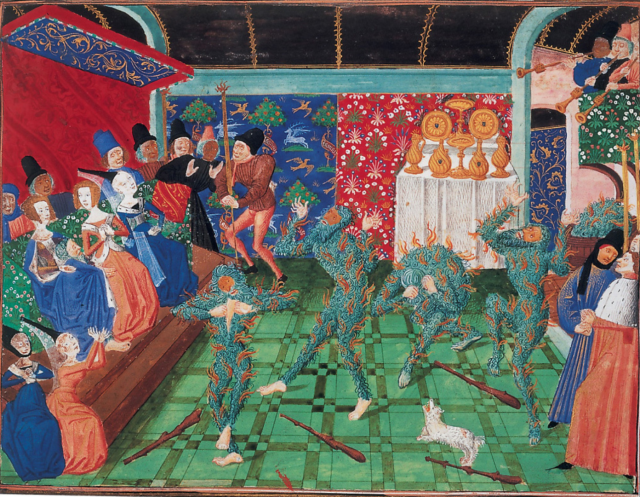


-
A young Koravian woman would gaze upon the stars in the night sky, though she was not the only one, a festive spirit was in the air all around Jerovitz as Koravian families gathered to gaze upon those gleaming stars that symbolized their culture so well, from the bounties of the harvest, the bringing of new life, to the changing of the seasons.
-
A smile graced the face of a certain "Rose" as she sat upon her saddled steed. Her gaze trailing along the herd of Koravian Grey's that would graze upon the grasses within Jerovitz, her scanning pausing for a moment as she spotted her father's mighty bull Šemík proudly meandering along the herd.
-
ISSUED BY THE COUNTY OF JEROVITZ c. [571] E.S. Courting is a staple of human life, a mainstay as most men and women will eventually find themselves seeking a life partner to marry and raise a family alongside. As with all cultures, the Koravian culture has its own traditions and quirks when considering the progress from intending to court to a lawfully wedded couple. Throughout this informative missive, we shall elucidate the various cultural traditions and rituals associated with a blossoming and developing relationship. From gaining permission to court one another, to the special dance that a newly wedded couple will do as their first dance together, the Koravian courtship culture is a strong one that places great importance on the bond between two people as they seek to marry. ⋅ ───────────────⊱༺⠀I⠀༻⊰─────────────── ⋅ A Koravian woman after having her courtship braid woven The true beginning of a relationship is the beginning of the Courtship, while some may get to know one another prior with the odd meeting to discuss various matters, courtship is the start that the Koravian people recognize. Courtship is rather strict, following all protocols of the canonist faith, prohibiting any premarital affections between two people to ensure the sanctity of the marital institution is upheld. Should this not be seen to be the case by the head of the Koravian house, the courtship shall be terminated. After seeking the approval of the woman’s head of house, the man shall make an item out of bull leather for the lady he is courting. This act is known as the Bond of Bulls/ve svyiez i bykin, a well-known and much beloved aspect of the Koravian courting culture. Most often this will be a decorative leather belt, however it can be a variety of things, so long as it is made by the man himself especially for the lady. The acceptance of this gift seals their bond and cements their courtship together, ensuring that they are considered bound in a union that may only be broken by the returning of the leather item. Upon the acceptance the leather gift shall be blessed by a local priest, so that the courtship is similarly bound by faith. The day after the gift is blessed and accepted by the woman, she shall be taken aside by the women of her family where they shall weave a braid into her hair. The braid may be as large and as elaborate as the family wishes to make it; however, it cannot be removed from her head whatsoever. To remove the braid prior to marriage would mean that the courtship or engagement is cancelled as the braid is considered to be symbolic of their bond together. Upon their marriage taking place, the braid will be cut out of the hair by the man and tossed into the fire, symbolizing a rebirth of the two as they become a happily married couple. ⋅ ───────────────⊱༺⠀II⠀༻⊰─────────────── ⋅ A Koravian woman picking the flowers planted by her and her fiancé A betrothal is of great importance to two families and the couple to be wed, and as such it is treated with delicate respect. Once both families approve of the union, they shall often come together in order to have a feast with one another, symbolizing that the two families are soon to become united through the nuptials of their kin. They shall break bread and drink together, getting to know and understand one another and their familial ways so as to respect them correctly. Once betrothed to one another, the couple shall search for fertile land at the home they shall share upon their wedding. There they shall plant a lot of flowers with two different kinds, each symbolizing their favored flower or one that is considered their familial flower. The flowers must bloom before their decided wedding date, and failure for such to occur foretells a poor union where they will not grow together as one. Once bloomed they shall harvest the flowers, some for the wedding and decoration, but a handful of both for their petals. These petals shall be tossed onto water, being watched for how they interact, it is the hope of that the petals shall float together for it signifies a strong relationship that shall only grow stronger. All relationships be them friendships, courtships or simple colleagues, should always be founded upon a basis of the utmost truth and honesty between all sides. A marriage, being the strongest relationship two can engage in, must always be founded on this basis, and as such the Koravian culture seeks to eliminate any secrets that the two may have between one another. The week before the wedding is to take place, the couple will sit down together with a bottle of vintage wine and delineate any secrets that they may have, whether related to one another or not. Only once all secrets have been told, and the two find themselves with a relationship founded on nothing but purest honesty, may they drink from the bottle of vintage wine together. However, should they fail to achieve this, or the secrets be considered a betrayal, the bottle shall be smashed, alerting any nearby of the ending relationship, ⋅ ───────────────⊱༺⠀III⠀༻⊰─────────────── ⋅ A newly married Koravian couple performing the Polka dance The day of a Koravian couple’s wedding is a momentous and beautiful occasion of which must be celebrated accordingly. The first thing anyone would notice about a Koravian wedding would be the several bouquets of flowers along the aisle of the church, made of the two flowers grown by the soon to be wedded couple. The intertwining of their stems and being wrapped together in a tight bow is done to show the interwoven fate and bond between the two people as they find themselves wedded. In ancient Koravian society, a couple would find it very hard to seek a priest for their wedding should they be peasantry, as such they would seek a local official, who would witness their vows and the rites that take place and then send a letter to the closest priest so he may bless their union. In contemporary culture, this is no longer done, however it has translated to a tradition that the family engages in, where a family member, chosen by both, will aid the couple in planning the wedding. While this is no longer done for convenience, it is practiced as a way to bring the family into the tradition and to show that the family is accepting of their new family member. Once the wedding has been completed and the two joined together in holy matrimony, the wedding party shall congregate together for the reception. A bonfire would be constructed of the branches of a Linden tree in the middle and lit so that it will be a raging fire for all to see. As bards begin to play, the couple shall engage in the traditional Polka dance, a lively and fast dance, which they shall perform around the burning fire for their family and friends to witness. The superstition is that a strong and well performed dance will show them to be a powerful and well-matched couple, however, should sparks come to harm the man’s wife, the man is suspected to be a poor protector to her. HER LADYSHIP, PRIMROSE EMELYA KORTREVICH, The “Rose” of Kortrevich JIRI BEDRICH NOVAK
-
ISSUED BY THE COUNTY OF JEROVITZ c. [571] E.S. The goal of this work is to describe the organization of an agricultural homestead and its equipment and function. One of the main units of the agricultural homestead was a house. We will focus on the ground plan, building material, wall construction, roofing, facilities and furnishing of such a house. The house together with a courtyard forms a connected system sensitively reflecting every change in living conditions of the living person. Therefore, the next task in this area is to find out what makes up the compound of an agricultural settlement, what kinds of yards there are to accompany it. How such a settlement functions, the agricultural tools and how animals are kept. Thus, contributing to a full understanding of aspects of the social and economic status of the people in our times. Manors are also part of a number of villages. These are mostly residences of the gentry, and in their organization, they are not much different from larger servile homesteads. Another reason why we will be referencing manors is the fact that agricultural production techniques used at manors are the same as those of servile homesteads. By surveying the manors and servile homesteads, we can cover the agricultural production of the whole Koravian village. The agricultural production is directly related to a croft, which forms the economic base of any village. Studying it will provide us with the characteristics of the natural environment and cultivated land. A grouping of all agricultural homesteads in the village together with a central common as its significant part forms the village ground plan. Besides homesteads, there are other important constructions in the overall arrangement of a village, such as a church, possibly a fort, a mill, a smithy and, in bigger villages, a tavern. ⋅ ───────────────⊱༺⠀I⠀༻⊰─────────────── ⋅ The evolution of village rural settlements has undergone a number of changes coming to a climax in our current century. The village is a basic unit of settlement, whose inhabitants make a living growing crops and keeping livestock. One of the major changes concerning the layout of the house is the study of early Koravian settlements. The continuity concerns size, function and furnishing of the interior. The single-chamber dugout as well as surface structure which do not radically differ in size are omnipresent. This tells us that there were no great social and economic differences in the early Koravian settlements. The key issue to be clarified is the process through which the single-chamber house has evolved into the three-part house and why these changes have occurred. The evolution of house layouts in fact plays an important role in determining the contemporary economic as well as social situations. The three-part house was created by the attaching of a hall to the single-chamber dwelling, thus creating a two-part house. The originally separate storage room was then attached to this two-part house. One may find constant study in the process of the enlarging of the single-chamber house by means of new rooms being attached along the lengthwise axis of the house. Single-Chambered A dwelling is termed single-chambered if it is one room equipped with a heating unit. It is important to note that single-chamber houses including dugouts have not disappeared, most predominantly found in the urban setting. They also often serve auxiliary purposes as well. Dugouts often serve as provisional measures and as auxiliary buildings. Apart from single-chamber dugouts there are also single-chamber houses built on ground level. Their layouts are designated by either stone walls or by a system of postholes. The floor is often paved with large flat stones. The heating unit found in the corners, sometimes they may even contain an oven. Though they will often be accompanied with a hall of a post construction type, in effect creating a two-part house along with a separate storage room standing in the yard. Two-Part Houses Houses with two basic parts - the chamber and the hall - continue this category. The chamber is the most important room and is equipped with a heating unit, usually an oven. The hall also serves purposes concerning agriculture. All two-part houses lack a storage room. Consequently, these houses lacking an auxiliary element are often considered to be the dwellings of those of a landless class, writings often regarding these habitations as huts. Three-Part Houses A house is termed three-part when it includes three rooms: the chamber, the hall and the storage room. The hall is accessible from the yard and is the central part of the house; one door leads to the chamber and a door on the opposite side enters the auxiliary buildings - usually a storage room or granary. Consequently, these types of houses are termed the three-part house of the chamber and granary type respectively. There are three distinguishable types of these houses. The first of which being the terraced three-part house which is a classic case of the house constituted by a chamber, hall and storage room or a multiple storey granary along a lengthwise axis. Some may also feature the three-part core to which auxiliary buildings are attached. Though rarely are the farm buildings on the chamber side of the house. The three-part house of a segmented two-wing layout also features the basic core, constituted by a chamber, a hall and a storage room or granary, but the rectangular layout is not only divided crosswise, but also lengthwise, creating in effect the so-called two-wing house. Narrow rooms are often located along the chamber, hall and storage room. Sometimes they may all give accessway to the cellar. Auxiliary buildings, especially stables, are attached along the lengthwise axis to three-part houses of segmented layouts in much the same manner as to terraced three-part houses. There are also atypical layouts, such as almost square ones where it is divided into four rooms and comes into existence through the process of inside segmentation. Where the other three rooms are accessible through the hall: the smaller storage room, which is built into the hall in its western end, the chamber itself and the storage room next to the chamber, which is akin to that of multiple storey storage rooms in other houses. A small cellar will be dug out into the weather-worn rock of the adjacent hillside as another accessible place for storage. Apart from layouts, buildings are usually constructed of stone, wood, red-fired daub along with building components and fittings along with roofing material. The largest mass of construction material is constituted by quarry stone, some of which is scabbled, especially that which is used for thresholds, portals, swivels for doors and bollards placed beside gates. The stonework in all houses comes from a local source. The prevailing type of rock is granite, used for a majority of all constructions. The stonework is laid directly onto the soil. In the construction of the less afforded people there will be no mortar to be used in construction, the width of stone foundations generally ranges from sixty to ninety cm. The walls are faced on both sides. Larger quarry stones are used for the two faces while the middle is filled with smaller ones and dirt. Stones for quoins are chosen on account of their size and their shape which has to permit the attaching of the wall masonry in between corners. The height of the walls varies according to their function: they could either be underpinning for a log construction or a building constructed entirely of stone. In the latter case the height of the walls may reach two meters. Buildings which are fully built of stone are represented by multiple storey granaries. Stone thresholds are found in the entrance doors of houses and the doors to individual rooms, often equipped with a threshold of two pieces of scabbled stone. The entrances to houses are lined with large flat stones. An important part of the entrances are doors. Their swivels are placed either directly into the stone thresholds or in separate swivel stones. Doors are made of vertically oriented planks held together by massive iron bands with hinges at one end. This type of door is suspended on massive masonry fixings. Besides the masonry fixing, the other important part of the door is the mechanism which ensures the locking of residential and auxiliary buildings. Three types of keys are included: a hook type, an insert type and a turning type. There is also a number of keyhole fittings, padlocks, door handles, latches and hasps and staples. Locks which are an integral part of the door are also found by iron latches or in stone jamb modifications. Wood is also an important construction material. Widely used woods are majority pine, though included with spruce, rowan and aspen. Coniferous trees are used more widely mostly because of their straight-grained wood. The chambers are usually constructed of timber, along with shreds of daub within the chambers. This is used for pointing - filling in cracks between beams and for wall daub. Wood is used for thresholds, frames etc. Wall daub is used for curbed walls of two kinds: those with round impressions are used for whole logs while ones with straight imprints are constructed of beams. Ceilings are to be found in most houses, especially within the chamber room. Which will make use of ceiling daub, which falls in together with the wooden ceiling construction - usually of a staging type. The heavy ceilings are supported by wooden props which are placed in the middle of the room. Set in by flat stones, or by post holes in the case of farm buildings. The layout of houses often is created with the use of gabled roofs. Though they may use either a rafter or clasp type of construction. The roofs are covered by straw thatch, although ridge tiles are used as well. The Chamber The central room of the house is the chamber. It is there that the most important equipment in the house is situated - the heating unit. These are primarily ovens, they usually have a rectangular horseshoe-shaped, pear-shaped or circular layout. The rectangular ovens usually have a low wall enclosing area of the oven and are usually block-shaped. If the layout is horseshoe-shaped, pear shaped or circular, the body of the oven is usually dome-shaped. Ovens are usually placed in a corner of the room along the wall separating the chamber from the hall. The bottoms of ovens are lined with small stones - usually quartz, or with shreds of pottery and finished with a layer of fine clay hard fired to colors ranging from a variety of shades red to a black, grey hue on the surface. There will generally be several layers of clay daub located at the bottom of an oven. The body of the oven itself is a dome or a block, created by a wattle-and-daub construction. The ovens are relatively large; the oven in the chamber of houses may generally fill almost twenty-five percent of the area of the room. Fireplaces are situated before the mouth of the oven - the fireplace bottoms are daubed in the same manner as the bottoms of ovens and are on the same level. The space of the fireplace itself is enclosed by large flat stones placed vertically. The space before the oven is daubed with clay and lined with stones as well. A small stone oven may be bridged over by a large stone slab, which can be used to keep food warm or for heating water, etc. They are usually bordered by two flat stones. An important fact is that all ovens are handled and fueled from inside the chamber. The fuel burned in ovens as well as in fireplaces was wood. The charred remains of it are found in all homesteads. The types of wood used included pine, fir, birch, oak, hornbeam, maple, elm, lime, alder, polar, aspen, and cherry. Pine, birch, aspen and maple were primarily used for fuel. Most villages prefer the use of light-demanding trees like birch, aspen, pine and spruce. The alder is also widely used for fuel. The connected fireplace and oven within the area of the chamber tells of their respective roles in the functioning of the household. The fireplace was used for preparing meals. Tripods served the purpose. Hanging kettles, which could be used for cooking out in an open fireplace are not to be found within the chamber, pots with loops and handles along the rim are used instead. The oven is primarily a source of warmth and is used for preparing meals that require baking. Particularly this means the preparation of breads. Only a minority of the poorer housing would have any form of smoke management, though because of the absence of post holes in the immediate proximity of the heating units it is possible to augment such with chimney hoods, which may be suspended above the oven and fireplace. Though those of the gentry who occupy manors may be fortunate enough to install stoves in replacement of ovens. Having both an oven and an open fireplace in front of the oven in the chamber allows for preparing meals in the open hearth as well as baking in the oven. An important piece of equipment in the homestead is the tripod with a hollow handle; a wooden handle can be inserted into this, and the tripod can be placed directly into the fire. Floors in chambers may often be made of packed earth. Though some may feature a floor of clay daub or a lining of flat stones. Ceramic articles are an important piece of equipment in the chamber, including pots of various sizes, lids, bowls, pitchers and cups. Beside ceramic ones, the chamber is also furnished with wooden vessels and utensils: pails, bowls, plates and spoons for eating. They may also own tin utensils or a small tin kettle. These dishes are often stored on a shelf. The pails may stand on the floor next to the oven. Some furniture may also be included: a table, benches, bedding, in some cases also cabinets. It is also possible to sleep on the oven. Chests are used to store dresses, shirts, comforters, tarps, towels, tablecloths, undershirts, woolen jackets, leather trousers, rabbit skin coats, sheets, Koravian skirts and scarves. And are often fitted with lock and key. The Hall The middle part of the three-part house is the hall, accessed directly from the yard. The hall is primarily a passage into both the chamber and the storage room. Its size, however, may allow the allotment of a workspace. Especially in the larger hallways of those living in better conditions. That may feature hallways that range from forty-five to almost fifty percent of the total house area. Though in areas living under worse conditions the halls are often much smaller than the chambers. Some halls may feature two entrances - one from the yard and another from the common. This will often imply its higher status within the village. The only items of interest regarding the furnishings of halls are stone beater mills found in the more affluent of homes. This is a tool used for the hulling of grain, i.e. for obtaining hulled barley and millet. Sometimes halls are illustrative cases of a fireplace situated in the corner of the hall at the wall separating the hall itself and the chamber. In these cases, the fireplace is moved because of a lack of room in the chambers. Though sometimes it is done with the intentional purpose of separating the fireplace and the oven. Though this may also be an Auvergnian influence on the Koravian house that still lingers. Torches are used for lighting the interiors but are being replaced by lamps to prevent fire. Burners are standard equipment in a Koravian homestead. Iron lamps are used alongside ceramic ones. The third part of the three-part house was the storage room, or a garner or granary. The storage room is not heated and commonly is the smallest part of the house. It is used for storing foodstuffs, tools and other equipment necessary for running a household. The furniture of a storage room consists of chests for storing clothes and chests to keep flour in. In the storage room of manors, they will often also house the weaponry that pertains to that house. Which may list such things as an iron crossbow, a jack for the crossbow, a sword, spurs, a halberd, a neck-collar, a rapier, lances and front body armor. Along with items such as daggers, arrowheads used for both bows and crossbows, cocking hooks for crossbows or even stirrups for cavalry. The floor of the storage room lay on the same level as the floors of the chamber and hall. The three-part dwelling, whose third room serves as a storage room is termed a chamber house. On the other hand, in case a granary is adjacent to the hall, its floor is sunken below ground level and in consequence was a multiple storey room. A three-part house of this construction is termed a granary house. The existence of storage rooms and granaries indicates that the storage room is used for different purposes than the granary. Because granaries are fully built of stone, they offer better protection in case of a fire. Granaries are used to store a vast quantity of grains, buckwheat, peas, flax seed, poppy seed, millet, foodstuffs like bacon, smoked meat, cheese, pots of butter and honey. Though they may also double as temporary living quarters for spending the first winter. Or the solution to the coexistence of two families - the farmer and the old parents - under a common roof. Cellars Cellars form part of the homestead. The underground rooms are usually situated outside of the layout but are accessible from the hall or from the chamber. The cellar itself and the hallway leading to it are lined with stone. Generally accessible from the hall by means of a short ramp-shaped hallway. There would be a recess in a sidewall. The walls are hewn out and halfway along each lengthwise wall there are post holes which prevent the ceiling from falling in. The cellar is accessible by means of a staircase from inside the house. The walls of the passage are lined with large flat stones. Though the most affluent may have a ramp-like entrance with stone sidewalls led into a masonry-lined passage with a barrel vault ceiling. This passage placed along the lengthwise axis of the house wouldn’t be straight, but is angled at a right angle into a hallway which is somewhat wider, from which the passage then leads in the direction of the transversal axis under the whole breadth of the chamber and into yet another wider room, which has the barrel vault ceiling that takes up all the space under the chamber alongside the perimeter walls and all the way to the gable. These vaulted rooms are divided in two by a wall with a doorway. This type of cellar is unique in a rural environment, showing the special status of such homesteads. Some sidewalls may not be reinforced by stone, but by a lining of timber to prevent them from sagging. Lighting is provided for by torches or even lamps, which are placed into nooks near the ceiling. Round vents are placed in the hallways, functioning as ventilation holes. The underground area itself can be closed off from the entrance hall by a door, which can be fastened by means of a latch which leaves distinct marks in the sidewalls. Cellars undoubtedly have a practical use and are used for storage of foods which have to be kept cold, such as milk, cheese and meat. Auxiliary Buildings Apart from the house itself, farm buildings form an important part of the homestead, the Koravian homestead consists of sties, stables and cowsheds, barns, garners, haylofts, grain dryers etc. This cluster of buildings has to be enclosed. Sties, stables and cowsheds play an important role in the homestead. The development of agriculture was and is closely linked with the role of the horse and what the horse required was a stable. Although cattle, sheep and pigs could spend most of the year outside, they also had to have a place to spend the wintertime. Large homesteads have several stables or sties for different animals. In the case of single-span homesteads the stable was placed right next to the living quarters, but in all cases the stables were accessed by separate entrances from the yard. With most other types of yards, the stables and sties are opposite the house. Other kinds of stalls for livestock besides stables are also to be found within the yard. With the location of a stable one may notice the discoloration of the soil, the so-called “fat clay” and the depth to which the discoloration has penetrated the subsoil. Stone-lined channels for draining away dung-water have also been built. These channels lead from either the stables or stie itself or from its immediate vicinity. The sizes of stables differ, some are wooden structures with thatched roofs, plank or wicker walls; these are structural elements which are common in Koravian design. There are several reasons as to why stalls and sties were established in the homestead. Cattle stands for wealth and so it is necessary to guard it from robbers as well as from wild animals. Production of manure is no less important; in the case of cows and sheep also the production of milk plays an important role. With the introduction of traction, the horses and cows concerned have to be at hand in the yard. There are no cases of a stable accessible from inside of the hall of a house. Up till the recent century, structures called “klet” are noted as being a part of the settlement. Though within our own current it is noted that these have become a third part of the tripartite house or an isolated structure within the yard. In the case it is turned into a part of the house it has become a multiple storey storage room, if the structure remains isolated or integrated among the other structures of the yard it is called a granary or garner. Klet is an old Koravian term most likely meaning granary. The ground plans may also include “cuts” which lead into the sunken parts of a granary. These are called “šíje”. They are usually placed at the center of the walls facing the yard. The “šíje” of the granary in the homestead may be curved at an angle at the end. Floors of the “šíje” are ramp shaped. Above ground levels of a granary are constructed of stone. Postholes, stone thresholds and other works of masonry, along with doors that opened on the inside. Separately standing granaries must have a “šíje” sheltered by a covering, especially when the “šíje” was a long one. Granaries differ from semi-subterranean structures in that they have a ceiling. Barns While barns built on manors are of stone and have shingle roofs, those of the lower status have ones made of wood and covered with straw. The barn has two main functions associated with growing grain: it is a dry place to store unthreshed grain and it then serves as a covered threshing-floor to thresh it. They are often the targets of bandits or the first to be damaged or destroyed in quarrels among the landed gentry. The basic criterion is a passable threshing-floor. Generally taking up a whole of one side of a yard - the side facing the garden and fields. The walls are generally made of logs, though in some cases stoneworks. Haylofts And Sheds These are necessary in the homesteads for storing agricultural equipment, especially wagons. Though they are also lean-tos where hay may be stored. Often located just beside the barn, they are often stored with all the basic farm equipment necessary for both growing grain and for keeping livestock. The Shaping of the Agricultural Homestead The homestead is a general term for an agricultural estate. The homestead as an agricultural unit contains not only the house and the farm buildings, but also the fields, the meadows, the garden, the forest and in regions where wine is grown also the vineyard. Some claim that the formation of different types of agricultural homesteads is connected with the ethnic and tribal peculiarities among the population. Settlement geography perceives the agricultural homestead as a unit and its functionality as that of an agricultural whole. The development of individual homesteads of the normed type in the present-day Jerovitz can be dated back to the influences of the “Auvergnian yard”. The so-called Auvergnian yard type of gothic homestead has become a part of the Koravian village. The Auvergnian yard has been preserved in the places where it developed along with the Waldenian populace. Within Jerovitz it is mainly located within the Karoswood. Single-chamber dwellings grouped in an arc- or horseshoe-shaped layout surrounding an open area, which formed the common yard. As far as farm buildings are concerned, grain pits are to be seen in these settlements. These are usually close to the dwellings and are used to feed the family, while others in the common yard contain seed grain. As land cultivation is a communal activity. Early Koravian settlements in Haense were of agricultural character with an autarchic economy. Research of the earliest phase of settlement in Markev has shown that the importance of the family within the village community gradually grew. There is an emphasized importance of the family in the development of the enclosed complex of farm buildings, the time of origin as “from time immemorial, as soon as the family began to live economically”. The courtyards in individual homesteads, beside houses the yard also contained stables, several “klet”, a threshing floor and several grain pits. The grouping of buildings within the yard is the oldest evidence of the collective or type of yard in Jerovitz. Entrances into underground passages are located outside of the yard and are common for several families. This led to the development of gentry land ownership and to their rights of ownership of land and serfs. In this way new requirements regarding the social system and rule of court came into existence for the control of the rural population. According to the area of individual yards the homesteads may be divided into two groups: homesteads with yards over four-hundred meters and homesteads with yards under four-hundred meters. Yards are bounded by a wall of masonry with gateways and small entrance gates on the side facing the common. The basic type of the regular yard is the one-wing yard, where the farm buildings are connected to the house along a longitudinal axis. An important characteristic of living quarters as well as of farm buildings were separate entrances into the farm buildings directly from the yard. Another type of building arrangement is defined by buildings standing on opposite sides of the yard. This type of yard is known as two-wing, parallel or paired. Both of these types of yard layout are to be found throughout Haense upon inspiration from their Koravian equals. Now that the different kinds of yards encountered in Koravian villages have been defined, several questions appear. The shift from a collective homestead to a regular grouping of residential and auxiliary buildings within one yard was due to a change in the economic situation after the second half of the last century. Theories advocate the spreading of normative types of yards, especially, the so-called Auvergnian yard type by means of Waldenian migrations. A second issue is the evolution of the various yard types. All basic types existed throughout the last century, along with several types were to be found in one place: all types were to be found in Jerovitz. The type of development was largely determined by the size of the settlement. Half-yardland homesteads were of the one-wing type yard, while more complex types of yards with more farm buildings corresponded to one-yardland homesteads. As far as our current time is concerned, it is impossible to delimit regions by specific types of yards occurring there. If we are to compare earlier theories with the evidence produced by that the Auvergnian yard spread into the present-day Jerovitz, that the house with the hip roof is of the Old Koravian origin and that the shift from the side orientation to gable orientation is stated in the last century, that the spreading of the gable design among rural buildings has only started within recent decades during the leadership of the Kortrevich Greats, it may be plainly discerned there is a lack of archaeological sources. Ethnographic Analogies If we were to compare the types of agricultural homesteads ascertained to date with maps, we will come to the conclusion that yard types have not experienced any significant changes since the arrival of the Koravians to Haense. Irregular yard types with free-standing buildings can be found in the rural parts of Jerovitz within the Karoswood, settled by shepherds. By far the most numerous in Jerovitz, however, are yards which feature the house and auxiliary buildings spread out around its perimeter. The one-wing yards with a gable orientation towards the common can be seen just along the hillside along the Karoswood, overlooking the valley where the River Lahy flows. Attempts at tracking the development of settlement types throughout history up till the present day are futile when lacking archaeological sources. The most important issue regarding rural architecture is the question of continuity or discontinuity. While current standing villages are evidence of continuity of development regarding village settlement. It is difficult to find deserted villages for excavation of Koravian origin. The only few to be found are of old Waldenian origin prior to their movement to the establishment of Reinmar. ⋅ ───────────────⊱༺⠀II⠀༻⊰─────────────── ⋅ The agricultural homestead is the basic unit of agricultural production. For judging this production, it is necessary to start with the area of the fields, meadows and pastures belonging to a homestead. All other factors, such as the number of animals and equipment, are derived from the area. The unit of area is the yardland. Its real area is not standard but rather fluctuates according to the value and quality of the land and also to the whole amount of land that the village has at its disposal. An average yardland has an area of about eighteen ha. Ploughland can end up having an overall area of one-hundred and twenty-four ha of arable land and over two-hundred ha of meadows and pastures. One of the most important pieces of equipment for tilling land is the plough. This means a land plough, which has an asymmetrical iron ploughshare and an iron coulter. A plate that dumps the soil to the side is featured as well. The wooden shaft rests on wheels and is connected to these by means of an iron axle pin. A plough staff completed the fitting. This is used for scraping off soil from the ploughshare. Oxen or Horses provide for traction. The homestead not only uses the plough, but also the wooden plough. These sweeps had sockets for attaching to a spade or an axle guide stay. Ranks among handlebars may be considered a special type. V-sweepers can also be a part of the handlebars for a plough. Wooden harrows with iron spikes are used for finishing the ploughed field. They are to be found in all agricultural villages in Jerovitz. Hoes and spades are also used for fieldwork. There are two types of hoes identified. Narrow ones - grubbers or grubbing axes. And the second type - known as pronghoes. Spades are made of wood and fitted with a sharpened iron blade at the edge. An important event in the life of a Koravian village is the haymaking time and the annual harvest. The tools necessary for the jobs associated with these events are scythes, rakes and hayforks. Whetstones used for honing the scythes, an important procedure is also hammering the scythe out with a special scythe hammer. On a stock anvil, which is a head of iron on a pedestal onto which the scythe is laid when being hammered out with a scythe hammer. Other tools needed for haymaking are wooden rakes, along with double-pronged hay forks are used for loading hay. The most frequently used tools of the harvest are sickles. They are the basic tool of every homestead. The mowed hay is tied into sheaves and when dry is carted to a barn or an “oboroh” which is a Koravian term for hay racks. A chaffcutter is used for cutting straw into chaff, which is fed to livestock. Grass, which is mixed with the chaff, is also cut in this way. A chaffcutter is a simple wooden box with four legs. The important part is an iron knife with a “spike” for attaching a handle at one end and a round hole at the other. The knife in question is attached onto the bottom part of the front part of the box in such a manner as to enable moving the blade up and down, thus cutting the hay. A wooden handle is attached to the aforementioned “spike”. The right front leg is longer to prevent the box from moving from side to side. A Waldenian leaflet depicts the cutter has a crosswise beam, protruding on one side and thus enabling the connection of the bottom part of the knife by means of a round hole. For processing flax homesteads are equipped with iron hackles “which chafe the flax”. These hackles are used to rid the flaxen fibre of any ligneous remains. There are also often numerous ceramic spindles for processing flaxen or hempen fibre further on into the process. A homestead is also equipped with wagons for carting hay and grain: the so-called wains which are fittings for the wagon when carting hay or grains. They’re fittings of axles, hubs, poles and wooden stakes. A wain is also equipped with a number of axle pins. There are several types of wagons one may list in their inventories: a wooden wagon, wagon platforms, twined baskets for manure, an iron-fitted wagon, etc. Grain stored in a barn or in an “oboroh” is threshed with flails during the wintertime. Homesteads in wine-producing regions are also equipped with vine pruning knives. A number of tools in the agricultural homestead has much to do with raising livestock. Stables and sties are equipped with pitchforks and hoes for manure. Along with for the purposes of horse breeding which may include horseshoes, bridles, stirrups, spurs and various parts of harnesses such as collars and traces. Stables are also equipped with currycombs. Besides tools for expressly agricultural and livestock-keeping purposes, homesteads also held tools for everyday use such as axes, saws, chisels, pliers, drills, hammers, scythe hammers, drawknives, augers, wedges, chains, etc. Stone tolls are also found often in cases such as the beater mill which is used for husking grain, usually for obtaining hulled barley, millet and buckwheat. The beating in a stone beater mill is done with a wooden mallet called a beater. Besides the beater mill, stone mortars are also used for grinding the seeds of oleaginous plants, these mortars are made of non-calciferous Ruskan sandstone. Stone grinding disks have a central square-shaped hole for attaching to a wooden axle. The Economy of an Average Homestead Any analysis of the economy of an average half-yardland vassal homestead takes into account so many unknowns such as soil condition, climate and unpredictable events in the life of the farmer or the livestock. Yield of the crop often has a ratio of 1:3. The yield generally being about eight hundred to one-thousand kg from one ha. If we take into account the total area sown, the total yield can hit six-thousand four hundred to eight-thousand kg of grain. The individual kinds of grain in a half-yardland homestead within Jerovitz can be a wide variety, though the most notable are to be named as Oats, Rye, Wheat and Buckwheat. Along with other crops such as barley and peas. Oats are a staple feed for livestock. A homestead with four horses will generally feed about five hundred to seven-hundred kg of oats per horse per year. Rye, wheat and buckwheat are used to feed the family. These grains altogether meant two-thousand three hundred to two-thousand nine-hundred kg, which is enough to feed a family of seven to ten for a whole year. On condition that the family only has six members, five hundred to one-thousand kg is left either for sale or as a reserve in case of a poor crop. Some grain is also consumed by poultry. Besides grain only, livestock is an important source of foodstuffs. Six to eight cows need about ten ha of meadows and pastures. Cattle are not only important as a source of meat, but also of milk and - last but not least - of manure, produced during winter stabling. Average yearly milk production of one cow is around six-hundred liters. Five dairy cows means that the family would have three-thousand litres of milk yearly, i.e. almost ten litres per day. Cream is collected off of the milk for butter production. Sheep’s milk is used either for making cheese or for feeding pigs. During the warmer months of the year pigs are left to fend for themselves in the woods, but in the winter, they have to be kept in sties. Pigs are mostly for meat and lard along with for sale. Poultry is also a significant source of foodstuffs. A half-yardland homestead may generally keep twenty to forty chickens, along with some geese and ducks. One hen is expected to lay about one-hundred eggs per year. If there are about twenty layers in the homestead, the family would have about four-thousand eggs per year. If the family consumed one half of this, almost two-thousand eggs would still be left to be sold. Geese are kept mostly for their feathers. This analysis of the economy of a half-yardland homestead shows that a family's sustenance is fully provided for. There is enough grain, meat, milk, butter and eggs. Moreover, weather conditions permitting, there is actually a surplus, which can be used to pay taxes, purchase tools and other equipment. The situation in one-yard land homesteads is even more favorable. It may be safely stated that the standard of living in one-yardland homesteads is evidence of a relatively good economic status of the people within Jerovitz and Haense as a whole. Manors within Jerovitz Within the Koravian village the manors hold a unique position both regarding architecture and layout. They also play an important role in the economics of Hanseti-Ruska’s society. We are given two terms: a ‘court’ for the residence of a prince and a ‘courtyard’ for a complex with residential buildings as well as auxiliary buildings such as stables, barns, granaries, haylofts and oast houses. For the purpose of further discourse, I will use the term courtyard. This term is always used for a manor with residential and auxiliary buildings. The term ‘court’ comes from the Koravian language. Likely derived from the ruling family of Kortrevich. There are also places termed Velkolepý Manor where they did not function as producers of agricultural products but rather served as centres for their accumulation within the Koravian lands. The “court” is enclosed by a log stockade, there is a number of residential as well as auxiliary buildings and it serves as both a residence as well as for representation. The right-angle shape is reminiscent of the Auvergnian agricultural homestead. Though now often sport Churches built in following of Koravian influences. Within the last century, manors have started to become a standard part of a number of rural settlements. These courtyards are centers of agriculture for the gentry. Individual buildings are situated along the sides, so that the yard itself is enclosed on all sides. Places along the perimeter with no buildings are closed with stone walls. The north side is occupied by a three-part house, the western by laborers’ quarters, a stone tower and the main gate. On the other side of the gate there are stables for horses and cattle. On the side facing the walls there is a blacksmith shop, two smaller stables and sheds. New structures will often be attached, such as a chamber, a kitchen and an oven for baking bread. Auxiliary buildings like the already mentioned blacksmith shop or a sheepfold. The yard is also enclosed by a stone wall. A new type of auxiliary building was also built: the brewery. Breweries become the most profitable enterprise within the scope of the economy of scale. The residential type of manor usually functions as the owner’s residence or serves as a base for supplying the residence - sometimes that being a fortress. Entrepreneurial manors do not have to be the owner’s residence but are at least situated on land which he owns. Ploughland An inseparable part of every rural settlement is the ploughland, i.e. the management of land used for agriculture. The village itself is usually situated in the centre of the croft. The immediate connection of the houses and estate is a basic trait of every village and rural settlement. Consequently, one cannot just focus solely on residential and auxiliary buildings, but must also take into account the adjacent fields, meadows and pastures. The croft is the economic foundation of each village. Its shape was delimited by the lay of the land as well as on the manner in which land ownership is distributed in the particular village, thus several croft types are distinguished. The documentation of crofts in the Karoswood has found that in the hilly forested terrain the crofts have formed into a segmented type. Two to three additional tracts are situated along the croft base, which corresponds with the three-field economy. Beside the croft base, there is also a tract type of land, which features narrow strips of fields. The lower classes have fields in all tracts. Because the tract land originally had no paths at first the peasants had to work simultaneously. This type of fieldwork is associated with the three-field economy, because the croft is divided into three parts, which are alternatively sown with the spring crop and winter wheat and then left as fallow land for a year. Such crofts only took hold for the Koravians upon the joining of Haense and innovating upon their already established institutions. All of the changes taking place in the rural areas of what is now the County of Jerovitz have impacted the arrangement of the ploughland. Particular pieces of evidence are provided by the crofts which have adjusted in such a clever manner that - with only minor changes - its main characteristics have started to spread across Haense. One of such being the introduction of a new type of field with the arrangement of a rectangular field. The new field provides all farmers with a necessary share in each tract. In accordance with the three-year cycle strategy the fields are divided into three tracts whose functions shift every three years: spring crop, winter wheat and fallow. The rectangular field is also advantageous for ploughing with the new plough with an asymmetrical ploughshare, which not only cuts the ground up but also overturns the soil. Oxen and Horses provide the traction. An animal-drawn plough enables the farmer to cultivate larger fields. Furthermore, it makes the process more thorough than it was during the first arrival of the Koravians to Markev, when their only tools were wooden ploughs with small sweeps. This century has been a turning point for the villages not only as concerns the equipment of individual homesteads, but also regarding croft arrangement. This economic and legal reorganization, while having started within the Koravian led lands of Jerovitz, is now an omnipresent function of lands across Haense, thus making the study and documentation of the croft an inseparable part of rural settlement. HER LADYSHIP, PRIMROSE EMELYA KORTREVICH, The “Rose” of Kortrevich
-
A woman lost in her own study and writings would pause from her work. As another publicized work from her sister would arrive upon her desk as a large smile formed upon her features, pushing aside her books on agriculture and cuisine, as she'd lean back in her chair and admire the Heart of Kortreviches work.
-
Primrose Kortrevich would become a giggly mess of delight upon receiving the personal invitation to her girlhood best friend's celebration. She would end up cooped within the kitchens of Jerovitz... If one were to walk past, they might catch a whiff of pomegranate filling the air!?
-
The bubbly Primrose would let out a delighted squeal upon the announcement of the wedding. "Let's go Drima! Let's go Drima!" She'd exclaim excitedly with use of the tokened nickname of the two to be wed.
-
ISSUED BY THE COUNTY OF JEROVITZ c. [567] E.S. Leatherworking has a long and storied history spanning countless generations of artisans and craftspeople. From small villages to bustling cities, the creation of leather goods has been an integral part of communities for centuries. This ancient craft connects us to the past while continuing to thrive in the present day. We as a people rely on animal hides for warmth and shelter. Leatherworking provides crucial protection against the elements for societies. For centuries, leatherworking has been about creating practical items for daily use. Leather is often fashioned into utilitarian objects like shields, waterskins, harnesses, and storage pouches. Skilled artisans' hand-stitch functional leather clothing, belts, and sandals. Beyond basic necessities, leatherworking is continually evolving as an art form. These decorative touches include the likes of woven leather, gold ornamentation, and jeweled accents. Along with embossed leather for book covers. Artisans have experimented with new methods like dyeing, gilding, inlaying, and Koravian leather stamping. ⋅ ───────────────⊱༺⠀I⠀༻⊰─────────────── ⋅ On Leather The process of making leather hasn’t changed much over the centuries, however the process of leather production is lengthy and complicated, relying on skilled artisans known as tanners, to turn animal hide into a valuable product. Fleshing This process turns a raw, unruly hide into a workable material. It is important to determine the hide’s top and bottom. If it still has its tail, identifying the bottom is straightforward - the tail is at the bottom, and the neck is at the top. This distinction matters because, beginning with the neck facing you makes fleshing a lot easier, because removing flesh goes more smoothly when you work your way down from the neck. To begin the process, firmly pin the hide under your body, using your weight to keep it steady and with a sharp blade begin cutting in a downward motion, scraping the flesh from the hide. You do not want to move sideways as that will lead to gouges or cuts in the hide. Curing The process of curing prevents putrefaction by preventing bacterial growth on the hide between procurement and processing. It greatly reduces the moisture content of the hide. The hides will be heavily covered in salt before being left out to dry. This will also lead to the hide stiffening as a result. Soaking Once the hide has been cured, it is left to soak in water for several hours - sometimes even days. The objective in this step is to rehydrate the hide, as well as to remove any excess salt or dirt. Liming After soaking, the hides and skins go for liming. This means soaking the hides in a drum or pit filled with milk of lime, an alkaline solution. Liming results in the removal of natural grease and fats as well as keratin and hair. It also causes the swelling and splitting of fibers to the desired extent and prepares the collagen in the hide to a condition that is ideal for tanning. Deliming This step is where the alkalinity of the hides is reduced by adding acids to the hides in the drum or pit. The swollen fibers of the hides shrink once more in preparation for the bating process. The deliming process takes around two hours for cattle hides. Bating The process of bating involves adding enzymes to the hides to soften them, this process will lead to the now shrunken hides to flatten and relax. Pickling After bating is the pickling process, which involves treating the hides by salt and then acid. The salt prevents the adverse effects of a sharp increase in acidity from the acids used in pickling. This process is important as it prepares the collagen to take in the tanning agents fully. Tanning After the preparation stages comes tanning. There are many ways to tan hides, but the end result is that the hides will not putrefy and are ready for dyeing and other uses such as manufacturing goods. The most often used of these methods is vegetable tanning, it is where you take the tannins from the bark and leaves of trees and plants. After the preparation phase, the hides are placed in the tanning pit, where there are drums containing tanning solutions of various strengths. Over a period of two to three months, the tanners move the hides from drum to drum, with the solution getting progressively stronger. The tanning agents soak into the skins and the fermentation and deposition process leaves the hides with a distinct color and appearance. The use of vegetable tannins will have a distinctive sweet, woody fragrance that is normally associated with leather. Another method is brain tanning which is a labor-intensive and specialized way of tanning hides. It is usually practiced by hunters to preserve the hides of fresh kills. Animals such as deer, elk and moose have enough acids of the right type to tan their own hides. The process varies from person to person, but the method involves first cleaning the hide thoroughly by scraping off the flesh, fat and membrane covering the inside of the hide. After this, the tanner washes the hide thoroughly, wrung and stretched on a frame. A tanning solution, made by mixing warm water and the mashed-up animal brain, is applied by rubbing it onto the hide. Once the hide is ready, it is smoked to complete the process. Once a pelt has been tanned, it is now considered leather. ⋅ ───────────────⊱༺⠀II⠀༻⊰─────────────── ⋅ Shoemakers Shoemakers are a well-respected trade within society, Cordwainer is the title given to shoemakers, while Cobblers are those who repair shoes. All shoes are made from a wooden mold from which the shoe is fitted and stitched over. Wealthier families pay cordwainers to keep wooden molds per each family member's footing. Cordwainers and Cobblers without established shops often travel from town to town, exchanging shoe repairs for room and board, along with circulating news and gossip. Many families will apprentice a son to a Cordwainer or Cobbler, so that shoes and repairs could be made with little cost. Boot making is the most sophisticated and prestigious branch of the trade, Riding boots and Jackboots are made especially for those of the warrior class. They’re not intended for walking, as the tight leather around the calf makes it easier to feel and control a horse. Mules are a type of slip-on, generally used for walking around inside. But some versions of mules are made to slip over the shoe to protect it from mud or muck. Patens, usually made for women, are clogs with wooden soles intended to increase the wearer’s height or keep them out of the mud. A recent innovation by the Koravian Cordwainers is the high-heeled shoe. They require a modification in design, the shank in the arch of the shoe needs to be strong and stiff enough to keep the shoe from collapsing forward, while the sides of the shoe need to be molded so that the foot does not slide down into the toe area. Due to their intricate design, only the wealthiest find it feasible to acquire this style of footwear, along with are adept enough to hide the discomfort of wearing this symbol of style over comfort. Girdler An occupation heavily ingrained within Koravian culture, most notably in aiding those who seek to complete The Bond of Bulls. A ritual in which a man must produce a decorative item made of bull leather to present for the woman he desires to court. Belts have transformed from a strictly utilitarian item to a fashion accessory. Leather is the most popular belt material due to its ability to withstand being bent, folded and tightened without being damaged. Pouches to carry objects, such as coin purses, scabbards and a list of many other things can be attached to belts and used instead of a garment’s pockets. Buckles were almost exclusively worn by the wealthy. It wasn’t until recent manufacturing techniques have made it possible to produce them through Moulds allowing them to be made available for the general population. A conventional buckle has a frame, a bar, and prongs. It’s reliable rather than aesthetic. If a buckle consists of two separate pieces, one with a hook and the other with a loop, it’s actually called a clasp. Clasps cannot be adjusted easily. A trim or slide is a buckle without a chape or prong. This type of buckle is used in home dressmaking and purely for decoration purposes. Saddler A vital occupation in revolutionizing how our societies would be able to grow from a small collection of towns to vast Kingdoms with metropolises like New Valdev. Horse saddles are more than just functional equipment; they are a testament to centuries of innovation and refinement. A nickname given to this vital component in developing transportation, agriculture and warfare is the “Seats of Empire.” A saddle tree raises the rider above the horse’s back and distributes the rider’s weight on either side of the animal’s spine instead of pinpointing pressure at the rider’s seat bones, reducing the pressure on any one part of the horse’s back, thus greatly increasing the comfort of the horse and prolonging its useful life. Within recent centuries the saddles were improved upon, as the Marian Retinue needed saddles that were stronger and offered more support. The resulting saddle has a higher cantle and pommel, to ensure prevention of the rider being unseated during battle, when riding in these war saddles, the leg is really close to the horse, as the upper leg is not impeded by a broad tree or lots of padding and leather, yet the surface area in contract with the horse is large. A surprising factor with these saddles is how light they are, around half the weight of a regular saddle. Which is a needed bonus with the already added weight of generally large riders wearing heavy armor. They’re padded with wool or horsehair and covered in leather. It has since received modifications for use in tending to cattle as well as Koravian bullfighting. Though in the lands of Koppány, historically a semi-nomadic and semi-militarized people, have formed their own unique saddle culture. The Koppány saddle is a simple and strong design. They do not need integral padding and can be left as just bare wood; it sits on several layers of wool or fur to protect the horse. It does not need breast or breeching straps, although they may be of use over long distances and rough terrain. The horseman's shanks stretch back, and he raises considerably higher over the horse’s back. The influence of the legs over the horse is much less. As a result, the riders of Koppány manage their horses mostly by means of the bridle, the bending of the body and the whip. When standing still or cantering they put little weight on the stirrups, however, at a trot they have to lean forward, bend their legs more, pressing against the stirrups. At a gallop one almost does not need to press against the stirrups, and the rider sits deeply in the saddle. Leather Dyers Dyes come from a lot of different sources, some of them far more expensive than others. Still, even the humblest of people can afford to have colorful clothing. Using plants, roots, lichen, tree bark, nuts, crushed insects, mollusks, and iron oxide, virtually every color of the rainbow can be achieved. However, adding color is an extra step in the manufacturing process that raises the price, so clothing made from undyed leather is very common among the poorest folk. A dyed leather would fade fairly quickly if it wasn’t mixed with a mordant, and bolder shades required either longer dyeing times or more expensive dyes. Thus, the leathers with the brightest and richest colors cost more and were, therefore, most often found on the nobility and the very rich. One natural dye that does not require a mordant is woad, a flowering plant that yields a dark blue dye. Woad is used so extensively in both professional and home dyeing that it is known as “Dyer’s Woad,” and garments of a variety of blue shades can be found on people of virtually every level of society. HER LADYSHIP, PRIMROSE EMELYA KORTREVICH, The “Rose” of Kortrevich
-
While the sun may shine brightly over the lands of Hyspia, a little girls mind would quickly be shrouded in malaise. Lucia Ana del Maravilla the youngest daughter of the now passed woman, would lay bedridden within her now darkly lit room. The frail child of timid nature shivering under the blankets as the news of her beloved mother struck upon her heart. While she was too young to truly process what the loss would mean, her heart still seemed to tear into pieces as she wept. She'd shut her weeping eyes, though rest would not be granted. "Madre... we never got to the happy ending." She would croak out, the stories of dragons, knights and princesses, left to fade into memory of the ailing child.
-
There stood at the entrance to their family's home a young woman, no longer the girl that had greeted her father just past the very same gates upon his retirement long ago. But the product of Emma's constant presence and guidance in her task of motherhood. The blooming Rose grinned jovially towards her ever-adored mother, hurrying over to her as she'd guide her into an embrace. "Come Mamej, ea made vy some hot cocoa." She would chirp out in turn, hand in hand together returning home.
-
Primrose much to her dismay, would not be there to support her brother in person, crouched within one of the few logging clearings beside the southern side of Lake Georg, where it's glacial waters from the tops of The Karenina's, would start their journey down the river Lahy towards the ocean. She idly tended to newly planted saplings of Ruskan Maples. Though as Andrei dove within the vortex, the young Rose would freeze. A sibling's bond is a powerful connection, but for the triplets of Kortrevich it was an unbreakable bond of love and support. She one of the two horns, that made up the head of the future bull to lead family felt a cold shiver as she felt a surge of cold winds coming from Ailmere upon her, it'd catch her surprise as she'd fall back into the snow, a cold shiver running down her form. "Dri . . . ?" She would murmur out meekly as he descended in search of the sword. "Eam sorry, ea should've been there for vy." She'd state out weakly, timidly shaking in the cold, before soon enough the surge would cease, as warmth would return to her as she'd sit up once again. A faint grin gracing her lips than. "Though, it seems a bull does niet always need it's herd, to face the unknown." She'd chirp out proudly, returning to her task with a newly reinvigorated spirit.