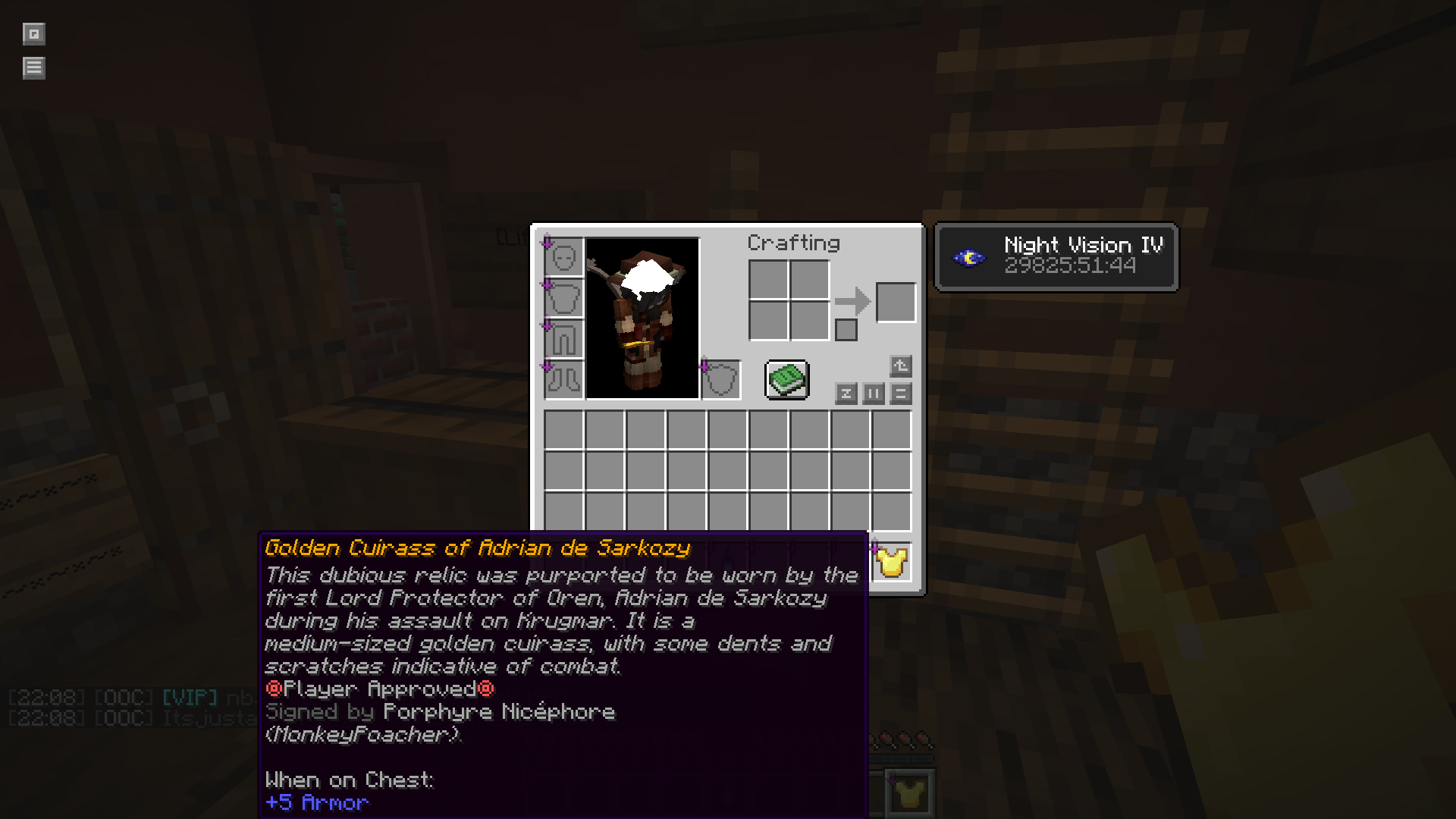
frankdh 2418 Share Posted December 21, 2018 Qui Exaltatus, Sanctificamini, et BenedictusThose Exalted, Sanctified, and BlessedLast promulgated by His Holiness, Everard IV, 7th of the Grand Harvest, 1629 Codified and Updated by His Holiness, Daniel V As of the 15th of Godfrey’s Triumph, 1695 Among mankind, there are those who have acted with utmost piety and compassion, and the Church has recognized them for their valor. Whilst paragons of virtues have graced the realm since ancient times, it was only under the High Pontiff Marcus I where a canonization process was established, to deliberate those beautified and saintly. However, with the great heathen sack of the Liberian Pontificate, the canon list of the sainthoods had been lost. It was under only High Pontiff Everard where a tradition of universally recognized sainthoods were restored. Above the saints are, the four Exalted are those foretold in the Holy Scrolls, known formerly as the Divine, whom would restore humanity in this life and beyond. Only the exalted have ever held full dialogue with the Creator, and all have performed countless miracles and acts of greatness, standing aside the Creator in the Sixth Sky. All these canonized figures are not to be worshiped, but revered, whether for their fulfillment of the Creator’s prophecies, or for their exceptional degree of holiness. They may be asked to pray for us as they act in intercession, close to the Creator himself. The Prophets The Prophets, or Exalted, are determined by the Canon and are noted for receiving their respective Scrolls from the Aenguls Artifai and Tesion, along with innumerable acts of faith, good works, and miracles. Horen I “the Father” - Golden Laurel Patron of Humanity, Covenants, and Humility. Owyn I “the Purifier” - Flaming Sword Patron of Purity, War, and Fire. Godfrey I “the Redeemer” - Silver Scepter Patron of Dominion, Glory and Justice. Siegmund I “the Preserver” - Globus Cruciger Patron of Clairvoyance, Wisdom, and Sight. Those Sanctified One is sainted if he or she lives a wholly pious and virtuous life and has proven he or she is in the highest skies by traditionally performing miracles posthumously. Thus, they are often attributed symbols to identify with. St. Godwin of Paradisus - Skull Patron Saint of the Deceased, the Afterlife, Ghosts, the Supernatural and Heartlanders. St. Julia of Paradisus - Golden Rings Patron Saint of Mothers, Matrimony, and Exorcism. St. Joren of Paradisus - Iron Shackles Patron Saint of the Mountains, Winter, the Imprisoned, and Highlanders. St. Lothar of Balian - Lorraine Cross Patron Saint of the Lorraine Cross, Princes, Courage, and Heraldry. St. Daniel of Al'Khazar - Wooden Staff Patron Saint of Peace, Cities, Pilgrims, and Travel. High Priest St. Everard I of Al'Khazar - Red Cross Patron Saint of Tradition and Persecution. St. Amyas of Yore - Wild Herb Patron Saint of Medicine, Healing, Botany, and Wild Herbs. St. Godwein of Huntshill - Oaken Shield Patron Saint of Honesty, Woodworkers, Fungi, and Skin Afflictions. St. Tobias of Sarkoz – Silver Comet, Gold Coins Patron Saint of Merchants, Comets, Wealth, and Charity. High Pontiff St. Lucien I of Ulmsbottom – Kaedreni Cross Patron Saint of Crusaders, Change, and the Family. St. Adrian of Leuvaarden - Open Book Patron Saint of Statesmen, Lawyers, and Politics. St. Thomas of Gaekrin -White Rose Patron Saint of Leadership, Discipline, Frontiersmen, and Kaedrin. St. Peter of Gaekrin - Flaming Rose Patron Saint of Order and Victory. St. Humbert of Bar - Sun’s Smile Patron Saint of Perseverance. St. Edmond of Lachsin – Knight on Horseback Patron Saint of Patron saint of the loyal soldier, knights, and the Auvergnian People. St. Theodosius of Istiam - Gray Pigeon Patron Saint of Messengers, Birds, Translators, and the Raevir People. St. Wilfriche of Hanseti - Black Mace Patron Saint of Brotherhood, Chancellors, Opposition of Setherin, and Franciscan Martyrs. High Pontiff, St. Daniel I - An Aged Scroll Patron Saint of Scholarship, Fate, and Literature. St. Otto ‘the Bald’ of Vanderfell - Bald Eagle Patron Saint of the Schism War, Fate, Ward Fathers, and Northern Peoples. St. Charles of Haense - Golden Crow Patron Saint of Strength, Fortitude, and Prisoners’ of War. St. Michael of Cordobe - White Bull Patron Saint of Passion, Exiles, Service and the Eighteen Years’ War. St. Emma of Woldzmir - White Sword Patron Saint of the Schism War, Loyalty, Valour, and Adrians. Saint Henry Otto of Alban - Wooden Scales Patron Saint of Commoners, Justice, and Fatherhood. Saint Kristoff of Hanseti - Rosary Patron Saint of Martyrs, Victims of Strife, and Bishops. Saint Jude of Cyranium - Inkwell and Quill Patron Saint of Scholastics, Authors, and Monasteries. Saint Catherine of Felsen - Pair of Gloves Patron Saint of Oaths, Integrity, and Innocence Those Beautified One is beautified if he or she lives a wholly pious and virtuous life and is either martyred for his or her faith, or posthumously performed a miracle upon a High Pontiff's prayer. Blessed Patrick Denims Blessed High Pontiff Adeodatus Blessed Hunwald Blessed Francis Karovic Blessed Lorethos Basileus Blessed Damon Kovacevic Blessed Vladislav Blessed Zacarias Mosquera Blessed Father Stephen Blessed Frederick Royce Blessed Dmitri of the Dreadfort Blessed Jon of the Whirlwind Blessed Peter Blessed Lendus Blessed Jan Jeremi Blessed William the Beggar Blessed High Pontiff Daniel I Blessed Thomas Denims Blessed Richard de Bar Blessed Humbert de Bar Blessed Radovid of Blaviken. Blessed Marius Baruch Blessed Vytenis of Visiga Blessed Leon of Amaury Blessed Baldwin de Bar Blessed Wilhelm of Hermann Blessed Stephan Himmel Blessed High Pontiff Daniel II Blessed Rafael de Cordobe Blessed High Pontiff Everard II Blessed Adrian of Kaedrin Blessed Johannes de Rutyer Blessed Foltest of Aeldin Blessed High Pontiff Sixtus III Blessed High Pontiff Lucien III Blessed Publius Bracchus Blessed Andrik Vydra Blessed Jack Rovin Blessed Polycarp of Aeldin Blessed Noah Wheezer Blessed High Pontiff Pius II Blessed Adelran Coulthard Blessed Sigismund of Couentre Blessed Jon Renault de Savoie Blessed George de Bar Blessed Ari of Abresi Blessed High Pontiff Owyn II Blessed Enoch Blessed High Pontiff Sixtus IV Blessed High Pontiff Clement II Blessed Naffis Yar Blessed Vladimir the Golden-handed Blessed Mother Judith of Markev Blessed Abbot Wigbrecht Blessed Adaldag Wanderfoot Blessed Melchior Guillen Blessed High Pontiff Daniel V Saints Information St. Godwin of Paradisus – Skull Patron Saint of the Deceased, the Afterlife, Ghosts, the Supernatural and Heartlanders Spoiler The second of the three sons of Horen, Godwin and his brothers took it upon themselves to collect the scattered peoples of Humanity after the murder of Horen and his wife Julia at the hands of Krug the Betrayer. Godwin established the kingdom of Aaun within the valley of Jrent, and this became the most prosperous of the brother’s three kingdoms. Aaun continued to progress and flourish under his reign, but this was tragically brought to an abrupt end when Godwin was murdered by his own brother, Harren, at the beginning of a twisted conquest; Harren smashing Godwin’s skull. This would eventually lead to the rise of Owyn, son of Godwin, and the fall of Harren. Miracles: Due to the violence of his death, it is said that Godwin appears as a ghost to the children of humanity to guide lost souls to the Skies. St. Julia of Paradisus - Golden Rings Patron Saint of Mothers, Matrimony, and Exorcism Spoiler The wife of Horen, Julia was a gentle soul who was devoted to her husband, children, and the Lord. After her husband embarked on his journey to the Grotto of Gamesh, pious Julia was left with her young children to tend to the camp of Horen. It was then that Iblees, in disguised as Horen came to the camp, trying to lull the people down a path of sin and iniquity. Before he had the chance, however, it was Julia who stepped forth, seeing Iblees for what he truly was: the Deceiver, and she cast him out from the camp. She would go on to defend her children from the iniquity of Saul, preserving the holy bloodline of Horen. Miracles: When a disguised necromancer tried to corrupt the flesh of an expectant mother, a bright light erupted from her golden wedding band about her finger. When the light faded, the necromancer was blinded, and its true form was revealed, allowing the woman time to escape. Months later, the woman birthed triplet sons. St. Joren of Paradisus - Iron Shackles Patron Saint of the Mountains, Winter, the Imprisoned, and Highlanders. Spoiler The third and youngest son of Horen, Joren established the kingdom of Edel upon the scattering of Horen’s people. When Harren attacked the kingdom of Aaun and murdered their brother, Godwin, Joren took it upon himself to provide sanctuary for Godwin’s only son, Owyn. Upon Harren’s treacherous capture of the uncle and nephew, Joren cast Owyn into the sewers of the holy city’s ruins, saving his life. Joren would spend many years trapped as a prisoner in his own brother’s keep, each day praying and remaining strong in his faith. It was this act of sacrifice that paved the way to Owyn’s rise in power as ruler of Idunia, where he finally defeated Harren and freed Joren from his shackles and the years of imprisonment. Miracles: When the dwarves had kidnapped a platoon of Canonist soldiers in the midst of the Schism War, the soldiers found themselves deep in the mountains with nothing but the chains that bound them. However, on the seventh night of their capture, the shackles rusted rapidly, crumbling to pieces, and they succeeded in escaping. St. Lothar of Balian - Lorraine Cross Patron Saint of the Lorraine Cross, Princes, Courage, and Heraldry. Spoiler Born as the Prince of Balior in the year 500, Lothar is most notably recognized as the religious philosopher behind the Lorraine Cross. He published a work elaborating on his logos, explaining that the Cross of Lorraine is a variation on the normal two-barred cross, consisting of one vertical bar pierced with two horizontal bars in the upper half. The upper horizontal bar represents the Seven Skies, the lower represents the World, and the emptiness beneath them is the Void. Miracles: Soon after the death of Lothar, a raging olog wandered into a village on the countryside, causing havoc. One such event that came of this, was the olog’s theft of a nun’s Lorraine cross and rosaries. The olog tried to bend the golden cross, but again and again, it did not bend or break, and in fact broke the orc’s hands after his seventh attempt. St. Daniel of Al'Khazar - Wooden Staff Patron Saint of Peace, Cities, Pilgrims, and Travel Spoiler The mythic Saint Daniel is celebrated throughout the Canonist community as a model monarch and pilgrim. Born as the third among brothers, St. Daniel was not expected to inherit, and thus his father had introduced him to the world of theology in hopes of finding a vocation for the pretender. Yet in a stroke of misfortune, the princeling's elder brothers fell ill to a sweeping plague, and Daniel took upon his father's mantle as King of Oren. He never forgot his theological training, however, and found himself engrossed in matters of faith. Daniel Horen's first act as King was shifting his capital away from the traditional Horen seat of Jrent to a small fishing village northwest, in hopes of being closer to the holy sites of Aegis and finding the lost city of Paradisus. This village, under his competent administration, became the bustling metropolis of Al'Khazar, the jewel of Aegis and city of world's desire as a center of commerce, culture, and prestige. Yet he never forgot his faith in his fortunes; he financed and led the construction the grand King's Road, a highway from the Cloud Temple to Al'Khazar in hopes in popularizing the tradition of pilgrimage and travel. But despite his success as a monarch, Daniel loathed to sit in his palace, an ardent admirer of the world around him, often slipping the guise of a beggar at dusk and blending in with his subjects. After twenty years of peaceful reign, the burdens of statecraft began to take a toll upon Daniel's ability to spread the word of God, and he promptly abdicated. Lacking sons at the time, Daniel yielded his throne to his seneschal, and the Sheffield regime henceforth commenced as Daniel retired to his estate in Alstion. Though never officially ordained in the Temple of the Faith, many contemporaries dubbed 'Good King Dan" as a missionary due to his nature of converting countless peoples in his voyages. A popular cult revolved around the former king as he traversed the land spreading the faith to the remote corners of the world, one famous pupil of the cult being St. Everard. After years of wandering, preaching, and delivering the faith, St. Daniel passed away in his sleep. Four hours after his death, he was canonized, with throngs of faithful rushing to Horen's Cathedral in Al'Khazar claiming miracles on behalf of St. Daniel. Miracles: St. Daniel's wooden staff is said to have miraculous powers; during the 5th Great Drought of Kramoroe, it was used by a priest of the Canon to find fourteen wellsprings, which saved the city. The footprints left behind in St. Daniel's travels throughout Krugmar never faded, despite the region's volatile sandstorms. High Priest St. Everard I of Al'Khazar - Red Cross Patron Saint of Tradition and Persecution Spoiler Born in the late 1200s as a prince of the antique House of Hightower, Saint Everard is widely known for his active resistance and persecution against the Iblees cults and Sheffield regimes. Among the unsophisticated clergy of High Priest Bernard's peerage, Everard distinguished himself as as scholar and keeper of holy rites, a traditionalist through and through. He was a disciple of St. Daniel, establishing various enclaves of his faith in the Oren frontiers and helped standardized the Church in a time of uncertainty. Yet, while the city of St. Daniel, Al'Khazar, was aflame with pro-Iblees sentiment, its very King conducting in the black worship, Saint Everard remained steadfast in his communion, performing secret vigils and taking to exile to insure the faith would survive against the onslaught of the Undead. Tortured, branded, and persecuted, the mythic Hightower never submitted nor faltered in his dogma, refusing to accept Iblees as anything more than the fallen Archdaemon. His adherence to traditional Canonist sentiments and devotion to his Creator have exemplified him as a model for all the priesthood to follow, as Everard kept his faith and vows despite the world around him crumbling to ash. He passed in his sleep in 1320. Miracles: A group of Aegan clergymen were traveling north to administer the faith, when a Red Cross appeared in the night sky. Being students of St. Everard, they took the sign as an omen and turned away later to discover an Undead warlock nearly crossed their path. Undead prophets stumbled upon the tomb of St. Everard and attempted to resurrect him with their dark arts. Their attempts were a miraculous failure, as their lightning spells were reflected back to their caster, and their hexes proved useless. St. Amyas of Yore - Wild Herb Patron Saint of Medicine, Healing, Botany, and Wild Herbs Spoiler Little is known about Saint Amyas' early life, but what is known is his family's patrician background. Born in a household of merchants, the young Amyas quickly grew disillusioned with the decadence of the Perea kingdom of Salvus and found himself disowned by his father when he refused to work in the family business. Mustering what money he could from a mother's farewell gift, Amyas became an apprentice physician in a wandering caravan. The novice apothecary's talents grow exponentially over time due to his genuine passion in medicine. During the wars against the Perea regime, Amyas found ample work in tending to those wounded and maimed by bandit, orc, and man alike. His selflessness enabled him to become a pioneer in his field, devising the triage method of healing and various poultices to remedy the wounds of war. These growing talents would be put to test during the Great Plague of Asulon. A calamity which killed over a tenth of the human population, the Great Plague of Asulon was characterized by a pandemic of countless ailments, but none as feared as the wicked rotbrain. The virus was notorious for inducing mind-numbing agony and savagery to those afflicted, who often were kept together in cages and treated as animals for their conditions. In the bustling city of Solace, Amyas, in a routine trip through the quarantines to treat the infected, was once forced in the quarantine by two guards, who refused to let the doctor out. Amyas spent ten days among these sick, three without food or water, yet despite the circumstance, Amyas continued his treatments whilst praying to God for freedom. When another apothecary of his caravan finally managed to bribe the guards into letting Amyas go, Amyas was miraculously found free from all affliction despite his vulnerable state. Taking this as a sign from God, Amyas enlisted among the clergy and became a prominent monk. Spending his days administering last rites to the terminally ill, healing the sick despite prejudice and quarantine, pioneering new methods of medicine, and selflessly risking his life for the damned wherever he went, Amyas became the embodiment of the godly physician. Miracles: A lame boy was brought before the tomb of St. Amyas and at once managed to kneel, the function in his legs restored. The body of St. Amyas is to smell distinctly of rose petals. St. Godwein of Huntshill - Oaken Shield Patron Saint of Honesty, Woodworkers, Fungi, and Skin Afflictions Spoiler As a youth, St. Godwein was reared in the Asulonian badlands, a noble refugee from the destruction of Aegis. Losing his family at an early age due to the bandits so common in the region and period, "Honest Godwein" took up his hatchet and swore to his Creator that he would live on and prosper, but through virtue and honesty, not through sin as those that took his family away from him. The young Godwein opened a woodworking business, exporting fine frontier timber with the merchants who traveled all across the human realm. His merchant contacts informed one day that one of Daniel's grandsons, a certain Godfrey Horen, had come into power. An ardent admirer of the selflessness and traveling spirit of St. Daniel, Godwein set out for Arethor upon hearing this news and swore utter loyalty. Aiding his king and later, Emperor, in combating heresy in reuniting the human kingdoms, Godwein became a beloved figure in the court of man, who was reputed to have never told a lie in his life. In an attempt to conduct in theological discourse with the Mori'quessir on a voyage to Menocress, Godwein was afflicted with a fungal growth upon his visage. Many physicians grew concerned as the blemish grew and grew, until it encompassed half his face. Yet, it is said that in response to this life-threatening illness, Godwein went to St. Everard's Church and prayed deeply for three days and three nights, and the growth did not grow anymore. Recognizing the ultimate power of God and his institutions, Godwein poured countless resources in aiding the poor and the priests of the faith. He passed away quietly, keeping his word with his Creator by going from a common lumberjack to a Marquis of the Empire without betraying his principles and living an exceptionally earnest life. Miracles: Godwein's axe nor shield has never dulled, even after consistent use decades from his death. Godwein's body is miraculously preserved, and its fungal growth still living, despite lacking a host to draw nutrients from. St. Tobias of Sarkoz – Silver Comet, Gold Coins Patron Saint of Merchants, Comets, Wealth, and Charity Spoiler Born as Toveah Goldman, his name anglicized from its Sarkozic root, St. Tobias is renowned for his immense fortunes. Ledgers indicate his wealth spanned beyond mortal comprehension, dizzying sums that definitively marked him as the richest human in the realm. Yet, Toveah was not born this wealth; a humble and impoverished manservant to Hadrien de Sarkozy, later known as St. Adrian, Goldman distinguished himself in the Count of Norfolk's council through his legendary stewardship. The Goldman Company helped settle and administer the Pontifical lands held by High Pontiff St. Lucien, enabling countless institutions of the faith to prosper. It is said Goldman had the Minas Touch; every business he ran prospered and returned its investments tenfold. At first, Toveah embraced his worldly wealth, erecting statues of himself of gold and being indulgent with his newfound wealth. But after assuming a monopoly on the Abresian port of "Tov Avev", Tobias had a religious epiphany. Realizing his great bounty would never satiate him as it was a worldly desire, he quickly took upon a vow of celibacy, and tirelessly worked to satisfy his spiritual desires. Patronizing countless religious institutions, from the St. Bogdan's Cathedral in Kralta, the Kaedrini Orphanages, the Hammerspoint Observatory and the Pontifical Palace in Savoie, Saint Tobias had distinguished himself by his utter devotion to charity, foregoing family, status, and prestige for the betterment of Anthosian society. Yet, the selfless Tobias later in life began to succumb to a lethal disease, ballooning his weight and forcing him to consume thrice his normal appetite at particular intervals less he pass unconscious. To eat so lavishly was to suffering for Tobias, who bemoaned this wealth could not go towards charity; one day when a Hansetian family of refugees approached the benevolent Tobias begging him for foodstuffs. Tobias, in his charity, gave his meal to the family, before realizing that he had missed his feeding interval. He passed into a coma and later perished, dying in ultimate altruism. His will dictated that his enormous fortunes did not go to his distant kindred, but rather various institutions of the Church and state, demonstrating the epitome of charity in both life and death. A common myth around St. Tobias is that he comes to give good children gifts with his "little goblins" during the month of Joma. Miracles During the reign of High Pontiff Owyn I, the attempts at demolishing the ghost town of Aldersberg were met with failure due to various Adunian raiders harassing the peasantry. Praying to Tobias for intercession, High Pontiff Owyn found the next day that a silver comet had struck and demolished the city in one blow, while also providing countless minerals and precious metals for the commons and Church. Upon a naval excursion to Hammerspoint, a group of sailors and clergymen alike were met with a vicious storm that lasted for twenty days. Nearly out of supply and facing mutiny, a silver comet soared through the sky pointing north. The captain swung north at behest of his chaplain, and found a small island littered with fresh fruit, meats, and coins bearing the image of St. Tobias. High Pontiff St. Lucien I of Ulmsbottom – Kaedreni Cross Patron Saint of Crusaders, Change, and the Family Spoiler Born as Velwyn Ashford in the dreary penal colony of Ulmsbottom, Saint Lucien’s background was that of the son of an exiled patrician. His father, a courtier, had been banished from the royal court of Pampo Perea in somewhat murky circumstances, and at the first opportunity young Velwyn hired passage on a slave galley from Ulmsbottom to the Teutonic state of Hanseti. There he began a new life for himself, quickly rising through the secular ranks of the Teutonic Order, building his assets and reputation until he was eventually appointed Landmeister (or governor) of the city of Dresden. In addition to this, for a brief time he acted as an ambassador from the lands of Hanseti to the court of Renatus, where he was exposed to the religion of the Renatian people. His tenure ended when Hochmeister Mirtok of Hanseti betrayed Godfrey of Renatus in the Salvite Wars, Ashford being quickly pronounced persona non grata and recalled. Ashford found himself unable to cope with the dilemma which he then faced - to him, Renatus had been a land of opportunity and moral principles, whereas his own realm of Hanseti had exemplified only betrayal and warmongering justified as pragmatism. He resigned from his post as Landmeister and was baptised into the Church of Oren, disappearing for a certain time. He reappeared around the time Godfrey unified the human realms into the Holy Oren Empire, having undergone a religious epiphany and joined the clergy. With Thomas (Later St. Thomas of Gaekrin) and Peter Chivay, he was one of the three founders of the Order of the White Rose, a religious military order which was the first and most powerful organization to espouse the more zealous principles of the Empire - the subjugation of nonhumans, the establishment of religious uniformity and the destruction of monsters, rebels and dissidents. It would later grow to become one of the most formidable forces in the history of the Empire, establishing the Kingdom of Kaedrin and almost entirely conquering the elven lands. In addition to his post as Seneschal of the Order of the White Rose, he was instated as the Bishop of Crestfall and Pontiff of the Church by the High Pontiff at the time, Adeodatus I the Simple. Under his proselytization, the Diocese of Crestfall would be scoured of infidels and heretics. In 1395, Adeodatus would resign from his position as High Pontiff and Velwyn Ashford would be elected in his place, taking the papal name of Lucien. Taking a far more active role in the operation of the Church than his predecessors, Lucien I proved to be one of the most devout leaders of the Faith in recorded history, casting aside the lax and corrupt precedent which had been maintained by James, Pius and Adeodatus. Upon the arrival to the promised land of Anthos, Lucien would be granted the northern fief of Savoie, becoming Prince-Archbishop of Savoie. A staunch defender of the family unit, the High Pontiff would become a model for virtuous and righteous families, providing charity and patronage to households with children. During his reign, he called the First Crusade on the Orcish Lands and established the Order of Saint Amyas, charging Guy Varodyr with the post of Grand Master. This First Crusade was a great success, many of the pious riding south to secure their place in the Seven Skies by fighting the orcish infidel. Varodyr would establish the fortress of Antrim before being forced to retreat when the crusade achieved its ultimate goal reclaiming the relics of St. Lothar, known more commonly as St. Lorraine. Known for the copper Kaedreni cross he bore, he resigned in 1420 upon leaving for Aeldin during the Exodus, having restored the good name of the Church as a pious and selfless organization which protected family values. Lucien died some time in the 1430s, his relics being recovered by Arjen de Sarkozy on an expedition sponsored by Radomir the Ecclesiarch. Afterwards, they were transferred into the custody of his grandson, Olivier, where they remain to this day. Miracles After kissing the hand of Lucien’s cadaver, a married couple of fifty-one and fifty-five were able to conceive and successfully raise a healthy child despite years of infertility. Saint Lucien’s crozier and Kaedreni cross, fashioned out of lead and copper respectively to show his humility in regards to his predecessors, were both buried with him in his tomb. When Arjen de Sarkozy exhumed his relics, the knight found that both the crozier and the cross had been transformed into solid gold. Alarmed by this discovery, he transferred both artifacts into the custody of the Church. St. Adrian of Leuvaarden - Open Book Patron Saint of Statesmen, Lawyers, and Politics Spoiler Born as Hadrien de Sarkozy, Saint Adrian was born in the Viceroyalty of Leuvaarden in the far off continent of Gaekrin. Raised in a household of middling burghers, Hadrien’s youth was marked with a characteristic rivalry with his elder brother and passionate ambition. His renown grew when he was sent to the continent of Asulon and read about potential legal work, posted by Velwyn Ashford (Later High Pontiff St. Lucien of Ulmsbottom). Hadrien set out for Asulon with meager supply and ended up in the Duchy of the Holy Lands, where he found work under Seneschal Ashford, acting as an advisor, barrister, and political theorist. His work found himself managing the many accounts and ledgers of the Order of the White Rose, and his stellar diligence and natural talent caught the eye of Velwyn’s other companions, prominently Thomas Chivay (Later St. Thomas of Gaekrin). He was quickly promoted to the rank of Conseiller and acted as a personal advisor to both Thomas and the Senior Command of the Order. His political works condemned the unholy city of Crestfall, and he personally participated in rooting out heretics among the city’s populace. When the Empire of Oren came to the continent of Anthos, Hadrien’s reputation as an able advisor had grown throughout the Empire. Countless sought his political expertise as he forged treaties, documents, and alliances throughout the realm. Hadrien also endeavored to promote a new Kaedreni culture in the kingdom, patronizing countless musicians and artists, whose works would spread throughout the newly conquered frontier. St. Adrian, above all others, that established a true Kaedreni culture among its people – a culture of nationalism, pride, and civic duty. What St. Adrian is most renowned for among the Canonist communion is his role in being the chief architect of Lucienism. His creation of the papist doctrine exemplified and outlined the theological goals of High Pontiff Lucien I, and its influence spread quickly throughout the Imperial west. Lucienism is regarded as a pillar of the Canonist faith due to his defiance of caesaropapism and the Horen cult. Thus among Canonist theologians, St. Adrian is praised for his philosophical and dogmatic contributions. Along with his involvement in the Kingdom of Kaedrin, Hadrien was also awarded other titles in the Empire. He was granted the title of Lord Privy Seal in the Emperor’s Council; and the County of Norfolk in the Prince-Archbishopric of Savoie, where the city of Aldersberg was established. Aldersberg would become a bountiful and industrious city, its inhabitants raised under the care of Lucienist teachings and Sarkozy protection. Hadrien was also one of the few lords in Orenic history to be a direct papal vassal, and it was he who also swore his devout faith to Lucien and championed the High Pontiff’s full papal authority as a separate body from the state. Lauded for his diplomatic ability, religious scholarship, political philosophies and diligence with the quill, St. Adrien worked tirelessly in service to the Pontificate, the Kingdom of Kaedrin, and most of all his faith. He would remain a devout follower of the church and capable statesman until his death in 1419, butchered by an unknown burglar in his own office. Miracles When St. Adrian was found slain in his office in Ard Kerrack, he had with him a ceremonial golden shortsword, bloodstained after an intense struggle against his killer. When the guard went to alert their superiors, they returned to find the blade cleaned of all its stains and resting in the crease of an open book, revealing the building projects for Lucienist churches throughout the frontiers of Kaedrin. Upon the Exodus, clergy rushed to Aldersberg to preserve what works there before looters preyed on the chaos. When the entered St. Adrian's chambers, the various books there began to fly about in his room in a heavy gale. As they landed, only one tome was left open, a scripture detailing a pentarchy. Later, the Holy Oren Empire would split five-ways. St. Thomas of Gaekrin -White Rose Patron Saint of Leadership, Discipline, Frontiersmen, and Kaedrin Spoiler One of the Co-Founders of the Order of the White Rose, Thomas Chivay, as the Order’s Grand Marshall, sought to bring an end to the heretical force of the elven nations.With approval from the Pontiff himself, Thomas embarked on a twenty year’s journey to convert heretics across all of Anthos by any means necessary. Miracles: A priest who had been blinded by an orcish clan stumbled into the church of Kaedrin, praying fervently through the night before falling asleep, exhausted. When he awoke, his blindness had been cured, and his first sights was that of a white rose in the stained glass of the cathedral. St. Peter of Gaekrin - Flaming Rose Patron Saint of Patron Saint of Order and Victory Spoiler The second of the co-founders of the White Rose, Peter was the Order’s leader. Passionate and outspoken, Peter was relentless in his efforts to better the world and end the iniquity of the World’s false religions alongside his brother Thomas. He would go on to become the King of Kaedrin, and eventually the Emperor of the Imperium. Miracles: An elven heretic attempted to wander into the capital of Kaedrin to convert and corrupt devout Canonists that resided there. But as the elf passed by a bush of roses, the buds erupted into flames, singeing the heretic greatly. St. Humbert of Bar - Sun’s Smile Patron Saint of Perseverance Spoiler Despite being born into the Savoy cadet branch of de Bar, Humbert rather quickly took the cloth, delving deeply into the scholarly works of the faith and prospering underneath the tutelage of Pontiff Daniel I, and thus quickly became the Pontiff’s Vice-Chancellor. When Daniel I had gone on pilgrimage, and the Schism Wars erupted, it was Humbert who stepped into the limelight, fervently defending the faith in the Pontiff’s absence. He declared himself regent, and called on Savoy, Akovia, Adria, and the proto-Haensic states to rally together to fend off the schismatic threat. Such bold strokes earned Humbert the title ‘Titan of the Faith’, and he was recognized as the second most influential clergyman of the Schism War. Miracles: A heartlander nobleman and a clergyman had gotten into a heated debate over the causes of the Schism War, a hundred or so years after it took place. In the heat of the moment, the nobleman caused an idol donning the symbol of Humbert to be knocked over, broken in two. When the nobleman went to pick it up, however, the idol resealed itself, the symbol glowing faintly for a fleeting moment. St. Edmond of Lachsin – Knight on Horseback Patron Saint of the loyal soldier, knights, and the Auvergnian People Spoiler Known in life as Sir Edmond Brunswick, the Auvergnian rose to become a veteran of many wars, serving the empire loyally and virtuously. He acted as the epitome of all virtues of a good knight and soldier until his final days, perishing on the battlefield. Miracles: During a chivalrous duel between two knights, one of the knights attempted to cheat by poisoning the end of his blade. In the midst of the fight, he somehow managed to cut himself, mumbling in Auvergnian until his death, which was not a tongue he had known prior. St. Theodosius of Istiam - Gray Pigeon Patron Saint of Messengers, Birds, Translators, and the Raevir People Spoiler In the times of Asulon before the Schism Wars, Theodosius rose as the religious head of the Raevir peoples for many decades, going on to create the foundations of Russian Orthodoxy and translating the Canonical works into the Raevir native tongue, spreading the word and translations by the use of messenger pigeons. In his later years, he had a chance encounter with the Prophet Exalted Siegmund, and Theodosius bore witness to Siegmund’s discovery of the Scroll of Auspice, translating and implementing it into the Scrolls of the Canon. Miracles: Theodosius lived well into his old age, passing away by an abrupt heart attack in the middle of a field. When the priests and clergy rushed to him, they were halted when hundreds of pigeons suddenly gathered around Theodosius, lifting his body up and carrying it away, never to be seen again. St. Wilfriche of Hanseti - Black Mace Patron Saint of Brotherhood, Chancellors, Opposition of Setherin, and Franciscan Martyrs Spoiler St. Wilfriche was born to a Hanseatic yeoman and his wife under the Kingdom of Hanseti in 1426. His early life was characterized by brutal strife as both Blackmont and Sethrenic forces ravaged his homeland. It was not long before Wilfriche was orphaned and his homeland destroyed, claimed by the Black Scourge. He managed his way south to the bustling town of Kralta and sustained himself through ill-means, but eventually was caught stealing two loaves of bread from a local bakery. The boy was apprehended by the local militias and brought forth to be judged by the Marquis of Raev. The traditional punishment for theft was a hand, but the exalted Siegmund took pity on the Hansetian in rags and ordered him instead to serve under the Bishop Bogdan, later canonized of St. Theodosius, as an Acolyte to atone for his theft. Wilfriche thus grew up in the ornate and mystic rites of the Ruskan Orthodoxy, undergoing a clerical education and becoming an ordained clergyman. Wilfriche and his trusted companion, Blessed Vladislav, son of St. Theodosius, left Kralta to minister their faith in the newly settled Kaedrini region after the ascension of their mentor. The pair became well-loved by the Raevir colonists as beacons of faith under the reign of the apathetic High Pontiff Regulus. However, these Kaedrini backwaters were infamous for Setherinic raiders and cultists. Under St. Wilfriche's leadership, the Ruskan fellowship erected a mighty holdfast known as the Flotstad and surrounding it the village Flotsam. The Flotsamites grew to be the first bulwark against Setherinic invasion and were critical in the reclaiming of Hanseti from Setherinite clutches. Wilfriche fostered a strong brotherhood bound by creed through the Jolly Band and was characterized by his jovial and amiable spirit, making friends with countless Anthosians. St. Wilfriche was also characterized as an ardent theologian, publishing countless articles on the faith and spreading the missives among its communion. He stood against the sectarian communalism of Oren, recognizing the blasphemies in permitting sects to possess dogmatic differences. Approaching the High Pontiff, he managed to list a series of grievances and help unite the faith into one universal dogma, marking him a pioneer of Canonism. However, the Order of St. Lucien soon attempted to check Wilfriche's rise in influence and power by petitioning to the High Pontiff to declare war on the Flotsamites for claims of banditry. Regulus accepted the prospects of civil war, and the two parties battled it out until a white peace was declared. Wilfriche later became Lord Chancellor to the King Henry and King Francis before being slain in the Franciscian Massacre. His power in the ministries were notable as he swayed the stalwart cynic Joseph Lane to erect an Abresian Church by purging the Abresian sewers of an unholy plague festered by cultists, spread the faith through mass baptisms, arranged feast days, and led battles against the Zionist menace before his death. His symbol is a black mace due to his purification of various Setherinite maces and also his Orthodox vows, which forbade clergy from bearing bladed weapons. Miracles A man possessed by Setherin was clubbed once about the head by Wilfriche's mace. After rising from the blow, he was exorcised of his demons. The week following Wilfriche's death, three sets of twins in Ancien were born with black mace birthmarks. High Pontiff, St. Daniel I - An Aged Scroll Patron Saint of Scholarship, Fate, and Literature Spoiler Becoming Pontiff during the ‘time of troubles’, Daniel I wanted nothing but to regain peace. The Schism Wars causing nothing but chaos and instability during the first years of his pontificate. When the Canonists of the Schism War finally declared victory, Daniel leapt at the opportunity to properly elaborate and adapt the Canon. He translated the Canon from Flexio into the common tongue, leading to a renaissance of religious knowledge and devotion. Praised by many at the time for his deep passion for academia, he was nicknamed ‘The Reader’ by his fellow clergymen, and is responsible for the texts still used today. Miracles: A bishop who had suffered from a stroke was struck by an inkwell that sat on a shelf above him during an earthquake. When the quake ended, his speech had completely returned to him, and he could speak in both Common tongue and Flexio fluently. St. Otto ‘the Bald’ of Vanderfell - Bald Eagle Patron Saint of the Schism War, Fate, Ward Fathers, and Northern Peoples Spoiler Otto was born into the Rovin family, but during the Schism Wars he was forced from his home of Vanderfell. It was after this incident that he worked relentlessly, finding himself at the center of the chaotic papal court, becoming a strong, guiding voice. With the Pontiff’s guidance, he soon succeeded in reclaiming his homeland upon the end of the wars. Again he worked tirelessly, and realized a new purpose: to help the ruined countryside destroyed by the Schism Wars. He rebuilt and established settlements for the peoples who were without a place to call home, bringing stability back to a people who had nearly forgotten the meaning. It was through these efforts did the beginnings of Haensetian states begin to form. Along the way, he took Saint Charles into his care, and groomed him to be the next Duke of Vanderfell. Miracles: Near the end days of Vanderfell, a human child was kidnapped by a dwarven ex-soldier and his elven concubine. As they ran through forests, trying to flee from the Vanderfell soldiers that pursued them, they found themselves hopelessly lost, tailed by an eagle, and wound up right back at the front gates of the city. St. Charles of Haense - Golden Crow Patron Saint of Strength, Fortitude, and Prisoners’ of War Spoiler Son of Emperor Alexander Carrion, Charles’ early life was turbulent and chaotic. At the beginning of the Schism Wars, he and his twin sister were abducted by his mother, only for his uncle, named Otto Heinzreich, to stop her and raise Charles as his own and groom him as his heir. Young Charles was greatly influenced by the High Pontiff Daniel I, establishing and solidifying his religious foundations. Charles grew to become the Duke of Haense, and established the family line of House Barbanov. Later, he would befriend Saint Emma Vladov, the two playing a key role in allying the duchies of Akovia and Adria to fight against the schismatic threat. Karl was often perceived as a stern, but strong figure by his people, with an unbreakable spirit and endurance. Miracles: Late one night, a Haensetic monk found himself lost in a blizzard with no torch, lantern, map or compass. As the night grew colder and colder, thinking he’d freeze, the monk prayed to St. Charles for veneration, and in the distance saw a flash of golden light. The cawing of a crow soon followed after, and the monk followed the sound to the safety of his monastery. St. Michael of Cordobe - White Bull Patron Saint of Passion, Exiles, Service and the Eighteen Years’ War Spoiler Miguel Cortez was born the son of a Canonist convert on the island of Cordobe. He and the other Canonists of the island were driven away and forced into the sea by the pagan inhabitance. He eventually fled with the Cordobonese converts, led by Blessed Rafael de Cordobe, across the ocean to Vailor, landing in Luciensport. Everard II welcomed them with open arms and they in return, aided him in the construction of the fledgling Papal State. Later in life he, along with his Uncle Rafael, formed the backbone of what would become the Inquisitorial Tribunal, formed to combat pagans, protect the Pontiff, and purge heretics. Miguel fought many battles against endless foes, participating in holy war against the Dwarves and the Qalisheen, and purging both the Xanist, and Clerical heretics from human lands. He was also responsible for capturing the renegade Abbess, Lorina Carrion for the breaking of her vows, and her conversion to the Qalisheen faith. Miracles: While hunting the rogue Lorina of Ruska, Michael and his inquisitors were lost in the deserts of Khalestine. After seven nights of wandering, Michael had a vision in which a purely white lion came to him in the night and led their party to the city of Al'Wakrah, where they learned of the oathbreaker's whereabouts. While the Pontiff Lucien III lay dying in his bed, following the Battle of Marnadal, Michael placed his hands upon a stab wound inflicted by the Azog berserker. After a prayer to God, Michael transferred the suffering of the wound to himself and therein he suffered for three nights. St. Emma of Woldzmir - White Sword Patron Saint of the Schism War, Loyalty, Valour, and Adrians Spoiler Born into the Vladov house, Emma often prayed for something greater than the chaotic life brought upon her and her family. One particular evening as she drifted off into sleep, it is said that she dreamt of a grand battle, shouting at the top of her lungs trying to aid the armies, but either side only continued fighting in their rage, witnessing the death of every single soldier in the slaughter. When Emma awoke, she found that her following years were haunted by this one dream, and was motivated to learn to take up the sword and shield. The more she trained, the more her faith grew, realizing that to fight for GOD was the key to victory. Through a series of chance encounters, Emma found herself the becoming the commander of the Canonist forces at the high tide of the Schism Wars. With nothing but her faith in GOD and her sheer willpower, the woman went on to bring victory to the Canonists. Miracles: During the bloodshed of the Ducal War, an Adrian maiden with her babe was tangled up in the battle of Barrowyk. A single arrow shot out from the sky, striking the cobblestone beneath the maiden’s feet, splitting the ground in two. She fell from the battlements, only to discover a hidden escape route beneath the keep. Saint Henry Otto of Alban - Wooden Scales Patron Saint of Commoners, Justice, and Fatherhood Spoiler Henry Otto Barbanov was a headstrong, proud figure of his house. Alongside his cousin, King Stephan, the city of Alban was built- starting as nothing but a mere war camp out in the wilderness of Tahn’s snowy wastelands. Guided by only his faith and his loyalty to his people, Henry reinspired the noblemen, gained the admiration of the common men and women, and worked towards progress, laying the foundations for a promising future for the kingdom of Haense. He was often keen to stop corruption and decadence within court and amongst commonfolk, constantly finding a way to maintain the balance, and was thus often referred to as ‘Henrik the Humble’. Miracles: In the midst of a particularly harsh winter in the early years of Markev, a farmer of seven years and father of seven children wept and asked for veneration from Henry to give his starving family strength to survive the winter. When he awoke the next morning, the wheatfields had suddenly become abundant with grain, with cows and sheep grazing about the fields. Saint Jude of Cyranium - Inkwell and Quill Patron Saint of Scholastics, Authors, and Monasteries Spoiler Born in Petrus, Jude began his holy journey at a young age, becoming a deacon in the holy city of Cyranium. Dedicated to his studies and the spread of the faith, he quickly became the first abbot of the Cyranium monastery, where he personally taught those who flocked to the Church. He soon developed a strong friendship with Daniel I, and rose to be a bishop of the faith. As the Schism Wars began, Jude was unafraid to defend the Canonists from the schismatic threat, becoming the first warrior monk amongst the Church’s ranks. However, Jude was most well known for his numerous published theses and sermons. Out of the thirty-five he had written, only twenty-four have been discovered thus far, but each of them stand as powerful, thought provoking pieces to guide the future generations of Canonists and clergymen. His writings were so influential, that near the end of his life, Jude managed to convert hundreds of heretics, most notably an entire band of orcish apostates. Miracles: After the fall of Adria in the Ducal War, the Belvitz church had caught fire in the midst of a chaotic raid, leaving nothing but rubble and ash. However, a wandering monk sifted through the wreckage of the abandoned city, and discovered a locked away chest. When he opened the box, he discovered seven of Jude’s theses, completely unharmed and undamaged. Saint Kristoff of Haenseti- Rosary Patron Saint of Martyrs, Victims of Strife, and Bishops Spoiler Kristoff of Hanseti began his journey as a recruit of the Order of Saint Amyas, and alongside them and the imperial legion, aided in the coup of the Chivay Empire. After he tragically lost his hand and an eye, he decided to retire from his time as a knight and join the ranks of the now independent Church clergy. He’d rise to become the bishop of Petrus, most notably known for unrelenting courage in holiness, which lead him toward his eventual martyrdom at the hands of Dunamis raiders, in his own cathedral. Miracles: When a humble monk of the faith was being robbed by a highwayman, an idol of Kristoff fell from the monk’s satchel. A blinding light erupted from the idol, blinding the bandit; allowing for the monk’s hasty escape. Saint Catherine of Felsen - Pair of Gloves Patron Saint of Integrity, Oaths, and Innocence Spoiler Saint Catherine was born Catherine Francesca Horen, youngest daughter of Emperor John Frederick Horen. Raised in a time of war, Catherine strove to reach out to the people of Felsen, giving them food and clothing. After the rise of the Flays, their attack on Felsen, and the near-death of her brother, Emperor John Sigismund, Catherine was so moved by the chaos and damage that had been caused she took both an oath of honesty and an oath of purity - deciding she would remain true to not only herself, but to God. In the years to come, Catherine would stand alongside her brother through the highs and lows of his rule, and became a strong and stalwart figure in the city of Felsen, her actions dictated only by compassion and truth. Her oaths were left unbroken, passing away at the age of 50. Miracles: It is said that upon her death, Catherine looked not a year past thirty. Even years after her burial, her body did not decay, the deceased woman looking to be slumbering in the casket. Link to post Share on other sites More sharing options...
osumanduas 1442 Share Posted May 11, 2019 Moved to The Great Library. It shall be sorted into the appropriate category shortly. If you feel this is a mistake, please contact myself or any FM and we'll restore it. Link to post Share on other sites More sharing options...
Recommended Posts
Archived
This topic is now archived and is closed to further replies.