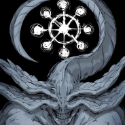
VIROS 2915 Popular Post Share Posted November 22, 2020 ON ASIOTH An Exposé by Caspian of Rhen ((The information presented here is not public knowledge. The exposé and documents herein are held in Roteth'Dravoz.) Asioth (pronounced ‘aa-see-oth’) translates literally from Draconic as “the gift of divine privilege”, and it is the spiritual objective of the eponymous philosophy Asiothism. The school was founded by the Great Titan Azdromoth, firstborn of the Drakaar, with his authorship of The Aurelects during an extended captivity. This set of thirteen hexametrical poems purports to be a guidebook to the achievement of Asioth, whereby the individual reaches a kind of gnosis or apotheosis: the full realization of his unity with the world, simultaneously with his own essential selfhood and that of all others. The first poem of the Aurelects is The Divine Gift, and at fourteen verses it is the longest. The following twelve poems are ten verses each and come in pairs of two called doublets: one Fire and one Vessel, each using language parallel to its partner to describe Asioth. Each Fire is a chapter in the life of Azdromoth, and each Vessel is a description of the world’s current state. The relationship between each Fire and its Vessel mimics the relationship of the Sun and Moon--the Fire is a luminary of its own, and the Vessel reflects its light into a new concept. The language of The Aurelects is descriptive and symbolic, apparently meant to stimulate insight in the reader. It is intensely self-referential, and many of the same terms or turns of phrases are repeated in different contexts or with slight variation. Each doublet discusses the Azdromoth’s acts, his relationship with his followers, or the nature of Asioth using a unique theme. For example, the Fire of Love characterizes Asioth as the bond between husband and wife, while its twin the Vessel of Strength discusses the bond between king and subject; the Fire of Growth characterizes Asioth as the growth of a seed into a tree, while the Vessel of Grace uses the metaphor of developing a book from an outline. Aside from Azdromoth’s Aurelects, the greatest work on Asioth is The Commentary of Eresar sin Nathemas, written by the elf of that name, who has been a companion of the Great Titan for several centuries. It contains sayings (probably apocryphal) of Azdromoth, and the teachings of Eresar to his students. Its tone is distinguished from The Aurelects by short, plainspoken, and often surreal descriptions of encounters between Eresar, Azdromoth, and other figures. Critics and layman initiates of Asioth are often told to read The Forgery of the Gate, a short letter by an anonymous student of Eresar. The body of the text makes no explanation for its ironic and ambiguous name--this, too, is likely intended to stimulate insight in the reader. Adherents to this school often call themselves Seekers of Asioth (or Heralds), and walk the pilgrimage of The Auric Path as a method of attaining insight. Before embarking, they are given a question called an Um’ei, or “Sacred Journey”, which they are engendered to answer at each stop. Upon completing the pilgrimage, if the teacher is not satisfied with their response, the student is sent forth again. This exposé presents the documents mentioned in the following order: The Aurelects, The Commentary, The Forgery, and finally, a collection of common Um’ei. The Aurelects, 13 Lessons of the Great Titan Biographical Element Thematic Elements The Divine Gift - - Fire of Vitality Vessel of Eternity Creation World (Waters/Trees) Body (Blood/Bones) Fire of Insight Vessel of Knowledge Exploration of the world Forms (Eye/Crystal) Names (Voice/Thunder) Fire of Love Vessel of Strength Covenants with man Marriage Fealty Fire of Splendor Vessel of Triumph Slavery to Iblees Conquest/Hate Rulership/Envy Fire of Growth Vessel of Grace Captivity Conception/Germination Painting/Writing Fire of Exaltation Vessel of Sublimity Freedom The Heavens The Earth THE AURELECTS The Divine Gift That which is within is like that which is without; that which is without is like that which is within. All things ariseth from One by the will of One, and so all things cometh from this subtle process. Fire shineth brightly upon its own vessel, as the heavenly sun’s light filleth up the moon. So cleavest thou sweetly the fire from her source, taking only the light that stretcheth between them. By this means thou mayest win the golden Asioth, and all deficiency shalt be taken from you. Herein is held the power beyond all power, that revealeth the subtle and hideth the known. By Asioth is every world created, for this is the golden gift of eternities. Fire of Vitality First, the World was a tossing sea of red waters. The waves crept and were still; they rushed and were frozen. Asioth was hidden beneath the darkest depths. Rising up, a golden sun clove One into two Buoyant waters rushed into the chasm: red-gold. Being, the red light waxed; Knowing, the gold light waned. Timeless insight froze the First-Born from red waters; His blood was red flame in an alabaster heart. Within, red-gold showed vigor in the darkest depths. First-born lapped up buoyant waters: vitality. Vessel of Eternity Last, the World is a misty weald of white branches. Trees reach for the heavens; they seek without growing. Asioth is shining above the bright heavens. Waxing out, a silver moon cleaves two into One. Spectral branches weave throughout each other: white-gold. Loving, the white light grows; Wanting, the gold light dies. Lively knowledge carves the First-Born from white branches; His bones are pale stone beneath plates of black onyx. Without, white-gold hides ages in the bright heavens. First-born tears down spectral branches: eternity. Fire of Insight First-born looked upon the World, seeing many forms: like crystals, his eyes fixed wavering lights in place. Unseen, he showed Second-Born the timeless insight. Asioth shone from brother to brother: unsaid. Crystals hummed like thunder, molding formless homelands; First-Born watched above them, eye casting over all. His brothers hid at the edges of his vision; watching, they each lit their flames with his blazing eyes. Now rose Asioth of One sight, voice like thunder. Last, First-Born revealed the humming crystal: insight. Vessel of Knowledge First-born chronicles the World, naming many kinds: like thunder, his voice envelops uncertain truths. Unsaid, he tells Second-Born of lively knowledge. Asioth sighs from lover to lover: unseen. Thunder shines like crystals, dubbing nameless nations; First-Born lives among them, voice calling to them all. His lovers whisper in stillness of his absence; hearing, they each fill their throat with his glowing voice Now comes Asioth of One word, eyes like crystals. First, First-Born describes the shining thunder: knowledge. Fire of Love Now the World was loved by good husbands and sweet wives, whom sons of timeless insight did rule lovingly. Cherishing First-Born, nations vowed themselves to him; Asioth was a golden band on their fingers. Their hearts: buoyant waters filled these red-gold vessels, and he was held with caring passion over them. First-Born’s household did grow, and he vowed to new kin; by him they ever multiplied across the lands. Golden fires shone brightly on their loving hearts. First-Born ruled royally these red-gold vessels: love Vessel of Strength Now the World is ruled by great kings and their subjects, whom sons of lively knowledge do love royally. Revering First-Born, subjects pledge themselves to him; Asioth is a silver seal on their fealties. Their souls: spectral branches hold these white-gold fires, and he is filled with mighty power over them. First-Born’s people thrive, and he accepts their pledges; by him they never diminish with the ages. Silver vessels are made full by their royal souls. First-Born loves lovingly these white-gold fires: strength Fire of Splendor First-Born wreathed his household in a sublime beauty; from empty silence, a fallen prince hated them. An adversary soared from his silent limbo, pledging First-Born glory greater than Asioth. Thus First-Born conquered nations with his glowing voice; Asioth was the noble grandeur of his throne. Full of vengeance, royal subjects turned against him, and their silver seals held him in the darkest depths. In limbo, First-Born clove the fire from her source, the adversary of the fallen prince: splendor. Vessel of Triumph First-Born guards his people with a noble grandeur, from silent limbo, a fallen prince envies them. An adversary broods in his empty silence, vowing First-Born vengeance greater than Asioth Thus First-Born watches subjects with his blazing eyes; Asioth is the sublime beauty of their crowns. Full of glory, loving nations bow before him, and their golden bands hold him in the bright heavens. In silence, First-Born shines between them all like light, the adversary of the fallen prince: triumph. Fire of Growth The World was a fruitful womb of red earth: a cage. Below, a white-gold seed, First-Born, became himself. Thus a sapling of Asioth emerged unseen. Lively knowledge was as sunlight upon its leaves. Above was a misty weald of noble grandeur; its spectral branches held fruit of golden fire. The tree of Asioth nourished landless nations, and subjects formed themselves upon its red-gold earth. Thus First-Born won the golden prize of his freedom, escaping captivity by Asioth: growth. Vessel of Grace The World is a blank canvas of white slate: a muse. Above, a red-gold spark, First-Born, creates himself. Thus an outline of Asioth appears unsaid. Timeless insight is as pigment beneath its strokes. Within is a tossing sea of sublime beauty; its buoyant waters fill words like silver vessels. The book of Asioth teaches ageless subjects, and nations name themselves upon its white-gold slate. Now First-Born frees his students of deficiency, inspiring artistry by Asioth: grace. Fire of Exaltation For First-Born, his royal kin climbed the bright heavens, and brought him the sparks of starry grandeur held there. Loving, he lapped up the red waters of their muse, and raised them upon a throne of shining thunder. In turn they filled his vessel with timeless insight, and wrote his name upon the book of Asioth. Like the golden sun was above the misty weald, a thousand lives were warmed by but a single source. Asioth held the power beyond all power. Each was raised above his brothers: exaltation Vessel of Sublimity For First-Born, his loving kin plumb the darkest depths, and give him the seeds of earthly beauty held there. Being, they tear down the white branches of his cage, and put upon him a crown of humming crystal. In turn he lights their fires with lively knowledge, and seats them all beneath the tree of Asioth. Like the silver moon is within the tossing sea, a thousand lights reflect from but a single source. Asioth reveals the subtle and hides the known. Each is found within his brothers: sublimity. THE COMMENTARY OF ERESAR SIN NATHEMAS On Asioth The words of the Teacher, Eresar sin Nathemas: The philosophers speak of equal opposites. But bringing these together, nothing results. First and second are neither equal nor opposite. Light is greater than darkness, but there is no light without darkness. There is no first without second. The source begets the river But without the river there is no source Who can say which is greater: that which is first, or that which is last? It is the order that begets them Here is the secret of Asioth: Greater loves lesser; core loves periphery. Parable of Horen Horen encountered the Great Titan on the road, and said to him “I have never said anything the truth of which I was not completely certain.” The Titan said unto him “Be thankful I do not say the same.” On Heaven and Earth One morning, a student reported that he had dreamed a vision in which he departed the earth and reached high into the heavens. The Teacher said to him “Heaven that can be reached is not heaven, and Earth that can be departed is not earth.” Parable of Malin Malin once asked the Great Titan “Where is the threshold at which the grove becomes sacred?” The Titan said unto him “The grove becomes sacred when you enter it.” On Teaching The Teacher announced to his students “Today, I will teach only what I have taught before.” A student said to him “You are a liar.” Parable of Urguan Urguan told the Great Titan “My granary is empty! How will I fill it?” The Titan said unto him “Tear down the eastern wall.” On Absence The Teacher held up a ring while teaching, and he asked his student “What is this made of?” The student said “It is made of silver and emptiness.” Parable of Krug The Great Titan came upon an orc about to be executed. He asked Krug “Why is he to die?” Krug responded “So others will know it is a wicked thing he has done.” The Great Titan said unto him “It is good he did it, then.” On Teachers and Students A kind person is the teacher of the wicked. A wicked person is a lesson for the kind. Do not think of teacher and student. Proceeding from one to the other, the lesson is what defines them. Each teaches the other; each studies the other. Parable of the Astrologer One evening, an astrologer saw the Great Titan as a Drakaar flying above, and begged him to come down. The Titan descended, and the astronomer spoke to him “Titan, I have seen the stars in heaven, yet I wonder what is above them. What is outside the world?” The Great Titan said unto him “Unask the questions. Without boundaries, there is no outside.” On Love Asioth reaches out forever. Reaching out, it reaches in. Who can answer the riddle of loneliness? Love needs another. Parable of the King A king requested the Great Titan visit his court. In his audience, the king asked “How does it feel to attain Asioth?” The Titan extended his empty palm and said to him “How does this apple taste?” On Law Kind and foolish, a king kept the law but neglected the sentence. Carefully, he tallied the crimes of his subjects. On their day of judgement he cast his records into the fire. Who can call the king merciful? Parable of the Sage Eresar confronted the Great Titan on a mountain path, and said to him “What are the merits of Asioth?” The Titan took his draconic form and engulfed the sage with fire, but it passed over him like a breeze. Eresar bowed to him. On Wind Two students were arguing as they watched the wind rustling a tree. The first said “It is the wind that moves.” The second said “It is the tree that moves.” Eresar said unto them, “It is your voice that moves.” Parable of the Student A student of Eresar encountered the Great Titan in the courtyard, and said to him “Master, I have stayed awake three days and three nights contemplating truth. Please tell me, what is the essential nature of Asioth?” The Titan told him “If your bed is uncomfortable, try stuffing your pillow with rubies.” On Ignorance A student came to Eresar and asked him “My sister is deaf and blind. If she cannot be taught Asioth, what worth is it?” Suddenly, another student ran across the courtyard and punched his peer in the nose. Eresar asked “Did you not hear him coming? Did you not see his hand?" Parable of the Priest The Great Titan was walking in an orangery when a priest approached him and said “Unlike the Virtue, your Asioth bears no fruit.” The Titan plucked an orange from above and offered it to the priest, asking him “Do you prefer it with the rind, or without?” On the Path A student asked Eresar “Where does the path to Asioth begin?” Eresar told her “Three feet to your left.” The student responded “Is that all? Surely not.” Eresar said “If that is not enough, you will need to begin by walking up Mt. Augustus backwards and blindfolded.” Parable of the Shaman A shaman came upon the Great Titan in the desert and asked him “Do the ancestral spirits know Asioth?” The Titan said to him “None that you have met.” On Death Some men say there is no judgement after death. But among everything under heaven, what comes to an end without balancing? The body returns to the earth, the breath returns to the lungs, the fruit returns to the tree, and the mind returns to Asioth. Parable of the Merchant A merchant asked the Great Titan “How can I attain Asioth?” The Titan said to her “I will trade you mine for that ruby.” On the Aurelects A student came upon Eresar reading in the library and asked him “Teacher, will you recite the third line of the Vessel of Grace?” Eresar responded “I have yet to reach it.” Parable of the Drakaar A Drakaar encountered the Great Titan in flight and said to him “I have read your book. I, too, have a glowing voice.” The Titan said to him “That is nonsense. How can a voice glow?” On Fishing Eresar came upon a student who had been silent for three years, and asked him “How does silence attain Asioth?” The student responded “Words are a net and Asioth is a fish.” Eresar said to him “I have never gone three years without a meal.” Parable of the Farmer The Great Titan landed in a field and asked its farmer “What is timeless insight, if wheat is only harvested in autumn?” The farmer said to the Titan “This is winter barley.” On Royalty A queen was visiting Eresar’s school, and was commanded to leave her regalia in the vestibule. That evening, she encountered the Teacher in the hall wearing her diadem. Eresar began to lecture, but the queen slapped him. She said “I already have a fool in my retinue.” Parable of the Orrery-Keeper The keeper of the orrery asked the Great Titan “Master, who decides the motions of the celestial bodies: the orrery, or the heavens?” The Titan said to her “This morning you decided the motions of the celestial bodies. Now, it is I who decides.” On Pilgrimage A student was preparing for his sixth attempt at pilgrimage and he asked Eresar “Teacher, when will you accept my answer to the Um’ei?” Eresar said to him “Fool! Give me your pack, now I must go myself.” Parable of the Artisan The Great Titan and Eresar encountered an artisan carving a statue. Eresar asked the artisan what he was carving, who responded “I am carving Asioth.” The Teacher said to him “Your studies have become distracted.” The Titan said nothing, but later asked of Eresar “At what point were his studies distracted?’ On Answers Eresar asked his student “Where is the white-gold seed planted?” to which he responded “In the red-gold earth.” The Teacher said “No. Go and re-read the Vessel of Growth” to which the student said “But I have asked you the same question, and that is what you told me.” Eresar asked him “What is your name?” THE FORGERY OF THE GATE Student, With the leave of Teacher Eresar, I have written this exegesis, intended to introduce the layman to our philosophy. Asioth is an escape from the restricting net of language (even here, to describe it so, is inaccurate). However, although the map is not the territory and the word is not the thing, each of the former is a sign that points us to the unutterable. Thus, Asioth is the realization that the world and all of our experiences are meaningless--not in the sense that they are pointless or worthless, but in that they lack meaning. Unlike a map or a word, the world (read: everything, real and unreal) does not signify something greater than itself: it is itself. Further realization of Asioth reveals that it is not the acceptance of a hidden truth which cannot be spoken, for this would place outside of the world the idea of “meaning”, and imply that things which point the way are illusory or false. Yet does a horizon or a rainbow have any physical, underlying truth? Each is only the product of a mind’s perspective as it witnesses a collision of certain physical accidents. Stand in a natural grove and listen to the combined music of a river, a bird, and rustling branches. There is no composer to this music; if you were not there, the birds would still sing and the river babble, but it would only be music when you listened to it. Although the author intends a certain story when he writes a tale, the reader’s takeaway is always unique. This argument may seem so abstract as to be trite, but it is the key to understanding Asioth. It is also the fundament of our philosophy’s connection with the Drakaar, or dragonkind. The Drakaar do not reproduce as mortals do, with our lack of control over the process of reproduction and what it produces. Their children are sculpted, as an artist works clay, and so they have unique insight into the relationship between creator and created. When mortals breed and rear their young, the process is so unconscious that many do not realize they are participating in the creation of a new world. The way in which they teach their child, and even by the choice of making that child, impacts the development of a new consciousness: a new reader, who offers a singular perspective on the story we all share. Recognizing this, the Drakaar assert both their own selfhood and their universal interdependence in the act of creation. Last, whatever I have written here is only my own apprehension of Asioth. Similarly, whatever is written by Eresar or the Great Titan are only theirs. The seekers of Asioth have a saying: “if you see yourself on the path, turn back.” That is, there is no creativity, and thus no realization of Asioth, by making copies of yourself. Neither is there Asioth in the negation of all but itself, for this is an attempt to make it separate or other. Learn, improvise, imitate, and elaborate upon your wisdom and that of others, as the composer writes variations upon a theme. COMMON UM’EI How is Asioth attained? When was the origin of all things? Who is the Great Titan? What fills the Vessel of Triumph? Where is the spring of buoyant waters? What is the sublime beauty? Who is the adversary of First-Born? What is the subtlety of timeless insight? What is the difference between red-gold and white-gold? What is immortality, if time is finite? When is the Great Titan absent? Who is Second-Born? What is royalty, if each of us is found within his brothers? What is the Um’Ei? What is the contest of the golden prize? What shines between the fire and the vessel? What is the significance of the cage and the muse? Why did First-Born dub the nameless nations? How is deficiency removed? Where is the silent limbo? Why did First-Born seek a prize greater than Asioth? Where is the white-gold seed planted? How are the bright heavens reached? How can one know the moon from its reflection? Who are First-Born’s royal kin? How does one create himself? What is written in the book of Asioth? Who is the author of the Forgery of the Gate? 86 Link to post Share on other sites More sharing options...
Malaise 1570 Share Posted November 22, 2020 (POST RESERVED) 7 Link to post Share on other sites More sharing options...





.thumb.png.4e5370fc69f142d96a905e477cd5dd97.png)







Recommended Posts