Jump to content

THE WINTER CROWS: Volume XIV; Andrik III - The Great (I)

 Share


Nectorist

Recommended Posts


THE WINTER CROWS: Volume XIV; Andrik III - The Great (I)

Written by Demetrius Barrow

image.png.902ec417294548869ee842653e66bada.png


Andrik III - The Great (I)

image.thumb.png.7cd78a92d8bf4628d7e104f54af181ac.png

“If you look into the mouth of the beast, its teeth are not so plentiful, not so sharp, as one might first assume. Unfortunately, that analysis means little when your head is halfway up its maw.” - Lerald Stafyr, Count of Graiswald and Lord Palatine of Haense, c. 1723


The dream of Joseph Marna was dead. The rebellion against Godfrey II, the Emperor of Man, was dead. Tens of thousands of Haeseni, if not hundreds of thousands, were dead.


King Marus II of Hanseti-Ruska was dead.


To take his place was his son and heir, the nine year old Andrik Lothar, who on the 12th of Owyn’s Flame, 1719, became king of a realm that was now ablaze in the fiery horror of a war that had been lost years before. However, on account of his age, it was not his problem to confront. True power was held in the hands of the regent, Prince Georg Alimar, brother of the wealthy Red Prince of Muldav, Josef Alimar. The two brothers had often found themselves at odds with King Marus, but they had remained loyal vassals until the end, and now were two of the only men able to guide the realm. A generation of nobility, the men and women expected to now lead Haense in its darkest hour, had been slaughtered in battle along the banks of the River Rubern, died of sickness outside the walls of Helena, or been burned within their homes, now set upon with impunity by Renatian raiding parties.


One would assume that now would be the time to explore some of Andrik’s earlier childhood, in the short few years before the War of Two Emperors, but in his own words:


“The war was my mother, the loom of death was my father. Their embrace was cold, unforgiving, one that brought me to tears more times than it ever comforted me, yet it spared me from the heat and prevented me from being consumed.”


Andrik Lothar was born on the 8th of Horen’s Folly, 1710 to a father who had overseen Haense’s ascension to its greatest heights a year before, but the great intrigues of the reign of Marus II were unfamiliar to him. His older half-sisters, Mariya Angelika and Sofiya Theodosiya would feature more prominently in his life than either his father or his mother, Queen Klaudia of Vasiland, but the pair had been warded to the wealthy, loyal Red Prince of Muldav further south, so they were barely present in his early life as well. He had younger siblings, but they did not seem to have a great effect on his life either. By the time the war began, when the Grand Prince of Kurosaev, as all heirs to Hanseti-Ruska were designated, he was a relatively isolated five year old boy.


In part because of the lack of oversight of his education and upbringing, which his parents left to others, Prince Andrik was notoriously ill-mannered and reckless, though conversely bright and gregarious. His antics and pranks seem to have mostly been limited to those in charge of his care and hapless vendors on the streets of Reza. He easily befriended soldiers of the Royal Army and fellow children of his father’s court, demonstrating a youthful charm that would never leave him. Even before the hardships of the war, his energy, as troublesome as it could be, breathed life into a royal family that had been molded by the often oppressive atmosphere of Marus II’s reign.


However, on the 12th of Owyn’s Flame, 1719, the boy’s youth, once seen as a symbol of a warm future during the summer of Marus II’s rule, was now a complete liability. The person who sat the throne, as the legions of the Empire marched against it, was too young to act. His recklessness, once a fiendish, yet harmless, quirk was something that had to be hidden away. What few shopkeepers could keep their stores open could not afford to have even a single small, withered apple stolen for the young prince and his friends to share. His charming sociability, once an endearing feature of the heir to the realm, would not be enough to turn the hearts of the generals and regents of Emperor Godfrey II, who were intent on exacting revenge against the realm that was the beating heart of Joseph Marna’s failed revolution. 


Thus, this tale turns, for a brief time, away from the young king, Andrik III, and towards the end of the war, to be decided not by those who held the rungs of power: namely the House of Alimar, as well as the Baron of Rytsburg, Lerald Vyronov, the Lord Palatine and one of the last few experienced statesmen in the realm who had not perished during the war. The situation was beyond dire: the Baron of Koravia, Otto Kortrevich, had garrisoned Reza with 3,000 soldiers, though disease and desertions were whittling these numbers quickly. A mere few weeks away, Sir Martinus Horen, at the head of an army of 9,000, was advancing quickly towards the capital.


The news became worse before it became better. Mere days after King Marus’s assassination, Prince Georg was informed that Prince Alfred Myre of Ves, one of the last few of Haense’s faithful allies, had also been killed within his palace walls. The prince chosen to replace him had come from the patrician class, which had little love for the Barbanov Dynasty, and much less for the war. Peace was soon signed, and the birthplace of liberalism fell beneath the fold of Pertinaxi tyranny once more. The few soldiers that Sir Martinus had assigned to pressure Ves were given orders to make way towards Haense.


Possessing few options, Prince Georg made a move wrought with desperation. The regent declared Haense to be independent from the de facto defunct Holy Orenian Empire, and renounced its role in the rebellion and pledged to remove any remaining Marnan elements within the realm. Unsurprisingly, this hollow gesture backfired. The Imperial regents rejected anything short of an unconditional surrender. The Prince of Fenn, the last major ally of Haense remaining in the war, perceived the regent’s action to be an attempt to escape the war and instead redirect the focus of Renatian aggression towards the elven realms (which it was). A few weeks after Prince Georg’s attempt at peace, Prince Aelthir Tundrak negotiated his own.


After the debacle of the peace efforts, some good news did come. On the 11th of Tobias’s Bounty, 1719, a small band of Reivers attacked the Renatian siege camps along the banks of the Silver Sea. Much of the Imperial siege weaponry was burned and destroyed, and thousands of soldiers were slain, before Sir Martinus could rally his soldiers and drive the Reiver force out. The bandits paid for this effort with their lives, being killed nearly to a man, but their efforts had bought Prince Georg another few months of time. Unfortunately, time meant little to a kingdom that was out of both money and manpower by which to utilize it.


By the next year, Sir Martinus’s armies had regrouped, and the feared general was on the march towards Reza again, this time at a deliberate pace, wary of a Reiver attack that would not come. Owing to the desolation of the Haeseni countryside, inflicted by orcish and Norlandic raiders, the Imperial host was relatively smaller. Only 7,000 soldiers marched through the thick Koengswald, the great forest west of Reza, so that initial siege preparations could be made. After conferring with the Baron of Koravia, Prince Gerog agreed that this would be the final opportunity to deal any kind of blow to the Renatian army, one that could possibly give them space to make peace. 


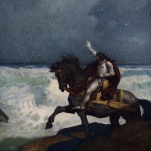
On the 12th of Sigismund’s End, 1720, before the waving Andrik III, now faintly aware of what was happening, Prince Georg rode at the head of the Haeseni army to fight what would be the last battle of the War of Two Emperors.


The 3,000 Haeseni that marched from Reza were a far cry from the 15,000 that had done so just five years earlier. Gone were the grizzled mountaineers and dashing knights. No longer did powerful lords lead their hosts, equipped with the finest steel money could buy. Most of what remained were starved peasants driven from their tenant farms, carrying only sickles. Grey-bearded, maimed veterans of the wars against Aurelius solemnly trudged through the mud-covered roads as they prepared to relive the events of forty years ago.  The few soldiers that still bore arms and armor of some quality were given limping palfreys and old farm horses so that they could form a guard around Prince Georg. When they finally came face-to-face with the Imperial army on the 25th of Horen’s Calling, 1720, in an unmarked place in the middle of the Koengswald, they all gave a final prayer to the Lord.


The Battle of the Koengswald went about as disastrously as could be expected. To open the engagement, Duke Konstantian of Vidaus rode forth alone to challenge Sir Martinus to a duel, hoping to at least balance the scales of morale. Although brave, the effort was futile. The former Lord Palatine was killed in under a minute by the Empire’s most brilliant swordsman, who, after ensuring the body was returned to the Haeseni lines, ordered his soldiers to advance. The ensuing melee lasted less than fifteen minutes before the faltering Haeseni broke and fled, only to be cut down mercilessly by the Renatian cavalry. Prince Georg and his brother, Prince Godfric, were only barely able to escape, though they were separated from their men.


The brothers fled towards Rytsburg, but the dwindling of daylight forced them to spend the night at an inn just a half day’s ride away. The intention of the regent was almost certainly to find shelter in the seat of House Vyronov before returning to Reza, but his plans would not get that far. The next morning, the Alimar brothers were awoken to the sight of a dozen Norlandic spears mere inches from their faces. A minor chief and his followers had gotten lost the previous night while in pursuit of the Baron of Koravia, only to stumble upon the tavern by accident as the sun rose once more. Their bumbling mishap had resulted in the capture of the regent of Haense and his brother, by far the greatest prize of the war.


Now prisoners of war, Prince Georg and Prince Godfric were unceremoniously delivered to Helena, chained in the back of an ox-drawn cart. The Aulic Council in Reza, paralyzed by leaderlessness, and still ignorant of the fate of the man who guided it, did not send a force to try and rescue the two. In Helena, the brothers were tortured on the order of the Lord Justiciar, brought before the jeering throngs of the Imperial capital, and beheaded within the city square. Only then, as news spread of the death of the regent and his brother within the capital, did the Aulic Council learn of the true extent of the battle’s ramifications. 


image.thumb.png.957718741f5489d23d25bbe301559d98.png

The tragic death of Prince Georg Alimar has often been compared to that of his ancestor, Prince Karl-Sigmar of Bihar. Both men were young princes, inexperienced in war and politics, thrust into leading the regency for a boy-king during a war of national survival. Both died at the age of twenty eight while leading the Haeseni army 


Prince Georg’s natural successor to the regency was Lerald Vyronov, the Lord Palatine. Although the Baron of Rytsburg had been an obscure figure during the reign of Marus II, barely a fixture of the court, the culling of the high nobility over the course of the war had enabled his ascension. House Vyronov, whose fortunes had not recovered since the Great Northern War over a century prior, was a poor family whose lands encompassed little more than a few villages within the sparsely-populated Koengswald. Although most of these settlements were destroyed during the war, Baron Lerald had opened his castle’s gates to those who could not flee to Reza. His assistance in governing the seized lands of Carnatia also earned him some repute, and by the height of the war he counted himself as one of the few ‘war administrators’- those whose service to Haense came not on the battlefield, but within the Prikaz Palace.


Despite his experience, the initial challenges that the new regent would face were beyond his capabilities, though few others would have flourished under such strain. Curiously, he first turned to handling some of the paperwork that had been neglected by Prince Georg, and even King Marus, over the past two years. On its face, this appeared to be a horrible choice of priorities, as Renatus, now bearing down on the capital, would be besieging the city within days. 


In practice, the decision was not entirely senseless: the defenses were already being overseen by the High Seneschal, Siegmund Corbish, and the Baron of Rytsburg was not martially-inclined. The reason why this decision ever became controversial (a mass-publication of backdated edicts and missives would have hardly garnered any notice under the circumstances) was because one of them, more likely signed and stamped by a secretary, was an award for the County of Graiswald to Lerald Vyronov, drafted in 1719. Graiswald was a rocky, barren land that housed nothing more than a small keep, but in the minds of those who cared to read the edict, it looked as if the regent, now the Count of Graiswald, was giving himself lands and titles while Reza was threatened with imminent destruction.


The arrival of Sir Martinus and his 8,000-strong army on the 16th of Sun’s Smile, 1721, turned the growing trepidation within Reza into a full-blown panic. Spontaneous riots, fueled by fear, famine, and foreboding, stretching Otto Kortrevich’s resources thin. “For every soldier posted atop the walls, we are forced to put two to each shop in the city. It is not because a single guard may be under threat so much as it is necessary to ensure that they do not take advantage of their position and enrich themselves upon the meagre spoils to still be found,” wrote the Lord Marshal in his diary. The end of Haense was nigh, so thought its people, but unlike Tobias the Conqueror, or even Aurelius, who had proven themselves merciful at times, the Pertinaxi that now ruled would surely see that every last man, woman, and child, was killed.


On the 19th of Sun’s Smile, 1721, Sir Martinus rode to the gates of Reza, alone, armed only with the standard of the Empire, and summoned the regent to his tent. Diplomacy would be had.


The Count of Graiswald, who feared that he would be slain in an act of treachery, was greeted with wine, meat, and fruits brought from the south. Treated as a guest of honor, the regent found no chains, not even a single weapon, within the general’s pavilion. Instead, the two, surrounded by the quiet company of a dozen of the Empire’s high lords and generals, spoke at length. At first, they did not speak of the war, nor of the war’s end, but instead of their homes, their families, and their friends, ruined or spared from the horrors of the war. Only after the plentiful flow of wine dulled did the two turn to the discussion of concluding the rebellion that had nearly undone the fabric of humanity, and still threatened to do so if left to continue.


Sir Martinus began by ordering the bodies of the Alimar brothers, Prince Georg and Prince Godrfic, to be brought forth. As he stood over the golden caskets that entombed them both, the somber Horen offered his sincerest apologies. It had never been his intention to see them so cruelly tortured and executed. “Warriors they may not have been, yet the devotion to one’s people, one’s liege, and one’s country, may still guide the arm as would a dozen years of training. Although I defeated them both, I will stand in defense of their honor and conduct against those who would seek to impugn it.” As an additional gesture of goodwill, he ordered the two bodies to be sent to Muldav, so that they could be buried with dignity.


The negotiations continued for a week, but there were few matters to be debated. Sir Martinus’s personal intervention had saved Haense from destruction, but they would still have to pay the price for rebellion. Under the terms of the Treaty of Reza, Haense would cede Leuven to the Empire, along with the Haeseni Crown’s own lands in Ves, allow for a Legion garrison to be stationed in Reza, pay yearly tribute for an indefinite amount of time, and recognize Godfrey II as the rightful Emperor of Man. Other minor terms rounded out the comprehensive agreement, but the crux of the peace was clear: Hanseti-Ruska would be left intact but too weak to repeat the course of action that Marus II had taken. In what would be the second and final rebellion against the Empire in all of Haeseni history, it emerged from the war as little more than a burnt, starved husk.


Nonetheless, to the refugees huddled within Reza or in hiding in the bogs and makeshift shelters of the deep woods, the standing of the realm did not matter. The war had ended, and while there was no cause for celebration, there could be a period of relief that had not been felt in five years. Aided by food relief brought by Sir Martinus, life in Haense could resume once more. Families, broken as they were, slowly returned to what was left of their homes to rebuild their lives. The young sons and daughters of the lords who had perished during the war followed the peasants, taking their place as the new generation of the Haeseni nobility. The Aulic Council, having exhausted itself during the war, was ordered by King Andrik to rest for a full week. Their jobs were far from finished, but the occasion could permit a moment of stillness, where one need not worry about the twists and turns of politics.


However, before peace could grace the lands of Hanseti-Ruska, before the healing and reconciliation could begin, a final tragedy struck. Prince Josef of Muldav, who had spent the past few months at his estate, guarding the lives of Princess Mariya and Princess Sofiya with what few men he had, died two weeks after the ceasefire, on the 5th of Harren’s Folly, 1721. During a routine patrol around Muldav, a flash flood swelled the rivers, forcing the Red Prince and his soldiers to return to the castle. However, the waters rose quickly, and they soon found themselves neck-deep beneath the rushing tides. Ever a brave servant of his country, and a generous man, the Red Prince gave his horse to a struggling guardswoman so that she could return safely, allowing himself to be swept up in the surging river. The body of the Red Prince of Muldav, the last of the great lords from the reign of Marus II, was found two days later by an Imperial page traveling to Muldav to bring news of the war’s end. 


On the 18th of Owyn’s Flame, 1721, Emperor Godfrey himself arrived in person to formally sign the peace and bring a conclusive end to the War of Two Emperors, though still being in his minority, he was joined by Sir Martinus and his wife, Empress Adeline. King Andrik, in what would be his first true act as the sovereign of Haense, awaited inside the Prikaz with the Count of Graiswald. Immediately after jointly signing the treaty, the child-Emperor and child-king went off to play, leaving the other three to discuss the process of Haense’s reintegration into the Empire. Over the clacking of wooden swords and the sloshing of grape juice (which the two boys pretended was wine), Sir Martinus, Count Lerald, and Empress Adeline charted the future of the reunited humanity. The ‘Playdate Conference’, as it came to be called, was an immense success, and while enmity between the Crownlands and Haense remained, the leaders of both could at least see a path forward where hopefully, one day, the Empire could be made whole again, in a way it had not been under the Pertinaxi.


With peace in hand, and the ability to guide the realm’s recovery, the Count of Graiswald could finally deal with matters that suited his expertise. The problems that faced Haense were as severe as they were plentiful: the treasury was out of money, the army had been shattered, the bureaucracy was in tatters, the nobility had been gutted, and depopulation and desolation had ruined the countryside. If there was one silver lining to be found in the situation, it was that King Andrik and the regent were firmly secured in their respective positions. So long as they proved able to guide the realm’s restoration, they would retain the confidence of their subjects. 


Building a new base of support was the regent’s first priority. Both the new Red Prince of Muldav, Kazimar Alimar, and the new Duke of Vidaus, Viktor var Ruthern, were still in their minority, meaning House Barbanov would have to look outside of its traditional allies. Count Lerald first turned to House Baruch, which had seen its lands and titles revoked when Jan Baruch, the Count of Ayr, had betrayed the realm at the outset of the war. The late traitor’s son, Sigmar, who was only six at the time, had remained a page of the Prikaz Palace throughout the war, and the rest of House Baruch had fought for King Marus, wishing to prove their loyalty. Demonstrating a craftiness that would come to define his time as regent and Lord Palatine, Count Lerald agreed to return the County of Ayr to House Baruch, but it would be on the condition that he sit as regent until Sigmar turned twenty. Eager to be restored to the royal graces, House Baruch agreed, netting King Andrik both their undying fealty, but also the rule of their lands.


House Kortrevich, which had firmly established itself as the leading vassal in the kingdom, was further rewarded for their efforts. The Baron of Koravia had tendered his resignation from the marshalcy, citing his failure to deliver victory for Haense, but he was asked to stay on the council to oversee several reforms. Ser Nikolaus Kortrevich, who had proven his valor and skill on the battlefield during the war, emerging as one of Haense’s few heroes, was confirmed as Knight Paramount and leased a few tracts of land near the River Rubern with which to have an additional revenue stream to support the Marian Retinue. A third Kortrevich, Martin, was named Aulic Envoy, reviving the office which had fallen into abeyance during Marus II’s reign. It was no empty post: Haense’s reputation and alliances would need to be rebuilt, and House Kortrevich was one of the few families that could be trusted with the responsibility.


New men were also raised during this time. In 1724, Wilheim Barclay, another one of the surviving heroes from the war, was awarded the Barony of Freising in recognition of his service. His family, which had occupied several key military and government positions towards the end of the war, was quickly rising to become an important cornerstone of royal authority. Their rise mirrored that of House Kortrevich before the war, and it was not long before the two families were regarded as the Rutherns and Kovachevs of the new era.  


Although the great houses of Haense independently rose and fell during this time, their collective power within the government increased. The Count of Graiswald’s influence was immense, but it was far from total. The recovery of the realm still required the full cooperation of the nobility, which would have to manifest itself within the Duma. The body, which had been little more than a rubber stamp for Marus II, saw its influence grow during Andrik III’s regency. Ser Konrad Stafyr, a respected soldier and statesman, became Speaker of the Duma in 1723, in a compromise between the regent and the assembled nobility. A gifted orator and a forward-thinking legislator, Ser Konrad was one of the few individuals able to balance the needs of the state (economic recovery, rural repopulation, military self-sufficiency), the desires of the crown (centralized power, security for King Andrik), and the desires of the nobility (tax exemptions, greater oversight of the royal government). 


Through a combination of sheer necessity, Ser Konrad’s steady guidance of the Duma, and Count Lerald’s flexibility, the government was slowly reconstructed to fit the new demands of the state, one that had moved away from its war footing. Swithun Aldor’s retirement in 1719 had left the Office of the High Justiciar empty, and the subsequent Imperial invasion meant that, while in a state of martial law, law and order in Haense was left to the army. Given that the war was over, the challenges posed by recovery- tax enforcement, inheritance disputes, land surveying, etc- would need to be addressed by a defter hand. Ser Gerad Stafyr, the elder cousin of Ser Konrad, was another compromise choice between the crown and the Duma: he would gently respect the interests of the nobility while upholding the honorable conduct that the office demanded.


At the same time that the realm was recovering and changing, Andrik III’s own rule evolved. For the first part of his reign, he had been content to live out his youth, making mischief and learning what little his tutors could make stick in his head. “Only when swords were brought into the room, or the page turned to the discussion of battle, did His Majesty’s head crack like a whip and engage with the instructor,” wrote Father Vlad of Carnatia, the king’s confessor. The priest’s frustration was understandable. The king had a penchant for skipping mass to watch, or even join, his soldiers as they trained. He also maintained a regular correspondence with Sir Martinus Horen, who, stationed in the western reaches of the Empire, would never have the opportunity to visit Haense. Nonetheless, the famed Imperial general, through letters, instructed King Andrik in matters of warfare and strategy, impressing upon him decisive, yet humane, conduct at every occasion. 


However, maturity, as belated as it came, eventually reached the mind of the boy-king. In 1723, he attended his first meeting of the Aulic Council, where he made clear his desire to reform the Royal Army. Its performance during the War of Two Emperors had not led to total disgrace, but its near-complete destruction had tainted its reputation beyond repair. Low recruitment, a lack of funding, and dismal supplies made a career in the army a thoroughly unattractive prospect, especially compared to a Duma whose influence was surging. Lord Otto Kortrevich had proven his loyalty and ability, but it was under his command that the kingdom had fallen. The Baron of Koravia was aware of this, and agreed to relinquish his control of the army after aiding in its reform.


For the next year, the king and his military officials worked tirelessly to bring about the necessary change to Haense’s martial tradition. The feudal levies of the nobility, which had experienced a similar decline during the war, were heavily-restricted so that available manpower could be devoted to the central army. Both the army’s logistics and artillery had been deemed lacking in several post-war reports, so the curriculum in the state’s officer training school was amended to account for these deficiencies. To assist with shortages in money, commissions were opened for purchase, but at the king’s insistence, a soft cap was placed on the level to which a noble officer could rise without merit. Recruitment stations outside of Reza were developed, and fortifications that had been abandoned were rebuilt and remanned. To finalize these changes, the Royal Army returned to its old name, The Brotherhood of Saint Karl, and the Baron of Koravia stepped down from the position of Lord Marshal to be replaced by Prince Otto Alimar.


One might assume that Andrik III’s focus on the Haeseni army was purely due to his obsession with military matters, but this was not (entirely) the case. The perceived might of the Empire after the War of the Two Emperors had proven to be a facade, the procession of legionaries before the walls of Reza merely a last gasp of glory from a frail regime led by a quibbling regency council guiding a boy-Emperor. The might of the Legion had evaporated, the wealth of the state had been spent, and its people were exhausted from war. Lord Vyronov had (correctly) predicted that the Treaty of Reza was a reprieve, not a deliberate construction of a post-war order, and King Andrik took this warning seriously.


To stave off their demise, the Pertinaxi regents maneuvered to undermine their vassals. When the patrician Prince of Ves was overthrown in 1721, the commander of the local Legion garrison put a hand on the scales to ensure a more pro-Pertinaxi prince was elected. King Pierce of Curon, who succeeded to the throne after the death of King Alfred in 1720, was given extensive donatives to keep him on the side of the Empire. Even Haense was not spared. Shortly after the death of the Red Prince of Muldav, his younger son, the jealous and ambitious Vladrick, was given the lands of Leuven and named Prince of Rubern, splitting the House of Alimar in two and positioning a Pertinaxi loyalist on Haense’s doorstep.


As aggressive as these measures were, they were taken in reaction to compounding state failures. The staunch Renatian allies in Norland, Haelun’or, and Krugmar had withdrawn their armies from the Crownlands. The Kingdom of Urguan, the only major country to have avoided the destructive war, licked its chops at the sight of a weakened humanity and began courting Renatian exiles and claimants to the Imperial Throne. Worst of all, in late 1722, the valiant, gallant Sir Martinus Horen was killed while defending a company of pilgrims from a bear. He had been the last sympathetic, reasonable figure within the court of Godfrey II, and with his death, the worst, most insidious elements within Helena gathered again. Factions formed around a number of possible contenders for the throne, and the pretense of the survivability of Emperor Godfrey’s reign died a mere year after it had seemed solidified. The last hero of the Pertinaxi era was dead, the final safeguard against the coming chaos.


It was in this context that King Andrik developed an almost desperate resolve to strengthen his army in preparation for a second civil war that he believed to be inevitable. Throughout 1724, he threw himself into the project of military reform. Acting both as architect and as laborer, the king’s demanding schedule was noted by Ser Konrad Stafyr: “In the mornings, he trains with the soldiers as if he were a common recruit (in fact, King Andrik had joined the Brotherhood of Saint Karl at the rank of footman, intent on progressing through the chain of command in accordance with his merit as a soldier), in the afternoon, he drafts policy with his officers, and in the evenings, with a mug of ale in hand, he demands to know if I have moved the Duma to provide the necessary support, which he typically deems insufficient.” Likely as a means of handling the stress his work brought upon him, the young king appears to have developed his famous alcoholism early in life.


The king was not the only one preparing the realm for a coming war. As mentioned above, the Lord Speaker had been actively persuading the Duma to support the royal initiatives, mostly through surrendering several tax exemptions and centuries-old levy privileges. The effort was personally taxing on Ser Konrad, who is said to have had only an hour’s sleep over the course of a fortnight, but his diligent efforts, supported by the Alimars and Kortrevichs, secured Prince Otto the resources he needed to rebuild the army, even if it was a project that had to be done at a haste, without the conveniences that had been at Marus II’s disposal during his own build-up. 


The Lord Palatine, for his part, looked outward, and began correspondence with several of the prominent factions within the Empire that could soon vie for control. After a review of the leading strongmen within the realm, it was determined that Adrian de Sarkozy, the Baron of Renzfeld, would be the most likely to advance Haense’s interests. His lands, which encompassed Rodenburg, were well-situated within the Crownlands to advance onto Helena, Ves, or Rubern. The young count’s familial connections to House Sarkozic had also allowed him to draw on the support of disenfranchised aristocrats from Leuven and Adria, who effectively managed his estates, brought their wealth to be taxed, and developed a small but growing court to rival the floundering Pertinaxi. Despite his connections to the former Marnans, the Baron of Renzfeld was far from a liberal, and thus would not harbor the same disdain for Haense that many of his supporters did.


image.thumb.png.5ae7177ddfee876de9318c650ef3e7fd.png

Several adherents of Joseph Marna’s political philosophies (who called themselves ‘Josephites’; ‘Marnans’ refer to his former allies, regardless of where they stood on his views) attempted to form civic societies in the aftermath of the war in an attempt to keep the flame of enlightened, liberal monarchy alive. Under order of the Emperor, these organized were deemed rebellious radicals and were forbidden to preach ‘Josephitism’ under penalty of death. In Helena and Rodenburg, harsh reprisals led to the executions of around twenty Josephites. For his part, Lord Vyronov made a public show of closing Reza’s most prominent underground society, but he ordered the prosecution of its members to be slow-walked.


In the midst of the frantic preparations for the future that were now being undertaken by every political player of consequence in the Empire, the first domino fell without warning. On the 14th of Tobias’s Bounty, 1724, Emperor Godfrey II passed away after a yearlong illness. With no children to inherit the Empire, the succession fell to his brother, Achilius, who was crowned as Emperor John VII the next day. Only eleven at the time of his inheritance, Emperor John would be powerless as the gaping, ravenous mouths of the regents and claimants sought to swallow the power of the Empire whole. However, in their greed, they failed to recognize that the prize of glory was too grand for any one of them, and so the dominoes continued to fall, one by one, as the leaders of the collapsing Empire made their bid to keep it whole, or to lord over its ashes.


In Ves, the republic was deposed by the Duke of Cathalon, Helton Helvets, and the Caer Bann company, a group of mercenaries that had fought for Joseph Marna. The Prince of Ves could not be saved by his Pertinaxi masters, who themselves had to deal with a greater crisis. Two months after John VII’s coronation, the King of Urguan invaded the Empire, brushing aside the meagre border defenses and advancing deep into the Heartlands. Whole legions defected, and local landowners found safety under the protection of regional generals and high lords, but the Imperial administration remained completely paralyzed. Its decay ceased by means of execution when John VII was either killed or forced to abdicate (this remains debated among historians, but the evidence weighs towards the latter) on the 15th of Horen’s Calling, 1725. Thus ended the rule of the Pertinaxi Dynasty over mankind, and further of Haense, from whom four kings had lived in service, and another five beneath its shadow.


Far away from the burning Heartlands lay fair Reza, now, in an ironic turn, the place of refuge from the disputes to the west and to the south. King Andrik and Count Lerald had agreed to refrain from intervening to try and save John VII; for as warlike as the young king was, he was not blind to the folly of challenging the might of Urguan. Instead, they spent the precious few months they had building a new alliance network. The Aulic Envoy, Martin Kortrevich, and his deputies, found themselves flying at a break-neck pace between Renzfeld and Reza, then Reza and Avalain, then Reza and Ves, as they tried to keep Haense diplomatically afloat during this time, but for as fast as their horses rode, their hurried pace could not hope to match the speed of the unfolding conflict for control of humanity. 


A day after the disappearance of John VII, the Baron of Renzfeld had mobilized his army and declared himself Holy Orenian Emperor, supported by the King of Urguan.


A week later, King Pierce of Curon began marshaling his own armies in response, and called the other great vassals of the Empire to join him.


On the same day, Duke Helton of Cathalon established full control over the former republic and ordered his soldiers north, to his border with Haense and Rubern.


Prince Vladrick of Rubern remained eerily silent, refusing to commit himself to any one faction, though he did open his realm to many of the former Pertinaxi soldiers and officials fleeing the Crownlands.


Without a means of getting ahead of these developments, King Andrik and his advisors agreed to side with the Baron of Renzfeld, who seemed poised to easily take Helena and secure the Empire. A secret alliance between the two was formed on the 25th of Horen’s Calling, and it was expected that, aside from a possible war with Curonia, there would be little resistance to the new Sarkozy-Barbanov order, especially seeing as it was backed by the dwarves. However, within days, the promise of a quick, easy takeover of the Empire was dashed. As the mobilizing army in Renzfeld would quickly find out, near-control of the capital was not the same as control of the capital.


In the aftermath of John VII’s disappearance, nearly all of the regents, councilors, and courtiers of the Pertinaxi had fled or been killed, save one: Charles Alstion, the Duke of Corazon. While he had been a relatively minor figure in the Pertinaxi regency, he was recognized for his virtue and seen as the natural leader of the remnants of the old order within the capital, albeit without much competition. After a few days of street battles with defecting garrisons, riotous burghers, and a few petty claimants, the Duke of Corazon had established firm control of the city and crowned himself Holy Orenian Emperor. What had looked to be an easy occupation for Adrian de Sarkozy would now be a long siege, and within days the furious claimant was sending letter after letter to Reza, requesting, then demanding, then begging for assistance, for his own forces, while ample, were insufficient in numbers and supplies to take the capital.


King Andrik, overeager to taste combat, nearly agreed to give the Brotherhood of St. Karl the order to march after the first letter, but he was swiftly reigned back by the Aulic Council. Prince Otto had been preparing to defend against a Curonian incursion from the northeast, or even a threat from Rubern or Cathalon, not to lead the army to besiege Helena. Soldiers would have to be diverted, siege engines would have to be built, and additional companies would have to be raised to manage at least a rudimentary defense of the frontier. There was one more factor at play that provoked hesitance within the army. “It also need not be said, though it must be still, for His Majesty was not present for the calamity, as I was, that the image of a King of Haense leading his army to besiege Helena will not, even under these favorable circumstances, earn us the favor of the soldiery, the peers, or of God,” wrote the Lord Marshal to King Andrik from his encampment at Carnatia.


The Duma was also opposed to sending the army to join Renzfeld. The royal treasury simply could not bear the brunt of an offensive, and Ser Konrad informed the Aulic Council that the nobility patently refused to support any war taxes. King Andrik, ever-insistent, prodded and questioned to see if there was some way, some angle of argument, some obscure law, that would allow him to raise the funds he needed, but it was not to be. The king resigned to the reason of his councilors and informed the Baron of Renzfeld that he would not be marching to his aid. The future of the Empire would come down to a negotiated settlement, not another civil war.


Fortunately for humanity, there was little appetite for another war, and so the parties that could bring peace emerged at the forefront. From Ves, High Pontiff Daniel VI summoned the kings and claimants of the Empire to his court, where he, as an impartial arbiter, would adjudicate. In place of King Andrik, still officially too young (and also too hot-tempered) to represent Haense in the proceedings, the Lord Palatine made south, arriving weeks later at the steps of the Varoche Palace. As the days passed, and the early lords were treated to minor games and feasts, the trickle of banners came in through the gates of the Golden City: Sarkozic, Alstion, Helvets, Alimar, Devereux, and dozens more. Finally, on the 12th of Godfrey’s Triumph, 1725, the Diet of Varoche was convened, and the future of the Empire was discussed beneath the auspices of the High Pontiff.


While nominally a council of equals, Daniel VI held unquestionable command over the proceedings. In an unspoken agreement among the delegates, neither Charles Alstion nor Adrian de Sarkozy were deemed suitable candidates for the throne. The former was far too associated with the Pertinaxi, and would be perceived as just a continuation of their rule, to be accepted among the vassals of the realm. The latter was, in the words of Martin Kortrevich, who was present to assist Lord Vyronov, “a brutish man of low cunning, inspiring only to those in the dredges of society, which, unfortunately, comprised the greater body of the Empire.” A compromise candidate would be needed, and fortunately for the council, the Church had its pick.


Alexander de Joannes, the fourteen year old nephew of Joseph Marna (and, ironically, uncle to Charles Alstion), was brought forth on the tenth day of deliberation, where, surrounded by Vesian clerics, he was proclaimed as the Church’s favored candidate. A timid, quiet boy prone to stuttering, the to-be Emperor did not impress in his introduction, but at a squint, he seemed capable of being all that was needed for the different factions of the realm. To the liberal Marnans, he was the nephew of Joseph I, and his two most prominent tutors, Sinjin Cardinal St. John and Msgr. Simon Basrid, were notable Marnans themselves. To the Curonians, he was not Adrian de Sarkozy, and that was enough for them. To those who had been loyal to the Pertinaxi, he was at least the son of Prince Alexander of Alstion, and he did not seem the sort to seek retribution. To the Haeseni, he was too weak to put his boot atop their neck. 


The boy’s youth belied inexperience, but it was assured to the delegates that the capable hands of the clergy would be able to effectively rule the government in his stead, while the interested parties of the Empire would each walk away with something to say they had gained. After another few days of negotiation, it was determined that Adrian de Sarkozy would receive the Duchy of Adria as compensation, greatly enhancing his prestige and placing him among the foremost vassals of the Empire. Charles Alstion would be confirmed in his inheritance of the Principality of Alstion, allowing him the wealth of his family’s vast estates. The Prince of Rubern would be confirmed in his lands, and allowed to house many of the former Pertinaxi officials and officers. Several Haeseni would be brought onto the new Council of State, most notably Prince Otto Alimar, who would be named the Solicitor-General of the Empire (however, as an inexperienced legal mind, and busy with leading the army, he would come to delegate most of his duties to Ser Gerard Stafyr).


With compromises made, and having received Andrik III’s assent from Reza (he cared only that the new Emperor not intrude on Haeseni autonomy), the Lord Palatine finally gave Haeseni approval for Alexander de Joanes’s elevation on the 8th of Tobias’s Bounty, 1725. The next day, in a small ceremony within the Varoche Palace, he was crowned as Emperor Alexander II, and accepted oaths of fealty from the vassals present. The following morning, the Emperor’s procession rode out to Helena so that he could take his seat and begin to govern the realm. The Lord Palatine and his retinue joined him up until the crossing at the River Rubern, where the Haeseni party split off and returned to Reza.


The Diet of Varoche would be the last initiative that Lerald Vyronov undertook in his capacity as regent, and soon full control of the realm, which had been slowly collecting in the king’s hands, transferred to him entirely. Andrik III, now fifteen, was eager to make his place known in the new Empire, and he could no longer bear to delegate the matters of highest importance to a regent. Owing to Lord Vyronov’s good service, he was retained as Lord Palatine, but his role from then on was to serve at the express direction of the King of Haense, not make judgements for him. In practice, King Andrik would continue to consult his councilors, especially during the remainder of his youth, as despite his rashness, even in moments of outburst, he would often come to a sensible decision later. “Only when the king’s senses have been dulled by his indulgences in the spirits, which admittedly is several nights a week, does Graiswald take on his responsibility as regent,” joked Ser Nikolaus Kortrevich. 


The effects of his father’s meddling in inter-Empire affairs, and the circumstances of his early reign, instilled in King Andrik a great appreciation for grand strategy. “Talk of war rouses the interests of His Majesty more supremely than any other matter,” the Duke of Kvasz once said to the second cousin of Nymore Opoti, the pseudonym of a bakery critic who had once visited Reza on tour, “But second comes his marriage. Alas, it is not festivities or even the woman that he concerns himself with- well, perhaps some for the second- but rather the implications of his decision.” While still young in 1726, King Andrik had already decided that it was in his interests to be wed earlier rather than later, to secure both family and alliance.


It is of historical judgement that the return of King Andrik’s sisters, Princess Mariya and Princess Sofiya, in late 1725, played a major role in spurring his interest in the wider Empire. From the time of their wardship in Muldav, the two young women, now twenty two and nineteen respectively, had seen a world that their younger brother was not privy to. House Alimar, wealthy and well-connected, traveled frequently outside of Haense, finding gleefully receptive hosts throughout the Heartlands. From the city palaces of Helena, to the country estates of the Crownlands, to the dirty streets of Rubern, the princesses became acquainted with the notables of the Empire, and from them learned the arts of gossip, intrigue, and political maneuvering. Upon their return to Reza, they excitedly told their brother of the Empire beyond the grey walls of Reza, where the topics of the day’s discussion were not Carnatian grain yields or the reconstruction of a mill by Ayr, but instead the battles, schemes, honor duels, feasts, the romances, that filled the lives of those to the south. 


Greatly influenced by his worldly sisters, King Andrik traveled more in 1726 than he had any other year. Leaving Lerald Vyronov to govern in his absence, the king, his sisters, and Ser Konrad Stafyr, traveled to Helena that spring so that he could swear fealty to the new Emperor. Although he reportedly got along well with his new liege, despite being the more commanding of the two, Andrik III was disappointed by the squalor of Helena, which contrasted greatly from the opulence and grandeur he had expected of the Imperial capital. However, in discussion with the Lord Speaker, he reasoned that Helena, much like Reza, would have to be revived from the brink, and in a private audience with the Emperor, he reaffirmed his faith in the new Imperial government’s ability to bring renewal to a desolate Crownlands, and promised to send monetary support when Haense’s own finances were sorted.


Next, the king and his retinue traveled to Adria, where he met with its duke, Adrian de Sarkozy. He found the duke’s lands, centered around the town of Rodenburg and his seat of Renzfeld, to be prosperous, even competing with Helena. As part of his compensation for renouncing his claim, the Duke of Adria had been named Fieldmarshal of the Empire, and throughout his lands, one could see his own men-at-arms, armed with the finest steel money could buy, training with soldiers of the Imperial Army, equipped with degraded surplus from the war. Ever the braggart, Duke Adrian informed King Andrik that one of his own men, Sir Hans de Ruyter, the former, disgraced Knight Paramount of Haense, was Captain of the Nauzica Brigade, the Emperor’s personal guard. Another was Bishop of Helena. Dozens more staffed various military and administrative offices throughout the Empire. 


When the Duke of Adria was not bragging about his impending control of the levers of the fledgling Empire, or parading his large, well-drilled army before the Haeseni company, he was urging King Andrik to convene the Crowsmoot once more so that a new, pan-Karovic alliance could be built. Additionally, he offered to strengthen their hastily-made alliance through a marriage pact. His cousin, Milena Tuvyic, the granddaughter of Duke Ratibor of Adria, was away on a tour of the Empire, but he could ensure her return by the year’s end, and see that she and the King of Haense were wed that winter. King Andrik initially balked at the thought of marrying a girl with little to bring to the table on her own, but his sisters encouraged the union of the Carrion and Barbanov dynasties once more, and Duke Adrian’s scribes were quick to procure a signed, yet unfulfilled marriage pact made at the Crowsmoot of 1701. The king relented and sent Princess Sofiya back to Reza with orders to begin the preparations for a wedding to take place by the year’s end.


Continuing on to Ves, Andrik III attended the coronation of Helton Helvets on the 12th of Horen’s Calling, 1725. As part of his own settlement in the Diet of Varoche, the Duke of Cathalon had been allowed to make himself a king, and he did so eagerly. With the assent of the Caer Bann company and the people of Ves, who, despite the tumult of his coup, greatly appreciated the stability he had brought, he had himself crowned as King Adrian of Kaedrin. While King Andrik made a show of appreciation for his new brother-king, complete with several lavish gifts from Haense, he could not help but notice the hostile reception he received from the Kaedreni, even those who had not been among the republican Vesian betrayed by Marus II. Noting his poor reception in the rechristened lands of Kaedrin, King Andrik stayed only a few days longer, to attend the wedding of King Adrian and Annabelle Chivay, the last daughter of the Chivay Dynasty, before swiftly departing.


Returning to Reza brought no reprieve for the young king, for as soon as he stepped foot back into the Prikaz Palace, he found himself having to plan his wedding. He delegated as much of this work to Princess Sofiya, who had proven herself to be quite adept at making the most of the paltry budget that could be afforded (rumor has it that, during their time in Adria, she had instructed the local stewards on how to collect taxes more efficiently, then the duke himself on how to spend them); however, some matters still required his own begrudging attention. “Of the miseries of this world to compare to that of His Majesty, one must first think of twenty years’ captivity,” said Ser Konrad in jest during a session of the Duma, while requesting the imposition of a cheese tax to help pay for the festivities. The raucous laughter of the hall that followed may have been what pushed the body to vote in favor of the measure.


To King Andrik’s relief, his wedding day finally came on the 15th of Tobias’s Bounty, 1725. Milena of Adria, the orphaned girl of House Tuvyic, had arrived the day before, joined behind by a cavalcade of thousands from Adria, Rubern, and the Crownlands. At her side was Henry de Sarkozy, brother of the Duka of Adria, acting as her guardian. The bride herself, adorned in crimson velvet encrusted with a hundred black diamonds, with a dark robe drifting from her shoulders to the ground and a chiffon headdress with a veil obscuring her face, caught the attention of the eager throngs of Haeseni. She was not one of them, not at that moment, but she captivated the masses. ‘Milena the Red’, the name history would know her as, was born.


Dressed in similar finery on the day of the wedding itself, she made a striking match to King Andrik, who for the first and final time in his life, wore the finery demanded of his station: long, flowing, gold-green robes that stretched out of the Basilica of Fifty Virgins. Save the Emperor and the King of Kaedrin, every notable figure in the Empire crowded the temple and filled the streets, though, at King Andrik’s request, enough space was provided to his own subjects so that they could watch. The wedding went as pleasantly as it could, for King Andrik found himself quickly-enamored with his pretty bride, while Milena of Adria was overwhelmed by the splendor and celebrity that she had never seen in all of her life. As the two sealed their union with an exchange of rings, and then walked, hand-in-hand, down to the Prikaz Palace. A week of dancing, jousting, and feasting followed, and for a time it seemed that the troubles of the realm were far in the past now.


image.thumb.png.6d9edff465533c2d85bc07c2fa6f886c.png

At great personal expense, King Andrik ensured that the people of Reza were able to enjoy the bounty of the realm, which had seen its first successful harvest since before the War of Two Emperors. The king’s personability and public presence had already endeared him to his lowest subjects, but his financial commitment to their wellbeing made him the most beloved monarch of the day. From his wedding onward, he was able to walk the streets of the capital without accompaniment (though he rarely did), for he need not have feared any harm.


A rosy picture of humanity, as much as it presented itself in the mind of the common man at the end of 1726, was not what King Andrik pictured when he looked back on the year. What conjured in his mind was revealed only through spliced fragments told to his new queen, Milena, Ser Konrad Stafyr, and Count Lerald Vyronov, while in the depths of his mug.


The red-faced king, after ten mugs of Carrion Black, babbled on to his bride about a good many things, but one comment, said clearly enough for her to recall, piqued her interest. When she asked about his visit to Helena, he called Emperor Alexander “a lamb led by lambs. Never to command, only to be commanded, yet if not his office, then duty, will be my general, for I shall march to his aid a thousand times.” He then nearly expelled the contents of that night’s meal onto her dress, souring the mannerly Tuvyic's mood in an instant. Over the following days, she, along with the other two aforementioned councilors, heard similar things.


Few can say that Andrik III’s grim outlook towards the Empire was anything but correct. While he certainly placed too much responsibility for the weakness of the Imperial Throne on the shoulders of the boy who sat upon it, the truth was that little had changed from the reign of John VII, only that the Emperor was not the common enemy of all. He could not possibly be, for he was known to be a bright, kindly young man, one with all the aptitude to be a competent Emperor, but none of the resources, and half of the health. He and his councilors, in trying to establish the sound governance that the Pertinaxi had lacked, ran into the same issues over, and over, and over again: they had no army, and they had no money. Without a means of exercising authority much beyond the walls of Helena, the realm was quickly made in the image of the squabbling vassals that inhabited it.


The Duke of Adria had become the true power of the Crownlands and saw his influence manifested over multiple rungs of government. 


The King of Kaedrin, seeing an enemy in him and in King Andrik, was maneuvering to secure his position against what he deemed to be a united Karovic front to control the Empire.


Prince Vladrick of Rubern, while compliant, was anything but forthcoming with his intentions, and treated friend and foe alike with the same cold, callous regard. 


Prince Charles of Alstion, while now High Seneschal of the Empire, had sworn off any role in the politics to come: he had seen what had come of the end of the Pertinaxi, and he would refuse to take part in its resumption.


King Pierce of Curonia, despite his early ambition, had proven unable to right the sinking ship that was his realm. Unlike the Prince of Alstion, it would be capacity, not will, that prevented him from having a presence within the coming events.


Other regional lords also made their bids for power, though none were as consequential as Leufroy d’Amaury. A supporter of Joseph Marna, then of Alexander II, the descendent of the esteemed line was rewarded for his services by receiving the Duchy of Lorraine, encompassing the former lands of Norland. Taking advantage of the bounty of the land, and the presence of several forts that had been built during the war, the new Duke of Lorraine was able to grow his power, though the sorts of men that he drew to his banner were among the rogues and outcasts of society, as well as many disgruntled Norlanders who had refused to join Edvard Ruric in Morsgrad.


The first tests of Imperial stability came in 1727. For months, enmity between traders from Haense and Kaedrin, as well as verbal barbs between patrols, had caused tensions to simmer around the borderlands. Little had come of these spats, but the rivalry suddenly escalated on the 17th of Harren’s Folly, 1727, when Richard de Reden, under orders of King Adrian, occupied the Barony of Guise. Guise, a poor stretch of land on the eastern banks of the River Rubern, had been under contention between the two since the end of the War of Two Emperors. To the Haeseni, its acquisition would allow control over both banks of the River Rubern, while to the Kaedreni, it would act as a buffer zone against the west. While its ownership was under Imperial arbitration (and admittedly was expected to be awarded to Kaedrin), its takeover was a clear provocation. Incensed by the move, King Andrik ordered the arrest of several known Kaedreni troublemakers within Haense, and advised Haeseni merchants against conducting business in Ves.


To the west, Adria and Lorraine found themselves at odds, much in the manner of their ancestors two centuries before. Patrols between the two parties often clashed at disputed farmlands and streams, and the Duke of Adria showed no reluctance in using the Imperial Army and the Nauzican Brigade to bolster his own forces. The outcry from the Duke of Lorraine forced Emperor Alexander and his advisors to summon both to Helena for mediation no fewer than six times, but each new compromise lasted for a shorter time than the previous one.


When not responding to the provocations from Kaedrin, or reassuring Duke Adrian that when the time came, Haense would aid him against Lorraine, King Andrik was tending to matters of his household. While his wedding had been a success, he and Queen Milena’s relationship had soured quickly. She had been content to limit her oversight to the courts, which she governed with an iron fist, but her open revulsion towards his personal conduct could not be hidden. The king was loud, oft-drunk, and spoke in a plain manner, which upset the sensibilities of the queen, who took great care to see that her conduct was unimpeachable. While she was respected, he was beloved, and within the taverns of Reza, all of which had received his patronage before, his name was among the cheers from thirsty workers during the cold evenings.


Complicating the relationship between the king and queen was Andrik III’s personal disregard of her. When not attending to his duties as king, he entertained himself with hunts, military drills, and pub games. For the Queen of Haense to attend these would be a breach of expectation, but the standards that a consort needed to adhere to did not extend to the wenches and maidservants that the king often had at his side. Queen Milena did her best to not allow the face of envy to become the feature of the court, and she acted diligently and faithfully in her role, but when her and her husband appeared together for public ceremonies, even she could not hide her pallid expression.


Always closer with his sisters, the king found little reason to dictate their lives and futures, and permitted them to marry whom they wished. In Princess Sofiya’s case, this meant a betrothal to the Red Prince of Muldav, Kazimar Alimar, whom she had befriended during his wardship in Muldav. The two were eventually wed in 1729, and the happy young couple became a bedrock of King Andrik’s support among his vassals. Although Prince Kazimar was not the leading statesman that his father had been, nor the powerful lord that his brother, Vladrick, was turning out to be, he was a loyal fixture of the royal court. Princess Sofiya also took well to her new role, though she became a vocal opponent of the Prince of Rubern, whom she believed would eventually invade Muldav, if not all of Haense.


Princess Maryia, though the more cerebral of the two sisters, begat a tumultuous wooing period between the Duke of Adria and the Prince of Rubern. While she had initially been betrothed to the latter, whom she had also come to know during her early years in Muldav, as Prince Vladrick came to be perceived as a more antagonistic, or at least forebodingly inscrutable, figure within the Empire, she turned her gaze towards other suitors. Duke Adrian, though an infamous philanderer, enticed Princess Mariya; Emperor Alexander was weak, House Sarkozic controlled many of the levers of power in his government, and the future lay in a Karovic alliance. Swayed by his arguments, the princess shockingly spurned her betrothed and announced her match to Duke Adrian. The two were wed a month after Princess Sofyia and Prince Kazimar. King Andrik and Count Lerald had worried greatly that the broken pact with Rubern would cause the notoriously hot-headed Prince Vladrick to abandon the alliance that it had formed, but in letter, he pledged his continued support for King Andrik, even if the betrayal, inflicted upon him by another of Haense’s allies, was a grievance he would not forget.


But even unforgettable grievances would have to be forgotten in the interim. Earlier that year, on the 2nd of Sun’s Smile, 1729, another brawl had broken out between soldiers of Lorraine and Adria. The fighting, quelled only by the intervention of the two dukes, had left three men dead. While the two men were summoned to Helena once more so that the Emperor could try to resolve the matter, King Andrik was requested to occupy the area and ensure that any fiery sentiments remained quelled. Leading his army for the first time in his life, the nineteen year old king marched with 1,200 soldiers of the Brotherhood of St. Karl to the Crownlands to help ensure the peace was kept. It was boring, quiet work- a sign that he was doing his job well- but in a letter complaining about the mundane reality of military life to the Lord Vyronov, he remained keenly aware of the importance of his duties.


“... It may be to my excitement, and the excitement of the ignorant soldier who desires it, that war will again come to the Crownlands. I pray that you have seen that I, heeding the council of you and many of my wisened councilors, have endeavored to see that peace has been kept for as long as it has remained feasible to see it maintained. However, the clouds of greed circle these mad lords of the Crownlands, whom we have thrown our lots with or against for too long to avoid our coming part. When I return to Reza, it will be my method that rights this flailing Empire. I will pick up the sword so that others will be prevented from doing the same.”


image.thumb.png.0df466bdb7c37f6e0c1e0381caa98416.png

King Andrik III’s ‘campaign’ of 1729 lasted little more than a month and saw nothing in the way of combat. Its relative simplicity and lack of any violence was a good test in the king’s patience, as well as his skills as an organizer and logistician. The three wars that would come during his reign would be a far more serious challenge.


O Ágioi Kristoff, Jude kai Pius. Dóste mas gnósi ópos sas ékane o Theós. Poté min afísoume na doúme to skotádi, allá as doúme móno to fos tis sofías kai tis alítheias. O Theós na se evlogeí.


The second half of the reign of Andrik III shall be covered in the next volume of The Winter Crows.

Link to post
Share on other sites

tldr pls? 

Link to post
Share on other sites

2 minutes ago, kuerbis said:

tldr pls? 

McDonald's

Link to post
Share on other sites

13 minutes ago, Nectorist said:

McDonald's

image.thumb.jpeg.db0a681c3737afade6e686eb83df27f1.jpeg

Link to post
Share on other sites

 Share

  • Recently Browsing   0 members

    No registered users viewing this page.


×
×
  • Create New...