


Draeris
-
Posts
2385 -
Joined
-
Last visited
Content Type
Profiles
Personas
Wiki
Rules
War
Systems
Safety
Player Conduct
Roleplay Leadership Guidelines
- Roleplay Leadership Guidelines
- Roleplay Leadership Guidelines Comments
- Roleplay Leadership Guidelines Reviews
Forums
Everything posted by Draeris
-
Cardinal Reinmar & Cardinal Albarosa playing chess in the Duchy of Reinmar, 1793. TWO CARDINALS A DIALOGUE BETWEEN OPPOSITE WORLDS On his way to the Duchy of Reinmar, a weary Laurence observed the horizon intensely. For the first time, he felt that his decade of hostile publications, from the safety of his cathedral, might now pose dire consequences. Bandits, Haeseni soldiers, angry mobs? As much as his paranoia and stress tightened the muscles of the Cardinal: the serene landscape alongside Reza had a rather calming effect. Walking through Haense simply felt weird. In the distance, he saw Cardinal Reinmar gathered among a crowd. His kinsman was harmed, and Laurence was immediately instructed to aid in their healing efforts. Taking a medical box from a stranger, to take care of another stranger: to Laurence, this was simply routine. A human was hurt after all, and his Haeseni roots did not matter. The boy, Cedric Barclay, was carried towards New Reza: the Amador Surgeon-General soon arriving at the scene. Laurence silently watched the scene unfold, taking a drag from his Rochefort cigarette. “He is your kinsman, correct?” he inquired to Cardinal Reinmar, who promptly responded with “Aye.” Laurence turned to him with his head lowered: ”I shall pray for him tonight, then.” Ailred would motion dismissively with his hand “No need, he’ll be fine.” To that, the Albarosan could only shrug. The Amador took the young Cedric to the clinic, where Laurence felt increasingly uneasy. Watching the door in his corner, and the crowd gathered around Cedric in the other: he held tightly onto his cross. Then suddenly, the Surgeon General asked him to cover his wounds. With extreme reluctance and immediate regret, the Cardinal pressed his decorated napkin against the stab wound: staining it red beyond recognition. “Reinmar, can you get my flask from my back pocket?” he inquired, biting his lip. Having poured its contents onto the wound, and applying some Salve provided by the Amador shortly after, the condition of Cedric began to improve. She took charge of further treatment, as Laurence retired to the back of the room. --- “Does Father Anton live here, or live at all?” Laurence would retract his carton of Rocheforts, Ailred rejecting his offer: “He passed a few years back, peacefully.” he then glanced about “I think there’s a portrait of him around here somewhere”. “Did you know him?” Laurence pouted “He was a dear friend and partner.” as he crossed his legs “Not just to me, but also to the entire Albarosan clergy as a whole. My only Haeseni friend, I would joke.” a deep drag would be taken “Did you know your kinsman well?” Ailred would grin in response “He inspired me quite a bit, and I’ll also admit there was perhaps a bit of nepotism involved in my becoming a cardinal.” Laurence chuckled, tapping some ashes into the ashtray: “My brother essentially made me a cardinal back in the day, I never imagined myself dedicated to the faith in my teenage years.” Ailred shrugged in response “That’s how it goes”, smirking as he took a sip from his Carrion Black “There wouldn’t be enough Cardinals if it weren’t for a bit of politicking to fill the ranks.” “I suppose so.” Laurence would lean forward through the cloud of cigarette smoke, leaning his elbows onto the table “Although, for the record, I highly frown upon nepotism and politicking”. As both would chuckle and raise their respective flasks, Laurence continued: “Tell me, Cardinal Reinmar: did your kinsman ever speak of me to you?” Ailred nodded slightly, leaning backwards into his chair: “Well, a bit. More so the Pruvias in general.” He would finish his first mug as Laurence interjected “Praise and positivity, I hope?” The Cardinal cracked a smile “We were Everardines originally, so naturally John Everard Pruvia carried some degree of respect here.” “Pfft.” Laurence would pout, taking a sip from his flask “To be fair, I said some slanderous words about you lot at the time.” “Aye.” Ailred would raise his chin “I am aware of the Kaedreni-Haeseni rivalry”. Laurence would offer his carton of cigarettes once more, the offer being politely rejected “Mhm. My predecessor was assassinated nearby, I frankly didn’t feel safe walking here. Though the landscape is refreshing: Helena chokes me, too much Urbanism and large crowds.” A short silence would fall in the room: the cigarette smoke being pushed away by the movement of Ailred’s mug and Laurence’s cigarette hand: “I must admit.” Laurence would then break the ice “Kaedrin and Haense are more alike than most Orenians would expect.” “Oh?” Ailred tilted his head inquisitively “How so?” “The piety, the appreciation for personal liberties: despising overbearing authority. What matters is not the colour of your banners, or how much you find our wigs fashionable: what matters is the integrity of your soul.” “Aye, I suppose so.” Ailred would tilt his head “When is the Empire evicting Kaedrin then?” “God I wish.” Laurence laughed, feeling rather naughty, reaching for his second flask in his breast pocket “They will never let us go, and frankly, we don’t want to be let go. Kaedreni are too interwoven into the Imperial fabric, for it to tear properly like yours.” “Eh..” Ailred scoffed in doubt “The way I see it: the whole idea of an Imperial fabric precludes any tearing. Oren without the Kingdom of Joren is a farce, really.” “Quite the spicy expressions, Reinmar.” Laurence would raise his glass, to the chuckling of Ailred, who had now reclined into his chair “Maybe so. Haense takes after the Dual Kingdom of Renatus-Kaedrin in many ways.” “Interesting angle.” Laurence pondered “Though I wonder where this separation will bring our sacred home.” “It’s a tougher job being Pontiff when humanity’s divided.” Ailred sighed “That’s for sure.” “It also plants the seeds of rivalries that transcends the original Albarosa-Jorenus one.” Laurence muttered, Ailred responding questioningly: “Hmm. I don’t actually know the current Cardinal Jorenus, come to think of it.” “Ahh.” Laurence rubbed his fingers over his chin “I believe his name was Rodrigo?” he reclined in his chair “Some dubious Illatian name, I wonder what his roots are.” “Rodrigo?” Ailred repeated, “Wasn’t that the last cardinal of Helena, or somewhere?” “No idea.” Laurence chuckled “I was on pilgrimage for a while: had to get away from all these deaths in my family, frankly.” “Fair enough.” Ailred nodded, avoiding the tragedy hidden behind the explanation “Go anywhere interesting?” “It was boring.” he would shrug to Ailred “No idea why we pretend like it is some honorable, amazing ordeal.” he motioned his hand dismissively “Anyways, I must ask: if I may let my curiosity free.” “Go on.” “How do you feel about the Albarosan clergy, assuming you are aware of what we are and stand for?” Ailred would press his lips in thought “I am entirely unacquainted with them, I must admit.” “I don’t blame you.” Laurence would take a chug from his flask, offering it to him “Want some? It’s wine from the Adrian I days.” “Why not?” Ailred responded, stopping the flask that was shoved towards him over the table. As he took a sip, Laurence spoke “I also have some Albarosan powder, if you wish to try.” Finishing his sip, Ailred responded, “No thank you, the wine is good though.” as he shoved the flask back. “Fearing the unknown is a sign of weakness,” Laurence winked in jest, taking the flask and emptying it himself. He chuckled “I am just afraid of developing strange addictions.” Laurence chuckled awkwardly “Ahh, those.” He then felt compelled to touch his nose, perhaps out of insecurity. “Do tell me, Ailred, if I may call you that?” the Cardinal nodded back “Go ahead.” “Do the Haeseni hate us Orenians as much, as we hate the Haeseni?” Ailred licked his lips in contemplation “I think feelings have reversed since our independence: beforehand, I’d have said the Haeseni disliked Oren more than the reverse. But now, I hear nothing about Oren in Haense, but I hear about Haense a lot in Oren.” “Frankly.” Laurence would lean forward as if he was about to tell a secret “I think my contemporaries find it hard to accept that they failed in reforming Haense. Imagine you’re the Imperial government, and you keep achieving victories. You dissolve Curon, you reduce Kaedrin’s standing.” he would suddenly raise his voice “BAM! Suddenly Haense isn’t abiding by their will like others are, in almost treasonous defiance.” “The dissolution of Curon was definitely a misstep, in my view. It happened before my time, so I don’t have the full context, but it strengthened the us-against-them mentality. Curon was after all, the only province Haense did not have issues with.” “It broke an unwritten consensus that vassals were untouchable.” Laurence would interject “Right after Curon, they started to pressure our electoral system in Kaedrin quite a bit.” he would summon a new cigarette “Though I feel Haense provoked quite a bit. You actively undermined our systems wherever you could.” “How so?” Ailred scoffed in confusion. “Didn’t you form this Muldav political movement to undermine most government legislation?” “The Muldavs only voted against insane bureaucracy.” Ailred would state, as Laurence shook his head. “Like laws against abdication, or creating thirty new agencies, and the likes.” “Do you think abdication laws are insane bureaucracy?” he would perk a brow at Ailred “Surely, there is a benefit to this legislation?” “If a lord is no longer able to perform his duties to the best of his ability, prohibiting him from abdicating only leads to bad governance. Or even non-existent.” Ailred would pour some more Carrion Black into his mug “Furthermore, it wasn’t even permission from the Emperor that was required. But permission from a minister.” he takes a short sip “How demeaning is that? Some random bureaucrat prevents you, a Duke, from abdicating because you don’t qualify under Section 3(I) of Page 4 of some memo they wrote?” “Hmm.” Laurence would take another drag “I don’t think they had these intentions, but I can relate to the abstract discontent with overbearing bureaucracy.” “-- As for being obstructionists.” Ailred would interrupt “One of our family who was in the Commons passed one of the largest legal reform bills during the ‘Muldav Menace, but of course it was never put into law. The Emperor just refused to look at it! So much for Haeseni obstructionism.” Laurence chuckled “I suppose the relationship itself was a grand tragedy.” he nods “What I find insulting is that they never consulted His Holiness before expelling you. It was he who coronated both Sovereigns after all.” “It certainly makes our lives more difficult too.” Ailred would rub his forehead with his thumb “Of course, I imagine the Empress still intends to be treated like the Empress of all humanity. Haense will also want favourable treatment.” he would let out a deep sigh at the thought of these complex relationships “Which of course, could put us in plenty of binds in the future.” “Which is why this conversation is important, I suppose.” Laurence smiled weakly, trying to lighten up the mood as he puffed some smoke from his cigarette “I do worry about looming conflict, Cardinal Reinmar. One of your clergy is preaching that Aenguls have free will.” “Indeed.” he sighs “And what a long argument that was. Letters were coming in and out of Reinmar like it was nobody’s business. I’ll imagine you’ll chime in at some point, the Council is still open?” “I don’t know what to say frankly.” Laurence would fiddle with the ashtray now “My opinions aren’t always as appreciated. Besides, it takes time to ease back into my role as Cardinal.” “By the way.” Ailred would perk up, a curious expression would dominate his face “Who do you think fills the empty seat?” Laurence sighed with a smirk, these type of conversations making him nostalgic “I of course hope it is one of my own. But it might be some Haeseni that I am yet to be aware of.” Ailred nodded “I thought of Bishop Benedict as the main contender myself. Although His Holiness would be slow to raise yet another Haeseni cardinal.” “You are the dominant faction after all.” Laurence would roll his eyes “How much time can change, huh?” Ailred shrugged “It’s a natural position, really. Haense has dominated the College of Cardinals for the majority of time Haense has existed.” Laurence perked his brow “It is natural that the Haeseni are dominant?” he would clasp his hands “I suppose the Albarosan era was an exception to the rule, in your eyes?” Ailred would silently nod, before looking up towards the entrance. --- Charlotte Rosamund Helvets & Victoria Hildegarde Pruvia-Albarosa would’ve received word from Laurence regarding his whereabouts, just in case he would go missing in Haeseni territory. Bearing a gift from Owynsburg, the two madames would sound the bell in front of the Reinmar keep. As the gift, a bush of Albaroses, was given to the Cardinal Reinmar, Laurence inquired about the painting of his late friend: Father Anton. With the entourage trailing after the Barclay, they moved through all kinds of hallways in their vast estate. Somewhere in the maze: they reached the portrait of Anton Barclay. “That disgusting beard..” Laurence muttered, his hands clasped behind his back: tears forming beneath his eyes. “Quite the detour your Eminence.” Charlotte would express in an annoyed fashion, her side being elbowed by the watchful Victoria. The Cardinal Albarosa would kneel before the painting, his head lowered to hide the tears as he whispered “May you have a lot of beverages up there, you bastard”. As he signed a cross, and rose back onto his feet, Victoria would stand ready with a dose of Albarosan powder. The conversation that followed was short, as Cardinal Reinmar wished to retire to bed. As the entourage walked back to Owynsburg, Laurence remained terribly silent. The two women looked at each other in confusion, unaware of the emotions that the Cardinal kept to him. As he walked by the path towards the Basilica of New Reza, he would stand still for just a moment: signing a cross in its general direction. “Rest in peace, Cardinal Barclay.”
-
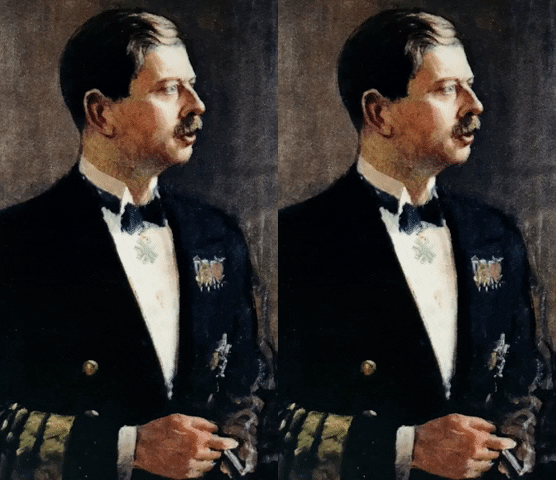 "God has blessed this family." Laurence would sign a cross, snorting lightly.
 -
“So this is when I told her that I hated wig-“ “SHH!” Adrian interrupted, pressing his finger against his lips: both kneeling in the corner of Prince Philip's playroom in Johnstown. “What?” Judith Helvets exclaimed in sheer irritation, pushing Adrian slightly. Before Judith could speak further, Adrian would cover her mouth with his palm, beckoning to something above them. [!] Hovering over the two, was the left ear of Empress Anne. The ear spastically rotated from its floating position, desperately looking for any Helvets that would commit the crime of wrongspeak. Adrian would then whisper to Judith: “Her Imperial Majesty can hear anything.. Anywhere..”
-
“Quite adorable” Adrian would state, looking briefly at the document on notice board of New Reza “Half of the youth in Helena would never even earn the badge of Skill. In Urbe living rots the brain..” he would shake his head, continuing on his travel to the capital.
-
A MISSIVE FROM THE PONTIFF The Palatine courier nervously ventured through the Pruvian estate, flanked by the fatigued Viscountess Margaret & the gregarious Alexander Laurence. As the Mahony door opened: a large room was revealed to the courier, its grotesque Bordeaux carpet leading to the windows in the back. Before them stood Laurence August Pruvia-Albarosa, facing a row of many topless albeit bowtie-wearing servants: holding up various wines for the Monsignor to taste. His wigged head would rotate towards the entering guests as his hand levitated above the glass: “Just a moment, whoever you are.” The Courier nodded silently, motioning his hands dismissively towards Alexander who offered to take his coat. The Monsignor would take the glass from the young Sutican male before him, circling it in anticipation. “And which one is this, Xaohui?” he raised his chin, the servant responding almost immediately “A de Savoie from 1564 your Eminence, gifted by Ferdinand de Bar.” “Hmph.” Laurence stopped the glass, bringing it towards his lips. After chugging it empty he would return the glass to Xaohui, who promptly bowed and returned to the kitchen. “Margaret dear, get Victoria to ask for more bottles from this Ferdinand figure.” The Viscountess chuckled at him “I’m not your servant fossil, go fetch some yourself.” He scoffed, placing his hand nimbly on his chest. He then turned to the Courier, who had placed his attention onto the frescoes of White Rose soldiers on the ceiling. The young lad considered it pretentious, as the outlandish nature of this place became more evident to him. “You.” Laurence snapped his finger, quickly walking towards him despite his cardinal robes “What brings you here?” The Courier cleared his throat as he summoned an elegant envelope, bowing his head as he offered it to the Monsignor. “Your Eminence, I have come here to inform you that His Holiness has decided to reinstate you as Cardinal Albarosa, effective immediately. He summons Your Eminence to his private residence in anticipation. Please join me in my travel there.” The Monsignor smirked subtly, weakly holding his fingers with a tilted head. He turned to Alexander, who was eyeing the servants that were still standing further in the back. “Can you get Xaohui to prepare my carriage and two traveling companions, those Carnatian maids if you will?” Alexander would sigh deeply as he turned to Laurence, crossing his arms “You’re not even reinstated for a minute, and you’re already back at it with your commanding.” Laurence remained unphased by the comment “And don’t forget to hand them my bag of powder, I haven’t slept well last night.” As the carriage of His Eminence tailed the Courier’s steed towards the Palatinate, two Carnatian maids and Xaohui would be crammed together inside it: desperately trying to balance their wine glasses as the bumpy Haeseni roads slammed them up and down. Some powder fell off the crystal pocket mirror, right onto Laurence’s scarlet robes. “God f-.” he would cough in restraint “Tissue. TISSUE!” Truly it was the beginning of something beautiful. Or rather, the continuation of it. While the four traveling companions attempted to avoid breaking their necks over these roads, Pruvian servants ran all across Owynsburg to dust off portraits, clean robes & prepare trinkets for the reinstated Cardinal Albarosa. An era of yore had returned in the true spirit of the Albarosan motto: In Semper Flore. Laurence August Pruvia-Albarosa Pontifical Chamberlain to His Holiness James II Cardinal Albarosa
-
”Eminence, it's 4 o’clock! Time for your daily dose of modernism.” TO ARCHITECT A FAITH OUR MOTHER CHURCH AND ITS PLACE IN MODERNITY Only one legacy within our sacred institution can be attributed to the notorious Friar Boniface: the silent death of our relevance. In our locking of arms to counter the Friar’s attempt at a schism, to handle the expulsion of Haense and our general efforts to counter mankind’s march to atheist modernism: we have failed to articulate a proper case for our monopoly on morality, and our monolithic standing as an institution of the faith. This cannot be blamed on anyone specifically: for it is a proper human instinct to focus on the imminent threats, rather than the abstract ones that are further ahead. But it is my duty as a former Cardinal and Prince-Archbishop to return our gaze onto what truly matters for our continued existence. Namely, the way we operate as an organization and our attitudes as its custodians. EMBRACING GOD’S FINEST The Holy Canonist Church should be the last to turn its back on willing Canonists, even if they appear to be astray from our doctrine and norms. This belief is for example displayed by our generous patience to the Friar Boniface, or the willingness of His Holiness to trust our Owynist contemporaries with legitimacy once more. But not all have the piety and dedication necessary to be impactful heads of dioceses, even more so to be seated on our Synod. And even if they have the piety, do they have the competence and vision necessary to preserve the relevancy and presence of the Church? Do they profoundly understand that we are in a perpetual competition to remain the monolith of morality, and the sole proprietor of faith for mankind? The traditional notions of what makes a good clergyman, like their presence in their congregation, whether they author a thesis from time to time & the general perception that they are pious: have become outdated and thus, insufficient. Unlike the circumstances of their predecessors: the authority of the Church is no longer backed unconditionally by Imperial society, who allows anyone to influence its decision making, and grants power to those that we do not demand adherence to Canonist tenets of. The clergyman now must compete with an array of temporal authorities who, either electorally or through their participation in the general discourse, weaken if not contradict the vision of a pious society. As he stands silently, he cedes space to the loudest voices to be listened to instead. Voices that defend Edward Napier’s lovemaking to an Orc, the freedom of religion in Oren & the overall loosening of standards in human conduct. He will find his congregation indulging themselves with philosophies and lifestyles that inherently do not align with the wishes of our Holy Mother Church. He must find a way to successfully sway his congregation to the worldview of the Church, and cement his intimate social ties into a bastion of faith and conservatism. Do all Bishops and Cardinals fulfill this role, while a few are essentially missing from their diocese entirely as I write this? Do the Monsignors that surround His Holiness use their temporal authority & influence to aid the clergyman with this task? Not universally, unfortunately. But as a General cannot afford half of his officers to contribute insufficiently, neither can His Holiness. We truly are embroiled in a philosophical war as an institution that we cannot afford to lose, and yet we have reluctant and unwilling soldiers in our midst. The sad fact of the matter is that our sacred institution has perpetually dealt with de facto vacant dioceses and passive clerical prominents: who do not sustain a congregation, and who do not fight for us in the bigger discourse. The memory of my heydays where the Bishopric of Jorenus and our Prelate of the Priesthood stood empty, and where a majority of the Synod was unknown to mankind, have not faded. And while improvements certainly have been made, and more than commendable and competent people have ascended: competency, presence & sight of the bigger picture are far from universal among the clergy. Our new and amazing talent share a workspace with those responsible for our stagnation. It is an issue not tied to a specific region or culture: as the bustling dioceses swap seats with the derelict ones every generation or High Pontiff. Even within my lifetime I find my former diocese, once the largest, to now be devoid of life in its many churches and monasteries. It has everything to do with the way our institution chooses from its clergy, and the expectations that they enforce after selection. If a Cabinet Minister is practically absent from his workplace, he is fired. If a Bishop is practically absent from his congregation, he can maintain his standing if he is deemed sufficiently kind, or if he doesn't bother anyone. After all, a Friar who spend his entire life in Helena was the Bishop of Ves for over a decade. And while the commoners of Haense didn't know it had a Bishop, the Bishopric of Jorenus was officially ‘filled’. These shenanigans only occur within an organization unwilling to demand more from its own. Once we exclusively allow clergymen that see this bigger picture, and aid in our defense within it, to ascend to dioceses & the Synod: we can then formulate a more successful defense against progressivism and secularism. We must strive for a Church that has every diocese bustling, and that presents an united front in the discourse of temporal politics. Periodically empty dioceses in Jorenus & Ves, our inability to maintain a wholly present Synod and the lack of political allyship from our Monsignors are unacceptable in our times of war. Niceness, and our unwillingness to squander social capital with the temporal elites, do not transcend the stakes in this philosophical conflict: the authority and relevance we risk to lose. We simply must demand more, as there is no compromise on fulfilling God’s will. Cardinal Albarosa, Jorenus & Sutica with the Bishop of Ves and Lieutenant Governor Helvets, 1763. OUR ROLE IN MODERNITY Even if the previous advice is implemented by dawn, this collective of present and competent clergymen would still not operate in an optimal fashion. We have since the days of yore expressed our faith through sermons and publications, and have trained our lesser in the ecclesiastical hierarchy to follow suit. But if our congregation is given more power in the Imperial political system, we find ourselves more responsible over the overall direction that they take our society in. The degrees of separation between hostile influences over our Canonist society and our congregation have drastically disappeared. It is no longer a single Emperor or Cabinet Minister that formulates, steers & influences the discourse: it is the brothers, mothers & companions of those in our congregation that do. Temporal folk that mingle with our own, share a dinner table or even a bloodline. The formula of the late Albarosan clergy was correct. We fulfilled all tasks traditionally expected from us by the Holy Canonist Church, but we also actively involved ourselves in the temporal affairs of the Commonwealth of Kaedrin. It was our clergymen that spoke to consecutive governor-generals on laws and our Bishops that drew crowds for their homilies that praised or rejected specific developments in our society. They raised their glasses with the Rhoswenii, financed the tavern for the locals & even sat on the Kaedreni government themselves. The result spoke for itself: as Kaedrin that prided itself as the most pious subject, intimately interwoven with the interests of His Holiness and the clergy. Had the Lendian heresy evolved into a schism, had the Károly trial eroded ecclesiastical authority: His Holiness could’ve counted on an entire populace and government to aid him. More specifically, to aid him in matters that most temporal entities would not know and not care about. Perhaps these dangers seem ancient by now: but the threats did not disappear entirely. Can we reliably say that all Canonist values remain as strong and universal in two decades, as they are now? Can we trust the heirs to all human polities and Crowns, generations from now, to care as much about our faith as the current ones do? If we do not put our foot in the door preemptively, we shall one day find it closed. This is why His Holiness and His Synod shouldn’t shy away from meddling in temporal affairs any longer. Dioceses must receive the instruction that they are to offer candidates for governmental functions locally, lobby against legislation they deem as destructive to the Canonist framework & to craft relationships in every echelon of society. Only when our clergy staffs all courts as advisors, ministers and representatives, when the will of His Holiness must be represented before every temporal leader: can we say that we have successfully defended our role in the temporal world. Our interests must always be considered before decisions are made. Every time a temporal leader does not ask himself: “would this fly with the clergy?”, is a time where we have lost our war of influence against secularist elements. Gentlemen of the cloth: do we dedicate our lives to God, so that His Word slowly erodes from the consciousness of men in the generations after us? Did hundreds before us sacrifice their youth to architect the most ancient institution known to man, so that it may be weakened by the newest institutions built by men? Shall God’s presence in the souls of mankind die off at the ballot box and the speaking podium, because we did not dare to set demands? We have too much to lose for us to tolerate passiveness and a lack of quality. There is no excuse for any higher clergyman or Monsignor to not see and fight in the philosophical, social and political battles that we are embroiled in. Maiora Premunt, Laurence August Pruvia-Albarosa Monsignor to His Holiness James II; Spiritual Advisor to Governor-General Richard Victor Helvets
-
[Completed]Homophobia and Hate within Roleplay
Draeris replied to Jentos's topic in Completed Debate
Homophobia is whack dawg -
PETITION TO HIS HOLINESS JAMES II To His Holiness James II; And His Most Eminent Synod, The Commonwealth of Kaedrin prides itself as the most pious of subjects under Her Imperial Majesty, boasting multiple eras wherein the Kaedreni architected bustling dioceses and the modernization of Owynism. Our interests pertaining to the maintenance of a pious realm is interwoven with that of the Holy Canonist Church: who seeks to perpetually keep the Canonist flock in an intimate and obedient union. It is from this understanding that we regret the previous rejection of our petition to bestow upon a Kaedreni hero, Foltest of Aeldin, the divine privilege of Sainthood. With new historical developments and revitalized determination to do right by our most pious of ancestors: we henceforth wish to petition Your Holiness most humbly once more: Foltest of Aeldin, an enclosed painting Foltest of Aeldin remains an icon of faith and discipline within the Commonwealth: renowned for his grandiose successes in sieges on behalf of the Imperial Tertius, a Holy Order & as Count of Krinfrid. Defending the Canonism realm from heretical threats and the undead time and time again, willing to sacrifice his own life for that of his brethren and those dedicated to the cloth. Most famously is his defense of the Brelusian cathedral: wading through flames and heathens to save the innocent congregation from their demise, rescuing a plethora of children and clergy in the process. It is during this rescue that the Kaedreni believe a miracle had occurred: as Foltest did not get burned by the sea of flames, enabling him to escort every living soul from the Brelusian cathedral before its collapse. The Kaedreni firmly believe that the fact that Foltest did not burn to death during the rescue of the Brelusian congregation, is a sign of God’s intervention: allowing his most humble of servants to save his Flock. Sparing Foltest from sacrificing himself, as God saw function to allowing a man like him to continue living. These historical accounts prompted a reverence of Foltest: one where he is deemed as the icon of bastions & siegeworks. Much like his body resisting the engulfment of flames, his military career is riddled with occasions wherein he led successful resistance against sieges of human strongholds: while also leading sieges against heretics to its legendary successes. Foltest of Aeldin inspires centuries of Kaedreni youth to defend the faith with their lives, and to consider piety the most valued of traits. It is within our most genuine belief that celebrating and rewarding his pious life with this privilege would truly enrich our moral message to our congregations, and act as a proper homage to the continued piety and civility of the Kaedreni people. Yours Most Humbly, President Adrian O. Helvets; Governor-General Richard V. Helvets; Father Erasmus; Sister Anabel;
-
‘The crowning of progress’ - 1790 ET GLORIA ORENIA One’s progress can be determined through a myriad of methods: one prominently being to observe the extent of which one obsesses, displays and bases its right to exist off history and previous state of affairs. It is from this that scholars at times state that it is better for some things to die an organic death: as they no longer establish something new of substance, but rather cling onto old and passed glory. Looking at the zeitgeist of our Empire: we have almost collectively forgotten how recent humanity’s dark age was. Days of absolutist Pertinax reign, an insanity-driven Lord-Protector and a democracy hijacked by Haeseni saboteurs: these affairs coloured the daily lives of humanity, and installed a regime of terror and an atmosphere of fear within all echelons of mankind. Every victory was stained by these poisonous status quos: each bright light dimmed by the reluctance and fatigue to deal with notions from a dark past, that stubbornly refused to die off. It is from this frustration that mankind embraced Providence: the ability to foresee the correct path that humanity must walk, if it is to avoid descending into a darkness it had barely survived. And it is with this Providentia, that Her Imperial Majesty unshackled herself from Hanseti-Ruska, and loosened the reins of our civil society. What has God and its flock given in return? THE ENLIGHTENMENT OF MANKIND can find its first seeds planted by His Imperial Majesty Peter III, when he consciously refrained from authoritarian rule in favour of granting breathing space to his young judicial and democratic institutions. But alas, these seeds remained relatively unnoticed for the commonfolk: as most fought for Hanseti-Ruska’s and Oren’s survival against a menacing coalition of barbarians and piastdoms: who made up for their lack of serious statecraft with brutish force. It shouldn’t be a surprise therefore that the saplings from these seeds first became noticed upon the ascension of Her Imperial Majesty Empress Anne: who embraced the first beams of this enlightenment and institutionalized them through her new bureaucratic apparatus. This succeeded because of two developments: On one hand, her appointment of statesmen that embraced the virtues of providence, ensured that the executive layer of Orenian government sought to use its authority responsibly and in a civil fashion. Brute displays of power and deadly political feuds turned into collegial differences of opinion, as the distinctions of lineages and peerages slowly faded away. In a climate where being Orenian reigned supreme over regional identifications, who were often delusional and self-serving in nature, these men of the enlightenment could peacefully formulate government reforms without risking the destruction of the apparatus itself. On the other hand, the political appetite of the people turned in favour of egalitarian and progressive politics. The consecutive defeats of the Everardines, with exception of the separatist Muldav movement, proved that a consensus in the Empire existed. Mankind wanted devolved rule instead of absolute ones, and wanted to bring the lesser privileged and non-humans into the fold. Racial supremacy and pride through power was replaced with pride in civility, and whoever contradicted that consensus was electorally and socially punished. Rightfully so, as only the sick and delusional would desire a return to that dark age willingly. Those two developments are perhaps the greatest feats of Empress Anne’s so far short reign, although they happened relatively quickly and consecutively. One might forget that the Imperial Crown could have resorted to the regnal styles of yore, and undermine if not entirely dissolve all democratic institutions we currently enjoy. It is thanks to the dominant philosophy of Providence that even the most powerful human of the world submits herself to these virtues, in turn bestowing a seemingly never ending Golden Age for our beloved Empire. Its sheer superiority as a philosophy and model transcends racial boundaries and inspires even our Elven and Dwarven brethren, prompting them to seek a better and more profound life within the confines of our Imperial capital. Once there, the newfound egalitarian virtues allows them to move through our bureaucracy and society unrestrained: some aiding our government diligently, and some even convincing a human electorate that they properly represent them. This is perhaps taken for granted by those that live amidst this era of progress. Yet, barely decades ago, such a notion would be laughed at. The awkward freshness of this status quo cannot be ignored when its fruits are emphasized: as the contrast between the Empire now, and some decades ago, seem to be from different dimensions. THE ERA OF GREAT EQUALIZATION is barely decades old. Put that in perspective of the previous era lasting entire centuries: and you realize how unique this accomplishment is. Only because the right circumstances appeared at the right time, and the right people were at the helm, could a fragile sliver of hope be institutionalized and cemented into the undeniable reality of mankind. Had any person within a long chain of command thought differently, our current fate might’ve been radically worse. Such is the benevolent care of our Creator: facilitating temporal developments so that his will manifests itself through his flock. A reality where all his creations enjoy the rights and privileges necessary for a proper life, one where the descendant of a king now lives amongst the commoners in an apartment. God’s desire for his benevolence to be exercised on our mortal plane eradicates the often arbitrary and cruel distinctions that once dominated our discourse. Being a descendant of a high peer, having an ancestor that once led wars, no longer protects you from the consequences of the law and the society that it protects. A King’s descendant must pay tax as any citizen, and a commoner of no particular lineage can compete against him in fair elections. External forces may frown and laugh at this notion, but only because these selective few wield the scepter of might. That hundreds beneath them suffer, are stripped from opportunity or find their personal growth undermined: is irrelevant to them. A silent majority hibernates as their soldiers patrol the streets and behead and persecute at a single man’s whim. A hated man is sufficiently protected in Oren to cultivate his path to redemption: a hated man elsewhere is found dead on the pavement. This too is God’s benevolence: who finds all of his creations redeemable. The sheer fact that the primitive instincts and dangerous passions of man can no longer translate into harmful acts of barbarism against another, despite that being the case for nearly all of our existence, represents a simple fact: that through Providence, we have achieved the epitome of civility. That we have done so without weakening the integrity of God’s mandate bestowed upon Her Imperial Majesty, His Holiness the High Pontiff or the practical might of our sword and pen: is the testament of our superior statecraft that cannot be replicated elsewhere. For it is irrelevant what Monarch, Piast or Warlord ascends into power outside of Oren’s bastion of civility: everything they create and represent is antiquated in comparison to our ways of life and governance. And so they laugh at our expansive bureaucracy, rooted progressivism and civil society: but once a single arbitrary decision by their liege means the end of their entire lineage, livelihood or existence: every free citizen of Oren would not laugh back: for he would only pity his fellow human that is shackled to the darkness of yore. If only the era of great equalization was equally applied among all of mankind. Perhaps if Hanseti-Ruska was a more mature society and government, perhaps if its people saw what enlightenment would mean for their own lives and kinfolk: would they have stayed around long enough to enjoy the fruits of this golden age. But as their calendar counts backwards, with the sun there slowly going under the horizon: it is Oren that shall shine bright in the distance, as there the sun has only started to come up. And that is the glory of Oren: that we have conquered the final plane before Providence. Namely, our own temptations and primitive nature. An unmatched self restraint and degree of civilization that is the envy of the world, even if the world reluctantly chooses to deny that. But for as long as Oren will shine: a window of opportunity will exist for our brethren outside of it. They too can embrace the virtues of Providence, and come into our fold as equals under God and our law. They too can lead a life of meaning: all they need to do, is to reach out towards it. Authored by: Adrian Othodoric Helvets
-
The First Apology: Adversus Scismam Bonifacii
Draeris replied to thesmellypocket's topic in Church of the Canon
“GOD bless this man.” Monsignor Albarosa would state. -
“If I wasn't in an altercation with a person at any point, he is irrelevant in Oren.” Adrian would scoff “And I don't recall yelling at this d’Emyth or whatever!”
-
41 THESES FOR THE DISSOLUTION OF THE VIROSI CHURCH
Draeris replied to ReveredOwl's topic in Church of the Canon
Somewhere in a gold gilded room, inbetween two young Sutican women, Monsignor Albarosa clinks glasses with the Helvets elite. “Good riddance, the most useless Bishop of Ves.” he would roll up an Imperial Mark, and snort the line before him: “If people as evil and incompetent as you say, have eclipsed you in their contributions to the church, what says that about you?” -
“Well then.” Adrian would clasp his hands.
-
A NEW IMPERIAL HORIZON AN EVERARDINE PLAN FOR THE FUTURE OF OUR EMPIRE The future of humanity looks bright: our fine nation is bestowed a competent leadership and a cohesive vision by our Josephite colleagues in the House of Commons. We wish to first and foremost transcend our electoral strategies and ideological differences to compliment Jonah Stahl-Elendil and his associates for the accomplishments they have made. They singlehandedly cured the malaise Oren was feeling under the Basrid Ministry, and brought new life to the inventive and ambitious souls of our fine race. But alas, something good always has something better. If we did not genuinely believe that our policies are the better alternative: we would not be organizing under the banner of the Everardine Party. Therefore, despite our appreciation for the Josephite administration, we gotta do it to them: and present to you our new plan for the Holy Orenian Empire. ANNOUNCEMENT The Everardines, seeking to preserve all unique identities and harmonious societies in existence, will cooperate with Kairn Igus Ithelanen from the Elven Traditionalist Party: allowing them to consult the Everardines on legislative proposals, and standing united as citizens of Oren who do not want to dilute the beautiful differences that exist within the Holy Orenian Empire. We will also allow for Mr. Ithelanen to run for House of Commons on our behalf: proudly being the first elf to ever run for an Everardine seat. Huzzah for progress! STATEMENT ON THE CENTRALISTS The Everardines deeply regret the actions of EDWARD SELM, a person who tried to blackmail and threaten the Everardine leadership. His Centralist party is nothing more but an attempt to overthrow the Stahl-Elendil administration. Although we have major ideological differences with Stahl-Elendil: we compete electorally due to our sheer convictions in our worldviews, not to procure power for our own cronies. If the latter was true, we would’ve given up after our series of poor electoral results. Unlike the Centralists, we shall persist and continue to fight for the Everardine ideology. The Centralists however, will disappear the moment their power grab fails. Do not entertain these clowns, who poison the electoral discourse like the Muldavs before them. CAPITAL CITY POLICIES The Everardines believe that the capital should be a prosperous city within the Holy Orenian Empire in terms of commerce, culture and political organization. To ensure that the society within the Imperial Capital remains heard, participative and active: we wish to introduce the following systems: CIVIL PETITION SYSTEMS, that allow folks to express discontent or support for any project or reform related to the capital. If for example the government is abolishing the livery system, citizens of the Capital can petition the government not to do so: finding their petition, and its arguments, discussed in the House of Commons. This will also act like a civilian veto on Imperial projects in Helena. PROTECTIONISM TO CAPITAL BUSINESS, that ensures that citizens of the Imperial Capital can always start a new business and sell their goods: without having to compete with vendors from outside the Empire. ESTABLISHING A CULTURAL BOARD, that unites the functionaries from the Palace, those of the Clergy and private organizations in hosting festivals and events in the Imperial Capital: while also ensuring that no schedule collides, and that each party can benefit off the infrastructure of another. ESTABLISHING A MINISTRY OF CULTURE, that makes the government able to maintain and update our historical records, display the diverse cultures of the Empire and aid communities with their own cultural recordkeeping by providing historical records and references regarding their identity. EMPLOYMENT LISTS, that registers those interested in serving in the government: so that upon new vacancies, the incumbent government can invite remaining members on the list for interviews, processing or hiring. REGIONAL POLICIES The Everardines wish to see humanity remain diverse, and to not succumb to the paranoid and authoritarian instincts to suppress the development of regional polities post-Haense. Through this, we can ensure prosperity Empire-wide and avoid to recreate the malaise that haunted Oren during its past generations. DEVOLVED GOVERNANCE, that allows peers of the same cultural identity or political alignment to organize and manage its territories in a modernized and civil manner: abandoning feudalism in favour of an assembly, elected head from among the peers and the legislation of local laws pertaining to their respective communities. LET LIVE POLICY, that allows regional polities and cultural communities to determine who they want and don’t want to reside on their land: allowing the Imperial Capital to remain open to all, while simultaneously allowing for peoples to preserve their homogeneity. GUARANTEEING THE VOICES OF MINORITIES, ensuring that communities other than those in the Imperial Capital can have influence on legislation that affects them, while not boasting sufficient electoral power to influence the House of Commons: by guaranteeing seats for locally elected representatives in the House of Commons. BALANCING THE HOUSE OF LORDS, so that an equal number of peers from all respective regions are represented in this Chamber, and thus, are able to maintain the quality of our peerage without regional biases affecting its decision making. SOCIAL POLICIES The Everardines hope to preserve the good aspects of human life that were carefully cultivated through centuries of our history. By saying we wish to preserve the past, we do not romanticize the horrendous days of a Lord-Protector beheading people at will, or soldiers committing genocides against non-humans. Rather, we wish to counter the rapid urbanization and modernization of Oren: giving space to those that wish for their agrarian lifestyles and unique identities to remain. TURNING THE NENZING PROCLAMATION INTO LAW, so that the rights of a civil society and benevolent government become an obligation, and not an ideology. Through this we can assure democracy, freedom and prosperity in the Empire continues. CULTURAL SELF-DETERMINATION ACT, so that each culture within the Empire can petition to be formally recognized and thus considered by policymakers on matters of social norms, land distribution and cultural celebrations. ELVEN HOMELAND INITIATIVE, which ensures that Elves remain among their own kind, to proliferate their culture and maintain their own city, polity, and neighborhoods under the Empire. The equality of the Elven People is not in question, as they too have the right to vote and become Imperial citizens; however, it is in the best interest of the Elven People to settle in their own towns and partake in their own forms of cultural exchange. Marriage among Elves is a necessity, as the Elven People are barren after a mere four-centuries of life, and struggle to conceive offspring. When a half-breed is born, they inherit both the curses of Horen and Malin, and are short-lived and infertile -- an injustice to the Eldar Blood. THE CHURCH MATTERS TOO ACT, so that the government maintains intimate dialogue with the Holy Canonist Church about what social reforms and cultural developments please the faithful of the Empire and which undermine the moral authority of Canonism, by hiring clergymen as advisors to the government. CURRENT LIST: Adrian Othodoric Helvets @Draeris Lemuel de Langford @Trenchist Lajos Sandor Károly @CrownedLime747 Paul Blowitz @Proddy Theodore Zirid @Seus John das Ross @Farmer John Jacques de Robicheau @Wurfv Leofric Edmund Pruvia-Albarosa @MCVDK Kairn Igus Ithelanen @Gwynbleidd
-
“A party that first tried to blackmail and threaten itself into Everardine leadership, and now out of bitterness sets up this milquetoast political movement in mere spite of the incumbents and Her Imperial Majesty's Most Loyal Opposition. By god am I thankful for not heeding the serpentine words of Edward Selm: for this pamphlet exposes the ideological bankruptcy and the sheer hunger for power that is manifested in this single man, and his uninspiring followers.” Adrian would state, leaning forward to snort another line of Albarosan powder with a rolled up Imperial Mark. He was feeling terribly profound lately.
-
Adrian Othodoric Helvets, 1788 DOING BETTER ADRIAN’S JOURNEY TO INNER PEACE The young Helvets wasn’t sleeping well these days, churning beneath his weighted bedsheets like a Striga in the night. His head was a perpetual musical: his most awkward moments extravagantly at play. “That is a second warning.” George Galbraith would speak, “You look like a Hu-Zhi” another elf spat at him, “I will f**king disinherit you if you snort that again”, his father disappointingly spoke. Why was he so disliked? Did his wife like him? What about his future children? Questions upon questions would besiege his brain. Intimacy with his wife brought him only so far, and the Albarosan powder only a tad further. He had to reject the temporal and look within, answer his questions entirely by himself. And so he ventured out of Helena on his steed called Isabel Franziska, trotting forwards into the farmlands of the former Provins. After tying his horse to a fence pole: Adrian would lower himself to the ground, straightening his posture. Closing his eyes, taking deep breaths: he would remain stationary for hours on end. The many lines of Albarosan powder and wines flew through his veins, a certain peace was bestowed upon him. Then, from within his closed eyes, Adrian could see a spirit in the guise of Jonah Stahl-Elendil appear: seated in front of him at Varoche Hall. “Adrian.” the former Adunian pirate would dryly state, crossing his legs. “J-Jonah?” Adrian blinked, discovering he himself was seated on the carpet before him. “You’ve caused a lot of trouble, Adrian.” the spirit would shake his head, crossing his arms. “I-I didn’t mean to Jonah.” Adrian muttered, his hands placed flat on the carpet. “It’s because you doubt yourself, first and foremost.” Jonah stood up, now suddenly wearing an eye-patch “Just stop doubting yourself, have some trust.” Adrian couldn’t help but nod in awe, listening intently. As spirit Jonah Stahl-Elendil circled around him: he spoke of words like “trusting in yourself”, “accepting your faults” and “believing you’re doing better”. Minutes felt like centuries, but Jonah’s incessant monologuing continued. Adrian’s head started to feel dizzy, the words doing better sounding louder and louder. He eventually collapsed onto the carpet. “Ahh!” he woke up with widened eyes, covered in his sweat: his back wet from lying on the soil. He would bring himself to stand, straightening his posture as he dusted off his Kaedreni silk. “Doing better.” he’d mutter to himself, his lips pressed in wonder. “So I was doing better than everyone after all?” walking towards his horse, he’d straighten his sleeves “Hmph. Nothing to change then.”
-
THE CROWN OF ROSES KAEDRIN’S RELATIONSHIP WITH HOLY ORENIAN EMPIRE TITLE I. FROM THE TOME OF KAEDRIN Commissioned & Authored by: Adrian Othodoric Helvets PREAMBLE Kaedrin underwent many forms and styles throughout its entire existence: an inherent privilege to one of the Empire’s most ancient of vassals. From its militaristic foundation under Peter Chivay, to its modernization under Richard de Reden, a single jewel of Kaedrin’s crown outshone that of its now derelict contemporaries. Where once proud vassals such as Lorraine and Savoy lay buried in the annals of history, Kaedrin still exists and develops with nearly no interruption. That matter of fact can chiefly be attributed to its harmonious relationship with the Empire: built upon the foundation of two crowns in union, ever since the ascension of the late Chivay to the throne of Oren. From there the relationship changed formally, but never substantially. Patriotism to Kaedrin remained synonymous with patriotism to Oren, as it remained the home of many titans of Oren’s history who led our Empire forward to glory. To profoundly understand the Kaedreni, to then finally be able to document its vast history and culture, we must first and foremost identify and dissect the unique relationship between Kaedrin and its sovereign. Therefore, the first title of the future Tome of Kaedrin shall be dedicated to this phenomenon. THE GOVERNOR-GENERAL The statecraft of the Commonwealth of Kaedrin had always been a dubious and complicated affair: transitioning from a military junta, to a monarchy, to a republic, to a monarchy, to a personal union and to finally reach direct integration under Her Imperial Majesty’s crown. In between these transitions, one consistency remained most of the time: the presence of a Governor-General, an Imperial representative who managed the Commonwealth’s affairs on behalf of the reigning sovereign at the time. Historically these Governor-Generals were local Kaedreni, who were entrusted by the central government to maintain the devolved form of governance that existed in the Commonwealth. Incumbent Governor-General Richard Victor Helvets While the Governor-General had legal executive power over all affairs within the Commonwealth, not all had used it to a similar degree. Richard de Reden was notoriously authoritarian and managed many affairs of state by himself, whereas Henry Frederick Helvets delegated his portfolio almost entirely to the local government organs of Kaedrin. What mattered to the Imperial Crown was not the execution of the role of Governor-General, but moreso the continued stability and harmony of the Kaedreni-Orenian relationship. The necessity of a figurehead that was a local Kaedreni and a trusted member of the Imperial Crown’s government remained enshrined in Kaedrin’s successive constitutions: as neither Kaedrin nor the Empire wishes to abolish the underlying framework of their relationship. The Governor-General furthermore could mediate the disputes that the local government could have with its sovereign: pushing both parties to dialogue instead of hostile diplomacy. A fair observation could be made that the Governor-General is the reason why inter-Imperial disputes did not escalate to the degree it had with former subjects such as Savoy, Lorraine and Hanseti-Ruska: instead of dealing with lesser sovereigns, they were depending on a representative of their own. This only was possible due to established responsibilities, and the existence itself, of the Governor-General. “The consumables of harmony” - a painting of the food table besides between the Sovereign’s chair and the Governor-General’s in Varoche Palace, by Mátyás Károly - 1765. THE FUNCTIONAL COMPROMISE The Commonwealth of Kaedrin had historically aligned itself with the Holy Orenian Empire more intimately than its contemporary Imperial subjects. It stands as the only vassal in modern Imperial history that voluntarily abolished its own military, and to further its Imperial integration after the succession crisis of Her Imperial Majesty Anne. External critics and radical elements would often ridicule Kaedrin for its unwavering loyalty to the Empire, as much as the extremists would point at Kaedrin’s individual power and question its path to integration. Both parties refuse to understand the truth behind the historical functionality of Kaedrin in the Empire, embodied by an unwritten and de facto compromise. The Imperial Crown could, legally, actively manage Kaedrin from its central government. It could, hypothetically, appoint a Governor-General that is neither Rhoswenii nor aligned with Kaedrin. In return Kaedrin could abuse its intimate relationships within the Imperial framework, and much like Hanseti-Ruska before them, actively sabotage its institutions. Neither parties opt to do so. This refusal to abuse the exposure of each other’s internal workings comes not from perverse dynamics such as mutually assured destruction or codependency: it comes from a deeply interwoven patriotism that understands that mankind must unite under an Imperial Crown, but that the Imperial Crown cannot eternally govern all directly. Because Kaedrin is loyal and reliable, it can exist with more autonomy and liberties than any subject around it. It motivates the sovereign to continue its delegated privileges, as much as it motivates the Kaedreni to continue its loyal and productive existence within the Empire. This mutual understanding is coined as ‘The Functional Compromise’. It is inevitable to any relationship that threats to its existence occur from time to time. When extremist elements enter the halls of Kaedreni power, or when the Imperial bureaucracy fails to properly represent Kaedreni interests: the question arises whether the functional compromise can continue to exist. History has proven that the answer to this question is a simple yes. The interests of both parties to ensure the continued existence of a loyal subject, to maintain its status quo and to guarantee continued harmony during the growth of both: consistently transcended the more selfish interests oriented around might. An intimate family evening between the houses of Novellen and Helvets, 1784. THE RELATIONSHIP ANNO 1788 The Commonwealth of Kaedrin had abolished its monarchy during the House of Electors convention of 1786. The electors unanimously voted to alter the old Constitution prohibiting Her Imperial Majesty Anne ‘I’ from succeeding the throne of her predecessor, Peter III of Kaedrin. Fatigued by the ancient notions of monarchy, and captivated by the modernesque governmental reforms of the central government, the at the time Lieutenant Governor Richard V. Helvets pushed for a more modern form of statecraft for the olde Commonwealth. By abolishing the Monarchy and rendering it a direct constituent and subject under Her Imperial Majesty, the Kaedreni liberated themselves legally to architect a new government for a new Commonwealth. This also avoided any future constitutional issues in regards to Imperial succession, or its integration into the Empire. Thus, the Commonwealth of Kaedrin exists as a direct province under the Imperial Crown: enjoying vast levels of autonomy and privileges to govern and maintain itself. Beneath that foundation of statecraft also lies a degree of cross-cultural integration: as former Helenite houses such as Pruvia-Albarosa venture into Kaedrin, and Kaedreni houses such as Dubois seek fortune in Helena. Both contribute to the cultural harmonization between the two, and guarantee the presence of familiar faces on both sides of the aisle. Kaedrin in that sense is the only entity that can have a profoundly distinct history and culture, while simultaneously being perfectly aligned in the mosaic of the Imperial human. An Oren without Kaedrin, wouldn’t be the same Oren: as much as Kaedrin without Oren, would simply not be Kaedrin. Simply put, it means that Kaedrin is inherently Orenian while boasting a culture that is identifiable as ‘Kaedreni’. He who is Kaedreni would be from Oren first and foremost, but pride itself with its Kaedreni heritage secondly. With all the victories and despite all the headaches that stem from a symbiotic relationship like this, Kaedrin can pride itself as the model province of Oren for the past few centuries. [!] AUTHOR’S NOTE The Crown of Roses is a Kaedreni term for the Imperial Crown, one that is portrayed with multiple roses: each representing a subject that forms the Holy Orenian Empire. Historically this would be a dark yellow Rose for Hanseti-Ruska, a red Rose for Savoy, a light yellow rose for Lorraine and the white Rose for Kaedrin. The constantly changing make-up of the Empire and the stigmatization behind the history of the now derelict Imperial Subjects prompted this term, and its depictions, to go out of fashion.
-
No. - Adrian O. Helvets
-
A painting of a potential debate, 1787. CHALLENGE TO DEBATE The Right Honourable Archchancellor keeps departing from House of Commons sessions early, rendering Her Imperial Majesty’s Most Loyal Opposition unable to properly debate him. Therefore, The Leader of Her Imperial Majesty’s Most Loyal Opposition challenges Jonah Stahl-Elendil to a one on one debate with Adrian Othodoric Helvets. We believe that @Braehn Elendil An'Hiraeth has some questions to answer to the people, whether it would be about the lies of his President, the death threats against us, the extremism against conservatives in the Empire, and the institutionalized left-wing menace across the Empire. Accept this challenge, and let the people judge! THE TERMS Each party gets to appoint one moderator, meaning two moderators oversee the debate. The debate will be held publicly, in the town square or in Varoche Hall. Each party gets to name two topics to discuss during the debate. The debate will end with questions from the audience.
-
20th Imperial Diet, House of Commons (1787)
Draeris replied to Office of the Registry's topic in Imperial Diet
A letter arrives “The Leader of Her Imperial Majesty's Most Loyal Opposition votes AYE on both nominations.” -
SPEAKING TRUTH TO POWER, A REPLY TO GALBRAITH PHC THE RIGHT HONOURABLE PRESIDENT has sent this letter to HER IMPERIAL MAJESTY’S MOST LOYAL OPPOSITION; HER IMPERIAL MAJESTY’S MOST LOYAL OPPOSITION responds accordingly: “To the Right Honourable President of the House of Commons, Having received your letter, Her Imperial Majesty’s Most Loyal Opposition is obliged to respond. There exists a fine balance between political narratives and outright deception: a balance that our Right Honourable President has seemingly broken with his letter. In my publication ‘The Dangers of Mediocrity’, I stated my opinion on the conduct of the Josephites in the House of Commons. As the nominees were questioned, no Josephite except the one time exception of van Halen MHC, rose to the occasion to question them as well. Due to your personal relationship with them, one being your own blood relative, you let them enter the procedure with no questioning or investigation. It is this that shows the nepotism and cartel-like behavior of the Josephite Party. To invoke my aunt, Her Imperial Majesty, in hopes to score a point on tying my publication to treason: is utmost pathetic and unbecoming of a President of this Chamber. Furthermore, multiple witnesses have reported and transcribed the conversation you had with Padraig O’Rourke. When four different witnesses transcribe an identical conversation: we can only safely assume that that conversation happened. The fact that the Right Honourable President changed entire sentences of this conversation in his response to our private correspondence, only shows the manipulative nature and petite human that the Right Honourable President George Galbraith represents. Philip Louis Pruvia-Provins was a part of our first Everardine Congress and voted on our party program as a Party Official, something that our Vice-Chairman maintains records of. We furthermore found our program leaked before its publication, with only Philip Louis Pruvia-Provins defecting towards the Josephites almost simultaneously. Perhaps we rushed to conclude it was Philip Louis that was sent as an infiltrant: but a foundation for an investigation is there. Right Honourable President, I am a member of the Helvets family, a prestigious line tied to the Imperial Household. When a man stands before you and threatens to bash my skull in with his cane, you tell him off or call the guards. When you act as my Right Honourable President in this Chamber, you don’t exit that very Chamber to then proceed to slander my name. It is utterly unbecoming to indulge yourself with these women-like temperaments, and is worrisome. If you still refuse to speak the truth before the upcoming session, we will explore all options available to materialize your resignation. Yours Truly, The Leader of Her Imperial Majesty’s Most Loyal Opposition”
-
THE DANGERS OF MEDIOCRITY REFLECTIONS ON THE FIRST SESSION Adrian Othodoric Helvets, MHC Leader of Her Majesty’s Most Loyal Opposition The first session bestowed an immense degree of gratitude and duty upon me, as I felt the eyes of my electors watching my every word and movement. If only I was able to hold onto this euphoria for longer, for it was taken from me due to the sheer horror of what I laid my eyes upon. Before me set a grotesque majority of Josephites, almost a third of which are members of the Imperial Cabinet. How Cabinet members get to keep themselves in check through our Chamber is beyond me, and shall fortunately be addressed in our upcoming Corruption Prevention Act. But the main concern was their conduct and their quality: appointing their own friends to judge positions, and allowing them to pass without any questions or rebuttals. The Josephites stood silent as Edward Napier confessed to making love to Orcs. The Josephites furthermore stood silent and voted aye for Edward Galbraith, a man that faced two separate impeachment inquiries over his debacle of a character. And so we sat and watched how the Josephites stayed practically silent: the chamber and its instruments only being used by Her Majesty’s Most Loyal Opposition. A session where The Right Honourable Archchancellor simply departed halfway through, as our democracy certainly was not important enough for him! Beyond this sheer mediocrity in our chamber, The Right Honourable President George Galbraith spared not a second to speak ill will upon my conduct to none other than Josephite icon Padraig O’Rourke. During this conversation: Padraig O’Rourke threatened my life, and our Right Honourable President didn’t do anything about this as he was talked to! He then proceeded to lie about the contents of this conversation, deceiving the House of Commons as its very custodian! If the Right Honourable President George Galbraith does not answer for his abhorrent conduct, Her Majesty’s Most Loyal Opposition will use all venues to seek his resignation. The Josephites also tried to infiltrate our party by sending Josephite operatives, such as Philip Louis Pruvia-Provins, to leak our strategies and proposals before they were shown in the Chamber. Are we truly that opposed to each other that strategies used during wartime are used in between elections? Surely we can do better than the shenanigans of Edward Galbraith, and adhere to ethical rules of conduct instead? The Josephites showed that they weren’t capable of transcending lies and silent observation. What has the Electorate done to our fine nation, to entrust its existence with unremarkable folk like these? I truly hope to find proper and substantial debate next convention, one where the Josephites can do better than simply calling us racist or extremist. Is wanting humanity to be prioritized in its own nation racism? Is wanting the rights of peers to be respected extremism? Is wanting to preserve the difference of cultures, lifestyles and ideals within Oren a niche idea? There is more to Oren than just Helena, but there is more to Helena than just the Josephites. If the electorate is watching, and they see the mediocrity and lack of vision within the Josephite party as we do, we hope to see a change of guard next election. Not because we seek to destroy the Josephite way of life. Not because we personally harbour hatred for the Josephites. Not because we aren’t willing to compromise for the sake of our nation. But because unlike them, we take this system seriously. Unlike them, we wish to protect all walks of life, and not just the In Urbe Josephite one. Because unlike Jonah Stahl-Elendil, we appreciate your votes enough to stay until the end of a session. Also, one final reminder: PRESIDENT GEORGE GALBRAITH CONSCIOUSLY AND CALCULATIVELY LIED TO THE HOUSE OF COMMONS IN COLD BLOOD. What that says about his character, is up to you. Yours most patriotically, Adrian Othodoric Helvets The Leader of Her Majesty’s Most Loyal Opposition ((George Galbraith to Jonah Stahl-Elendil, 1787.))
-
"Very based papa." Adrian would pleasantly smile, pouring lemon over Richard's extravagant chicken filet in gratitude.
-
Adrian Othodoric Helvets rejoices!
-
