


Draeris
-
Posts
2385 -
Joined
-
Last visited
Content Type
Profiles
Personas
Wiki
Rules
War
Systems
Safety
Player Conduct
Roleplay Leadership Guidelines
- Roleplay Leadership Guidelines
- Roleplay Leadership Guidelines Comments
- Roleplay Leadership Guidelines Reviews
Forums
Everything posted by Draeris
-
THE FIRST HOMILY OF VES On the times to come in our blessed Commonwealth PUBLISHED & HELD BY His Eminence the Cardinal Ves; Secretariat to His Holiness; Speaker of the Kaedreni House of Commons, Laurence August Pruvia HELVETS HOUSE OF LITERATURE A Rhoswen-Pruvia Ltd. Enterprise De Sola Plaza, Nr. 4, Owynsburg 23rd of Owyn’s Flame, 1764 EDITOR’S NOTE A homily is a verbal interaction a clergyman can have with his congregation or the faithful in abstract. Whereas sermons are usually about scripture or the interpretations of such: homilies are often a form of address or conversation relating to the lives of one’s parishioners. While classically these were verbally held by the High Pontiff, the spread of the printing press and expansion of civil institutions popularized it among Bishops and priests as well: for they too were now apart of the political discourse, which often homilies were a general response to. Dearly beloved, It has been a year since His Holiness had entrusted me with the diocese of my late predecessor, who sought the restoration of his homeland with his diligent Kaedreni compatriots. It is unfortunate that he is not alive to witness the fruits of their collective efforts. It does, however, instill a profound mission for the Kaedreni clergy to further aid in the statecraft and re-population of our blessed Commonwealth. As our artisans, bureaucrats and clergy see the first signs of a sustainable state: we now found ourselves with something valuable to protect. No longer is Kaedrin just the encompassing name of an idea and a history, but now a state that provides the livelihoods and hopes for many. It is with this value, and perhaps the temporary fragility of this state of affairs: that I found it of utmost expediency to address our folk in a more collective manner. While we have plenty to rejoice over, we must never forget the looming threats we gamble with from day to day. To our north we share borders with a demesne embattled by an ongoing heresy crisis, as to our west a Josephite political entity has arisen that seeks the secularization and dilution of His Divine Word. These issues seem far away, for now. But with our first Kaedreni House of Commons convention merely a day away, and the first Imperial one soon: the knowledge and morals that people vote with, can greatly decide the outcome for our beloved realm. But first and foremost, I wish to reassure our congregation regarding the heresy crisis in Hanseti-Ruska and the violent passing of my late predecessor. The Bishop of Jorenus in Haense and myself are monitoring the situation closely, and are engaged in an extensive cooperation to contain and in turn decimate this threat. The people of Kaedrin have not forgotten the culling of one of their own, and we put faith in His Holiness and the Ministry of Justice to deliver retribution accordingly to the barbarians still at large somewhere in their realm. The Bishopric of Ves, as much as the Government of Kaedrin, was displeased with the consistent skirmishes against the faithful by the likes of Arthur. K. Callahan, Tarcharman Otto and the former Bishop Boniface. The first even being a former Kaedreni senator, entrusted with protecting our pious and agrarian realm. As they assume the mantle of the people under the pretension that they speak for them, they chisel at the pious pillars upon which the Commonwealth of Kaedrin stands. They do not speak for our congregation, for the Kaedreni has historically been staunchly pious and in harmony with His Imperial Majesty. Kaedrin cannot conceptually exist without the Oren Empire, as much as the Empire would be incomplete without our olde frontier state. Understanding this, I call upon my Kaedreni faithful to reject any notions of sedition or secularization: and embrace the Canonist and Everardine doctrines that embody the Rhoswenii agrarian dream. We must unite not just civilly and economically as we are now, but also politically as a coalition of the faithful. If we fail in this task, we will enable a coalition of questionable political operatives to be seated in institutions that preside over us. Ones that might entertain the heresy and subversion of the Callahans and Bonifaces among us. Or even worse, we might be meek in the wake of a hostile clientelist lobby encircling our most holy institution like primitive tarcharmen. We find this applicable locally too. For the first time in decades: the Kaedreni citizen can determine his own destiny, and that of his Commonwealth, in a democratic organ known as the House of Commons. As its speaker, I have profound love for the democracy and civil participation that is to ensue. But as any experiment: things can go wrong. That is why I ask of my faithful to be careful with the fragile institution they are about to partake in. Claim your seat because you wish to help your people, propose an idea with the cleanest of conscience and profoundly understand the immense power you as a citizen now wield. Legislate responsibly, so that Kaedrin may grow sustainably. Let this serve as a stark reminder that we must never venture alone and unprotected: and to not heed suspicious invitations, wherever they may stem from. The Empire and its Faith are eternally under siege by those that do not profit from mankind's collective progress: from regional separatists, heretics or both. Arcas would be struck with tragedy if a loyal faithful to the Canon becomes a casualty in this fight. Stay safe and stay vigilant, and surround yourself with brothers as you rebuild Kaedrin with us. The Clergy in Kaedrin is entrusted with the provision of necessary bureaucratic, human and materialistic resources to its government. I implore the faithful to contribute in this diligently and willingly. Seek employment in up and coming bureaucratic, military and commercial organizations in Owynsburg. Seek out our heroes of labour for a purpose that fits you. We find it in the direct interest of God’s Institution to further nurture and expand the most pious demesne of Oren. Here we find a distinctly serene bastion where the interests of the Fidei Defensor, his faith and the native populace are in utter harmony. If we are careful with the treasure that we now own, reject the treasonous soothsayers and contribute diligently: we shall see God’s benevolence materialize in the form of wealth, new families and life breathed into our courts and squares. All this would be protected by the shieldwall of our vigilance and caution, as we collectively reject the evils of heresy and mankind’s fragmentation. And then, dearly beloved, will we wake up in a realm that is strong and healthy. Last but not least, I wish to dedicate this first homily of Ves to the blessed people of Kaedrin. To Mariana Dubois for her unparalleled productivity and dedication to the Commonwealth, to Albrecht Euler for his immense contributions to our construction efforts, to Father Erasmus for his most pious work, to Senator Lajos S. Károly for his loyal representation of our interests abroad, to Count Richard V. Helvets of Rochefort for his remarkable guidance, to Armande de Falstaff for his restoration efforts in Guise and to Edmund Bren for his contributions to our entertainment industry. IN NOMINE DEI His Eminence the Cardinal Ves Laurence August Pruvia
-
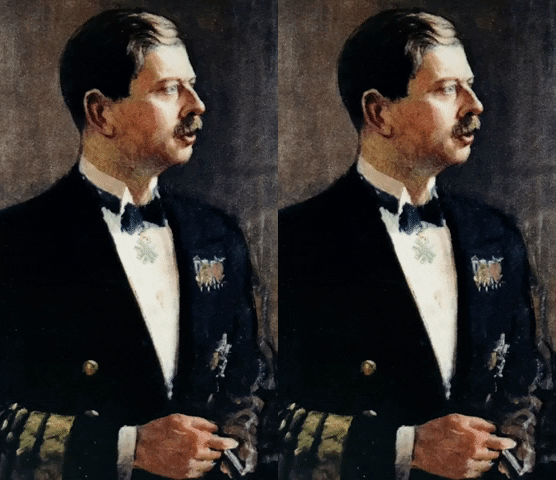 Somewhere among the Kaedreni hills, a cardinal and a few priests are having a pleasant picnic. Then suddenly: a pain tears through the back of Laurence, all the way to his neck! He shakes a bit, the priests looking at him in utter confusion. He doesn’t pay attention them. Instead, he looks in the general direction of Hanseti-Ruska. “No..” he mutters, scratching his back in pure shock “they’re not that stupid, right?..”
 -
"The profound and mysterious psyche of the electorate captivates me to this day.." Laurence would state in awe.
-
Multiple Pruvia-Rhoswen Ltd. executives are working overnight on their latest advertisement strategy to ensure a 5% growth rate for profits in the second quarter: they commission a research paper that proves this milk makes women infertile!
-
HOUSE OF COMMONS OF THE COMMONWEALTH OF KAEDRIN From the belief that each Kaedreni may freely pursue the manifestation of his destiny, and in reverence of the liberties once enshrined in the former Golden Republic: we establish the House of Commons in pursuit of liberty for our people. An open legislature for all citizens of Kaedrin to participate: where they can legislate, elect and hold accountable for their great demesne. CURRENT HOUSE OF COMMONS INCUMBENT KING OF KAEDRIN HIS IMPERIAL MAJESTY, Peter III Holy Orenian Emperor King of Kaedrin and Grand Duke of Ves INCUMBENT SPEAKER OF THE HOUSE HIS EMINENCE, Laurence August Pruvia Cardinal Ves FUNCTIONALITY The House of Commons is an unique organ, in that it carries legislative and instructive authority with neither elections nor electoral seats: being truly open for all to partake in shaping their democratic destiny. It establishes six criteria of eligibility that need to be met before a citizen can partake: I). An Imperial Subject residing in Kaedrin; II). That is Human; III). Of the Canonist faith; IV). Registered in the Imperial Census as such; V). Having reached the age of legality; VI). Who is also literate. The assembly is led by the Speaker of the House of Commons, who is entrusted with maintaining a functional session and extensive records of such. He carries the exclusive authority to: I). Interrupt or silence an assemblyman; II). Remove an assemblyman or spectator from the premises; III). Speak on behalf of the government on matters discussed in the House of Commons; IV). Advise against bringing a proposal or amendment to a vote. For the maintenance of records, penning summaries and tallying votes, the House of Commons can count on the clerks, who are entrusted with aiding the Speaker during and after assemblies. PROCEDURE Each eligible participant to the House of Commons has inherent rights attached to its eligibility: ensuring that he or she can participate fully as a free citizen of Kaedrin. These rights are: I). the right to propose bills; II). the right to amend bills; III). the right to discuss bills; IV). the right to vote on bills; V). the right to call upon officials of Kaedrin for public questioning. THE BEGINNING consists of participants raising their hands to propose bills. These are then added to a roll in random order. THE HANDLING OF A BILL would then proceed, starting with the highest proposal on the list. Everyone once more can raise their hand if they wish to discuss the bill, express a statement or wish to inquire about it further. If a participant wishes to respond to another person: he points at the person he wishes to respond to. It is allowed to respond multiple times to the same person. Responding to each other is allowed as well. Once everyone that raised their hand or pointed their finger has spoken, and all questions are answered, the bill then goes to a vote. THE VOTING then commences: each vote either being AYE, NAY, ABSTAIN or AMEND. If a majority votes to amend, the proposer is forced to amend its proposal and re-introduce it during the next session.
-
Mariana Dubois smoking her Rochefort’s, 1763 ROCHEFORT™ CIGARETTES SUPERFINE & READY ROLLED Est. 15th of Owyn’s Flame, 1763 A Pruvia-Rhoswen Ltd. Corporation Károly Tower, Floor 3, Owynsburg, Kaedrin The Rhoswenii agrarian dream and the rustique of all beneath Mont Claire: the entire experience now handheld as a luxury consumer product, composed of the finest tobacco and materials from the old north state. Class no longer is determined by wealth: it is determined by your cigarette brand. FOUNDING STORY A taboo in the early tobacco industry was the practical monopoly Kaedrin had on quality plants: the fertile lands and valley weather causing for rapid and healthy growth of the herbs necessary to produce a cigarette. Kaedrin was the main supplier for the Illatian Palina’s, and the later Papal Cigarettes Ltd. Cigarette brands came and went: often relying on the temporary popularity of a single person. Due to Illatians often going to jail, and clergymen being commercially inept: most cigarette brands fell into obscurity rather quickly. The folk of Kaedrin understood that, for the survival of their own tobacco farms, they had to maintain a steady demand. But then Richard Helvets, Mariana Dubois and Laurence Pruvia concocted a commercial wonder: what if we used the tobacco for ourselves? Starting in a rented apartment on the third floor of the Károly tower, Rochefort quickly became a hallmark in the industry. With the clergy and House Helvets smoking this particular brand, it soon conquered the social circles of the Empire. From the Duke of Angren to the Minister of Intelligence: all flocked behind the Rhoswenii flagship brand. From that point onwards Rochefort became a prospering Pruvia-Rhoswen Ltd. Enterprise that not only introduced cigarettes as a staple of the upper echelon, but as a chief cultural export of the former Commonwealth. When you smoke Rochefort, you experience Kaedrin’s ancient glory. ETYMOLOGY The trademarked ‘Rochefort’ brand stems from the County of Rochefort, belonging to Richard Victor Helvets. The name was chosen for the brand by Pruvia-Rhoswen Ltd. due to the cultural contributions by the Count of Rochefort himself. The name evokes a sense of trust, quality and cultural excellency for the average Kaedreni. But to the outsider, it demands a vibrant vision of Kaedreni elegance and civilization. COMPARISON TO THE COMPETITION Pruvia-Rhoswen Ltd. set up an independent panel of tobacco-frequents in Helena, Owynsburg, Reza and former Avalain to compare the brands: with each only being identifiable by ‘A’, ‘B’, ‘C’ & ‘D’. In this credible study, Rochefort was found to be an excellent performer in all measurements but disappointment: its brand, labeled as A, scoring the highest with every panelist! We found the most success in the following demographics: I). Intelligent people; II). Successful people; & III). Tasteful people. Before commercial release, we collected reviews from our samplers: “It’s so good that it’s almost a sin”. His Holiness the High Pontiff James II “An absolutely ludicrous amount of quality!” Duke John d’Arkent “I don’t even need to travel to Kaedrin anymore.” Riordain MacDroch “A taste so treacherous, it should be dragged to court.” His Excellency the Solicitor-General Joseph Adler “Okay fine, I guess one thing is good about Kaedrin” Ser Osvald Barclay of Haense
-
The Cardinal, still recovering from his hangover, groans as the thesis is delivered to him. Seeing a familiar name on the paper: he smiles. "How swift."
-
THE RHOSWENII HUNT OF RICHARD VICTOR HELVETS & LAURENCE AUGUST PRUVIA 13th of Owyn’s Flame, 1763 It was a peaceful day in Kaedrin: the afternoon sun ascending over Mont Catherine as a comfortable breeze drifted through the grassy fields. Most had opted to spend a lazy day in the sun, the epitome of the Rhoswenii agrarian dream. Two young men sought a different pastime however, interrupting the serene silence covering the demesne as a warm blanket. “Get ‘m!” Laurence exclaimed, Richard aiming to hit the Pheasant with his crossbow. It would be the first of many pheasants, squirrels and geese populating the Kaedreni plains. The galloping of horses, the chatter: a jolly duo getting acquainted through the most refined of Kaedreni hobbies. “Off we are then” Richard chuckled, galloping his steed after the antagonized bird. Laurence had struck it in his wing, but failed to cull it. In a burst: Richard halted his horse and fired at the Pheasant, hoping to kill it instantly. The Helvets had failed as well, promoting Laurence to enter a hot pursuit of the Pheasant. Despite his best efforts, he missed once more. “By the lord” he would exclaim “That’s one stubborn lass”. Richard was less entertained, snorting “blasted bird!” as he pursued her to the bushes nearby. “I’ll hold her steady this time” Richard then groaned, preparing his contraption to end the pursuit after this illusive pheasant. Laurence smirked, holding the reins of his horse tightly. Even with the steadiness of a marksman: Richard failed to slay that dodgy lass, prompting Laurence to reload his crossbow again. “Perhaps we can spook it to flee?” Richard inquired, nodding towards Laurence as he dismounted to come closer. Without saying a word, Laurence shot a bolt: finally slaying the pheasant. As Richard went to mount his steed, Laurence looked towards the contours of the Falstaff estate. “Shall we venture deeper into the woods?” he asked, with Richard puffing “Fair, down to the Rills perhaps”. As both ventured past the Falstaff estate into the swamp, a conversation had erupted. “Say, Richard.” he’d turn to him “If I may call you that?”. “Ay, of course.” Richard replied, halting his horse “It gets dull to stand on ceremony”. Laurence slightly closed his eyes in satisfaction: inquiring “You mentioned that you were married earlier. To whom? If I may be privy”. The Count tilted his head “Lorena Antonia, His Majesty’s daughter”. “Happily married?” “It’s tiring, but rewarding,” “How come?” Laurence would chuckle, thinking of his last passion in Helena “She requires.. A great measure of support. But I suppose in any type of partnership that is the case.” “I salute any man that endures the complexity of women.” he chuckled, simulating the tipping of his hat to Richard “While I certainly miss it, clerical celibacy has its boons.” “It takes a fair bit of weight off your shoulders, that I do expect.” he answered Laurence, his eyes darting between him and a bird flying past. “Truly.” Laurence chuckled “though it has been hard to adjust to clerical life.” “How recently did you come upon them.. The Cloth?” Richard interjected, tilting his head. “S-Several days?” Laurence answered in an insecure fashion, fiddling with his crossbow. “How peculiar.” Richard laughed in response, albeit reassuringly “We will grow in kind then”. His gaze turned to the lake ahead, beckoning for Laurence to follow: “Now let us find that bloody goose.” Their horses reached the lakeside: decorated by lush plantations and the sounds of hectic geese. Laurence was the first to spot a nesting in the green: “Over there, do you see it?” “A wee blur, the habitat is thick with green” Richard admitted, sneaking forward as he placed a bolt in the chamber of his contraption. “Shall we go for the seated goose, or the male one swimming about?” Laurence went on his knees, readying his contraption “I believe it is prudent to leave a mother and her ilk.” Richard answered, sneaking towards an opening “It’s a clearer shot anyhow.” As both aimed their crossbows at the drifting goose, Laurence winked at Richard: “I’ll leave this one for you.” as he lowered his own. The whistle of Richard’s bolt broke the peace of the lake, its hit on the upper back of the bird turning its white feathers quickly red. The goose began to flutter as its essence leaked into the lake below. Richard calmly readied his crossbow once more, going for that elegant finish. “Bugger me, if this silly goose was instead the Lord Selm: it would be a wider target at least.” The duo chuckled, although the young Laurence had not acquainted himself yet with the intricate history of political prominents, waiting patiently for Richard to finish his shot before asking. He missed his shot however, sighing: “It appears I’ll have to borrow one from you dear Bishop: before this blasted bird gets away.” Laurence immediately went to aim and fire, missing his shot as well. “Are we this incompetent?” “Mayhaps it’ll have bled out by the time it reaches the other end” Richard reassured, jogging towards his steed. Laurence followed in pursuit, both now galloping around the lake to catch up with the wounded goose. As Richard reloaded his crossbow and aimed it once more, he dryly stated: “Third time’s the charm” before cleanly penetrating the goose’s neck. It flung into the water directly. As Richard went to pick up the goose’s carcass, now drifted ashore. He beckoned him: “Shall we venture to Varoche? I’ll catch up!” Laurence nodded, galloping away towards his new home. With that, as the hunt came to an end, a friendship came to a start.
-
“If one is to recognize that the Bishop of Jorenus spoke correctly, one cannot then seek to reconcile our scripture with notions from the Lendian heresy. One cannot negotiate over the substance of an absolute truth: either one accepts, or denies it. Tradition by no means justifies opposing God’s Word and scripture for the sake of local sedition and anti-Orenism. One can bathe in the feces of doves without stating that the dogma of the Holy Church of the Canon is wrong, by establishing a different truth for itself. This Lendian heresy is filth!” Laurence would write to Friar Benedict, frustrated at this expression of tolerance towards a declared heresy.
-
THE FIDEI DEFENSOR A thesis by Laurence August Pruvia, D.B.S. 15th of Owyn's Flame, 1763 The matter of Church and State is an inherently complex one: where theologians and men of statecraft carefully tread alongside the lines separating the analytic from the seditionist, the division of authority and the questioning of it. This leaves the concept of our Fidei Defensor relatively obscure to the minds of the commonfolk, despite it being the most crucial of concepts for the integrity of the faith and the state. While the Canonist Faith holds a monopoly on theological truth, its function goes far beyond the spreading and institutionalizing of it. The fact that mankind is destined to be bound by one faith: establishes a certain universality to whatever values and notions it upholds. While theoretically sensical, for this to exist, it must adhere to certain pragmatic realities. The most important one being: that a monopoly in whatever form, must be defensible if it is to stay a monopoly. This is done by the Fidei Defensor, which anno 1763 is His Imperial Majesty. While he wields no authority to prescribe an interpretation of the Holy Scrolls or ecclesiastical laws, he is entrusted to protect and enforce them. If Hanseti-Ruska was to hypothetically embrace the Lendian heresy further than it does not: the Church would not have to fight them alone. For we can rely on His Imperial Majesty, his institutions and thus his military to decimate any threat to the monopoly that binds mankind. This backs our word and our scripture, like gold is backing our currency. It leaves His Imperial Majesty with a profound responsibility of mediating, if not destroying, any divisions within the faith. It is why those from Hanseti-Ruska call upon the ‘Fidei Defensor’ to restore order in the Church, while His Holiness the High Pontiff calls upon the same to cease Haeseni heresy. Critics of the state argue that this makes the Church weak, because an entity stronger than us can rule against our interests. It would make us dependent, or worse, an Imperial puppet. But those critics fail to understand an inherent logic to this unicum: that we get a seat at the table due to His Imperial Majesty in the first place. For without the nearly consistent harmony between the Fidei Defensor and the faith: our authority as God’s institution would’ve been questioned, if not diminished, throughout the realm. We can only uphold the ultimate truth, because the consensus on the truth is enforced in this fashion. Would the fair people of Hanseti-Ruska even entertain His Grace Bishop Anton’s declaration against the Lendian heresy, if it weren’t for the threat of Imperial intervention? Would mankind even unite without a singular faith? It is no surprise that the rebel human realms of the fifth Norlandic war were all heretical: for a supporter of the scripture cannot be rebellious to the authority the scripture establishes. To be rebellious, means you reject the notion that the Emperor defends your faith. “But what if the Emperor is a tyrant?” another critic would ask. This too, is very obvious. In the rare case that His Imperial Majesty would act against scripture or the will of God: the High Pontiff wields the sole authority to strip the title of Fidei defensor from him. In such a scenario, the Empire failed to uphold the Church to begin with. We chose to be codependent due to the mutual benefits that come with it. For both God and the State wish to see an unified humanity, under one God and one nation. God arranged this relationship so that the forces of morality and the architects of the state, in order for each other’s success, need to cooperate and unite. But in modern times, where secularization and liberalism are becoming increasingly popular: the balance is altered. The state had civilized its enforcement of law, including ecclesiastical law, from the days of pikes and beheadings. There is now due process: and that process complicates a lot of traditions such as Holy Orders, papal tribunals and witch burning. But is that necessarily bad? I would argue that it isn’t. For the Fidei Defensor hasn’t diluted his responsibilities despite these developments. It is why you find blasphemy and heresy to now be forbidden in Imperial law, and Chaplains in the Imperial State Army. Civilization inevitably leads to an expanding state. But instead of opposing these developments as a Church, as a clergyman or Canonist generally: we must understand that our monopoly on morality is not endangered. Better yet, it is now woven into the fabric of Imperial law and society. From Vice-Chancellor Hugo Wright being a cardinal, to the Reverend Károly being a Senator: we find more individual examples of this church and state harmony day by day. Never has the Church been stronger than it is now, and never are the fears of a Godless state more unjustified. The ambitions of many preceding High Pontiffs are now materialized before our very eyes. Those that refuse to rejoice, but chose to reject instead: are not just heretical, but on the wrong side of history as well.
-
A CARNATIAN WITHERS THE DEATH OF KRISZTIÁN MÁTYÁS KÁROLY, CARDINAL OF VES Nervously did Krisztián look up to the sky: watching his dove carry a letter towards the Septarchy. The hastily written letter would read: “To my esteemed colleagues, Bishop Anton Barclay and myself are a part of a delegation to attend the board meeting of the Royal Academy of Haense. Siegmund Corbish is, slightly violently, blocking our attendance in New Reza. Yours humbly, Cardinal Ves” Unbeknownst to the Septarchy: this would be the last letter the avid writer ever penned. For as he walked to meet Vice-Chancellor Rodericus in the Basilica of Fifty Virgins: fate had ruled against him. A bolt to his neck had, unlike a monarch before him, made an end to his controversial life. While the Vice-Chancellor waited and the Bishop was speaking to his congregation in New Reza, the Cardinal’s body was dragged to the Helena Cathedral: where he was desecrated. Where once a beheaded crow and pig’s head lied with the words “Haense will rule again”, now was decorated by the head of the young Cardinal. Behind the altar: his headless body was elevated by an intricate work of ropes. The Vice-Chancellor and Cardinal Wilhelm were the first to discover the travesty: but were not the last. Soon a flock of ISA guards, curious citizens and couriers carrying the word spread throughout the realm. A man that once stood in court on charges of sedition, died because of his patriotism. May the realm remember him fondly. R.I.P. Krisztián Mátyás Károly
-
His Eminence reading over his notes in the Bishopric of Ves, 1761. WHO ARE THE IMPERIALS? A chronicle highlighting the characters populating the Holy Orenian Empire AUTHOR: His Eminence Krisztián Cardinal Ves Secretariat to His Holiness PUBLISHED BY: HELVETS HOUSE OF LITERATURE ST. OWYNSBURG, STREET C, NR. 1 THIS CHRONICLE IS DEDICATED TO THE BRAVE PEOPLE OF OREN PREAMBLE The extensive machinations of the Imperial empire provide us with detailed census data, geographical outlines or written epics. They are the building blocks of how we perceive the Empire today, and what will come for it tomorrow. Albeit crucial, it is easy to forget the tales of the men making this all happen. The Imperial functionary, the diligent farmer and the vigilant guard: all a part of a great mosaic that make mankind’s greatest feats possible. This chronicle will explore these characters all across the Empire, and celebrate their existence in utter gratitude and reverence. IMPERIAL CITIZEN: His Excellency, Joseph Adler Imperial Solicitor-General, former Lieutenant of the ISA and former Ensign of the ISA. An illusive man responsible for our bastion of civility: Joseph was born in 1722 in the outskirts of Ves to an academic couple, trying to cope with the hardships brought on the family since the 6th Empire. His ancestor David Adler, a military theorist, became a milestone on the descent towards the debauchery and chaos of that Empire’s final years: as taught to the young Joseph, a martyr. The passing of his father at fifteen and the sadness of his mother made him seek an escape elsewhere: serving the Imperial State Army as an ensign, due to the Archchancellor recognizing his family name. His service in the Nordling War is remembranced by a well maintained painting in his office: a memorial to the loss of his brothers, but also the ascension into manhood that this war had given him. Joseph Adler is a private man: unwilling to divulge much about his passions, his love, his ambitions and his guilty decadency. A man with a straight posture and calm expression: a true professional, hard to emotionally relate with. The things he does divulge are mostly about his relationship with Kaedrin and Helena. The jewel of the Empire feels as home to his cosmopolitan self, but his youth in Ves gives the land of Highlanders a special place in his heart regardless. He appreciates its existence from a distance, but sees no reason to return there himself. In his later years as a soldier however, the young Adler did try to find a path home. The idea that a job in Kaedrin would lead to a reassignment there brought him to serve on the Eastern Circuit Court as a judge. God, or perhaps favorable timing, placed him as a candidate for the office of Solicitor-General. Without serving a day as lieutenant in Kaedrin, nor as a Circuit Court Judge: he was nominated for the office of Solicitor-General and then confirmed by the Senate. This intervention kept him in Helena, perhaps even chained him to the metropolis forever. A seemingly random turn of events brought forward a fine candidate. For Joseph carries a profound attachment to the legality and civility of the Imperial legal system. Horrified by a familial history of barbarism and arbitrary persecution, also leading to his family’s isolation, Joseph understood the value of the status quo he was entrusted with. He wakes up everyday with a sense of besiegement, seeing elements of barbarism and dark age seeping into the political and social circles of Oren. His biggest fear isn’t so much about history repeating itself, as it is about the uncertainty of the future. A busy man that ponders about who he will hand over his torch to, and if that person is capable of successfully defending the bastion. He vividly remembers his first case: the one against Ser Robert Vyronov, which to Joseph stands as a proper example of the barbarism still present in Orenian society. He had inherited the investigation from his predecessor: but the case lied dormant for over a decade. A rather mentally ill landholder had killed his patriarch over a slight, and blamed it on fictional bandits for years. A cold blooded slaughter between men of high peerage and renown: a true shock for the populace at the time. Not particularly for Joseph however, who profoundly understood the looming dangers of primitive temptations. Despite the towering shadows of uncertain futures: the Solicitor-General starts his day as an optimist. Where there is evidence of uncivil sentiments, there is evidence of the opposite. A given example of this is the history between myself, the author, and Joseph Adler, the interviewed. For he was the prosecutor in the case of the Crown. v. Károly before the supreme court. A case that stands in stark contrast with his first case of Ser Robert Vyronov: as he feels it teaches three lessons of redemption, understanding and learning. Redemption because it redeemed actions taken in anger and ignorance. Understanding of one’s upbringing and worldview, considering the influence of these concepts on the person himself. And at last learning, because he felt the trial was a lesson on what might be a better life to all that doubt imperial ways. The Solicitor-General is a man of mandate. Even though the annals of history will not refer to his personality, his demons and his private affairs: it will recognize a man that feels like the nation is watching him work, as he puts a greater good before himself. PREVIOUS EDITION(S) John d’Arkent, Vol. I. ((https://www.lordofthecraft.net/forums/topic/190221-who-are-the-imperials-john-darkent-vol-i/?tab=comments#comment-1764339))
-
Krisztián smirks politely.
-
Krisztián shakes his head at the missive “Define ‘The Imperial State’?” his frail hand shakes in slight frustration, reaching for a cigarette “This is basically slander. Didn’t they cut tongues over this in Haense?”
-
Carnatian cattle farmers in the outskirts of Owynsburg, 1747 NOTHING LIKE KAEDRIN AN ODE TO MY HOME One can easily be distracted from radiant beauty by the affairs of the everyday: where a thick mantle of responsibility and duty await all Orenians waking up at dawn. For most of us residing in the cities: we no longer think about the effort, the manpower and the creativity required to shape your humble abode. We no longer care about the bee resting on a flower, or the aesthetic of well-dressed cosmopolitans chatting in a bustling tavern. Why would we? The stream of duty takes us all to our daily routines, and once they’re finished, we long nothing more but to return amongst our brethren and kin. Everyday I wake up before the city does: so that I may quickly dress and eat, before riding off to whatever corner of the Empire needs me. Witnessing the Senate in session in Helena, or attending a masquerade in Hanseti-Ruska. Chatting with lady Devereux in Curon, and passing by former Suffonia for old time’s sake. But as I travel and talk and write, worry and ponder and think: I too stop thinking about the beauty of home. In the days between being informed about your promotion, and it being published in a bull: one can detox from the functionary life. The joy of your progress is not yet impeded by the weight of your new mantle: you are free, and you are happy. This serenity perhaps enlightened me enough to see how beautiful my daily life is, and that of many of my Rhoswenii friends. Because nothing can quite capture the feeling of Kaedrin: not even the jewel of the Empire known as Helena, or the newest city on our map in Curon. Don’t get me wrong: Helena certainly is a jewel, and Curon definitely embodies imperial prosperity. In today’s Empire, ugliness appears scarcely. But even though most of our Empire is beautiful: not much is as beautiful as Kaedrin. For when I depart from my daily chatter with Mariana Dubois, I see an idyllic farmland stretching around her estate. Small creeks and flowers decorate the pittoresque path to the city of Owynsburg: slowly becoming bustling once more. For a couple of minutes: you stroll through a remarkable painting. While I prepare a sermon with my Acolytes Ludomir and Franz in St. Catharines: I feel the mountain breeze going through my hair. I look through the opened stained glass windows, and am greeted by a clear blue sky and an ever pleasing sun. When Edgar de Sarkozy asks for a moment in private, he takes me just outside the cathedral: where a contrast of sharp shadows and noon sun decorate my brick staircases running through my yard. When I taste wine with Richard Helvets and his lovely wife Lorena, I am surrounded by an extravagant display of colours and decorations in Varoche palace. A perfectly balanced interior that doesn’t impose on you like in Helena’s, but gives far more warmth than the dark lumbers of Haense’s. A fine abode to conversate and to feel comfortable in, but which is also the seat of Rhoswenii power. Whether I look out of the window there, or stand outside of the palace gate: these magnificent mountains greet me again, with the familiar contour of the Cathedral speaking to me softly: “Home.” But fluffy clouds, green grass and a radiant sun are only half of the beauty resting in the former Commonwealth. Where Helena is bejeweled by its architecture, Kaedrin shines through its people instead. Nowhere else did I find this warm hospitality: as a Carnatian peasant, or as a Bishop. I remember running into Henry Frederick Helvets vividly. He was a prince and governor-general of Kaedrin, jogging past me as I arrived at Owynsburg from Helena. Despite it being our first interaction: he greeted me warmly and asked me about my day, before knowing that I was to be his new Bishop. A small albeit remarkable interaction, but one simply impossible to replicate with the social etiquettes of Helena or the cold culture of Haense. This proved to be just the appetizer for me however: for I have yet to meet a rude Kaedreni, at a point where nearly the entire population consists of familiar faces. Random strangers would accompany my relatives in the tavern, help me decorate my home or escort me to previously undiscovered corners of this paradise. They would involve me in their games, their stories and their grief. No place becomes home quicker than Kaedrin, because everyone treats the other as family. But I of course cannot just talk about my personal experiences, when their hospitality is the reason for my people’s comfortable existence. Even as peasants we lived comfortably in Kaedrin, obtained literacy and were given a seat at the table. The Kaedreni and their recent ancestors had no obligation to cater to a weak and troubled culture like ours, but chose to help it recover regardless. A rare type of gratitude is felt for this: one that feels impossible to repay. My father once rightfully said: “never lose the opportunity to see something beautiful, for beauty is God’s handwriting”. This divine presence is felt in the piety and purity of the Rhoswenii folk: being the best congregation one may wish for. Substantial but polite in debates, gossipy but within the realm of the civil and decadent but handled in a fashion that is respectable. Temperance is another wealth that Kaedrin possesses in excess. Kaedrin is a place where the friends are the trustiest and the wine is the headiest, where my love is felt the liveliest, and my life is spent the loveliest. Wherever I might be, there truly is nothing like Kaedrin. Now that I can see once more, I always look behind me on the road and think: never will I forget the beauty waiting for me at home.
-
Appeal for Information - Karina Sophia Barbanov
Draeris replied to Office of the Registry's topic in The Kingdom of Oren
The Carnatian would sign a cross, baffled by this tragedy “Another sheep culled from the Canonist flock.. May God give her rest. the poor lass..” -
DECIMUS AUREA BULLA HELENAM: The Tenth Golden Bull of Helena
Draeris replied to VIROS's topic in Church of the Canon
A frail Carnatian looks over his tower window at C street in Owynsburg, seeing the sun rise and his congregation milling about below. Mornings like these were always blessed: but this morning was slightly more blessed than the others. With a weak smile, he pens a letter to His Holiness, thanking him for the given trust. -
The author couldn’t hear Otto in his palace, but Otto could probably smell the rotting scent from the human carcass in the palace courtyard!
-
“Such a seemingly emotional man couldn’t possibly be nominated judge?” the Carnatian would lean over the railing, watching the ongoing Senate session “Bah, democracy wills it I suppose.”
-
Joseph Adler to Otto Sigmar: “cease these executions at once!” TEACHING HANSETI-RUSKA A STUBBORN CASE OF BRUTALITY WITHIN OUR BORDERS AUTHOR: His Eminence Krisztián Cardinal Ves Secretariat to His Holiness PUBLISHED BY: HELVETS HOUSE OF LITERATURE ST. OWYNSBURG, STREET C, NR. 1 12th of Owyn's Flame, 1762 His Imperial Majesty is an unicum in the Canonist faith: beyond being its defender, it carries a mandate handed to GOD. Through this mandate, he appoints functionaries in his privy council: who in turn delegate authority to lesser functionaries or democratic institutions. This process birthed the Senate, the Circuit courts and the Supreme Court: and it has made life significantly better for all ever since. The excellence of such institutions rely on the cooperation of mankind. In most of the Empire, it works: from the agrarian hills of Kaedrin to the bustling construction sites of Curon. All adhere to the consensus of civility, from the sovereigns to the Senators and the peasants beneath. A man in Kaedrin can rely on the prospect of a fair trial, a ruling in accordance with imperial law and the proper execution of said ruling. One may notice that since this system prevails: less blood has been spilled on the steps of Varoche Hall or Owynsburg. But what if an Imperial subject breaks this consensus, and deems itself more capable to deliver justice than the imperial framework? I am, of course, talking about the Kingdom of Hanseti-Ruska. Having personally witnessed two executions without trial, a child nearly being imprisoned instantly by their military, as much as hearing accounts from Vanir and Amador on other occasions: I find myself disgruntled with this arrogance. Why is a person within the territory of Hanseti-Ruska, less likely to receive a fair trial than a man in Curon or Helena? This isn’t a case of wayward vigilantes or mutinies in the military either. The Lord Regent and the military leadership all gather to see a rain of arrows pierce the back of an untried man: only to collectively loot his carcass afterwards. Is his body buried? Nay, an awards ceremony is held after by the Marshal. People feast while a man’s body rots in front of the Haeseni palace, a man that never faced justice beyond his initial arrest. How is this acceptable in 1762? Unsure how to answer that question, I wrote with utter disgruntlement to His Holiness and His Excellency the Archchancellor in hopes to bring this ongoing issue to light. Why is the Bishop of Ves meddling with extrajudicial executions in Hanseti-Ruska, one may ask? I refer to my previous publication ‘We may drown’, where I implore all Canonists to carry the mantle of civic duty and vigilance. As a witness, man of the cloth and imperial citizen: should I let this barbarism occur in my own country? Should I furthermore tolerate this slander against the very procedures that tried me fairly, ruled me innocent and spared my life? How fearful do my fantasies run, imagining being the defendant in such a high profile trial in a jurisdiction like Hanseti-Ruska. Would I face such a fair trial there? Would I be able to write this? I doubt it. Which is what upsets me the most. What would have been a stark difference in outcomes: within the same country. Fortunately the Kingdom of Hanseti-Ruska knows many good faithfuls that care as much as I do. And I ask of them humbly: please do not be silent about issues such as these, dare to reach out when the institutions above you falter to meet the imperial standard. Demand the same civility that your peers abroad enjoy, for you might be missing out on the greatest delivering of justice and fairness known to mankind. The same applies to the worrying rise of Sigismundic Canonism within their borders. It is not long ago that severed heads were placed on our altar in Helena, citing that Haense will rule again. Is this the doing by the government like the extrajudicial executions? Of course not. But it is a testimony to the boiling rage underneath the northern ice: a rejection of modernity in its most vile and seditious form. It is within my personal belief that there is no historical reason behind the rise of this Sigismundic heresy, beyond it being an instrument to create yet another divide between ‘them’ and ‘us’. ‘Why seek these false trials, if true northern justice can be served?’ you are asked. ‘Why listen to Canonist Helenites, when our northern mystics know it better!’ you are being told. But is this true? And are Imperials truly that different from the average Haeseni? These distinctions seemed entirely irrelevant to its creators when the existence of the Kingdom was threatened, and Imperial troops were needed to protect it. They serve a specific purpose only: to keep you away from Imperial enlightenment, so that you are isolated and easier to rule over. So that you can witness the slaughtering of a man without due process, and feel you have nowhere to go to protest. GOD bless the architects of rapprochement. Men like Terrence May or Conrad Barclay: considering the Empire as whole. Families like Kortrevich and Vanir, who frequent the capital as if it is a city of their own - because it is. Our country is for all of humanity. Time will run out for those that thrive on barbarism and isolation, for a new generation awaits with proper respect for mankind’s oneness and its architects. GOD bless Joseph Adler, who took my correspondence seriously and sought to protect fair and free justice because of it. A question is lingering however: if His Excellency is to speak, will the Lord Regent listen?
-
His Eminence reading over his notes in the Bishopric of Ves, 1761. WHO ARE THE IMPERIALS? A chronicle highlighting the characters populating the Holy Orenian Empire AUTHOR: His Eminence Krisztián Cardinal Ves Secretariat to His Holiness PUBLISHED BY: HELVETS HOUSE OF LITERATURE ST. OWYNSBURG, STREET C, NR. 1 THIS CHRONICLE IS DEDICATED TO THE BRAVE PEOPLE OF OREN PREAMBLE The extensive machinations of the Imperial empire provide us with detailed census data, geographical outlines or written epics. They are the building blocks of how we perceive the Empire today, and what will come for it tomorrow. Albeit crucial, it is easy to forget the tales of the men making this all happen. The Imperial functionary, the diligent farmer and the vigilant guard: all a part of a great mosaic that make mankind’s greatest feats possible. This chronicle will explore these characters all across the Empire, and celebrate their existence in utter gratitude and reverence. IMPERIAL CITIZEN: His Grace, John d’Arkent, Duke of Sunholdt, Baron of Selm Chief Justice of the Supreme Court, former Arch-chancellor, former Vice-Chancellor, former First Minister of Curon. The lord of Selm was born in 1699 in Arkent to Joseph Marna or Joey the Pretender, and a kitchen wench of little repute named Diane. She formed most of his parenting, with his father preoccupied with the politics of the realm. With grey eyes, brown hair and facial hair, a straight but frail composure and a warm aura: John d’Arkent might be your typical Helenan cosmopolitan. A man that wakes up for the finer things in life, such as the whiskey that flows in our markets, but most importantly, to see his children’s health. He feels a calling to ensure that his offspring inherit a better world than he has, proudly boasting eight in total. To John d’Arkent, a better world for his children would entail their protection from another Pertinaxi reign. To maintain the quality of the noble aristocracy, and redefine how blood is valued in our Empire. He maintains liberal values, but staunchly demands for his peers to adhere to the upholding of institutions such as the Imperial throne. A meritocracy in the imperial context, where a father can trust that his children can succeed through sheer diligence and loyalty. He stands as a diligent man, working against the manifestation of his greatest fear: that the Time of Troubles return to wreak havoc on his offspring and his grandchildren, far beyond his own lifespan. More interestingly, the lord of Selm fears that the inheritors to the current Empire will not see its formula to success: casting aside the icons of greatness and prosperity for other tried experiments. But his political mind can be distracted by the simple temptations in life. He sees the Helenan class as a singular band of companions: who he drinks and feasts with. A man usually weighed down with fears of the future: finds bliss in these moments of simplicity. Hearty smiles, quality wine: the beauty of Helenan life. His greatest challenge was as Arch-chancellor for Alexander II, as it was poisoned with chaos and terrible affairs. Holding his cabinet together nearly cost the mental health of John, if not his own fingernails. He stood isolated, surrounded by incompetence and deception. Opposed to that stands his greatest victory: leading the Empire to the end of the Troubles. A lifelong professional dedication, accomplished through sheer merit and luck. With the end of the fifth Norlander war, John d’Arkent walks victorious through life. There is one man deserving of his wroth, that being Duke Godric and the citizens of Morsgrad. He feels that they constructed an entitled and delusional world that destroyed the civility around it. Furthermore, he despises the murderers of his daughter: the Belmonts. This horror had brought him closer to the psyche of a companion, Ester Rose. Both losing their daughters to Barbary. Though she is long dead at Godric’s hands some twenty years ago, he feels more attuned to her sorrow with the loss of his own daughter. He goes through life with a single wish: that the story of his comrades and him in their most heinous of struggles, is a worthwhile lesson for our progeny. That the terrible chapters of mankind’s history do not repeat, and that those that carry mankind further heed the warnings from the past. He furthermore hopes to die before any of his children: this also being his sole ambition left in life. The man feels accomplished and enfranchised: a true Imperial contributing to a collective destiny. The lord of Selm truly embodies a cosmopolitan. Feeling at home in every corner of the Empire: seeing no difference in worth between the many cultures that roam. He considers humanity ‘one nation and one culture’, even though he recognizes that each have their own lovely quirks. But to move beyond the point of recognizing these differences, seems to be of no interest to d’Arkent. For “nothing is more glorious than the providence of our imperial unity, a single humanity.” To assert anything else, like autonomy from the Empire or an identity that is distinctly separate, is to stand in the way of progress, and progress does not infringe upon anyone, so he believes. We either move together as one humanity, or we fall divided. If he could say one thing to all of mankind, it would be that mistrust is a breeding ground for hatred and deceit. To let one’s guard down and invite your fellow man into your house for a drink, and expect nothing from them. That would be a fine day for John d’Arkent, Baron of Selm.
-
WE MAY DROWN SAILING OVER THE WAVES OF HATE THE PUBLISHED EDITION OF THE SERMON OF His Eminence Krisztián Cardinal Ves Secretariat to His Holiness Spoken to his congregation in the Cathedral of St. Catherine’s in the Kaedreni capital of Owynsburg, 1760. PUBLISHED BY: HELVETS HOUSE OF LITERATURE ST. OWYNSBURG, STREET C, NR. 1 THIS SERMON IS DEDICATED TO THE BRAVE ISA SOLDIERS OF ORENIA The biggest fear of modern man is failure. The idea that despite the gallant defense by our brave soldiers, the care of our imperial functionaries, the voice of our elected representatives and the refinement of our cultural icons: we may not stay afloat, but instead, drown. Drown in the sea of hatred towards our modern existence: where the dark age concepts of absolutist rule and clerical autocracy swim freely. To mention this possibility is often seen as a form of distrust to the fine gentlemen in Helena: who sap their strength to march on from the fruits of their success. It is indisputable that mankind has progressed immensely since the end of the Lord-Protector’s reign: since we may exist in a blessed reality of wealth and enlightenment in excess. These gentlemen in Helena know, as much as those in our Canonist flock, that nothing is guaranteed or eternal. And while I spoke of gratitude towards these successes in Helena, I feel it is wise to go beyond gratitude: and seek to defend our bastion of civility. Defend against whom? You may ask. Imagination in your heads leads you from Haenseni separatists to Norlandic slaughterers. But do not heed these threats exclusively, for an enemy is amidst our flock. Not just the hecklers in my previous sermon, calling Helena a godless city. Not just the practitioning heretics beyond our borders: no, these are your common men and women who manifest in your circles. They are not your caricature type of evil: spitting on Imperial monuments every day. They are the priest that refuses to be accountable to the state, they are the guard that fantasizes of revolution or the separatist wishing for imperial disintegration: these can be the citizens that sit at your dinner table, that are the mother of your children or the local monarch you revere. But just because they are deserving of your affection or respect, does not mean that their ideas deserve tolerance. And herein lies our greatest challenge of today: truly enforcing the loyalty that GOD demands from us, without tearing the social fabric apart that has led to our prosperity. The Imperial government understands this fragile balance, but should not stand alone in maintaining it. It is the calling of the Canonist flock to do so as well. For GOD spoke to us in the Canticle of Patience: “And as I have created for you the struggles of the world, so too do I create the struggles of the spirit. And as I have created the struggles of the world and the spirit, so too do I bring their remedies. [...] I bid my faithful this: You shall not raise a hand in wrath, nor in envy, nor in any kind of sin. [..] My trials are the holy trials, and My Cure is the virtuous cure, and all the reliefs of Virtue are open to the righteous forebear.” If we do not remedy the struggles of the spirit through adherence to Canonism and loyalty to the state: we shall find more and more people becoming astray. They shall hate the institutions that granted them a liveable life, as they speak ill of those that affectionately take care of him. They shall become the wayward sons of GOD, leaving behind a path of destruction and social decay wherever they manifest. While no nation can conquer the Oren of today: its citizens certainly can poison it. This is why the Canonist must carry the mantle of GOD’s mandated authority: His Majesty and His Holiness, with the Imperial government. A true Canonist goes beyond not heeding the words of sedition and hate, but decimates them with sheer faith and a rebuttal. It is not long ago that I was spat upon by a man who spoke of a Godless Helena, in Helena’s very cathedral. Barely a day has passed since the head of a crow was placed on our altar, with the proclamation that Haense will rule again. They reject the notion that GOD has established a rightful authority over mankind through his institutions. Much like the apostates and heretics of the AIS, they speak to GOD: “Your Word is of no relevance to me, and I shall act against your Word”. Even though the Holy Scrolls state that His Word shall not be blasphemed. The sons of Horen and Malin heeded the call to defend GOD’s institutions, and thus, they won. But they are the soldiers that fight under our banner during war. The head of the beard, as much as the spit on my robe, did not occur during wartime. They happened during a period in which the people of Oren enjoyed peace and prosperity: the status quo of modern life. It needs no context to be present, no justification: it merely disrupts the social order, and acts as the iconoclast to humanity's prosperity. This is a sickness that only we, collectively, can defeat. By looking at the Canonist next to you, and asking to what extent he respects the doctrine of GOD. If one claims to be a Canonist but rejects the mandate of the Emperor or the sanctity of the Holy Canonist Church, he is nothing but a pretender and deceiver. If one identifies as a faithful, but rejects his fellow faithful, he simply is not a faithful. The Imperial apparatus, as much as the Holy Church of the Canon, cannot and should not have his eyes and ears everywhere. But you, the citizen of Oren, can be the witness of a soul gone astray. You are the only one with the access and understanding of the state of piety around you, or within yourself. Do not heed their words, reject their disruptions and isolate them from the benevolent life of mankind. This is your duty. Thus, it must fall upon you to protect your Canonist flock from these sinners. For if we don’t: the tides of hate and sedition might capsize our ship. And once it does, nothing is stopping us all from drowning.
-
Portraits of Konstanz and Reinhard Barclay had collected dust in the hallways of the Reinmar keep since their passing: their painted cynical expressions watching a new generation mill about their day. Their former presence nearly forgotten in the bustling albeit troubled house, their legacy replaced by new blood boasting about new accomplishments. A Barclay would walk through the hallway as he notices something: for the first time in decades, the portraits of these men were dusted off. “Finally” he smiles, continuing to the throne room.
-
A mosaic of vineyards and wheat-fields stretched over the Kaedreni landscape, with the towering mountains being the home of the St. Catharine’s cathedral. As dawn arose: a young Bishop would still be awake, kneeling over various parchments spread across the cathedral floor. These were scrolls borrowed from the Varoche palace library: explaining the intricate Kaedreni history. Infatuated, perhaps obsessed: while the folk partied in the palace, he studied the scrolls. Krisztián was intrigued by a particular man: having heard only a few vague tales growing up as a Carnatian peasant in the Commonwealth. But from his Bishopric, with access to all the scrolls he could desire, he now finally learned the tale of Ser Foltest of Aeldin. Noon almost broke when he was finished with the last scroll. He stretched his shoulders, took a deep breath, and walked to his small desk. Once there: he penned a letter to His Holiness. PETITION TO CANONIZE SER FOLTEST OF AELDIN TO HIS HOLINESS THE HIGH PONTIFF JAMES II, I send this letter not just as a man of the cloth, but also as a man with a profound respect for perhaps the most pious realm within our great Empire. While studying its magnificent history, I have come across the particular tale of Ser Foltest Helvets of Aeldin, a man currently considered blessed by the Holy Church of the Canon. Understanding that Ser Foltest had not only defended the Brelusian cathedral as mentioned in His Holiness Daniel VI’s “Lives of the Saints”, but also had pursued faithful service in the Imperial Tertius, the Order of the Flaming Rose, administered a true Canonist realm as the last electoral count of Kaedrin while having saved the lives of many from our Canonist flock: I wholeheartedly wish to petition to canonize such a pious man. For it is in my belief that our congregations in Kaedrin and abroad can draw a profound inspiration from this faithful man posthumously, and learn from his life that pious administration and defense of the Canonist flock are rewarded by GOD. It is furthermore my belief that celebrating his reverence will truly enrich our moral message to our congregations, and act as a proper homage to the continued piety and civility of the Kaedreni people towards the Holy Church of the Canon. I shall provide further explanation in the upcoming ecclesiastical council if deemed necessary by His Holiness. DEO JUVANTE, HIS GRACE THE BISHOP OF VES SECRETARIAT TO HIS HOLINESS Krisztián Mátyás Károly, Msgr.
-
A Carnatian composition, 1578 THE CARNATIAN PEOPLE KARNASZ EMBEREK A PUBLICATION AUTHORED BY; His Eminence Cardinal Krisztián M. Károly of Ves, Msgr. Author The Reverend Excellency, Senator Lajos S. Károly of Kaedrin Co-author His Excellency Sir Frederick S. Armas of Kaedrin Consulted historical expert INTRODUCTION The Carnatian people (Old Carnatian: Karnaszy) are the original inhabitants of Carnatia, before what we now understand to be the Duchy of Carnatia. The intensified settling of Haeseni folk during Otto I’s reign, combined with the ongoing chaos due to the Schism War, caused for them to be steadily disenfranchised from their homeland. During this war, they stood at the side of the Canonist league, who employed them as light cavalry. This equestrian service continued under the Savoyard dynasty, with several Carnatian-only battalions existing within the Royal Army. This steady employment made a certain degree of cultural unity possible: with the families of the soldiers living in the same neighborhood of West Felsen. This existence remained sustainable until the end of the Savoyard dynasty in 1526: when the second Carnatian diaspora happened. Not only did their main source of income evaporate with their loss of their equestrian mandate, but the increased gentrification of Felsen made living for the peasantry unaffordable. Most abandoned the mantle of their identity and remigrated back to Carnatia as reformed Raevirs, while a few stayed on the road as travellers. It would be these travellers that would find refuge in the Commonwealth of Kaedrin in the early decades of Arcas. With most reduced towards mere peasantry, with nearly to none literacy among them and haunted by a malaise of cultural homelessness: they sought to restore themselves in this new land of foreign ways. ETYMOLOGY The exonym ‘Carnatian’ derives from the flower most prevalent in their homeland, which was used in a variety of their festivals and rites. The name ‘Carnatian’ that foreigners used to identify them is similar to the native identification of ‘Karnaszy’: also meaning Carnatian. Carnatians in their quarters in West-Petrus, 1521 CULTURAL BRANCHES Within the Carnatian heartland once existed a cultural confederation that was ethnically similar, despite having minor cultural distinctions. Although these distinctions are last chronicled centuries ago: it is likely that some have lasted until today. Carnatians to the east, which were called the Serhaszy, were the least opposing to the Haeseni newcomers under Otto I. They had a significant share of the agricultural homesteads within the region, which profited heavily off new consumers at home and a new buyer abroad. They became increasingly non-Carnatian, being the last to leave Carnatia with most staying under the Haeseni occupation: finding their lives sustainable with maintained employment and greater tolerance to their Raevir-like identity. The Serhaszy are the most distinct in that they speak a language with components between Carnatian and Ruskan, and are culturally prone to be sympathetic to Ruskan Orthodoxy or ancient houses such as Kovachev or Barbanov. Northern Carnatians were identified as the Magiaszy, who had the greatest decree of cultural self determination and were the first to oppose Haeseni settling. The Magiaszy represent the majority of Carnatians currently in Arcas, adhering to the classical Canonist dogmas and remaining restorationist about their homeland. They are believed to speak the most original form of Carnatian, and adhere to its rites and festivals. Carnatians to the west are the Bohaszians. They are believed to be the oldest Carnatian ethnic group, who found their origin as a mixture between Waldenians and the original Arenic steppe folk moving into Orenia proper. They are often lumped in with the Magiasy, even though they speak in a distinct dialect and have variations between in ethnic appearance. This is primarily due to their mutual linguistic nationalism and political leanings, something that the Serhaszy lacked. MASARIST SOCIAL CONTRACT Since the formation of the tribal confederation that became the Carnatian people, the inhabitants had adhered to an established set of liberties and duties by the unifying warlord Mátyás Masaryk: the disputed founding father of the Carnatian identity. It is said that during his reign, each settlement had similar writings carved into wood, and placed in the town square: A Carnatian is to grow in its life; With the land he shall own Through the wife he shall have By the children he shall make And the swords of his brethren that protect him. A Carnatian shall grant others a honorable life; By the sharing of his wealth Through the loyalty to his kin By helping others grow And to be the sword that protects another. This is deemed as the social contract still dominant within Carnatian society: the fabric that makes social cohesion woven into the culture of this particular people. The application of these statutes can vary: but the expections remain universal. One is to contribute to the collective, and loyalty to his brethren. Deviation from this contract most certainly will result into social isolation, if not banishment. The Basilica of Fifty Virgins in Old Reza CANONISM AMONG CARNATIANS One of the reasons that the Carnatians existed for centuries without a homeland or consistent unity, was their enshrinement within the Holy Church of the Canon. Generations of monks, priests & nuns had served the church before they arose to prominence under Bishop Krisztián. The legacy of the church and the gratitude towards its special unifying function made the Carnatians not just staunch Canonists, but extremist advocates of Canonist doctrine. In the collective Carnatian consciousness: anti-Church sentiments were one of the primary reasons for the Schism War, and thus the loss of their homeland. Combining this with the fact that the Church recorded their culture sufficiently for it to survive until today, makes the existence of the Church strongly associated with their own cultural unity and existence. From this grew the disdain towards developments that seemingly diluted Canonist authority within the realm, which are often of liberal or separatist nature. The decrease of racial homogeneity had cost them their homeland, but would also weaken the institution that preserved them: this renders them prone to oppose multi-racialism or liberal interpretations on the rights of other races. Church careers are very common among them and are extremely revered. Many Carnatian clerics lobby for allowing for the clergy to marry, so that this popular career doesn’t harm the sustainability of their own people. Outside of this reform, they support the orthodoxy established by His Holiness the High Pontiff. Carnatians traveling to Helena to light the candlestick of St. Daniel, 1760 NEXT YEAR IN CARNATIA: A PEOPLE DIVIDED Even though the Serhaszy had evolved into an integral part of what is now Hanseti-Ruska, the Magiaszy and Bohaszians had walked a different path as most of them now settled in Kaedrin. That leaves a sensitive and complicated matter unresolved: with one group integrated into Haense, and the other longing a motherland of their own. If one was to ask the question: “Are Carnatians disenfranchised?”, the answer would depend on what Carnatian you ask. For those that had not opted to stay in their homeland centuries ago, say the Carnatians in Hanseti-Ruska are distinctly different from what they are. The existence of a Duchy of Carnatia is therefore complicated, as it delves into the question of: when does one stop being a Carnatian, and becomes a Raevir? Is House Kovachev still Carnatian? But if they are, what are the others? With a modern renaissance of this particular culture ongoing: it struggles to find its place in the modern geopolitics of Arcas. Will they accept their new existence as Kaedreni, or opt to restore the cultural confederation of old? With no marital, social or political ties to what is assumed to be a third of their population: the future has yet to answer if both shall identify as Carnatian still a century from now. Until that point, awkward conversations and steady rehabilitation will have to suffice. The Candlestick of St. Daniel after the Ceremony of Provenance, 1737. THE CANDLESTICK OF ST. DANIEL: ICON OF CULTURAL UNITY When St. Daniel the Great was the High Pontiff of mankind, Ruthernites robbed his Cyriaum estate: stealing the ceremonial candlestick used by His Holiness. It was used in his sermons and prayers, rendering it a significant religious component to the sanctity of this Pontiff. Centuries later, a couple of Carnatian Acolytes under Bishop Krisztián of Ves recovered it in the donated inheritance of a deceased Ruthern. It was considered a miracle: a holy item returned to pious men. The Bishop offered it back to His Holiness James II, who opted to make this a gift to the Carnatians instead as a reward for their clerical service. From that day, candlesticks have become a significant cultural icon for the Carnatians: with the Candlestick of St. Daniel the Great being the embodiment of their unity under the church. On the birthday of this Pontiff, all Carnatians light a candle on copies of the original. The original Candlestick of St. Daniel the Great gets lit during the rites before the annual sermon: called the Ceremony of Provenance, where Carnatian clergymen speak of their people’s history and their devotion to God. The first rite was performed by His Holiness James II himself.
