Jump to content

THE WINTER CROWS: Volume XVIII; Sigmund II - The Liberator

 Share


Recommended Posts

THE WINTER CROWS: Volume XVIII; Sigmund II - The Liberator

Written by Demetrius Barrow


image.png.aca1216ba7e9d7aa6d03957915dd8c84.png


Sigmund II - The Liberator

 oNsuRVG.png

“You are a prince forced to be a king. I pity the champion that you could have been.”- Emperor Peter III


In the twilight of 1753, Prince Marius’s plan had succeeded. King Andrik IV, an able and well-liked monarch, had been slain. His son, the five year old Prince Otto, would now inherit. In the long history of Haense, the inheritance of a child had typically spelled disaster. Marus I had ascended during a time of great turmoil in the Empire, which culminated in Haense’s conquest. Karl II had ascended in the midst of the ‘Dark Decades’, which saw Haense nearly collapse under a strain of failed wars, rebellion, famine, and plague. Andrik III, while ultimately a successful king, spent years pulling his kingdom out of the turmoil and devastation that had been wreaked during his early reign.


It was a testament to the power of the state built by Andrik III and Andrik IV that Otto Sigismund would reign for twenty three years.


Born on the 10th of Sigismund’s End, 1748, Otto Sigismund, son of Andrik IV and Maya of Muldav, the heir to Hanseti-Ruska emerged into a period marked by the two hands of rapid change and unbreaking stalemate. On one hand, social, political, and economic progress throughout the Empire was in the midst of upturning the old feudal order. Old fiefdoms were replaced with electoral districts, and duels of the sword, fought over honor, turned to duels of the written word, fought over higher ideas, where the only blood spilled was the quill’s ink. 


On the other hand, the Rubern War, advancing into its eighth year, had seen the armies of Duke Godric of Morsgrad, the most feared warlord of the age, rebuffed by strong fortifications in both Haense and the Crownlands and changing climatic patterns that made the gathering of large hosts impossible. A stagnation had set in to the war, which became defined by small skirmishes between patrols, lightning raids on undefended villages, brief sieges of antiquated castles, and executions of captured prisoners. The war had no end in sight, and while the imminent danger Haense had faced in 1741 had subsided, few could count themselves safe while on the roads of the Empire.


During his brief childhood before he ascended the Haeseni throne, Prince Otto was doted on by a loving father and directed in his early education by a sterner mother. The full breadth of his education would not come during this period, for he was far too young, but Queen Maya was insistent that her son, the heir to the realm, be raised in a manner befitting his future. Despite being put under a relatively rigorous schedule of tutelage for a boy his age, Otto Sigismund proved to be a bright, diligent, and curiously focused student, much in the mold of his father. “Were it not for a broad, hefty frame, and his mother’s piercing, focused eyes, I would have thought he was a student of mine from nineteen years ago, for even in wit, he did not fall far,” remarked Georges Melenchon, Andrik IV’s childhood tutor, who agreed to assist in the instructor of his old pupil’s son.


However, it would not be his studiousness, nor his appearance, that fostered comparisons between him and his father the most. Instead, it would be the captivity that he and his mother endured by a group of Haeseni deserters, organized by Prince Marius of Rubern, who invaded the Ekaterinburg Palace on the 10th of Owyn’s Flame, 1753. The young heir and his mother, fast asleep, were taken prisoner and threatened with their lives, while the rest of the palace was occupied and held for hours. A counterattack led by King Andrik saw the deserters killed, the palace retaken, and the queen and prince saved, but it had cost the twenty four year old monarch his life. Six weeks after the attack on the Ekaterinburg Palace, Andrik IV passed away from the wounds he had suffered during the fighting. The throne of Hanseti-Ruska would now pass to a boy who was barely five.


(Author’s note: Otto Sigismund, to be Otto IV, would adopt the regnal name “Sigmund II” upon his coronation. To prevent confusion, he shall be referred to as such throughout this volume.)


Too young to be given a coronation, signifying rule in his own right, the child-king, Sigmund II, would be guided by a regency for his early life. On his death bed, King Andrik had intended for the regency to be led by a council of three: Queen Maya, Ser Tiberias Barrow, and the Lord Palatine, Georg Alimar, respectively representing the court, the army, and the government. However, this power was quickly consolidated by Ser Tiberias, whose hold over the army allowed him to encroach on his fellow regent’s spheres of influence. The Lord Palatine effectively became Ser Tiberias’s assistant, handling the day-to-day management of the Haeseni government, but not directing higher policy. Queen Maya, still in mourning, retreated to her family, where she would oversee the raising of King Sigmund and his siblings.


Barely aware of what it even meant to be the King of Haense, Sigmund II’s childhood was mostly removed from his station, save when certain religious and cultural ceremonies, or the convening of court sessions, required him to fulfill the sacred role that he had inherited. Aside from these occasions, he was raised much as he would have been if his father were still alive. Most of his time was spent in his lessons, preparing him for his majority and self-rule, but Queen Maya, not wishing her son to develop some of the reclusive habits his father had, ensured that he was permitted to fraternize with his peers and play within New Reza. When questioned about her willingness to let her son run (somewhat) free while assassins could be on the prowl, the dowager claimed that “it would be unjust for him to be prevented from enjoying his youth, in the efforts to preserve his life, only for it to be taken away.” However, Queen Maya was not a neglectful parent, and she would often have her children accompany her on visits throughout Haense, and even as far as Helena, the capital of the Empire, where the young king would make an impression on all whom he met.


The frequent traveling that would shape the boy-king’s childhood became all the easier in the twilight years of the Rubern War. A month into his reign, Duke Godric struck at Rodenburg, where he drove back an ISA regiment under Darius Sabari after a hard-fought engagement. However, the victory was tainted when a young colonel, Sir Peter d’Arkent, led a unit of cavalry behind enemy lines to burn their baggage train, forcing a withdrawal. A year later, at the village of Krasna, Duke Godric forced Tiberias Barrow into battle, but after eight hours of fighting was only able to compel his enemy into an orderly withdrawal. Frustrated in his attempts to find a decisive victory that would progress the war, he would eventually die of a winter illness on the 23rd of Tobias’s Bounty, 1755, depriving the AIS of their famed commander.


Duke Godric’s death was the death blow to an alliance that had been unable to recapture the momentum it enjoyed from 1740-1742. One by one, the member states of the AIS withdrew, each making a separate peace with the Empire. By 1756, only Rubern, a land that had been disputed for fifty years, still stood in defiance of Peter III and his consolidation of humanity. The barbaric raiding parties and merciless patrols that had scoured the roads, sparing none, had withdrawn behind the walls of Prince Marius’s capital. At the beginning of the year, the Archchancellor, Simon Basrid, had announced that the war would end only when Rubern was returned to the Imperial fold. 


The Siege of Rubern, the culminating event of the Rubern War, saw the easy capture of the city and the surrender of Prince Marius. More a mop-up of the final elements of the AIS than a decisive campaign, the only thing of note to come from it was the death of Tiberias Barrow, who was killed during the initial assault against the city walls. However, even this would prove fitting for the realm, for now that war was concluded in full, it would no longer be controlled by the tight-fisted, militant regent. After a brief period of deliberation, the old, reliable Prince of Muldav, Otto Alimar, would assume the regency and the Office of the Palatine. For the next four years, he would oversee the elimination of the last pockets of insurgency and final peace arrangements, until the Treaty of Helena formally concluded the war in 1760.


Even before the Siege of Rubern, the worst of the war had long since passed. As evidenced by Sigmund II’s travels with Queen Maya, crossing nearly every corner of the Empire, travel, trade, and communication could resume as they had in times of peace, unimpeded by the worries of banditry or enemy offensives. The Imperial economy had also recovered, with Simon Basrid’s policy of market liberalization leading to a boom in commerce and manufacturing. Helena would prove to be the center of these changes, as had been the case with the cultural, political, and artistic developments during the Petrine Era, but New Reza, benefitting from many of Andrik IV’s mirroring reforms, did not fall far behind.


With the Prince of Muldav’s adroit hand guiding the government, ensuring that the kingdom capitalized off of the new era of peace and Andrik IV’s reforms, Sigmund II was not compelled to assume power  earlier than necessary. While took a formal place at the head of the Aulic Council, and was present for all of his ceremonial duties, he was content to allow the regent to do as he wished, for it usually benefitted the king. A Centralist himself, the Prince of Muldav all but broke the power of the Duma during his time as regent. For instance, when Haense received the lands of Rubern as part of the peace agreement in 1760, the Duma wished to divide the lands between a number of smaller lords and second sons, dividing the lucrative properties evenly between several houses. The Prince of Muldav, insistent that it was the Haeseni Crown that reaped the lion’s share from the war, owing to the cost it incurred, vetoed three bills regarding the division of Rubern, making it a property of House Barbanov (though significant tracts of land were given to House Alimar).


Aside from his formal studies that reflected a typical curriculum for a king of the time, Sigmund II took a particular liking to his martial training, including lessons on swordfighting, archery, horseback riding, tactics, and strategy, which had come at his mother’s insistence.His Majesty excels at the pursuit of war, above even his other lessons, so I have been told,” wrote Erwin Barclay, who was the Haeseni Lord Marshal and the king’s personal tutor. A strong, healthy young man, Sigmund II was the very image of a soldier, and as his role in the government expanded during his minority, it was often meetings among the leadership of the Brotherhood of Saint Karl, or the Marian Retinue, that he found himself having the most active voice within.


In part due to his militant training, and in part due to the influence of his strict, no-nonsense mother (which influenced the former), Sigmund II grew to become a quick-tempered, brash man, for whom the courtesies of court were worn uneasily. As he aged, he chafed beneath the constraints of his regency, always more comfortable in command than as a pupil in a deliberative body. His frustrations developed into a habit of argument, as he sought to challenge sources of authority, even his own tutors, when he deemed them to be incorrect, presumptuous, or too familiar for his liking. Only rarely would he be brought to shouting at his advisors, and never would he threaten violence, but it was noted by all, most poignantly the Margrave of Korstadt, that “the king will have what he desires, or he shall deprive the room of air until it is noted by all that he is aggrieved.”


Despite his growing temper, the king sided with good reason more often than not. While he would be more forceful in his objections, and react more temperamentally when corrected or contradicted, he did not go so far as to seize control of the government for himself, nor allow disagreements to extend outside of meetings of the Aulic Council, or private lessons with his tutors. To the myriad of lower officers, mid-level bureaucrats, and common servants, he was a humble, direct, austere man, traits which endeared him to his common subjects, who saw in him a demanding liege, though one that was fair and willing to discard archaic social conventions and cumbersome procedures to ensure that his orders were clear, concise, and feasibly-managed. Thus, it would not be the king’s zealousness to end his regency, but instead internal developments throughout the Empire that compelled his decision.


Throughout the Rubern War, it had been the policy of Emperor Peter III, shaped by Simon Basrid and his government, to centralize the Empire. Operating on similar logic to the Centralist faction within Haense, it was believed that a central government, army, and tax system, would allow for the resources of the state to be marshaled at greater levels, enabling the Empire to combat the AIS through a war of attrition. Over the course of the war, many of the smaller fiefdoms of the Crownlands, which had been weakened over decades of fighting, were directly absorbed by the Imperial Crown, who possessed castles for use by the Imperial State Army, broke up large estates to distribute to smaller farmers, and put old titles into abeyance. By the war’s end, the feudal order in the Crownlands had essentially been erased, replaced by direct oversight from Helena.


More alarmingly, even the larger Imperial vassals were not spared. In 1741, the Kingdom of Curon had come into the Emperor’s inheritance, who thereafter oversaw the region directly through appointed governors. In 1750, King Adrian of Kaedrin had died of consumption, leaving a vacancy atop Kaedrin’s electoral throne. After bribing the electors with vast sums of money, Peter III was elected King of Kaedrin, and thereafter would strip away the same institutions that had delivered him the crown. It would be a long process, but by 1768, the last vestiges of the Kaedreni monarchy had been done away with, leaving behind yet another region governed by the Emperor’s appointed representatives. Their armed forces, be they Caer Bann or regular levies, were integrated into the ISA. By the end of the Rubern War, Haense stood alone as the only great Imperial vassal that was not yet ruled from Helena.


Despite promises from the Archchancellor that Haense’s autonomy would be respected, the actions of the Emperor himself suggested otherwise. In a conduct that verged on harassment, he relentlessly pursued the hand of Queen Maya, who, dedicated to the raising of her son and the memory of her husband, refused him at every turn. The Emperor’s incessant attempts at courting the queen, joined with rumors of his lechery, soured relations between he and King Sigmund, who sought to defend his mother. In the rare, often-indirect correspondence between the two, the Emperor would speak patronizingly, chastising the young king for not showing more gratitude for the Empire’s role in standing by Haense during the Rubern War. It was a line of argument that, while unfair given the subject matter, was one that King Sigmund never developed a clear retort to; he grew up well after the height of the Rubern War, thus he was not inclined to be all too personally grateful for events that occurred well before he was born.


Fearing the Imperial government’s designs for Haense, especially given how it was led by a regency, Sigmund II made it known at the beginning of 1762 that he would see himself crowned by the year’s end. Fourteen was a young age to assume control over the state, but it was not unprecedented, and few within the Aulic Council wished to oppose him, least of all the Prince of Muldav, who believed a strong crown was imperative. The coronation was planned for the year’s end, enough time to prepare a lavish ceremony, one that would serve to deter the Emperor and his advisors from making an aggressive play to bring Haense into the Imperial fold by showing a strong, united monarchy. Well-versed in the role that his coronation would play, though not one to enjoy the minutiae of planning the details, King Sigmund equipped his court staff with a series of broad instructions for the ceremony, which would take place on the 9th of Sigismund’s End, 1762.


In the months leading to his coronation, Sigmund II traveled extensively throughout the realm. Following an advised schedule left behind by his father, he alternated between months devoted to his education and months devoted to his leisure. When it pertained to his education, he visited farming villages and grazing pastures, inspected the northern canals that Terrence May had begun the construction of, and reviewed border defenses that had seen repair and renewal during the war. When it pertained to leisure, he hunted in the Koengswald, rode on the southern steppes, and fished along the Silver Sea. Only occasionally returning to the capital, it would be the last year of his life that he was not absorbed in the day-to-day administration of the realm, which was left to the Prince of Muldav.


Sigmund II’s coronation (where he adopted his regnal name), held on the 9th of Sigismund’s End, 1762, was the most impressive, and most expensive, coronation seen by the kingdom. In a week filled with games, feasts, religious and civic ceremonies, and dramatic oaths, New Reza, brimming with Haeseni grandees and invited guests from across the Empire, including Peter III himself, the opulence and culture of Hanseti-Ruska was put on display to the entire world. Archaic poetry, recovered and translated by Otto the Tarcherman, was read aloud at dinner, while new cantatas, composed by the Choir of the Basilica of the Fifty Virgins, sponsored by the Crown, were sung at dinner. Haeseni book binding and furniture were highly desirable to the Heartlander elites, who spent great sums to ensure their homes had the latest.


mbariMH.png

Inspired by the king, poetry readings (often accompanied by music) became a favored pastime of the aristocracy during the reign of Sigmund II. One’s ability to recite both old (recovered) and new works was a mark of prestige, and it was not long before poetry became part of the traditional curriculum of the higher classes of Haeseni society.


For his part, the king, with the eyes of the Empire upon him, performed magnificently. “He bears resemblance to his grandfather,” wrote Simon Basrid after the festivities. Despite his youth, Sigmund II had a commanding presence and a voice that could fill a cathedral. Whether he was presiding over jousts, reciting his solemn oaths to the laws of Hanseti-Ruska, or giving speeches at evening dinner, he carried himself masterfully and held his regal aura throughout. Another assessment, from the Governor-General of Kaedrin, Richard Helvets, praised the king’s conduct towards his non-Haeseni guests, whom he took great care to entertain.


In a moment of inauspicious foreshadowing for the rest of Sigmund II’s reign, the joy of the festivities were swept away on the 16th of Sigismund’s End when the king was attacked by an assailant, nearly slain by a crossbow bolt that had pierced his neck but narrowly avoided any arteries. The attempted assassination came while the king was in the Basilica of the Fifty Virgins, where he had been swearing oaths to the City of New Reza, leading his miraculous survival to be credited to the intervention of God. Whether it was divine intervention, or merely a poor shot from the assassin, a former Ruberni soldier, the king was confined to his quarter for a month while he recovered. Even after he rose again, his voice took on a harsh, raspy character.


Tragedy struck a second time two days later. Grieving her son’s wounding, Queen Maya had been shut in her quarters for two days, forbidding any visitors. It was during this time that a second Ruberni assassin (it was unknown if he was connected with the first) made his way into her bedchambers from the balcony, which could be accessed by scaling the walls. It is unknown precisely what happened in the dowager’s quarters, but when she was found three minutes later, the sounds of fighting having caught the attention of the Ekaterinburg servants, both she and the assailant were found dead. The next day, in a curious show of grief, Peter III, enraged, burst into the late queen's quarters, where he “tore apart curtains and garments, wailing as one would the death of someone dear.” It was during this rampage through her chambers that he knocked over several lit candles, starting a fire that spread quickly. By the time that it could be quelled, an entire wing of the Ekaterinburg Palace had been burned down.


What had begun as a joyous coronation ceremony had ended as one of the most grievous stains on the Imperial-Haeseni relationship. The Emperor’s conduct itself had horrified the people of Haense- such an effusive, emotional display was thought unbecoming- but causing extensive damages to the Ekaterinburg Palace, a symbol of Haeseni pride, caused outcry. A popular satire of 1763 (originally in New Marian, here translated into Common) went:


“The palace is charred,

Though Andrik III would loathe to hear,

It was not Godfrey who did it,

Nor was it Martinus,

Instead it was his dear Petey.”


By the time he had recovered, Sigmund II’s outlook on his servitude to the Emperor had changed. Where before he had thought it necessary to merely correct against any tendencies of the Imperial Government to overreach against Haense’s privileges, he now believed that nothing short of obstruction and challenge would curtail Simon Basrid and his ministry’s push for centralization. Moving forward, Haeseni senators would block and delay any new laws that would chip away at Haense’s autonomy, and the king and his councilors would halt all military and infrastructure programs that integrated the resources of the Empire and of Haense.


The primary battlegrounds centered around taxation, ennoblement, and law, where the Imperial Government sought to integrate, if not dominate, existing Haeseni institutions. 


The former proved to be most pervasive, as Imperial senators friendly to the Archchancellor proposed numerous bills that would create a common, pan-Imperial system of taxation. These measures were often defeated in the halls of the Senate, where the voices of representatives from Haense, Curonia, and Kaedrin often overrode those from the Crownlands. In the rare case a taxation bill did pass, such as 1774, Sigmund II would personally threaten to annul it within Haense. It was a challenge that Peter III never rose to confront, though the question of taxation was never entirely dropped. Several consumption and externality taxes were still levied on Haense, collected by armed subcontractors, but were more a cause for consternation than a brutal imposition.


If taxation was brought up at least once every session of the Imperial Senate, ennoblement was more fleeting. It was a long-held desire of the Imperial Crown to maintain tight control over the peerage, to the point of being the sole body allowed to grant and revoke land and titles, but it proved infeasible to implement in the face of King Sigmund’s resistance. To make a mockery of the Emperor’s wish to control the peerage, in 1766, Sigmund II granted the Duchy of Reinmar to Erwin Barclay. As he desired, this prompted a response from the Imperial government, which claimed it was the Emperor’s prerogative to appoint his vassals. A bitter back-and-forth ensued, but within the year any enforcement of this supposed responsibility was dropped.


One area where the Empire was to have success was in supplanting Haeseni law with the Orenian Revised Code. Far more wide-reaching, thorough, and organized than the centuries of contradictory, often-outdated Haeseni laws, it proved too useful in its aims to be wholly resisted. While it did establish the supremacy of the Imperial Senate, which had the power to modify the law, over the Duma, few could deny that a law codex that rationalized centuries of tradition, common law, and half-remembered edicts was wholly superior. While Andrik IV had begun a similar process with Haeseni law, it was far too expansive of a project to be finished in his own time, and thus it was left to Sigmund II to continue it, which he did.


Ironically, the reign of Sigmund II saw the political death of the Feudalist movement as the king, intent on centralizing the state so that the Empire could be opposed, systematically dismantled the last vestiges of feudalism within the country. This is best exemplified by the appointment of the Duke of Valwyck, Peter Baruch, to the office of Lord Palatine in 1764 after the death of the Prince of Muldav. The Duke of Valwyck had been among the leading Feudalists, even challenging the Prince of Muldav’s centralizing policies on several occasions, but he had been defeated within the Duma time and time again. Even as Lord Palatine, he would serve at the behest of the king, making limited political gains for any Feudalist ambitions while successfully reforming and strengthening the royal bureaucracy at the expense of the aristocracy’s power. 


In another paradoxical turn, King Sigmund’s crippling of any domestic barriers to his assumption of total power was paired with loosening of restrictions on the press. The Golden Crow Chronicles, Haense’s oldest and most esteemed newspaper, was founded by the Margrave of Korstadt in 1759 after laws banning non-state newspapers were lifted. Throughout the reign of Sigmund II, small newspapers, periodicals, and debate societies would form freely and rapidly, contributing to the spread of liberal and nationalist ideas, as well as analysis of economic and political practices that, while never going so far as to directly critique the king, did offer suggestions to the Aulic Council in the public sphere. Far from treating these soft critiques of his reign as treasonous, Sigmund II encouraged his councilors to regularly read papers and university-sponsored studies, so new ideas, aimed at making the state more efficient, could be regularly incorporated.


No organization was as emblematic of Haense’s fostering of scholastic pursuits, guided by Andrik IV and continued by Sigmund II, as the Northern Geographic Society. Founded by Haense’s preeminent scholar, Celestine Herbert, and a council of the realm’s leading historians, alchemists, philosophers, economists, botanists, engineers, architects, magicians, and explorers, in 1762, the NGS grew rapidly, establishing itself as the most heralded academic institution in all of Arcas within years. From its headquarters in New Reza, the NGS became the authoritative publishing body of new research on virtually every topic imaginable, surpassing all other competing institutions. By 1770, even the Crownlands, the birthplace of the sort of scholarly ventures that the NGS had now come to master, could only claim law, politics, and military engineering as its avenues of world-leading innovation.


Although the NGS remained committed to political neutrality despite its origins, it inspired a number of Haeseni-focused organizations, which studied Haeseni history, culture, thought, and language, conceptualizing the kingdom as a true nation. The name ‘Hanseti-Ruska’ had been an artificial creation, the result of Petyr I’s reward for aiding John III in his wars, but as historians and linguists and anthropologists dug into its progression over the course of its founding, they saw for themselves a coherent people. The Haeseni nation was not merely the political creation of the Empire, but was instead the culmination of a grand project undertaken by an ethnic population that could draw their descent from the Hanseti and the Ruskans. Unrecognized at the time, this picture of a national history inadvertently removed the necessity of the Barbanov Dynasty from the country it ruled, though the ramifications of this, as well as the conception of Haense that did not include various ethnic groups ruled by the Barbanovs, such as the Waldenians, would not manifest until some time later.


Sigmund II, a patron of the artists and the scholastics, was influenced by the ‘liberal nationalism’ that was becoming a dominant philosophical strain within the realm. On one occasion, he attempted to effectively purchase the NGS and reorient it to serve Haeseni ends, though they refused him in favor of impartiality. Elsewhere, he attended lectures held by prominent academics who argued that Haense occupied a unique role within the Empire, one that commanded it to remain loyal when it so benefitted the realm, and to resist when it did not, for an Empire was conditional upon the assent of the Haeseni. Other thinkers, many of whom he entertained in his court, recontextualized the Imperial loyalties of notable Haeseni such as Harren of Metterden, Prince Karl of Bihar, and even Petyr I as reflections of pragmatism support rather than inherent devotion. 


However, it was still the noble class that held many of the rungs of power, so in part to temper any possible resistance from the Feudalists, and to counterbalance the ascending families such as the Kortrevichs and Barclays, Sigmund II’s councilors arranged for him to marry Viktoria var Ruthern, daughter of the Count of Metterden, a distinguished yet impoverished old lord. Although the arrangement would bring the Haeseni Crown no great wealth, nor a strong alliance, Viktoria had been personally tutored by Queen Maya, who had ensured that, more than typical matronly duties, her education was centered around war and politics. In 1766, the two were married in New Reza, in a splendid ceremony, though one very formal, ritualistic, and without any pretensions of romance. Viktor Kortrevich, the Margrave of Korstadt, would later remark that the holy ceremony befit the end of negotiations between two states rather than a union of love and family.”


The marriage between King Sigmund and Queen Viktoria was not to be the most disastrous in Haeseni history, but there was little love lost between the two. In many ways, the two were mirror-images of each other- militant, brash, stubborn- but these traits were wholly uncomplimentary. In public, the pair could project strength, and when at the head of the army could inspire the ranks, but in a courtly or private setting, they bickering, ignored, and overruled the other on multiple occasions. There are no recorded instances of abuse, nor the screaming fits that often came with Andrik III and Queen Milena, but there was a palpable frigidity between the two strong-willed monarchs. “There is a reason that generals do not wed each other,” joked the Margrave of Korstadt. 


That said, Sigmund II did not force his queen to occupy a role that she did not want. At her insistence, she was an active participant in meetings of the Aulic Council, reformed the royal court to her liking, and was a patron of literature. However, it was with the Haeseni Royal Army that she found her most comfortable footing (like her husband). Donned in armor given to her by the late Queen Maya, she would frequently review the army in her husband’s absence, oversee the training of new recruits, and join them on campaign. It was her unique connection to the army, rarely seen before or after her that, that earned her the affectionate nickname ‘the Soldier-Queen.’


Much as in the case of his grandfather, it would be Sigmund II’s sisters who played the most profound influence on his life. The Princesses Analiesa, Alexandria, and Amelya, all triplets, were among the few allowed to refer to him familiarly, using the affectionate nickname ‘Sigi’, which was a permission not even afforded to Queen Viktoria. Their presence also alleviated the grievances and burdens that wore him down throughout the day, and it was said that only in their company, usually around dinnertime, could the king act his age. His confidence in his sisters was reflected in the high positions that he appointed them to: Princess Analiesa was given extensive latitude over Crown Treasury investments in New Reza, Princess Alexandria was made head of the Haeseni Royal Academy, and Princess Amelya fought by his side while on campaign. The king did not even go so far as to compel them to marry high-ranking suitors, instead allowing them to choose their husbands as they wished.


Less close to King Sigmund was his brother, Prince Nikolas Stefan, who, though a loyal soldier in the Haeseni Royal Army, had found himself drawn to the courts of the Heartlands. Often away in Helena or Owynsburg while not on duty, he found favor in the Imperial government, who pressured Sigmund II to name him Lord-Lieutenant of New Reza in 1769.


After six years of stable self-rule, now firmly into his maturity, King Sigmund was confronted with another of the many challenges that would endure beyond his reign. The northern expeditions that had been ordered by Andrik IV to survey the last hospitable stretches of Arcas had drawn the attention of the peoples known as the Scyflings. Either a foreign tribe that had recently settled on Arcas, or a tribe that pre-dated Haeseni settlement in the region (scholarly opinion is mixed), the Scyflings proved to be immediately hostile upon contact. The first mention of their aggression came from accounts dated to 1767, detailing attacks on fishing villages in the Almanland, Haense’s northernmost province. Later that year, they mounted a serious assault on Valwyck, the seat of House Baruch, with an army that reportedly numbered in the thousands, but they were driven back by Duke Petyr and his garrison.


The Scyfling War, which lasted from 1767-1777, is among the most well-recorded wars of the period, though a number of questions have arisen nonetheless. While the accounts of various battles, sieges, and even minor raids and skirmishes, are vivid and thorough, they nonetheless fail to capture the extent to which Hanseti-Ruska was seriously threatened. There are scant mentions of support from the ISA, which would seem irregular were the invasion a true danger to the kingdom, but several prominent castles are mentioned as having been captured by the Scyfling invaders, and accounts of raids as far south as New Reza exist. The curiosity of the extent and prominence of the Scyfling War has led three camps to form:


The first, propagated by advocates of Haeseni independence, which was a growing movement by this time that saw widespread support among the estates of the realm, posits that the invasion of the Scyflings was a serious and grave threat, which cost many lives and strained the kingdom’s resources. The lack of any wider Imperial involvement in the war is attributed to Peter III’s desire to see his disobedient vassal weakened, and thus be rendered unable to fight off more forceful attempts at centralization. 


The second, a strongly-held belief by Haeseni allies of Prince Nikolaus (though not the prince himself, in all likelihood), alleges that the Scyfling invasion was a minor affair, citing King Sigmund’s open rejection of the offer of any military support from Helena. The invasion, to them, served to consolidate the king’s hold over his subjects, as by intentionally weakening local levies and bolstering the Royal Army’s coastal defenses, he significantly reduced the strength of his vassals’ holdings, allowing them to be taken by the Scyflings with ease, and putting their recovery solely within his own hands.


The third, believed by the Basrid Ministry, revealed in secret correspondence with Prince Nikolaus, was that the invasion was of moderate seriousness, and could necessitate Imperial intervention, but was not likely to be enough of a threat much beyond the coastal regions of the realm, where defenses had already been fortified by King Sigmund. Thus, they perceived Haense’s rejection of support to be the product not of military calculations, but instead of King Sigmund’s wish for a ‘national war’ against an acceptable foe, one where the resolve of his people could be strengthened in the face of a hard-fought invasion, but would not result in an existential crisis if all went poorly.


The nature of the Scyfling War saw King Sigmund, almost always accompanied by Queen Viktoria and Princess Amelya, frequently on campaign in the north with his army. As had been the case with the Rubern War, it was more likely that skirmishes, raids, and brief sieges defined the style of warfare, for the Scyflings were a poorly-armed, seafaring peoples by nature. The mettle of Sigmund II’s soldiers was tested by the constant marching, poor conditions in the cold, sparse reaches of the north, and frequent logistical difficulties, more so than imposing enemy armies of large, set-piece battles. It was in this role, as a leader, logistician, and general, that the king flourished, for he proved willing to subject himself to the same conditions as his soldiers, always eating the same meals with them, and sleeping only in a standard officer’s tent. More than anything else, this behavior endeared him to his soldiers, who, mirroring their devotion to Queen Viktoria, called him ‘Soldier Sigmund.’


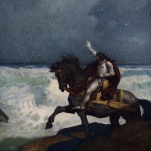
The king also distinguished himself in combat where, often at the head of his cavalry, he proved his bravery by throwing himself into the enemy ranks. Few great feats, such as dramatic battlefield duels or the capture of enemy commanders, are attributed to him, but all available sources attest to his bravery. A further sign of his fearlessness in battle were the many wounds he acquired, nine in all, most grievous of which being the loss of an arm in 1770


Whether by a true strength of their arms, the element of surprise, or a weakness in the local levy and militia forces, the Scyflings overran much of northwestern Haense, securing several ports from which to strike further inland, from 1767-1770. Vasiland was stormed and taken during this time, an event which saw the death of Dame Arianne Helvets, still wielding her sword for the realm, as she had promised Andrik IV, alongside a dozen other young nobles. The kingdom’s luck at sea fared little better, for the Scyfling ships, smaller and swifter, outmaneuvered the large, clunky Haeseni vessels in battle, exposing the inadequacies of the navy. The three years of Scyflings success certainly startled the kingdom, as evidenced by King Sigmund and Queen Viktoria’s near-constant presence with the army. By 1770, the immediate threat ceased as a series of sharply-fought skirmishes kept the Scyflings bottled up around Vasiland and the coastal towns they had taken.


The only time that King Sigmund and Queen Viktoria would return to New Reza was during the birth of their children. The first, Princess Nataliya Reza, came in 1668. A second, their eldest son and heir, Josef Sigismund, came a year later. Four more children between them would be born during the war, but they rarely lingered in the capital for long, and only did so when other duties of the state compelled them to remain. Sigmund II proved a caring father, as displayed in his personal correspondence with his sisters, but neither he nor the queen were natural parents and left the raising and education of their children to governesses and tutors. Both took a personal interest in the methods by which their children were being raised, emphasizing the necessity of a thorough and well-rounded curriculum.


Although the king had been able to stabilize the Scyfling deluge by 1770, it became increasingly apparent that Haense no longer possessed the highly-skilled, highly-mobile soldiers that it needed to decisively win the same small-army engagements that they had mastered during the Rubern War. Part of this was undoubtedly due to the retirements and deaths in the fourteen years since the Rubern War’s effective end. The knights and officers that had been reared by the conflict had since given way to a generation of younger, less-experienced soldiers. In the assessment of Ser Boris Ruthern, a later Knight-Paramount, “the character of Haeseni knighthood, adopting the model of the Heartlands, shifted away from emphasizing feats-of-arms and classic chivalric values, and instead became a scene of the cultural elite, adorned in the decoration for achievements in libraries and theatres as much, if not more, than accomplishments on the field of battle.”


The fundamental tension between King Sigmund’s warriorlike qualities, and his appreciation for the cultural and artistic achievements of his father’s reign could never be wholly resolved during his time upon the throne. He would continue to prosecute the war against the Scyflings ably, but the ill-equipped Haeseni army would take years to redevelop the capacity to fight a limited, guerilla war against the invading forces. These circumstances prevented any significant progress from being made, even if Sigmund II and his armies managed to liberate a number of smaller towns and keeps from 1770-1775, even if they were small victories powered by the realm’s overwhelming advancements in resources. There was one tragedy, the death of the king’s dear sister, Princess Amelya, in the midst of battle, but as rattling as her early demise was, it came in the backdrop of a war that was presumed to be near its end.


03gFXM1.png

The death of Princess Amelya in battle is thought to have been caused by a spear wound to the abdomen while protecting a wounded soldier. Third only to the king and queen in the esteem of the royal army, Princess Amelya’s death was widely-grieved by all, as she had developed a reputation for fearlessness, humility, and generosity towards the common soldier. Those who had fought beside her would affix their uniforms with real or fake rubies, in honor of the gemstone that had symbolized her.


It would be another war, one that was at most an indirect threat to Haense, yet far more destabilizing, that proved to be Sigmund II’s undoing. 


The end of the Rubern War had brought most of the known world, directly or indirectly, beneath the rule of the Empire. Besides larger polities, such as Urguan or Norland, independence could only be found in rump fiefdoms, backwards tribes, and other places of little significance. These villages and holdfasts, scattered as they were, formed the nucleus of resistance against the Empire, fiercely safeguarding their independence against any attempts of Imperial conquest (of which there were, for the moment, none).


One such place was the Free City of Sutica, traditionally a place of lawlessness, home to outcasts, thieves, sorcerers, and other criminal elements of Arcas. For much of its history, it had remained an obscure trading port, largely ignored save by the occasional warlord who sought to overthrow its ruling powers, just to be overthrown themselves at a later time. The instability and complete lack of a civic society had consigned it to the status of a backwater settlement, barely worth consideration. This would change in the 1770s when one particularly-successful strongman, Corwin von Alstreim, managed to secure firm control of Sutica. A former Renatian, Pertinaxi loyalist, and veteran of the War of Two Emperors and the Rubern War, the Tyrant of Sutica had managed to take over the free city in 1760, supported by many of his former allies. Drawing from a network of experienced allies and likeminded opponents of Peter III, he had managed to stabilize his rule by 1770 and join the ranks of the noteworthy powers outside of the Empire.


Although he had taken great care not to anger the Empire, he imprudently slew a cousin of the Emperor, Peter de Sarkozy, during an honor duel in 1762. Whether intentional on Alstreim’s part- he seems to have been indisposed to violence- or an accident on account of Sarkozy’s youth and inexperience, the killing, along with the Tyrant of Sutica’s aggressive posture towards the Empire, as well as other accusations of murder, gave Peter III the grounds he needed to order the arrest of Corwin von Alstreim, treating him in the same manner as a fugitive. For three years, a quiet stalemate ensued as both sides gathered their forces.


From the outset, a hypothetical war against Sutica was unpopular within Haense. The killing of the young Peter de Sarkozy, while tragic, was wholly irrelevant outside of the Imperial Household, and Corwin von Alstreim, while an old foe, did not possess the means to threaten the Empire as a whole, much less Haense. The Margrave of Korstadt, Viktor Kortrevich, an influential statesman in the House of Lords, advocated for an embargo of Sutican goods but nothing more. The Lord Palatine, Petyr Baruch, drafted a (dubiously accurate) report that concluded that Haense lacked the funds and the manpower to simultaneously fight Sutica and the Scyflings. The High Seneschal, Edvard Amador, personally led a demonstration in New Reza that protested a war against Sutica, which was deemed an ‘Imperial venture.’


Even lords who were more vocal supporters of the war had their reservations. Erwin Barclay, the Duke of Reinmar and Lord Marshal of Haense, wrote to the Imperial General Alren DeNurem, warning that in the thickly-wooded hills around Sutica, the ISA would face similarly logistical issues that the Haeseni army was contending with against the Scyflings. He also questioned the army’s readiness to fight another war in the mold of the Rubern War, which required precise tactics and skill in small unit combat that needed to be sharpened over years. As had been the case in Haense, many of the ISA’s most talented officers had resigned or died since the Rubern War, leaving younger successors whose experience amounted to peacetime patrolling and garrison duties. These concerns, though shared somewhat by the old general, were mostly brushed aside: the Empire’s overwhelming advantage in resources would simply crush what Sutica could muster.


Concurring with his subjects, Sigmund II formally protested to the Archchancellor and his ministry, at first through private correspondence but increasingly through public venues, such as the court. He echoed the words of many agitators against the war, calling an intervention in Sutica an ‘Imperial project’ that was irrelevant to the Haeseni. He affirmed his loyalty to Peter III, but profusely argued that if any war against Sutica was to take place, it was best-left to those in the Heartlands, while Haense could focus on its own affairs. He frequently cited his Lord Palatine’s report about the army’s unreadiness, implying that what support he could send, if he even would send it, would be inadequate. Most damningly, albeit never iterated outside of private correspondence, he frankly informed Simon Basrid that, “the people of my country perceive His Imperial Majesty to be a tyrant, surpassed only by his father, though with a similar character of madness and brutality that, if fueled by the flames of unquestioned loyalty, shall lead to our ruin.”


While King Sigmund’s defense of his realm won him the adoration of his subjects, the language he employed drove an unbreakable wedge between him and the Imperial Government. Offended by the notion of ‘Imperial ventures’ and ‘Haeseni matters’, as opposed to a shared cause beneath an Empire to whom Haense was subject, Peter III and his councilors issued a sharp order to mobilize when commanded to, then proceeded to leave Sigmund II and his officers out of all strategic planning for the war. Any further correspondence would be delivered through the Lord-Lieutenant of New Reza, Prince Nikolaus, who remained among the few still in support of the war by then.


The long-awaited declaration of war came on the 4th of Tobias’s Bounty, 1775, as Sigmund II was in the field concluding negotiations of surrender with several bands of defeated Scyflings. When word arrived from his brother that Haense had been called to send 4,000 soldiers (a third of the realm’s strength) to join the ISA’s offensive against Sutica, the king raced back to the capital, leaving Queen Viktoria and the Duke of Reinmar to guide the army through the winter. Unbeknownst to all, it would be the last time that he would lead them in the field.


In New Reza, King Sigmund ordered his armies to remain committed to the Scyfling front and issued a protest of the declaration of war, again citing the matter’s lack of relevance to his realm, as well as his personal exclusion from strategic planning. “This war is not Haense’s war,” he assured a gathering of nobles during a hastily-assembled session of the royal court, to the rapturous applause of those in attendance. “Our people’s blood will not be shed for Imperial conquests.” In an action interpreted as a preparation for war, though not certain to be against Sutica or against the Empire, Sigmund II ordered Prince Nikolaus to mobilize the entirety of the garrison of New Reza and the city watch, in total numbering about 1,000.


As the Duke of Reinmar had predicted, the Imperial war machine that had been the efficient killer of Rubern was no longer equipped to fight the same war that it had won twenty years earlier. The moment the Empire declared war, Urguan, Norland, and a dozen other tribes, free cities, and smaller fiefdoms declared their support for Sutica. Leveraging his old Renatian connections, Corwin von Alstreim was able to hire thousands of mercenaries, who would leniently accept the spoils of the Empire as their pay. Proving himself craftier than the average warlord, the Tyrant of Sutica also drove a wedge between the Empire and its Haeseni vassal, claiming that his only grievance was against Peter III and his ministers, that Haense, were it to recuse itself from its obligations of military, would be left untouched. The war was looking to be fought on relatively even footing.


Privately, the Tyrant of Sutica opened correspondence with King Sigmund, who entertained his cajoling. The extent of their communication has not been fully studied, and while the King of Haense is alleged to have entertained offers of being named Lord Protector of the Empire, or even Emperor himself, it is more likely that his aims, while still treasonous, were limited to simply negotiating Haense’s neutrality. This clandestine communication went back and forth throughout 1776, but the communications between two sovereigns, no matter how private, could not be hidden for long.


XZVDJrL.png

For a time, the ISA studied a possible naval invasion of Sutica, but lacked many officers with the acumen to plan an amphibious assault. Haeseni admirals and ship captains, who had learned much from their early defeats in the Scyfling Invasion, were rarely consulted for their expertise. This would become the subject of a number of 'mockery plays' written in Haense in the 19th century.


As the ISA offensive, undertaken only with auxiliary reinforcements from Kaedrin, began in the spring of 1776, its unreadiness became immediately apparent. The arrows of pestilence and fever fell upon them in the humid forests near Sutica, where armies of thousands, far too large to be sustained by thin supply lines, saw hundreds die before even reaching the enemy. As more soldiers were fed into the Whispering Woods, advancing the lines of war closer towards Sutica, they were finally met by the armies of the coalition, who found repeated successes in the many skirmishes that took place over the spring and summer. The sheer material advantage the Empire possessed allowed the war to peter out into a stalemate by the time of the harvest, but even this was a triumph for the coalition, who had felled nearly 6,000 ISA soldiers at the cost of 1,200 dead during the initial campaign.


Losing men and supplies at an unsustainable rate, the Imperial War Council informed the Emperor that, absent a mass conscription of new recruits in the Heartlands, or reinforcements from Haense, the ISA would be unable to withstand another year’s fighting. Heeding the advice of his generals, but not wishing to rile dissent in his own lands, the Emperor went back to commanding Sigmund II to send 4,000, then 6,000, then 7,000 soldiers to fight in the Sutican woods. For months, the Emperor and the king sparred back and forth, with Peter III’s demands, and threats, escalating and Sigmund II’s refusals remaining consistent. Finding no success in getting King Sigmund to move his army to aid the ISA, the Emperor turned to the only other man who could.


On the 17th of Godfrey’s Triumph, 1776, Prince Nikolaus, the Lord Lieutenant of New Reza, ordered the garrison under his command to prepare their transfer to Helena, where they would join the war against Sutica. He also called up an additional 2,000 soldiers, drawn from local militias and reserve units beneath his lieutenancy, to gather in New Reza to be sent to join the garrison. With the weight of his office, and the Emperor’s seal, with which he justified his action, a clear violation of his brother’s wishes, he had unilaterally committed Haense to the Sutica War. Neither the king nor the Aulic Council had been informed prior, nor were they aware that the plan had been a contingency established four years prior.


Blindsided by his brother’s betrayal, King Sigmund hesitated for the first time in his life. Already burdened greatly, as the king grappled between the multitude of problems that now surrounded him, he found himself trapped. He had been outplayed by his liege. If he were to permit his brother’s orders to be carried out, he would be condemning his kingdom to fight a second war, one it did not want, and effectively cede his power to the Emperor. If he were to revoke it, he would still send Haense down the path of war, though this time with an Empire that could still overwhelm a Haeseni army caught between them and the Scyflings. For just over a fortnight, the King of Haense dithered, refusing all visitors as he locked himself in his chambers, debating what was to be done to free his kingdom of the knot that had been tied around its neck. 


On the morning of the 6th of Tobias’s Bounty, 1776, King Sigmund II of Haense was found dead in his room, having stabbed himself through the throat.


As soon as the king’s death was announced, an outpouring of grief consumed New Reza and soon after the entire kingdom. Sigmund II, his heart broken by his own brother turning on him in his darkest hour, prompted by the tyrannical Peter III, had been so consumed by the grief dealt to him that he took his own life. It was a tragedy that horrified the people of Haense, for they loved their king, who, despite his youth, had proven himself an able figure, under whom the kingdom had prospered. As funeral preparations were made, thousands flocked to New Reza, walking freely beneath the auspices of a ceasefire negotiated between Queen Viktoria and the Scyflings, the latter of whom offered to lay down their arms for a period out of respect for their foe.


As time allowed the wounds of the early deprivation of a beloved king to heal, many, with a critical lens, saw Sigmund II actions not as a sudden decision, wrought of emotion, but a logical calculation made upon observing the intractable dilemma that he was found in. Were Prince Nikolaus to assume power over Haense at his assent, the kingdom would inevitably be absorbed into the Empire. Were he to fight and lose a civil war, it would be destroyed. By removing himself from the equation, he would forestall a confrontation between Haense and the Empire until the situation became more favorable for his successors, and his subjects, who would never forgive nor forget the circumstances that drove him to his suicide, would resist the Lord Lieutenant. As this interpretation grew in popularity, King Sigmund, while still viewed as a tragic figure, saw his standing elevated to that of a martyr, a man who ended his own life to ensure his realm’s freedom.


Others, with an even more critical lens, though they numbered few, adopted a far less romantic perspective. Panicked in a moment of crisis, and lacking the political tact to navigate through it, Sigmund II rashly took his own life, leaving the problems of his reign to those after him. It was not an act of calculated martyrdom but instead the avoidance of a difficult decision, one that he had played no small part in creating, even if it was eventually forced upon him against his will. 


It was the first of these that, on the 10th of Tobias’s Bounty, 1776, guided the funeral of Sigmund II, which was attended by tens of thousands, followed by even more who came to the site of his burial in the weeks following. The funeral ceremony was itself simple, as had always been the king’s wish: the soldiers he had associated his life with carried his casket, while the New Marian poetry he sponsored sung mournful tales of his deeds. A number of orations were given in his honor, but it was his sister, Princess Alexandria’s, that stirred the hearts of the weeping crowds the most:


“He was not a man who smiled easily, but his love was without limit: for his family, for his army, for his people, he devoted his short life to you all. As I stand here now, where my eyes cannot see his face, hidden within his final place of rest, I can see only the proud, demanding, spirited boy whom I called brother. He did not know then the tragedy that would bring his end, but I have no doubt that even then, even as a child, he would readily live the life he had, if he were to know where it would lead. Question not the devotion he had to you, our cherished Haeseni, nor his bravery- a missing arm shall inform you of that, nor the character of his rule, which was enlightened, peaceable, yet strong when it needed to have been. Question only the forces that would conspire to make a good man such as he, and a great king such as he, take his own life within his chambers, alone, away from his wife and children, consoled only by the hope that his people may prosper one day in his absence.” 


By the hand of Sigmund II, the well of Imperial-Haeseni relations had forever been poisoned. The victory that Peter III had achieved with his unruly vassal’s death would prove to be a pyrrhic one. The man he had appointed to govern Haense, Prince Nikolaus, could not hope to win the loyalty of the people, for they saw him as near enough to a kinslayer, and wholly a traitor. Even Haense’s entry into the Sutican War, the very purpose behind the coup, would prove to be indecisive. A confrontation between the Crownlands and Haense was inevitable, and though neither side could claim the ability to see into the future, all knew when the time would come.


Josef Sigismund, a boy-king like his father had been, was nine years away from his maturity.


Dravi, Sigmund II ‘the Liberator’

qIKy95V.png

10th of Sigismund’s End, 1748-6th of Tobias’s Bounty, 1776

(r. 22nd of Godfrey’s Triumph, 1753-6th of Tobias’s Bounty, 1776)


O Ágioi Kristoff, Jude kai Pius. Dóste mas gnósi ópos sas ékane o Theós. Poté min afísoume na doúme to skotádi, allá as doúme móno to fos tis sofías kai tis alítheias. O Theós na se evlogeí.


The reign of Josef I shall be covered in the next volume of The Winter Crows.

Link to post
Share on other sites

 Share

  • Recently Browsing   0 members

    No registered users viewing this page.


×
×
  • Create New...