Jump to content

Meditations on the Turnip


Sagwort

Recommended Posts

Meditations on the Turnip

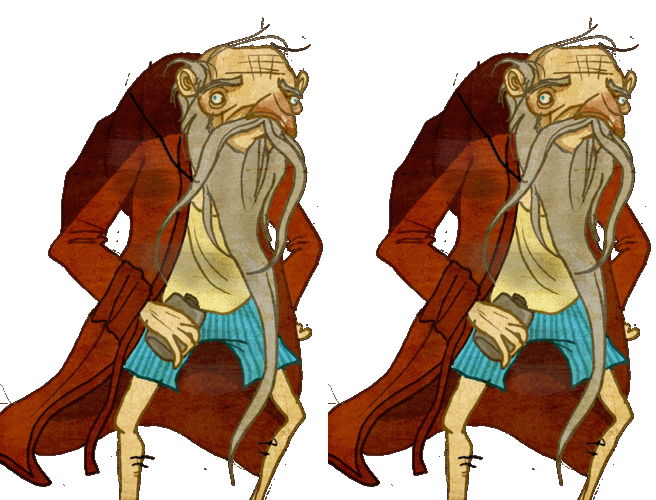
By Dr. Ambros, Wiz.D.


Forward

Consider, if you will, the dignified turnip.  A most virtuous of herbaceous plants of which no other vegetative organism can compare.  Much knowledge can be harvested from the turnip, just as the yeoman harvest this tenacious crop from the venerable soil from which it spawns.


Before one may learn from the inherently esoteric nature of the tuber, they must first understand its metaphysical essence.  This begins with the cosmogony of the turnip.  Through my studies I have theorized that the origins of the turnip are cosmological, truly an alien creature of archaic and hoary genesis.  It rests in harmonious equilibrium with the four elements.  The quadrivium of qualities rest within its intangible essence, a reception of the unanimity of the cosmos in its origin.  For, before there was man there was turnip, as it represents a balance that has not existed since the dawn of the formation of matter, a flora from the utopian gardens of the clay men in the Age of Genesis.  Thus, it would not be so absurd so assume the turnip holds some sort of eldritch power of its own, given its perfected composition and near divine essence.  It is in the domain, then, of the alchemists and transmutational experimentation to extract the spirits from the turnip through achromatic processes, separating the the spiritual qualities from its earthen salts.  But such things are not the ambition of this thesis, as the ethics of the turnip hold the most value, though I should have no doubts that a stave or wand of turnip ought to hold some reverence in the occult communities.


The Turnipician Ethics

In this passage, and the ones to follow, I do hope to distill from the turnip a scholastic and pragmatic philosophy from which all man might benefit.


The most obvious, yet ponderous, of conducts one might draw from the taproot lies within its anatomy.  While its soft greenery ostensibly explodes from the earth, the far more precious root lies beneath.  While this is mayhaps the most valuable and treasured aspect of the vegetable it is what the turnip keeps most hidden, to no avail from the root farmer.  Indeed, the turnip has not defenses beyond the earth from which it sprouts, and is consumed nevertheless and to no fault of the turnip or the farmer.  So too in the drivel of which man surrounds himself with, he attempts to protect his most precious qualities, and is bested by decay and death, the all consuming farmer of life.  Yet, like the turnip, man must realize this is of no fault of his own and continue living accepting of his fate in some peasant stew.  This is a most just way to live, accepting of that which cannot be changed, nevertheless, carrying out one's life with all the hearty vigor and pleasantries of the turnip.


Turn now, to the physical composition of the turnip.  It is uniform.  Not like the discordance of the nut, or the fruit which hides its jewels deep within flesh.  Nae, the turnip has no layers or seeds and is simply as it is, a single totality of edible flesh.  All of the turnip may be used, whilst the shell of the nut or the skin of the melon might find itself in waste.  Man then, must also be uniform in his composition.  He hides no ulterior motives or hardening secrets that might turn his soul to a nut or a seed.  For certain social constraint is a matter of maturity, though such constraints remain throughout the dealings of man, and not exclusive to his social dealings in the market or political office.  The man of the turnip acts as he does with business partners as he does with his bed partner.  That is not, to say, he is of dry qualities and stoic in his humor.  No, he is of good humor with all, and not prone to placing facades and personas upon his true self.


Finally, the turnip is wise.  In tandem with its uniform composition, it is not glamorous nor lavish in its appearance.  The turnip, as though self aware of its modesty, acts as nothing more than what it is, a root vegetable.  For certain other root vegetables exist, the carrot, for instance.  Though the turnip is pale in its complexion, while the carrot is outlandishly titian in it color.  The carrot believes itself to be wiser than what it truly is, it does not know itself nor accept itself for what it ought to be, nothing more than a root.  Man, then, ought to know themselves before they approach any other intellectual endeavor.  For, if one knows what they do not know, they might present themselves for what they are, and not be seen as naive or pompous in his dealings.

Link to post
Share on other sites

"In the 'clubs' they say 'Turnip'" A young Adunian lad comments.

Link to post
Share on other sites

This research, although slightly conflicting in particular findings, is broadly confirmed by another independent study conducted in segregated conditions. Any research that is produced that disagrees with these notes, in the general sense, are outright incorrect and should be scorned by the academic community.

Link to post
Share on other sites

Moved to The Great Library. It shall be sorted into the appropriate category shortly.


If you feel this is a mistake, please contact myself or any FM and we'll restore it. 

Link to post
Share on other sites

Archived

This topic is now archived and is closed to further replies.

  • Recently Browsing   0 members

    No registered users viewing this page.


×
×
  • Create New...