acronius_
-
Posts
30 -
Joined
-
Last visited
Reputation
199 Brilliant
1 Follower
Recent Profile Visitors
1563 profile views

.thumb.jpeg.7a2a5c6fda5bc3b4e960a8645bb0ab98.jpeg)
-
-
Food, so much food. I had never seen so much food. Smelled it, too, from miles away. Coming here was worth skittering through the mud and dodging scorched earth. It was as if the greatest feast had been set out for me after so long subsiding on scraps from a kitchen and burrowing under compost to find fruits and nuts. It should have been impossible. I met a crow along the way, and he cawed in his strange crow-tongue. “They bless me,” He said with a chatter of his beak. “This food is from men. They give it to me as apology.” He spoke oddly, and I could understand, but his grasp on verbal structure was not my own. I did not speak, but only nodded and continued running over the grayed grass stained every so often with a dry maroon that stunk horribly of metal. Many I knew had died to a similar smell, unknowing of the origin but curious to it, and ingested poison. I would not take the risk unless I saw the food for myself. The ground was tiring to climb over. There were valleys in the sodden soil followed by mountains that dropped into cliffs I could barely climb from if I tried. They always seemed to be circular. I did not want to have to face the muddy slopes, so I went around these valleys on a path that doubled my journey. I met another black-feathered bird on the way; a smart, cunning raven. He swooped down as if to grab me, but he clicked his beak once to call my attention. I stopped, cowering, but listened. “The field is nearly picked clean, little one. You are late.” Even yet, given this, I did not speak. I only stared up at the bird with beady black eyes as my legs tensed to run. He seemed to see this, and he endeavored to speak quieter. “I have already gotten my fill. I cannot carry more, lest I wish to tumble from the sky in flight, or not to be able to take off at all.” Oddly, the crow and the raven had the same chattering, chirpy laugh. I nearly mistook the call for a warbler, but I had not seen any of them since the trees had been felled. I knew they had gone south, to where the forests were still lush. My forest had been turned to a field of toothpicks impaling the drab, soggy earth. I did not mind it. “If you want to go quickly, I will carry you.” The raven spoke, lifting one leg and flexing the blood-stained talons. They smelled of a stronger metal, and that frightened me, but the raven’s beak had the same quality. He was still alive. I could trust it. I waddled closer slowly, until I was close enough for him to grab, and he wrenched me from the ground and took off in the same motion. In seconds, I was higher than I had ever been. I closed my eyes to shield from the winds that assailed me on the ascent until I could feel the acceleration level off, and it felt safe to peer down to the earth I knew I had left. "The clouds you see,” the raven spoke over the wind that swirled around us in flight. I curled in on myself as I looked out to the horizon. I saw clouds, indeed, but they were an ugly dark gray that curled up from the ground rather than sitting in the sky where the other clouds were. I counted five. “They are smoke. They come from fires. Fires set by descendants.” I could not believe it. I had seen fire before, and set by humans before, but never so large. The clouds were a day’s journey away, but I could smell them already. I lowered my eyes from the horizon. All around, beneath, beyond, and as far as I could see, the earth was leeched of all its color. The trees were not green, but a dull brown, or black if they had been scorched. The grass had been gone for months. Valleys larger than any I had ever seen were cut into the landscape like scars on a tree’s trunk, winding and curling over the ground like veins. The ones to my left were full of those circular valleys I had to avoid. The ones to my right were completely burned out, blackened. The biggest smoke cloud rose from those to my right, and the raven notably steered away from it. I chittered in approval. “You are welcome,” he hummed, then called out with a piercing wail that I could only gawk at. It was a triumphant sound. I could see a number of black specks rise from the thin valley we flew toward, and I figured immediately that the raven had announced his presence. Meanwhile, just how lucky I was to have him as my guardian. “We go to the safer side. The food on the other side has already been burnt. I do not like burnt food. I also do not like burnt feathers.” I squeaked with laughter, and the raven clicked his beak in concurrence. As we began our descent and flew past a number of disgruntled birds that hurled insults at us, I began to know the nature of these valleys. They could not have been natural. I saw that the walls of the valleys were held up by the same planks men use to separate their homes from the ground, and the same that they made their floors from. They were wood from the trees before they were scorched, but they had begun to rot and turn gray with time. We came closer. I realized there were beings in the valley. The raven must have felt me struggle and squirm to escape rather foolishly, and sought to grip me tighter in his talons. “Calm down, little one.” When I did not heed this, he stopped our descent and hovered above the valley, swiping the air beneath us just often enough to remain afloat. “These ones will not hurt you.” I could not imagine why they would not. “They can't hurt you.” That was a more outlandish idea. They can not? Why? The raven must have read my thoughts, or my chittering in contemplation gave me away. “They are dead, little one. Our food is them. They killed each other for us.” I realized, then, that the fires and bursts of tempests from falling stones that killed the trees and scarred the land like a man’s face of pocks was not meant to kill the earth, but instead meant to kill their fellow. Yet, even as the answer was given, my chest twisted with so many more questions. Primary among them: Why? Why should the titans that rule our world and seek to rid it of pests kill one another? Surely that would hamper their goals. I knew now that the raven truly could read my thoughts. “They kill one another because they do not know what it is like to be hunted.” He spoke, gliding down to come to a soft landing in a puddle at the bottom of one such valley—a trench, he called it—and continued as I was released at last from his talons. “They are not afraid of nature. They are more afraid of themselves. They seek to control what they do not hold, and one man can never control all.” Yet, obviously, someone had tried. I ran up to the body of a boy who must once have been no older than that Whittaker boy who set the traps for me in that house–looked like him, too. Now, the boy had been gnawed to the bone by maggots and other animals that had come before them, and before myself. His armor remained, loose upon withered bones, and his death was clear; something had pierced right through his head. A small knife? “A bolt, from the sticks they use to shoot one another from much distance. They each have one, a bow with a crank.” The raven cawed, then dug his beak beneath his feathers to relieve an itch. He spoke as if this sight was a fact of life, a guarantee. “A guarantee, it is, and I have seen it many times. They call this one a triumph. The dead ones call it nothing. Why did the victors decide they could not speak? I do not know.” Neither did I. To commit such brutality that even a lowly rat cannot understand the reason is to forfeit the claim to being the dominant lifeforms. I have seen many terrible things, I’ve seen many dead rats, but that day I saw more dead descendants, slain by their own kind, than I can recall blades of grass in those same fields. The dead outnumbered the living. This was not humanity. This was hardly even animalistic. This was feral, a slaughter, and they did not even eat their kills. They killed for sport, for something they cannot hold, for something so intangible as honor, or duty. What duty needs to be paid with death? What honor must be defended by felling your own as you would cut down a tree? “They will always fight, little one. They don’t understand nature, but they understand each other even less. That scares them. They are scared of what they do not know, and they are the only ones who are capable of making such horrible weapons. That is nature’s cruelty, little one.” A little peck on the head from his beak, making me flinch. He had my attention. “The finest form occupied by the foulest heart. The greatest races, overcome with envy.” -=-=-=-=-=-=-=-=-=-=-=-=-=-=-=-=-=-=-=-=-=-=-=-=-=-=-=-=-=- A Narrative by Ariadna Secada Pachakutiq Lady of Virú
-
[!] The following in-character post is intended for your entertainment only and cannot be referenced in-roleplay. Lorandil Sindarin knew that things would happen before they did, and he was proven correct. Alas, a sharp tongue and oft-drab attire made him no more convincing than a petulant child begging for yet another cookie. Time, and time again, he watched loved ones tread too close to the edge of oblivion and brush away the rope he cast to them. He watched them fall and lamented the latest failure. His fact of life was a constant languor born of the sense of inevitable disappointment that his efforts would yield. Recollections, vivid and evermore painful, flashed upon the back of his eyelids as a canvas and showed him exactly where his life had been decided. They told him what sort of man he would become. They burrowed into his mind, clamping claws of steel and conjured deceit that drilled deeper into the man’s soul. He became them. These visions were called forth for a reason–that he could understand–but further thought eluded him. He felt himself frown but could not lift it. He felt his body shift in a forward motion through the artificial void of his subconscious and he could not drag himself back. His only choice was forward. His only choice was a frown. The crossroads came and he simply bypassed them, carrying on straight through a rarely-traversed frontier. A stranger on the roads, a beautiful, bright woman, offered him a smile in greeting, and he ignored her. He hit a wall. The void around him had become dark and deeper still, all light banished but from an inconceivable number of windows from which motes of swirling mana coincided with beams of gentle light appearing as if from dying lanterns. They flickered into existence, opened wide to accept what may come, then space would consume them just as quickly. When one closed, another was summoned from the Nothing. One appeared just before the man, and without thinking it, he was delivered into the window’s dim scene. Time turned in upon itself. He felt himself bend, fold, and be shorn of his skin, then sinew, then bone. Each fragment of his existence was removed, tailored, then returned in a smaller shape, with less muscle, less pain, less guilt. He felt lighter, yet awkward, as if he was walking above the clouds upon stilts. The contradictory existence he must sustain would not last long, he knew, but he was an actor in the play. He would follow the pull of the windows. He came to the first scene. Act One, Scene Two: Reunion in Remembrance [Enter ILYTHYRRA SINDARIN, a fair ‘aheral of golden hair, playing a soft, strumming song upon a lute. Her face was hidden by a shroud.] ILYTHRRA, singing: O’ far doth ancient path lead thee, thither mountain majesty, forging further, and again do you leave me, eternally. (quieting) Can he truly be lost? Thirty years–most of my life–I have not seen him. I showed enough defiance to survive. Did he not? [Enter LORANDIL SINDARIN, a younger ‘aheral with bright silver hair shorn at the shoulders. He lowers himself into the alcove to speak with the minstrel.] LORANDIL: Good lady of the light, I lift my eyes up to thee, but you are sat upon the earth. Such cannot be true. Your song belongs in the heavens. ILYTHYRRA, blushing: The clouds do not have ears to hear it, and the birds do not have a voice to praise it. He who has ears to hear, let him hear, and he who has a voice to praise, I should hope he stands near. LORANDIL: Your own sings rhyme and speaks it in the same rhythm with equal grace. I shall say my day has been made. Who do you sing for? ILYTHYRRA, bowing her head: I sing for a man I lost a very, very long time ago. I miss him more dearly each and every day. LORANDIL: A lover? ILYTHYRRA: A brother. [LORANDIL is quiet. ILYTHYRRA speaks again.] ILYTHYRRA: I hope that he will hear my song. Perhaps you are right; I should sing in the heavens. There, he may hear me more clearly. LORANDIL: I believe he can hear you just fine. Do you think his spirit would ever leave you, as long as you shall live? ILYTHYRRA: I cannot imagine it so, but I cannot even remember his face. I cannot imagine much of anything. I can only hope, friend. LORANDIL: What was his name, fair lady? [ILYTHYRRA is quiet for a moment. She frowns pensively, eyes closed.] ILYTHYRRA: His name was Lorandil. I can remember now. I named him. [LORANDIL hides his excitement.] ILYTHYRRA: Lorandil, the Lover of Gold. Why? Because I had golden hair, and I wanted him to love me. I held him first, after mother had finally been removed of his burdening weight. He cried, oh, how he cried. His little lungs must have been two sizes too large for his chest. LORANDIL: Your golden hair is beautiful. ILYTHYRRA: And I was always near. I thought I must have chosen the perfect name, for when I held him and rocked him in my arms, he grabbed at my hair and held it like a Dwarf clings to jewels. LORANDIL, reaching for her hair: He must have seen only you. [ILYTHYRRA looks up. Her eyes go wide and she lifts her veil.] ILYTHYRRA: And does he stand before me today, or am I living the finest dream? LORANDIL: He still only sees you. [ILYTHYRRA jumped to her feet and grabbed LORANDIL by the shoulders.] ILYTHYRRA: Lorandil. LORANDIL: Ilythyrra. ILYTHYRRA, tears springing to her eyes: Now that you are here, I remember your face. How you have grown, brother. I am so proud of you. [LORANDIL embraces her, hiding his own tears. ILYTHYRRA loudly sobs, clinging to her brother. The scene around them fades until it is only the two siblings, reunited.] BOTH: Oh, how I’ve missed you. Lorandil Sindarin was torn from Ilythyrra, sobbing silently. He wished to cry out, to reach for Ilythyrra, but he was leaving her behind. The window was closing, and it sought to drag his soul from whence it did not belong. Another was left behind, the younger, innocent Lorandil. The two siblings hugged each other still as Lorandil watched from afar. When he passed clouds, he reached for them as if they were solid, and did not feel even the damp chill of lofted steam. He sped up, above the world, towards the midday sun. He felt no heat. He simply was, then was not. He returned to the Mind-Void. His tears evaporated into shimmering motes of light. He blinked, and the window was gone. It disappeared as if it had not been there to begin with. Lorandil looked up and aside, finding the same matrix of unseen possibilities. He lifted his will to one in particular, for no reason other than that it was closest, and it gravitated toward him. He chose it, this time, rather than the window choosing him. He peered within. He saw a pleasant scene lit by means of a blazing hearth. He saw himself curled up on a sofa with a gorgeous woman in both arms, their forms relaxed against one another so that they appeared as one. Both wore gentle smiles and had eyes closed. They were so clearly at peace that Lorandil could not help but feel a deep envy. This was the life he was meant to have. He could sense that this Lorandil was older than he, but this Lorandil was not burdened by his dread. This Lorandil had both eyes. This Lorandil caressed his wife’s cheek with a biological left hand. This Lorandil kissed her with smooth lips. A small child toddled up on novel legs from the tall doorway to the sofa, supporting themself by their hands as their legs shook. The little one clearly spoke, though Lorandil could not hear, as that man’s eyes opened and fell upon the child’s visage. He smiled so fairly, so kindly, that Lorandil could hardly recognize the man as himself. The toddler tried to climb onto the sofa. Another person came into the room from the same doorway, one Lorandil suddenly recognized, yet could not remember. He knew he had seen it, or would see it, but could not recall such. He felt a distant tug at his soul, and he reached out to touch the window. Suddenly, silence was broken, and as he held the contact in the Mind-Void, he could hear the scene. Act , Scene : Antagonistic Victory [LORANDIL SINDARIN and ANJWHW LQJGUWWV embrace on a comfortable sofa. A small girl, no older than three, waddles over to them.] GIRL: Maln! LORANDIL, smiling: Hel-lo tinuviel. GIRL, mumbling: We made you tea. Come sit down. LWJJIBWW: We? Did MAL sisters HANN GIRL, JANNWO: Oh. [GIRL looks to a corner of the room. She points.] GIRL: Iblees is watching. Lorandil Sindarin held the contact as long as he could, until he was forcibly repelled by an unseen force. Those in the scene, including the version of himself he could not recognize, learned of him. They saw him watching. If he was truly meant to be there, they would not have seen anything at all; so he thought. He did not know precisely how this knowledge came about–it seemed as if he had spoken–but it had, and the three in the scene banished him back to the Mind-Void. The window slammed shut violently, collapsing in on itself. He could not see inside, but he knew that he had erased that existence. He dared to hope. Hope was dangerous, see. Hope that he could renew himself, hope that he could repair his relationships, hope that he could call a family his own once more; all was in vain. He had seen the future he was meant to have and that Lorandil, the better Lorandil, pushed him away. That could not be his future. Lorandil may have found himself at peace a century ago, and grown to be that version of himself, but he had deviated so far from the steady silence he once knew to a reprehensible position of intentional chaos. He had ruined it. Yet, he forged onward. Or, rather, he was taken again. The windows had their will and he was to bend to them, enter when they opened, and be thrown from them when they no longer wished to be so. That sole attempt to choose his own destiny, though he had not known what he had seen to be anything within the realm of possibility, had been fruitless. He could not choose. The Mind-Void chose for him. Another window to the material shimmered in the distance. It became clear to Lorandil that he was not moving. He did not feel the gentle tug any longer when his perspective appeared to shift in space. Rather, the edges of the Mind-Void became colored. Where there had been nothing, suddenly there was something, and it was more vivid than the most fragrant wildflowers. In fact, he noticed a near-overwhelming scent of wildflowers whence the thought was proffered to the Mind-Void. He willed the scent away. It went away. It was replaced with absolute tedium; there was nothing again. The Mind-Void had reached out to the motes of peace lingering in his shriveled soul and was denied. He lamented yet another loss of character. As Lorandil did refuse the Mind-Void’s hospitality, the space around him ceased its collective movement and he was forced to drag himself through it again. He went, partly by his will, mostly by that of the Mind-Void, to the third window. This one held a golden glow and an undulating, warping surface that seemed ready to shatter. The power within was so great that it magnetized the soul of its observers and dragged them within. He did not go. He was stolen. He did not look. He saw. He did not listen. He heard. The visions were forced into his subconscious and settled into the material. He did not reach out, but he felt. He was touched. He was dragged forth into the arms of a protector, that embrace warm and motherly, and he was held close as he went into the next scene. Act One, Scene Seven: Passionfruit [Enter LORANDIL SINDARIN, forlorn. He takes a seat in a tavern and is served a simple meal of pottage and tea. The setting is known to be Kalldur, a lost isle, home of the descendents before Azuras.] LORANDIL, bemoaned: Sorrow, that is my liege. I bend to her, and she beats me with her wooden cane. Betrayal, that is my knight. He defends me from insult yet allows a barbarian to impale me. Loneliness, that is my eternity. I reach out to its subjects and they turn to their own. They do not see me. Alas, I see them, and long for them, but what attention can a wastrel claim? None, save pity. I am pitied, and that is worse than being ignored. [He spills his pottage onto the floor deliberately.] LORANDIL: I am not worthy of service. I should sit and starve. Pity my grave, all, and read my epitaph. Read it aloud and know thee fault. I could have been saved. [He sips his tea. He makes an ugly face at it.] LORANDIL: Even my tastes betray me. What can I find joy in if not for lavender tea? To a ratio of one-part milk, three-parts broth, and a spoon of sugar? Where has the sweetness gone? Ah. I understand. I do not deserve sugar. [He calls over the waitress, one JULIEA KORALI, an ‘ame of short stature yet strong presence.] JULIEA: You shan’t have me clean your spill. LORANDIL: No, no, fair Lady. I only ask what has happened to my tea. JULIEA: It was brewed. LORANDIL: There is no sugar. JULIEA: I assure you, there is. LORANDIL: There is not. JULIEA: You must have strained it through your teeth. LORANDIL, becoming annoyed: I cannot imagine such inflammatory speech proffered of fine lips. JULIEA: Then what of it? Find your own sugar. You will have none of mine. LORANDIL, loudly: I will wait for you. (quieter) Explain your distaste when the sun has fallen to rest. I cannot stomach my drink, nor your language. JULIEA, smiling innocently: You may as well lay your bedroll upon the grass. LORANDIL: So I shall. [LORANDIL leaves the tavern empty-handed. He indeed lays his bedroll out upon the grass outside the tavern and resigns himself to await JULIEA. Hours pass. The last patron leaves the tavern, followed by JULIEA as she locks the door. She is surprised to see LORANDIL waiting with a glare.] JULIEA, taken aback: The stubbornness of the ‘aheral rears its head and raises its hackles! You did wait! LORANDIL, clearly remembering why he was upset: My tea had no sugar. JULIEA: It did not! I admit and beg you banish the thought it had been intentional. LORANDIL: Was it so difficult to admit your fault? JULIEA: You so clearly consider yourself of immense importance. LORANDIL: I admit my own fault in accosting the owner of the establishment. JULIEA, grinning triumphantly: Good man. Next time you shall not waste. LORANDIL: I shall not. I was caught in my own mind. JULIEA: So I could tell, were it not even for your outburst. You have the look about you of a man severed from his will. LORANDIL, surprised: Can you read me as you would a novel? JULIEA: I suppose I could read you as I would a dish. LORANDIL: A dish? JULIEA: Taste. [LORANDIL grew flustered. He opens his mouth but cannot speak.] JULIEA: And your complexion takes such color. It reminds me of the peppers I grow. LORANDIL: Surely they rival your tongue in heat, for your words seem to have my heart skewered upon a glowing stake. JULIEA: Can you handle spice, llir? LORANDIL: I would certainly be willing to try. JULIEA: Then have your taste. [The two kiss. LORANDIL is left wide-eyed and gawking. JULIEA laughs.] JULIEA: A blowfish, that is what you remind me of most. LORANDIL: And yourself, a lantern-lit temptress. JULIEA: Oh, be strong, Ser. Do not fall victim. LORANDIL: I am not a victim. I am a subject. JULIEA: Mine own? LORANDIL: Who else? JULIEA: The woman you bemoan in your thoughts. [LORANDIL shakes his head.] JULIEA: Then you are mine. LORANDIL: I would not have it another way. [JULIEA takes LORANDIL’s hand and leads him into the quaint ‘ame village. They stop at her hut and she ushers him within. There, the ancient curse of Malin would have missed its mark. The sun rose upon the village and revealed the two intertwined underneath a blanket. LORANDIL kisses JULIEA’s forehead. She wakes.] JULIEA: Can it be that morning has risen? I would have assumed our embrace to outlast death’s reaches. LORANDIL: Such a scenario demands my eternity. I cannot give it to you. JULIEA: Yet you proffer your blood? LORANDIL: Something much more easily given, Juliea. JULIEA: Call me ‘darling’ and you will tie the knot. LORANDIL: Is a promise enough? JULIEA: But it is a promise, Lorandil. It is a promise of that eternity. You crossed a line you did not wish to but did so with such vigor I assumed you had known the consequence. LORANDIL: Consequence? JULIEA: Eternity. LORANDIL: Something I cannot offer. JULIEA, exploding: Why not? You say your heart is severed of its bonds but it cannot be! You wear your sorrow, still! [JULIEA stands, holding her nightgown shut. She pointed to the door with her other hand.] JULIEA: Be gone. I will not abet a deceiver. If I had known, I would have steeped hemlock for your tea! [LORANDIL gathers his belongings and quickly leaves the hut. The door slams behind him. He walks into a shadow.] Lorandil watched from his perch in the metaphysical as he realized his deceit. Perhaps that is what this was meant to be, this journey into his possibilities; a simple reminder. He had met the Korali woman under the guise of a longing bachelor, and had delivered himself to her hands. He gave unto her a child, and in his selfishness, damned the gentle woman to death. She died by his will, alone. She delivered his blood at the cost of her own. She had no remaining family, nobody to claim her body but an acquaintance who endeavored to have her fate known to Lorandil. Alongside the messenger came a basket that carried an infant wrapped in cool quilting. The girl possessed shorter ears than he, and her visage held a golden tone. What marked her as his, however, was her pair of blue eyes. He gave her the name of Mira’lean, for he likened her soft cooing to his attention to a gentle summer song at the hands of a graceful minstrel. In siring a daughter, he betrayed both Juliea’s trust and that of the woman he had so-nearly pledged his life to, that woman whom he mourned for. She came back to him, in time, and he was forced to reveal Mira’lean to her. Despite the betrayal, they were wed, much to the disdain and near hatred of the woman’s blood. He was never considered one of their own save for the love of his wife. At times, it felt as if he was one with her, but those times were rare. It was more common for him to act as an observer. He watched as she kissed him and allowed his subconscious to decide his action. He watched when she bent over her garden and strained her withering bones. He watched when their home was besieged and she went to battle. He drank tea. She achieved for the family a position in a ducal society. She rose to power as a duchess, dragging him along. Not a decision was made, nor proffered as a suggestion, from his lips. He was but a jelly carried without even languor on a lazy current befitting his stagnance. The Duchy fell. He was carried to Aelwen, the Sanctum of Malin, and given yet further clemency. She still loved him, still held him, still tailored his suits, still fed him, and still sought to deliver him a son. He was undeserving, he knew, but selfishness overruled his desire to be proper, to be honest. He reaped what he did not sow, and eventually the field dried. He found famine. Only then, when her affections began to fall away, did he finally decide to forge a path anew. Lorandil Sindarin closed his eyes for recollection. When they were opened once more, and he gazed upon the Mind-Void, the window had gone. There was pure white in every direction, bright but not blinding. It was not alight, but simply colored for the quality of tranquility. His tumultuous heart would not be fooled. He turned to find the direction from whence he came, but found only more white. Had he turned at all? He tilted his head to the right, or rather made the motion of such as would be expected of a descendent. He could not see his perspective shift, nor sense any movement. Yet, he knew he moved. What was not seen, nor felt, was known. As such, he knew a presence befell him. He was turned without his will. First, an embrace of heat curled over his limbs that before could not feel. His soul was not burdened by machine. Where tendrils of flame wrapped around skin, the touch was reminiscent of the trickling fall of a hot spring’s outflow. He bathed in it. The presence beckoned him forth and he allowed his soul to float where it was desired. Blurred vision hinted at a wall of feathers, and sharper vision owed to an increased focus told him he looked upon a titanic gray wing. He snapped his head to the left, but this was not the will of the presence. His movement was ignored. His soul was no longer his. He was a spectator once more, an observer, free to comment yet choosing silence. He watched. He listened. “Once noble, once honorable, turned to a deceiver. A villain,” a voice spoke, feminine in nature and commanding in its diction, “And not a fine one.” “What do you demand of me?” Lorandil spoke up. The voice made a sound like clicking its tongue, though the figure he assumed the voice belonged to did not betray the act. Its–her–eyes glowed a piercing silver hue. Her face was angled, reptilian in nature, and seemingly sensing the man’s sudden trepidation, the woman sneered to expose yellowed, gnarly teeth. “Nothing at all. I wished only to accompany you on your journey. It is difficult to ignore an intrusion to my plane. Consider me a nosy neighbor.” The woman cackled, her trilling laugh bouncing off the walls of the metaphysical and centering on Lorandil’s senses like a gong struck in his head. He blinked. She was no longer tangible, discernable as an animalistic figure. She had turned to a swirling mass of light, both dark and bright, either side clashing within her form as they did in his mind. She had no mouth to smile with, but he felt the gesture. Her light touched him. “Who was she?” “A lover. Nothing more.” “But there is always something more.” Lorandil bit his cheek. He felt no pain. “She was the mother to my daughter.” This delighted the woman. He watched the swirling dark coincide with the light to make gray, then flickering blood-red burst without in the shape of musical notes upon a page. He heard the sound as if it was a distant memory of a choir singing the praises of a Lord. She hummed. “You were responsible for her death.” It was not a question. “Yes,” he answered, still, “I was.” The woman laughed, a strange, grating sound like pebbles tumbling down a steep cobblestone road. “You did not even think to go back to her.” “I did not.” “Selfish.” “Yes.” “And you still married the other one? The one on the sofa?” “Yes. “Selfish.” “I know.” “You cannot fix it.” He shook his head. “I cannot.” He could tell the woman raised her eyebrow. “But you could have.” “I could have.” Such was known to him. There was a time when he could see his future so clearly it appeared as if it was already set in stone. He was able to decipher the writing on the walls. “Long ago.” “It may as well have been yesterday. Time is fickle.” “I will live much longer than many expect. I am hunted–” “As a villain should be.” “But, not so easy to find.” He shook his head. The swirling light went nearly completely dark. Lines of gold criss-crossed where her head should be. They made two images of the letter ‘x’ where eyes would be. Lorandil laughed. “You are awfully pessimistic.” “It is my nature. That is all I know.” “Is your position not worse than mine? I am free.” “Are you?” Her voice echoed in the Mind-Void. He suddenly felt shackled. He lifted his arm, knew he did, but it did not appear in his perspective. He turned his head, felt the movement, but still he remained focused on the woman. He could not move. Each effort to shift his metaphysical body was answered with an opposite movement of space within the Mind-Void by the woman he spoke with. “Are you free?” He was allowed to speak. He knew then that, if she did not want him to, he could not. “I would certainly like to be.” “You cannot fix it.” “I know.” “Then why do you want to go back?” He closed his eyes for a moment. “It is the only world I know.” “You know mine, now.” “But it does not know me.” “I can introduce you." “Please free me." The swirling stopped. It froze as if reaching a limit on a crank and began to reverse. It swirled slower, now. The light thrummed with palpable energy like a beating heart. He felt his heart beat in tandem. With equal parts horror and awe, he realized she was controlling it. She was controlling him. She was him. The swirling light wrapped him in its embrace and dissipated. He felt her within, and he reached out with his will to touch hers. She spoke directly into his brain. “I wish to know yours.” His thoughts were no longer his own. His disapproval was known to her before he had a chance to speak it. “I want to watch. Your life is interesting to me.” He attempted to repel her from his mind but she latched on with iron talons. The pain was too great, and he ceased the effort with a heavy breath. “Or I can keep you here, and you can watch my tedium.” He heard her hum, the sound vibrating in his chest. He was humming. He nodded. “Good.” The Mind-Void remained as they did not. Finally, outside of her grasp, he was free to move. He turned his head and he found that the exit was directly behind him, a mundane cobblestone arch to his chambers. He was still in his bed, fast asleep, the candles burnt out by this hour. He was so near, yet had assumed a journey of days’ time. He knew he would never understand the woman’s nature. “And I do not intend you to.” He nodded, lips pressed into a thin line. He took a step forward to the edge of the Mind-Void. He leapt from the cliff down into the material and found his soul gravitating back to his true body. His pain returned, and he no longer felt his renewed limbs. His vision was halved. His heart strained. Worst of all, he felt a weight in his head from the presence newly residing there. One last little push, and a sharp pinch within, and he resigned himself to being a vessel. He woke up. [Begin Act Two] Posted it correctly this time. Yay!
-
whoops. accidentally posted.
-
holy smokes, a popular topic? just for me? you guys are too kind
-
[!] A letter would have been plastered to bounty boards across the continent by a near-army of couriers. To whom it may concern, This feud shall end. There exists some truth in the words of my adversary, Emrys Ana’halrae. Much of it was manufactured, but based on rather unpleasant reality, and I shall not pry it open to reveal only further deceit. I will not give him further leeway. Let it be known that this letter is not a guarantee of his safety, nor the safety of the Haelun’orian identity, of which I find myself willingly estranged. I do not wish to be counted in their census, nor will I preach my purity. I know it will not be recognized. My sole mistake is in allowing my taste for revenge to leak into the public mind. I will not make such a habit. I hereby declare that any contracts proffered on bounty boards across Azuras penned above my signature are henceforth nullified, and are considered void in my mind and legally. I will not offer payment for any contracts assumed to be completed before this missive if I did not receive the promised goods. I have no pity for bounty hunters. I intended to use them, anyhow. Profiting from the dead is a condemnable act. I offer another form of contract; a promise, penned in my hand and emblazoned with my golden signature. The terms of such are as follows: I forfeit any claim to Haelun’orian blood and denounce the Maehr’sae Hiylun’ehya ideology. I forfeit any claim to Ana’halrae inheritance and henceforth sever my legal bond with Celia’dant Ana’halrae as my wife. I disown the child of my blood, whose name will be omitted in an attempt to guarantee their safety. I shall raise no sword to Delphin Ana’halrae, nor Aurelith Silevon, as they are both victims of circumstance. Concurrent with all of the above, in the event of a perhaps timely death, I leave the aggregate of my belongings, my wealth, and my property, to the Crown of the Imperium. I do not expect all qualms to be flattened by this quickly-penned letter. I do, however, expect the bounty against myself to be dropped as I have done the service of fulfilling my end of the deal. Signed Lorandil Sindarin To Emrys Ana’halrae, To Delphin, To Celia’dant Ana’halrae, To Mira, To Aurelith Silevon, To Ignotus, OOC: As is proven time, and time again? No drama is more entertaining than High Elf Drama.
-
Lorandil watched. Lorandil waited. The bustle in the streets outside his temporary establishment was undisturbed, contrasting so heavily with his heart. The beetle seemed to crawl up to him, alone. The beetle whispered to him. "You will die." He'd run so far, levied his terms from across the continent, and had been answered with equal fervor. He could not know how Hymnal may feel in the West, but it could not match his dread. He imagined the burdened man finally sitting straight, wearing a potent pride, and he could not bear it. "Mercy... A mercy has been given to me. I will answer."
-
It is necessary to recognize. . . . . .transgressions against me. . . . . .the entirety of Elvendom. . . . . .my own people are a scourge on this plane. Damn them all. Damn them to the stasis after death, and pain in life. Let them suffer. [!] The following would be detailed first in letters to the author’s family and friends, then released months later in a continent-wide missive. To whom it may concern, It is necessary to recognize the events undergone in the past century and change, beyond the time of most upon Azuras, but not forgotten to some. The circumstances require that I preface my statement with the following: My hand has always been forced. The eternal indoctrination of my mind began in childhood, nearly two-hundred years ago. I was made to believe that I was fortunate to be born in my station, among the proletariat of the Haelun’orian ilk, simply because I was indeed born among them. My mother was pure, and my father, but neither were very wealthy, nor involved in politics. They were a simple pair. This principle was a pleasant idea in the mind of a youngling. To imagine that I was somehow better than any individual who shared my skin, my hair, and my eyes, only because of the banner I had fastened to my lapel, was exceptional. They were killed by a band of urukan when I had just passed the threshold of valah adulthood, and I survived by their mercy. They wanted jewels, and my parents had failed to provide such. El’urukan could not fathom that I would carry anything they did not. So, I was free. I was left in the jungle north of Haelun’or upon Aevos, roughly thirty miles east of north relative to the old merchant city of Kaethul by my recollection. By all means, I should have died. I nearly did, in fact, and my sister, another pure ‘aheral, met her end there. I do miss her yet, every day. I found the road eventually. It was simple to return to Haelun’or. I watched the sun for one day, discerned which direction was east by watching it set in the west, and I followed the road thence. The climb to the top of the mountain was arduous, but I made do. I was turned away at the gate. Without my parents to vouch for my origin, and neither of their names being on the city’s ledgers, as they lived at the base of the mountain, I was deemed an outsider, despite my blood. The caution expressed was enraging, and I was denied again, and again, despite begging and a request only for simple sustenance. I subsided on berries growing from bushes along the city path. Those citizens that passed by were alerted from the bridge as to me and ordered not to give me anything. They were content to let one of their own starve at the gates of their city. Eventually, I resigned myself to that label they had forced upon me, and I turned in defeat. I heard talk on the road in my hunger-induced stupor of the city upon the coast, the merchant city of Kaethul, and something in my subconscious led my weary feet there without any true recognizance of where I was headed. I did not stop until I saw their open gates and fell to the cobbles. I awoke, now twenty years of age, staring up at the fair complexion of another ‘aheral. He introduced himself and so did I, and he frowned at my origin. I was just alienated by my own people, and another who shared my blood showed distaste at my claiming to be of that Silver City. I am not the only ‘aheral, then, who feels unfit. I grew older at a rapid rate. Kaethul was not a friendly place, but it was certainly an active place. People came and went, evil and good, and clashed in a cacophony of singing blades. It was there, however, that I had my mind rewritten in a way. There, I peacefully coexisted with valah, bortu, and even called them peers. We shared a common goal, the advancement of the sciences and commercial wealth, and it was a simple life. The many ‘aheral there were pleasant and amenable to working with other races. Kaethul was constantly under threat from its overlord in Haelun’or, and a certain disdain grew in my own thoughts as well as those other ‘aheral within, and we felt oppressed. The Haelun’orian desire to understand and record became so easily the desire to control. I could not see the fortune that my parents had preached. I saw only silver-tongued people that could not take no for an answer and would pull any strings attached to urge the world in the direction of their own will. Kaethul fell, Celia’nor fell, Haelun’or went under vassalage of valah overlords, and I went west. I found a forest of mushrooms many fathoms high, seeming to support the eternally-clouded sky, appearing akin to a plaster ceiling. There, I lived by my lonesome for nearly a century. I did not desire the company of my people, the Haelun’orians, nor ‘aheral as a whole, and the impulsivity of the shorter-lived races became maddening. I sought seclusion. It was upon the turn of my one-hundred-and-twentieth that I revised my plan for eternal reclusivity and returned to the bustle of civilization. I had not been so removed from propriety that I would have appeared castaway, but I was not of the finest manners. I fit in more with el’valah in the Heartlands than my blessed brethren. I lived in Petra, took a job in their tavern, and learned to cook. I found myself among a friendly, delicate folk, prideful in their nation, yet humble in courtly proceedings. Their lack of rationality, although reprehensible in serious instances, was endearing as if they were impertinent hounds whelped much too early. I could tolerate them. Such was my life for the peace observed before Orsathiael’s reign. I returned to Haelun’or under a different name, proffered myself as a wayward one returning home at last, and I was accepted not for the guardsmen’s good heart, but for the opportunity to bend another to their ideals. I would not bend, no. I was beaten down by word, by action, and once by fists. These transgressions against me would have felled any man befallen and broken the back of an olog. In partnership with the Sythaerin family running an apothecary, the success of which I am solely responsible for, the patriarch and matriarch did not so much as acknowledge me. Their daughter, my business partner, laid sole blame for the stasis and later failure to rebuild on myself. I had ideas, I stocked the place, I advertised, and she reaped the reward for her family. The Sythaerins grew wealthy on my behalf. I was never recognized. I was promised the allegiance of the Calith family. El’Sohaer of my time I had assumed to be a close friend of mine. His older relatives, some of the wisest ‘thill of the last millennium, vested trust in my word. Unbeknownst, they took every word, recorded every conversation, and flipped the context upon its head. Secrecy had made the Calith family, and secrecy kept them in power for as long as I can remember. Secrecy banished them from their homeland, killed their people, yet alas, that misfortune did not befall the prideful perpetrators. They still live, Seth and Acalmaehr Calith, and should not, but they defy the will of the universe in continuing to do so. The Ana’halrae family are made entirely of scheming, foul beings, from top to bottom. I have learned such, being unfortunately wed to one of their deceptively fair folk. I was misled into believing that they were truly benevolent. The first disparate clues came at the announcement of my daughter’s birth. I was beheld with scorn, a reasoning unknown and unsaid. I made no prior commitment to any within the family and had the child of my own volition, to a pure woman who died during labor. From that day, the patriarch vowed to see me removed from comfort, or life, if circumstances permitted. Behind my back and without my knowledge, the blessed peerage of Haelun’or were misguided to believing I was a criminal, a turncoat, and surprisingly worst-of-all, impure. I, born to two Haelun’orians, married to a Haelun’orian, father of a pure ‘aheral, was deemed impure. How nominal, how insignificant must a race of people be for mistaken steps in unexplored territory to influence the greater community? How fragile is their mind? They were told to hate, and hate they did. They were told to ignore, and that they did. They were simply told how to act by the demon named Hymnal, and they acted upon his word as if it were a decree from an Aengulic council. Lies undid me as lies bolster the foundations of the Haelun’orian mind and as they undermine all that is good and pure, and they do damn the entirety of Elvendom to stasis. The remainder of ‘thill claiming blessed parentage and progeny are against the general fortuitous ongoing of the rest of Azuras and are poised to take such for themselves. They cannot maintain their haughty livelihood without taking the right to comfort of others deemed beneath them. They alienate their own people and by consequence themselves. No people in this material plane have ever been more hated than they. No people have ever done more harm than them. They are a scourge on this plane. I am not advocating for another Adunic slaughter. I am, however, taking matters into my own hands. Henceforth, and as long as I live; I place a bounty of four-hundred mina on the head of Hymnal, patriarch of the Ana’halrae family. I place a bounty of two-hundred-and-fifty mina on the head of Acalmaehr Calith. I place a bounty of two-hundred mina on the head of Lenniel Sythaerin. Bought. I place a bounty of two-hundred-and-eighty mina on the head of Seth Calith. I place a bounty of two-hundred mina on the head of Delphin Ana’halrae. I place a bounty of one-hundred-and-fifty mina on the head of Aurelith Silevon. Bought. The prize will be proffered upon deliverance of the dead and the means by which they were taken. Should the victim be proven yet alive, the prize will not be given. If this plea is not answered in reasonable time, I will be forced to find them, armed with my own dagger. Let those named above know that I will kill them. If not by my hand, then by my word. They will die. I damn them hence to the eternal stasis offered by death, and so do I wish only pain in their long life. Let them suffer. Signed by Lorandil Sindarin
-
Ariadna Secada Pachakutiq remained by her lonesome in a foreign home that had begun to feel like her own over the last few months. There, she had been first cleansed, then imprisoned, and now, she felt the sun on her face once more and deemed that life was better now. She would have to hold her head high and face the retribution owed to the wrongdoings behind her, and the perils before her. She had no way of knowing. She had severed her ties to the extended family, and apart from her youth bathed in its golden glow, her and Daniel—Danny—had grown distant. Still, a piece of her heart was dedicated to him as the progenitor of her rebirth as a fine young woman, and the guiding light to point her in the proper direction through adolescence's fog. When she was delivered the monthly newspaper by her once-captors, now healers, weeks after his death, she could not bear the news. She had collapsed into sobbing delirium, forgetting all that she was until the sun had fallen behind the horizon once more, and she had run out of tears to give. She would never forget Daniel.
-
In Character What is your name? Ariadna Secada de Leomonte Why seek membership to the Guild? I wish, above all, for guidance. I have been turned away at every crossroad, and sent back from whence I came, only to return with further vigor. Obstacles lay in my path, unforeseen, and I believe the Guild will demolish them. What arts, if any, do you practice? I am attuned to water, that which, from my hands, I may set forth in all of its beauty and power. I wish for more, and more even yet. What position do you desire to obtain upon acceptance? Practicus When should you be contacted for an interview? Time is beginning to weigh upon my shoulders. I cannot wait for long. I suppose, 'as soon as possible'.
-
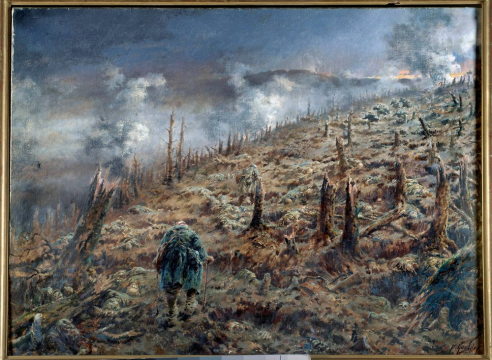
[A painting by artist Holvius Griya depicting a war-torn Emberrest, devoid of its autumnal hues.] [!] This essay would be read aloud by hired criers wearing the colors of Viru in major cities within the Empire of Man and the High Kingdom of Idunia. The author is proudly announced at the end of each reading. “I call upon the squalid, the modest, and the noble to hear my words. For in me lies possibilities both within and outside of our imagination. We are worldly, and our world will die.” - The Author Birth and Death Nothing is permanent. As the fruit upon the tree may grow from a wonderful pink blossom, and may ripen into its perfection, then finally fall from its tree and spoil on the grass, so, too, will the world fall into oblivion. From nothing was the world brought to light, and to nothing it will eventually return. All that which exists now in the vision of God will decay and cease to exist in its current form, being the fruit of His tree. Of course, as the dead and decayed apple will lay its seeds upon the earth and bear a new tree, so, too, will this world give birth to a new world. On such a day, descendants and all else that lives on Aos will have died, and the formation of a new world will be watched only by God as He gives life to His new stage. My Place in the World I find myself to be usually optimistic, so I must assume that the end of this world will not come until long after myself and everyone that I love to have gone naturally, but even so, the concept of the Great Dying is of interest to me. That is what I have decided to call the world’s end, the Great Dying, a mass extinction of all descendant-kind and their livestock, as well as all that breathes, eats, moves, and lives. This is not a common thought. The deer will never peer into the sky and wonder when it will no longer have ground to stand upon, or sky to observe. In contrast, it is the nature of mankind to think, figure out our place among the stars, and I believe such a concept’s conclusion will elude the minds of mankind until the Great Dying. On that day, all will be revealed as a final decree from God to give us closure and allow us to pass into the Seven Skies with peaceful souls. Such is my belief, rooted primarily in the grace of God to allow mankind to slip quietly into oblivion, and His love that would allow us eternal life after this Great Dying. It is His gift of thought and foresight that allows me to scrutinize and tear away the fabrics of the fog that therein overlies the vision of nothingness into what shall be seen and told. That is the purpose of mankind, to take the signs from the heavens and interpret them. The Dying Days - Existential Clarity There are two primary possibilities, and one minor facet of the first, available to my reasoning, and that which I may in any way comprehend. This world is prosperous even in its eternal chaos, and will continue to be as long as it is allowed to. If such prosperity is realized in the constant expansion of mankind, then by the product of Assured Destruction in Existential Clarity (that being the theory brought forth by one old Claudia Lorena Temesch, and that which I agree with wholeheartedly) will mankind find its demise. Something so overarching about our existence shall be wrought from the confines of Aos and disseminated. It would then be upon the backs of the lawmen and the clerics to quell rebellions and conflict arising from the despair or anger that will almost spontaneously appear. If such an instance of civil war (surmising that all of mankind will remain in one nation for some time, or if not, will still be connected enough for such to be true de facto) is otherwise allowed to endure or is even intensified by inaction, then the remaining races on Aos will soon feel the war as well. That will be the doom of descendants, an Aos-wide war amongst themselves, for the ground will be scorched beyond repair and the seas drained of life-giving water. God will see the failures of His children and draw the world into His hands. He will crush it, then flatten it like clay to start anew. The Dying Days - Cataclysm This section is dedicated to the minor, a subset of the section preceding it. The Cataclysm mirrors much of what has been detailed before, where humanity or another group uncovers some item, some idea, something that they shouldn’t have. This may be from Moz’Strimoza, where a disturbance could mean a crashing open of the gates to the Nether where infernal forces will descend in their entirety on mankind and his brothers. In any way, this scenario describes demise as it will come in a war at the hands of some group other than descendantkind, but still as a result of its actions. The Dying Days - Inadvertent and All-Encompassing This world is limited, and its resources naturally scarce. Water cannot be brought forth from the Void for sustenance, as it will evaporate into its origin, and grasses cannot grow where mankind has plowed land for his farms. As humanity inevitably grows to suffocate with its sheer volume, the world will begin to die. Famine will arise from lack of proper food, and farmers hurry to plow more land, which ruins further nature. Water will grow scarcer, and grains will grow less readily, exacerbating famine. Farmers then rush to plow more land for more crops, and more nature is ruined, with water growing scarcer even yet. This is to be a catastrophic cycle, and the day will come when no water flows, and no food is grown. Such will begin the demise of mankind. Men will starve first, then their wives, and lastly their children. The last human on Aos will be a small child, held in his mother’s arms as she had withered away the night before. Away from her care, and under the sweltering heat of the sun, he will perish without his forbears. God will then speak to the child and induct him into His army for his strength. This child will be the Horen of the new Aos, an exalted warrior of millennia past, and the proprietor of the new race of Men. A Perpetual Wheel Even in these scenarios of the apocalypse that are so many years in the future, one thing is ever-clear; the fact that the birth and death of our known universe is a cycle. As the wheel of time turns evermore, its bellows shall inflate with the power and life that God molds from the Void with His grace, and then fall into contraction, the life being thrust outward into the fires that rewrite and destroy, for all memory will be lost. The Seven Skies cannot be infinite, as such is illogical given the finite scope of our realms. If the Seven Skies are but a mirror set in the sky, they must also have the bounds of Aos. When all is lost, so, too, will be the souls of the damned and the cleansed, alike. Our world is imperfect, as many things have been and will be wrought away from His will, and given the opportunity to start anew after these courses of the Great Dying take their toll, He, in His eternal wisdom, will simply start again. Reconciliation Death is inevitable. All will fall into oblivion given enough time, and time is the essence of my argument. The only beings alive today that may see the end of our Aos are the Aenguls, and a handful of Elves that will refuse to die in a normal way. This passage is speculative, a window into the natural sciences as they relate to what we know of God and His will. You and I, readers of mankind, will not live to see this day. We are far from oblivion. Yet, it is approaching for our long-awaiting descendants, and they will experience what I have written, for I believe what is inscribed here is both possible and plausible. All will be gone, yes, but we have the fortune of watching life go by from the heavens after we are long dead. That is my peace. The Great Dying will be a show, friends will return, we will be forgotten by the living, and when all finds repose we will be allowed to sleep eternally, never to reawaken. Life is chaotic, and death is peaceful, but the journey from end-to-end is a gift impossible to overstate. We will all return to the same start, beggar or noble, so it is needless to allow corporeal judgment to weigh you down. We are the same. We are all men, and of us, mankind. We must act as if we are brothers. Nothing matters, at least in the long run. You will be forgotten, and your work will be downtrodden or eroded into sand. Yet, among the living, you will make your mark. These are the people you will spend the rest of eternity with after death, so live exuberantly, for peace is that; peaceful, but boring. Life is your only opportunity to enrich the world and enrich your soul. “I beg of you, in life, when all will be lost, live loudly and brilliantly, for you will be remembered in the minds of the dead and dying for what you did, not what you didn’t do.” - The Author Penned by Ariadna Secada de Leomonte on the 11th of Horen’s Calling in the 288th Year of Our Lord

-
haelunor An Announcement for a Debutante [Haelun'or Ball]
acronius_ replied to Hush's topic in Forum Roleplay
Another had watched close-by as the event had been originally detailed on a scroll in the hands of its progenitor. At the completion, there was jubilation, and he would make a great showing, even if only for the company. -
[EVENT] THE IMPERIAL PARADISIAN ADVENTURER’S GUILD
acronius_ replied to Sarven's topic in Empire of Man
APPLICATION FOR INTERVIEW FULL NAME: Ariadna Secada AGE: 21 PRIOR EXPERIENCE: Didn't die to a Manticore. SIGNED NAME: METHOD OF CONTACT: acronius_ | acronius_
-
the name of the map is inconsequential dawg, just call it whatever you like. exonym vs endonym
-
"It is my calling. There are finally those who share my vision." A particularly disgruntled descendant declares into an open window, after the missive had been read to him by a friend. Treason took his own hands. "Revolution is afoot. Descendants were at far greater peace when humanity was shattered."