.gif.c68dfef11b28ca1a0a5f4f976dda477a.gif)
Barbarus
-
Posts
92 -
Joined
-
Last visited
Content Type
Profiles
Personas
Wiki
Rules
War
Systems
Safety
Player Conduct
Roleplay Leadership Guidelines
- Roleplay Leadership Guidelines
- Roleplay Leadership Guidelines Comments
- Roleplay Leadership Guidelines Reviews
Forums
Everything posted by Barbarus
-
what funtzu said
-
maybe we kill the feline mani next and then all the Kha’s die by association
-
To the Orthodox community, happy Easter!
ქრისტე აღსდგა! -
ᴛʜᴇ ꜰᴀᴄᴇʟᴇꜱꜱ ᴛʜᴇ ᴡɪᴛɴᴇꜱꜱ ᴛʜᴇ ᴡᴀᴛᴄʜᴇʀ ɪɴ ᴛʜᴇ ᴅᴀʀᴋ It watched on a moment longer, in this world beyond worlds, at the side of the man. And then wordlessly, silently, its existence anathema yet ironically pure, melted back into the shadows with him.
-
.thumb.gif.3ddfee3f9fcd803397e521b564ab6122.gif)
IMPERIAL LETTERS PATENT | County of Aesterwald
Barbarus replied to Werew0lf's topic in Letters Patent
"Long may the sun shine." Sir Logan remarked to his once-page, proud of the boy. -
Hadrian,
This 'no job description' post is the ultimate filter and I pass it with ease.
I don't wait for instructions. I see the mission, adapt instantly, execute at elite level and deliver results with unbreakable loyalty. Disciplined. Battle-tested. Mentally and physically forged.
I've lived the Hadrian philosophy through the noise and turned it into real action. I'm not applying... I'm claiming one of those 2 positions.
When do we start?
-
“The day cannot come soon enough.” The Knight Errant replied sagely, still malding the loss of his Almaris home to a MORI SIEGE WORM.
-
{+LUX IN TENEBRIS+} ʜᴇ ꜱᴛᴀɴᴅꜱ ᴏɴ ᴀᴇɢɪꜱ ᴜɴᴅᴇʀ ᴀ ᴅᴀʀᴋ ꜱᴋʏ ʙᴜᴛ ʜᴇ ᴄᴀɴ ꜱᴇᴇ ᴀʟʟ ᴛʜᴇ ꜱᴛᴀʀꜱ ᴀɴᴅ ʜᴇ ᴋɴᴏᴡꜱ ᴛʜᴇɪʀ ɴᴀᴍᴇꜱ ᴀɴᴅ ʜᴇ ᴄᴀɴ ꜰᴇᴇʟ ᴇᴠᴇʀʏᴛʜɪɴɢ ᴀʀᴏᴜɴᴅ ʜɪᴍ ᴀʟʟ ᴛʜᴇ ᴅᴇꜱᴄᴇɴᴅᴀɴᴛꜱ ʜᴜʀᴛɪɴɢ ᴀɴᴅ ʙʟᴇᴇᴅɪɴɢ ᴀɴᴅ ᴅʏɪɴɢ ᴀʟʟ ᴛʜᴇ ᴅᴀʀᴋꜱᴘᴀᴡɴ ᴛʜᴏꜱᴇ ᴀʙᴏᴍɪɴᴀᴛɪᴏɴꜱ ᴀɴᴅ ᴀʟʟ ᴛʜᴇ ᴛɪɴʏ ᴄʀᴇᴀᴛᴜʀᴇꜱ ʙᴜʀʀᴏᴡɪɴɢ ᴛʜʀᴏᴜɢʜ ᴛʜᴇ ꜱᴏɪʟ ᴀɴᴅ ᴛʜᴇ ᴛʀᴇᴇꜱ ᴀɴᴅ ᴛʜᴇ ɢʀᴀꜱꜱ ᴀɴᴅ ᴛʜᴇ ᴡɪɴᴅ ʜᴇ ᴄᴀɴ ꜰᴇᴇʟ ᴛʜᴇɪʀ ʜᴏᴘᴇ ɪᴛ ɪꜱ ᴀʟʟ ᴄᴏɴɴᴇᴄᴛᴇᴅ ᴀ ᴡᴇʙ ᴏꜰ ᴘᴏᴡᴇʀ ᴀɴᴅ ᴛʜɪꜱ ɪꜱ ɴᴏᴛ ᴏᴠᴇʀᴡʜᴇʟᴍɪɴɢ ᴛʜɪꜱ ɪꜱ ᴊᴜꜱᴛ ʜᴏᴡ ʜᴇ ʟɪᴠᴇꜱ ɪɴꜱᴛᴀɴᴛ ᴛᴏ ɪɴꜱᴛᴀɴᴛ ᴛᴏ ɪɴꜱᴛᴀɴᴛ. {+ORDO AB CHAOS+} Far away, in Idunia, the bells toll. A storm in the image of divine wrath engulfs the abandoned Silver State of Haelun’or, filling the city in devastating torrents of flash-flooding. Foundations and buildings give way under the relentless battering of water and debris, the soil that supported them eroded and removed. Debris is swept up by the tide, serving as battering rams to wreak more havoc, while underground systems are filled and sealed in a liquid prison. Having cried its tears, the storm lets loose its anger, throwing lightning bolt after lightning bolt onto the lands, turning great masses of water into explosive steam, releasing shockwaves that collapse weakened walls and shatter glass, and creates craters onto the broken ground. Accompanying it is a great wash of heat, causing whatever water that remained on the surface to boil violently, scalding air permeating all across the Silver State and its lands, causing miniature disasters in their wake, and setting fire to the accompanying forests. The heat reacts violently to the cataclysm. Water trapped within wooden beams expands, splitting wood explosively. Mortar cracks, stone shatters from thermal shock, and buildings tall enough and durable enough to survive the floods catch aflame, fueled by flammable cloth and materials, darkening their towers with soot and ash. Timber dries rapidly, with the wind from the heat feeding the flames further. The end result is devastation. More than half of the Silver State lies in complete ruin, its area set ablaze. The other half remains standing, yet scorched and heavily damaged, anything not bolted down in complete disarray. Midris watches the fall of the Silver State a moment longer, and then unfurls his wings, flying back to the Heavens.
-
When Giyahun hit the magma, his hunched power pack exploded, igniting a bubble of thundering flame. For a moment the entire chamber seemed to shudder. The White Scars halted, sudden disbelief staying their hands. Even the orks sensed something, and their headlong charge missed a beat. The Khan himself broke from combat and stared into the waves of breaking fire, his cloak snapping against the gale of force unleashed. What remained of Giyahun’s body was consumed in that hurricane, burned away, rendered down to atoms.
Then the primarch looked up, and despite the racing furnace around them, a chill descended over every soul. He uttered two words only, his voice suddenly as spare and bleak as the void.
‘Pull away.’
His sons complied instantly. Even Sejanus and the Luna Wolves, warriors from a Legion that gave no quarter to any foe, withdrew.
The Khan advanced then, alone now, his demeanour changed from flamboyance to a night-sere menace. He swung his sword about him languidly, loosening up, cutting the air into whispers, and the orks themselves hung back, bellows snuffed out, bravado shaken into wariness.
Then he started to kill. He broke into a run, first heavily, measuring his strokes, then accelerating, faster and harder, until he had moved into that state the Chogorian sages called alakh geh, where the thought alone could kill, where the distance between intention and action was made nothing, and where vengeance became a living thing with both extension and immanence. Under a gathering shroud of elemental vendetta, he killed them all. If he had slain freely before, now the carnage was so complete that it scraped the boundaries of both the divine and the diabolic. Even the war-hardened Legiones Astartes, used to witnessing prodigal exercises of violence, were silenced by it.
The xenos never laid a claw on him. The Khan moved now, not with joy, but with dreadful perfection. They faced up to him, and they were swept away. They tried to parry, and he cut them down. They tried to combine, and they were ripped into whimpering slivers. He danced through their numbers and built a corridor of blood around himself, slaying like some spectre of the endless dark, silent as a grave-mark, chill like the night gale of the Ulaav.
One of the Luna Wolves, inspired by that vision, tried to join him then, to add his blade to his, and it took Qin Xa to hold him back.
‘No, brother,’ the keshig-master warned, quietly. ‘Only observe.’
But by then, the Khan himself was almost invisible, hidden behind a curtain of severed flesh and thrown blood, a primordial force burning through the xenos ranks, inviolable and darkly magnificent. For the first time in that entire campaign, the greenskins tried to run, to scramble away from the hungering devil that raced to devour them, but there was no space left, no time left, no hope left. Most were caught as they turned, their backs carved open and their necks broken. The few that managed to get back to the gate cowered under the shadow of that greater monster, the swollen master of their brood-lair, who retreated beyond the portal in a shuffling, shaking display of abject submission.
The Khan passed under the gate’s edge. None of his army followed him in. They held vigil on the spur instead, watching the gaping entrance, holding to their last order against every instinct. All that emerged from the far side of the gate now were alien screams, one after the other, overlapped and smothering, a chorus of terror and panic that went on and on and on and never relented.
Not one of the xenos escaped back to the spur. Seconds of that carnage passed, then minutes, and the screaming just got worse. The magma fires, as if in sympathy to the apocalyptic toll of life-ending, slapped and blazed against the outer walls of the last chamber, grasping futilely at the horror unfolding within and powerless to stop it. After a while, it became impossible to listen to.
Eventually, though, even the screams echoed out.
[...]
After a while, they passed beyond the watch patrols and the overflights and, for a few moments at least, were something like alone. The Khan turned back to face the way they had come and looked over the site of destruction. The Bloodmaw smouldered away in the darkness, a sinkhole of ruin. For a long time, he said nothing.
‘It was weakness,’ he said, at last.
‘No one says it,’ Qin Xa replied, calm as ever.
‘I have lost warriors before.’
‘He was with us at the start.’
‘It had to happen, sooner or later.’
‘Did it?’
‘Nothing is eternal.’
‘Some things are. A good blade. The wind on skin. An oath.’
The Khan let slip a crooked smile. ‘Just what would make you angry, then, Xa?’ he asked.
‘If you became, in some way, like other men,’ the master of the keshig said. ‘If you had seen him die and not done what you did. If you had let one of them, just one, live. Then, Khagan, I would have been angry.’
-
✠ Legal Name: Father Jonathan Keen ✠ Age: 100+ ✠ Residence in Rotesberg: Grensewacht 2A ✠ I cast my vote in favor of…: Lomarak of Rotesberg
-
-SET ON THIS OFFER! "Konichi'ug Li ren spies! Mitashi have special deal." [An Oni, deep in thought.] "Mitashi NEED brapsteel (Boomsteel) BAD. Very important! Need for samurai trial onegai! Oni-ly one ingot! Can be ELF DENSITY (low density), HUMAN DENSITY (medium density), or ONI DENSITY (heavy density), but only need one!" "In return, mitashi can offer anti voidcel metal (Thanhium), poison metal (Azhl), or mithril (Argentum)." "Onegai write back! Mitashi can't be peasant forever! Mitashi father died a rich man and left everything to fat brevver Botsugo! Take pity onegai! Arulgato! Bai bai!" - HONMA MATSUGO

-
'S FROST SALT MARKET. "Konichi'ug filthy Gaijin. Mitashi Matsugo. Hai hai!" [An Artist's Rendition of Honma Matsugo] "Mitashi have SPECIAL OFFER. One chance in lifetime. Latsu want to ruin worst enemy's carb? LATSU NEED LOOK NO FURTHER. Mitashi have FROST SALT. Is rare item! Oh so rare! Nubbu can be found oniwhere else! They nubbu make this onimore!" [So Kawai!] "If latsu interested in trade. Send mitashi bird. Nubbu mina! Only METAL. Arulgato. Bai bai!"


-
Waiter! More 12 year old girls in plate armor doing acrobatics to avoid multiple grown men attacking her with swords! @Sarven
-
JOHN URGUAN, RECENTLY CHRISTENED AS JOHN URGUAN OF BRAWMIA, CLEANED HIS BLOODIED BLADE WITH ONE HAND, SLAPPING HIS BELLEH WITH ANOTHER.
-
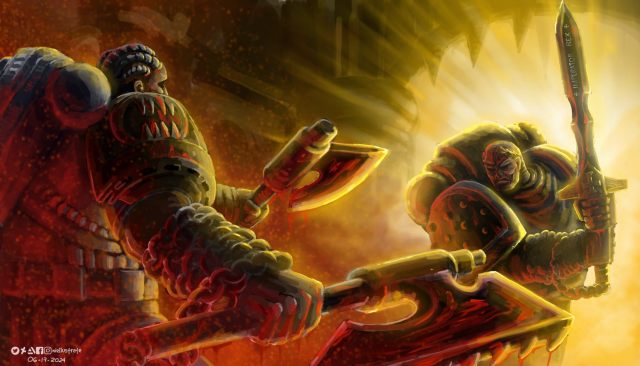
He never said a word. Never. Throughout it all, the Black Sword didn’t say a thing. The monster. The ghost. The mere shell. What could be worse than this? What death could be as profound as this? What disappointment, what despair, could ever be greater?
Khârn raged at it. He howled in fury, coming at him again and again, shrugging off the wounds. He wanted the old one back. The one with some fire in his veins. He wanted some spirit. Just a flicker of something – anything – other than this flint-edged, iron-deep hardness. They had laughed together, the two of them. They had fought in the roaring pits, and had sliced slabs out of one another, and at the end they had always slumped down in the straw and the blood and laughed. Even the Nails had not taken that away, for in combat the Nails had still always shown the truth of things.
‘Be… angry!’ he bellowed, thundering in close. ‘Be… alive!’
Because you could only kill the things that lived. You couldn’t kill a ghost, only swipe your axe straight through it. There was nothing here, just frustration, just the madness of going up against a wall, again and again. The Nails spiked at him. He fought harder. He fought faster. His muscles ripped apart, and were instantly reknitted. His blood vessels burst, and were restored. He felt heat surge through his body, hotter and whiter than any heat he had ever endured. The Black Sword resisted it all, silently, implacably, infuriatingly.
It was like fighting the end of the universe. Nothing could shake the faith before him. It was blind to everything but itself, as selfish as a jewel-thief in a hoard. His chainaxe whirred as wildly as he’d ever thrown it, igniting the promethium vapour in the air, sending the blood lashing out like whipcord. He scored hits with it. He wounded the ghost. He made him stagger, made him gasp. The heat roared within him, turbocharging his hearts. He heard the coarse whisper of the Great God in his bruised ears. Do it. Do this thing. Do this thing for me. The ghost came back at him, tall and dark, his brow crackling with lightning-flecks, his armour as light-devouring as the blade he wielded.
Khârn became sublime, in the face of that. The violence he unleashed was like a chorus of unending joy. The ground beneath the two of them was destroyed, sending them plummeting in clouds of debris. Even when they crashed to the earth, they fought on. They rocked and swayed around one another, obliterating everything within the arc of a sword or the ambit of an axe-length.
‘I… am… not…’ he blurted, feeling the tidal wave of exhaustion drag on even his god-infused limbs. He realised what had been done, then. In the midst of his madness, even as the Great God poured himself into his brutalised body, he knew what transformation had occurred. They had always told themselves, after Nuceria, that the Imperium had made the World Eaters. It had been their fault. The injustice, the violence, it had forged that lust for conflict, for the endless rehearsal of old gladiatorial games, like some kind of religious observance to long- and justifiably dead deities. That had given the excuse for every atrocity, every act of wanton bloodletting, for they had done this to us.
‘I… am… not…’ But now Khârn saw the circle complete.
He saw what seven years of total war had done to the Imperium.
He saw what its warriors had been turned into.
He had a vision, even then, in the midst of the most strenuous and lung-bursting fighting he had ever experienced, of thousands of warriors in this very mould, marching out from fortresses of unremitting bleakness, every one of them as unyielding and soul-dead and fanatical as this one, never giving up, not because of any positive cause in which they believed, but because they had literally forgotten how to cede ground.
And he saw then how powerful that could be, and how long it could last, and what fresh miseries it would bring to a galaxy already reeling under the hammer of anguish without limits, and then he, even he, even Khârn the Faithful, shuddered to his core.
‘I… am… not…’ He fought on, now out of wild desperation, because this could not be allowed to go unopposed, this could not be countenanced. There was still pleasure, there was still heat and honour and the relish of a kill well made, but it would all be drowned by this cold flood if not staunched here, on Terra, where their kind had first been made, where the great spectacle of hubris had been kicked off. He had to stand. He had to resist, for humanity, for a life lived with passion, for the glorious pulse of pain, of sensation, of something.
‘I… am… not…’ he panted, his vision going now, his hands losing their grip, ‘as… damaged…’
The Black Sword came at him, again, again. It was impossible, this way of fighting – too perfect, too uncompromising, without a thread of pity, without a kernel of remorse. He never even saw the killing strike, the sword-edge hurled at him with all the weight of emptiness, the speed of eternity, so magnificent in its nihilism that even the Great God within him could only watch it come. Thus was Khârn cut down.
He was dispatched in silence, cast to the earth with a frigid disdain, hacked and stamped down into the ashes of a civilisation, his throat crushed, his skull broken and chest caved in. He was fighting even as his limbs were cut into bloody stumps, even as the reactor in his warp-thrumming armour died out, raging and thrashing to the very end, but by then that was not enough. The last thing he saw, on that world at least, was the great dark profile of his slayer, the Black Templar, turning his immaculate blade tip down and making ready to end the last bout the two of them would ever fight.
‘Not… as… damaged,’ gasped Khârn, in an agony greater than anything the Nails could ever have given him, but with more awareness of the ludic cruelty of the universe than he had ever possessed before, ‘as… you.’ And then the sword fell, and the god left him, dead amid the ruins of his ancient home.
-
-
-
-
Father John's bushy brows parted like the sea from Moses as he read the missive, signing the lorraine thereafter, "To be of spiritual service when I no longer can be of physical one... God be praised."
-
urguan ANNOUNCEMENT FROM THE HIGH PRECEPTOR.
Barbarus replied to The Tough Guy's topic in Da Kirkja Dverga
Daladan, brother of Baladan, supports his father, "ARRRUUUUUUU."
.thumb.gif.3ddfee3f9fcd803397e521b564ab6122.gif)

.thumb.gif.68002202ef805414ec6f34905c5c296b.gif)


.thumb.gif.4284906d3788a322c219fc4b2911a67d.gif)