Jump to content

Knowledge of Knowledge


yopplwasupxxx

Recommended Posts

The Knowledge of Knowledge

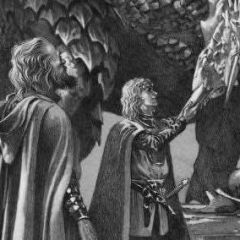
See the source image


@Hunwald


As recorded from the lecture of Archbishop Otto the Tarcharman given to J.C. Sarkozy, Duke of Helena.


PALAIS DE NOVELLEN, HELENA, OREN

14 G.H. 1742


    “I WAS BROUGHT BEFORE YOU, in wisest council of your peers, to teach oneself of the knowledge of the world, the wisdom of the sages ancient and contemporary- to glimpse into the bare root of logic itself, from the annals of mythical history to the abstract methodology of ethics and morality. In you, I am to sow seeds of reason, and from it bear the fruits of prosperity, for in you your youth can cultivate the bountiful harvest, rich mind and body, lest you come beridden of weeds and bearing of ill-repute and repeater of damnation. Your councillors, like myself, wish not for the field of despair but the acre of perfection, and what not is the diligent farmer to do but fertilize and care for his crops? They are the humble sponsors of the age-old mantra, ‘THE GREATEST TOOL OF THE MONARCH IS THE KNOWLEDGE FROM WHICH HE RULES’, and like the farmer who helps his wheat grow full, we too must give you the tools from which you will excel, the careful nurturing by calloused and loving hand.


Indeed, for these tools, these instruments of rule which shall be given to you, while they are done for the Matter of State, are also given in love and affection. The others, they see the rationality of knowledge, the empirical truth, yet to myself I clamor and exclaim, ‘TO LOVE KNOWLEDGE IS TO LOVE MAN ITSELF’, and in it wisdom is the greatest expression from which man can give love to his fellow man. And what ruler does not care and love for his subject, his fellow peers which he guides and commands? What leader does not protect the group from which he is delegated responsibility for? Yet to love and protect requires to know: to know how to love, to know in what ways to love, to know in how one is to be loved. If we know, then we may act accordingly- but if we know not, then how may we act in conscious thought? If the Rhenyari are to be believed, and concentrated action (or motion) is what makes existence, then to be, or to be something, is to inherently know what to be and what that being is.


Yet before we delve into the rabbit hole of existence, we must know: what does it mean to know? What is knowledge? Such a lofty question, simple at first, though any answer not of merit will fall apart in a moment's examination. Is it the accumulation of experience? If it is only that, then how does a baby know to suckle the mother’s teet before he has ever done so? Is it the God-given instinct given to even animals? If it is only that, then how do men have such disparity in knowing, and that one may learn beyond others? Is it what our senses see? If it is only that, then how do we carry knowledge of morality, love, and hate, which cannot be seen, or how to think in the theoretical which has not or cannot be experienced? 


Knowledge, in its raw form, takes on the most varied forms, and to teether it is like chaining the beasts of yore into the shackles of modern man, but if one sees beyond what knowing is but it does in application, the image comes much more clear. What does knowledge do for man? It tells us how to act, how to live. How to live meaningfully.  By bare of meaning, it is the capacity of life from God has bestowed to us, the ability of both enjoyment and suffering in ordered fashion. Without knowledge, we would know not how to drink the water, and surely would perish in drought, or we would know not how to rule, and surely all nations would perish in anarchy.


And so, we may define knowledge as such: TO KNOW IS TO LIVE, or TO HAVE KNOWLEDGE IS TO HAVE THE CAPACITY OF LIFE.


This capacity can be divided into three different spheres, which correspond to different  types of knowledge, from which our life derives. First there is the PRIOR KNOWLEDGE, or the reason of instinct, which is the capacity of breath and base emotion. It is the knowledge which is born in all creation, the bare element of existence which is required for life. Next is our EMPIRICAL KNOWLEDGE, or that which derives from our senses, from the color, to warmth, to our knowledge of mathematical logic. We assume this knowledge which total truths, truths which cannot be disproven, from statements such as ‘water is wet’ or ‘there is one red apple’. Lastly is METAPHYSICAL KNOWLEDGE, or that which comes from our reason and intuition, and covers what is believed not in total truth (or truth that is subjective). Such examples are the application of action (Should I do this? Should I do that?) or the beliefs of man which cannot be proven by the senses (preferences of tastes, aesthetics, companionship).


PRIOR KNOWLEDGE

Knowledge of Instinct

Survival, Basic Emotions


EMPIRICAL KNOWLEDGE

Knowledge of the Senses

Arithmetic, Geometry, the Physical


METAPHYSICAL KNOWLEDGE

Knowledge of the Potential

Ethics, Interpretation, the Mental


    In showing these principles, let us take an example of a singular red apple. Now, if I show you this apple, you will recognize it as such: through empirical knowledge, we recognize that it is red, that is one, and that it is a fruit. Perhaps you taste it with a bite in order to arrive at this conclusion, but ultimately it is by your senses to which you determine what the apple is. Through prior knowledge, we know that we desire food, as it is a requirement of life, and so we know that this object carries so value for survival in some capacity. And through metaphysical knowledge, we know whether or not to eat it now, or to eat it at all. Perhaps you have worry that you shall not eat later, and so save the apple, or you have a companion which desires more food than you, and so you give the apple to them instead. Or through combination of both your prior and metaphysical knowledge, you recognize the value of the apple it bears and in the future, and so save the seeds to plant for more apple trees.


    If to know is to live, then all three spheres of knowledge are required to live, or in more philosophical view, they are required to live meaningfully. One cannot depend purely on one form of knowledge to base one’s action, and while prior knowledge is carried in all of man, it is the contrast between the empirical and metaphysical which cause friction. Both are innately similar yet opposites: the empirical requires scientific thought and rational mind, while the metaphysical requires subjective interpretation and individualistic meaning. However, to take one without the other is as if to blind oneself in an eye, keeping from ever seeing the truth in totality. 


    Though this creates an issue, an eternal conflict, a PARADOX OF TRUTH in which cannot be escaped, from where we must choose either the empirical or the metaphysical when they fight for dominance of ideal. This ignores the small choices, the petty ones which do not fall under true thought, such choices of appearance and what have you, but instead we focus on the momentous, the great choices which dictate career and passion? What should be more important in rulership, for given example, the ideals of principle or the bare costs of numbers? Shall you, as a steward of the nation, abandon morality for the sake of unrighteous victory or have it be the burden which dominates greatness? Or will you live a meaningful life, and see both as no answer is truthful? In the paradox, indeed, there is no ‘right’ answer in both the Physical and the Mental planes.


    Lastly, I shall touch on the topic of our next discussion, on the concept and definition of existence, from which is derived from knowledge. To know is to live, and to know is the symptom of the God-given soul, bestowed upon us by the Supreme Being. However, to exist, or existence, is entirely separate from the life that man lives, from the soulless physical objects such as the chair you sit on or the clothes you wear, to the animals and plants which we bear our lives upon. To know is to live, and to know is to be able to know the sheer concept of existence, and see it in abstract form from purely our plane. Unlike the chair or the animal, we know to see beyond purely existing and see the concept of existence over the pale of basic needs and desires. We see the plurality of existence (our empirical knowledge) and seek to apply it to ourselves (our metaphysical knowledge).


    Now, as we conclude, let us reflect. We know what is to know, and we know the different spheres of knowledge- the prior, the empirical, the metaphysical- and that to know is to live. But many will say, ‘IGNORANCE IS BLISS’ and that the ‘WISE MAN IS DOOMED TO DESPAIR’, which in many cases is true. And so if to know is to live, is to know also to be happy? Or are they mutually different? Upon our time of recitation, we shall converse on what this means.


    For now, I leave you with the riddle,


I am that which is seen once by many but many times by one,

Which can bless one man and curse another,

Some can ignore me while others are burned with me for life.

And while you may try to rid me, you will always have more of me everyday you live.


What am I?”


As Scribed by Brother Robert the Judite, 1742


Link to post
Share on other sites

Archived

This topic is now archived and is closed to further replies.

  • Recently Browsing   0 members

    No registered users viewing this page.


×
×
  • Create New...