


sarahbarah
-
Posts
2616 -
Joined
-
Last visited
Content Type
Profiles
Personas
Wiki
Rules
War
Systems
Safety
Player Conduct
Roleplay Leadership Guidelines
- Roleplay Leadership Guidelines
- Roleplay Leadership Guidelines Comments
- Roleplay Leadership Guidelines Reviews
Forums
Everything posted by sarahbarah
-
"You should never pick blissfoil with your bare hands, Erika." Emma knelt before her youngest, scrubbing her hands clean. As she did so, she couldn't help but spare her a warm look, one conveying immense pride.
-
Emma sat at her son's bedside, tucking blackened curls behind his ear. How he had grown to resemble his father, she thought. She could do naught but hold her son tight, cherishing the years of childhood he had left.
-
The Deputy Emissar glances over the Princess Milena's shoulder, a smile playing at the corners of her lips as she spied the ornate parchment on the desk. "We ought to prepare some fine gifts for them," she thought aloud.
-
ISSUED BY THE VISCOUNTY OF KRUSEV c. 545 E.S. In the name of duty and honor,, the Viscount and Viscountess of Krusev extend their warmest greetings and a most gracious invitation to all good people of Hanseti-Ruska. We are delighted to announce the forthcoming celebration of our beloved heiress's nameday. The nameday festivities will be held within the esteemed halls and courtyards of the Viscounty of Krusev, adorned in splendor for a grand masquerade ball. The theme of this evening will be that of birds, a symbol of freedom and grace that our Karlotta cherishes so dearly. Guests are encouraged to don masks and attire befitting the noble creatures of the sky, transforming the night into a grand avian spectacle. Paying homage to our cherished Koravian heritage, the celebration will also embrace the time-honored Koravian traditions that bind us to our forebears. Throughout the evening, guests may partake in the ancient Koravian art of fortune-telling through the mystical language of flowers. All will interpret the blooms, revealing what fate has in store for those who seek its wisdom. Moreover, in the spirit of protection and prosperity, we shall gift our heiress a bull leather amulet, a token of strength and safeguarding, as was custom in the days of old. And in a gesture as ancient as our lineage, the first calf of the newest generation shall be gifted to our beloved daughter, ensuring that she is watched over by the steadfast spirit of our noble house’s emblem. We humbly request the presence of all Haeseni citizens at this grand event, where the old and the new shall intertwine in celebration. Join us in revelry, masked in the guise of majestic birds, as we honor our past and look towards our heiress’s future that is bright with promise. HIS EXCELLENCY, ERIK OTTO KORTREIVCH Lord Palatine of Hanseti-Ruska, Viscount of Krusev, Baron of Koravia, Lord of Emsgrad, Lord-Captain of the Bykursain THE RIGHT HONORABLE, EMMA MARIYA KORTREVICH Viscountess of Krusev, Baroness of Koravia, Lady of Emsgrad, Deputy Emissar of Hanseti-Ruska, Surgeon General of Hanseti-Ruska
-
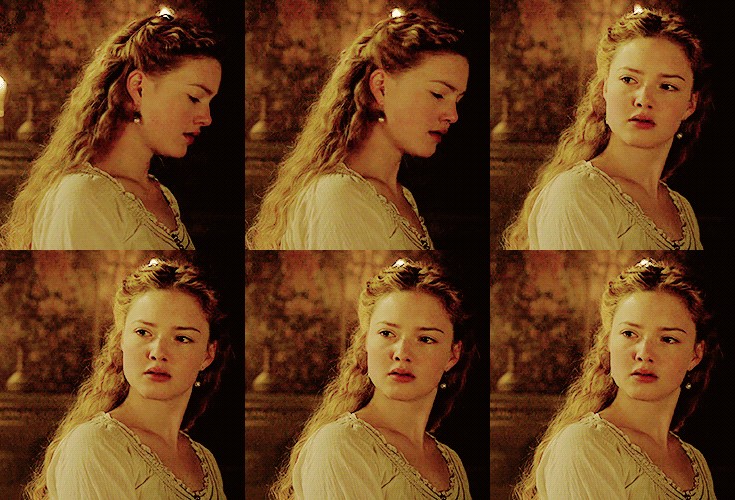
Eso's Guide to Women's Fashion: the 1300s
sarahbarah replied to esotericas's topic in Human Realms & Culture
showstopping (i am using every single skin) -
I'm very demure and very mindful. I don't comment rude things on lore pieces "too long didn't read, bad holy magic." I don't do too much. Ladies, let's be mindful about what we comment on the forums. Let's remember that there are humans on the other side of the screen. Be demure. Be considerate. Be cutesy.
-
HOUSE KORTREVICH The House of Kortrevich is one of the most enduring noble families of Hanseti-Ruska. Established over three centuries ago, the House has weathered the tests of time, maintaining their prominence and influence through numerous generations. The family is notably distinguished by a long lineage of influential figures who have played pivotal roles in shaping both local and broader historical events. Over the years, members of the House Kortrevich have been prominent in various domains, including politics, the military, diplomacy, and cultural patronage. Their leadership has often been critical in forging alliances, enacting reforms, and guiding Haense through periods of change and development. In addition, the House’s common blooded roots uniquely position the family as a vital link between the common folk and the nobility of Haense. This heritage affords them an understanding of the everyday experiences, needs, and values of the general Haeseni populace. As a result, the Kortreviches are able to serve as an effective mediator, advocating for the interests of the common class while also upholding the responsibilities and traditions of the aristocracy. Presented here is a comprehensive cultural study of the Koravian people that details their history, traditions, and customs. Through careful research and analysis, this study captures the essence of the Koravian way of life, offering insights and perspectives that are essential for both scholars and the general public. This work is intended to serve as a testament to the legacy of the Koravian people, preserving their cultural identity for the future generations to come. TABLE OF CONTENTS -x- I. HISTORY II. ATTIRE III. TRAITS IV. TRADITIONS V. LANGUAGE ⋅ ───────────────⊱༺⠀I⠀༻⊰─────────────── ⋅ -x- KORTREVICH is a Low Marian (or Karovian) subcultural line that is also distantly related to the Old Raevir and Hanseti settlers who established their foothold in the lower regions of Haense. Traditionally, the tribes of Koravia consisted of farmers, shepherds, and ranchers. Cattle, in particular, became a specialty of the Koravian people. However, it was not until the Haeseni reached Atlas that the commoner House of Haldor displayed their military prowess under the leadership of the war hero Ser Tilman and his sons, Lukas and Henrik. Prior to the conclusion of the Third Atlas Coalition War, the brothers settled in Markev and bore sons that would carry on the Haldor name. However, a split between the brothers occurred after the war, and Henrik abandoned his surname and took on the name of Blackwood, separating their sons for their entire childhood. The unification of the two branches wasn't achieved until the next generation, when Edmund, the youngest brother of Lukas and Henrik, and their sons brought it to fruition. Through ancient archives, they discovered that the lines of Haldor and Blackwood were not only related but had once been unified under a different name: the House of Kortrevich. The House’s recognized founder is Otto Kortrevich, the first Baron of Koravia, who rose to peerage through cross-generation military service on Atlas and Arcas. After achieving nobility, the once fledgling family of craftsmen and soldiers swiftly transitioned into government service in numerous positions: the Palatinate, Marshalship, Speakership, the Knight Paramount, the Grand Lady, the Emissary, the Royal Curator, and the Grand Maer respectively. The common-blooded house would even integrate into the royal family, with Queen Emma "The Golden" and Queen Esfir "The Heir" both claiming lineage from Kortrevich lords. Kortreviches have often pursued knighthood, producing many notable Sers and Dames; namely, Ser Tilman Kortrevich, the first known Kortrevich and progenitor of the Koravian line who was a renowned Haeseni bannerman during the late 1500s. He would earn the moniker 'The Valiant' for his role in the vanguard of all his engagements. Similarly, Ser Nikolaus Kortrevich, Knight Paramount of Haense, was a distinguished swordsman and bannerman during the War of Two Emperors and is regarded as the father of modern Haeseni knighthood. Conversely, Ser Rodrik Kortrevich, another Knight Paramount of Haense, was a respected swordsman and bannerman, though he is remembered as a turncloak during the same war. Ven. Dame Primrose Kortrevich, one of the first female knights in modern Haeseni history, was a champion for female representation within the military and is venerated by the Church of the Canon for her sacrifice during the Athera Expedition. Ser Ivan Kortrevich, additionally, was a renowned Haeseni bannerman during the mid to late 1700s, and would further cement the Koravian legacy in knighthood due to his service. More closely-guarded history of the House often includes rumors of dabbling in magic. Several generations of Kortreviches saw sons plagued with strange ailments and natures, though these rumors have never, ever been publicly addressed, and are likely to die with those ancestors who know their origin. Otherwise Kortreviches often engage in housemagic to assist in overseeing the estate, and more recently, bardmancy, usually to enhance a proud tradition of storytelling (namely the legends of their ancestors). ⋅ ───────────────⊱༺⠀II⠀༻⊰─────────────── ⋅ -x- VE KORSIKT Ve Korsikt, which translates to "the corset" in New Marian, is an elegant dress named for its intricately embroidered corset, adorned with vibrant beads or floral designs that reflect the wearer's personal preferences. The corset is available in two distinct styles: one features square lappets around the bottom edge at the waist, while the other is a single piece that flares out at the waist and integrates seamlessly with the chemise. The chemise is made of white linen and is often embellished with additional embroidery. The length of this gown varies between unmarried girls and married women, with the former wearing shorter variants. Unmarried girls frequently enhance their skirts by sewing a contrasting strip of color along the bottom edge, usually in the House colors of red, yellow, and black, to add variation to the garment. Ve Korsikt is a beautiful fusion of Raev and Hanseti fashions, with roots tracing back to the very conception of House Kortrevich, as seen in its ancestral homes of Haldor and Blackwood. In later years, the gown would more closely resemble a sarafan due to the influence of the Haeseni Queen, Emma of Jerovitz, who hailed from House Kortrevich. This rich historical background has allowed the garment to evolve over time, leading to shifts in the embroidery styles on the corset and the layering techniques of the skirts. Despite this evolution, the gown still holds a distinctive identity as a staple of Koravian culture. Queen Emma of Jerovitz VE KRAWN I BLAUWMS Alongside their distinctive attire, the women and girls of Krusev adorn themselves with flower crowns, a tradition deeply embedded in Koravian culture. Flowers have always held a significant place in their customs, particularly during the arrival of spring. Crocuses, snowdrops, and lily-of-the-valley flowers are most commonly collected and woven into crowns and wreaths. In honor of Dame Primrose Kortrevich and the rose's tendency to bloom early in the spring, primroses symbolize grace, valor, and persistence; thus, primrose wreaths hold special significance for Kortrevich heirs. Following their debut, these wreaths are typically woven by their siblings as a gesture of devotion and respect during the first spring. For weddings, a crown of white orchids and kaffir lilies is hung above the bride's head. The day after the wedding, the bride and her husband toss this crown into the hearth of their shared home for good luck.1 VE SOROCHKA The traditional men's shirt, known as ve sorochka ("the shirt"), is a staple of Koravian fashion. These shirts are crafted from either linen or cotton, offering both comfort and durability. Ve sorochka is usually also adorned with beautiful embroidery, much like their feminine counterparts. These patterns are not just decorative but carry cultural significance, often reflecting local traditions and familial symbols. A key component of the attire is the waist tie, which is most often crafted from finely tanned Koravian leather. In addition, this tie is embellished with brightly painted tassels, usually seen in shades of red, black, or yellow. The ensemble is completed with sturdy boots made from the same high-quality Koravian leather. Leather, in fact, is a predominant material in Koravian men's fashion. VE KAFTAN For the colder seasons, the men don a kaftan, a piece of outer clothing that varies in length and fabric. These kaftans are typically made from leather or the skins and furs of animals native to the Haeseni region. The choice of material not only provides warmth but also pays homage to the region's rich natural resources. The kaftans are lined with soft furs for additional comfort and insulation, making them ideal for enduring the harsh winter months. 1] Fabian Otto Kortrevich, 469: The Flowers of Jerovitz [Link] ⋅ ───────────────⊱༺⠀III⠀༻⊰─────────────── ⋅ -x- HEADSTRONG Koravians often take after their emblem, the Bull. They are steadfast in their beliefs and decisions, once they have made them, and can be difficult to dissuade. Whichever course they may choose for themselves - the military of yore, the knighthood of tradition, or the diplomacy and artisanry of recent years, a Koravian charges forth upon the path to which they are bound. COMPASSIONATE Perhaps a result of their common blooded roots, Kortreviches tend to be remarkably empathetic towards the commonfolk, affectionate with family (blood-related or chosen), and quick to make friends with Descendants of other races and nations. NATURALISTIC As an agricultural seat, Kortreviches love hunting, and also enjoy animal husbandry, gardening, and otherwise connecting with nature. This has led Kortreviches past to forge unlikely alliances with Wood Elves and Orcish shamans alike, and Kortrevich women have proven particularly prone to leaving the noble life in favor of the untamed wilderness. Furthermore, furs are a staple of the Koravian wardrobe. INDEPENDENT A history of dabbling in secret studies and unorthodox friendships has forged a culture of secrecy among the house, even from one another. Kortreviches can be wildly independent in their pursuit of duty, desperate to prove themselves in a family once stained by scandal -- or fiercely secretive, if in pursuit of something which conflicts with their familial obligations. ADVENTUROUS Koravians possess a strong sense of adventure, often driven by a desire to explore and experience the unknown. Whether embarking on daring journeys, seeking new horizons, or undertaking bold endeavors, they embrace the thrill of discovery. CHIVALROUS Due to the long lineage of knights present in the Koravian line, a strong sense of chivalry permeates their values and actions. This tradition of knighthood instills a code of honor, bravery, and service within them. Many Kortreviches will even pursue the path of knighthood, embracing the ideals of protecting the weak, upholding justice, and exhibiting courtesy in all their endeavors. ⋅ ───────────────⊱༺⠀IV⠀༻⊰─────────────── ⋅ -x- REARING OF THE BULL Upon their fifth birthday, Kortrevich children may, at any time, receive a calf to rear. This bond teaches them both the duty of servitude -- and the natural cycle of life, as they will, inevitably, outlive their bovine companion. THE HEIR’S MANTLE Firstborn sons of the mainline have always carried the middle name Otto, after the first Lord Kortrevich. Firstborn daughters of the mainline carry the middle name Stefaniya, for the first Countess instated after the Karenina Accord. KORAVIAN LEATHER First decreed by Countess Ileana Kortrevich. Koravian leather, named for the ancestry of the House, is the distinct leather worn by Kortreviches in boots, gloves, and belts, used in their crafts, and derived from the House’s own livestock. KEEPING THE HERD Kortreviches historically tend their own livestock, regardless of the other duties of their servantry and retainers. A connection to their cattle, particularly cows and bulls, is considered an essential skill to be a dutiful scion. VE ASSERALA NUCHT The Summer Night Celebration Originating from the early Raev settlers and Koravian tribes who revered Asseran, the pagan god of the sun, The Summer Night (Ve Asserala Nucht) is a cherished tradition that has evolved over time. Initially a celebration dedicated to Asseran at the height of summer, it has transformed in the modern Koravian age into a festival that honors love, the Canonist faith, and the beauty of summertime.2 The celebration includes several unique customs and rituals. Participants leap over bonfires to cleanse themselves and ward off evil spirits. Couples also partake in this ritual to test their relationships; a successful jump signifies a happy union, while a stumble is seen as a bad omen. Wreaths made from wildflowers and herbs significant to Koravians, such as snowdrops and crocuses, are worn. Unmarried women will throw these freshly made wreaths into the river, and the person who retrieves a wreath is believed to be the woman's destined partner for life. Fresh wreaths are also hung on doors after being blessed with prayers to ward off lingering spirits. At the conclusion of the celebration, Koravians gather around the bonfire and toast with finely carved bull's horns filled with Carrion Black, a traditional beverage beloved by the Koravian people. VE ANDIYEK I BYKIN The Birth of Bulls In Koravian culture, the birth of a new child is celebrated with a deeply symbolic ceremony. This ancient tradition blends reverence for nature with the protective power of ancestral customs. A central element of this tradition is the use of bull leather, which is prepared beforehand by the family. On the day of the ceremony, the bull leather is fashioned into a protective amulet, which is placed in the newborn’s crib or nearby. The bull leather amulet is passed through the flames, symbolizing purification and the removal of any negative influences. Afterward, the amulet is returned to the child’s crib, where it remains as a protective charm that the child will carry with them for life. The ceremony concludes with a communal feast, wherein the family and guests share food and drink. During the feast, stories of ancestors and their blessings are recounted, reinforcing the connection between the newborn Kortrevich and their revered Koravian heritage. VE SVYIEZ I BYKIN The Bond of Bulls In traditional Koravian courtship, the Bond of the Bull is a time-honored ritual that symbolizes the strength and commitment of a relationship. The ritual begins when a young man decides to formally court a young woman and seeks her family's blessing. The man prepares for the ceremony by crafting a decorative item from bull leather, often a belt or a finely carved pouch. On the chosen day, the man presents this leather item to the woman in a formal gathering, which usually takes place in the presence of family and close friends. The presentation of the leather craft is accompanied by a declaration of his intentions with the young woman in question. To seal the bond, the woman accepts the gift and wears it as a symbol of their union. The leather is then blessed by a local priest. VE RYIT I BYKIN The Rite of Bulls The Rite of the Bull is a significant Koravian tradition that celebrates the strength and vital role of bulls in Koravian life. This ritual is held annually during the early spring, marking the beginning of the farming season and the return of the herds to the pastures. The tradition involves bull herding, blessing ceremonies, and communal festivities. On the day of the rite, herders gather their bulls at the edge of the village. The bulls are led in a grand procession through the village streets, accompanied by Koravian villagers playing their instruments. This procession leads to the chapel wherein a local priest conducts a blessing ceremony. The bulls are lined up, and the most senior Koravian present offers prayers to Godani and the saints for the continued prosperity of the herd. In addition, offerings of bread, salt, and water are placed on an altar within the chapel as tokens of gratitude and hope for a prosperous farming season. At the conclusion of the ceremony, a communal feast is held. The meal includes dishes made from the season’s fresh produce, dairy products, and traditional Haeseni cuisine. Special treats, such as honey cakes and fruit preserves, are prepared for the children of the household. FORTUNE TELLING Koravians have long cherished fortune-telling as a tradition, believing it to be a powerful way to gain insights into their lives. Among these traditions, one of the most beloved is celebrated during the peak of spring, a time when nature is in full bloom and the energy of renewal and growth is at its highest. In the days leading up to the ceremony, villagers gather flowers from the nearby fields. The most commonly used flowers include camomile, crocuses, lily of the valley, snowdrops, and primroses, which all hold a particular significance to the Koravian people. Thereafter, the petals of each flower are collected and blessed by local priests prior to the ceremony. As dusk falls, Koravian villagers and lords alike will gather at a riverbank, where the water is clear and still. The designated priest will then lead a prayer, seeking guidance in the fortunes proffered by the petals. At the conclusion of the prayer, each participant takes a handful of petals from the baskets. They hold the petals close to their hearts, focusing on a specific question or desire. One by one, they toss the petals onto the surface of the water, watching how they float and interact. The designated fortune-teller will then interpret the patterns and movements of the petals. The following are some common interpretations: I. FLOATING TOGETHER Petals that cluster together indicate strong bonds and harmonious relationships. If the petals of two different flowers (representing two people) float together, it is seen as a sign of a forthcoming union or a deepening of an existing relationship. II. SPIRALING Petals that spiral or move in circles suggest upcoming changes or cycles in the participant's life. This can indicate a period of personal growth or transformation. III. STILLNESS Petals that remain still on the water surface are interpreted as a sign of stability and peace. It suggests a period of calm and contentment. IV. DRIFTING APART Petals that drift away from each other symbolize separation or the need for independence. It can also indicate the resolution of a current conflict. V. SINKING Petals that sink quickly suggest challenges or obstacles ahead. The individual in question may need to prepare for difficulties but also recognize the opportunity to forge their inner resilience and strength. 2] Year and author unknown: Haeseni Mythologie [Link] ⋅ ───────────────⊱༺⠀V⠀༻⊰─────────────── ⋅ -x- Language, like many aspects of Koravian heritage, has evolved significantly over time. In years past, particularly during periods of social engagement with the Elysian Auvergnian people, the Koravians would adopt elements from the Auvergnian dialect. Over the years of the House’s existence, however, Auvergnian influence in House Kortrevich dissipated; thus, Auvergnian elements would gradually fade from the culture. Despite this, remnants of the Auvergnian influence remain embedded in the language. During the reign of Ileana I, a significant period of linguistic fusion occurred. This blending of the New Marian dialect with the Auvergne dialect resulted in a distinctive linguistic development within Koravian culture. As a result, Northern Auvergne3 was born, and the result was a unique dialect that became characteristic of the House Kortrevich. While Northern Auvergne is still preserved and utilized by distant Koravian lines, its use has become increasingly rare in everyday communication among the mainline Koravian population. The mainline Koravian speakers have thus adapted their language to include a blend of New Marian and Common phrases, much like their fellow Haensemen.4 COMMON PHRASES Yes - Da No - Nie Not - Niet You - Vy Your - Vyr Thank you, formal - Spasiba Thank you, informal - Spasibo Please - Balzym Hello, formal - Prevja Hello, informal - Eja Goodbye, formal - Dravi Goodbye, informal - Dravo Spare me, God - Aide, Godani 3] Fabian Otto Kortrevich, year unknown: Northern Auvergnian [Link] 4] Fabian Otto Kortrevich, year unknown: Traveller’s Guide to Haeseni Conversation [Link] THE RIGHT HONORABLE, EMMA MARIYA KORTREVICH Viscountess of Krusev, Baroness of Koravia, and Surgeon General of Hanseti-Ruska HIS EXCELLENCY, ERIK OTTO KORTREIVCH Lord Palatine of Hanseti-Ruska, Viscount of Krusev, and Baron of Koravia With anecdotal writings and journal entries sourced from His Lordship, Fabian Otto Kortrevich.
-
ISSUED BY THE HOSPITAL OF ST. AMYAS On this 10th day of Joma ag Umund of 539 E.S. In the dawn of a new era ushered in by Their Majesties, King Marius III and Queen Juliya of Reinmar, our realm stands poised at the threshold of progress and prosperity. In alignment with the shared vision of Lady Kortrevich and the Crown, the following reforms are deemed essential to further fortify the Hospital of Saint Amyas and ensure it continues to serve the Haeseni people dutifully. I. REINSTATEMENT OF THE SURGEON GENERAL Effective immediately, the role of Surgeon General is reinstated as the paramount physician overseeing all operations of the Hospital of Saint Amyas. Lady Emma Kortrevich, recognized for her present leadership of the clinic, shall assume this pivotal role. II. INDEPENDENCE OF THE CLINIC The Hospital of Saint Amyas shall operate henceforth as an independent entity, separate from the Royal Court. It will be led by Surgeon General Emma Kortrevich, with oversight from the Crown. II. ON THE ROYAL PHYSICIAN The Royal Physician, integral to the esteemed court of Their Majesties, shall henceforth focus exclusively on the healthcare of the Royal Family and designated courtiers. Continued affiliation with the Hospital of Saint Amyas and active licensure are prerequisites for this position. III. ON SUSTAINABILITY Recognizing the critical need for ongoing expansion, clinicians shall manage a marketplace stall granted by the Haeseni Treasury. All revenue generated will be allocated towards vital hospital renovations and equitable compensation for medical staff, ensuring the sustainability of this esteemed institution. IV. THE AMAYAN OFFICE OF SURGERY In honor of the late Blessed Queen Amaya of Venzia, renowned for her compassion and immense dedication to healing, the Amayan Office of Surgery is henceforth established as a secondary branch of the hospital. Led by distinguished surgeons Siegmund and Verena Weiss, this specialized division will spearhead surgical procedures, research, and education. THE HONOURABLE, EMMA MARIYA KORTREVICH Viscountess of Krusev, Baroness of Koravia, Lady of Emsgrad, Surgeon General of Hanseti-Ruska HER ROYAL MAJESTY, JULIYA OF REINMAR Queen-Consort of Hanseti and Ruska, Princess-Consort of Bihar, Dules, Lahy, Muldav, Solvesborg, Slesvik and Ulgaard, Duchess-Consort of Carnatia, Vanaheim, and Valwyck, Margravine-Consort of Korstadt, Rothswald, and Vasiland, Countess-Consort of Alban, Siegrad, Werdenburg, Alimar, Baranya, Graiswald, Karikhov, Karovia, Kaunas, Kavat, Kovachgrad, Kvasz, Markev, Nenzing, Torun, Toruv, Valdev, and Werdenburg, Viscountess-Consort of Varna, Baroness-Consort of Esenstadt, Kraken’s Watch, Kralta, Krepost, Lorentz, Rytsburg, Buck, and Astfield, Lady of the Westfolk, Protector and Lady of the Highlanders, etcetera.
-
ISSUED BY THE VISCOUNTY OF KRUSEV c. 8th of Wzuvar ag Byvca, 539 E.S. Let it be known to all throughout the land, from the grand halls of our noble ancestors to the farthest reaches of Hanseti-Ruska, House Kortrevich is blessed with the arrival of a precious child, born grey of eye and brown of hair. From this day forth, she shall be recognized as the heir apparent to all titles, lands, and honors held by our esteemed House. Henceforth, all shall know that she is named: KARLOTTA STEFANIYA KORTREVICH @MunaZaldrizoti May her life be long, her wisdom great, and her rule just. By the grace of Godani and the strength of our lineage we proclaim this joyous news to our friends and family alike. HIS EXCELLENCY, ERIK OTTO KORTREIVCH Lord Palatine of Hanseti-Ruska, Viscount of Krusev, Baron of Koravia, Lord of Emsgrad, Lord-Captain of the Bykursain THE HONORABLE, EMMA MARIYA KORTREVICH Viscountess of Krusev, Baroness of Koravia, Lady of Emsgrad, Royal Physician of Hanseti-Ruska
-
cool stuff :3
-
CURRICULUM AND CODE OF CONDUCT Issued on this 9th day of Jula and Piov of 536 E.S. It pleases the Office of the Royal Physician to unveil its newly published curriculum and code of conduct, authored by Viscountess Emma Kortrevich. These foundational documents shall serve as a guide for both current and future medical practitioners within the hospital's esteemed ranks. Prospective candidates aspiring to join the esteemed ranks of the Hospital of St. Amyas are encouraged to communicate directly with Viscountess Emma Kortrevich, the leading Surgeon General, through correspondence via bird. ⋅ ═══════════════ ⋅ ❀ ・│ I │・ ❀ ⋅ ═══════════════ ⋅ I. THE FOUNDATIONAL BASICS The curriculum for the Hospital of St. Amyas begins with foundational basics, emphasizing the importance of cleanliness in preventing infections. Techniques for sterilizing tools using boiling water, alcohol, and fire are taught, along with proper storage methods for sterile equipment. Patient care covers basic hygiene practices, hydration and nutrition, as well as bedrest. Good bedside manner is essential, with a focus on compassion, empathy, effective communication, and maintaining patient dignity and comfort. II. WOUND TREATMENT In the treatment of wounds, students learn various suturing techniques, including simple interrupted, continuous, and mattress sutures, and the appropriate materials to use. Hands-on practice with suturing on practice skins is included. Wound care also involves initial assessment and triage, cleaning and disinfecting techniques, and the use of antiseptics and dressings. III. BROKEN BONES The hospital’s curriculum additionally covers the treatment of various fractures and broken bones. Treatment includes proper techniques for setting bones, splinting and immobilization methods, and monitoring and follow-up care. IV. ALCHEMICAL TREATMENTS Alchemical medicine focuses on the basic principles of alchemy and its application in medicine, preparation of common alchemical remedies by residing alchemists in the clinic, and the dosage and administration of potions for various ailments. IV. HERBOLOGY Herbology covers the identification and collection of medicinal herbs, preparation of herbal teas, salves, and tinctures, and the uses of specific herbs for different conditions commonly seen within the clinic. V. EMERGENCY MEDICINE In emergencies, students will receive training on handling stab and arrow wounds, including immediate response and triage, techniques for stopping bleeding and preventing infection, removal of foreign objects, and wound closure. Also covered are amputations, discussing indications for amputation, preparation and pain management, surgical techniques, and post-operative care. VI. HUMORAL THEORY Humoral theory is thoroughly examined in the curriculum. Students learn about the four humors - blood, phlegm, yellow bile, and black bile - and their association with the elements of air, water, fire, and earth. The balance of these humors is considered essential for health, and imbalances are believed to cause illness. Instruction covers diagnosing humoral imbalances through patient symptoms, appearance, and behavior. Treatments to restore balance include dietary changes, phlebotomy (bloodletting), and the use of specific herbs, stones, and alchemical remedies tailored to each humor. The curriculum also addresses the influence of the stars, the seasons, stones, temperament, and other such factors affecting humoral balance. ⋅ ═══════════════ ⋅ ❀ ・│ II │・ ❀ ⋅ ═══════════════ ⋅ To ensure the highest standard of medical care, the Hospital of St. Amyas requires apprentices and aspiring physicians to undergo a licensure process. All trainees must take a comprehensive exam covering the content they have learned during their training. This exam assesses their knowledge and practical skills, ensuring they are well-prepared to provide quality care. In addition to passing the exam, apprentices must attend at least five lessons to be officially licensed as medics within the hospital. This mandatory training ensures that all practitioners have a solid foundation in key medical areas. The required lessons therein include foundational basics, wound care, and emergency medicine, which are essential for competent and effective practice. THE PHYSICIAN’S OATH All newly licensed physicians must take the Physician’s Oath, which reads as follows: In the presence of Godani and the saints above, before the venerable assembly of this sacred house, I, [Physician's Name], do solemnly vow to uphold the honor and duties bestowed upon me as a healer in the service of the Hospital of St. Amyas. I swear to minister to the sick and the suffering with compassion and humility, to offer solace and care to all who seek aid within these hallowed walls, regardless of their station or creed. I shall endeavor to ease their pain, to cure their ailments, and to provide comfort in their final hours, as the Lord sees fit. I pledge to uphold the ancient knowledge and wisdom of my craft, to study diligently the arts of healing, and to teach and share this knowledge with my fellow healers, that we may together advance in our sacred duty. I shall use my skills for the benefit of the ill and the injured, and never for personal gain or malevolence. I vow to keep sacred the confidences of my patients, never to reveal their ailments or sufferings save to those who are entrusted with their care, and always to respect their dignity and privacy. May the blessings of St. Amyas guide my hand, and may I ever seek to embody the virtues of charity, patience, and mercy in all my endeavors. Should I stray from this path, may I face the judgment of the Skies and the censure of this institution. This I swear, by my faith and by the sacred name of St. Amyas. Amin. ⋅ ═══════════════ ⋅ ❀ ・│ III │・ ❀ ⋅ ═══════════════ ⋅ The Hospital of St. Amyas prides itself on its four main specializations: combat medics, alchemists, surgeons, and herbalists. Physicians, once licensed, are free to choose a specialization of their liking. I. COMBAT MEDICINE Combat medics are physicians who hold a unique dual role within the Hospital of St. Amyas. Licensed to practice medicine at the hospital, they are also enlisted members of the Brotherhood of Saint Karl. This dual affiliation requires them to possess not only medical expertise but also the ability to operate in challenging and often dangerous environments. To become a combat medic, candidates must complete a rigorous training program that includes five intensive lessons covering both medical and tactical skills. Following this, they must pass a comprehensive exam that tests their knowledge and readiness for fieldwork. ❖ RESIDING CHIEF OF COMBAT MEDICINE: Tatiyana vas Ruthern II. HERBOLOGY Herbalists play a vital role in the healthcare system at the Hospital of St. Amyas by sourcing and preparing the natural ingredients needed for various treatments. They are experts in herbal remedies, possessing extensive knowledge about the medicinal properties of a wide range of plants. Herbalists not only gather herbs but also process them into usable forms for usage. Their deep understanding of botany and traditional healing methods allows them to treat various illnesses effectively and support the overall health of patients through natural means. ❖ RESIDING CHIEF OF HERBOLOGY: Vacant III. ALCHEMY Alchemists at the Hospital of St. Amyas are the masters of potion-making, entrusted with the critical task of brewing potions for the sick and injured. Their expertise in alchemical remedies is unparalleled, enabling them to create powerful concoctions that can alleviate pain, cure ailments, and accelerate healing. Alchemists spend years studying the properties of various substances and perfecting their techniques to ensure that each potion is effective and safe. Their work is crucial in situations where conventional medicine might not suffice, providing an additional layer of treatment that can make a significant difference in patient outcomes. ❖ RESIDING CHIEF OF ALCHEMY: Vacant IV. SURGERY Surgeons represent the pinnacle of medical expertise at the Hospital of St. Amyas. These highly skilled professionals are responsible for performing extensive surgical procedures to treat a variety of conditions, ranging from traumatic injuries to chronic illnesses. Surgeons undergo extensive training, mastering the latest technique in the field of surgery. Their work requires precision, a steady hand, and the ability to make quick, life-saving decisions. ❖ RESIDING CHIEF OF SURGERY: Siegmund Weiss, Verena Weiss The Honorable, EMMA MARIYA KORTREVICH Viscountess of Krusev, Baroness of Koravia, and Surgeon General of Hanseti-Ruska
-
WRIT OF AULIC APPOINTMENT: LORD PALATINE
sarahbarah replied to kaylacita's topic in Aulic Government
Emma peers across the dinner table to regard her husband, hands clutching the piece of parchment as a shocked sort of silence befell her. ... Regardless, the Viscountess of Krusev had no doubt her husband would serve the Kingdom well. -
ISSUED BY THE VISCOUNTY OF KRUSEV c. 533 E.S. The lands of Krusev have thrived under the stewardship of the Viscount, Erik Otto, and his wife, the Viscountess Emma Mariya. In only a few short years, the once modest homestead has been refurbished and rebuilt, now standing proudly with its tall spires piercing the northern clouds and its flourishing gardens spreading vibrant colors across the landscape. The Viscount and Viscountess have poured their hearts into restoring the estate to its former glory. The Viscomital couple has thus deemed it fitting to host a grand celebration in honor of this golden age. The event is set to span two months in the coming year, promising a plethora of activities and festivities that will bring joy and excitement to all who attend. ⋅ ───────────────⊱༺⠀I⠀༻⊰─────────────── ⋅ The centerpiece of the celebration will be a farmer's market, showcasing the rich agricultural bounty of Krusev. Farmers from across the region will gather to display their finest produce, artisanal goods, and handmade crafts. The market will also serve as a hub for cultural exchange, with musicians, storytellers, and performers entertaining the crowds with their talents. ⋅ ───────────────⊱༺⠀II⠀༻⊰─────────────── ⋅ In addition to the farmer's market, a grand costume ball will be held in the opulent halls of the newly refurbished homestead. This majestic event will be a night to remember, filled with music, dance, and lavish costumes that reflect the enchantment of notable fairytales. Nobles and commoners alike will don their most whimsical attire in accordance with the theme. THE HONORABLE, ERIK OTTO KORTREIVCH Viscount of Krusev, Baron of Koravia, Lord of Emsgrad, Lord-Captain of the Bykursain THE HONORABLE, EMMA MARIYA KORTREVICH Viscountess of Krusev, Baroness of Koravia, Lady of Emsgrad, Royal Physician of Hanseti-Ruska
-
Emma pins a copy of the missive to her wall.
-
The Viscountess casts her vote for RICKY DICKY.
-
"MY GOD! We must fetch Reza a lawyer at once!" Emma cries.
-
Haeseni Hearsay, A Revisitation XVII
sarahbarah replied to HearsayofHansetiRuska's topic in Kingdom of Hanseti-Ruska
Emma blushes at the artistic rendition presented in the column. "Oh, gosh!" -
A LETTER TO THE ROYAL DUMA: ON PUBLIC DISPLAYS OF AFFECTION
sarahbarah replied to shay's topic in Kingdom of Hanseti-Ruska
Emma Kortrevich weeps. PUBLIC SLANDER! . . Then again, it is free press. She hopes, perhaps, that people will come work in the clinic, now that she's gained such newfound publicity. -
The Royal Physician, one Lady Emma, had been toiling away, creating various tinctures to soothe the Queen's slumber. Whispers were exchanged with the handmaidens regarding the Queen's state, and all she could do was helplessly watch as the Queen succumbed to a fitful rest. Emma's concern deepened with each passing day, the shadows under her own eyes darkening as she pored over ancient texts and experimented with various herbs. The castle's atmosphere was thick with worry, the air heavy with the scent of medicinal incense which wafted from Emma's laboratory. Every evening, she would bring her latest concoction to the Queen's chambers, hoping that this one would bring peace to her liege's troubled nights. "Perhaps this one will work," Emma murmured to herself as she prepared yet another concoction - lavender and chamomile. She glanced at the Queen's handmaidens, their eyes wide with fear and hope alike. As Emma approached the Queen's bed, she saw the monarch's face contorted in distress, her sleep far from restful. The Queen's once-vibrant complexion had paled, her strength waning with each passing night of unrest. Emma knelt by her side, gently lifting her head to administer the tincture. "Your Majesty," she whispered, her voice trembling. "This should help you rest." The Queen's eyelids fluttered, her breathing ragged. Emma's heart ached at the sight. "Please, let this work," she prayed silently, watching as the Queen swallowed the potion. But the minutes ticked by, and the Queen's fitful sleep continued unabated.
-
A queen of yore embraces a leal soul as he ascends to the Skies. The martyr would guard his dignity in death, as he had done for her in life.
-
Lady Emma resolves to send ANOTHER round of invitations. Paper is expensive.
-
ISSUED BY THE VISCOUNTY OF KRUSEV C. 531 E.S. A portrait of the Viscount, Erik Otto, and his Viscountess-to-be, Emma Mariya. It is with great elation that the Houses Kortrevich and Amador announce the forthcoming nuptials of the Viscount of Krusev, Erik Otto, to his esteemed betrothed, the Lady Emma Amador. The union marks a momentous occasion, unifying the noble houses of Kortrevich and Amador, and promising a future of prosperity, harmony, and strengthened alliances. All are beseeched to join in bestowing blessings and well wishes upon the Viscount Erik Kortrevich and Lady Emma Amador as they embark upon the new journey they’ve sought together. May their union be blessed with enduring happiness, prosperity, and the continued favor of Godani. ⋅ ───────────────⊱༺⠀I⠀༻⊰─────────────── ⋅ Following the ceremony, guests are cordially invited to convene within the feast hall of Kastell Lesanov to celebrate the nuptials. A grand feast and joyous celebrations await, paired with a boxing tourney per the Viscount’s request. Invitations shall be dispatched forthwith, extending a warm welcome to our noble peers, allies, and subjects to partake in this celebration of mirth. ⋅ ───────────────⊱༺⠀II⠀༻⊰─────────────── ⋅ Their Royal Majesties, IVAN VIII and NATALIYA OF GHAESTENWALD, King and Queen of Hanseti-Ruska and their royal pedigree His Grace, GAREN BARUCH, Duke of Valwyck and his noble pedigree Her Grace, TATIYANA VAS RUTHERN, Duchess of Vidaus and her noble pedigree The Most Honorable, HENRIK-OTTO LUDOVAR, Margrave of Kvasz and his noble pedigree The Right Honorable, MIKHAIL COLBORN, Count of Malkovya and his noble pedigree The Honorable, KARL WEISS, Viscount of Novkursain and his noble pedigree The Honorable, HENRIK AMADOR, Viscount of Zvezlund and his noble pedigree Her Ladyship, REZALISA KOVACHEV, Baroness of Kovgrad and her noble pedigree Her Ladyship, GALINA GODUNOV, Baroness of Vereskya and her noble pedigree PERSONAL INVITATIONS ARE EXTENDED TO Their Highnesses, Alfred I and Leon II, Princes in Reinmar and the citizens of Reinmar Her Highness, Ramona I, Sovereign of Hyspia and the citizens of Hyspia The Honorable Firr, Hadeon Valkonen and the House of Valkonen Firress Adelina van Leuven and the House of van Leuven Firr Lorand Korvacz and the House of Korvacz Lady Astoria Amador Lady Juliya Barclay Commandant Fabius and his kin Firress Deia Firress Annika Lady Verena von Kanunsberg Lord Siegmund Weiss THE HONOURABLE, ERIK OTTO KORTREIVCH Viscount of Krusev, Baron of Koravia, Lord of Fort Ileana, Lord Captain of the Bykursain HER LADYSHIP, EMMA MARIYA AMADOR Royal Physician of Hanseti-Ruska
-
RECRUITMENT FOR THE HOSPITAL OF ST. AMYAS c. 531 E.S. In accordance with the wishes of the Crown, the Royal Physician, Lady Emma of House Amador, and her Deputy Physician, Duchess Tatiyana of House Ruthern, extend a call to the dedicated and the aspiring to serve within the hallowed halls of the Hospital of St. Amyas. It is by virtue of both duty and honor alike that we seek to strengthen our ranks with new physicians and apprentices, devoted to the health and well-being of our beloved Kingdom. ⋅ ═══════════════ ⋅ ❀ ・│ I │・ ❀ ⋅ ═══════════════ ⋅ For those with a fervent desire to learn and a commitment to the healing arts, the Royal Physician extends an invitation to any aspirant medics to obtain an apprenticeship under the tutelage of the Kingdom’s physicians. Apprentices will receive thorough and extensive training to earn their licensure as appointed physicians within the realm. ⋅ ═══════════════ ⋅ ❀ ・│ II │・ ❀ ⋅ ═══════════════ ⋅ Hired physicians of the Hospital shall receive a yearly salary dependent on the workload they take within the clinic. The Royal Physician also welcomes the contributions of auxiliary staff, including alchemists and traveling medics. These individuals receive compensation on an occasional basis, reflecting the crucial support they provide through treatments or the provision of alchemical wares. Together, the medics, apprentices, and auxiliary staff shall form the lifeblood of the Hospital of St. Amyas. Her Ladyship, EMMA AMADOR Royal Physician of Hanseti-Ruska
-
ON HEARTS AND NAMES | HOUSE AMADOR
sarahbarah replied to critter's topic in Kingdom of Hanseti-Ruska
Emma Mariya, the Heart of Amador, quietly brims with joy and pride alike. -
Emma Amador’s jaw drops onto the floor.


