Jump to content

A Glance Upon Creation

 Share


Samoblivion

Recommended Posts


A world in two layers. One of solids, a hard shell riddled with hollows and heat, where ordered stuff was packed together so that it could not move apart, sometimes so tight as to create new forms of matter, and one of free movement and air, which extended out as far as this world’s inhabitants could conceive of.


These beings lived on the meeting point of these layers, kept attached to the first layer by the ordering of something as wild and untamable physics into laws. In this world such abstracts as ‘up’ and ‘down’ existed, limiting the way the world was experienced and creating a number of conundrums for the creatures there. For example, if one of them wished to reach a ‘high area’ (another abstract term relating to ‘up’ and ‘down’ that must be applied when dealing with this world) from a ‘low area’ that did not have clear path along the the solid ‘down’ (referred to by others as ‘ground’) with a low gradient they would be unable to reach this point. This assumes, however, that the being in question is not one of those odd exceptions to the rule in possession of ‘wings’, a variety of functional appendage that manipulated the lighter matter in the ‘up’ layer to gain a form of free movement. These beings were in the minority of those that populated the world - most were unable to move freely in three dimensions, with some being completely anchored to a fixed point in space on the ground. Of course, winged beings and rooted things were not the inhabitants of this world that were worthy of any close attention.


All of the mortal races lacked wings and all, for the most part, were mobile. Unlike the winged things, rooted things, scurrying beings and others ad infinitum, the mortals were not added to the tapestry of this world purely as an addition to it - indeed, these mortals were intended to be its masters. Or at the very least they intended to be its masters. The term ‘master’ was a curious one as well - to exist in a way that things can be so static that sentients could lay claim to them as ‘owned’. These concepts of ‘ownership’ led to conflicts among the mortals, conflicts that amongst other elements of this world led to a most intriguing phenomenon - death.


Beings in this world could entirely cease to exist in their original form, usually - with a few exceptions - rendering them unable to interact with their world. Death played a huge role in their ‘societies’ (another term related to the knowing of these creatures, referring to their need to co-exist with others in order to achieve much beyond basic survival), and the vast majority of sentient life. The very word ‘mortal’ means ‘subject to death’. The ability to die defined their existence.


This trait aside from any other was most intriguing. Where others might note their sentience, their ability to reason and dream and Create things from the available matter of their world, these things were by no means unique to mortals. These beings, unlike anything else, could end - but they could also begin.


For as many mortals die and pass from their existence in their world as many are born. Mortal beings, of all the myriad things that exist in worlds beyond theirs, have the ability to reproduce, to create new individuals independent of spontaneous generation or original genesis. These individuals would not be mere copies or shallow conjured forms but new and unique, with souls if they were capable of having them and individual thought and imagination. Every creature on that strange plane of ups and downs and layers and laws from the lowliest lichen to the sentient descendants of Man and Woman had it in them to generate entirely new life - something that for all their crippling limitations and insignificant petty strifes made them so much more than any of the Firstborn, to be akin to The First itself.


Not for the first time, as he glanced momentarily upon it’s tiny spark in the endless Void of horror and wonder, Orichalcus thought:


“How alien Creation is”.


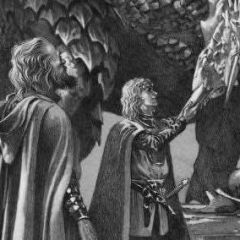
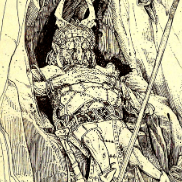
An introductory piece for what I hope will be a regular thing from me. Introducing Orichalcus, a Daemon and one of the many guardians of Creation from the horrifying powers that swirl and lurk in the infinite sea of the Void. This introduction provides an insight into how I believe an Aengudaemon, particularly one of the many who do not act in the mortal world, would view the world of mortals - as a confusing and alien plane of existence, but one worth protecting.


All comments and criticisms welcome!

Link to post
Share on other sites

HE'S OPTIMUS PRIME


HE DOESTN KNOW THIS WORLD BUT HE WANTS TO PROTECT IT


 :O O O O O 

Link to post
Share on other sites

This is an honest question: Do you mind reading some on Sufism? You'll love the creation myth according to Sufis.

Link to post
Share on other sites

This is an honest question: Do you mind reading some on Sufism? You'll love the creation myth according to Sufis.


After you mentioned it I had a little look. The cosmology is very similar to my ideas on the nature of the Void/how Aengudaemons experience the Void but I couldn't find much on the creation myth. Can you summarise it for me?

Link to post
Share on other sites

Add me @ ptolemaioi_hamza or Gaius Khan on Skype again, I'll definitely illuminate this most interesting creation myth more for you.

Link to post
Share on other sites

Guest
This topic is now closed to further replies.
 Share

  • Recently Browsing   0 members

    No registered users viewing this page.


×
×
  • Create New...