
.jpg.7931442780dbde5dd5f69cb46460c2a4.jpg)

Ryanark
-
Posts
368 -
Joined
-
Last visited
Content Type
Profiles
Personas
Wiki
Rules
War
Systems
Safety
Player Conduct
Roleplay Leadership Guidelines
- Roleplay Leadership Guidelines
- Roleplay Leadership Guidelines Comments
- Roleplay Leadership Guidelines Reviews
Forums
Everything posted by Ryanark
-
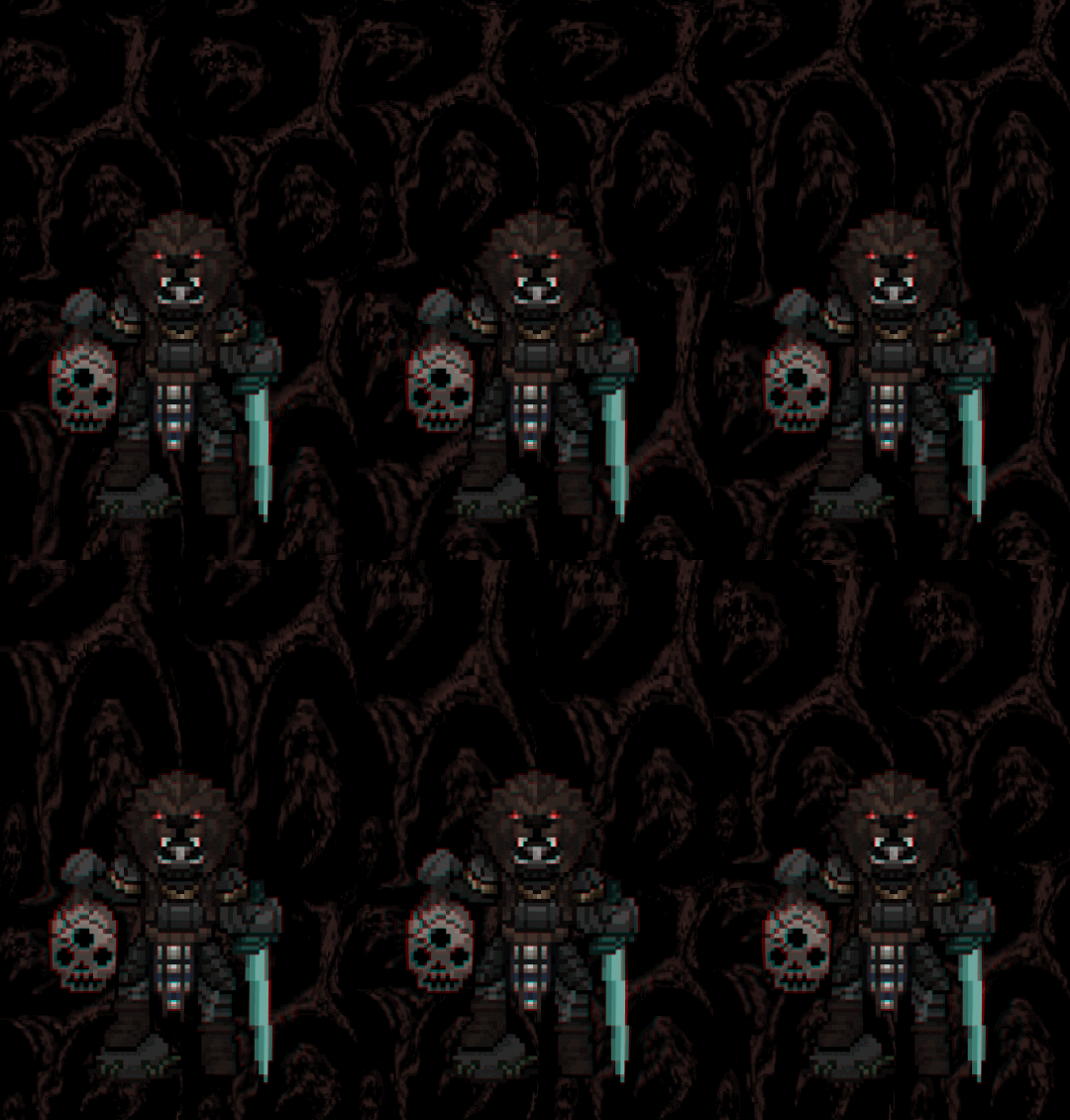 Repentance is born from love, forgiveness, and a mind unshackled. Love, indeed, I bear for mankind. One would graciously repent. Yet, know this—repentance shall be granted upon my will and my terms alone. For in the end, what does it matter? Kingdoms shall rise and crumble, faith shall swell and wane. But I... I shall endure. AHNAKRIEL, in his chamber of brimstone and hoard of war-trinkets, lamented.
 -
"I also read this missive." Beówulf said, after reading the missive, scratching his beard.
-
Murder, in an RP context, can be seen as a conflict-driven storyline fettered with mystery and intrigue to drive a narrative forwards. This could be used to, with the appropriate permission, hold a Jack the Ripper type eventline/character with a string of killings in a town, for example. In 1993 I drunkenly struck a family of four killing everyone instantly and got away with it. What a Jack the Ripper type story could bring to a village in terms of conflict and chaos makes up for in a potential catharsis when the killer can be eventually revealed through solving clues and puzzles. Maybe the town does not figure out who the killer is? This could lead to future consequences. Perhaps there'll be a scare in the town or even entire nation, a witch-hunt, one might call it, for said killer. Thanks for reading. I didn't read your post but I assumed this is what you were talking about. This is actually what you should be talking about.
-
The Sólgaard Pagan ᛡ Wyrdwytches & The Weave
Ryanark replied to Isvinity's topic in Characters & Cultures
WHERE ALL MY WYRDWYZARDS AT 💯💯💯‼️‼️ -
"TO THE GATES OF TOR-PRAETH," || Declaration of Challenge
Ryanark replied to M1919's topic in Human Realms & Culture
Beówulf grinned, despite his smoldering cairn of a soul fighting over his senses to bestow protection over his kith of ash. The giant relented, shaking his head. A holmgang ritual is as sacred as the stone of his flesh. "Neh. Their actions are their own." The man left, returning to his tent. -
"Verily, you shall live forever, great Vedyolthur." Ahnakriel bid his farewell amidst a burning ritual of mourning, knelt before the embers of his memory.
-
"War has truly changed." Ahnakriel surmised with a dreary smoke-laden sigh from his maw, scratching the dead skin off his scaly chin atop the throne of meteor.
-
Ahnakriel raised a goblet of fire in his brothers' honor, reading the news from his vacation home amongst the Flohirrim.
-
Beówulf raised a horn of mead in little Sveta's honor. "Skål!"
-
"Not very lady-like of her." Beówulf mused with a pout to Conan-Thegn, reading the missive by the fire. @M1919
-
A COMMONER'S GUIDE TO "THE DEMON" OF AAUN
Ryanark replied to Epicethan4's topic in Human Realms & Culture
"Grendel has many forms... Men— easily corrupted by Grendel, this one also poisons thee with the idea of an empire.. I hear whispers of it in the wind, but heed, it is just the ramblings of a mad man!" Beówulf sat around the campfire at Sólgaard with his shield-brothers, donned in warpaint, telling foreboding tales around the campfire under the thundering moonlit night. -
"Our battle will be glorious, and my great killing sung of in songs back home!" Beówulf screamed in the camp of Sólgaard, as he tediously applied the azure warpaint across his body, to grant him strength in battle.
-
The Grand Kingdom of Urguan goes to War
Ryanark replied to Papa Rock's topic in Grand Kingdom of Urguan
"Jei can trust a dwarv to fight hard! Good that we will be shield-brothers in the field of battle.." Beówulf lingered, sharpening his ax in the camp of Sólgaard within the woods. -
Now include the vassals.
-
"The evidence seems irrefutable. I see the body right there! Who painted this masterpiece?" Beówulf points eagerly at the missive and its attached appendix, looking around the camp of Sólgaard.
-
-
Beówulf sat pondering, flecks of cinder spilling from his maw; the table whence he sat at was scorched and blackened with raging dragonsflame. "Where is my Thegn?"
-
"This plaase ran oot of ale and wine long ago anywe!" Klaas-Jan van der Oort, 9th generation mercenary in the Vrijkorps, exclaimed as he tossed an empty bottle over his shoulder, leaving the decrepit Fort Roche with his halberd.
-
WELCOME TO MANCHESTINGTON OUR BEAUTIFUL NATION HOME OF THE MANCHESTRIANS
-
“HE WAS FORTHRIGHT AND OPEN TO ME, OF EARTHY AND SALTY MUSK— A LIVING TALE WOVEN INTO THE THREADS OF HIS BEARD, EACH STRAND WHISPERED A CHRONICLE OF STORMS WEATHERED, AND SHORES NAVIGATED.” A temperate landscape, with the veins of great snowy mountains etching through the quaint landscapes of Sólgrunnr, a land shrouded in mist at its shores, the Sun a central behemoth in the skies above the lands from which it draws its energy. Surrounded by icy seas and isles of bitter rime frost itching at the beard, it was deemed locked and withdrawn from the rest of the world. Thus, the native folk, the Norns, looked inward, where banners of many rose and waved. Only a few stood, and ultimately, only one stood to rival none. The Jarldom of Sól was at its ultimate peak, with only itself to conquer. Sólgrunnr was theirs to hold. As the jarldom stagnated and waned from its peak golden age, it faced challenges of its own after decades of lethargy and nepotism: overpopulation in the cities, harsh weather that leveled mountains, and internal conflicts that spawned generations of scoundrels and freebooters. The throne of the jarldom at the bustling town of Hógstaby, from where the High Jarl Åsgót av Gránskägg ruled with a mighty beard but a weak hand that could hardly move a brush. There was a lowly Thegn in the ranks of the kingdom; many of his like bore the same title, ruling over a portion of loaned land from the High Jarl himself; the Thegn named Roáld was a brick in the wall, controlling his pile of another man’s horde, in a time of constant bloodshed. Such strife and troubles are hard to miss and merely avoid, even for the recluse hermits upon the Isle of Sólgrunnr— ‘There must be more beyond those icy shores,’ the curious Roáld thought. Many thought the ice was seemingly impenetrable for a time. Hundreds of years passed, and many brave sailors attempted to sail through the ice to no avail—their ships were simply too weak, and innovation was far from the priority. The Nornish would rather fight among themselves than look outward. Seeking a brighter future for himself and a few lucky men and women who were sympathetic to his cause, he sought to make his escape from the troubled isle, embarking upon a four-and-a-half year-long campaign around the isle to recruit like-minded men, warriors, and yeomen to sail with him into uncharted waters and to break through the ice finally, and to shatter this curse of stagnation. Thegn Roáld had come up with a plan, as crafty as he was: constructing the fastest ship ever built at the time through many trials and tests over several years and training a crew of fishermen to work the rope and rows. The Norns weren’t much of the sailor types at the time— for the ice that confined them to their isle impeded them at every step, and none of the warrior-folk paid much attention to it. Attaching iron plates and spikes to the front of his ship, weaving the thickest and widest sail to grace the shores of Sólgrunnr, all was finally ready. Upon the eve when the gale was at its peak, Roáld and his crewmates rolled his ship, the Mistbreaker, along over the logs, set it unto the icy shores, and sailed it out along the high winds to the dreaded ice. Picking up speed by sailing in circles and finally spiraling out and into the ice at a ramming speed— Roáld finally shattered the ice, carving his way through to a vast and deep-blue ocean, heralding a new age of exploration for the Nordyr. Roáld would never see a foreign shore, for he died at fifty-seven, having completed his life’s mission. He left behind a multitude of children and grandchildren to recall his legacy. An odd thirty years later— one of his great-grandchildren set course for a new shore, one to call home. The high fortress of Örnskjöld protects the icy shores of Sólgrunnr. Guided by the stars' wisdom and the spirits' whims, they endured a perilous journey across uncharted waters with their longboats. Landing from wayward shores and inopportune lands, those ships became their huts, digging the earth to forge a new home in harmony with the elements. Donning the newfound groves to perform their sacred rites and to pay homage to their ancestral gods of yore, the sailors made one of Aevos’ many shores their very own. Arriving in a storm that had raged for several nights, their undermanned ships finally crashed against the shore and its jagged cliffs; their ships broke into disrepair as they landed, marking the finality of their decision; this was the place of destiny upon those very shores. Men tired through the storm, shouting and slipping through the mud and sand, torrents of rain beating against their maille and tired faces, as they unloaded their supplies, horses, and keepsakes from Sólgrunnr. The companions were rowdy and grumpy from the arduous journey— having arrived with half as many men as they started with. Their morale was at an all-time high, beating the odds of survival and playing the hand dealt to them. Remembering the many brothers lost on the journey to this shore, their memories had to be preserved, and for it to serve as a wayshrine for their souls in the ocean to swim and reunite with the shore once more. Once the supplies, horses, and keepsakes were unloaded, foraging parties and surveyors were sent out to familiarize themselves with the land. A third party of Norns erected a great monolith upon the shore where they landed to commemorate their lost brothers and celebrate their landing. From thereon, their camps were to be constructed, and great swathes of the earth were to be moved to build the motte and bailey that was to be their bastion for the time being… The exodus from Sólgrunnr at the beginning of the 2nd Era. For what is a Norn, without his horse? — They are called the horse lords by their contemporaries, a band of wayward humans from the far-away place known only as Sólgrunnr. Not much is known about the place other than a handful of stories one might press from a willing native Norn, perhaps enlightening one with the story of Darre “Rödhand,” hero of Vestfold, who is known and described in great detail as a man with such excellence, martial prowess, and brawn to have slain and tore his way through the Jarl Sigrén’s elite cadre of guards one by one, only to kneel and offer his services as a guard to the Jarl himself once he stood before him— and him only. Or perhaps one might tell the tale of Tórveidd Järnäve in the epic titled “O’er the Plateau,” where a once-unremarkable warrior rose to stand among the greatest of the legendary Heroes— those mightiest of warriors that ascended to become eternal and surpass even death itself, when the aspiring Tórveidd fought unarmored and with merely his fists, he slew his opponent’s steed through a single fist to its throat, killing the warhorse instantly, and winning the final duel to stand with the ascended few. The Norn is a human, usually prone to frequent hair growth of varying colors, and a particular skin sensitivity to the sun's rays—it easily tans under its gaze. Braids are commonplace for both men and women, representing experience and age. Long hair is celebrated and revered, and it is a fashionable choice to accompany them on the battlefield. Some even shave their scalp to a thin layer of fuzz to let it grow throughout a campaign or hunt. Grooming standards are kept high, and it is uncommon to see a grimy and otherwise purposefully unkempt Norn; teeth and mouth are washed clean each day and night, and natural ointments from the wilderness derived from plants, minerals, and animals to keep their bodies clean. Traditionally, the face of a warrior is adorned in war paint, regarded as a blessing and a token of luck and favor in battle. The traditional priest is painted across their entire body with delicate, colorful paints, depicting scenes from legends or twisting lines connecting across the limbs to channel the energy of the elements into their vessel. The Norns believe that in the beginning, the union between god and man, the early Men and the goddess Sól, breathed life into the continent from the mingling of the sun and the innate gift of men upon the fertile, young soil of Sólgrunnr, breathing life into the earth that cascaded from the dour heavens and rolled down the highest mountain, the Erhimmeln. As the offspring of Sól and the Common Man, their ancestors whom they hold an intense reverence for, the Norns are said to possess an inherent connection to the natural world, along with the cycle of night and day. It is said that among the first settlers of Sólgrunnr is widely believed to be the wise druid Vorndyr— who sailed from Aeldin with his sect of druids and clairvoyants to settle on the untamed wilds of Sólgrunnr, establishing his sacred grove deep within the Black Forest. Nornish history is clouded and muddled with the blood of the young. A Norn might be inclined to speak of Sólgrunnr and its temperate climate, the dry farmlands, and most of all, the great stagnation of innovation. If there was time for innovation and technology, it could be better spent fighting, was the usual notion—perpetuated through several generations of jarls. Many wars and blood feuds were fought over food, resources, and clout among the houses. The land was already spread few and far between; it was seen as less lucrative to take. Resilience and fortitude in the face of utmost adversity, performing the impossible, persevering even among the hottest cinders, and lighting flames in the face of biting cold—this is what it means to be a Norn. Through drought and poverty, the everyday struggles, yet the firmest of ice, cannot stop them. Despite hardships in day-to-day life, hospitality is a cornerstone of their ideals, and guest rights are commonly afforded at the price of the host’s honor and safety. To foster community is to share food and drink with those who need it the most and to extend helping hands to those less fortunate, which is believed to accrue favor with the winds of the spirits. Too is the honor of one’s word significant to the Norns, as honor and loyalty are valued above all else, for no oath goes unbroken with a Norn. Loyalty to family and community is paramount. At the same time, independence and self-reliance play a prominent role in the grand scheme of their values, taking pride in their ability to fend for themselves, with craftsmanship, hunting, and farming contributing greatly to personal autonomy and the benefits of freedom that come with it. Among the men of Sólgrunnr, a thirst for adventure and exploration is shared, with some more keen to take considerable risks to chart and venture into the unknown; the greatest of heroes in the weave of Nornish stories are bold and daring, wholly unafraid to face impossible odds in search of glory and discovery. Many young cubs keep stories of heroes close in their hearts, so a seed of curiosity and gallantry is sowed at a young age. Men and women are equal in Nornish society; each has their role, and the proper Norn takes no shame in performing his wife's duties should it be asked of him. Though men are stout with their brave hearts and brawn, the women can also uphold their duty to family, the King, or the land with their gentle touch. Older souls had written into tomes detailing the value of a woman being more than that of a man; as one Norn phrase goes, ‘there is no Hearth without Her.’ And as another would tell you, it is the balance of life. It is not uncommon to see strong women with great martial prowess or gentle men with powerful and meaningful connections to the ways of nature. The Norns aren’t known for their perfection, as they are plagued by a deathly acceptance of fate. Namely, on a continental scale, such resignation in the face of adversity led to complacency and stagnation in remaining in their homeland, trapped by the ice. Rather than taking proactive steps to change their circumstance, Thanes opted to accept the weave of fate that had been dealt to them. This acceptance of fate is becoming uncommon with the breaking of the ice and the colonization of Aevos, but it was nonetheless the cause of much misery. With their strange and foreign concept of honor and loyalty— when mere insult can usually lead to deadly, life-changing duels; it devolves into cycles of vengeance and feuding, particularly between rival families or clans, historically. Perceived slights and petty offenses escalate tensions and perpetuate the cycles of needless violence & bloodshed within Nornish society. They, too, view foreigners attempting to integrate into their culture with great suspicion and skepticism; Nornish loyalty, as strong as it may be, can sometimes manifest as distrust towards outsiders. For this reason, aspiring newcomers hoping to be accepted into Nornish society may become disinterested. The mother tongue of Sólgrunnr is called Nornska — Nornish in the common tongue. It is what each child is taught at a very young age, though there are specific dialects of Nornish that are specific to the eastern coast, and the southern plains that differ slightly in pronunciation. Generally, two Norns could easily tell where the other is from based upon their dialect. For the sake of consistency, Nornska is based on Norwegian and Old Norse (archaic), for now. Just use Google translate in normal roleplay. Thy name is thy strength and protection in life, is what the Norns believe. A newborn is given their name upon their first breath and welcomed into the world. Commonly are the Norns named after great beasts such as wolves, bears, or other foes of legend. Too is it common for parents to name their children after one of the Áesr, or perhaps after someone they once knew in life, or a family ancestor, to celebrate them. Individual last names are uncommon, with clan names usually taking precedence. However, one might be called Olaff, son of Tór. With Tór being Olaff’s father, he may also be called Olaff Tórsson. One may be part of a clan but still be referred to as the son of their father. Nornish names can be pretty freeform, but generally you should name your character with a Scandinavian name unless you fancy yourself special and use a Celtic Welsh name, which is also perfectly okay. Clans are encouraged to consist of at least three people or more; in that case, you should use a special name for the clan. Here are the recommended name generators: Swedish, Norwegian, Danish, Viking, Celtic Welsh “How do I make a Norn? How do I fit my persona into the lore?” Inserting your persona into the hook of the arrival of the Brotherhood on Aevos is simple and open-ended; Norns of all ages participated in the exodus from Sólgrunnr, and many different ships and minor parties made the journey possible. Perhaps your persona was a rower on a specific Norn’s ship, doing X and Y. Or if your character was an urchin who snuck into a barrel for the remainder of the journey, the possibilities are endless and only limited by your creativity. For this reason, the hook is purposefully left vague. Would you like to take part in a new, fresh culture and community on LoTC? You can join our Discord here, and become part of the warband. CREDITS Art: Midjourney v6 and Niji 6 Graphics: Ryanark Written by: Ryanark Spellchecking and grammer edits: @M1919 (next post) Faith/Eldrtrún: @Witchring and Ryanark The original Norn writer: @Jentos and if anyone had a problem that I wrote this culture this is for you
-
An old mercenary, a long descendant of Emiel 'the Fair-haired' van Aert, sat hunched by his campfire in the quiet woods, repeating prose not uttered in hundreds of years. "So once again I will hear the landsknecht sing their bladesong, like silk to my ears. And only then shall they know, that we do not fall easily."
-
Beówulf's shadow loomed in the candlelit room, "Die easily, I do not." the Berserker of Sólgaard proclaimed with a stern expression. With a calloused hand he took up his hammer from its resting place, signing the contract upon the oaken table and sending the pen through the table. Then, he took his leave, upon his own accord.
-
