Morphine
-
Posts
115 -
Joined
-
Last visited
Content Type
Profiles
Personas
Wiki
Rules
War
Systems
Safety
Player Conduct
Roleplay Leadership Guidelines
- Roleplay Leadership Guidelines
- Roleplay Leadership Guidelines Comments
- Roleplay Leadership Guidelines Reviews
Forums
Everything posted by Morphine
-
T’was early light before the birds woke that Siegfried set foot on board a ship, bound for the open seas. Following a path only few of his ancestors would venture down, the annals of Reinmaren history took fervent hold of the Prince’s mind. He was compelled by some will in his blood to wander and seek answers. Many miles from the shores of Azuras, the Prince’s ship steadied onward East into the rising sun. Upon first light, there beyond the horizon, a large mast rose from the depths. Her beams were rotted, turned to sponge after decades of being submerged. Her sails, thin as parchment yet never tearing. As the hull emerged, so too did it have the qualities of driftwood, caked in algae and barnacles. This wretched shape was merely no abandoned ship left behind. Nay, this were a dead man’s ship; the Withered Wail. A ghastly vessel, crewed by the most obscene and grotesque beings neither alive nor dead. Their skin rendered to jelly from sea-slug mucus, and their brains turned to soap. They did not seek riches or renown, merely acting on instinct for an insatiable bloodlust. Siegfried held firm, ordering his crew to prepare. His ship, no more than a mere trading vessel, was armed with a few cannons. The Withered Wail had no intention of engaging from a distance. Without warning, a swirling, raging storm gathered overhead. The gale filled the deadmen’s sails fully, allowing them to sprint across the water toward Siegfried’s ship. With a mighty crash, the Withered Wail rammed through the bow of the Barclay vessel, knocking good men off and to the depths. The deadmen aboard quickly vaulted from their deck with axe and sword. Without fear, Siegfried rallied his crew to charge the attackers head on. The storm grew worse, and a torrent of wind and rain swept across the ships. The Prince’s mace made quick work of the deadmen, but his crew were not so fortunate. Many had fallen to their blades, and those that cowered, leapt into the sea believing they could escape, but were soon swallowed by the waves. Soon the rain subsided, but the wind still rocked the ships violently. In desperation, Siegfried ordered what was left of his crew to gather the black powder and head for the bow. At the bow, where the Withered Wail had breached, the crew climbed aboard the deadmen’s vessel with kegs of powder, and set them along the walls of the hull while their crew was distracted. Leaving a few men to dispatch the deadmen still on deck, Siegfried climbed to the stern, dipping an arrow wrapped in cloth, into a barrel of whale oil before igniting it with a lantern nearby. One of the deadmen snuck up behind Siegfried and plunged his sword into the Prince’s back. He cried out in pain before turning around and bashing the deadman to pieces with his mace. Struggling to take aim, Siegfried drew back his bowstring and loosed the arrow onto the Withered Wail, striking the powder, and igniting a massive explosion. The blast obliterated the dead ship, but struck the powder inside the men’s ship as well, causing a chain reaction. Bleeding out from his wounds, Siegfried closed his eyes, breathed calmly, and gave a final prayer as he gazed upon his immediate oblivion. Siegfried Otto Barclay 2012-2077


-
LETTERS FOR THE BARONY OF ADELGAR BARONIE VON ADELGAR | BARONY OF ADELGAR Issued by the PRINCE IN REINMAR In the year of our Lord 2074 SÖHNE UND TÖCHTER VON REINMAR, FOR MANY LONG YEARS HAS OUR BELOVED BROTHER, Sir Rudolf Lothar Barclay, stood in service to Reinmar, his loyalty unbent by time and unburdened by expectation of reward, serving with some distinction as Herrenmeister these twenty-two years past, ever diligent in the ordering of war when duty calls, and in his tireless provision and keeping of fine Reinmaren Thoroughbred horses, by which Our forces have been made swift and well-mounted. It is therefore meet that We, in the fullness of Our princely duty, do now grant and bestow upon him the Barony of Adelgar with all rights and and honors thereto belonging; to be held in perpetuity, and passed onto his children, and their children, and so on. Further, We do decree that he and all his issue shall, as of this ascension, previously having been known as Barclay, take and bear the name of von Adelgar, and be known thereby in all dealings from henceforth. WER RASTET, DER ROSTET His Princely Highness Siegfried I, GMSTSR, Prince in Reinmar, Prince of Sutica and Minitz, Duke of Reinmar, Count of Kretzen, Neu Brandthof and Freimark, Burgrave of Langenkirch, Viscount of Tucay, Baron of Freising, Madvon, and Boriënwald, Lord of Sankt Johannsburg, Freisburg, Wilheburg, Rozenfeld, Erwinsburg, Leonstadt, Neuberg, Durres, and Holsord, High Chief of the Reinmaren


-
The old man Oswald grinned, knowing that he hadn't left this world before seeing his son marry.
-
Siegfried broke bread with Othmar and company, toasting the newly wedded pair. "May GOTT grant you long and healthy lives, and may He bless you with many children."
-
A certain Prince takes a close look at the missive. Then a look back at his titles. "Oh good, I thought there was some mistake."
-
"Hrm?" Prince Siegfried squinted at the mention of Suticans, quite confused as to what this meant.
-
Siegfried gave a hearty chuckle at the missive before continuing to read his other parchments of mail.
-
"You and mother were the pillars that kept this nation from total collapse. It is by your guidance, your model of leadership, I can only hope to mirror." Siegfried sat in silence near the warm hearth of his otherwise dark and clammy room. Questions of the future, feelings of regret, fear of failure; all of these speculations, laid bare at his feet.
-
LETTERS OF COVENANT, SIEGFRIED BARCLAY & CLEMENTINE ALDERSBERG
Morphine replied to DuhPuhWuh's topic in Imperial Vassals
The Baron of Sigradz and of Hussen partook in several hunting trips, gathering pelts for the inevitable ceremony. -
Siegfried silently grieved his late mother's departure. Taking the time to reflect on family portraits and childhood trinkets, her memory is forever cherished in his heart.
-
Oswald peered the missive with delight. "Uncle, you've outdone yourself once more. I cannot wait to see what amazing works this venture will bring."
-
In the Year of Our Lord 2047 Effective immediately, I, OSWALD VON WESENBURG, in sight of the HOUSE PATRIARCH, do willfully and lawfully retire my tenure as BURGRAVE OF WESENBURG. The title of BURGRAVE shall pass down to my son and heir, AERIK LEON VON WESENBURG, who will, with utmost decency and fortitude, carry his House and title forward unto glory! My son has proven himself capable of the task ahead, in light of our departure from Aevos. Further service to my House will be in an advisory role. His Lordship, Oswald von Wesenburg Burgrave of Wesenburg His Lordship, Varik von Wesenburg Patriarch of House Sturmweber, The Stallion of Reinmar, Kastellan of Westturm
-
Oswald wept privately within his room after receiving the news. "May you rest well, mother."
-
this is so incredibly awesome! +100
-
Siegfried breathed a heavy sigh, as sheer relief washed over him. The amount of pride he felt reading this missive could not be put into words.
-
Alea iacta est...
-
To my fellow Tribeswoman, I accept your formal apology and invite you to break bread with us once more within my home. It is the belief of our House that strengthening bonds is a far better approach than breaking them. May you feel welcome beneath our roof once more. Signed, His Lordship, Oswald Anton Sturmweber Burgrave of Wesenburg
-
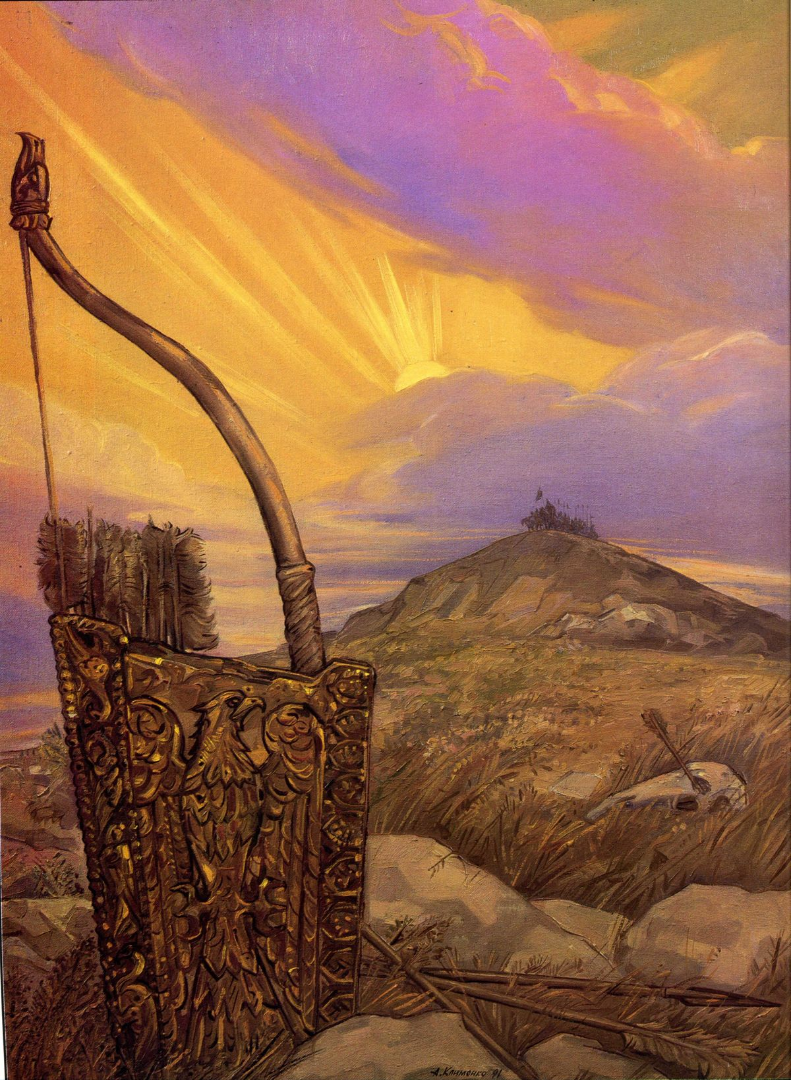
Children of the Eternal Hearth In the beginning, there was a people, lost, wandering a dry, frigid sea of sand and stone. The Age was dark, cold, and most often dreary. Then, a powerful flame emerged from the heavens; TUR, the Eternal Hearth. The light beamed from above and poured over the people, giving them warmth and life. The wastes, which were a dry barren land, had flooded with green as far as the eye could see. The people called themselves TURGHITS, or ‘Children of the Eternal Hearth’, who would bask in the warm glow. The sea beneath their feet, like small curved swords, covered all they saw, and so they called it DALAIN IR, or the ‘Sea of Blades’. Gert Uulan rising from his deadly haze Most days the warmth and light from Tur could be seen, but a terrible force would emerge to rival it. GERT UULAN, or Sky Demon as he was known, filled the air with dark clouds and mist, halting Tur’s influence, and bringing with it, cold and death. Gert Uulan is a pale, skeletal horse demon, riding along the sky, smothering Tur with his smokey black cloud. As the heavens rage and glow with each clash of their conflict, Tur’s influence manages to spearhead through and strike the ground, leaving the gift of fire, or GAL. Many would try to harness this power but most would not succeed. The wars of the sky continued for many days at a time, and while the gift of gal was ever present, so too was the sky water from Gert Uulan to smother it. Then, miraculously, a great flame appeared. It drove the dark clouds of Gert Uulan away from Tur, and blazed upon the ground yet never singed the grassy sea. Within the flame was a man, not of Tur, but of unknown origin. He sat atop a fiery stallion, carrying a large golden sword. His skin, dark as night, wearing illuminated armor adorned in foreign patterns. His appearance was ethereal, yet ever so present. Once the sky demon was repelled, this figure spoke to the people, offering them solace. He gave them wisdom of gal, how to tame it, and nurture it. This man would be known as SKYKHA, KHAN OF FIRE AND SKY. Skykha cleansing Gert Uulan’s influence from the land From his saddle bag came small black stones that could summon eternal flames. As Skykha did this, the large pyre he created was named DOL EKH, or ‘Mother Flame’. Dol Ekh was to be the centerpiece of Turghit lifestyle, and revered as the great gift passed down by Tur to Skykha, for driving off Gert Uulan. He could not destroy the sky demon outright, but keep him away for most of the Age; when Dalain Ir is green and the air is warm. When Skykha had finished his work with the Turghits, he climbed aboard his stallion and flew to the heavens with great speed. A trail of fire followed wherever he went, and many would claim to see Skykha in their lifetime. His rapid journeys across the sky helped inspire the Turghits to travel themselves and become a nomadic people. All across Dalain Ir, more and more Turghits appeared and soon, many different cultures and clans followed. Now, many Ages later, a multitude of clans have risen and fallen like ash in the wind. When Dalain Ir suffered a massive drought, the sea of green returned to the sand and stone it once was. Gert Uulan returned, but there was no help from Skykha or Tur. Much of the Turghit history since the time of Skykha was filled with bloodshed of kin, leading many to believe all Turghits fell out of favor with the Khan of Fire and Sky. A noble and more passive clan, TUNGKHUIDAI, noted for their loyal service to great khans, ventured off into the open waters in search of new lands, perhaps even more of Dalain Ir that was separated by water. It just so happened that they arrived onto a large landmass, which would come to be known as AEVOS by the native and local population. Word was sent back to Dalain Ir for more Turghits to take heed and follow the Tungkhuidai, as the homeland was dying too quickly for their horses to sustain. Many clans would embark on this journey to Aevos, and soon reconvene with the Tungkhuidai at their first KURULTAI since leaving Dalain Ir. The decision was made to explore the land for suitable fields, similar to home, to raise their horses and families. It wouldn't be long before a location was found and settled in a place called the MIDLANDS, where they are currently settled still today. With the current Age having promise, the Turghit people hope their time on Aevos will endure. For if not, they will prepare to set sail once more in search of a new home. Who are the Turghits? The Turghits are an Eastern Farfolk nomadic culture, hailing from a far off land called Dalain Ir. They’ve migrated to Aevos in search of a new home, where their horses run without limit and the sky is boundless. While they tend to travel from place to place, many clans are hoping to find an area to settle for an indefinite amount of time. This is not only a result of their low numbers, but also due to the logistical dilemma of seeking refuge on other lands without much to offer. However, should the Turghits grow in strength and numbers, they will conduct a kurultai, and proceed from there. What is Turghit culture? Turghit culture is centered around core elements that they perceive as necessary to daily function and tribal longevity. First, is gal, or fire. Fire is the life essence that keeps Turghit culture going. Without an appreciation for fire, the culture withers and dies, much like their homeland. This has culminated into a generational fear of death and darkness that only a flame can bring comfort to. The practicing religion is called Ariun Gal, or Galism. All Turghit camps will have some large bonfire going, typically called the Dol Ekh, or Mother Flame, where all other fires in and around the camp are born from. This fire is to never extinguish so long as the camp is settled, And, when the clan decides to move, the flame is only extinguished by a Galyn Takhilch, or Fire Priest. These priests are typically dressed in normal Turghit attire, but carry flame shaped pins on their coats to signify their role. Fire Priests are also responsible for most of the cooking and cremating, as fire is most sacred and should not be mishandled. The misuse of fire for malicious intent or for use on food that has charred and is a waste, is punishable based on severity. The second most integral part of Turghit culture is food. Food transcends language, dialect, clan or creed. It is the creative element within Turghit life that displays full appreciation for the gift of fire, and pays utmost respect to Tur and Skykha. With clans differing from one another, the variety of dishes that can be found at a feast or around the hearth, are ever expanding. Fire priests not only cook food, but introduce spices and flavors from the surrounding landscape, so that you not only enjoy your meal, but it is unique to where you are everytime. This is how many young Turghit children learn life lessons, and understand the world around them, along with many other teaching methods. Third on the list of important core culture values is war. Turghit society is, for the most part, passive and reasonable. However, there is much more to gain from battle than just riches. A Turghit warrior learns discipline, a sense of duty, and pride. All of these aspects help mold a young man or woman into great soldiers. They are loyal to their khan and khatun, and will execute any order given. The Khan and khatun are responsible for the lives of their soldiers, and a good leader will always hold them in prestige. The aftermath of a Turghit Khan’s fury While war is mostly fought for resource gain, Turghits may also start wars over insults to their honor and hospitality. It is always recommended to treat Turghits with respect and gratitude, as they too will treat a person similarly. Insult or slight a Turghit, and such actions will not go unanswered.To kill a Turghit out of malice will summon the need for a kurultai, and a war council will convene. This applies to outsiders and fellow clans. Aevos has proven itself a difficult land to conquer through means of war, but such a thing is never off the table completely. Most gains are won through diplomacy; it’s personal glory that many tend to seek in battle. Armor and Weapons Bow – DASHAO “Big Siyahs” The Dashao, meaning "Big Siyahs" in the old tongue, refers to the pronounced curved tips of the Turghit composite bow—a hallmark of power and precision on the open steppe. It is both a weapon and a cultural pillar. A rite of passage begins when a Turghit youth can walk with balance and focus. At that age, a simple bamboo bow is placed in their hands — not for war, but for learning. Through trial and error, the child begins to understand the spirit of the bow: its bend, its pull, its voice. These early tools are humble, often crafted with a mentor’s guidance, but they plant the seed of craftsmanship and respect. As they grow, so too does the complexity of their bow. A true Dashao is forged with patience and ritual. It is a composite weapon, made from carefully layered materials: goat horn for strength and elasticity, animal sinew for tension and resilience, and a core of sturdy wood to provide the backbone. These elements are bound together over weeks—sometimes months—of drying, shaping, and curing. The siyahs, or the enlarged tips of the bow, are shaped last, giving the Dashao its signature power and elegant curve. To craft a true Dashao is to prove one’s readiness for the trials of adulthood, war, and wilderness. It is not simply made—it is earned. Dao - or traditionally, KHARZUTAI "Saber" The Dao, sometimes referred to as the Kharzutai, features a straight blade with a subtle curve near the tip, enhancing both cutting power and thrusting capability. Forged from folded steel and tempered over the sacred flames of the Dol Ekh. The hilt is wrapped in braided horsehide, often dyed in the vibrant colors of the respective clan, and capped with polished horn from steppe goats or bulls. A brass or ferrum guard curves upward, providing protection and balance, while a hooked loop at the sword's end offers additional grip and versatility. Turghit youth often begin their martial journey by training with bamboo sticks shaped like the Kharzutai. Under the guidance of elders, they learn the foundational forms and movements, emphasizing fluidity and control. This early practice instills discipline and respect for tradition. Much like the Dashao, the path of the Turghit swordsman is not one of quick mastery, but of lifelong dedication. From youth to elderhood, a warrior continually refines their technique, learns from each encounter, and grows in wisdom. Over time, the Dao becomes more than a weapon—it becomes as natural as one’s own hand. Armor – KHUURTSAKH “Clatterhide” The Khuurtsakh—translated as “Clatterhide” for the distinctive sound it makes while in motion—is the preferred armor of the Turghit warrior. Built for riders, it offers a balance between protection, mobility, and endurance over long distances. Constructed from overlapping lamellar plates, the armor is often crafted from hardened leather, ferrum, or a blend of both depending on the resources of the clan. Each plate is laced together with rawhide cord, allowing it to shift with the body rather than against it. The result is a flexible yet durable shell, capable of turning aside blades and absorbing the shock of glancing blows. Turghit armor is typically worn over a quilted jacket of cotton or felt, both for insulation and comfort. The plates themselves are shaped in clean, vertical rows. Patterns or engravings may be present, but ornamentation is always second to function. Helmets are rounded or conical, often with simple nose guards or cheek flaps, and tied securely beneath the chin. A padded cloth veil is commonly worn beneath, offering comfort and further protection from dust, wind, and rain. Colors vary by clan, but earth tones and muted dyes dominate the palette: deep greens, browns, yellows, blackened metals, or ochre. Clan marks may be burned into the plates or sewn into the underlayer. The Khuurtsakh is not ceremonial. It is worn, battered, and repaired over the years. Warriors do not polish it to shine—they paint it with dust, sweat, and the memory of each ride and raid. Bestiary Horses One major facet to Turghit culture and military are their most treasured beasts of burden; horses. These creatures are the workforce of Turghit life, their main mode of transport, and sacred from head to hoof. If one should fall in battle, it is given full honors and death rites without distinction from a human. If killed for nourishment of the clan, the same rites apply, and none of the meat and bones are wasted. Horses are usually adorned with handmade saddles and blankets, specific to the clan that owns them. They are even given full lamellar armor if their owners have the means to smith or pay for such. Mares provide delicious milk that Turghits will ferment and make airag from. This drink is considered a favorite among young and old, and goes well with any dish. It’s featured at celebrations, battle victories, and diplomatic ventures. Falcons and Eagles While a horse is the necessary transportation on the ground, a Turghit’s visibility is limited to only his surroundings. Unless, he has eyes in the sky. Falcons and eagles are incredible birds, able to spot prey from well over a mile, and strike with deadly precision and stealth. Once tamed, a falcon or eagle becomes a hunter’s aerial companion, perched on his gloved arm. They wear small masks that cover their eyes to keep calm and focused, allowing for less stress during travel on horseback. For longer distances, a small box is used to keep them safe and secure. Cattle, Goats and Sheep Goats, sheep, and cattle provide milk, which is a staple in the Turghit diet. Not only used to make fermented milk, but also cheeses and yogurt which are self preserving. In addition to dairy, these animals are sources of meat, which is often consumed during feasts or special occasions. The meat is typically dried or salted to preserve it for long periods of time, over great distances. Sheep are the primary source of wool, which is used to make clothing, blankets, and tents. Goats also provide cashmere wool, prized for its softness and warmth. The hides of cattle, goats, and sheep are used to make leather goods like boots, saddles, and bags. Hierarchy At the top of the Turghit hierarchy is the KHAN OF KHANS, or GREAT KHAN, leader of all clans. This authority is paramount, and unquestioning. Below this, is the KURULTAI, a council composed of fire priests, the lesser khans, generals, and advisors. This body of administration is responsible for planning events, ceremonies, war, trade, and so on. They may also elect a new Great Khan if the previous one has passed with no suitable heir. ADVISORS speak directly with the Great Khan, and relay messages to subordinates in his absence. They will also visit clans for collecting tributes, speak with foreign diplomats, and serve as negotiators towards enemies. GENERALS take their orders directly from the Great Khan, and will devise battle strategies amongst themselves and the khan. From here, LESSER KHANS are the sole authorities of their respective clans, who are tasked with managing their own customs and rules, but are overall subject to the laws of the Great Khan. Under the Lesser Khans, the hierarchy splits into individual clans, which sets authority to the clan leaders, elders, and fire priests. Clans can create whichever hierarchical system they wish, but must always keep fire priests towards the top, or separate from the system altogether.
-
no steppe -1




.thumb.gif.a00a63e36b40e4212895251afe914934.gif)