.gif.a5d53ca00926eb20047eb21a2b419b45.gif)
Unwillingly
-
Posts
2243 -
Joined
-
Last visited
Content Type
Profiles
Personas
Wiki
Rules
War
Systems
Safety
Player Conduct
Roleplay Leadership Guidelines
- Roleplay Leadership Guidelines
- Roleplay Leadership Guidelines Comments
- Roleplay Leadership Guidelines Reviews
Forums
Everything posted by Unwillingly
-
oh also lore for house fairies got accepted :D
-
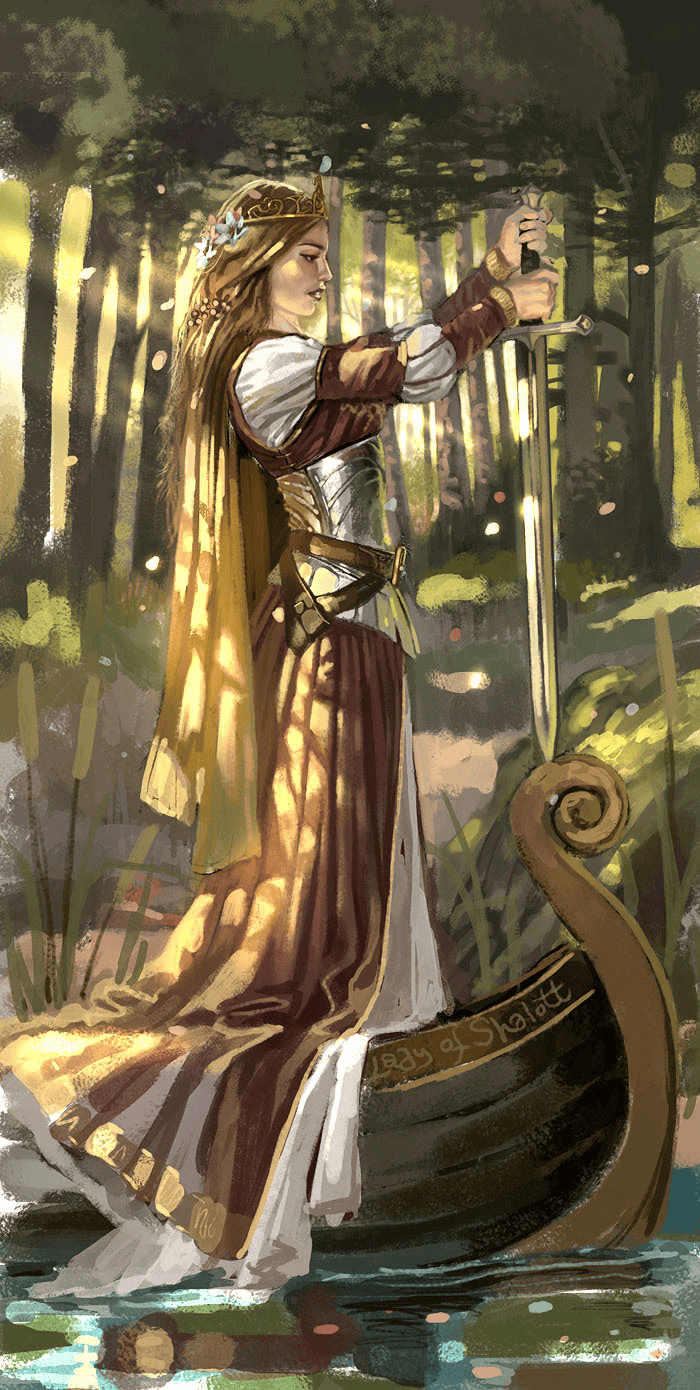
your time to whimsymaxx is now @Frawlic
-
-
-
This line in particular meets Galahad to no particular surprise, to suggest that the affairs of Mankind would soon leech beyond their jurisdiction and into the realms of those less fearsome than they. After all, it had been written many times before, and shall be written many times onward, but unwise would it be of any highborn lord or ruler to so recklessly neglect the prospect of betrayal from any ally, human or not. It is the volatile, ever-changing nature of politics, a lesson he had learned with swiftness in his youth and practiced with such force in his reign that he too would be dubbed tyrannical for it, however insignificant these assertions to him. Nonetheless, The frequency with which the term is pitched struggles to inspire much passion in the young prince. After these thoughts had passed, Galahad concerns himself with the many elvish architects and engineers drafting evacuation orders in the name of inevitable voyage.
-
what if im not home when my package arrives
-
I dont have characters for every single box so I just did Things
-
.thumb.gif.9200049f1e9ae4031b060af8a5c775d7.gif)
[✗] [Rewrite] [World Lore] - Rokodra, The Infernal Steel
Unwillingly replied to PrimnyaQuorum's topic in Denied Lore
cursed children propaganda you are evil you are created from evil embrace the high hells next -
what's something harmless on lotc or that people do that ur secretly mildly judgemental or annoyed about
-
sutica daughter or alba son
-
so uhhhhh my dad just offered me beer... im 16...
-
NOTICE FROM THE I V O R Y C R O W N Issued by the Ivory Crown and Grace of the High Prince, 17th of the Grand Harvest, 242 S.A. ᴛᴏ ᴛʜᴇ ᴅᴇɴɪᴢᴇɴs ᴏғ ᴄᴀᴜʀósᴛ, The expulsion of dark forces, bogeymen, and shadow-lurking monsters is vital to the Caurósian mission in preserving the dignity of Elvendom. On this day, 17th of The Grand Harvest, 242 S.A., the vigilance of our stalwart hunters has uncovered a more grievous revelation. Within the walls of our Princedom, there dwelled an accomplice of the dark who not only shared company with the demonic, but collaborated a covert assassination plot against an Imperial politician. Thus, the Ivory Crown hereby decrees the following: I. Henceforth, the Maehr known as ɴᴇɪᴀ is sentenced to exile, effective immediately. II. Henceforth, the Maehr known as ɴᴇɪᴀ is to be ᴋɪʟʟᴇᴅ ᴏɴ sɪɢʜᴛ, effective immediately. III. Henceforth, all known accomplices and collaborators are to be apprehended and reported to the High Prince, where they shall be tried for their transgressions under the watchful eye of Ivory Law. Individuals in possession of information or knowledge surrounding her status are to report to the Praeven’tir. Signed, The Ivory Crown
-
is alchemy fun
-
E L V E S O F I V O R Y A N D F I R E The Caurósian elves are a pan-elven society rich in culture and history. Best defined by their austere yet zealous outlook on life, they’re warriors with a resolved mission towards being exemplars of elvendom as both the enforcer and protector of elven realms abroad. The day-to-day life of these elves is quick paced and restless, for they promote a life of constant innovation and development in order to challenge the conventionally apathetic tendencies of their kin. ɢᴇɴᴇsɪs The origins of the Caurósian people began in wistful longing for brighter futures. During this time, worldly elven affairs were perceived to be in a critical state of stagnation and despotism, leading to a filtering of elves from various walks of life who grew contemptible of their homelands. After many years of uncertainty, these likeminded elves would venture to the northern crags and make way for a small, but peaceful human kingdom, where they would share their many woes to the King. The King, in his benevolence, temporarily bestowed upon them the remnants of a distant camp within his territory under the condition that they would gather herbs native to their northern pines and distribute them to his kingdom’s people. For many years, the elves dwelled in deliberation of their future, sharing mythos and war stories in the comfort of bonfires and tents beneath the moon. Some proposed attempting to reason with the elven rulers of the states they had fled, while others believed it wiser to quietly mind their own as the subjects of the King. Others, however, proposed something far more visionary — that they not negotiate with the rulers who had failed them, nor quietly dwell under the authority of another, but foster the dream of a new elvish power, a domain by their own rule. It was bold, yes, but not undesirable. Elven politics had remained relatively unchanged for decades prior, so the notion of pursuing such status would prove challenging, for they would be a contemporary folk against long-established countries. ᴛʜᴇ ᴄᴀʟʟ ᴛᴏ ᴡᴀʀ As the northern gales carried word of their splinter faction southward, they would be approached by a bloodlusted Orcish commander with a conviction for warfare. He not only sought to employ these elves to do his bidding, but promised them a vast wealth of territory in victory as well, through which their dreams of a mighty elven domain might one day be achieved. For many weeks, the elves deliberated among themselves. The scent of their ancestors’ blood lingered with uncomfortable familiarity, spilled at the hands of orcish broods, and inspired distrust among their kin. Many of them questioned whether or not the orcish warleader would hold true to his word, cautioning that this bloodshed would be in vain. However, others wished to capitalize on the opportunity with fervor, believing it wiser to take the risk than let it pass without certainty that they would receive another like it. Eventually, the elves’ leader came to the decision to swear their allegiance to the orcish commander. They went on to wage war alongside him and his people, cultivating a sense of familiarity and reconciliation with the orcish warriors. Through each battle did their conviction for the future grow and resolve burned brighter than the last, and word of their many victories spread to the elven domains, who grew cautious of their uprising. Some resorted to outright threats and efforts to subjugate, while others feared that they, too, would be their next subject of war. ᴛʜᴇ ᴄɪᴛʏ ᴏғ ᴅᴀᴡɴ ᴀɴᴅ ᴅᴜsᴋ By the time the wars had been won, the elves had built enough status and apparatus to lay claim to a portion of seized territory in the midlands of Aevos formerly belonging to rogue bandits and brigands. There, their camps would be established, eventually blooming into small fortresses and outposts as their population and wealth accrued. With the aid of many elvish architects and engineers, their city would establish a diarchy rule alongside the orcish people as dual-realms— each retained internal autonomy, yet coexisted as one united entity. It was only with the death of the orcish warleader with whom they had previously fought that their realms were partitioned, and the Princedom of Cauróst was founded. ɴᴀᴍɪɴɢ ᴄᴏɴᴠᴇɴᴛɪᴏɴs ᴀɴᴅ ʟᴀɴɢᴜᴀɢᴇ While the names of foreigners and outsiders may vary, the names of Caurósian-born elves are typically rooted in elvish and human mythos of fabled, knightly legends rather than the elvish tongue most are accustomed to. Given names and surnames are common, while middle names are often rare and even unheard of. Names will often begin with consonants such as G, L, H, R, and C, or vowels such as E and I, and will roll off the tongue with ease, typically containing no more than one to three syllables. ⊱ Galeas, ⊱ Elvaine, ⊱ Hurin, ⊱ Galar, ⊱ Rian, ⊱ Carys, ⊱ Gawain, ⊱ Rumil, ⊱ Turin, ⊱ Lorien, ⊱ Lavain, ❧ Many Caurósian names overlap with the naming conventions of the Adunians. In its inception, elvish was uncommon and scarcely utilized among the Caurósian, for a great portion of their early history was in unison with the humans and orcs rather than their blooded elven kin, which lead to a dispersal of identity between their elvish heritage and the customs of non-elven realms. In the city’s youth, Common was their typical nomenclature, but faded over the course of many years as an influx of elves reintroduced ancient elven to their ancestral dialect. Some commonly seen translations in everyday use are as follows. Uell ito Maruthiran Death to Tyrants. Refers to the duty of righteousness in rule. elMyumier’tir The Law of Myumier. A warrior’s code of virtues and principles. elHalern’yulln The Ivory Mission. The guiding political and ideological doctrine of Cauróst. ay’Cauróst For Cauróst. A common battle cry. ❧ Uell ito Maruthiran is a maxim that can be traced back to the age of the Dominion of Malin, having been recited by King Kairn during the Bronze Rebellion and High Prince Evar'tir during his rule of Elvenesse. ᴀᴘᴘᴇᴀʀᴀɴᴄᴇs Due to their all-encompassing demographic, there exists a diverse range of appearances among the elves of Cauróst. Hair commonly comes in shades of brunette, jet-black, or platinum white, while blonde or ginger are scarcely seen. Body types often encompass a more robust, heavy-set physique as opposed to the conventionally elegant and slim forms typically associated with elves, likely the product of their devotion to constant martial mobilization and active lifestyle. In spite of their rugged builds, they retain a regal and noble demeanor described as austere at best and stern at worst. ᴀʀᴄʜɪᴛᴇᴄᴛᴜʀᴇ Like many elvish domains, Caurósian architecture speaks to an expression of culture, art, and practices. Organics and natural flora are carefully grown into shape by elvish florists, providing the city with a serene, earthly essence among its many stone spires and arches. Throughout the city, there exists a variety of training courtyards, stone sculptures, gardens, and waterways, but most notable are the far-reaching eldertrees, whose canopies fan over the city sky with grace. These mighty trees are often used as hosts for ceremonial structures or royal chambers, rather than common housing superficial dwellings. ❧ Caurósian architecture notably resembles the likeness of the historical city of Caras Eldar, which citizens believe to have been the last true elven world-power in recent elvish history. ᴀʀᴛ, ᴄᴜɪsɪɴᴇ, ᴀɴᴅ ғᴀsʜɪᴏɴ While Caurósian art comes in a variety of forms, material art is typically crafted in reverence of elvish war-stories, heroes, and epics, reflected in the excellence of their marble statues and stone idols throughout the city that promote famed elvish warleaders and cultural exemplars of their time. Although possessing no critical palate, there exists a diverse variety of favored cuisine introduced to the city’s colorful demographic, subcultures, and even external imports. Wild game is most common, while marine fare and shellfish are secondary to their diet. In addition, the Caurósian favor distilled, grain-based spirits as opposed to fruit-based wines, promoting an unconventionally raucous and excitable liquor culture among their people. ❧ The imported Ilatian cuisine “Pi’zza” is a popular dish among the Widow’s Wine & Inn Tavern. No one really knows why. Most profound of their cultural affinities, however, is the vogue fashion of their denizens. Earthy, neutral colors such as auburn orange, moss green, teal blue, and soft beige are common attire dyes, while bright, ostentatious shades are frowned upon for their implication of self indulgence. Among the gentry, loose-fitting silks and gowns are often threaded with flecks of rose-gold embroidery, complemented by intricately crafted copper or gold ear cuffs, wrist cuffs, layered necklaces, hair clasps, and circlets. Modesty is not only encouraged, but expected, for to walk bare footed or to expose profound marks of skin is viewed as unconventional and ill-fitting of social etiquette. Hair, too, is a critical indicator of Caurósian fashion. Most men and women favor long, sweeping locks that reach the waist, often styled with copper clasps, pins, and jewels. However, it’s not uncommon for men to elect for shorter and more simplistic cuts, especially those in service of the military. War braids are a common symbol of kinship among warriors and soldiers, woven only by one’s compatriots as a token of respect, love, or protection in battle. Body art and tattoos are prominent among seasoned warriors as well, though they possess a more recreational connotation rather than the sacrilegious implications of the Ilmyumier favored by their wood elven cousins. Although not binding, there exists an informal dress code among the people; citizens are expected to maintain an orderly, kempt appearance, and a clean-shaven complexion, anything less often regarded as taboo, if not an outright indicator of foreign origins. ❧ It’s believed the traditions of body art and war braids originated among bored, weary soldiers stationed at outposts and camps in order to pass the time during times of war. ᴅᴇᴍᴏɢʀᴀᴘʜɪᴄs ᴀɴᴅ sᴜʙᴄᴜʟᴛᴜʀᴇs As a pan-elven state, a vast lineage and array of identities comprise the Caurósian people. Although the city’s inception brought with it a great presence of Proto Elves, or elves without a defined lineage, Dark Elves and High Elves have since then assumed the mantle as the dominant classes among the people, while Wood Elves are fewest in number, though hardly looked down upon. Among the citizens, a variety of notable subcultures have emerged. ᴍᴀᴇʜʀ The Maehr are a diaspora of dark elven remnants who have found a place within the Princedom. Though originating from vastly different backgrounds and cultures, each of them finds a kinship with the virtues of filial piety and ancestor veneration. ᴀᴄᴀᴇʟᴀɴɪᴛᴇs The Acaelanites are a creed of ethnoreligious proto-elves who worship Acaelan and believe Availer, the Wandering Wizard, was his mouthpiece. They have kept their beliefs largely private, teaching an esoteric interpretation of sacred texts and rituals best described as a form of mysticism. sᴜʟɪʏᴍᴀʀ'ɪ The Suliymar'i are a culture of desert-dwelling elves from distant southron lands who, after a period of indebted servitude divided their ilk, migrated to the capital city of Eldwyn on the continent of Aevos in the Second Age. ❧ The Acaelanites are among the first and oldest faction of elves to have migrated to Cauróst amid its inception. Although the Caurósian hardly look down upon non-elves, individuals of non-elven blood are strictly prohibited from pursuing citizenship or government stations within the city in an effort to protect the sanctity of culture and heritage of elvenkind. To a lesser extent, this attitude is even sometimes enforced upon elves who are believed to be ill-conforming to the cultural values and ways of the people, a common critique of former elven states who permitted undesirable or eccentric behaviors. ʙᴇʜᴀᴠɪᴏʀ ᴀɴᴅ ᴇᴛɪᴏ̨ᴜᴇᴛᴛᴇ Hardly obeying the rigid demeanor of the High Elves, nor the easygoing laissez-faire attitude of the Wood Elves, the Caurósian tend to carry themselves with middling mannerisms. Sophistication and discipline is critical to their day-to-day attitudes, for humiliation of the self is often regarded as humiliation of the collective. As such, raucous or belligerent behaviors such as undue hollering, public intoxication, or vulgarity is greatly frowned upon. However, as elves with an often restless and quick-paced day to day, festivities and recreational affairs are a welcome form of socialization. One is to hold their compatriots to high esteem and greet them with warmth. When at odds, they are beholden to speak plainly and without deceit or snakish whispers one cannot defend, and challenge to a most honorable duel when slighted. Individuals of royalty, nobility, or government standing are to be addressed by their appropriate designations and honorifics, while visitors or invited guests are to feel welcomed and comfortable among the people. ᴇᴄᴏɴᴏᴍɪᴄs ᴀɴᴅ ᴠᴏᴄᴀᴛɪᴏɴs The expectation of contribution is vital to those who would call the city home, for the Caurósian possess a strong sense of community and devotion to one another. Most young elves tend to promote themselves through martial enlistment, while those of a less battle-ready caliber will relegate themselves to blacksmithing or medicine as supplements to the fighting forces of the city. Less common, but still appreciated vocations pertain to horticulture, glassblowing, stone sculpting, scholarship, and seafaring, while those who assume none of these vocations, if any at all, are easily overshadowed among social circles and public affairs. ᴛʀᴀᴅɪᴛɪᴏɴs ᴀɴᴅ ʀɪᴛᴇs There exists a vast tribune of traditions, customs, and rites among the people, many of which having been introduced from the many subcultures and unique demographics the city is home to. Among them exists the following three. ᴛʜᴇ ʜᴏɴᴏʀ ᴅᴜᴇʟ In times of interpersonal strife and citizen disputes, a Caurósian who feels slighted or aggrieved may challenge their offender to honorable combat in order to settle their differences. With the oversight of the ruling High Prince or Princess, participants may negotiate their terms of defeat and demands of satisfaction. Duels to the death are forbidden in the absence of grant from the High Prince or Princess. ᴍᴇᴍᴏʀɪᴀʟ ᴏғ ᴛʜᴇ ғᴀʟʟᴇɴ Often held in the wake of catastrophic fatality or fallout, the Caurósian may dedicate a day, or many, in devotion to their slain soldiers or victims of war in order to ensure their soul is rested in the afterlife. During this memorial, the lives of the fallen are honored through ceremonies, burial rites, and mourning attire. ᴡᴇᴀᴘᴏɴᴄʀᴀғᴛ Known for their almost sacrilegious devotion to the blade, denizens are often tasked with forging or commissioning a weapon to serve as a totem of identity. These weapons serve equally as tools of war and coveted totems of identity, heritage, personal traits, and values that signify one’s fellowship with their Caurósian brethren. ᴍʏᴛʜs ᴀɴᴅ ғᴀʙʟᴇs The Slaying of the Darrac The youngest of Caurost's legends, The Slaying of the Darrac, also known as The Darrac-Hunt, recounts the journeys of the heroes Hurin and Kairn, two sword-brothers, into the haunted lands of Sutica. While journeying through its barren wastes, they came across a lake which held a fearsome darrac, guarded by an army of warlocks. Undaunted, Hurin and Karin made battle with the corrupted servants, killing them and the darrac. The Duel of Leures A legend over a thousand years old, The Duel of Leures tells of a conflict between two princes, Parsifal and Feirefis, over the bountiful valley of Leures. Parsifal, leading a tribe of warriors and craftsmen, claims that the valley should go to the fittest. Feirefis, leading a tribe of elders and priests, claims the valley should go to those who have stewarded it the longest. The two princes duel for forty days and forty nights until their exhaustion forces a resolution. The tribes are joined as one, where the elders instruct the youth on how to tend the fields, while the youth take ownership of them and help provide for the elders. ❧ The Slaying of the Darrac and Duel of Leures are lost texts, and their full stories are yet to be recovered by scholars. It’s in their interest to one day publish a full retelling of each when the scripts are found. ᴇʟᴍʏᴜᴍɪᴇʀ'ᴛɪʀ The Law of Myumier Myumier is the core guiding philosophy of the Caurósian people. Although the idea itself can be traced back to their genesis, it was not until their city was built that it was first recorded in practice. Originally, Myumier existed as a policy of arms with little significance beyond a legal context, but its interpretation gradually shifted into an ideological following among the people, who use these creeds as a means of exploring various philosophical outlooks and the necessity of elven uplifting. Now, it’s revered as a warrior’s code designed to guide the morality and ethics of the Ivory Mission, its virtues best represented by the iconography of the Unicorn, Dragon, Basilisk, Stag, and Gryphon. ᴇʟʜᴀʟᴇʀɴ'ʏᴜʟʟɴ The Ivory Mission At its most basic, the fundamentals of elHalern’yulln speak to an ideological prerogative to uplift and redeem Elvendom to its former glory. The rejection of vice, apathy, and disgrace are vital to its execution, for a common critique of failed elven states relates to unchecked social tendencies and the failure to eject threats to elven dignity, and it’s believed to have been the cause for the trend of stagnation and fragility witnessed among late elven states. The Caurósian would seek to promote themselves with a political agenda designed to maintain an active presence in elven affairs and politics, in which they act as both the enforcer and protector of Elvendom. Not as tyrants, but overseers of what they believe to be in elvenkind’s best interest. ❧ Myumier means “to act” or “to bring forth” in ancient elven, so the Law of Myumier roughly translates to a call of innovation and trailblazing. ᴍᴀɢɪᴄ ᴀɴᴅ ᴛʜᴇ sᴜᴘᴇʀɴᴀᴛᴜʀᴀʟ Although elves are held to high esteem for their mastery of the arcane and magical forces, the Caurósian do not share their kin’s lust for magical scholarship. Instead, their regard towards magic slants towards an apprehensive outlook. Magic is not promoted as a science nor hobby, but rather a sacred craft that requires both social and cultural control in order to mitigate recklessness. Accordingly, the frivolous use of magic as though it were a mere plaything is highly frowned upon. Where the Caurósian reject citizenship to non-elvish broods, their codex of law decrees that beings of unnatural or malevolent origin, such as stone golems, automatons, or devilpeople, are “less than” and are not afforded basic legal protections nor rights. In addition, adverse to their regard towards magical forces is their favor towards the worldly, grounded elements of alchemy, potion-brewing, and herbology, for its production of both medicine and battle elixirs. City alchemists are often approached for contract work by the Praeven'tir military. ❧ The Cinctus Aurifex Alchemist’s Guild is one of the oldest guilds in the city and is still in business today. ɢᴏᴠᴇʀɴᴍᴇɴᴛ Elvish politics are notoriously less demanding than the likes of the far more convoluted realms of Mankind. As such, authority and governance remains readily subject to change and development without the need for extensive legislature or politics. Like traditional elven realms, Cauróst is overseen by the High Prince or High Princess as the land’s ruling sovereign, and is generally assisted by various branches of appointed government below them. sᴜᴄᴄᴇssɪᴏɴ As a tanistry the throne may be assumed on the basis of competence, virtue, and station, hand picked only by the ruling High Prince or Princess. Upon the death, abdication, or deposition of the High Prince or Princess, the selection of a new ruler is relegated to their selected heir. ᴀʀɪsᴛᴏᴄʀᴀᴄʏ ᴀɴᴅ sᴏᴄɪᴀʟ ᴄʟᴀssᴇs The nature of Caurósian aristocracy and nobility is only loosely binding, for the concept of high society itself rarely identifies with the interests of elvenkind, unlike humans. However, there exists recognizable social classes and forms of peerage, recognizable as social circles or economic standings instead. ᴍᴀʟᴀᴜʀ'ɪʀ The Malaur’ir comprises the absolute upper echelon of Caurósian society, that being those of royal blood. These elves are often born into lavish and luxurious lifestyles, much of their youth being spent shadowing their ruling progenitors on the study of politics, economy, and government. This is a hereditary status, and cannot be granted to elves of non-royal blood. ʟᴀᴜʀᴇʜ'ɪʀ The Laureh’ir stand second to the Malaurir’ir as the seasoned soldiers and cultural exemplars of the populace. These are individuals who not only raise their blade in valorous defense of their homeland, but also embody and promote Caurósian ideals as watchful protectors of the people and culture. This status is earned through example and recognition only by the High Prince, which calls for a minor ceremony. ᴛʜᴜʟɪᴛʜsᴀᴇ'ɪʀ The Thulithsae’ir are the working class. They’re the backbone and lifeblood of the city, providing economic support through the distribution of weapons, battle potions, or herbs. They may sometimes receive personal commissions from the state, and be eligible for discounted tax rates on shops they own. Unlike the Malaurir’ir or Laureh’ir, this is not a codified status. ᴀᴠᴇʀɴ'ɪʀ The Avern’ir refers to elves who’ve not yet found their place or calling among Cauróst, and dwell in the prestigious shadow of their kin as bystanders among the city’s day-to-day. They contribute little, and are often easily overshadowed in public affairs. They might also be defined as individuals who refuse the call of service and specialty, or otherwise rebuke the ways of the Caurósian. ᴍɪʟɪᴛᴀʀʏ Vital to the ways of the Caurósian is the essence of military life, for it’s believed that warfare and times of turmoil are the most effective means of testing the virtues of Myumier. Most elves will be shepherded towards enlistment at some point in their lives, regardless of skill or affinity, for the esteemed Caurósian soldiers act as both law enforcers and peacekeepers, and cultural enforcers and protectors as well.
-
not trying to be an op marb but in the nicest way possible but this was the skin they were denied for, of which there's nothing wrong with. it's abundantly clear what the skin is communicating and if whoever reviewed this app didn't understand that then they shouldn't be reviewing apps. it brings into question what kind of other silly, easily adjustable things players are being denied/pending if things as oddly specific as "eye brightness" is enough to get someone put on denied or pending speakign in a more generalized sense here but like, while obviously it's critical to retain some kind of filter, the LOTC RP experience is so unregulated that it's hard to not criticize why it seems like the standards for whitelisting are more rigid than when you're actually accepted and playing server. staff don't regularly moderate how tall a character is, their eye brightness, skin tone, hair saturation, their backstory, their emote length, etc, and yet these are standards that applicants are held to because... why, exactly? if these were things staff actually moderated, it'd be annoying and stupid but at least it'd be consistent if it's something easily adjustable, non problematic, or that doesn't otherwise get moderated post-application process, it shouldn't be a barrier for entry. it just seems like an incredibly detrimental attitude towards applications that most people outside of CT actually care about or would be impacted by in-game. I try not to fault CT because I acknowledge that admins have a vice grip on the application process and actually putting forward any change would mean they'd have to give the greenlight but it's hard not to when this is stuff they regularly defend as lotc's number one opinion haver my DMs are open if this is something CT are open to discussing I have many thoughts u_u

-
T O T H E T H R O N E - T H I E V I N G M I S C R E A N T Issued by the Ivory Crown, 17th of the Sun’s Smile, 240 S.A. To the Denizens & Myumiaran Mali of Caurost, It would seem pesky thieves and vagrants know no borders, for our resplendent throne has been seized in the night! Although since then replaced with haste, individuals in possession of knowledge pertaining to its removal are to report to the Praeven’tir. Upon their arrest, the offender is to be issued a monetary fine of 25 minae. In addition, they shall be thrown from the windswept branches of the Eldertree and be made to aim for a narrow bucket of water at its roots as they fall, and be permitted to leave with their life should they succeed. Survival odds are likely contingent on the individual’s bodily build, of which we can presume our thief in question is of a particularly rotund and corpulent likeness☺. Signed, The Ivory Crown
-
[!] This tome can be found in the Caurósian Library. C R E E D S O F T H E I V O R Y T R E E An exposition to the beliefs, practices, and calling of Myumiaran elves “ᴅᴜᴛʏ ɪs ʙᴏᴛʜ ᴛʜᴇ ʙᴜʀᴅᴇɴ ᴀɴᴅ ᴛʜᴇ ʙᴇᴀᴄᴏɴ, ᴛʜᴇ ᴄʜᴀʀɢᴇ ᴀɴᴅ ᴛʜᴇ ᴄʀᴏᴡɴ ᴏғ ᴇʟᴠᴇɴᴋɪɴᴅ. ɪᴛ ᴅᴇᴍᴀɴᴅs ᴀ ᴄᴏʟᴅ ᴀɴᴅ ᴄʀᴜᴇʟ ɢʀɪᴘ ᴛᴏ ʙᴇ ᴡɪᴇʟᴅᴇᴅ ᴇғғᴇᴄᴛɪᴠᴇʟʏ, ᴀ ʟᴇssᴏɴ ᴄʀɪᴛɪᴄᴀʟʟʏ ғᴏʀɢᴏᴛᴛᴇɴ ʙʏ ᴏᴜʀ ᴡᴏᴇғᴜʟ ᴄᴏᴜsɪɴs ᴡʜᴏ ʜᴀᴠᴇ sᴀᴄʀɪғɪᴄᴇᴅ ᴛʜᴇɪʀ ʙʀᴏᴛʜᴇʀ's ғᴜᴛᴜʀᴇ ғᴏʀ ᴛᴏᴅᴀʏ's ᴄᴏᴍғᴏʀᴛ.” Studied & Issued by Galahad Ilumrin, Galar Ithelanen, et al. 14th of The Grand Harvest, 239 S.A. THE IVORY MISSION Critical to the virtues of elvish dignity are the grounded, cohesive principles of their cultures. From the high-stooped marble walls of the mali’aheral, to the windswept woodlands of the mali’ame, what unites the clashing tendencies of elves is the deep-rooted heritage beholden to them by their progenitors. Misconceptions surrounding the intricacies of Cauróst’s ideological motives or agenda would promote them as warmongers and belligerents. While it's true that they adopt an inclination towards inquisition and military, it is recognized within their dogma that Malinor was not a conquest, but a home, and little more than a dream wistfully recited by elves before them. No true elvish world-power has followed since the collapse of the Dominion of Malin, if at all challenged by the rise and fall of the Crown of Elvenesse or the Principality of Celia’nor. Both states collapsed well into their existence after an arguably promising reign, the former by economic failure, and the latter due to political unrest. Since then, few have risen to compete with their political status or mark in history between the rise and fall of these states. An artist's rendition of a traveler entering the lands of Cauróst, 211 S.A. While there lay a great deal of social, political, and economic factors to be attributed to the fall of their rule, the scholars of Cauróst have carefully studied the universal traits that might hinder the frequency with which cultural or political prosperity is realized in Elvenkind. They believe that Celia’nor’s legacy lies not in its rise to power, but how swiftly that power was lost, a lesson crudely summarized to be the consequence of political weakness, social degradation, and the disregard of the heritage and history by which their state was risen. Cauróst's historic similarities and closeness with humans, and strained and conflicting interests with their elven kin have notably divorced from traditional elvish politics. Such is the fundamental rule that, where it was Malinor's mission to see a united elvendom, it would be Caurost's to see a powerful, and mighty elvendom. As such, the Princedom of Cauróst founded its claim to power on the study of their cousins. The rejection of vice, apathy, and disgrace are critical to its philosophy, rules practiced and executed through the uplifting of the Caurósian people as stewards of Elvenkind, to be both the protector and enforcer of elvish might where others have failed to self-manage. They would seek to be the hand to guide their kin to an age of cultural and political wealth, and put asunder those who would stand affront to their mission. TO BE MYUMIARAN While the literal definition of Myumier can be translated as “to bring forth” or “to carry,” wisened scholars of the city have taken to studying local dialect in order to analyze the social and cultural developments of the tongue. In the codex of law, the Law of Myumier is described as a binding doctrine that decrees that all citizens remain armed, willing, and capable to come to the defense of themselves and their kindred. While the origins of such were written as little more than mere policy drafted for security purposes, over time, Myumier has begun to adopt a more ideological interpretation and grander purpose among the Caurósian elves. Some consider it a simple ethical outlook, while others promote it as a warrior’s code. THE FIVE FLAMES Although Myumier itself is a greatly subjective dogma, capable of being interpreted from person to person, it’s best simplified into five core creeds. For recognition and comprehension, the five creeds are often represented with animal iconography. ʟᴀᴡ ᴏғ ᴛʜᴇ ᴜɴɪᴄᴏʀɴ ⋄——————————༺❖༻——————————⋄ On account of their longevity, some pious scriptures believe elves to be more susceptible to corruptive influence, be it worldly sin or Ibleesian meddling, which in turn entices temptations of pride, self-interest, and vanity to take root in Malin’s kin, lest thwarted by a charge of clarity. Seldom is the merit of a warrior measured in the channels of blood that stain his sword, but the ability to forsake cruelty itself. Goodness is what decrees the bastion from the ravaged, the venerable man from the venomous man, and the guiding tenet by which both the blade and heart are steered with goodness. He who wields violence without virtue is no appraised knight, but a disgraced marauder. ʟᴀᴡ ᴏғ ᴛʜᴇ ᴅʀᴀɢᴏɴ ⋄——————————༺❖༻——————————⋄ Few in number are elves who exist beyond the self, elves who exist in pursuit of higher calling, rather than idle pleasures or personal upbringing. As the bold, sweltering flame of Myumier, valor summons the warrior to rise to the crucible instead of the cot, and take challenges as they come. As such, it’s the willingness to tread the steep path, the craggy cliff, or the impossible foe that guides the sword and strengthens the heart, seeking to shape the world, rather than permit that it shapes them. Not to be mistaken for haphazard recklessness, for the valorous do not seek to cultivate woes that only exist to be challenged nor serve as a vessel for their own vainglory. ʟᴀᴡ ᴏғ ᴛʜᴇ ʙᴀsɪʟɪsᴋ ⋄——————————༺❖༻——————————⋄ The elven heart, resilient it may be to long-lived woes and turmoils, may become a pit wherein temptation might fester if left unchecked. Pride, venom, and malice may linger in the hearts of those who mourn too often, and forgive too seldom. Discipline is the tempered flame, the creed that ensures war remains an instrument of order rather than carnage. It is what separates the just from the vengeful, the resolved from the reckless, for the disciplined warrior does not answer every insult with a blade, nor permits that the thrill of conquest stirs him. He must ensure his blade is as guided as the hand that wields it, for he who strikes without reason is he who levies unmeasured cruelty upon his victim. ʟᴀᴡ ᴏғ ᴛʜᴇ sᴛᴀɢ ⋄——————————༺❖༻——————————⋄ Best learned from their human counterparts are the principles that steer their blade from the less fortunate, and teach that there exists no honor in the challenge of a foe who resists none. Honor is the flame that tethers virtue to the soul. Without it, there exists no goodness, valor, temperance, or vigilance— merely empty bravado and a hand divorced from the heart. It is what grants weight to one’s oaths and clarity to one’s charge, that steers the blade from the defenseless, the surrendered, the weaker, the infirmed. ʟᴀᴡ ᴏғ ᴛʜᴇ ɢʀʏᴘʜᴏɴ ⋄——————————༺❖༻——————————⋄ The life of an elf, if traversed with the ambition of the more-mortal races, may be a fountain of achievement. If there is one race that may achieve mastery in anything, the nearest thing to perfection, it is the elves. Near-immortality may give the illusion that, unlike the other races of Aevos, elves are permitted time to think, reflect, and eventually decide the path in life that they will take. However, the Myumiaran hold that this is a path in itself, and it is one that leads to something near death: complacency. The gift of a long life can easily be turned into a curse if it is not taken advantage of the moment that it is realized. In the interest of simplicity and comprehension, this exposition was summarized to its most basic form, for there exists a great myriad of guiding principles pertaining to the Caurosian charge. Although the Princedom is young and yet to be tested in the strength of its culture and heritage, it’s with hope that this exposition will serve as a foundation for which further developments among the people may be realized and thus written.
-
looking for someone good at formatting, particularly working with images and image editing, I have something for an in-RP culture post I need done :) its not too long
-
-
not a gatekeeper so u guys should check out milanote. rlly versatile app that lets u keep track and visualize all of ur projects and stuff into organized note boards and sections, v handy tool for writers and people who struggle to put their mind's eye onto paper I use it for so much lotc and even non-lotc creative works
-

-
This conversation was brought back into circulation after being dead for a year or so specifically because people were making RP lists of gay characters and were telling them to go to camps for therapy
-
for some people this rule means they can no longer pursue a certain avenue of RP on a minecraft medium and for others it means they're no longer exposed to painful and demeaning forms of bigotry. if the former is more important to you than the latter to such a degree that it somehow personally hinders your RP you probably use this server as a power fantasy and not a medium of creativity things are bleak right now for many people irl. there's nuance between the person using this server as a coping mechanism to such a degree that they're OOCly problematic when faced with adversities, vs the isolated person who lives in a rural red state wanting to use LOTC as an outlet to play a queer character in a way that brings them comfort in an environment where they as a person are highly politicized and debated. some of u are actual demons
-
[✗] WE'RE GOING TO FURCON - Lycanthropy Additions and Amendments
Unwillingly replied to femurlord's topic in Denied Lore
I don't disagree with the premise of the ability because I think CAs interacting with each other is far more conducive to RP than constantly hiding from one another, but how would this be enforced? I know "wuhh this can't be enforced" is thrown around a lot but siliti had this exact mechanic and it lead to the perceived OOC-ism that lead to the CA's eventual shelving b/c this mechanic couldn't actually be consistently practiced unless u had an OOC list of every new silit that was made. is it expected to just be conditional? if you OOCly know someone is a lycan you can RP sensing one, and if you don't OOCly know, you aren't expected to RP it? -
mapdev techs give us a failor map transition and I will glaze you all forever
.thumb.gif.9200049f1e9ae4031b060af8a5c775d7.gif)



.thumb.gif.f363e1e24ec35c023d600bb13f6d2f03.gif)



.thumb.gif.11b34176a67c7c3dc9d426aa7d2b0649.gif)